 Justin
The order did not fail. It stalled — which is worse, because nobody tells you it has happened. You paid a 30% deposit six weeks ago against a quote you liked. The booth says the goods are ready. Your freight contact says he is waiting on documents. The person you have been messaging says he is “checking with the market.” Nobody is lying to you, and nobody can tell you where your order is, because you never learned what each stage of a Yiwu order is supposed to produce.
That is the real failure mode in this market, and it is not the one the guides warn about. The scam story is dramatic and rare. The stall is boring and common, and it happens for a structural reason almost nothing written about Yiwu explains: goods bought in this market usually leave China under a customs mechanism that is different from the one a Guangdong factory uses, with a different invoice, a different tax outcome, and a different party filing the paperwork. Once you know that, every stage of the sequence has a name and a document attached to it.
This guide is the sequence. It assumes you have already decided that Yiwu is the right market for what you sell, and it takes you from “I have a product idea” to “the container is on the water,” naming the decision at each stage and the number that decides it.
Key takeaways
- Most Yiwu goods leave China under customs supervision mode 1039, market procurement trade — a mode piloted in Yiwu itself in 2013 and expanded to 39 pilot markets nationwide by September 2022. It caps a single declaration at USD 150,000 and is VAT-exempt with no export rebate. That is why a Yiwu quote and a factory quote are not the same kind of number.
- A negative list — currently MOFCOM General Office circular No. 261 of 2024, issued 30 August 2024 — names goods that cannot move under 1039 at all. Finding out after your deposit clears is expensive.
- The word “inspection” in a purchase order is decorative. Under ISO 2859-1 at General Inspection Level II and AQL 2.5, a lot of 501–1,200 pieces means 80 units checked, accept at 5 defects, reject at 6; a lot of 1,201–3,200 means 125 checked, accept at 7, reject at 8.
- Two of the most-used free AQL calculators return 10/11 and 14/15 for those cells. Those are the AQL 6.5 and AQL 10 columns. A buyer who copies them writes a PO several times more lenient than he believes.
- Under UCP 600 article 14(b), a bank has a maximum of five banking days after presentation to decide whether documents comply — the rule that makes a letter of credit a schedule rather than a hope.
- You may not need to fly. If you do, China’s 240-hour visa-free transit covers 55 nationalities and 60 ports across 24 provinces — Yiwu International Airport among them since the National Immigration Administration’s December 2024 expansion. Confirm your eligibility and your port before booking.
On this page
- Decide What You Are Actually Buying Before You Contact Anyone
- Understand How Yiwu Goods Legally Leave China
- Find and Shortlist Suppliers Without Flying Blind
- Price, MOQ and the Agent Decision
- Write an Inspection Clause That Actually Binds
- Structure Payment So the Balance Is Leverage
- Consolidation, Shipping and the Documents Each Stage Produces
- Do You Need to Fly to Yiwu at All?
- The Stall You Can Now Diagnose
- Frequently Asked Questions

Decide What You Are Actually Buying Before You Contact Anyone
Four variables, fixed before you send anything
Every guide opens by telling you to define your product. None of them says what happens if you do not, so here it is: you receive quotes you cannot compare, and you spend three weeks discovering that.
Four variables have to be fixed before an inquiry means anything. Each one, left open, breaks a different part of the process downstream.
| Variable | What it must say | What breaks if you leave it open |
|---|---|---|
| Product specification | Material, dimensions, weight, finish, packaging, and what counts as a defect | Quotes arrive against different products. The cheapest is cheapest because it is a different item. |
| Order size band | A realistic range, not a single number — “3,000–5,000 pieces, repeating quarterly” | You are quoted a sample price and plan a business on it. Booths price bands, not units. |
| Target landed cost | Your ceiling delivered to your warehouse, not the ex-works price you would like | You negotiate hard on a unit price that was never the problem, then lose the margin in freight and duty. |
| Destination-market rules | The certifications, markings and test reports your own market demands | Goods arrive and cannot be sold. This is the failure with no remedy. |
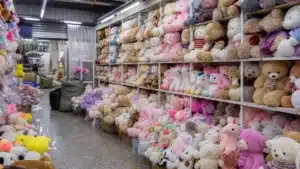
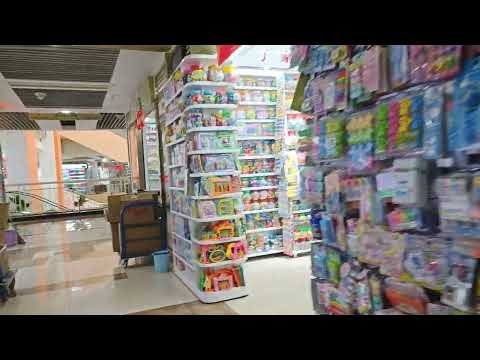
It is also worth being blunt about what this market’s available range actually covers, because the fastest way to waste a month is to source the wrong class of product here. Yiwu is a small-commodities market. The size, grade and material options available in volume run across gifts, toys, stationery, party and seasonal goods, hardware and tools, bags and luggage, kitchen and bathroom items, accessories, textiles and packaging — broad in variety, generally modest in unit value, and available at genuinely low minimums.
Where it stops is equally important. If your product needs a material certificate traceable to a heat number, a dimensional tolerance held in hundredths of a millimetre, or an accredited test report attached to each production batch, this is the wrong market — not because the sellers are careless, but because the trading structure that gives you a 200-piece minimum is the same structure that puts a layer between you and the plant. Buy your retail packaging and your gift lines here. Buy precision components somewhere that will put an engineer on the call.
The fourth one deserves a warning, because it is where confident buyers lose money.
CCC is not your compliance evidence
Ask a Yiwu supplier about certification and you may be shown a CCC mark — China Compulsory Certification, the 3C logo. It looks like proof. It is not proof of anything relevant to you.
CCC is a market-access requirement for goods sold or imported into China’s domestic market. It is not a requirement placed on goods exported from China, and it says nothing about whether your product satisfies the rules of the country you are importing into. A supplier holding CCC for the domestic version of a product is telling you he can sell it in Nanjing. Your customs authority has never heard of that.
The same logic applies to Chinese national standards generally. GB/T 19865-2024, the safety standard for electric toys, was published on 24 July 2024 and takes effect on 1 August 2026, replacing GB 19865-2005. For CCC certification the changeover is the same date: applicants may use either standard until 31 July 2026, and from 1 August 2026 certification is issued against the new one.
That is a real, current obligation — for the Chinese market. If you are shipping to the EU or the US, it is background information, and the test reports you need are the ones your own market names.
So the compliance question you put to a supplier is never “are you certified.” It is: can you produce, for this exact item, a test report from an accredited laboratory against the standard my market requires, issued in the last twelve months, with the report number I can verify with the lab? A supplier who can do that is a different class of counterparty from one who shows you a logo.
Understand How Yiwu Goods Legally Leave China
Why the vendor cannot simply invoice you
Here is the fact that reorganises everything else on this page, and that appears on none of the guides currently ranking for this subject.
Goods bought inside Yiwu’s market complex generally do not leave China as an ordinary export. They leave under customs supervision mode 1039, market procurement trade — a regime created for exactly this situation, where a foreign buyer purchases small quantities of many different products from many different sellers inside a state-recognised market cluster, and a registered market operator files one consolidated export declaration at the place of purchase. The pilot began in Yiwu in 2013 under China’s Ministry of Commerce; the General Administration of Customs added code 1039 in 2014, and the scheme has since expanded in batches — reaching 39 pilot markets across 18 provinces when MOFCOM and six other ministries added eight new sites in September 2022.
Three consequences follow directly, and each one changes a decision you are about to make.
| Feature of mode 1039 | What it means for your order |
|---|---|
| A single declaration is capped at USD 150,000 of goods value, inclusive | A large mixed order is split across declarations. That is normal, not a red flag — but it is why your paperwork multiplies as your order grows, and why “one container, one document” is not how this works. |
| VAT-exempt, with no export rebate available | There is no VAT rebate in the price for anyone to hand back. A general-trade factory can price with a rebate in mind; a Yiwu booth cannot. This is the single biggest reason the two quotes are not comparable. |
| A registered operator files the declaration, not the booth | The seller who took your money is frequently not the exporter of record. That is the structural answer to “why can’t he just ship it to me” — and it is why a party who can file is not an optional convenience. |
The second row is worth sitting with. When a buyer says a Guangdong factory quoted higher than a Yiwu booth for a similar item, he is often comparing a price that contains an expected VAT rebate against one that structurally cannot. Neither party is being clever. They are operating under different modes.
The negative list, and the goods that cannot use this route
Mode 1039 is not universal. A negative list names goods that may not be exported under market procurement trade at all, and the current instrument is the MOFCOM General Office circular No. 261 of 2024, issued on 30 August 2024. It moved in both directions: six pandemic-era categories — non-medical masks, coronavirus test reagents, medical masks, medical protective clothing, ventilators and infrared thermometers — came off the excluded list, while other goods judged unsuitable for simplified declaration were added to it. The direction of travel matters less than the fact that the list moves at all.
You do not need to memorise the list. You need to ask the question before your deposit clears, because the alternative is discovering that your goods have to move under general trade instead, with a different exporter, different documentation, and a timeline nobody built into your plan. The question is one line in an email: confirm this item can be exported under market procurement trade, and if it cannot, tell me now which mode it will move under and who the exporter of record will be.
What to check before any money moves
- Which customs supervision mode will this shipment use, and who is the exporter of record?
- Is this item on the market-procurement negative list?
- Will my order value require more than one declaration?
- Which entity’s name appears on the commercial invoice I will receive, and does it match the entity I am paying?
That last question catches more problems than the other three combined. If the name on the invoice is not the name on the bank details, you are not necessarily being defrauded — under 1039 that mismatch can be perfectly ordinary — but you must know which it is before, not after.
Find and Shortlist Suppliers Without Flying Blind
Routing: get to the right aisle, then stop
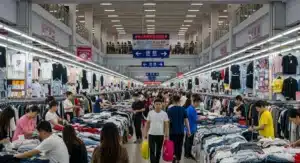
Yiwu International Trade City is organised by category across five districts, and the practical value of knowing this is narrow but real: it gets you to the right aisle. District 1 runs toys, jewellery, artificial flowers and craft supplies. District 2 covers bags, luggage, umbrellas, hardware tools, locks, kitchen and bathroom goods and small appliances. District 3 holds buttons, zippers, cosmetics, eyewear, pens, office supplies and sporting goods. District 4 is daily necessities, knitwear, footwear, belts, scarves and towels. District 5 carries imported goods, bedding, fabrics, auto and motorcycle accessories, and hotel and festival supplies.
Two honest caveats. Published sources disagree substantially on the market’s total floor area — figures of 4 million, 5.5 million and 6.4 million square metres all circulate, depending on what the writer counted — so treat any single confident number with suspicion, including on pages that look authoritative. And district boundaries blur at the edges; categories migrate. For the full navigation treatment, including booth-level reading, see our companion guide to the Yiwu market itself and how its districts work. This page assumes you have found the aisle and turns to what you do next.

The distinction that matters more than price
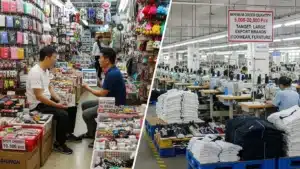
Behind a Yiwu booth there is either a manufacturer or a trader, and the difference is not primarily about margin. It is about who can answer a question that has consequences.
A trading booth can quote, source and dispatch competently. What it often cannot do is tell you what happens if you change the material, hold a tolerance, or need the same batch reproduced in nine months. Those answers live at the plant. When they have to travel through an intermediary who is protecting the relationship, they arrive slowly, vaguely, or optimistically.
So do not ask “are you a factory” — everyone says yes. Ask questions only a plant can answer well, and listen to the shape of the reply rather than its content:
- What is your scrap or reject rate on this item, and what causes it most often?
- If I change this component to a heavier grade, what does that do to your cycle time?
- Can you run this in the same colour in six months, and how do you hold the colour to the standard?
- Who does your final packing, and where physically does it happen?
A manufacturer answers these with specifics and often with complaints — the honest ones will tell you which part of the job they dislike. A trader answers with reassurance. Both are useful counterparties; you simply need to know which one you have before you commit a programme to them, and the answer should change what you write into the purchase order about tolerances and re-runs.
Then build a comparison set of three. Not one you negotiate hard with — three you can put side by side. The MOQ conversation changes character entirely when you have alternatives, and it is the cheapest leverage available to a buyer who has not yet spent anything.
Price, MOQ and the Agent Decision
What actually drives MOQ here
Minimum order quantity in Yiwu is not one number and is not principally a negotiation about volume. It is a function of what the seller has to disturb to fill your order.
Stock already sitting in the booth or a nearby warehouse carries a low minimum, because filling your order is picking. Anything that requires a production run carries a higher one, because a run has a setup. And anything requiring a change — your colour, your logo, your packaging, your carton marking — resets the minimum to whatever the smallest economical run of that change is, which is why buyers are startled when adding a printed logo multiplies a minimum that felt settled.
That gives you three practical levers, in descending order of usefulness: accept the seller’s standard specification and packaging wherever it does not matter to your customer; consolidate variants so one production run serves several of your SKUs; and commit to a repeat schedule in writing, which is worth more to a booth than a slightly larger single order. We do not publish a commission or minimum figure here, because we have no audited first-party number to publish and inventing one would be worse than useless. What we can tell you is what the number is made of, and what to ask so you can see it.
Direct or through an agent: the actual decision tree
This is the decision most readers arrive wanting answered, so here is a position rather than a survey. The question is not “is an agent worth the fee.” It is “which of these functions do I need performed in Yiwu, and do I have another way to perform them.”
| If this describes your order | Sensible route | Why |
|---|---|---|
| One item, one seller, small trial quantity, no customisation | Direct, or a freight forwarder only | There is little to coordinate. Paying a percentage to manage one relationship is poor value. |
| Many items from many booths in one shipment | Agent | This is the case mode 1039 exists for, and consolidation plus one declaration needs a party physically present. |
| Your market imposes real compliance obligations on the product | Agent, or a third-party inspection firm | Someone must verify test reports against the item actually being packed, not against a sample sent in March. |
| Repeat programme with your branding or packaging | Agent, moving toward a direct factory relationship | You need consistency across runs. Use the intermediary to find the plant, then shorten the chain. |
| You already have a trusted staff member or partner in Zhejiang | Direct, plus a filing party | You have the presence already. You still need someone who can legally file the export. |
Whichever route you take, make the fee structure visible before you commit. It is a fair question to put to us as much as to anyone else — our own product sourcing service page sets out the steps, the shortlisting process and the fee basis in writing, which is the minimum you should expect to see from any party before you engage them.
Ask how the fee is calculated and on what base, whether it is charged on goods value alone or on freight too, whether supplier rebates or discounts are passed through to you, and whether you will see the original supplier invoice. That last one is the test. A party willing to show you what he paid is in a different business from one who will not, and the difference is worth more than a percentage point either way. Our breakdown of how China sourcing agent fees are actually structured goes through the models in detail, including the ones designed to be hard to compare.
Write an Inspection Clause That Actually Binds
Why “subject to quality inspection” protects nobody
Most purchase orders written by first-time importers contain a phrase like balance payable after quality inspection. It feels like protection. It is not, and the reason is simple: it does not say who inspects, against what standard, how many units, or what result constitutes a failure.
When goods arrive wrong, both parties look at that sentence and see different things. You see a promise of quality. The supplier sees a step that was completed — someone did look at the goods. Neither reading is unreasonable, which is precisely the problem. A clause that can be honestly read two ways is not a clause.
The fix is to name a sampling standard and let it do the arguing for you. ISO 2859-1 is the international standard for sampling procedures for inspection by attributes, and it is what professional inspection bodies already use. Name the edition in your PO as well as the standard: the third edition, ISO 2859-1:2026, was published in January 2026 and cancels and replaces the 1999 second edition. The master sampling tables carry over unchanged, so the figures below hold either way, but a clause citing a cancelled edition invites exactly the argument the clause exists to prevent. It works in two steps.
First, your lot size and inspection level give a sample size code letter. At General Inspection Level II — the default for ordinary commercial inspection — a lot of 501 to 1,200 pieces takes code letter J, and a lot of 1,201 to 3,200 takes code letter K. Second, the code letter and your chosen AQL give the sample size and the accept and reject numbers.
| Lot size | Code letter | Units inspected | Accept at | Reject at |
|---|---|---|---|---|
| 501 – 1,200 | J | 80 | 5 defects | 6 defects |
| 1,201 – 3,200 | K | 125 | 7 defects | 8 defects |
General Inspection Level II, AQL 2.5, single sampling, normal inspection. Cells read from ISO 2859-1:1999 Table 1 and Table 2-A; carried over unchanged into the 2026 third edition.
The free-calculator trap, with numbers
Now the part that costs money, and the reason those cells are printed above rather than linked to a tool.
Several widely used free AQL calculators return the wrong figures for exactly this lookup. Asked for an 80-unit sample at AQL 2.5, one returns accept 10 / reject 11. Asked for 125 units at AQL 2.5, it returns accept 14 / reject 15. Read against the master table in ISO 2859-1, those are the values from the AQL 6.5 and AQL 10 columns — not AQL 2.5.
The consequence is concrete. On a lot of 2,000 pieces you believe you have agreed to reject at 8 defects in a 125-unit sample. Your supplier’s inspector, working from the same free chart, rejects at 15. Eleven defects in the sample is a failed lot under the standard you meant to invoke and a comfortable pass under the one you actually cited. Nobody has cheated anybody, and your container ships.
So write the numbers into the purchase order rather than the tool. Name the standard, the inspection level, the AQL, and the accept and reject numbers for your lot size in figures. Our fuller treatment of AQL inspection for Yiwu orders covers defect classification — critical, major and minor, which normally carry different AQLs in the same inspection — and how to brief an inspector.

Two rules that are leverage you already have
Two provisions of the same standard are routinely left unused by buyers who have already cited it.
The first is switching. Under clause 9.3.1, tightened inspection is implemented as soon as two out of five — or fewer than five — consecutive lots have been non-acceptable on original inspection. If you are running a repeat programme, that clause converts a pattern of marginal deliveries into an automatic, pre-agreed escalation. You do not have to argue for stricter inspection after the third disappointing shipment; you agreed to it at the start.
The second is resubmission. Under clause 7.6, a lot found not acceptable is not resubmitted until all items have been re-examined or retested and every nonconforming item removed or replaced, or every nonconformity corrected. This closes the most common post-failure move: the supplier who reworks the visible cartons and presents the same lot again the following morning. Under the standard you cited, that lot is not eligible for resubmission at all.
Structure Payment So the Balance Is Leverage
Condition the balance on a result, not a date
A deposit against a balance before shipment is the ordinary shape of a Yiwu payment. The shape is not the problem. The problem is what the balance is conditioned on.
If your terms say the balance falls due before shipment or when goods are ready, you have written a calendar, and calendars do not care about quality. If they say the balance falls due on presentation of a passing inspection report against the sampling plan in clause X, you have written a condition, and the previous section is what fills it in. That single change is most of the protection available to a buyer at this stage, and it costs nothing to negotiate at the start and everything to negotiate later.
Two further points buyers get wrong.
Under mode 1039 the payment often goes to a service provider’s corporate account rather than to the booth that sold you the goods. That is a normal feature of the regime, not a warning sign in itself — but it makes the invoice-versus-bank-details check from earlier essential, and it means you should have the entity relationship explained to you in writing before the first transfer, not after a dispute.
And if the order is large enough to justify a documentary credit, know the clock you are buying. UCP 600 — the Uniform Customs and Practice for Documentary Credits, 2007 Revision, published by the International Chamber of Commerce in 39 articles — gives banks, at sub-article 14(b), a maximum of five banking days following the day of presentation to determine whether a presentation complies. That is what a letter of credit actually buys: not a guarantee of quality, but a defined examination window and a documented decision.
If your goods are cheap enough that the bank charges and the document discipline outweigh that, use a simpler term and put your effort into the inspection clause instead. Our guide to Yiwu payment terms and deposit structures works through where each option earns its cost.
Consolidation, Shipping and the Documents Each Stage Produces
The document each stage produces
Almost every Yiwu order passes through a consolidation warehouse, because almost every Yiwu order is goods from more than one seller. Cartons arrive from booths across the districts, are checked in, held, and loaded together. That warehouse is where your order becomes a shipment.
It is also where orders go quiet, and the reason is that buyers do not know what each handoff is supposed to generate. Here is the map. Its value is diagnostic: when someone tells you the order is progressing, you can ask for the artifact that proves it.
| Stage | Document you should receive | What its absence tells you |
|---|---|---|
| Order placed | Proforma invoice naming item, spec, quantity, unit price and terms | Nothing is actually agreed. You have a conversation, not an order. |
| Goods delivered to consolidation | Warehouse receipt with carton count and gross weight per supplier | You cannot tell which of your suppliers is late. All of them will say it is not them. |
| Inspection | Report naming lot size, sample size, defects found, accept/reject decision | A photo set is not an inspection report. Without the numbers there is no decision to enforce. |
| Booking | Booking confirmation with vessel, cut-off date and destination port | “Shipping next week” is a hope. A cut-off date is a fact you can plan against. |
| Export declaration | Customs declaration under the agreed supervision mode | The mode may have changed without anyone telling you, along with your paperwork. |
| Departure | Bill of lading, packing list, commercial invoice, certificate of origin if claimed | You cannot clear the goods at destination. This is where a missing certificate of origin becomes a duty bill. |
The last row deserves emphasis: if you intend to claim a preferential duty rate under a trade agreement, the certificate of origin has to be arranged before departure, not requested after arrival. Buyers discover this at the worst possible moment. Our explainers on reading a bill of lading and on customs clearance processing cover what each document has to say.

Port routing and what actually moves the date
Yiwu is inland, so everything leaves by road to a seaport, most commonly Ningbo — roughly 190 km, typically a three-to-four-hour truck run, though this varies with traffic and terminal congestion and should be treated as an approximation rather than a schedule. Shanghai is the usual alternative. Which one you use is generally your forwarder’s call based on sailing schedules and space, and it is rarely worth a buyer’s time to override.
On timing, treat any single quoted lead time with suspicion until you know which of its parts is being quoted. A Yiwu order has three sequential clocks: production or picking at each supplier, consolidation and inspection at the warehouse, and then the ocean leg, whose transit time is a published sailing schedule you can look up rather than negotiate. The first two are where a schedule actually slips, and they are the two nobody puts a number on when quoting you.
What is worth your attention is what moves your date, because it is almost never the ocean leg. In order of how often they are the true cause: the slowest supplier in a multi-booth consolidation; a failed or disputed inspection; incomplete or inconsistent documents at declaration; and only then vessel schedule. Three of those four are fixable at the purchase-order stage by the clauses discussed above, which is the argument for spending your effort there rather than on freight quotations. If you are choosing between shipping modes, our comparison of LCL consolidation against FCL and air freight sets out where each stops making sense.
Do You Need to Fly to Yiwu at All?
When a trip changes the outcome — and when it does not
Buyers ask whether they should visit Yiwu as though it were a question of commitment. It is a question of what the trip can do that remote work cannot.
A visit earns its cost when you are selecting a supplier for a repeat programme and need to read people rather than messages; when your product has a tactile quality — hand feel, weight, finish — that photographs badly and samples inconsistently; when you are choosing among many variants and need to see a category rather than a listing; or when a relationship has gone wrong and you need to be physically present to fix it.
A visit is poor value when you are reordering a specification already proven, when your product is standard and judged on documents, or when you are placing a first small trial you could simply run and learn from. Flying to Yiwu to place a single trial order is usually the most expensive way to obtain information you would get anyway in three weeks.
Some context for the scale you are considering entering. On customs statistics reported on 29 July 2026 by Xinhua and CGTN, Yiwu’s total imports and exports reached 486.42 billion yuan in the first half of 2026, up 19.9% year on year, with exports at a record 420.72 billion yuan, up 17.3%, and imports up 39.1% to 65.7 billion yuan. Category detail tells you more than the headline: sports goods exports ran 6.22 billion yuan in that half, of which 1.25 billion went to Latin America, up 20.4%. A market growing at that rate is a market where booths have alternatives to your trial order, which is a negotiating fact as much as an economic one.
Getting in has changed, and the change is recent
If you do decide to travel, the entry route is easier than most published guides suggest, because many of them still describe the rules that applied before the end of 2024.
China’s 240-hour visa-free transit policy covers nationals of 55 countries, allowing a stay of up to ten days without a business visa, subject to holding an onward ticket with confirmed dates and seats to a third country or region within the 240 hours. The National Immigration Administration’s announcement of 17 December 2024 extended the stay from the old 72 and 144 hours to 240, and added 21 entry ports — taking the total to 60 ports across 24 provinces. Two of the additions were in Zhejiang, and one of them is Yiwu International Airport itself, alongside Wenzhou Longwan.
For an eligible buyer making a focused sourcing trip, that removes a visa application from the critical path and lets you land in the city you actually came to visit rather than routing through Shanghai or Hangzhou.
Two cautions, and they are not boilerplate. Entry policy changes, and China’s own embassy guidance states plainly that visa-free arrangements are subject to change and should be confirmed with the National Immigration Administration before travel — so verify eligibility, your intended port, and the onward-ticket requirement before booking anything non-refundable. And the 240-hour route is a transit facility with conditions attached: it is not equivalent to a business visa, and if your trip does not fit its shape, the ordinary visa is the correct instrument rather than a nuisance to be avoided.
If you go, in this order
A first trip is usually lost to the scale of the place. Impose a sequence on it.
- Before you fly, have your shortlist, your specification and your target price band written down, and appointments confirmed. Walking in cold burns the first two days.
- Day one, walk your category widely without negotiating. You are calibrating what normal looks like — quality, price, and how booths behave.
- Day two, return to your shortlist with specific questions and collect samples with the booth number recorded against each one. Unlabelled samples become useless within a week.
- Before you leave, see the consolidation warehouse your goods will pass through, and meet whoever will file your export declaration. That is the part of the chain you will otherwise never see and will most need to trust.
That last item is the one experienced buyers add and first-timers skip. The booths are the visible part of the market and the least likely part to fail you.
The Stall You Can Now Diagnose
Go back to the order stalling at the top of this page. With the sequence in hand, that situation is no longer opaque — it is a question with an address. Has the warehouse issued a receipt showing which suppliers have delivered and which have not? Has an inspection produced a report with a lot size, a sample size and a decision, or only photographs? Has a declaration been filed, and under which supervision mode? Each of those has a document, and the absence of the document is the answer.
That is the whole argument of this guide. Yiwu is not risky because the sellers are unusual; by volume it is one of the most routine trading environments in the world. It is risky because buyers arrive with a mental model borrowed from ordinary factory sourcing — one seller, one invoice, one export — and this market does not work that way. The mismatch shows up as vagueness, and vagueness is what you have been calling risk.
Everything in this guide is cheap at the purchase-order stage and nearly worthless afterwards, because each clause only binds if it is agreed before money moves. Run these checks before you send a deposit:
- Supervision mode. Confirm whether the goods will be declared under market procurement trade or general trade, and which party files the declaration — the invoice and the tax outcome follow from that answer.
- Seller type. Establish whether you are buying from a booth trader, the manufacturer, or an agent buying on your behalf, and read the quote accordingly.
- Negative list. Ask whether your product is excluded from the mode while the answer is still a check — after a deposit clears it is a discovery.
- Inspection standard. Agree the lot size, the sample size and the accept/reject numbers in writing; an inspection standard proposed after a lot has failed is a request for a favour.
- Payment structure. Fix the terms up front and keep the balance as leverage — terms renegotiated after goods are ready are a concession you will pay for somewhere else.
- Document trail. Name the document each stage must produce — warehouse receipt, inspection report, declaration — so a stalled order has an address instead of a silence.
Frequently Asked Questions
What is customs supervision mode 1039 and why does it matter to me as a buyer?
Mode 1039 is market procurement trade: goods bought inside a state-recognised market cluster are exported on one consolidated declaration filed by a registered operator. It caps a declaration at USD 150,000 and is VAT-exempt with no export rebate. It explains why the booth cannot invoice and ship to you directly.
Why is a Yiwu quote cheaper than a factory quote for a similar product?
Often it is not cheaper in the way it appears. A general-trade factory can price with an export VAT rebate in view; goods under mode 1039 are VAT-exempt with no rebate at all. The two numbers are built differently, so compare landed cost rather than unit price.
What AQL numbers should go in my purchase order?
Name ISO 2859-1, the inspection level and the AQL, then write the figures. At General Level II and AQL 2.5, a 501–1,200 piece lot means 80 units inspected, accept at 5, reject at 6; a 1,201–3,200 piece lot means 125 inspected, accept at 7, reject at 8.
Do I need a sourcing agent to buy from Yiwu?
Not always. A single item from one seller in trial quantity rarely justifies a percentage fee. Many items from many booths in one shipment usually does, because consolidation and a single export declaration need a party physically present who can legally file.
Does a supplier’s CCC certificate mean my goods are compliant?
No. CCC is a market-access requirement for goods sold or imported into China’s domestic market, not an export requirement, and it says nothing about your destination market. Ask instead for an accredited laboratory test report against the standard your own market names.
Can I visit Yiwu without a business visa?
Possibly. China’s 240-hour visa-free transit covers 55 nationalities and requires an onward ticket to a third country, and since December 2024 it operates at 60 ports across 24 provinces — Yiwu International Airport among them. Confirm current eligibility and your port with the National Immigration Administration before booking.
What is the minimum order quantity in Yiwu?
There is no single figure, because MOQ tracks what the seller must disturb to fill your order. Existing stock carries a low minimum, a production run a higher one, and any customisation resets it to the smallest economical run of that change.