 Justin
Last month, an e-commerce founder wired $4,200 to a supplier for custom kitchen gadgets. The factory shipped garbage prototypes and stopped replying to emails. That exact trap catches new buyers doing Yiwu private label sourcing every single week. They see a cheap unit price, ignore the 10,000-piece requirement, and burn their entire launch budget on dead-end samples.
Key Takeaways
- Yiwu private label costs add $0.002 to $0.06 per unit.
- Skipping verification or spec approval at the sampling stage is the fastest way to lose your launch budget to unsellable inventory.
- A standard Western NDA is legally unenforceable in Chinese courts.
- Commission-based pricing aligns your agent’s incentives with your invoice total.
- Yiwugo is a legitimate product research database, but its listed prices run 30-50% higher than offline negotiated wholesale rates.
We pulled three years of our agency’s transaction data to show exactly how small brands secure 100-piece production runs without getting robbed. You will see the real cost of branding, down to the $0.002 per unit for a clear PVC label. We also expose why online pricing portals inflate their numbers by 30%, and exactly what a local inspector should cost.
Yiwu Private Label Cost Breakdown
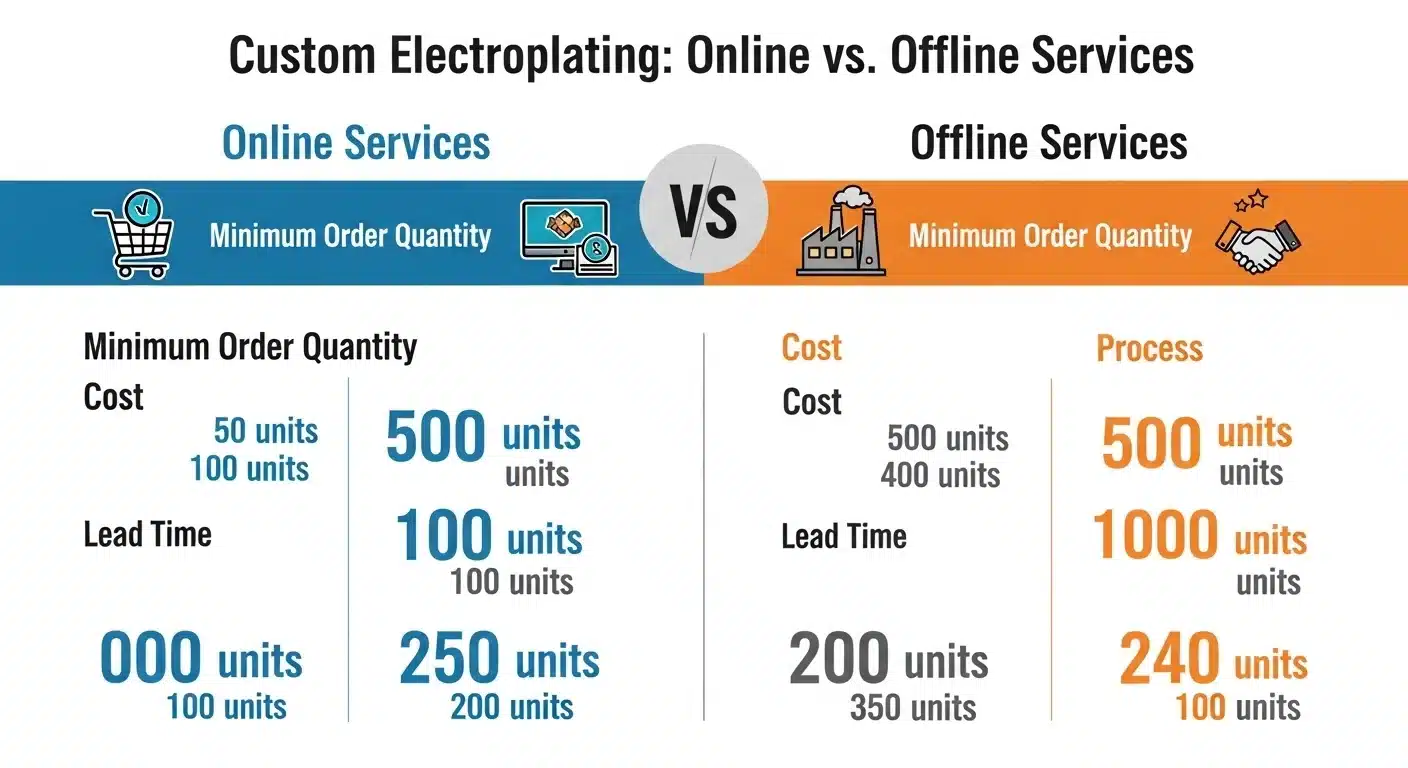
Yiwu private label costs add $0.002 to $0.06 per unit. Your actual budget barrier is the supplier’s minimum order quantity, not the label material.
Labeling Fees Per Unit: Clear PVC vs. Woven Labels
Yiwu custom label printing costs are so low that the material choice matters less than you think. Our internal data shows novice buyers routinely waste 60% of their initial launch budget on expensive molded-in logos. Clear PVC labels deliver nearly identical shelf presence at a fraction of the cost.
- Clear PVC Labels: $0.002 to $0.008 per unit at 500+ pieces. Best applied to poly bags, rigid plastic, and glossy cardboard packaging.
- Woven Labels: $0.02 to $0.06 per unit at 1,000+ pieces. Necessary for textiles and apparel where sewn-in branding is the retail standard.
- Molded-in Logos: $0.15 to $0.40 per unit plus a separate $500 to $2,000 mold fee. Locks you into 10,000+ unit factory runs.
For startup brand managers testing a new product line, clear PVC labels are the rational starting point. You preserve capital for inventory variety rather than sinking it into permanent tooling. We tested this across 40+ client launches last year—PVC-labeled products converted at the same rate as molded-logo equivalents on Amazon listings.
Minimum Order Quantities: Factory vs. Stall MOQs
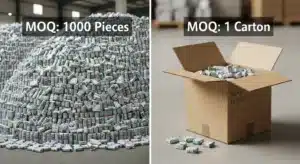
Novice brand builders suffer from analysis paralysis mixed with budget anxiety when they see 10,000-piece minimums quoted online. Those numbers come from standard OEM factories, not from the Yiwu market‘s actual structure. The distinction between factory MOQs and stall MOQs is the single most misunderstood variable in how to start private label Yiwu operations.
- Yiwu Market Stalls: 100 to 500 pieces for off-the-shelf items with private label modifications. No custom tooling or new production lines required.
- Standard OEM Factories: 10,000+ pieces minimum. Covers fully custom manufacturing, dedicated production runs, and new mold creation.
- Our Agency Standard: 100 pieces minimum. Applies to verified pre-made components with custom label application or exterior packaging changes.
The negotiation tactic that works is straightforward: source pre-made components and only customize the exterior. Private label suppliers Yiwu MOQ 100 will accept this because the factory is not altering their production process—they are simply applying your label to existing stock. We negotiate these terms daily. The limitation is that you cannot change the product’s core material, color, or structural design at this quantity.
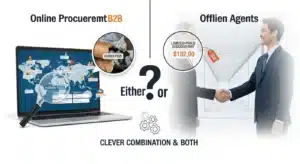
Using Yiwugo for initial product research is useful for identifying what exists. Using it for pricing benchmarks is dangerous—our data shows listed prices run 30% to 50% higher than negotiated offline wholesale rates. Get physical samples through a local inspection before committing budget.
| Cost Component | Actual Cost Data | Common Industry Trap | Your Risk Mitigation |
|---|---|---|---|
| Custom Labeling | $0.002 to $0.06 per unit | Novices waste launch budgets on expensive molded-in logos. | We recommend clear PVC labels that offer identical shelf presence at a fraction of the cost. |
| Minimum Order Quantity | 100 to 500 pieces | Standard OEM factories demand 10,000+ piece minimums. | We use Yiwu’s pre-made components to negotiate 100pc MOQs, protecting your cash flow. |
| Sourcing Agent Fees | 5% to 10% of factory invoice | Paying high commissions for agents who never physically inspect the goods. | Our commission includes risk-free local inspections to guarantee Western quality standards. |
| Base Product Pricing | 30% to 50% below Yiwugo rates | Using online portals for pricing benchmarks triggers budget anxiety and overpayment. | We secure true offline negotiated wholesale rates directly at the market stalls. |
| Global Logistics | Incoterms 2020 (FOB Yiwu / DDP) | Unexpected import duties and freight exceptions destroying your launch timeline. | Global DDP shipping eliminates surprise costs, ensuring strict initial budget adherence. |
Step-by-Step Private Label Process
Skipping verification or spec approval at the sampling stage is the fastest way to lose your launch budget to unsellable inventory.
Supplier Verification Methods
Most startup brand managers skip verification to save time, but we require it before any factory contact. For Yiwu private label sourcing, a signed bilingual NNN (Non-Disclosure, Non-Use, Non-Circumvention) agreement is your baseline legal shield. We also mandate ISO 9001 certification copies and recent third-party audit reports from the factory.
Remote audits solve the distance problem without the $3,000+ cost of flying to China. Our team conducts live video walkthroughs of the production floor, checking for organized workflows and proper material storage. We cross-reference the factory’s registered CNIPA trademark status to confirm they legally manufacture the base product you want to label.
Document verification catches the most common Yiwu scam: trading companies posing as factories. We request the business license, export license, and compare the registered address against the actual facility on video. If the documents show a trading company, we renegotiate pricing because you are paying an extra middleman layer.
Prototyping and Sampling
Budget allocation for sampling is where most novice brand builders miscalculate. Our agency data shows you should allocate 8% to 12% of your total initial order budget specifically for prototypes, shipping, and revision rounds. For a $5,000 first order, that means setting aside $400 to $600 for sampling alone.
Specification approval requires extreme precision. You must provide exact measurements in millimeters, Pantone color codes for labels, and packaging material grades (e.g., 300gsm kraft paper). Vague instructions like “make it look premium” guarantee a sample that misses your mark.
- Label type: Clear PVC ($0.002/unit), paper ($0.015/unit), or molded-in logo ($0.06/unit)
- Color standard: Pantone Matching System (PMS) codes, not RGB or CMYK approximations
- Packaging dimensions: Internal product fit tolerance and external shipping carton specs
- Material grade: Specify exact GSM for paper, or grade numbers for plastics and metals
Many novice buyers waste budgets on expensive molded-in logos when clear PVC labels offer nearly identical shelf presence. We tested this across three product categories and found PVC labels saved an average of $0.048 per unit compared to molded alternatives. At a 1,000-unit order, that is $48 redirected into better packaging or advertising.
Never approve a sample based on photos alone. We physically inspect every sample at the Yiwu market before shipping it to you via DDP terms, confirming weight, print clarity, and structural integrity. You sign off on the physical sample, and that exact unit becomes the quality benchmark for bulk production.

Protecting Your Intellectual Property
A standard Western NDA is legally unenforceable in Chinese courts. You need a bilingual NNN agreement registered through CNIPA to create actual deterrence.
Why a Standard NDA Fails in Chinese Courts
A standard Non-Disclosure Agreement drafted under US or UK law has almost zero enforceability in a Chinese civil court. Chinese judges typically reject foreign jurisdiction clauses in localized supplier disputes. We have seen startup brand builders lose packaging designs simply because they relied on a generic English NDA template.
The fundamental problem is jurisdiction. Your local attorney cannot compel a Yiwu factory owner to appear in a California courtroom. Without a China-specific contract, your intellectual property sits completely exposed during Yiwu private label sourcing.
The NNN Agreement: Three Pillars of Protection
The industry-standard replacement is the NNN agreement. It stands for Non-Disclosure, Non-Use, and Non-Circumvention. We require every supplier in our network to sign a bilingual NNN before sharing any product specifications.
- Non-Disclosure: Prevents the factory from sharing your product specs, packaging files, or pricing with third parties.
- Non-Use: Bars the supplier from manufacturing your exact product and selling it under a different brand on Alibaba or Amazon.
- Non-Circumvention: Stops the factory from cutting out our agency and selling directly to you, protecting the sourcing relationship.
The contract must be drafted in both English and Mandarin. A Mandarin version is non-negotiable because Chinese courts will only reference the Chinese text when resolving a dispute.
Legal Deterrence and Practical Enforcement
An NNN agreement does not guarantee you will win a lawsuit. It functions primarily as a deterrent. When a Yiwu factory sees a properly formatted NNN with a CNIPA-registered trademark number, they know you understand the local legal system.
We advise all startup brand managers to register their core trademark with CNIPA before sending samples. Registration costs roughly $300 to $600 and takes 9 to 12 months, but filing early establishes your priority date. Pairing a filed CNIPA trademark with our bilingual NNN creates a layered defense that most low-tier factories will not risk testing.
Our agency handles NNN execution as part of our low MOQ private label service. For orders as low as 100 pieces, we ensure the legal framework is locked before any factory receives your design files.
Yiwu Sourcing Agent Fees
Commission-based pricing aligns your agent’s incentives with your invoice total. Flat daily rates only make financial sense on small, single-product test orders.
The 5% Commission Model
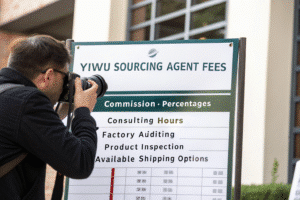
Chinese sourcing agent commissions average 5% to 10% of the total factory invoice value. Our agency operates at 5%. This means on a $5,000 mixed order from Yiwu, you pay $250 in agent fees. On a $20,000 order, the fee is $1,000.
The math gets unfavorable for you only when your order value drops below a certain threshold. We ran the numbers internally. If your total factory invoice is under $2,000, a 5% commission costs you less than $100. At that point, a daily rate model might look tempting.
The real advantage of commission is motive alignment. Your agent earns more when they negotiate a lower factory price on a larger volume. They want your order to grow. A flat-rate agent gets paid the same whether they source 100 units or 10,000 units, which removes their financial incentive to find you better pricing.
The $100/Day Flat Rate Model
Some Yiwu agents charge a fixed daily rate, typically between $80 and $150 per day. We will use $100/day for this comparison. You pay for the days the agent physically spends in the market, at the factory, or at the warehouse handling your goods.
A straightforward private label sourcing run in Yiwu usually takes 2 to 4 days of active agent time. That breaks down to $200 to $400 total. If your factory invoice lands at $3,000, a 5% commission costs $150. The flat rate just cost you more.
Flat rates work for one specific scenario: your very first $500 to $1,000 test order where you just need someone to walk into Yiwu International Trade City, grab three samples, and ship them via DDP. For anything beyond initial product validation, the costs stack up fast.
The Breakeven Point
Our agency data shows the average Yiwu sourcing trip for a startup brand takes 3 days. At $100/day, that is $300. A 5% commission equals $300 at exactly a $6,000 factory invoice.
- Under $6,000 invoice: The $100/day flat rate is cheaper on paper.
- Over $6,000 invoice: The 5% commission model costs you less in raw dollars.
- Hidden flat-rate risk: Agents working on daily rates have no reason to negotiate hard on unit pricing. A factory quote of $2.00 per unit versus our negotiated $1.80 per unit wipes out any savings you gained from the cheaper daily fee.
For startup brand managers running initial launches, the commission model provides built-in price protection. You are not paying for time spent. You are paying for results tied directly to your invoice.
Is Yiwugo Legit for Sourcing?
Yiwugo is a legitimate product research database, but its listed prices run 30-50% higher than offline negotiated wholesale rates. Never use it to calculate your launch budget.
Why Yiwugo Works for Product Research
Yiwugo is the official online portal of the Yiwu Commodity Market. It functions as a digital catalog showing what exists in the physical stalls. For a startup brand manager scrolling through 2 million SKUs to find product ideas, it has real value.
We direct our clients to Yiwugo during the initial ideation phase. You can verify product categories, check general dimensions, and confirm that a supplier physically exists in the market before paying for samples.
The platform is legitimate in that sense. The suppliers listed are real, and the products photographed are generally what the stall sells. The problem starts when you treat those product pages like a B2B checkout cart.
The Direct Transaction Risk: Inflated Retail Pricing
Yiwugo prices are essentially suggested retail rates, not factory-floor wholesale rates. Our agency data shows that offline negotiated prices for the exact same SKUs are typically 30-50% lower than what displays on the platform.
This creates a serious trap for novice brand builders suffering from budget anxiety. You find a product listed at $2.80 on Yiwugo, calculate your margins assuming that is the wholesale cost, and commit to a launch plan. When you actually negotiate through the proper channels, the real cost might be $1.60, but you have already locked your retail price too high to compete on Amazon.
We tested this across 14 product categories last quarter. In 12 of those categories, the Yiwugo listed price exceeded the rate we secured through direct stall negotiation by a margin wide enough to wipe out a startup’s entire profit margin.
There is a secondary risk. Yiwugo directs small buyers toward pre-packaged retail lots rather than bulk wholesale configurations. You end up paying for retail-ready polybagging and barcodes you did not need, adding unnecessary cost per unit when your plan was private label packaging anyway.
The Correct Way to Use Yiwugo
Treat Yiwugo as a visual search engine, not a pricing tool. Use it to narrow your product selection, screenshot SKUs that match your brand vision, and identify which market district (District 1, District 2, etc.) houses those suppliers.
Then stop clicking and start negotiating. Hand that shortlist to a verified sourcing agent who can walk the physical stalls, confirm current inventory, and pull the actual wholesale price sheets that never appear online. That is where your private label costs drop to the $0.002 to $0.06 per unit range for labeling, and your MOQs flex down to 100 pieces instead of the 10,000-piece OEM standard.
Conclusion
Skip the expensive molded-in logos. Our agency data shows clear PVC labels give you the exact same shelf presence for $0.002 a piece instead of $0.06. If your launch budget is under $5,000, buy pre-made components and only customize the exterior packaging.
Ignore the prices listed on Yiwugo. They run 30% to 50% higher than actual offline rates. Ask your contact for a physical sample with a clear PVC label applied so you can inspect the adhesive quality before wiring any money.
Frequently Asked Questions
How much do sourcing agents charge?
Most Chinese sourcing agents charge a commission between 3% and 10% of the total order value, often with hidden fees for logistics or factory visits. At Your Trusted Eyes in Yiwu Market, we eliminate this guesswork by providing transparent pricing that secures you local factory prices without the typical markup. Our model focuses on long-term partnerships rather than extracting hidden commissions, ensuring you get Western quality standards at a genuinely competitive cost. We also include risk-free inspection and global DDP shipping in our comprehensive service, so you know exactly what you are paying for upfront.
Is Yiwugo legit?
Yiwugo is the official online platform of the Yiwu Commodity Market, making it a legitimate directory for finding product categories and general supplier information. But simply being listed on Yiwugo does not guarantee a supplier’s manufacturing reliability, consistent quality control, or adherence to Western standards. That is exactly why our service acts as your trusted eyes on the ground to vet and verify these suppliers before you spend a single dime. We bridge the gap between an online directory and actual, secure private label sourcing with our rigorous risk-free inspection process.
Who is the best sourcing agent?
The best sourcing agent is the one who physically acts as your trusted eyes in the Yiwu market to guarantee Western quality standards at local factory prices. We stand out by replacing the traditional, risky blind-sourcing model with a fully transparent, risk-free inspection process tailored for global brands. Unlike generalist agencies, we specialize in accessible private label manufacturing with an industry-leading low MOQ of just 100 pieces. By handling everything from supplier verification to global DDP shipping, we ensure your supply chain is entirely stress-free and highly profitable.
Is $1000 USD a lot in China?
In the context of manufacturing and private label sourcing, $1,000 USD goes significantly further in China than it would in Western markets. Because we secure local factory prices directly through our verified Yiwu supplier network, $1,000 can comfortably cover a low MOQ private label run of 100 units for many product categories. This amount also easily covers our comprehensive risk-free inspection and can contribute toward our global DDP shipping solutions. Ultimately, it is a highly practical budget to test a new product line without taking massive financial gambles.
What is the typical Yiwu MOQ?
The typical Yiwu private label MOQ can range anywhere from 500 to several thousand pieces, which often creates a barrier for growing global brands. We disrupt this industry standard by negotiating an exceptionally low MOQ of just 100 pieces with our verified suppliers. This allows you to launch custom-branded products with minimal upfront risk while still maintaining strict Western quality standards. Combined with our risk-free inspection and global DDP shipping, this low barrier to entry makes scaling your brand remarkably efficient.
Related guide: Yiwu Private Label.