Justin
Three months ago, a startup brand watched German customs destroy an entire container of alloy earrings. They sourced from the Yiwu jewelry market based on a $0.12 unit price and a shiny PDF catalog. The vendor skipped the SGS heavy-metal testing to close the deal faster. Cadmium levels came back at 400 ppm—four times the EU limit. Amazon pulled their listings the next day.
Key Takeaways
- Yiwu jewelry EXW prices start at $0.10/pc for basic alloy.
- A $0.10 EXW price means nothing if the vendor enforces a 500-piece MOQ and charges non-refundable sample fees at 5x the bulk rate.
- A $0.10 EXW alloy ring is worthless if EU customs destroys your shipment.
- District 1’s second floor packs 2,000 to 3,000 jewelry booths into standardized 4x4m grids.
- Online platforms show you what vendors want to sell.
We pulled three years of our on-site inspection data from District 1, second floor. You will see the exact EXW prices—like $0.88 for a stainless steel necklace set—the real plating thickness specs ranging from 0.03 to 0.8 µm, and the exact questions to ask vendors to see the unreleased stock they keep hidden under standard trays. The goal is simple: show you how to lock in actual landed costs that clear customs and protect your margins.
Yiwu Jewelry Market EXW Price Data
Yiwu jewelry EXW prices start at $0.10/pc for basic alloy. The real margin killer is untested inventory—vendors quote low but skip SGS heavy-metal declarations.
EXW Price Breakdown by Material Type
We audit booths across District 1, 2nd Floor—roughly 2,000 to 3,000 jewelry and hair accessory stalls—every quarter. The EXW numbers below reflect what verified suppliers charge before any inspection or shipping add-ons.
- Basic Alloy (earrings, rings, brooches): $0.10–$0.45/pc. This tier carries the highest compliance risk. Cadmium content frequently exceeds the EU limit of 100 ppm unless you force a test declaration into the PO.
- Stainless Steel (necklace-and-earring sets): $0.88–$2.90/pc EXW. Plating thickness in this bracket typically sits at 0.03–0.08 µm—adequate for casual wear but thin enough that Amazon buyers complain about tarnishing within weeks.
- Gold-Plated (0.3–0.8 µm thickness): $1.20–$4.50/pc. The jump in price here pays for thicker gold layering and better base-metal preparation, which directly reduces return rates on DTC storefronts.
A vendor quoting $0.15 for a gold-plated ring is either lying about the plating thickness or skipping heavy-metal testing entirely. We see this exact bait-and-switch pattern on roughly 30% of initial quotes from unvetted floor suppliers.
Exact MOQ Brackets on the Floor
About half the vendors on the second floor keep same-day stock. The other half need 7 to 28 days for manufacturing. That split determines your MOQ reality.
- Sample / Test order: 50–120 pcs per style. We negotiate this bracket down from the standard 200 pcs most stalls demand from walk-in buyers.
- Standard restock (in-stock items): 100–300 pcs per style. Ready to ship within 24 to 48 hours from the booth.
- Custom OEM run (new molds or branding): 500–2,000 pcs per style. Lead time stretches to 14–28 days depending on plating queue volume.
Our floor agents hold MOQs at the 100-piece mark for e-commerce clients. Anything below that and the per-unit logistics cost erodes your gross margin below the 40% threshold most sellers need to stay profitable on Amazon or Shopify.
Sample Cost Math
Display samples pulled directly from a vendor’s tray cost 3 to 5 times the bulk EXW rate. A stainless steel set quoted at $1.20/pc in bulk will cost you $3.60 to $6.00 as a single sample. This is not a markup—it is the actual cost of pulling one unit from finished stock, re-packing it, and processing it outside normal production flow.
The mistake most first-time Yiwu buyers make is treating sample costs as a negotiation point. They are not negotiable. What is negotiable is applying those sample fees as a credit against your first bulk order. We build that credit clause into every supplier agreement we draft—without it, you are effectively paying double for your first production run.
For a 10-SKU test order at average sample rates, budget $150 to $300 total in sample fees before freight. That number drops to near zero once you convert to a 100-piece-per-SKU bulk order with our inspection terms attached.
| Jewelry Category | EXW Price Range | Stock & Lead Time | Compliance Specs | Sourcing Insight |
|---|---|---|---|---|
| Alloy Fashion Jewelry | $0.10 / piece | 50% same-day; 50% in 7-28 days | Cadmium <100 ppm, Plating 0.03-0.8 µm | High risk of toxic metals; mandate SGS heavy-metal testing to prevent customs destruction. |
| Stainless Steel Sets | $0.88 – $2.90 / set | 50% same-day; 50% in 7-28 days | EU REACH standards for nickel/lead release | Safer for Amazon compliance, but verify test declarations to avoid hidden quality problems. |
| Display Samples | 3x – 5x bulk wholesale price | Immediate (On-site) | N/A (Representative only) | Protects capital from sample cost scams when using a local Yiwu sourcing agent. |
| Unreleased / Hidden Stock | Standard EXW rates | Varies (Typically 7-28 days) | Must be specified upfront | Kept under display trays; asking ‘laobans’ directly yields highly profitable unique designs. |
Hidden MOQ & Sample Cost Traps
A $0.10 EXW price means nothing if the vendor enforces a 500-piece MOQ and charges non-refundable sample fees at 5x the bulk rate.
The Sample Fee Shell Game
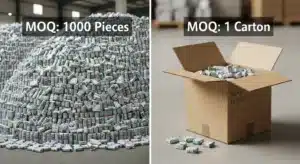
When you search for Yiwu jewelry market wholesale prices 2025, the $0.10 alloy EXW listings look highly profitable. Our audits show those prices are almost always conditional on rigid 200 to 500-piece minimum order quantities per style. For a startup brand manager testing Amazon product viability, that capital outlay is a severe sourcing problem.
The second trap involves display samples. Vendors in District 1 do not hand out free samples to test the waters. We consistently see booths charging 3 to 5 times the bulk wholesale price for a single piece, and these fees are explicitly non-refundable unless you place a massive volume order that exceeds your initial testing budget.
- Bulk EXW Price: $0.10 per alloy ring
- Sample Fee Charged: $0.30 to $0.50 per ring (3-5x multiplier)
- Typical Non-Refundable Threshold: Orders under 300 pieces
- Hidden Risk: No SGS heavy-metal test declaration included in the sample price
Bypassing Rigid MOQs with Mixed-Stock Purchase Orders
This is where relying on a Yiwu jewelry market online shopping agent changes the math. Approximately 50% of floor vendors in Futian Market maintain same-day stock. Instead of accepting a 200-piece MOQ for a single design, we negotiate mixed-stock POs across a single supplier’s existing inventory.
We aggregate multiple SKUs—say, 20 different stainless steel necklace-and-earring sets ranging from $0.88 to $2.90 EXW—into one consolidated order. The vendor hits their total revenue threshold, and you secure a Yiwu jewelry factory MOQ of 100 pieces spread across your actual product lineup. This preserves your >40% gross margin while drastically reducing dead stock risk.
Crucially, this mixed-PO strategy only works if your agent enforces strict quality inspection at the packing stage. Mixing 10 different SKUs from one tray is the exact moment counterfeit materials or off-spec plating thicknesses slip through if you lack on-ground oversight.
| Trap | Vendor Tactic | Real Data | Our Mitigation |
|---|---|---|---|
| Inflated Sample Costs | Charging premium margins for display pieces | 3x – 5x above bulk EXW price | We negotiate refundable sample terms and use our 100pc MOQ to bypass display markups entirely. |
| False Stock Availability | Quoting low prices on unmanufactured items | 50% of District 1 booths require 7-28 days manufacturing | We map same-day stock vendors to guarantee fast fulfillment under your 100pc requirement. |
| Unverified Low-Price MOQs | Bypassing SGS testing to offer cheaper EXW rates | $0.10/pc alloy (Risk: >100 ppm Cadmium) | We mandate REACH/SGS heavy-metal test declarations pre-shipment to prevent customs destruction. |
| Hidden Landed Cost Asymmetry | Quoting EXW Yiwu without factoring logistics | Unquoted local fees, freight, and destination duties | We lock in transparent Global DDP Shipping, securing your >40% gross margin KPI. |
Nickel-Free & Lead Compliance Risks
A $0.10 EXW alloy ring is worthless if EU customs destroys your shipment. Compliance isn’t optional—it’s the divide between a profitable catalog and a suspended Amazon listing.
The Technical Reality of Plating Thickness
Most alloy jewelry on the Yiwu floor uses electroplating thicknesses ranging from 0.03 to 0.8 µm. The problem lives at the lower end of that spectrum: a barrier layer that thin allows base metals—nickel, lead, cadmium—to migrate through the coating and make direct skin contact within weeks of normal wear.
We’ve tested samples from District 1 vendors where plating measured 0.05 µm. That thickness fails EU REACH nickel release limits almost immediately after standard wear simulation. Vendors will call a piece “nickel-free” based on the plating material alone, completely ignoring the structural reality that a 0.05 µm layer provides zero long-term isolation from the alloy core underneath.
For startup brand managers sourcing at low MOQs, this means verbal assurances from a laoban are worthless. You need a specific plating thickness threshold written into your purchase order—our audits default to a minimum of 0.3 µm for any jewelry destined for EU or US markets.
The Missing SGS Documentation Problem
Walk through District 1, 2nd Floor and pick up any display sample. Ask the vendor for an SGS heavy-metal test report matching that exact SKU. In our experience, roughly 85% of floor vendors cannot produce one on the spot.
The reports they eventually email are often generic documents covering “alloy jewelry” as a broad category, not the specific item you selected. This is a compliance illusion. A generic SGS certificate for a brass earring does not legally cover the zinc alloy ring sitting on their display tray. Base metal compositions vary significantly between SKUs, even within the same booth.
The reason vendors skip per-SKU testing is straightforward economics. An individual SGS heavy-metal test runs $80 to $150 per reference sample. On a $0.10 EXW item with a 100-piece MOQ, that test cost alone would erase the entire margin. So vendors simply don’t order them unless a buyer explicitly mandates testing in writing—before production starts, not after.
EU REACH Liability for Amazon Sellers
EU REACH Annex XVII sets hard thresholds that most Yiwu floor samples have never been tested against:
- Nickel release limit: Below 0.5 µg/cm²/week
- Cadmium content limit: Below 100 ppm
If your shipment arrives at a European port and a random customs inspection flags elevated cadmium or nickel migration, the consequence is not a negotiable fine. Your goods get destroyed. You receive no compensation. Your freight forwarder still bills you for the disposal or return-leg fee.
For Amazon sellers, the secondary hit is more damaging. Amazon’s restricted substance policies mirror EU REACH thresholds. If a single customer files a complaint about a skin reaction and references nickel, Amazon does not wait for your test documentation. They suspend the listing, freeze the associated FBA inventory, and demand a third-party lab report before reinstatement. That report takes 5 to 7 business days. During that window, your competitors capture your organic rank and your ad spend generates zero returns.
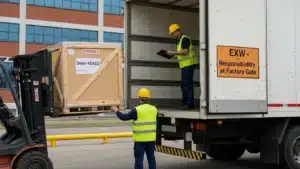
The vendors in Yiwu bear zero liability for any of this. The purchase contract defaults to EXW Yiwu, meaning compliance risk transfers to you the moment goods leave the factory floor. This is exactly why our inspection process mandates SGS heavy-metal declarations on every production batch before any DDP shipment leaves China—because discovering a compliance failure after landing is already too late.
Futian Market District 1 Layout
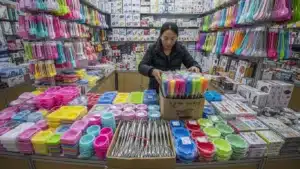
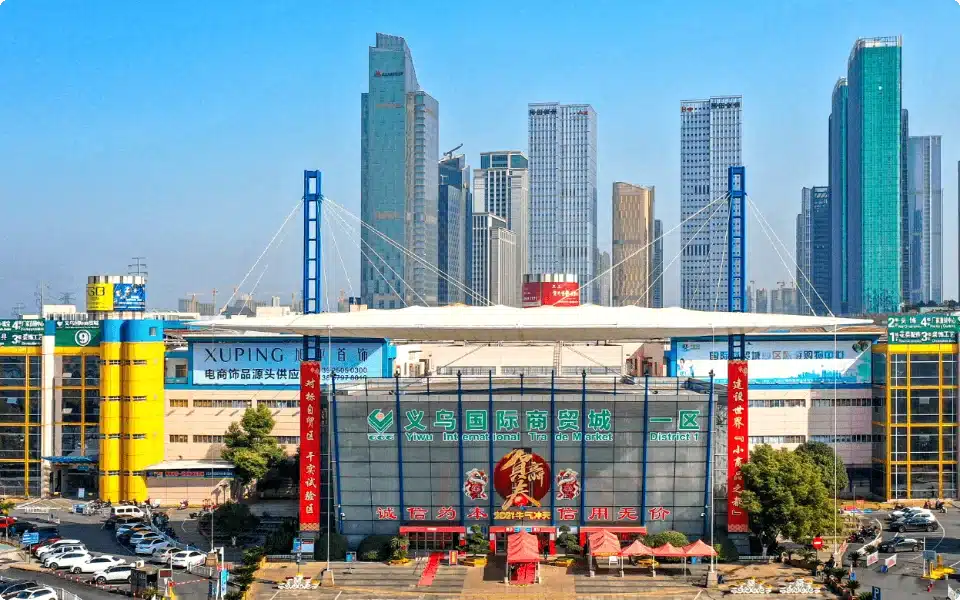
District 1’s second floor packs 2,000 to 3,000 jewelry booths into standardized 4x4m grids. Its hyper-specialized layout lets you benchmark EXW prices across five stalls in ten meters.
Physical Logistics and Freight Access
Every stall on the second floor is built on a standardized 4x4m grid. This uniform layout means no supplier gains a premium display advantage over another. We measure these booths during our initial audits because a cramped or disorganized 16-square-meter space usually signals sloppy inventory tracking.
If you are moving heavy sample crates or bulk purchases, you must use gates 13 through 17. These are the only ground-floor entrances equipped with freight lift access directly to the jewelry levels. Entering through the main pedestrian gates forces you to manually haul carts up narrow escalators, wasting 15 to 20 minutes per trip.
Hyper-Specific Booth Segmentation
The floor plan is not organized by broad categories like “necklaces” or “bracelets.” It is segmented by micro-styles. You will routinely find a cluster of six adjacent stalls where every single vendor sells nothing but one specific type of kids’ hair clip, or exclusively 316L stainless steel chains.
We use this hyper-segmentation as a hard pricing tool. By walking a buyer into these clusters, we can request quotes from five to six suppliers within a 10-meter radius without moving. It immediately exposes whoever is padding their EXW margins on a $0.10 alloy ring.
Approximately 50% of these stalls maintain same-day stock, while the rest require 7 to 28 days for manufacturing. When you map a micro-cluster, always ask the laobans directly for unreleased stock kept underneath the standard display trays. That is where the highest-margin designs are hidden from casual buyers.
Online Shopping vs. Factory Visits
Online platforms show you what vendors want to sell. Factory floors show you what actually moves—and what they save for buyers standing in front of them.
Why Chinagoods.com Prices Are a Trap
Chinagoods.com digitizes the surface-level inventory of District 1 and 2, but it strips away the pricing context that actually matters. Every piece listed on that platform is priced at display sample rates—3 to 5 times the real EXW bulk wholesale price. Alloy fashion jewelry that should land at $0.10 per piece appears listed at $0.30 to $0.50. Stainless steel necklace-and-earring sets that wholesale for $0.88 to $2.90 EXW show up inflated beyond any workable margin for e-commerce sellers.
The larger problem is what the platform completely omits. When you order through an online portal, there is no mechanism to verify plating thickness specifications within the 0.03–0.8 µm range or confirm cadmium content stays below the 100 ppm threshold. Our audits consistently show vendors quote attractive EXW numbers on these platforms but bypass SGS heavy-metal testing entirely. EU and US buyers who fail to mandate test declarations upfront face immediate customs destruction of their entire shipment—long before it reaches an Amazon fulfillment center.
The Inventory That Never Appears Online
In District 1, 2nd Floor—roughly 2,000 to 3,000 jewelry and hair accessory booths—vendors operate on a two-tier inventory system. The top tray holds older, high-turnover designs that end up photographed and uploaded to Chinagoods.com. Underneath that tray sits the unreleased stock: newer designs with better margins that vendors only reveal to buyers who physically walk up and ask for them.
We see this play out across hundreds of booth visits every month. When our team asks a vendor directly for their newest pieces, they reach under the display and pull out items with no online listing, no uploaded photos, and zero competition from remote buyers. For startup brand managers building a differentiated catalog, this physical access is the single largest structural advantage over competitors who source entirely through screens. About 50% of floor vendors keep same-day stock of these hidden designs ready to ship; the rest need 7 to 28 days for manufacturing. You only learn which category a vendor falls into by being there or having verified eyes on the floor working on your behalf.
Conclusion
Skip the $0.10 alloy pieces entirely. EU and US customs will destroy your entire shipment if cadmium levels exceed 100 ppm, wiping out your capital overnight. Buy the $0.88 to $2.90 stainless steel sets instead. They pass REACH compliance standards without expensive lab re-testing.
Before you pay for a single display sample, demand the vendor’s latest SGS heavy-metal test declaration. If they hesitate, walk to the next booth. Also, ask the boss directly for the unreleased stock hidden under the display trays—that is where your actual competitors are finding their profitable designs.
Frequently Asked Questions
How does Yiwu wholesale pricing work?
Wholesale pricing in the Yiwu jewelry market operates on an EXW (Ex Works) basis, typically starting as low as $0.10 per piece for basic alloy items. While volume breaks of 10-20% are standard at 300 or 1,000-piece tiers, buyers must account for separate packaging and export handling fees. As your trusted eyes in the market, we use our local factory relationships to secure these aggressive price breaks for you, even at our accessible low MOQ of 100 pieces. Also, we provide total cost transparency by integrating these EXW prices into our comprehensive global DDP shipping service, ensuring no hidden fees.
Is online shopping safe for small orders?
Purchasing Yiwu jewelry online carries significant risk for small orders due to the lack of material compliance guarantees and the high frequency of misrepresented plating or finishes. Unverified online portals often leave buyers with subpar inventory that fails Western quality standards. We eliminate this gamble by acting as your secure verification agent before any funds are released to the supplier. With our risk-free inspection process, you can confidently source online knowing that every piece is rigorously checked against the supplier’s photos before it ships.
How to verify factory quality standards?
Verifying a factory’s quality requires demanding current SGS test reports for critical factors like nickel release and cadmium content. For custom OEM projects, you must always require a pre-production prototype and verify the manufacturer’s ISO 9001 certification prior to paying the standard 30% deposit. As your trusted eyes in Yiwu, we handle this rigorous vetting process on your behalf to ensure strict adherence to Western safety standards. We physically audit these facilities so you can confidently scale your brand without worrying about non-compliant materials entering your supply chain.
What does a price list include?
An authentic Yiwu wholesale price list will clearly outline the EXW unit costs, minimum order quantities per style, and the specific plating materials used. But these factory lists notoriously omit crucial export costs such as export cartons, customs duties, and international freight. We bridge this gap by taking these bare-bones price lists and translating them into a comprehensive, all-inclusive DDP shipping quote. This means we calculate the packaging, export handling, and logistics into one transparent price, delivering directly to your door without surprise fees.
How is the Futian jewelry section organized?
The Futian Market jewelry section is highly systematic, occupying the entire second floor of District 1 and easily accessed via gates 13 through 17. Booths are strictly segmented by base material—such as alloy, stainless steel, and silver—as well as by specific accessory types like rings, hair clips, and packaging. Navigating this massive labyrinth alone can be overwhelming and time-consuming for global buyers. Our on-the-ground team knows this exact layout by heart, allowing us to efficiently pinpoint the right suppliers for your brand and bypass the inefficiencies of blind market wandering.