Джастин
Yiwu hardware and tools sourcing works differently from every other category in the market, and buyers who treat it like sourcing socks or toys lose money fast. Yiwu’s District 2 is stacked with hand tools, locks, fittings, fasteners, and hardware accessories at low minimums you can mix into one container. What it is not is a power-tool factory zone — the cordless drill on that booth wall was almost certainly made three hours away in Yongkang, then rebranded by a trading company standing between you and the plant.
That single distinction decides your unit cost, your certification paperwork, and whether your Amazon listing survives its first safety complaint. This guide maps what District 2 actually stocks, where the deeper factory supply really sits, the minimums and freight math for dense metal cargo, and the exact certification and vetting steps that separate a clean shipment from a customs hold.
Key Takeaways
- Yiwu District 2 is strongest for hand tools, hardware fittings, locks, and fasteners — high variety, low MOQ, easy to mix into one container.
- Motorized power tools sold in Yiwu are mostly rebranded trading-company goods; the real factories sit in Yongkang (“China’s hardware capital”), Jinhua, and Ningbo.
- Booth minimums usually run one to a few cartons per item; a custom-branded (OEM) run at the factory typically starts at 500–3,000 units.
- Hardware is dense cargo — sea freight is priced on weight, so landed cost, not sticker price, is the number that decides your margin.
- EU buyers often need CE, GS, RoHS, or REACH depending on the tool; US buyers face ANSI standards, possible UL/CPSC rules, California Prop 65, and Section 301 tariffs.
- Counterfeit brand tools (fake DeWalt, Bosch, Makita) are a walk-away, not a negotiation — they get seized and expose you to legal claims.
What Yiwu’s Hardware and Tools Market Actually Sells
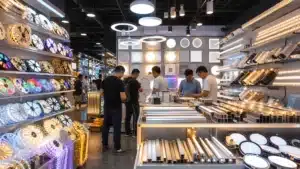
Hardware and tools live mainly in District 2 of the Yiwu International Trade City, the same halls that hold electrical goods and small machinery accessories. Walk the floors and the pattern is clear: this is a small-commodity market, so the depth is in things a worker holds in one hand, not things that plug into a 20-amp circuit and spin a blade.

The categories Yiwu does well
The reliable strength is breadth. A single afternoon in District 2 can fill a quotation sheet across a dozen sub-categories, most at minimums small enough to test before you commit to a full run.
- Hand tools: pliers, wrenches, screwdrivers, hammers, utility knives, tape measures, socket sets.
- Builder’s hardware: hinges, brackets, handles, drawer slides, casters, gate latches, shelf supports.
- Fasteners: screws, bolts, nuts, washers, anchors, cable ties — sold by the carton and by weight.
- Locks and security: padlocks, cabinet locks, door hardware, hasps.
- Abrasives and consumables: cutting discs, sandpaper, wire brushes, drill bits, saw blades.
- Garden and DIY: hand pruners, trowels, watering fittings, spray nozzles, hose connectors.
Where the market runs thin
The gap opens with anything motorized or precision-engineered. A booth may show a corded angle grinder or a cordless drill, but the seller is usually a trader who buys finished units from a factory elsewhere. You can still order them — you just accept a middleman margin and a supplier who cannot answer detailed questions about the motor, the battery cells, or the test reports. For a deeper walkthrough of the hall layout, our Yiwu District 2 hardware and tools guide maps the floors and gates.
| Категория | Yiwu depth | Typical booth MOQ | Watch for |
|---|---|---|---|
| Hand tools | Strong | 1–5 cartons | Steel grade and heat treatment vary widely |
| Builder’s hardware | Strong | 1–10 cartons | Plating thickness (rust in transit) |
| Fasteners | Strong | By carton / weight | Actual material vs. labeled grade |
| Corded / cordless power tools | Thin (traders) | Varies | Rebranded goods, weak test reports |
Yiwu vs Yongkang vs Guangzhou: Where Your Hardware Really Comes From
Understanding the supply map behind the booth saves you the classic first-timer mistake: paying Yiwu trader prices for goods you could have ordered closer to the factory. Zhejiang province packs three distinct hardware ecosystems within a few hours of each other, and each one owns a different job.

The power-tool reality check
Yongkang, about 90 kilometers from Yiwu, is nicknamed China’s hardware capital and produces a large share of the country’s power tools, electric appliances, and metal products. If you are buying angle grinders, drills, or garden power equipment in volume, that supply chain starts in Yongkang or Jinhua, not on a Yiwu booth. Sourcing there means dealing with a factory that can show you a UL or GS test file — and it means a real minimum, not a carton.
Rule of thumb: if it has a motor or a battery, source it at the factory cluster. If it fits in a toolbox and runs on muscle, Yiwu’s mixed-container model wins.
Is Yiwu right for your order?
| Sourcing hub | Core strength | Best for |
|---|---|---|
| Yiwu (District 2) | Hand tools, fittings, fasteners, locks | Mixed-category importers, small MOQ, retail assortments |
| Yongkang / Jinhua | Power tools, electric tools, metal products | Motorized tools at volume with test files |
| Guangdong (Foshan) | Furniture and architectural hardware | Cabinet, door, and heavy furniture fittings |
For a single mixed pallet of retail hardware, Yiwu wins on convenience even after the trader margin, because consolidating from one market beats coordinating three factory shipments. For a container of one motorized SKU, the factory cluster wins on both price and paperwork. If you are unsure which side of that line your order sits on, a factory versus trading company comparison will frame the trade-off before you request quotes.
MOQ, Pricing, and the Freight Math
Two numbers move most on a hardware order: the minimum you can buy, and the weight you have to ship. Get the second one wrong and a “cheap” screw becomes an expensive one by the time it clears your door.
Stock MOQ vs custom MOQ
Buying a stall’s existing stock, you can often start at one to a few cartons per item — that low threshold is exactly why Yiwu suits small and mixed importers. The minimum jumps the moment you want your own brand, color, or packaging. A custom (OEM) run typically starts around 500 to 3,000 units per SKU because the factory has to set up tooling, plating, or printing. If your target sits between those, negotiating minimums is its own skill; our guide on lowering MOQ in Yiwu covers the levers that actually work.
Why hardware is a freight game, not a sticker-price game
Metal is dense. A carton of wrenches or bolts hits the weight limit of an ocean container long before it fills the volume, so sea freight on hardware is usually priced by weight and the true cost hides in the landed number, not the quote. A batch of hand tools that looks unbeatable at the booth can lose its edge once ocean freight, duty, and last-mile delivery stack on top. Run the full landed cost formula before you compare two suppliers — the lower factory price sometimes ships heavier packaging and loses.
- Sample cost: stock samples are often a few dollars plus courier; custom samples carry a tooling or setup fee that is usually credited against the bulk order.
- Payment norm: a 30% deposit with the 70% balance before shipment is standard; be cautious when a new supplier demands 100% up front.
- Consolidation: pooling many booths into one shipment is where mixed hardware orders save on freight — see shipment consolidation.

Quality and Certification: What Tools Actually Need
Certification is where hardware buyers get hurt, because “we have CE” is one of the easiest claims to fake and one of the most expensive to get wrong. What a tool needs depends on the destination market, the product type, and whether it is powered.

The marks that matter by market
Requirements vary by product and by the importer’s role, so treat the list below as a starting map and confirm the specifics for your item with a testing lab or customs broker before you commit.
- European Union: many tools need CE marking; a GS mark adds voluntary tested-safety credibility, and material rules like RoHS and REACH may apply to coatings and plastics.
- United Kingdom: UKCA marking may apply in place of or alongside CE, depending on the product and current transition rules.
- United States: hand tools have no blanket federal mark, but ANSI performance standards, possible CPSC rules for consumer or children’s items, and California’s Proposition 65 warnings on lead and coatings can all apply.
- Powered and cordless tools: add electrical safety testing (UL or equivalent) and, for lithium battery tools, UN 38.3 transport testing for the cells.
- Amazon and marketplaces: may request test reports, and gated categories can hold your listing until you supply them.
Self-declared vs tested — and the counterfeit trap
A CE logo printed on a box means nothing without a test report behind it from an accredited lab. Ask for the actual report, check that the report’s product photos match your item, and confirm the lab is real. The harder line is on brand names: a booth offering “DeWalt-quality” drills at a fraction of retail is selling counterfeits, and those get seized at customs and can trigger legal claims against the importer. Treat brand knockoffs as a walk-away, and screen suppliers with the same discipline you would use to avoid fake suppliers in Yiwu.
| Market | Common marks / rules | Most relevant to |
|---|---|---|
| EU | CE, GS, RoHS, REACH | Powered tools, coatings, plastic grips |
| UK | UKCA (or CE per transition) | Most regulated tool types |
| US | ANSI, CPSC, Prop 65, UL (powered) | Consumer, children’s, electrical tools |
How to Vet a Yiwu Hardware Supplier
Most hardware disputes trace back to a step skipped before the deposit, not to bad luck after it. Because so many District 2 booths are traders, the vetting question is less “is this a scam” and more “who actually makes this, and can they hold the spec across a reorder.”

What we check before accepting a supplier
This is the routine our Yiwu sourcing agent team runs on every new hardware supplier before a client’s money moves. None of it is exotic — the discipline is doing all of it, every time.
- License vs invoice: the business license name should match the bank account and the invoice; a mismatch is the most common red flag.
- Booth and district: record the physical booth number and district so the supplier is traceable, not just a chat account.
- Trader or factory: ask who manufactures the item and where; a real factory answers material grade, plating microns, and heat-treatment questions without stalling.
- Sample stress test: for tools, load or torque the sample to failure; for plated hardware, ask about salt-spray hours to judge rust resistance in transit.
- AQL inspection before balance: book a pre-shipment inspection to a defined AQL level and release the 70% balance only after it passes — the core of any AQL inspection workflow.
- Bank account match: pay only a company account matching the license name, never a personal account.
Example: a 15-SKU mixed hardware order
Picture a buyer assembling a retail hardware assortment — pliers, hinges, padlocks, and drawer slides — across eight booths. The workflow that keeps it clean: negotiate each booth, collect samples into one place, confirm plating and steel grade, consolidate all eight into a single warehouse, run one AQL inspection on the combined lot, then ship it as one sea consolidation. One inspection, one shipment, one set of documents — instead of eight fragile threads that each fail on their own.
Shipping and Importing Hardware — Heavy, Dense, Duty-Sensitive
Hardware punishes sloppy logistics. It is heavy, it is duty-sensitive, and for US buyers it often carries extra tariffs — so the shipping plan belongs in your cost model from day one, not as an afterthought at the port.

Sea freight, weight, and consolidation
Most hardware moves by sea. Small mixed orders go LCL (less than container load) and pool with other cargo; once you fill roughly 15 cubic meters, a full container (FCL) usually costs less per unit. Because metal is heavy, confirm whether your rate is billed by weight or volume — for dense cargo it is almost always weight. Air freight only makes sense for urgent samples or high-value powered tools, never for a pallet of bolts.
Duties, HS codes, and Incoterms
Every tool has a Harmonized System code that sets its duty rate, and hardware is a category where US Section 301 tariffs on Chinese goods can stack on top of the base rate — so classification is a cost decision, not paperwork. Confirm your code against the official US Harmonized Tariff Schedule or your market’s equivalent, and check current rates with a customs broker before you price a deal. Decide your Инкотермс early: FOB gives you control of the freight leg, while DDP hands the whole customs headache to the supplier or agent and lands goods at your door — a common choice for Amazon FBA sellers who want tools delivered straight to the warehouse. A correct HS code classification also keeps your entry from being flagged.
Часто задаваемые вопросы
Is Yiwu good for buying power tools?
Only through traders. Yiwu excels at hand tools and hardware, but motorized power tools are made in factory clusters like Yongkang and Jinhua, so buying them at volume is cheaper and better-documented direct from those factories.
Are Chinese hand tools any good?
Quality spans a wide range, so the spec you agree on matters more than the country. Define the steel grade, heat treatment, and finish, then verify with a sample stress test and an AQL inspection before paying the balance.
What is the minimum order for hardware from Yiwu?
Stock items often start at one to a few cartons, which is why Yiwu suits small buyers. Custom-branded runs usually start at roughly 500 to 3,000 units per SKU because of tooling and setup.
Do Chinese tools need CE certification to sell in Europe?
Many tools do, but it depends on the product type and your role as importer. Ask for the actual test report from an accredited lab rather than trusting a printed CE logo, and confirm the requirement for your item with a testing body.
How do I import tools from China to the US?
Classify each tool under its HS code, check the base duty plus any Section 301 tariff, then ship by sea (LCL or FCL) under FOB or DDP terms. A customs broker confirms the current rate and clears the entry.
How much does it cost to import tools from China?
Your landed cost is the unit price plus sea freight (billed by weight for dense metal), duty and any Section 301 tariff, plus last-mile delivery. Because hardware is heavy, freight and duty often move the final number more than the sticker price.
Заключение
Yiwu earns its place in a hardware supply chain when you use it for what it does best: broad assortments of hand tools, fittings, fasteners, and locks at low minimums you can mix into one shipment. Push it toward motorized power tools or precision industrial parts and you pay a trader for goods a factory cluster makes better and documents properly. Match the product to the right hub, insist on real test reports, and price the freight — because with dense metal cargo, the landed cost is the only number that decides your margin.
If you are sourcing a mixed hardware assortment, buying below factory minimums, or need a supplier verified before a deposit leaves your account, walk your shortlist through the vetting checklist above, then decide which orders belong in Yiwu and which belong at the factory. You can also compare it against the full Yiwu market product categories to see where hardware fits your wider buying plan.
Written by the Yiwu Market Procurement Service team. Based in Yiwu, we help importers and Amazon sellers source, inspect, and consolidate small-commodity orders — with hands-on supplier vetting and quality control across District 2 hardware and beyond.