 Джастин
A supplier quote is not a price. It is one line of a number you will not know for another six weeks, and by the time the invoice from your broker lands, the margin you approved the purchase order on has already been spent.
The landed cost formula is how you close that gap before you commit. Most of it is arithmetic on figures your supplier and your forwarder hand you. The part that goes wrong is the small statutory layer in the middle — the government fees and duty base that nobody quotes you, that change on published dates, and that most guidance on this subject is currently reporting two fiscal years out of date.
Key takeaways
- The formula: Landed cost = goods value + freight + insurance + duty + statutory fees + inland delivery + risk costs. Duty and the statutory fees are calculated on a customs value that is not always your invoice total.
- The US Merchandise Processing Fee is 0.3464% of entered value, but with a floor of $33.58 and a ceiling of $651.50 per formal entry (19 CFR 24.23; FY2026 limits). Both rise to $34.58 и $670.86 on 1 October 2026.
- That percentage only applies between roughly $9,693 and $188,076 of entered value. Outside that band MPF behaves as a flat fee, and a spreadsheet using a straight 0.3464% is wrong in both directions.
- Your Incoterm moves the duty base, not just who books the freight. Under 19 CFR 152.103(a)(5), foreign inland freight is excluded from customs value on an ex-factory price and included where the price covers it.
- Buyer-supplied moulds, artwork and buyer-paid selling commissions are dutiable additions under 19 CFR 152.103(b)(1) — the line private-label importers most often omit.
- China-origin goods carry a dated cliff: 178 Section 301 exclusions expire at 11:59 p.m. EDT on 9 November 2026.
On this page
- The Landed Cost Formula, Bucket by Bucket
- Customs Value: The Number Duty Is Actually Calculated On
- The Statutory Fee Layer Most Formulas Get Wrong
- China-Specific Buckets: Section 301, Exclusions and the Dates That Move Them
- Per-Unit or Per-Shipment: The Allocation Step That Flips Supplier Rankings
- A Worked Landed Cost Model You Can Copy
- EXW, FOB, CIF or DDP: Which Incoterm Actually Lowers Your Landed Cost
- The Costs That Only Appear When Something Goes Wrong
- What to Ask Your Supplier Before You Can Build the Model
The Landed Cost Formula, Bucket by Bucket
Written out in full, with every bucket named:
Landed cost = goods value + international freight + cargo insurance + customs duty + statutory import fees + brokerage and entry costs + inland delivery + risk and holding costs
Every guide on this subject produces a list roughly like that one. The list is not where money is lost. Money is lost in three places: buckets sourced from the wrong document, buckets calculated on the wrong base, and buckets that are treated as percentages when they are not.
So it is more useful to write the formula with each bucket labelled by where its number legitimately comes from. If you cannot name the document a figure comes off, it is an assumption wearing a decimal point.
| Bucket | Where the number comes from | Behaves as |
|---|---|---|
| Goods value | Commercial invoice, plus statutory additions | Scales with quantity |
| International freight | Forwarder quote, priced on chargeable weight or CBM | Per shipment |
| Cargo insurance | Insurer or forwarder rate on declared value | Percentage of value |
| Customs duty | Your HTS classification, applied to customs value | Percentage of customs value |
| Statutory import fees | 19 CFR 24.23 and 24.24, plus the annual fee notice | Percentage, but capped and floored |
| Brokerage and entry | Your broker’s fee schedule | Per entry |
| Inland delivery | Drayage and trucking quotes | Per container or per pallet |
| Risk and holding | Free-time terms, penalty schedules, defect history | Contingent |
The buckets most quotes leave out
Four of them, consistently. Buyer-supplied tooling, because it was paid months earlier on a different invoice and does not feel like part of this shipment. Selling commissions the buyer pays to an agent, because the buyer thinks of that as his own overhead rather than part of the goods price. Per-entry fees, because they are small individually and invisible when you divide by 20,000 units. And the cost of money — the sixty or ninety days between paying a deposit and selling the first unit, which does not appear in any bucket but is real if you are financing inventory.
The first two are not optional bookkeeping preferences. As the next section shows, US customs law requires both to be added to the value duty is calculated on.
What changes when the supplier quotes DDP
If a supplier or agent quotes you a delivered price, most of the table above collapses into one number. That is convenient, and it is also the point at which you stop being able to audit your own cost structure. You are no longer buying goods plus a set of services; you are buying an opaque bundle whose duty component you cannot see and therefore cannot check for classification error. There is a case for it, covered further down, but it is a different decision from the one this formula is usually used to make.
Customs Value: The Number Duty Is Actually Calculated On
Ask most importers what duty is charged on and the answer is “the invoice”. That is close enough to be dangerous.
For US imports the primary basis is transaction value — the price actually paid or payable for the merchandise when sold for exportation to the United States, defined in 19 CFR 152.103. The regulation is explicit that this price may be the result of discounts, increases or negotiations, and that payment can be direct or indirect. It is the deal, not the invoice header.
Then come the additions, and this is the part that catches private-label buyers.
The five statutory additions
19 CFR 152.103(b)(1) requires the price actually paid or payable to be increased by amounts equal to: packing costs incurred by the buyer; any selling commission incurred by the buyer; the apportioned value of any assist; any royalty or licence fee the buyer must pay as a condition of the sale; and the proceeds of any subsequent resale that accrue to the seller. Those five, the regulation says, and no others.

The assist rule is the expensive one. If you paid for a mould, a cutting die, artwork, or engineering work and supplied it to the factory free or below cost, its value is apportioned across the goods and added to customs value. The regulation’s own worked example is unambiguous: an importer furnishes a tooling assist acquired for $1,000, with $100 of transport to the assembler’s plant, and the transaction value becomes the assembly price plus a pro rata share of $1,100.
So a private-label buyer who spent $4,000 on moulds and then imports 40,000 units across four shipments is carrying dutiable value he has almost certainly not declared, and probably has not budgeted for either. It is a small number per unit. It is not a small number in a customs audit, where the exposure is retroactive.
Where the Incoterm quietly moves the base
Here is the mechanism almost nobody explains. 19 CFR 152.103(a)(5) treats foreign inland freight — the leg from the factory to the port of export — differently depending on what your price includes.
On an ex-factory price that does not include a charge for foreign inland freight, the regulation states those charges “will not be added to the price”. Where the price does include foreign inland freight, “whether or not itemized separately on the invoices”, that charge is part of transaction value to the extent it is included in the price.
Read that twice, because it means the trucking from a Yiwu workshop to Ningbo is inside your duty base under one Incoterm and outside it under another, for the identical physical shipment. That is not a loophole to exploit — the declared value has to reflect the deal you actually made — but it is a real reason two structurally identical quotes produce different duty bills, and it is worth understanding before you assume a lower EXW price is purely a freight-responsibility question.
The Statutory Fee Layer Most Formulas Get Wrong
This is the section where published guidance on landed cost is most often simply wrong, and it is wrong in a way you can verify in about four minutes.
MPF: a percentage with a floor and a ceiling
The US Merchandise Processing Fee on formally entered merchandise is an ad valorem fee of 0.3464 percent, set in 19 CFR 24.23(b)(1)(i)(A) and charged on the value of the merchandise as determined under 19 U.S.C. 1401a. That rate is stable — the FY2027 fee notice states explicitly that “only the limitation is increasing; the ad valorem rate of 0.3464 percent remains the same”.
The limitations are what move. For fiscal year 2026, in force since 1 October 2025, MPF may not be less than $33.58 and may not exceed $651.50 per formal entry. From 1 October 2026 those limits become $34.58 и $670.86, published in the Federal Register on 31 July 2026.
| Fee | Rate | In force now (FY2026) | From 1 Oct 2026 |
|---|---|---|---|
| MPF, formal entry | 0.3464% | min $33.58 / max $651.50 | min $34.58 / max $670.86 |
| Manual entry surcharge | flat | $4.03 | $4.15 |
| HMF (ocean only) | 0.125% | no floor or ceiling | unchanged |
The Harbor Maintenance Fee is simpler and is set in 19 CFR 24.24(a): 0.125 percent of cargo value on commercial cargo loaded on or unloaded from a commercial vessel at a listed port. Vessel only. Air freight does not attract it, which is one of the few places where the cheaper mode carries a fee the faster one does not.
Two traps in these numbers
The first trap is the regulation itself. If you open 19 CFR 24.23 you will read a maximum of $485 and a minimum of $25 — and those are wrong to use. The section states plainly that its amounts “are not the actual fees or limitations, but represent the base year amounts that are subject to adjustment each fiscal year in accordance with the Fixing America’s Surface Transportation Act (FAST Act) using Fiscal Year 2014 as the base year”. The operative numbers live in a Federal Register notice CBP publishes at least 60 days before each fiscal year.
The second trap is staleness, and it is widespread right now. The figures $31.67 and $614.35 appear across a great deal of current landed-cost guidance, including pages carrying a 2026 date. Those are the FY2024 limitations — operative from 1 October 2023 to 30 September 2024. They have been superseded twice. If your cost model uses them, every entry above the cap is understated by $37.15 today, and by $56.51 after 1 October.
The break-even values worth writing on the wall
Because MPF is a percentage bounded by a floor and a ceiling, the percentage only governs across a band. Divide the limits by the rate and the band appears: $33.58 ÷ 0.003464 ≈ $9,694, and $651.50 ÷ 0.003464 ≈ $188,077.
Under FY2026 limits, then, MPF is effectively a flat $33.58 on any formal entry below about $9,694 of entered value, a true 0.3464% between roughly $9,694 and $188,077, and a flat $651.50 above that. This has a direct consequence for how you ship. Splitting a $200,000 order into four $50,000 entries turns one capped $651.50 charge into four uncapped charges of $173.20, or $692.80 — you have paid more for the privilege of four separate entries, before counting four brokerage fees instead of one. Consolidating in the other direction, a buyer making frequent small entries is paying the floor repeatedly on shipments too small to justify it.
China-Specific Buckets: Section 301, Exclusions and the Dates That Move Them
For China-origin goods entering the US there is an additional ad valorem layer sitting on top of the normal HTS rate, imposed under Section 301 of the Trade Act. It is applied by tariff subheading, not by product category or by supplier, which is why two items on the same purchase order can carry very different totals.
The original actions are well documented. The July 2018 action applied an additional 25 percent ad valorem duty to 818 tariff subheadings covering roughly $34 billion of annual trade value (List 1); the August 2018 action applied the same 25 percent to 279 subheadings covering about $16 billion (List 2). Later lists were added and repeatedly modified.
We are deliberately not printing a rate table for the later lists here. Those rates have been amended many times, and a number copied into an article is exactly how a stale figure enters someone’s spreadsheet — the failure documented in the previous section. The correct move is to look up your own subheading in the current Harmonized Tariff Schedule, where Chapter 99 carries the temporary modifications. As of this writing the HTS is on 2026 Revision 15. Fifteen revisions into a single calendar year is the useful fact: a duty rate you checked in January is not automatically the rate that applies in August.
The dated cliff in your Q4 numbers
Some products are covered by exclusions that suspend the Section 301 duty. These expire on hard dates. The 178 exclusions currently in force were extended through 11:59 p.m. eastern daylight time on 9 November 2026.
If one of your HTS lines sits under an exclusion, your landed cost has a step-change built into it that no forwarder quote will mention. Goods entered on 8 November and goods entered on 10 November can carry materially different duty on the same product. For a buyer planning Q4 arrivals against a sailing time of several weeks, that date sits inside the current booking window, not somewhere in the future.
Separately, the statutory second four-year review of both 2018 actions is under way, initiated in May 2026, with comment windows that opened on 7 May and 24 June 2026 and close on 5 July and 22 August 2026 respectively. The practical reading for a cost model is simple: treat the Section 301 line in any 2027 projection as under active review rather than settled, and check your subheading again before you commit to annual pricing.
One framing point for readers outside the United States, since these buckets are US-specific. MPF, HMF and Section 301 are US mechanisms. The structure of the formula ports everywhere — goods value, freight, insurance, a duty calculated on a defined customs value, statutory fees, inland delivery — but the fee names and the valuation rules are your destination country’s. An EU importer is working with a customs value defined by the Union Customs Code and an import VAT line that has no US equivalent. Use the method; source the rates locally. If you want the mechanics of clearance itself rather than the arithmetic, our guide to customs clearance processing covers the document sequence.
Per-Unit or Per-Shipment: The Allocation Step That Flips Supplier Rankings
You now have a shipment total. Turning it into a per-unit cost is where spreadsheets quietly lie, because most people divide the total by the number of units and stop.
That works only if every SKU in the shipment consumes cost the same way. It never does. A carton of ceramic mugs and a carton of nylon bags might have identical unit counts and wildly different volumes; freight follows the volume, duty follows the value, and the per-entry fees follow neither.
Four allocation bases, and when each is right
| Стоимость | Allocate by | Why |
|---|---|---|
| Ocean or air freight | Chargeable weight or CBM | The carrier prices space, not units |
| Duty and Section 301 | Line value, per HTS subheading | Rates differ by classification, not by carton |
| Insurance | Declared value | Premium is struck on value at risk |
| MPF, brokerage, ISF, drayage | Per entry, then spread on value | Fixed per shipment; the split is a convention, so state it |
A comparison where the cheaper unit price loses
Take two suppliers quoting the same 5,000-unit order of a light, bulky homeware item, both FOB Ningbo, and assume identical duty treatment.
Supplier A quotes $2.10 per unit. Supplier B quotes $2.30. On unit price alone, A wins by $1,000 across the order.
Now bring in the carton data, which is the information most buyers never request. Supplier A ships 40 units per carton at 0.085 CBM per carton: 125 cartons, 10.63 CBM. Supplier B, using a nested design and a compressed pack, ships 60 units per carton at 0.078 CBM: 84 cartons, 6.55 CBM. That is a 4.07 CBM difference on the same order.
LCL freight is quoted per cubic metre by your forwarder, and the rate is yours to obtain — it moves with lane, season and carrier. Run it as a variable and the crossover appears without needing anyone’s rate card. At an LCL rate of R per CBM, A’s freight is 10.63R and B’s is 6.55R, so B is cheaper on freight by 4.07R. B’s goods premium is fixed at $1,000. The two suppliers land level when 4.07R = $1,000, that is at R ≈ $246 per CBM.
So the decision rule is not a number someone else can give you: it is a threshold you check against your own quote. Below about $246 per CBM, supplier A’s lower unit price survives. Above it, the supplier quoting 20 cents more per unit lands cheaper, and the gap widens with every dollar the rate rises. Buyers who only compare unit prices never see the crossover at all, and in a rising freight market they find out about it after the goods are on the water.
The per-entry fees compound this in the same direction. Because MPF’s floor is charged per entry, a buyer running four small entries a quarter pays it four times whether or not the goods justify it — the arithmetic in the previous section, applied to a shipping calendar rather than a single order. This is the concrete argument for consolidating multiple suppliers into one shipment, and it is measurable rather than rhetorical.
A Worked Landed Cost Model You Can Copy
Here is the whole thing end to end. One instruction before you read it: the market-priced lines below are placeholders for your own quoted figures, not benchmarks. Freight, drayage and brokerage are priced by lane, season and carrier, and any article quoting them as fact is inventing them. What this model demonstrates is the arithmetic and the sequence — every statutory line is computed in front of you from a cited rate, so you can check the method and drop your own numbers in.
The order: 8,000 units of a homeware item, FOB Ningbo at $3.05 per unit, ocean LCL to Los Angeles, US destination, formal entry, HTS base duty assumed at 3.4% and no Section 301 exclusion in force.
| Line | How it is derived | Amount |
|---|---|---|
| Goods, FOB | 8,000 × $3.05 — your invoice | $24,400.00 |
| Tooling assist, apportioned | $2,400 mould over 3 orders — 19 CFR 152.103(b)(1)(iii) | $800.00 |
| Customs value | invoice + statutory additions | $25,200.00 |
| Duty at 3.4% | $25,200 × 0.034 — your HTS line | $856.80 |
| MPF | $25,200 × 0.003464, inside the band | $87.29 |
| HMF | $25,200 × 0.00125, ocean entry | $31.50 |
| Cargo insurance at 0.3% | on declared value — our published rate | $75.60 |
| Ocean freight, LCL | YOUR forwarder quote — placeholder | your figure |
| Brokerage, ISF, drayage | YOUR broker’s schedule — placeholder | your figure |
| Subtotal, computable lines | everything above except your two quotes | $26,251.19 |
Read what that table actually tells you. Before a single freight quote arrives, $1,851.19 of cost is already fixed and knowable — the assist, the duty, the two statutory fees and the insurance. That is 7.6% on top of your invoice, and it is computable at the moment you receive the supplier’s price, not six weeks later. Per unit, the computable portion is $3.28 against a quoted $3.05: a 7.6% gap before anything has moved.
Two sensitivities are worth running while the model is open. First, drop the tooling assist and customs value falls to $24,400, taking duty to $829.60 and MPF to $84.52 — the mould you paid for months ago is costing $29.97 in duty and fees on this shipment alone, and it will do so again on the next two.
Second, ship the same order after 1 October 2026 and nothing in this example changes, because $87.29 sits comfortably inside both the old and new bands. That is the useful negative result: the MPF limit change only bites entries below about $9,983 or above roughly $193,666 next fiscal year. Knowing which side of a threshold you are on is worth more than memorising the threshold.
EXW, FOB, CIF or DDP: Which Incoterm Actually Lowers Your Landed Cost
This is the decision the formula exists to inform, and it is genuinely a decision — not a formality your supplier fills in.
Сайт Incoterms 2020 rules published by the International Chamber of Commerce comprise eleven terms. Seven work for any mode of transport (EXW, FCA, CPT, CIP, DAP, DPU, DDP) and four are for sea and inland waterway only (FAS, FOB, CFR, CIF). Each moves three things at once: who pays which leg, where risk transfers, and — as established above — what sits inside your customs value.

The insurance detail buyers miss on CIF
CIF requires the seller to insure, and buyers reasonably conclude they are covered. The level matters: under Incoterms 2020, CIF obliges the seller to procure insurance complying with Institute Cargo Clauses (C) as the baseline, while CIP requires the substantially broader Institute Cargo Clauses (A). Clauses (C) is a restricted named-perils cover, not all-risks.
So a CIF quote can look competitive precisely because the insurance inside it is thinner than the cover you would have bought yourself. If you accept CIF, either negotiate the cover upward in the contract or buy your own supplementary policy — and if you are shipping by container in multimodal service, ask why the deal is on CIF at all rather than CIP. Our breakdown of cost, insurance and freight under CIF works through the obligations in detail.
What a DDP price hides — including ours
DDP puts everything on the seller: freight, duty, clearance, delivery. For a buyer without an import team it removes real operational burden, and there are sound reasons to choose it.
What it also removes is your visibility of the duty line. Under DDP you are quoted one delivered number. You cannot see the HTS classification used, you cannot check whether a Section 301 exclusion was applied to your goods, and you cannot audit whether the customs value declared matched your commercial reality. If the classification was aggressive, the exposure sits with whoever is the importer of record.
We should be straightforward that this applies to our own service. Our published DDP model states that we pay the duties, clear customs and act as Importer of Record, with import tax and VAT included in the quoted price. That is a genuine convenience and it is also, by construction, a price in which you cannot see the duty component. Buyers who want that visibility should be shipping FOB or FCA and running their own entry — and the fact that we sell the delivered option does not change the advice.
Best for, and not for
- EXW — best for experienced importers with a trusted forwarder in China who want maximum control and the narrowest duty base. Not for first-time buyers: you inherit export clearance and inland transport in a country where you have no leverage.
- FOB — best for most wholesale importers. Risk and cost transfer at a defined point, the price is comparable across suppliers, and you control the ocean leg. Not for air or courier shipments, where FCA is the correct term.
- CIF — best for buyers who want the supplier to arrange sea freight and accept a defined baseline of cover. Not for anyone assuming all-risks protection, unless it is negotiated in writing.
- DDP — best for Amazon FBA sellers and buyers with no customs capability who value a single number over line-item visibility. Not for buyers who need to audit classification, or who are building a long-term landed-cost model they intend to defend.
The Costs That Only Appear When Something Goes Wrong
Everything so far is the base case. A landed-cost model that only contains the base case will be right most of the time and badly wrong occasionally, which is the worst distribution to plan margin against.
ISF: a filing deadline with a real penalty
For ocean cargo the Importer Security Filing is due on a two-tier schedule that is usually described in one tier. Under 19 CFR 149.2(b), the seller, buyer, importer of record number, consignee number, manufacturer or supplier, ship-to party, country of origin and HTSUS number must be filed no later than 24 hours before the cargo is laden aboard the vessel at the foreign port. The container stuffing location and consolidator are due later — no later than 24 hours prior to arrival in a US port.
That distinction matters operationally, because the elements due before lading are the ones that depend on your supplier answering questions promptly. The penalty is specific: the bond condition at 19 CFR 113.62(j) provides for liquidated damages of $5,000 for each violation. It is not a fine in the ordinary sense — it is a claim against the bond, and it is mitigable — but it is a real number and it belongs in your risk line rather than your imagination.
Storage and detention: a clock, not a rate
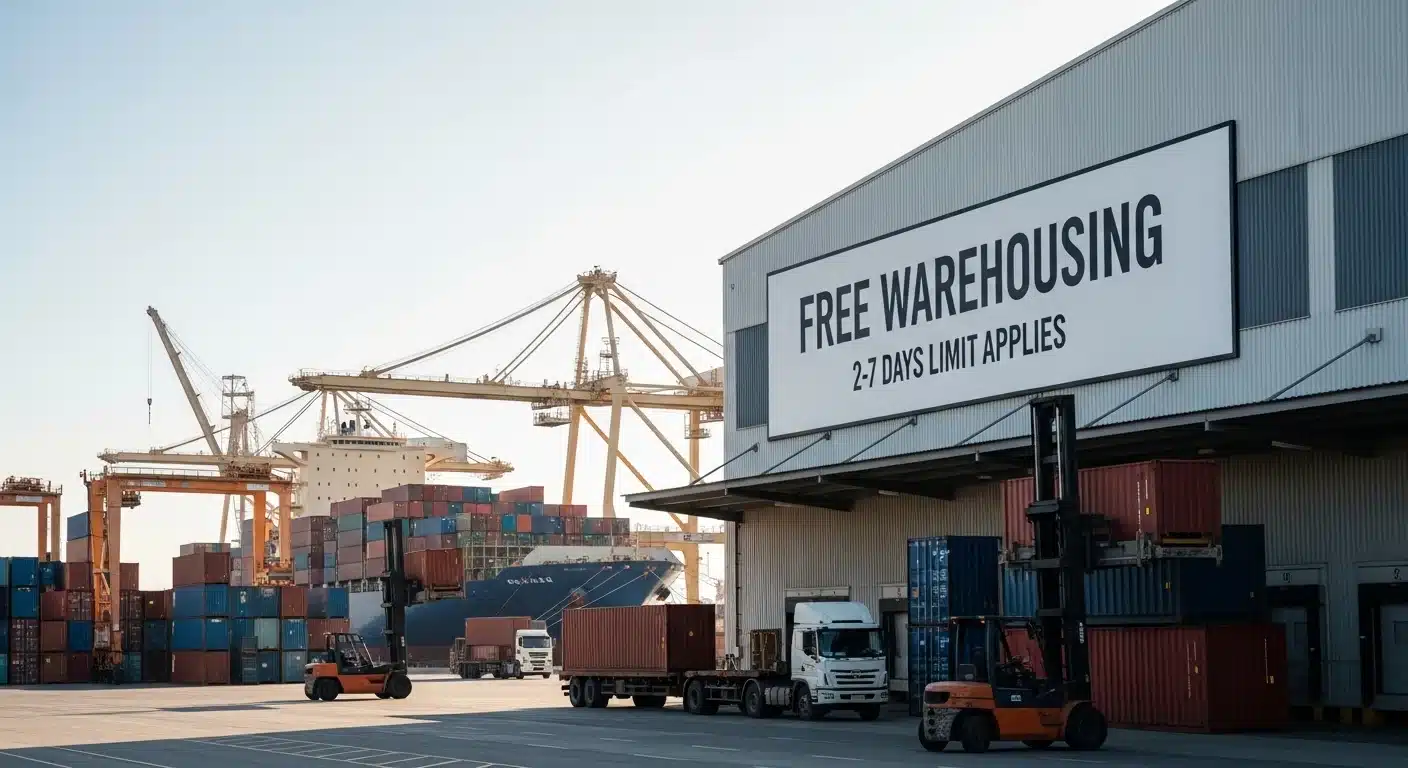
Demurrage, detention and warehouse storage are per-diem charges that begin when free time expires. We are not going to print a per-diem rate, because it is set by terminal and carrier and any single figure would be wrong for most readers. What you can control is the clock, and the clock is negotiable in a way the rate is not.
On the origin side this is concrete. Our own published terms include 30 days of free storage in a 3,000 sqm warehouse for consolidation, which is what lets a buyer collect goods from several Yiwu suppliers on different production schedules and still ship once. The cost model consequence is direct: the alternative to consolidated storage is either multiple small entries, each paying the MPF floor and a separate brokerage fee, or paying to hold goods somewhere while you wait.
Exams, holds and the bond
A customs exam adds cost and time, and the charges depend on exam type and location. We will not tabulate figures for them, for the same reason as above — published exam-cost tables are typically someone’s regional experience presented as a schedule.
What is worth stating precisely is the bond, because the internet is confident about it and the regulation is narrower. 19 CFR 113.13(a) sets the minimum amount of any CBP bond at not less than $100, stated to the next highest dollar. Sufficiency is assessed against criteria in 113.13(b): the importer’s record of timely payment, compliance with redelivery demands, the value and nature of the merchandise, and the degree of CBP supervision. Your surety will quote you a premium on that basis. Treat widely circulated formulas for sizing a continuous bond as broker guidance rather than regulation, and get the number from your surety.
Sizing the buffer honestly
The usual advice is to add a contingency percentage. Better: list the specific contingent events your shipment is actually exposed to — an exam given your commodity and history, an ISF claim given how fast your supplier answers, storage given your free time and production reliability, a rework or replacement given your defect history — and cost the ones that are plausible. A named 2% buffer you can defend beats a round 5% you cannot.
What to Ask Your Supplier Before You Can Build the Model
None of the arithmetic above is possible without data most buyers never request. This is the list to send before you ask for a revised price.
- The Incoterm, with the named place. “FOB” alone is incomplete; “FOB Ningbo” is a term. Without the place you cannot tell which costs are in the price.
- The HS code the factory uses, and why. A code without a reason is a guess you will inherit. Ask what material and function drive the classification, then verify it against the current HTS yourself — classification liability sits with the importer, not the factory.
- Carton dimensions, units per carton, gross and net weight. Without these you cannot compute CBM or chargeable weight, and therefore cannot compare two suppliers on anything but unit price. This is the data that produced the crossover in the allocation section.
- Whether tooling, artwork or plates are charged separately, and whether you own them. Both the cost treatment and the dutiable-assist question depend on the answer.
- Any commission payable to an agent, and by whom. A selling commission you pay is a statutory addition to customs value.
- Production lead time, and what changes it. Combine with transit to get the cash cycle. For reference, our published transit bands from Yiwu are 3–7 days by air express, 8–12 days by air cargo, 18–25 days by rail to the EU and 30–45 days by sea.
- MOQ, and how it is structured — per colour, per size, per carton or per order. MOQ interacts directly with the per-entry fee problem: a low MOQ that produces frequent small entries can cost more in fixed fees than a higher one shipped consolidated. Where a factory sets MOQ against your size and colour mix rather than a single number, get that structure in writing.
- The certification the destination market requires, and who holds it. Compliance is a cost bucket disguised as a checkbox. A children’s product entering the US needs CPSC testing and a Children’s Product Certificate; an electrical item entering the EU needs a CE declaration of conformity and the supporting test report; food-contact goods need their own documentation. Ask which certificates exist today, which are held in the factory’s name rather than a trading company’s, and what a test report for your specific SKU would cost — testing is quoted per SKU and per standard, so a wide range multiplies it.
- How you verify before payment. Sample, inspection, or both, and at whose cost. An inspection fee is a known line; a container of unsellable goods is not a line at all, it is the end of the model.
On specification range, be aware of what you are actually asking for. Yiwu is a consolidation market rather than a single-category factory base, so the practical range is wide — homeware, stationery, party goods, small hardware, textiles and accessories — but it is a range of suppliers, not a range of sizes and grades from one production line. That distinction matters for your model: a single-factory order gives you one HS code, one carton spec and one entry, while a mixed consolidation gives you several HS codes on one entry and the allocation problem from the section above.
So ask for the size, colour and material options a specific supplier can actually produce, and get the carton data for each variant. A variant that changes carton dimensions changes your freight line even when the unit price is identical.
What we check on the cost side, and where we stop
Since we quote the freight and consolidation half of this model, it is fair to say exactly what that covers and what it does not. On a consolidation we verify carton dimensions and gross weight against what the supplier declared, because that is the input that decides your chargeable volume and it is wrong often enough to matter. We consolidate multiple suppliers into one shipment so the per-entry fees are paid once rather than per supplier, and our published terms give 30 days of free storage in a 3,000 sqm warehouse to make waiting for a slower factory free rather than costly.
Where we stop: we do not classify your goods for you. The HS code is the importer’s legal responsibility and getting it wrong is your exposure, not ours, so we will tell you what the factory declared and what similar goods usually move under, and then you or your broker decide. We also do not publish a duty estimate as a promise — the rates move, as the fifteen HTS revisions this year show, and a number we gave you in August is not a number you should still be using in December.
Pricing itself is quoted per order rather than published as a rate card, because it moves with product, quantity, mix and destination — which is precisely why the eight items above matter more than any published price list would. Send them, get a complete quote back, and the model builds itself. For the sourcing side of that conversation, our product sourcing service page sets out how supplier identification and quoting work, and the companion article on using a landed cost calculator covers what to check before trusting any calculator’s output. If your concern is specifically agent and sourcing fees rather than the import arithmetic, true landed cost and sourcing fees takes that angle.
Заключение
The landed cost formula is not difficult arithmetic. What makes it unreliable in practice is that three of its inputs are not on any document your supplier sends you: the customs value after statutory additions, the fee layer with its floor and ceiling, and the origin-specific duty that changes on published dates.
Do these four things and the model becomes defensible. Build customs value first, adding assists and buyer-paid commissions before you apply any rate. Take the fee figures from the current fiscal-year notice rather than from a blog or from the base-year amounts printed in the regulation. Check whether your entered value falls inside or outside the MPF band, because that decides whether the percentage in your spreadsheet means anything. And check your own HTS subheading against the current tariff schedule before every quarter’s pricing, with the 9 November 2026 exclusion expiry marked in your calendar if it touches your goods.
If you are consolidating from several Yiwu suppliers and want the freight and delivered-cost side quantified against your own quantities, that is a conversation worth having before the purchase order rather than after the arrival notice.
Часто задаваемые вопросы
What is the landed cost formula?
Landed cost = goods value + international freight + cargo insurance + customs duty + statutory import fees + brokerage and entry costs + inland delivery + risk and holding costs. Duty and the ad valorem fees are calculated on customs value, which is not always your invoice total.
Is duty calculated on the FOB or CIF value for US imports?
On transaction value — the price actually paid or payable, plus five statutory additions under 19 CFR 152.103(b)(1). Whether foreign inland freight is inside that base depends on whether your price includes it, per 19 CFR 152.103(a)(5).
How much is the Merchandise Processing Fee in 2026?
0.3464% of entered value, with a minimum of $33.58 and a maximum of $651.50 per formal entry for fiscal year 2026. From 1 October 2026 the limits rise to $34.58 and $670.86. The percentage rate itself is unchanged.
Does the Harbor Maintenance Fee apply to air freight?
No. HMF is 0.125% of cargo value and applies to commercial cargo loaded or unloaded from a commercial vessel at a listed port, under 19 CFR 24.24(a). Air shipments do not attract it.
How do you calculate landed cost per unit?
Allocate each cost on the basis that drives it — freight by volume or chargeable weight, duty by line value, insurance by declared value, per-entry fees spread on value — then divide by units. Dividing the shipment total by unit count distorts any mixed shipment.
Is a buyer-supplied mould dutiable?
Yes. A mould, tool, die or artwork supplied to the factory free or below cost is an assist, and its value is apportioned and added to customs value under 19 CFR 152.103(b)(1)(iii).
When do the current Section 301 exclusions expire?
The 178 exclusions in force were extended through 11:59 p.m. eastern daylight time on 9 November 2026. If your subheading relies on one, model the duty both with and without it for goods arriving near that date.
Does landed cost include VAT?
It depends on your destination and whether you recover it. In markets with recoverable import VAT, most importers exclude it from landed cost and treat it as a cash-flow item. Where it is not recoverable, it belongs in the model.