 Justin
Yiwu vs Guangzhou is the choice every China buyer eventually faces once they outgrow a single market. Both are sourcing giants, but they solve different problems: Yiwu is the world’s small-commodity supermarket — endless variety at low minimums — while Guangzhou is a manufacturing metropolis with deeper factories for apparel, electronics, leather and furniture. Pick the wrong hub and you either drown in high MOQs you don’t need, or settle for commodity-grade goods when you needed real manufacturing.
Key Takeaways
- Yiwu is best for wide, low-MOQ small commodities; Guangzhou for deeper manufacturing.
- Yiwu wins on variety and consolidation; Guangzhou on customization and category depth.
- Guangzhou MOQs and prices suit larger, single-category orders.
- Apparel, leather, electronics and furniture run deeper in Guangzhou.
- Many buyers use both — Yiwu for the mixed container, Guangzhou for the hero product.
For the full buying process either way, see our complete Yiwu sourcing guide.
Yiwu vs Guangzhou: The Quick Verdict
| Factor | Yiwu | Guangzhou |
|---|---|---|
| Best for | Wide, mixed small commodities | Deeper single-category manufacturing |
| MOQ | Very low (cartons) | Higher, factory-scale |
| Variety | Enormous, one roof | Category-clustered across the city |
| Personnalisation | Light (branding, colors) | Deep (OEM, materials, tooling) |
| Consolidation | Easy — one container, many booths | Harder — separate factories |
| Strongest categories | Toys, jewelry, accessories, gifts | Apparel, leather, electronics, furniture |
What Each Hub Actually Is
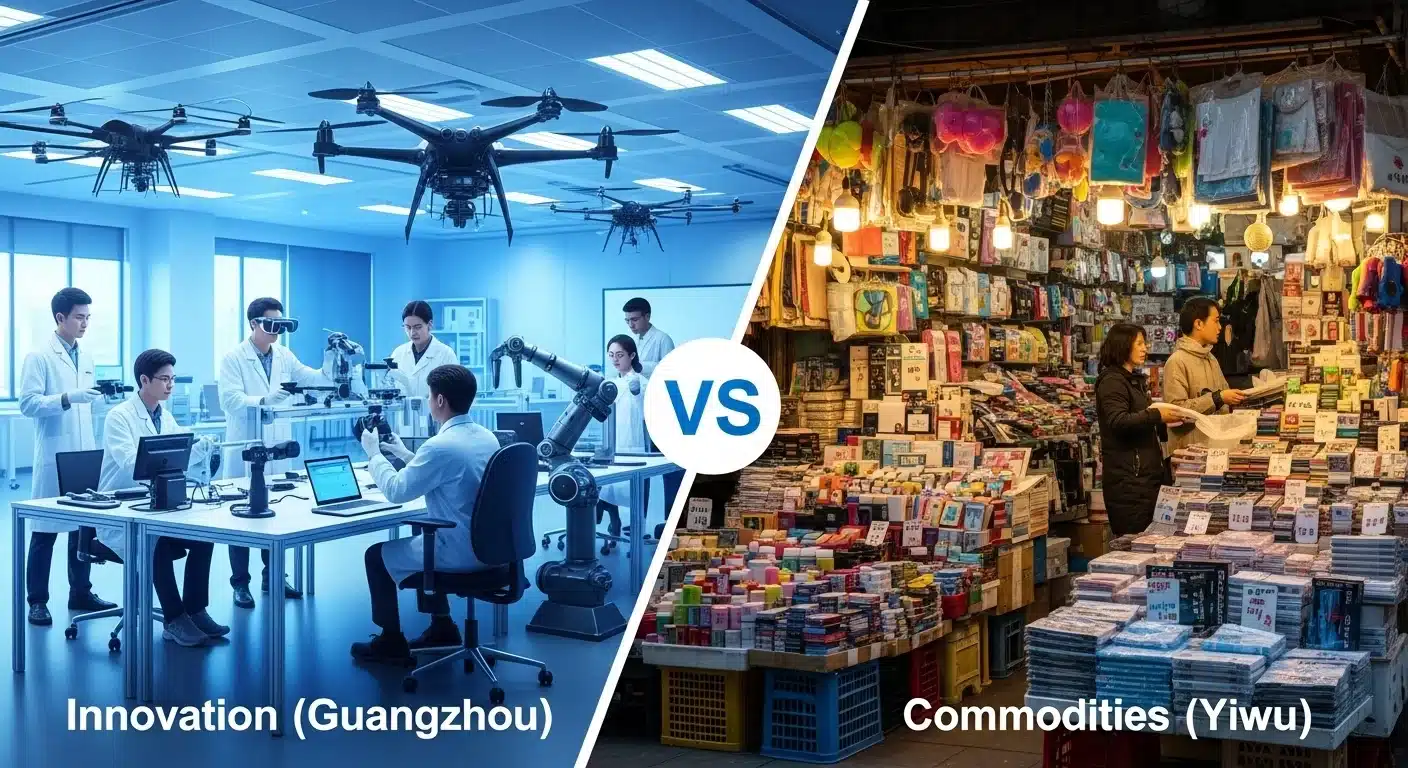
Yiwu is a single, connected wholesale complex built for export buyers: tens of thousands of booths, mostly traders, selling finished small commodities you can buy by the carton. Guangzhou is a sprawling manufacturing region — a collection of specialized wholesale markets and factory clusters (apparel in Shahe/Zhongda, leather in Sanyuanli, electronics in Huaqiangbei nearby Shenzhen) where you deal closer to the factory and at factory scale. One is a supermarket; the other is an industrial city.
Price and MOQ
Yiwu’s low minimums let you test twenty products cheaply, and its per-unit prices are keen for commodity goods. Guangzhou rewards scale: for one product in real volume, buying nearer the factory usually beats a Yiwu trader’s markup — but the minimums are higher and you cannot fill a mixed container as easily. If your order is wide and shallow, Yiwu; if it is narrow and deep, Guangzhou.
Variety and Customization
Yiwu is unbeatable when you want many categories in one trip and one container. But its customization is mostly surface — your logo, your colors, your packaging on an existing product. Guangzhou goes deeper: custom patterns and fabrics in apparel, custom tooling in electronics, real material specification in leather and furniture. Building a differentiated own-brand product often means Guangzhou; filling a varied catalog means Yiwu.
Which Categories Belong Where
| If you source… | Go to |
|---|---|
| Toys, gifts, jewelry, stationery, accessories | Yiwu |
| Apparel and fashion at scale | Guangzhou |
| Leather goods and bags (deep OEM) | Guangzhou |
| Consumer electronics (complex) | Guangzhou/Shenzhen |
| Home goods, decor, kitchenware, mixed catalog | Yiwu |
| Furniture and larger goods | Guangzhou |
Quality, Verification and Logistics
In both cities you verify the same way: approve a sample, lock it, inspect the bulk against it before the balance. Yiwu’s consolidation warehouses make a mixed container easy; Guangzhou’s factory-scale orders often ship as full containers per product. Language and negotiation reward a local agent in both, and for a first order in either hub, in-person or agent verification beats buying from photos.
Which Should You Choose?
| Your situation | Better fit |
|---|---|
| Wide, mixed catalog in one container | Yiwu |
| One product at real manufacturing volume | Guangzhou |
| Deep OEM, custom materials or tooling | Guangzhou |
| Low budget, testing many products | Yiwu |
| Apparel, leather or complex electronics brand | Guangzhou |
The honest answer for a growing brand: use both. Fill the varied catalog and test products in Yiwu, and take your proven hero product to a Guangzhou factory when it is ready to scale with real customization.
A Real-World Sourcing Split
Here is how an experienced brand actually uses both hubs. Say you sell home and lifestyle products with one hero item — a branded kitchen gadget. You go to Yiwu to fill the varied catalog: decor, accessories, gifts and seasonal lines, twenty categories consolidated into one container at low minimums, tested and inspected on the ground. Then you take the hero gadget — the product you want to own and differentiate — to a Guangzhou factory that can tool a custom housing, control the materials, and run it at the volume and price your growth needs.
The result is the best of both: Yiwu’s breadth and low risk for the long tail, Guangzhou’s depth and scale for the product that defines the brand. Splitting the order this way, rather than forcing everything through one hub, is what separates buyers who plateau from those who build a real, differentiated range.
How to Decide in Three Questions
When you are unsure which hub a product belongs to, three questions settle it fast:
- How wide is the order? Many categories in one container → Yiwu. One category at depth → Guangzhou.
- How much customization? Logo and colors on an existing product → Yiwu. Custom materials, patterns or tooling → Guangzhou.
- What is the volume? Small, testing many SKUs → Yiwu. Large, scaling one SKU → Guangzhou.
Answer those honestly per product and the map draws itself — and for most growing brands the answer is not one city but a deliberate split between the two.
Common Mistakes Choosing a Hub
Buyers lose money by forcing the wrong hub. The most common mistake is running a single hero product through Yiwu at a trader’s markup when a Guangzhou factory would give better unit economics and real customization at scale. The mirror mistake is chasing a wide, varied catalog in Guangzhou, where high minimums and scattered factories make a mixed container painful and expensive. A third is assuming one city does everything — it does not, and the buyers who plateau are usually the ones who never split their sourcing.
Avoid all three by deciding per product, not per trip: map each item to the hub that fits its width, customization and volume, and accept that a mature range is almost always sourced across both. The extra coordination is trivial next to the margin and differentiation you gain.
The costliest hub mistake is loyalty to one city. Decide per product — variety and low MOQ to Yiwu, depth and scale to Guangzhou — and let a proven range live in both.
What About Shenzhen and Yiwu’s Other Rivals?
Guangzhou is not Yiwu’s only alternative, and the right rival depends on the product. For complex consumer electronics, Shenzhen — an hour from Guangzhou — has the deepest engineering and component supply chain in the world, and it beats both Yiwu and Guangzhou for anything with a serious circuit board. For toys, Shantou (Chenghai) is the specialist cluster with deeper toy tooling than Yiwu’s trader booths. Yiwu still wins when you want many of these categories at once, in low quantities, in a single container — its edge is breadth and consolidation, not category depth.
So the real map is not two hubs but a network: Yiwu for the varied, low-MOQ catalog; Guangzhou for apparel, leather and furniture at scale; Shenzhen for real electronics; Shantou for deep toy runs. Start in Yiwu to test breadth cheaply, then graduate each proven product to the specialist hub that makes it best.
Conclusion
Yiwu vs Guangzhou is not a duel but a division of labor: Yiwu for variety, low MOQ and one-container consolidation; Guangzhou for category depth, customization and factory-scale pricing. Match the hub to the order — and for most growing brands, use each for what it does best.
Questions fréquemment posées
Is Yiwu or Guangzhou better for sourcing?
Neither is universally better. Yiwu is best for wide, low-MOQ small commodities in one container; Guangzhou is best for deeper single-category manufacturing like apparel, leather and electronics.
Is Guangzhou cheaper than Yiwu?
For one product at factory volume, buying nearer the factory in Guangzhou often beats a Yiwu trader’s markup. For small, mixed orders, Yiwu’s low minimums usually win. It depends on order shape.
Can I source apparel in Yiwu?
Yiwu has basic apparel and accessories, but for fashion at scale, deep customization or quality fabrics, Guangzhou’s apparel clusters go much further.
Should I use both Yiwu and Guangzhou?
Often yes. Many brands fill a varied catalog and test products in Yiwu, then take a proven hero product to a Guangzhou factory for scale and customization.
About the author: Written by the ChineseYiwu Sourcing Team — based inside the Yiwu International Trade City since 2005, with 50+ sourcing specialists and QC inspectors serving importers in 100+ countries.
Related reading: our Yiwu vs Alibaba comparison, the full Yiwu product categories guide, and background on Guangzhou as a manufacturing hub.