Justin
Yiwu vs 1688 is the choice that trips up almost every new China buyer. Both reach the same factories, but they are built for different people: 1688 is a Chinese-language online marketplace for the domestic market, while Yiwu is a physical wholesale market built for export buyers. Pick the wrong one and you either drown in a Mandarin-only checkout or pay tourist prices on the market floor.
Key Takeaways
- 1688 is an online, Chinese-language domestic platform; Yiwu is a physical export market.
- 1688 often shows lower listed prices; Yiwu adds in-person verification and easy mixed orders.
- 1688 needs a Chinese payment method and usually an agent; Yiwu needs a trip or an agent.
- Yiwu wins for mixed-category container loads; 1688 wins for one known product at scale.
- Most experienced buyers use both — scout on 1688, buy and verify in Yiwu.

For the full buying process either way, see our complete Yiwu sourcing guide.
Yiwu vs 1688: The Quick Verdict
| Factor | Marché de Yiwu | 1688 |
|---|---|---|
| Format | Physical market, in person or via agent | Online marketplace, Chinese language |
| Listed price | Slightly higher | Often lowest |
| Verification | See and handle goods on the spot | Photos only; verify remotely |
| Mixed orders | Easy — many booths, one container | Harder — multiple sellers, separate shipping |
| Payment | Cash/agent on the ground | Chinese payment method or agent |
| Best for | Mixed-category container loads | One known product at volume |
What Each One Actually Is
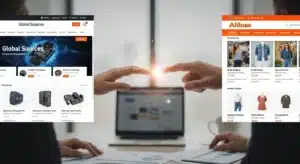
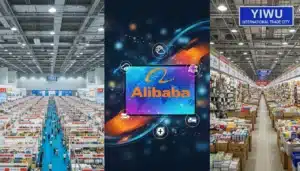
1688.com is Alibaba’s domestic wholesale platform, aimed at Chinese buyers — Chinese-language listings, domestic payment, and prices that have not been marked up for export. Yiwu is the physical Yiwu International Trade City: tens of thousands of booths you walk (or an agent walks for you), built from the ground up for international buyers and consolidated export shipping.
Prix
On paper 1688 wins price. In practice the gap narrows once you add the agent commission, the cost of moving goods from a domestic seller to an export warehouse, and the risk premium of buying from photos. Yiwu’s price is slightly higher but includes the ability to inspect before you commit.
MOQ and Variety
If your catalog is wide, Yiwu’s one-roof variety and easy consolidation is hard to beat. If you want one specific product at high volume, 1688 can surface a deeper bench of factories for that single item.
Quality and Verification
This is Yiwu’s biggest edge. On 1688 you verify remotely and hope the bulk matches the photos; in Yiwu you (or your agent) hold the sample, check the build, and lock it before production. For regulated goods, that difference is the whole ballgame.
Payment, Language and Logistics
1688 is Chinese-language and expects a domestic payment method, so most foreign buyers need an agent to transact at all. Yiwu is export-oriented with multilingual support, but the scale still rewards an agent or interpreter on the ground.
Which Should You Choose?
| Your situation | Better fit |
|---|---|
| Wide, mixed-category catalog in one container | Yiwu |
| One specific product at high volume | 1688 |
| First order, want to verify before paying | Yiwu |
| Tight budget, comfortable using an agent remotely | 1688 |
| Need export logistics handled end to end | Yiwu |
The honest answer for most importers: use both. Scout and price on 1688, then buy and verify in Yiwu — or hand both to one agent who can pull from either source.
Lead Time and Customization
Stock orders ship in days from either channel. For customization the choice flips on how hands-on you need to be: in Yiwu you brief the supplier in person and check the first sample on the spot, which catches misunderstandings before a production run; on 1688 you can reach factories with broad customization options, but every revision happens at a distance through your agent. For a complex custom product on a first run, the in-person loop usually saves a costly round of remakes and weeks of back-and-forth.
Risk and Trust
Both channels have honest and dishonest sellers — the difference is how you verify. Yiwu lets you or your agent stand in the booth, photograph the business license, and handle the product before any money moves. On 1688 you lean on transaction history and store ratings, which help but are harder for a foreign buyer to read confidently. For a first, unproven relationship, the in-person check is the stronger guardrail, which is why many buyers run their first order through Yiwu and move repeat orders online once the supplier is proven.
A Typical Real-World Workflow
Here is how experienced buyers actually combine the two. They scout on 1688 to learn the floor price and shortlist products, then send those references to a Yiwu agent who finds the same or better items in the market, negotiates in person, pulls samples, and inspects the bulk before the balance is paid. The goods from several booths land in one warehouse and ship as a single consolidated container. The result is 1688-level pricing intelligence with Yiwu-level verification and one clean shipment — the best of both, instead of betting the order on either one alone.
When 1688 Is the Clear Winner
Choose 1688 when you already know the exact product and want the deepest possible price discovery on that one item. Because it is the domestic platform Chinese resellers themselves use, 1688 surfaces a long tail of factories competing on the same SKU, and the listed prices have not been padded for export. If you are reordering a proven product, scaling a single hero item, and you have an agent who can pay domestically and handle the language, 1688 will usually shave the unit price. It is also the better place to research what a fair factory price even is before you negotiate anywhere else.
When Yiwu Is the Clear Winner
Choose Yiwu when variety, speed and verification matter more than squeezing the last cent off one item. A buyer building a mixed catalog — a gift shop, an Amazon variety seller, an event supplier — can price and sample dozens of categories in two days and ship them as one container. Yiwu is also the safer first move into a new product, because handling the goods and meeting the supplier in person removes most of the guesswork that sinks remote first orders. For anyone who values a single, inspected, export-ready shipment over a pile of separate domestic parcels, Yiwu wins outright.
Customer Service and Returns
Neither channel offers Western-style returns, so plan for that up front. On both, your real protection is the unpaid 70% balance and a pre-shipment inspection — not a refund policy after the goods arrive. Yiwu’s in-person relationship tends to make post-sale issues easier to resolve, because the supplier knows you (or your agent) can walk back into the booth. On 1688, recourse runs through the platform and your agent, which works but is slower across a language gap. Either way, fix problems before the balance is paid, because chasing money back after shipment rarely ends well.
Related reading: our Yiwu vs Alibaba comparison and what a Yiwu sourcing agent actually does.
Conclusion
Yiwu vs 1688 is not really a duel — it is two tools for two jobs. 1688 wins on listed price and single-product depth; Yiwu wins on variety, in-person verification, and export-ready consolidation. Match the tool to the order and you get the best of both.
Questions fréquemment posées
Is 1688 cheaper than Yiwu?
Listed prices on 1688 are often lower because they skip the export markup, but once you add agent fees, domestic-to-export logistics and remote-verification risk, the real gap narrows. Yiwu’s price includes in-person inspection.
Can foreigners buy on 1688?
Not easily alone — 1688 is Chinese-language and expects a domestic payment method, so most foreign buyers use a sourcing agent to transact and consolidate.
Which is better for mixed orders, Yiwu or 1688?
Yiwu. You can fill one container from many booths in a single trip, while 1688 means coordinating several separate domestic sellers and shipments.
Should I use both Yiwu and 1688?
Often yes. Many buyers scout and price on 1688, then buy and verify in Yiwu, or hand both channels to one agent.
About the author: Written by the ChineseYiwu Sourcing Team — based inside the Yiwu International Trade City since 2005, with 50+ sourcing specialists and QC inspectors serving importers in 100+ countries.