Justin
Almost every “wholesale” party-supply site that ranks on Google is a US warehouse reselling a container it bought from China. The balloons, the printed plates, the birthday banners and the party favors were made in a cluster of factories around one Chinese city — Yiwu — and by the time they reach a domestic distributor’s shelf they carry two layers of markup you are paying for. This guide is about buying the tier below that: sourcing balloons, tableware and decorations direct from Chinese factories and the Yiwu party-goods market, what it actually costs once 2026 duty and product-safety rules are counted, and the one tariff trap on paper plates that can turn a cheap order into a five-figure customs bill.
Key Takeaways
- The US “wholesaler” is usually a reseller. Party goods concentrate in Yiwu, where the party zone of District 1 holds an estimated 200-plus suppliers, most carrying 1,000+ SKUs. Buying direct removes the importer’s and the distributor’s margins.
- Most party décor is duty-free — but not all of it. Festive articles, party favors, streamers and confetti enter the US at a Free base rate (HTS 9505.90.40 / .60); plastic tableware is 3.4% (3924.10.40). The Section 301 China surcharge then varies by tranche — 7.5% on festive articles (List 4A), but 25% on plastic tableware (List 3).
- Flat paper plates from China carry a 515.40% antidumping duty. A March 2025 Commerce order slapped a China-wide antidumping rate of 515.40% on certain paper plates. Molded-pulp plates and paper bowls are outside the scope — knowing the difference is the whole margin.
- Balloons are a regulated children’s product. Every latex balloon sold in the US needs a specific federally-mandated choking-hazard warning; party favors for kids fall under CPSIA lead, phthalate and testing rules. This compliance work is exactly what the distributor used to absorb.
- Direct sourcing pays off by the carton, not the piece. You trade a 30–50 day lead time and the compliance paperwork for the 40–120% spread a domestic wholesaler keeps. Below a pallet or two, a US distributor is often still the smarter buy.
Where wholesale party supplies actually come from
Search wholesale party supplies and the entire first page is US-based sellers — Oriental Trading, Factory Direct Party, bulk-party e-tailers and paper-goods houses. They run real businesses, but the model is the same one every time: import full containers from Chinese factories, warehouse them, and resell to you at a markup that has to cover American rent, staff and risk. On standard (non-licensed, non-custom) party goods that markup typically runs 40–120% over the landed China price. If you are ordering by the carton for a store, an event business or an e-commerce brand, that spread is the difference between a healthy margin and a thin one.
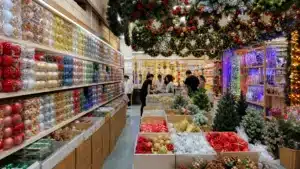
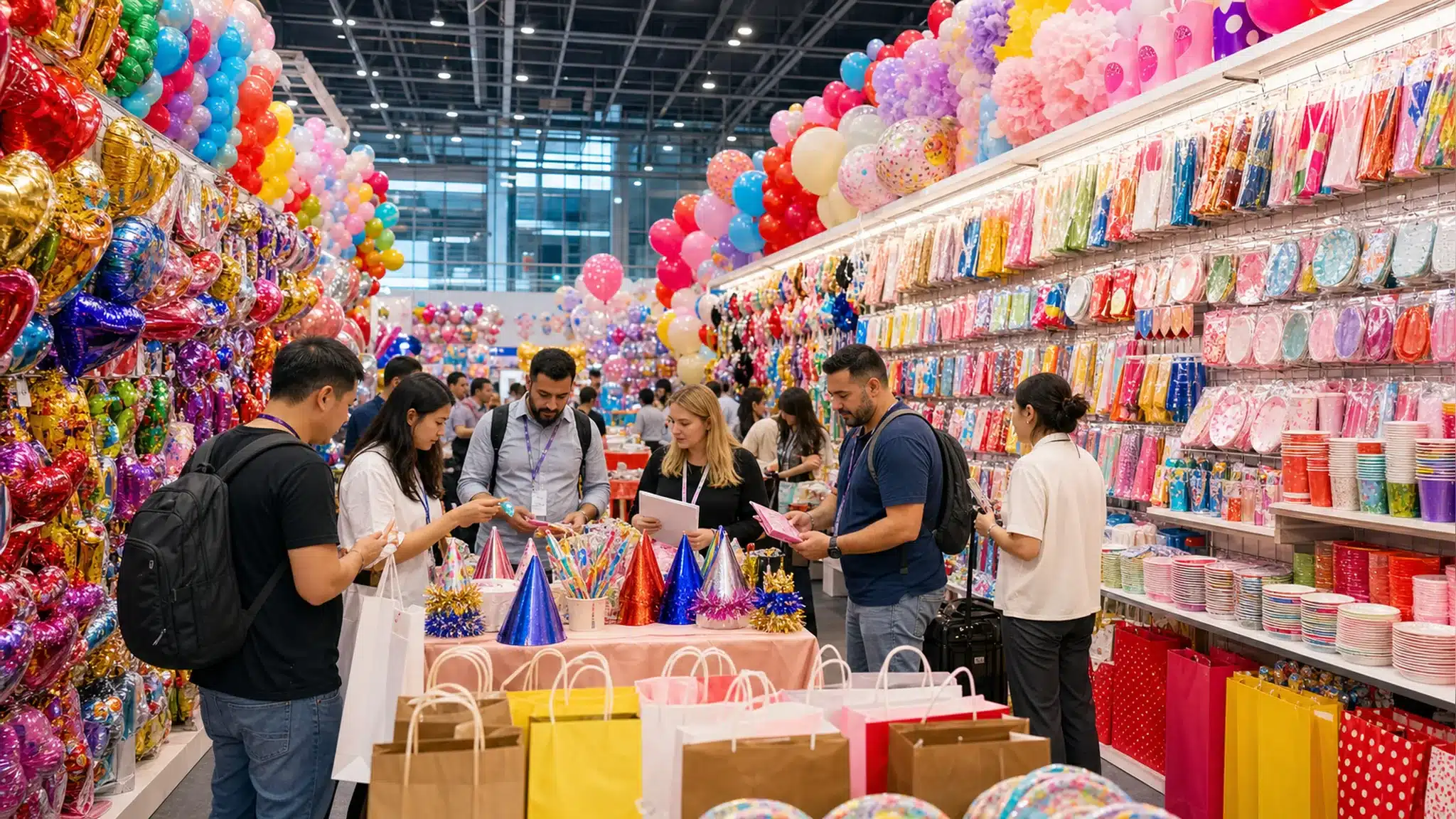
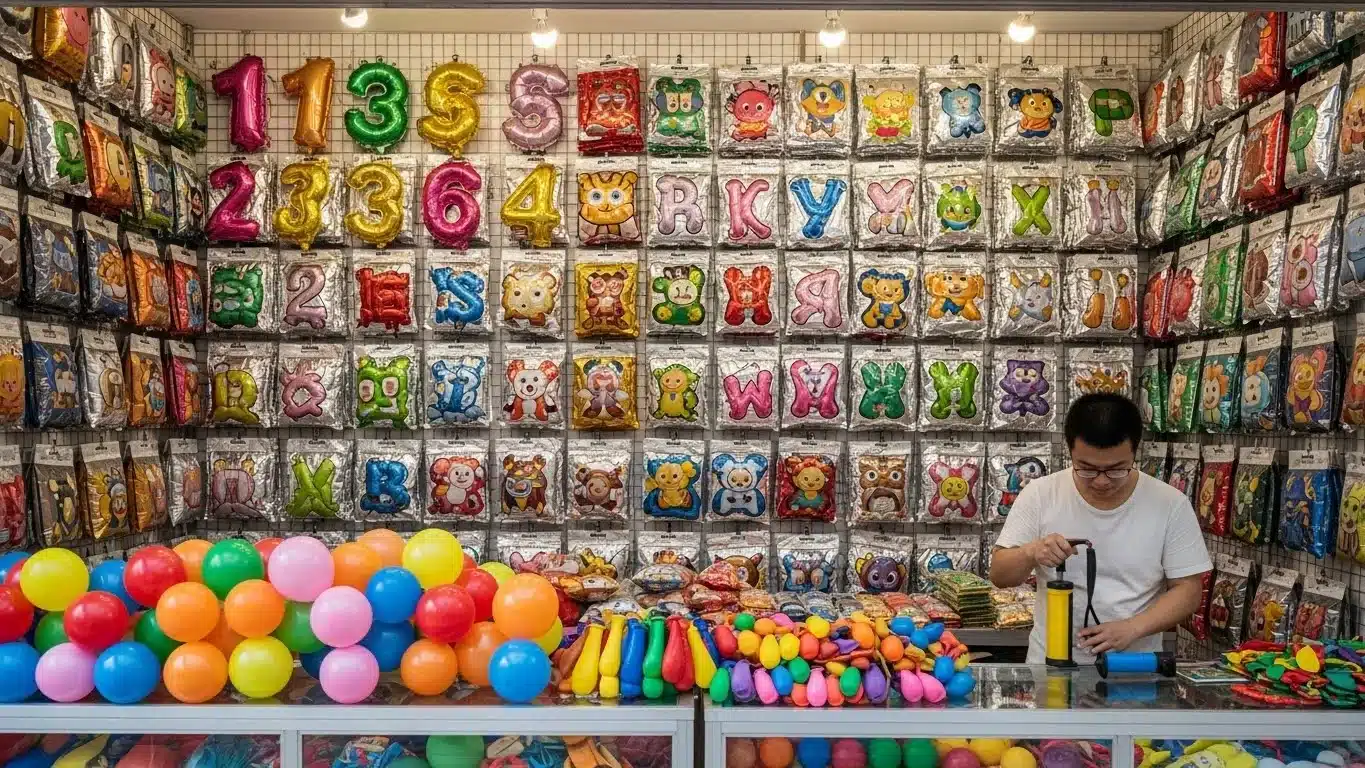
The concentration exists because the manufacturing does. The bulk of the world’s everyday party goods flows through Yiwu in Zhejiang province, home to Yiwu International Trade City — the largest small-commodity market on earth. An entire zone is given over to party and festive products: balloons of every fill and print, paper and plastic tableware, banners, backdrops, candles, piñatas, themed birthday sets and party favors. Booths here are the layer your domestic wholesaler buys from, which is why sourcing directly — or through an agent standing in the market — removes two margins from your cost base at once. For the wider picture of how these markets are organised, our guide to the China wholesale market maps the major product cities; to walk the party zone specifically, see how to navigate the Yiwu market districts.
Direct is not automatically the right move, and this guide is honest about that below. But the trade is simple: you take on a longer lead time and the safety-compliance work the distributor used to handle, and in exchange you capture the margin they were keeping. If your buyer is an event planner rather than a reseller, the calculus differs — our wedding & party supplies planner’s guide covers that angle.
The categories: MOQs, price bands and what changes per product
“Party supplies” is not one product with one supplier — it is five or six distinct manufacturing categories, each with its own factories, minimum order quantities (MOQ), material issues and compliance profile. A booth that is excellent at latex balloons is often mediocre at printed tableware, and the factory that presses foil balloons rarely also does injection-moulded cutlery. Treating them as one line item is how buyers end up split across the wrong suppliers. The table below is a planning reference; the FOB bands are market estimates for standard goods and move with materials, order size and print complexity — treat them as directional, not a quote.
| Categoria | Typical MOQ (per design) | Est. FOB price band | US HTS heading |
|---|---|---|---|
| Latex & foil balloons | 1,000–5,000 pcs | $0.01–$0.15 / pc | 9505.90.60 |
| Plastic tableware (plates, cups, cutlery) | 2,000–10,000 pcs | $0.02–$0.20 / pc | 3924.10.40 |
| Paper tableware & napkins | 3,000–10,000 pcs | $0.03–$0.30 / pc | 4823.69 (AD trap) |
| Banners, backdrops & decorations | 500–2,000 sets | $0.20–$3.00 / set | 9505.90.60 |
| Party favors, confetti & noisemakers | 1,000–5,000 pcs | $0.05–$1.50 / pc | 9505.90.40 |
| Themed sets (birthday, unicorn, baby shower) | 300–1,000 sets | $0.80–$5 / set | 9505.90.60 |
Two practical points hide in that table. First, MOQs are per design and print, not per category: a 5,000-piece balloon minimum spread across five colours is really 1,000 of each, which is why buyers consolidate artwork and colourways to hit minimums without dead stock. Second, the HTS classification is not cosmetic — it is the difference between a duty-free festive article and a plastic-tableware line that pays 3.4%, and, for paper plates, the difference between a normal import and a punitive antidumping rate. That last one is important enough that it gets its own section below.
The safety-compliance moat: balloons, tableware and children’s favors
This is the part a domestic distributor quietly handled for you, and the reason a cheap FOB price is not the same as a cheap landed product. Party supplies straddle three regulated categories at once — children’s products, food-contact articles and general consumer goods — so the paperwork is real. Get it wrong and the penalty is not a fine down the road; it is a container held at the port.
Balloons carry a mandatory federal warning. Under the Federal Hazardous Substances Act (15 U.S.C. 1278) and its labeling rule at 16 CFR 1500.19, every latex balloon — and any toy or game containing one — must carry a specific choking-hazard cautionary statement. The required text is not paraphrasable; it reads: “WARNING: CHOKING HAZARD — Children under 8 yrs. can choke or suffocate on uninflated or broken balloons. Adult supervision required. Keep uninflated balloons from children. Discard broken balloons at once.” Uninflated and broken latex balloons are a leading cause of child choking deaths, which is why the CPSC enforces the wording, placement and prominence closely. Foil/mylar balloons are not covered by this specific rule. Build the warning into your artwork and packaging before the print run — retrofitting labels on a landed container is expensive.
Party favors for kids are children’s products under CPSIA. If a favor is designed or intended for children 12 and under, it must meet the Consumer Product Safety Improvement Act limits: no more than 100 ppm total lead in the substrate (90 ppm in surface coatings and paint) and no more than 0.1% each of the restricted phthalates (DEHP, DBP, BBP, DINP, DIDP, DNOP) in items a child could mouth. It also needs a Children’s Product Certificate backed by a test report from a CPSC-accredited (ISO 17025) third-party lab, plus a tracking label identifying the manufacturer, production date/location and batch. The same standards that govern Yiwu OEM toy manufacturing (ASTM F963 / EN 71) apply to small toy-like favors, so a supplier that already builds toys is a safer bet for that line.
Tableware that touches food is food-contact regulated. Party plates, cups and cutlery must meet FDA food-contact requirements (21 CFR) for the specific polymer or paper used — a booth’s “food grade” claim means nothing without a migration/heavy-metal test report. This is the same discipline covered in our food-contact kitchenware sourcing guide, and it is worth insisting on before you print 10,000 plates. California’s Proposition 65 warnings may also apply to certain plastics and inks.
Selling into the EU or UK changes the rules again. There, latex balloons are legally toys under the Toy Safety Directive (2009/48/EC), so they require CE marking and must pass EN 71 — including EN 71-12, which limits N-nitrosamines and N-nitrosatable substances in balloons intended for children under 36 months or likely to be mouthed. Food-contact tableware falls under Regulation (EC) 1935/2004. If your channel is transatlantic, specify both US and EU compliance up front so the factory tools and tests once, not twice.

2026 duty math — and the paper-plate tariff trap
The good news for party buyers is that most of the category is duty-friendly. Festive and entertainment articles — balloons, banners, decorations, themed sets — classify under HTS 9505.90.60 at a Free base rate, and party favors, confetti, streamers and noisemakers under 9505.90.40, also Free. Plastic tableware (3924.10.40) carries a modest 3.4% base duty. On top of the base rate, each China-origin line takes a Section 301 surcharge whose rate depends on which tranche the code sits in: festive articles under 9505.90 fall on List 4A at 7.5%, while plastic household tableware under chapter 39 (3924) sits on the earlier List 3 at 25% — so the same “party order” can carry two different China surcharges. Section 301 itself — unlike the IEEPA “reciprocal” tariffs the Supreme Court struck down in February 2026 — remains in full force as of this writing because it rests on separate authority (the Trade Act of 1974). A temporary 10% Section 122 surcharge that had stacked on imports since February lapsed by operation of law on 24 July 2026, so as of this writing it no longer applies; tariff policy has moved repeatedly this year, so confirm the live rate with your customs broker before you cost an order.
Then there is the paper-plate trap. On 20 March 2025 the US Commerce Department issued antidumping and countervailing duty orders on certain paper plates from China, and the antidumping cash-deposit rate for the China-wide entity is 515.40%. That is not a typo — a flat paper plate sourced from a Chinese factory without its own separate rate can face more than five times its value in duty, which instantly destroys the economics of importing paper party plates from China. Critically, the order’s scope covers flat paper plates only; paper bowls, paper buckets and molded- or pressed-pulp plates are excluded. In July 2026 Commerce also preliminarily found that paper plates finished in Cambodia from Chinese paperboard were circumventing the order, so switching origin is not a clean escape. The practical takeaways: source flat paper plates from an origin the order does not cover, switch to molded-pulp/bagasse plates or paper bowls (outside scope), or use plastic tableware — and always verify the current scope and your supplier’s rate with a broker.
Here is what the numbers look like on a representative mixed order, using estimated FOB values to show the mechanics (your quote will differ):
| Line item (est.) | FOB value | Base HTS duty | + Section 301 China surcharge |
|---|---|---|---|
| 50,000 latex balloons @ $0.02 (9505.90.60) | $1,000 | $0 (Free) | List 4A 7.5% → $75 |
| 20,000 plastic cups @ $0.05 (3924.10.40) | $1,000 | $34 (3.4%) | List 3 25% → $250 |
| 2,000 themed sets @ $1.00 (9505.90.60) | $2,000 | $0 (Free) | List 4A 7.5% → $150 |
| 10,000 flat paper plates @ $0.05 (4823.69) | $500 | $0 base | + up to $2,577 AD (515.40%) |
Read the last row twice. On the festive-article lines duty is a rounding error; the plastic cups take a real 25% Section 301 hit, but direct sourcing still wins comfortably against a 40–120% distributor markup. On the fourth line, though, a $500 order of flat paper plates can attract roughly $2,577 in antidumping duty — swap them for molded-pulp plates, paper bowls or plastic tableware and the same order is clean. This single classification decision is worth more than any price negotiation on the rest of the container, and it is exactly the kind of thing an experienced sourcing partner flags before you place the order. To pressure-test any supplier before you wire a deposit, our guide on finding reliable Yiwu suppliers covers the vetting steps.
What we check before a party-goods order ships
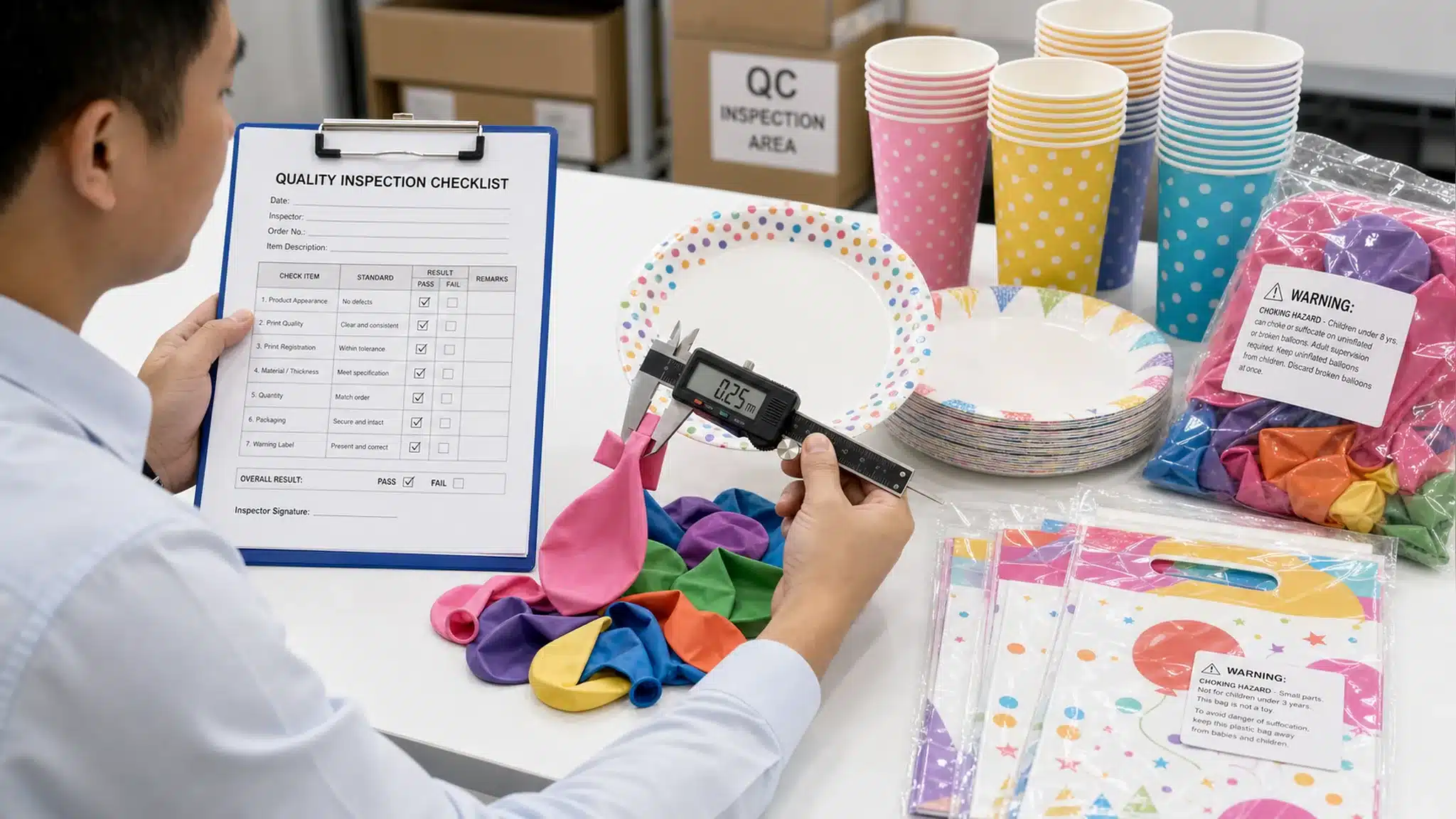
Party supplies are cheap per piece, which tempts buyers to skip inspection — a false economy, because the failures are the kind that get a product pulled from a shelf or an Amazon listing suppressed. When we run a pre-shipment check on a party order, the list is specific to the category:
- Balloons: wall-thickness and burst consistency across the batch (thin walls pop on inflation), colour and print registration, and — non-negotiable — the presence and exact wording of the choking-hazard warning on the packaging.
- Printed tableware: print alignment and colour match to the approved sample, food-contact test documentation for the actual polymer or paper used, and edge/lamination quality on plates and cups.
- Party favors & small toys: the third-party lab report for lead and phthalates, small-parts and choking-hazard labeling for the intended age, and a tracking label on the retail unit.
- Packaging & counts: retail-unit artwork and barcodes, carton counts and gross weights against the packing list, and drop-test integrity for the ocean leg.
The reason this matters more for party goods than for, say, hardware is that a single mislabeled children’s item can trigger a recall obligation, and a non-food-grade plate is a liability the moment it touches a customer’s cake. Catching it at the factory costs an inspection; catching it after landing costs the container. If you would rather not manage that yourself, our product sourcing service handles supplier selection, sample approval, compliance documentation and pre-shipment inspection end to end — the work the domestic distributor used to bundle into their markup.
MOQ, lead times and seasonality
Because unit costs are so low, party-supply MOQs are set by production economics rather than by value — a factory will not warm up a balloon line or a print run for a few hundred pieces. Expect roughly 1,000–5,000 pieces per balloon colour/print, 2,000–10,000 per tableware SKU, and a few hundred to a thousand per themed set. Stock (non-custom) goods can often be bought in smaller mixed cartons straight off a Yiwu booth, which is why the market is ideal for testing an assortment before committing to a factory run. Custom-printed goods — your logo on cups, a bespoke banner, a licensed theme — reset the MOQ upward and add a plate/tooling charge; a Yiwu sourcing agent can consolidate several booths into one shipment so you hit each MOQ without over-ordering any single line.
On timing, standard goods run about 15–30 days in production and custom-printed goods 30–50 days, plus roughly 30–40 days of ocean transit to the US or Europe. Party supplies are less seasonal than Christmas décor, but demand still spikes around graduation, Halloween, the December holidays and the Western wedding season — and two annual factory shutdowns dominate the calendar: the Golden Week closure in early October and, more disruptively, the two-to-three-week Chinese New Year shutdown (late January or February), when factories stop and lead times balloon. If you need stock for a dated event, count backward from the event, add a buffer for the nearest holiday shutdown, and place the order early. For seasonal party décor specifically, our wholesale Christmas decorations guide works through the same timeline in detail.
Who should buy direct — and who shouldn’t
Direct sourcing is the right call if you are a party store, an event-supply business, a themed-box subscription, or an e-commerce/TikTok Shop seller moving party goods by the carton or pallet; if you want custom print, private-label packaging or a themed assortment a distributor doesn’t stock; or if your volume is high enough that the 40–120% distributor markup is real money. In those cases the compliance work and the longer lead time are a fair price for owning the margin.
It is probably not worth it if you need a few dozen units for a single event, you cannot wait 6–10 weeks, or you are not set up to hold the importer-of-record compliance duties (the warning labels, the CPC, the food-contact testing). Below a pallet, a US distributor’s markup often costs less than the freight, duty, MOQ overage and paperwork of a direct import — and there is no shame in buying domestically until your volume grows into direct sourcing. If you are still deciding between platforms and channels, our comparison of buying via Made-in-China versus Alibaba lays out the online options.
Sourcing party supplies from China by the carton?
If you are ordering balloons, tableware, favors or themed sets in volume and want the compliance and paper-plate-tariff traps handled before you wire a deposit, we can help. Our team sits in the Yiwu market, consolidates suppliers, verifies safety documentation and inspects before shipment — so you capture the distributor’s margin without inheriting their risk.
Frequently asked questions
Is it cheaper to buy wholesale party supplies from China or a US distributor?
By the carton or pallet, direct from China is usually 40–120% cheaper on the goods, because you skip the domestic distributor’s markup. But you take on freight, duty, higher MOQs and the compliance paperwork. For small quantities — a few dozen units for one event — a US distributor is often cheaper once those costs are counted. The break-even is typically around a pallet of a given SKU.
What is the minimum order for party supplies from Yiwu?
Factory MOQs run roughly 1,000–5,000 pieces per balloon print/colour, 2,000–10,000 per tableware SKU, and a few hundred per themed set. Stock goods can be bought in much smaller mixed cartons directly off a Yiwu booth, which is why the market suits buyers testing an assortment before committing to a custom run.
Do imported balloons need a warning label?
Yes. US federal law (16 CFR 1500.19, under 15 U.S.C. 1278) requires every latex balloon and any product containing one to carry a specific choking-hazard warning stating that children under 8 can choke or suffocate on uninflated or broken balloons, with adult supervision required. Build the exact wording into your packaging artwork before the print run. Foil balloons are not covered by that particular rule.
Why are paper party plates from China so expensive to import?
A March 2025 US antidumping order set a China-wide rate of 515.40% on certain flat paper plates, so importing them from China can cost several times the goods’ value in duty. Paper bowls, paper buckets and molded-pulp plates are outside the order’s scope, and plastic tableware is unaffected — so most buyers simply avoid flat paper plates from China and substitute one of those alternatives.
What tariffs apply to party supplies from China in 2026?
Most festive articles (HTS 9505.90) enter duty-free at the base rate; plastic tableware (3924.10.40) is 3.4%. The Section 301 China surcharge then applies by tranche: 7.5% on festive articles (List 4A) and 25% on plastic tableware (List 3). Section 301 survived the February 2026 Supreme Court IEEPA ruling; a temporary 10% Section 122 surcharge lapsed on 24 July 2026. Rates have shifted repeatedly this year, so confirm live figures with a customs broker. Note separately that flat paper plates from China carry a 515.40% antidumping duty.
Are party favors subject to children’s product safety rules?
If a favor is designed or intended for children 12 and under, yes — it must meet CPSIA lead (≤100 ppm) and phthalate (≤0.1%) limits, carry a Children’s Product Certificate backed by a CPSC-accredited third-party lab test, and bear a tracking label. Small toy-like favors also need small-parts and choking-hazard labeling appropriate to the age grade.