Justin
Search candle supplier wholesale and almost every result on page one is selling you something you may not want: raw candle-making supplies — wax pellets, wicks, fragrance oils and empty jars — so you can pour candles yourself. That is a real business, but it is not the same as buying finished candles at wholesale and putting your own brand on them. This guide is for the second buyer: the shop owner, e-commerce seller or gifting brand who wants pallets of ready-to-sell scented candles, ideally private-labelled, sourced direct from Chinese factories instead of through a domestic distributor charging a 50–150% markup. The catch nobody on page one mentions is that one wrong word on your purchase order — “paraffin” — can add a 108.30% import duty in the United States. Get the wax right and China is the cheapest reliable candle source on earth. Get it wrong and you have imported a loss.
Key Takeaways
- “Candle supplier” splits two ways. The wholesalers ranking for this term mostly sell candle-making materials. To buy finished/private-label candles by the pallet, you are sourcing from manufacturers — a different supply chain, covered here.
- The wax you choose sets your US duty. The US antidumping order on petroleum wax candles from China (order A-570-504, in force since 1986) carries a China-wide cash-deposit rate of 108.30%. It covers any candle with any petroleum/paraffin wax. 100% soy, coconut, palm or beeswax candles are outside the order. Spec vegetable wax and you sidestep it entirely.
- Base duty is otherwise tiny. Candles enter the US under HTS 3406.00.0000 at a Free base rate, plus the Section 301 List 4A surcharge of 7.5% for China origin. A compliant soy candle lands at roughly base + 7.5% — not 100%+.
- Europe just changed the math. The EU imposed definitive antidumping duties of 56.7%–60.3% on candles from China (CN 3406 00 00), effective 27 January 2026 for five years. UK importers are outside the EU measure. EU buyers must recost now.
- Compliance clears customs, not marketing. US candles need lead-free wicks (16 CFR 1500.17), ASTM F2417 fire-safety construction, ASTM F2058 warning labels, and an importer’s General Certificate of Compliance. Skip these and the risk is detention, not just a fine.
“Candle supplier wholesale” means two different businesses
Before you send a single inquiry, decide which supply chain you are actually in. The confusion is baked into the search term, and picking the wrong one wastes weeks.
The first type — the one that dominates Google for this keyword — is the candle-making supply house: companies like Lone Star, CandleScience, Candlewic and Fillmore Container. They sell you soy and paraffin wax by the case, cotton and wooden wicks, fragrance oils, dye chips and empty vessels. You pour, cure, label and ship yourself. This suits a hobbyist or a small studio brand that wants full creative control and can tolerate hand-pour economics.
The second type — the subject of this guide — is the finished-candle manufacturer. You send a design or pick from a catalogue, and the factory delivers thousands of finished, boxed, labelled candles ready for a shelf or a fulfilment centre. This is how every mid-market candle brand you have seen in a boutique actually operates. China is the dominant source here because the whole ecosystem — glass jars, tin cups, gift boxes, wax, fragrance compounding, printing — sits within a few hours of the same factories. Buying finished candles from a Chinese manufacturer through a sourcing agent typically undercuts a US distributor’s price by a wide margin precisely because you are buying at the layer that distributor buys from.
The 108.30% question: the wax spec decides your whole margin
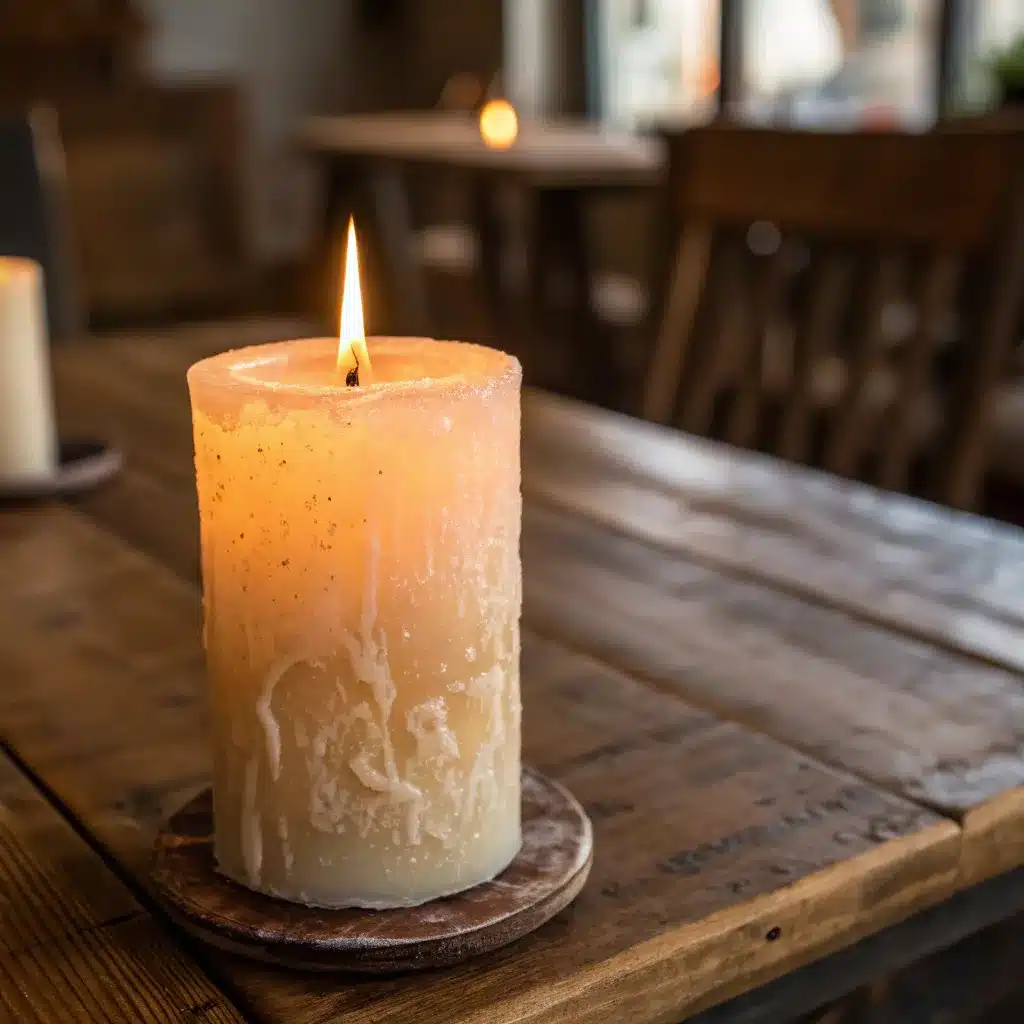
This is the single most important sentence in the article, so read it twice: the United States has maintained an antidumping duty order on petroleum wax candles from China since 1986. Commerce and the ITC reviewed it again and continued the order in October 2021 for another five years. The China-wide cash-deposit rate is 108.30% of entered value — the duty began at 54.21% in 1986 and was raised to 108.30% after later reviews found continued dumping. That is not a typo. A container of paraffin candles that costs you $20,000 FOB can owe roughly $21,660 in antidumping duty alone at entry.
What saves you is that the order is scoped to petroleum wax. Under Commerce’s scope and anticircumvention rulings, a candle is covered if it contains any amount of petroleum wax — but candles made entirely from vegetable wax (soy, palm, coconut) or more than 50% beeswax are not subject to the order. The lesson for a buyer is blunt: specify the wax on your purchase order and your commercial invoice, and make it a non-petroleum wax. This is also why “soy candle” is not just a marketing label in the US market — it is a customs classification with a six-figure swing behind it.
| Wax type | US antidumping order (A-570-504) | Practical takeaway |
|---|---|---|
| 100% soy | Not subject | The default safe choice; most popular US retail wax |
| 100% coconut / coconut-soy | Not subject (no petroleum) | Premium “clean” positioning; confirm blend has zero paraffin |
| Palm / other vegetable | Not subject | Fine on duty; watch sustainability optics |
| Beeswax >50% | Not subject | Expensive; niche natural market |
| Paraffin (petroleum) | Subject — 108.30% | Commercially unviable to import from China |
| Soy/paraffin blend | Subject — any petroleum triggers it | The hidden trap: “mostly soy” is still 108.30% |
Duty scope per US Department of Commerce order A-570-504 and its anticircumvention determinations. Always confirm the current classification of your specific product with a licensed customs broker before you order.
The 2026 candle duty map: US, EU and UK
Where you sell changes the sums as much as what you buy. Three markets, three very different pictures in 2026.
United States. Candles fall under HTS heading 3406.00.0000, “Candles, tapers and the like,” at a Free base rate. China-origin goods then take the Section 301 List 4A surcharge of 7.5%. So a compliant vegetable-wax candle lands at roughly 0% + 7.5% — plus the 108.30% antidumping duty only if it contains petroleum wax. Tariff policy has shifted repeatedly; confirm live rates with your broker.
European Union. This is the big 2026 change. Following a complaint from the European candle industry, the Commission imposed definitive antidumping duties of 56.7%–60.3% on candles from China (CN 3406 00 00), effective from 27 January 2026 and lasting five years. Provisional duties in August 2025 had ranged from 10.6% to 70.9% by exporter. If you sell into the EU, the direct-from-China cost advantage on candles has narrowed sharply — recost every SKU and check the exact product scope in the implementing regulation.
United Kingdom. Post-Brexit, the UK is a separate customs territory and is not covered by the EU’s candle measure. UK importers currently face neither the US antidumping order nor the EU duty — a genuine, if possibly temporary, sourcing advantage worth acting on.
| Market | Base duty | China-specific extra | Net on a soy candle |
|---|---|---|---|
| USA | Free (HTS 3406) | Section 301: +7.5% | ~7.5% (paraffin: +108.30%) |
| EU | Low MFN on 3406 | Antidumping: 56.7%–60.3% | ~56.7%–60.3% (from Jan 2026) |
| UK | Low MFN on 3406 | None specific to candles | Base only |
Worked example: landing a soy jar candle in the US
Say you buy 5,000 units of an 8 oz soy jar candle at an estimated $2.10 FOB each (a realistic mid-spec figure — treat it as an illustrative estimate, not a quote). Here is the honest landed-cost stack, and the difference the wax makes:
- Goods (FOB Ningbo): 5,000 × $2.10 = $10,500
- Base HTS duty (3406, Free): $0
- Section 301 (7.5% of goods): ~$788
- Ocean freight + insurance (LCL/part-container, estimate): ~$1,400
- Landed cost: ≈ $12,688, or about $2.54 per candle before your warehouse and marketing
Now swap the wax to paraffin. The 108.30% antidumping duty adds roughly $11,370 on the same $10,500 of goods, pushing landed cost to about $4.81 per candle — nearly double, and above what many US wholesalers would sell a finished paraffin candle for. That one line on the spec sheet is the whole ballgame. For the full method, see our landed-cost formula for import decisions, and lock your price basis with the right Incoterm (EXW vs FOB vs DDP) before you commit.
US safety and labeling: the compliance that clears customs
Candles are a consumer product the CPSC actively regulates, and the requirements are the kind that get a shipment detained rather than merely fined. Build them into the factory brief, not the post-arrival scramble.
- Lead-free wicks (mandatory). Under 16 CFR 1500.17(a)(13), metal-cored wicks and the candles using them may not contain lead exceeding 0.06% by weight in the core. This has been banned since October 2003. Specify cotton or lead-free zinc/paper-core wicks and require test documentation.
- ASTM F2417 fire safety (construction). The recognized US voluntary standard for candle fire safety, updated to its 2023 version, which added requirements addressing wick migration and wick leaning. It governs how the candle burns — flame height, secondary ignition, stability, end-of-life behavior.
- ASTM F2058 fire-safety labeling. Requires a safety-alert symbol, the word “WARNING” in bold uppercase, and three fire-safety statements (burn within sight; keep away from things that catch fire; keep away from children). Your labels must be right in the print file the factory runs.
- General Certificate of Compliance (GCC). As the importer, you must issue a GCC certifying the candles conform to the applicable CPSC regulation. Bulk shipments should also carry the “Conforms to 16 CFR 1500.17(a)(13)” statement on the outer packaging.
Most established Chinese candle factories can meet all of this — but only if you make it a written requirement and verify it, rather than assuming it. The same discipline applies to any regulated import; our customs-compliance guide walks through the documentation trail.
Private label vs stock: what you can actually customize
Most buyers coming to China for candles want their own brand on the product. There are two routes, and the honest trade-off is cost and lead time versus control. A stock candle with your label is fast and cheap; a fully bespoke candle is a real product-development project. This is the heart of a good private-label and OEM program, and it is worth being deliberate about which lever you pull.
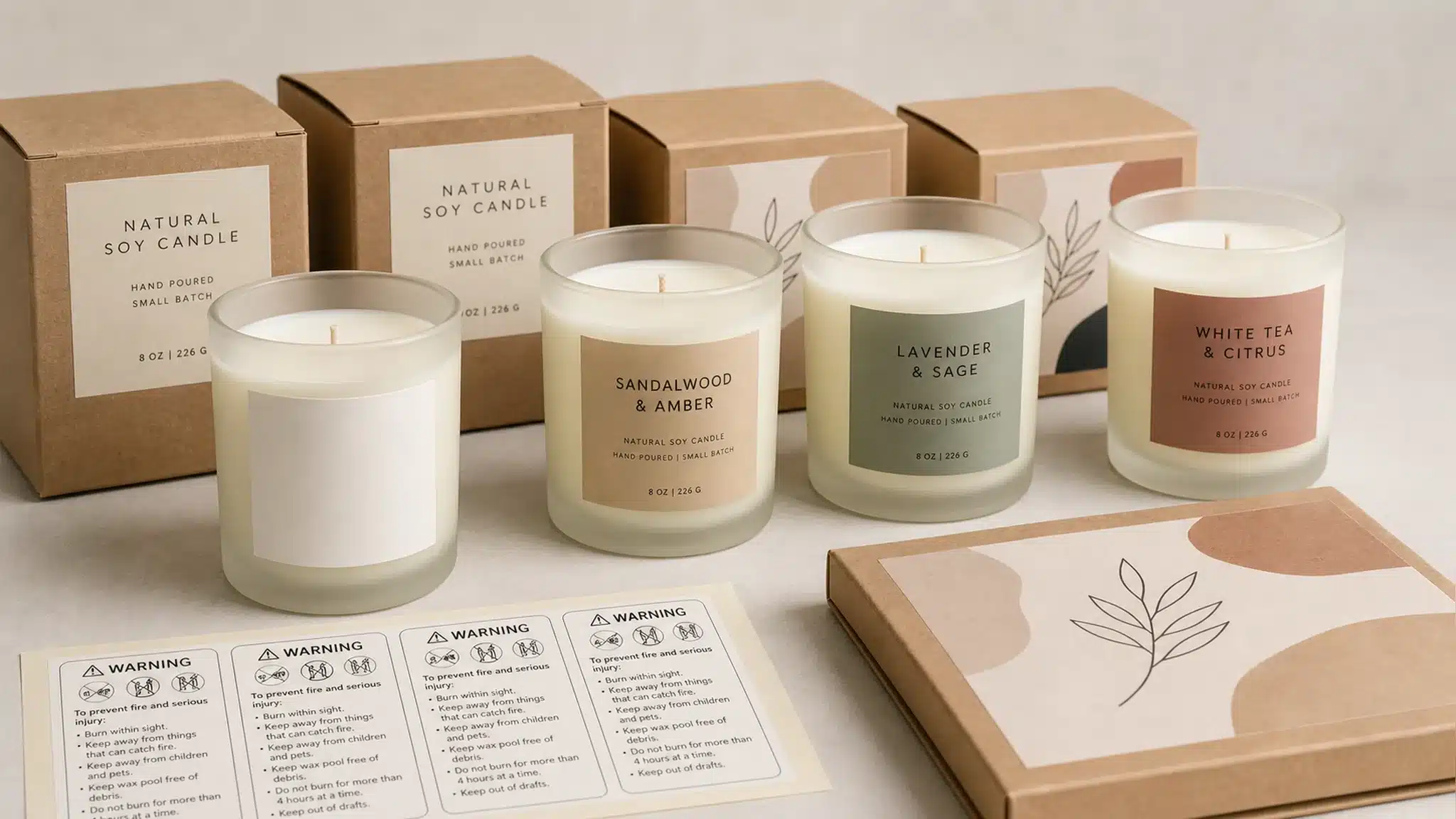
What is genuinely customizable, roughly in order of cost and MOQ impact: label and box artwork (cheapest, lowest MOQ) → fragrance selection from the factory’s library → jar/vessel choice from stock moulds → wax formula and fragrance load → custom fragrance compounding → custom glass or tin tooling (highest cost, longest lead time). The difference between “private label” (your brand on their product) and true OEM/ODM is exactly how far down that list you go.
Best for private-label / China-direct candles
- Brands ordering 500+ units per SKU who want soy/coconut candles with their own label
- Sellers who value a 40–60% landed-cost saving over US distributors
- Buyers selling into the US or UK (not currently hit by candle antidumping duty)
- Gifting and home-fragrance lines needing matched boxes and inserts
Not the right fit if
- You need fewer than a few hundred units — hand-pour or a US supply house is cheaper
- You want paraffin candles for the US market (108.30% duty)
- You sell only into the EU and can’t absorb the 56.7%–60.3% 2026 duty
- You need next-week stock — allow for production plus ocean transit
What to check before a candle order ships
Candles fail in specific, repeatable ways, and every one of them is catchable at a pre-shipment inspection. A finished-candle order is not “check the box count and go” — it needs a burn-and-build check on samples pulled from the actual production run. These are the failure modes worth writing into your AQL inspection checklist:
- Burn test. Light samples: check for tunneling (wax left on the jar wall), oversized or sooting flame, and whether the wick self-extinguishes near the base. A wrong wick size for the jar diameter is the most common defect.
- Wax adhesion and frosting. Soy waxes frost (white crystalline bloom) and can pull away from the glass; agree what is acceptable in writing, because it is cosmetic, not a defect, unless it is severe.
- Fragrance throw and load. Confirm the fragrance percentage matches the sample you approved — factories quietly cut fragrance load to save cost, and “cold throw” (unlit scent) is your first tell.
- Glass and thermal shock. Jar candles crack in transit and during burn. Require annealed, candle-grade glass and drop/thermal checks — this is a genuine liability risk, not just breakage cost.
- Label and warning compliance. Verify the ASTM F2058 warning text and your artwork are printed correctly on the run, not just on the digital proof.
Candles are fragile and consolidate awkwardly, so plan the freight leg deliberately — our LCL vs FCL vs air guide covers when part-container shipping is worth it for glass-heavy goods.
Prices, MOQs and lead times (what to expect)
The figures below are typical market ranges to plan against, not quotes — real numbers move with jar choice, fragrance load, box quality, wax and order size. Use them to sanity-check what a supplier tells you, then get firm quotes on your exact spec.
| Variable | Typical range (estimate) | What moves it |
|---|---|---|
| FOB price, 8–10 oz soy jar candle | ~$1.20–$3.50 / unit | Jar, fragrance load, box, wax, volume |
| MOQ, stock candle + your label | ~500–1,000 / SKU | Factory floor; label-only is lowest |
| MOQ, custom jar/box | ~2,000–3,000+ / SKU | Tooling and print minimums |
| Sampling lead time | ~7–15 days | Custom fragrance/artwork adds time |
| Production lead time | ~30–45 days | Season (Q3/Q4 peak), order size |
Add ocean transit (roughly 25–40 days to the US or Europe) on top of production, and note that Chinese New Year and the Q4 gifting rush both stretch these windows. If you need candles for a holiday season, the order should be placed months ahead — treat candles like any other seasonal home-decor import.
Sourcing a private-label candle line from China?
We help brands spec compliant vegetable-wax candles, vet factories, run pre-shipment burn tests, and land goods with the wax classification and paperwork right the first time — so you never import a 108% surprise.
Frequently asked questions
Why are candles from China hit with a 108% antidumping duty?
Only petroleum wax (paraffin) candles are. The US has enforced antidumping order A-570-504 on petroleum wax candles from China since 1986, with a China-wide rate of 108.30%. Candles made from soy, coconut, palm or more than 50% beeswax are outside the order — which is why importers spec vegetable wax.
What is the HTS code and base duty for importing candles into the US?
Candles classify under HTS 3406.00.0000, “Candles, tapers and the like,” at a Free base rate. China-origin candles then take the Section 301 List 4A surcharge of 7.5%. A compliant soy candle therefore lands at roughly 7.5%, not 100%+. Confirm live rates with a customs broker, as tariff policy changes often.
Did the EU really put duties on Chinese candles in 2026?
Yes. The EU imposed definitive antidumping duties of 56.7%–60.3% on candles from China (CN 3406 00 00), effective from 27 January 2026 for five years, following provisional duties in 2025. It materially narrows the China cost advantage for EU sellers. The UK, as a separate customs territory, is not covered.
What is the minimum order to get my own brand of candles made?
For a stock candle with your own label and box, MOQs commonly start around 500–1,000 units per SKU. Fully custom jars or boxes with new tooling usually push the minimum to roughly 2,000–3,000+ per SKU. These are typical ranges; individual factories vary, so confirm against your exact spec.
What certifications do imported candles need for the US?
Lead-free wicks per 16 CFR 1500.17(a)(13), construction meeting ASTM F2417 fire safety, warning labels meeting ASTM F2058, and an importer-issued General Certificate of Compliance. Make these written requirements to the factory and verify with test reports before shipment.
Is it cheaper to buy finished candles from China or make my own?
At volume, buying finished candles from a manufacturer is almost always cheaper per unit than hand-pouring from US-bought supplies, once you value your labor. Below a few hundred units, a US candle-making supply house or self-pouring can win, because you avoid MOQs, freight and duty overhead.
The bottom line
Wholesale candle sourcing from China is one of those categories where the product is easy and the paperwork is everything. The factories are capable, the unit economics beat any domestic distributor, and a private-label line can go from concept to pallet in a couple of months. But the margin lives or dies on three decisions made before you order: spec a non-petroleum wax so you never touch the 108.30% US antidumping duty, build CPSC compliance into the factory brief so customs clears you, and recost for your specific market — especially if you sell into the EU, where 2026 changed the rules. Get those right, inspect the burn on a real production sample, and China remains the smartest place in the world to buy candles at wholesale.