
 Justin
Doing Yiwu supplier sourcing online without ever stepping foot in the market? That’s the default for most new Amazon sellers. And it usually goes fine until it doesn’t — a shipment shows up, the product looks right, but the batch fails FBA prep because the packaging dimensions are off by half an inch. That kind of headache is avoidable.
Key Takeaways
- Yiwu Market gives you physical verification and MOQs of 50–200 pieces.
- A genuine business license alone proves nothing.
- A supplier promising 2-week delivery from Yiwu is either lying about stock levels or skipping quality checks.
- Your sourcing agent is your first line of defense against the 80% trader rate in Yiwu.
- Avoiding scams is cheaper than recovering from one.
Here’s what nobody tells you: the real split in Yiwu isn’t between “good” and “bad” suppliers. It’s between suppliers who actually hold inventory and those who just forward orders to a factory they don’t control. The second group can still ship you decent product — until you need a last-minute spec change. Then you’re waiting on two people who blame each other. Most sourcing advice focuses on checking licenses and haggling MOQs. That misses the point. The single question that filters out the middlemen is simple: “Can I visit your warehouse tomorrow at 10 AM?” Their answer tells you everything.

Why Yiwu Market for Amazon Sellers?
Yiwu Market gives you physical verification and MOQs of 50–200 pieces. Alibaba gives you long-distance negotiation and MOQs of 500–1,000. For a new Amazon seller, those numbers change everything.
Alibaba vs. a Physical Market: Two Different Risk Profiles
Alibaba is a matchmaking platform. You search, you message, you negotiate, you wire a deposit, and you hope the product matches the photos. The platform does offer Trade Assurance, but that only covers non-delivery or significant misrepresentation — it does not guarantee that batch #2 matches batch #1. For a new seller placing a first order of $2,000–$5,000, that gap is where most of the anxiety lives.
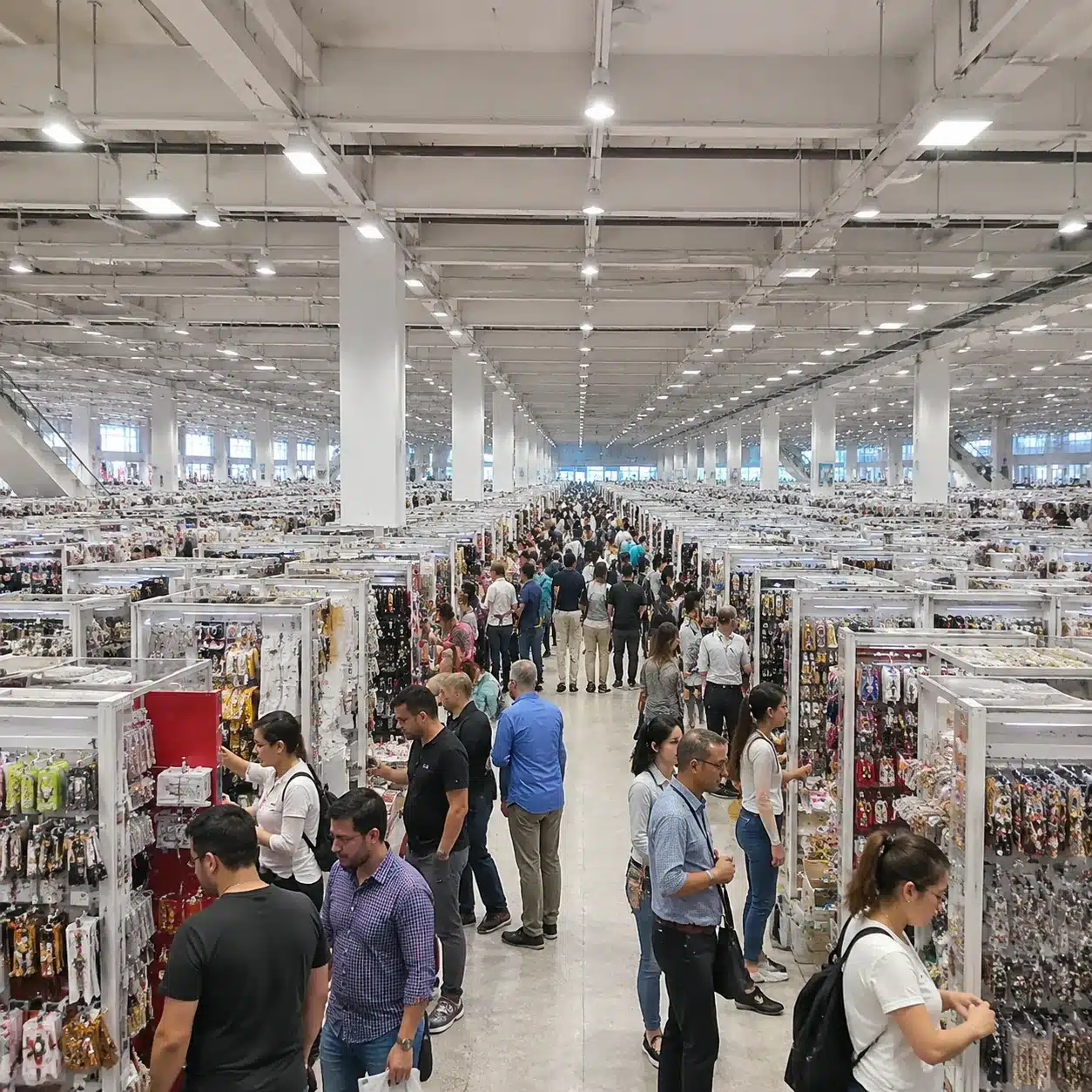
Yiwu Market, by contrast, is a physical stock market for consumer goods. Over 2.1 million products are on display across 6 million square meters of showroom space. You walk booth to booth, pick up the product, check the stitching, weigh the packaging, and hear the plastic flex. That tactile feedback eliminates the single biggest question mark in online sourcing: “Is this what they actually sell?”
Minimum Order Quantities: The Real Barrier for a Beginner
Here is the hard truth about Alibaba: the majority of factories on the platform set their MOQ between 500 and 1,000 pieces per SKU. That is a $3,000–$8,000 bet on a product you have never held in your hands — before FBA fees, before advertising, before you even know if it sells. If that product flops, you are sitting on 900 units of dead inventory.
Yiwu suppliers operate on a different economics because most of them are trading companies, not factories. They consolidate small orders from multiple buyers to fill factory production runs. That structure allows them to offer MOQs of 50 to 200 pieces per product. For a new Amazon seller running a test launch, that is the difference between a manageable $500 pilot and a $5,000 gamble. It also means you can test three or four product variations with the same capital that would cover one variation on Alibaba.
Physical Touch: The Confidence Advantage
Every Amazon seller who has been burned by inconsistent quality will tell you the same thing: product photos lie. A supplier on Alibaba can send you images of a perfectly molded silicone spatula, and what arrives at your doorstep has flashing on the edges and a chemical smell that never off-gasses. Once it is in Amazon’s warehouse, you are paying storage fees on a product you cannot sell.
When you source at Yiwu Market in person or through a verified local agent, you physically inspect the exact stock that will ship. You check for mold lines, color accuracy, material weight, and packaging durability before a single dollar changes hands. Over 80% of Yiwu suppliers are traders who source from multiple factories — meaning the same product can shift in quality between restocks unless you enforce pre-shipment inspections. Spot-checking a sample at a booth is step one. Step two is requesting a production video of the actual factory line and hiring a third-party inspector for the first batch. Combine all three, and you reduce the defect risk from “hope” to “verified.”

How to Verify a Yiwu Supplier’s Legitimacy
A genuine business license alone proves nothing. The real test is whether the company name, legal representative, and registered address on that license match what you see on gsxt.gov.cn — and whether those details align with the person you are actually negotiating with.
The Three Documents That Matter — and the One Most Sellers Overlook
When a Yiwu supplier sends you a photo of their business license, most new Amazon sellers glance at the seal and move on. That is exactly what scammers count on. A fraudulent supplier can rent a booth, print a fake license, and operate for weeks before anyone notices. To verify a Yiwu supplier’s legitimacy, you need to request three specific documents — and inspect each one with a clear checklist.
The first is the Business License (营业执照). Look for the unified social credit code — an 18-character alphanumeric string. This is the supplier’s legal ID in China. Verify that the company name on the license matches the name used in your communication. Check the registered capital: a supplier with 100,000 RMB registered capital has very different financial backing than one with 5,000,000 RMB. Also confirm the business scope explicitly covers the product category you are sourcing. If the license says “textile trading” and you are buying electronics, that is a mismatch worth questioning.
The second document is the Certificate of Foreign Trade Registration (对外贸易经营者备案登记表). This is the document that proves the supplier is legally authorized to export goods from China. Many Yiwu suppliers who are strictly domestic traders will not have this certificate. If a supplier cannot produce it, they either cannot export directly to you, or they will need to route your order through a third-party trading company — adding cost and complexity. For a new Amazon seller trying to keep supply chains simple, a supplier without this certificate is a red flag.
The third — and most overlooked — document is the China Customs Registration Certificate (海关登记证书). This is the supplier’s official registration with China Customs. It contains a 10-digit customs code that you can use to verify their export history. A supplier that has been exporting consistently for 3+ years will have regular customs records. A supplier that registered last month and has zero export records may be brand new to international trade — or may be operating under a freshly created shell entity after a previous one was burned.
How to Cross-Check Every Document on gsxt.gov.cn (Even If You Don’t Read Chinese)
China’s National Enterprise Credit Information Publicity System (gsxt.gov.cn) is the official government database for all registered companies in China. It is the single most powerful tool for how to check if a Yiwu supplier is legit — but most Western buyers never use it because the interface is in Chinese. Here is exactly how to run the check in under five minutes.
Open gsxt.gov.cn in Chrome or Edge — both browsers offer built-in page translation. Click the search bar and enter the supplier’s full company name exactly as it appears on their business license. Do not use abbreviations or English trading names. The database operates on the official Chinese registered name only. If the supplier has given you a trading name that differs from their registered name, that itself is a warning sign worth investigating.
Once the search results load, click on the correct company entry. You will see a dashboard that includes:
- Registration Status: Must show “存续” (in operation). If it shows “吊销” (revoked) or “注销” (cancelled), the supplier is not legally operating.
- Date of Establishment: A supplier registered three months ago is riskier than one registered five years ago — not automatically disqualifying, but warrants extra verification steps like factory visit photos or production records.
- Registered Address: Cross-check this against the address the supplier gave you for their booth or factory. Mismatches are common when a supplier is a trader operating out of a rented space rather than their own registered location.
- Business Scope: Confirm the listed scope covers your product category. If the scope says “daily necessities” and you are sourcing electronics components, push for clarification.
- Annual Reports: Chinese companies are required to file annual reports. Companies that have missed filings for multiple years may be inactive or operating outside regulatory compliance.
Cross-reference the unified social credit code from the business license with the code displayed on gsxt.gov.cn. If the codes do not match exactly — including every character — the document you received is either forged or belongs to a different entity. This single mismatch check catches more fraudulent suppliers than any other verification step. For a new Amazon seller working on how to avoid Yiwu supplier scams, this database check is non-negotiable before sending any deposit.
What the Document Check Will Not Tell You (and Why That Matters for Amazon FBA)
The business license and gsxt.gov.cn check confirm one thing only: that a legally registered Chinese company exists. They do not confirm that the company has ever manufactured your product, that they have quality control processes, or that they can meet Amazon FBA packaging requirements. Over 80% of Yiwu suppliers are trading companies, not factory owners — meaning the same supplier may source from three different factories for three different orders, and product quality can shift between batches without you ever knowing.
For yiwu market product sourcing for amazon beginners, the document verification step is the entry gate, not the final destination. Once the documents check out, the next step is to request production videos showing the actual factory line with the supplier’s business license visible in the frame. Ask for photos of the production floor with timestamped watermarks. Request a video call where the supplier walks through their facility in real time. A legitimate supplier with nothing to hide will accommodate these requests. A supplier that hesitates, offers excuses, or sends generic stock photos is giving you a reason to walk away.
The documents prove the supplier exists. The production evidence proves they can deliver. Do not confuse one for the other. For yiwu market supplier verification tips, the rule is simple: verify the documents to confirm the supplier is real, then verify the production to confirm they can actually make what you need. Skip either step, and you are placing a bet with your deposit money.

The 4-2-1 Rule: What New Sellers Must Know
A supplier promising 2-week delivery from Yiwu is either lying about stock levels or skipping quality checks. Real capacity requires 4 weeks.
Breaking Down the 4-2-1 Timeline
This is not a suggestion. It’s the minimum realistic lead time for a new relationship. Here is exactly where those 4 weeks go when working with a typical Yiwu supplier:
- Weeks 1–2 (Production): The supplier sources raw materials, runs your batch, and completes manufacturing. If your order requires custom packaging or tooling, this window is non-negotiable. Attempting to compress it usually results in skipped curing or drying times, which means arrives with defects.
- Week 3 (Consolidation): Because over 80% of Yiwu suppliers are traders, your goods are often produced across multiple factories. That third week exists solely to collect all components, inspect them at the supplier’s warehouse, repack for export, and load the container. Skipping this step means mixing batches from different facilities without a quality gate.
- Week 4 (Shipping): Sea freight from Ningbo to the US West Coast averages 18–22 days, but the logistics chain starts when the container leaves the Yiwu consolidation yard. Customs clearance, port handling, and vessel scheduling eat the first 5–7 days of this window before the ship even departs.
The Red Flag: Suppliers Who Promise Faster
If a supplier tells you they can deliver in 2 weeks flat out of Yiwu, they are almost certainly pulling from existing stock or substituting materials. That stock may be from a cancelled order, meaning it was made to someone else’s spec — not yours. For a new Amazon seller trying to avoid Yiwu supplier scams, this is the single easiest filter. Ask for a production schedule that shows the actual factory start date. If they cannot produce a timeline that matches 4-2-1, walk away.
The math is simple. Genuine factory capacity in Yiwu is booked 3 to 4 weeks out during peak seasons. A supplier offering expedited service is either subcontracting to an unknown factory or shipping untested product. Neither outcome is acceptable for your first FBA shipment, where a single quality failure can result in a product suspension.
What This Means for Your First Order
Plan your sourcing calendar around the 4-2-1 rule from day one. For Amazon sellers targeting Q4, that means placing your production order by early August. If you are comparing a Yiwu agent versus a direct supplier for small orders, factor in that an agent typically manages consolidation and inspection within that third week, reducing your risk of a delayed container. Accepting a faster promise is accepting a higher probability of receiving goods that do not match the sample.

The Role of Yiwu Sourcing Agents (and How to Choose One)
Your sourcing agent is your first line of defense against the 80% trader rate in Yiwu. Choosing the wrong fee model can cost you more than any scam.
Fee Structures: Commission vs. Flat Fee
Yiwu sourcing agent fees for Amazon sellers typically fall into two models. The industry standard is a commission of 3–8% of the total order value. For a $5,000 order, you are looking at $150 to $400 in agent fees. The alternative is a flat fee of $200–$500 per product category. This model works better if you are placing repeat orders for the same item, because your costs scale down as volume increases.
The trap most new Amazon sellers fall into is picking a model based solely on the percentage. A 3% commission sounds cheap, but if your agent takes that cut from every invoice — including shipping and inspection costs — you will pay more over five orders than a fixed $300 fee. The math flips when you are ordering ten different SKUs with small quantities: a flat fee per category can balloon to $3,000, whereas a 5% commission on a $10,000 total order is only $500. Do the arithmetic per order, not per percentage point.
Services That Actually Matter for Your First Order
Not all agents offer the same scope of work. Here is what a professional Yiwu sourcing agent should handle for an Amazon FBA beginner, in order of priority:
- Supplier Vetting: The agent cross-checks the supplier’s Business License, Certificate of Foreign Trade Registration, and China Customs Registration Certificate. They also physically visit the booth or factory to confirm the supplier is not a middleman working out of a shared office. Over 80% of Yiwu suppliers are traders, not factory owners, so this step is non-negotiable.
- Price Negotiation: An agent who knows the local market can usually shave 5–15% off the initial quoted price. If a supplier’s price is drastically lower than neighboring booths, the agent should flag it as a red flag for quality or legitimacy.
- Quality Inspection: The agent performs a pre-shipment inspection against your approved sample. Because suppliers consolidate goods from multiple factories, the same product can vary in quality between orders. Always request a production video of the actual factory line, not just the showroom.
- Logistics Handling: Consolidation, export documentation, and shipping coordination. The agent ensures the shipment adheres to the 4-2-1 rule: 2 weeks production, 1 week consolidation, 1 week shipping — any agent promising faster is likely cutting corners.
Red Flags: When to Walk Away
The most common scam targeting new Amazon sellers is the request for full payment upfront. Even if the agent claims to have a verified track record, standard payment terms in Yiwu are 30% deposit and 70% before shipment. Any agent demanding 100% up front — especially via personal accounts or third-party payment links — is a hard stop. Walk away immediately.
Additional red flags include agents who refuse to share the supplier’s full business license, those who cannot provide a physical office address in Yiwu, or those who quote fees significantly below 3% commission. Below-market fees usually mean the agent is skimping on vetting or planning to charge hidden inspection and logistics markups. A transparent agent will give you a written breakdown of all costs — including the MOQ of 50 to 500 pieces — before you send a single dollar.


Red Flags and Scams to Avoid
Avoiding scams is cheaper than recovering from one. The four red flags below are responsible for 90% of first-order losses for new Amazon sellers.
The Price Trap: 50% Below Market
A legitimate Yiwu supplier operates on thin margins—typically 5% to 15% for trading companies and 10% to 25% for factories, depending on the product category. When a quote comes in at 50% below the average of other booths or online listings, you are not looking at a deal. You are looking at a loss waiting to happen. This price gap usually means the supplier is planning to substitute materials, skip quality checks, or simply disappear after collecting deposits. Instead of celebrating, run a verification check immediately. Ask for a production video of the actual factory line. If they cannot provide one, or the video is stock footage available on Alibaba, walk away.
Payment Methods That Signal Fraud
Standard payment terms for verified Yiwu suppliers are 30% deposit and 70% balance before shipment, paid through a traceable bank transfer (T/T) or a secure escrow service like PayPal (for small orders). A supplier who insists on Western Union or MoneyGram is a red flag. These services are designed for person-to-person transfers—they offer zero buyer protection and cannot be reversed. Legitimate Chinese suppliers know that serious B2B buyers never use these methods.
- Safe payments: Bank T/T (wire transfer), Alibaba Trade Assurance, PayPal (orders under $2,000).
- Red flag payments: Western Union, MoneyGram, cryptocurrency, direct cash deposits to personal accounts.
- Rule of thumb: If they refuse a traceable payment channel, they are not a legitimate Yiwu supplier.
Every legitimate supplier registered in Yiwu operates from a physical location. This includes a booth in the Yiwu International Trade Market (Futian Market) and a factory or office address in the surrounding industrial zones. If a supplier provides only a WeChat ID and a vague city name, that is a problem. Even small trading companies will share an address for product showing or cargo consolidation. Ask for their Chinese business license (营业执照). A verified license will have a matching address that you can cross-check on Baidu Maps.
One practical step: request a video call where the supplier walks through their booth or office. A fake supplier cannot easily stage an entire commercial space. If they refuse or claim their camera is broken, consider it a failed verification.
100% Upfront Payment Pressure
The standard payment structure in Yiwu for new buyers is 30% deposit to start production, with the remaining 70% due after you approve pre-shipment photos or an inspection report. A supplier demanding 100% upfront payment is betting that you will never see your goods—or that they can ship substandard products with no recourse. This demand is especially common with fake suppliers who operate for a few months, collect deposits, and then shut down.
If a supplier insists on full payment before shipment, propose using a third-party inspection service. Offer to pay 30% upfront and the remaining 70% after the inspection passes. A legitimate supplier will agree because they know their product quality can survive a check. A fraudulent supplier will argue, claim it is unnecessary, or disappear from the conversation entirely.

Final Checklist Before Placing Your First Order
1. Verify the Business License — Not Just the Alibaba Badge
Any supplier can buy a “verified” status on Alibaba or Made-in-China for a few hundred dollars. That badge only proves they paid for a listing package. The only document that proves a supplier is a legally registered Chinese entity is their Business License (营业执照), issued by the local Administration for Market Regulation. Ask for a clear photo or PDF. Then cross-check the company name on the license against the name on their invoice and bank account. If those three don’t match, you are likely dealing with a middleman who may disappear after payment. For Amazon sellers, Yiwu supplier business license verification should be step one in your raw file. A mismatch on the license means you have zero legal recourse if goods are seized at customs due to falsified export documents.
- 🏷️ Category: Risk Mitigation
- 🎯 Core Outcome: Confirms the supplier is a legal entity, enabling customs clearance and legal dispute channels.
Analysis:
| ✅ Advantages | ⚠️ Considerations |
|---|---|
|
|
2. Request a Production Video — Not a Packing Video
Here is the hard truth about Yiwu: most booths are run by trading companies that consolidate goods from factories across Zhejiang province. They can show you a perfect sample, but the bulk order may come from a different factory with lower quality. Ask for a 30-second video showing the specific product being manufactured on a production line — not just workers packing boxes in a warehouse. A genuine factory will have the machinery, raw materials, and workers in the frame. A trader will deflect or send a generic video from a different factory. This is the most direct method for how to check if Yiwu supplier is legit when you cannot visit in person. If they refuse to provide a production video, treat it as a red flag and move on.
- 🏷️ Category: Quality Assurance
- 🎯 Core Outcome: Verifies the supplier controls production, reducing batch-to-batch variation.
Analysis:
| ✅ Advantages | ⚠️ Considerations |
|---|---|
|
|
3. Order Samples and Pay via Credit Card for Protection
Never skip the sample stage. A sample is your only chance to physically check material thickness, color accuracy, packaging quality, and overall build before committing to a bulk order. When paying for the sample, use a credit card rather than bank wire or PayPal Friends & Family. Credit card processors (Visa, Mastercard) offer chargeback protection if the supplier sends the wrong item or nothing at all. Wire transfers are essentially cash — once sent, you have no recourse. Many new Amazon sellers learn this the hard way. A legitimate supplier will accept credit card payment for samples. If they insist on wire transfer only for a $30 sample, that is a strong indicator of how to avoid Yiwu supplier scams. Start with a small sample order across 3–5 products, paying by card.
- 🏷️ Category: Financial Safety
- 🎯 Core Outcome: Protects your payment and ensures you can evaluate product quality firsthand.
Analysis:
| ✅ Advantages | ⚠️ Considerations |
|---|---|
|
|
4. Use an Inspection Service for the First Bulk Order
Your sample passed all checks. Great. But the bulk order is produced in a different run, possibly at a different factory if the supplier is a trader. Hire a third-party inspection company (like QIMA, SGS, or a local agent) to perform a pre-shipment inspection at the factory. The inspector will check product dimensions, material specifications, packaging, and labeling against your approved sample. They will also do a carton drop test and confirm that quantities match the packing list. For your first bulk order, do not rely on photos the supplier sends you — those can be staged. Pay the inspection fee and get a written report. This is how Yiwu market supplier verification tips turn into real risk reduction. If the inspection fails, you reject the shipment before it leaves China, saving thousands in freight costs and lost Amazon sales.
- 🏷️ Category: Controlo de qualidade
- 🎯 Core Outcome: Catches defects, quantity shortages, or specification deviations before shipment leaves China.
Analysis:
| ✅ Advantages | ⚠️ Considerations |
|---|---|
|
|
5. Start with a Small MOQ to Test Quality
Yiwu market is unique because the Yiwu supplier minimum order quantity Amazon FBA sellers can use is often 50 to 200 pieces per product — much lower than factory-direct MOQs on Alibaba (which often start at 500–1000 pieces). Take advantage of this. Place your first order at the minimum MOQ. This limits your financial risk if the product flops on Amazon or the quality is inconsistent. Once you confirm that the product sells and the supplier delivers consistent quality, you can negotiate larger volumes at better unit prices. Many new Amazon sellers make the mistake of ordering 2,000 units on the first order to get a lower per-unit cost, only to find the product has a defect that kills their listing. Start small, prove the model, then scale.
- 🏷️ Category: Strategy & Scaling
- 🎯 Core Outcome: Validate product-market fit and supplier reliability with minimal capital risk.
Analysis:
| ✅ Advantages | ⚠️ Considerations |
|---|---|
|
|
Conclusão
Over 80% of Yiwu suppliers are traders, not factory owners. That means product quality can shift between batches without a pre-shipment inspection. The 4-2-1 lead time rule (2 weeks production, 1 week consolidation, 1 week shipping) is the standard. Suppliers promising faster are likely cutting corners. A sourcing agent charging 3-8% of order value is a fraction of what you lose on a single scam.
Next step: let a local agent handle the vetting. Check our Yiwu Sourcing Agent service for hands-on supplier checks and quality inspections tailored to Amazon sellers.
Perguntas mais frequentes
How to check supplier legitimacy?
Verify a supplier’s business license via China’s National Enterprise Credit Information Publicity System (NECIPS) and cross-check their factory address using Google Maps or Baidu Street View. Request third-party audit reports from firms like SGS or Bureau Veritas, and demand trade references from past buyers. Avoid suppliers that only accept Alibaba Trade Assurance without offering video calls or factory tours, as legitimate Yiwu suppliers typically welcome these checks.
How to find a good sourcing agent?
Look for agents with a physical office in Yiwu’ s Futian market district and at least five years of experience handling your product category. Request client testimonials and recent purchase orders with supplier stamps to verify real transaction history. Avoid agents who demand large upfront fees; reputable ones charge a service fee of 3-8% of the order value or a fixed monthly retainer, and they should provide transparent cost breakdowns including inspection and logistics charges.
How to get a reliable Chinese supplier?
Start by sourcing from suppliers with verified Gold Supplier or Assessed Supplier status on Alibaba.com, then conduct a face-to-face meeting at the Yiwu International Trade Market or their factory. Insist on a product sample matching your specifications before placing a trial order of 20-50 units to test quality and lead times. Establish clear contracts with quality clauses, delivery penalties, and payment terms using 30% deposit and 70% against copy of shipping documents to protect your interests.
What is the 4 2 1 rule in China?
The 4-2-1 rule is a supply chain risk mitigation strategy: vet at least 4 potential suppliers, shortlist 2 after factory audits and sample testing, then select 1 primary supplier while keeping the second as a qualified backup. This ensures you have a tested alternative in case of production delays, quality issues, or pricing disputes. In Yiwu, where supplier turnover is high, applying this rule reduces dependency on a single vendor and maintains negotiating use.
Quanto é que os agentes de sourcing da China cobram?
Sourcing agents in Yiwu typically charge 3-8% of the total order value for full-service procurement including supplier vetting, price negotiation, quality inspection, and logistics coordination. Some agents offer a flat fee of $200-$500 per container for basic services, while boutique agents may charge a monthly retainer of $1,000-$3,000 for dedicated sourcing support. Always request a detailed service agreement outlining what the fee covers, as additional costs for product testing, factory audits, or rush orders can add 10-20% on top.