Justin
If a supplier quoting DDP asks for your EORI number, first confirm which legal entity will occupy each customs role. Ask who is the importer, who lodges the declaration, whether a representative acts directly or indirectly, and which entity’s identifier is required in the particular field. An EORI identifies a person or business for customs purposes; the shipping term alone does not explain the intended declaration.
The practical decision is whether the shipment plan and the request describe the same parties. Do not insert a supplier’s or forwarder’s number merely because it is available. Do not assume that providing your number is a harmless substitute for discussing the import arrangement. Resolve the identity and role question with the responsible customs representative before dispatch.
Key Takeaways
- Identify the customs territory before applying EU guidance.
- Write down importer, declarant and representative separately.
- An EORI is not proof of VAT registration or product compliance.
- Check an existing EU EORI before seeking another registration.
- Keep the declaration plan consistent with the actual entities.
- Ask for a clear explanation when a DDP quote leaves the importer unknown.
Watch the background explainer
Decode the request before supplying a number
A supplier may say that the courier needs “your customs number.” That phrase leaves several questions open. Is the request for an EU EORI, a VAT number, a national identifier or another field? Which country and customs operation does it concern? Who will receive the goods, and in whose name will the relevant declaration be made?
Request the exact field name and the party to which it belongs. You do not need to guess at the declaration software. The responsible representative should explain the requested information and the proposed role of your entity. If a message merely says “send any EORI,” the identity issue remains unresolved.
Check the customs territory as well. EU guidance concerns the EU customs territory. A GB EORI, a shipment involving Northern Ireland and an EU registration can raise different questions. This article does not treat an identifier issued for one system as interchangeable with another. Give the representative the actual destination and route rather than only “Europe.”
Keep a record of the request and the answer. If the supplier changes forwarders, the new agent may make a different assumption about the importer. A saved party-and-role record lets the buyer identify the change before the documents are lodged, instead of discovering it when a later import record names an unexpected entity.
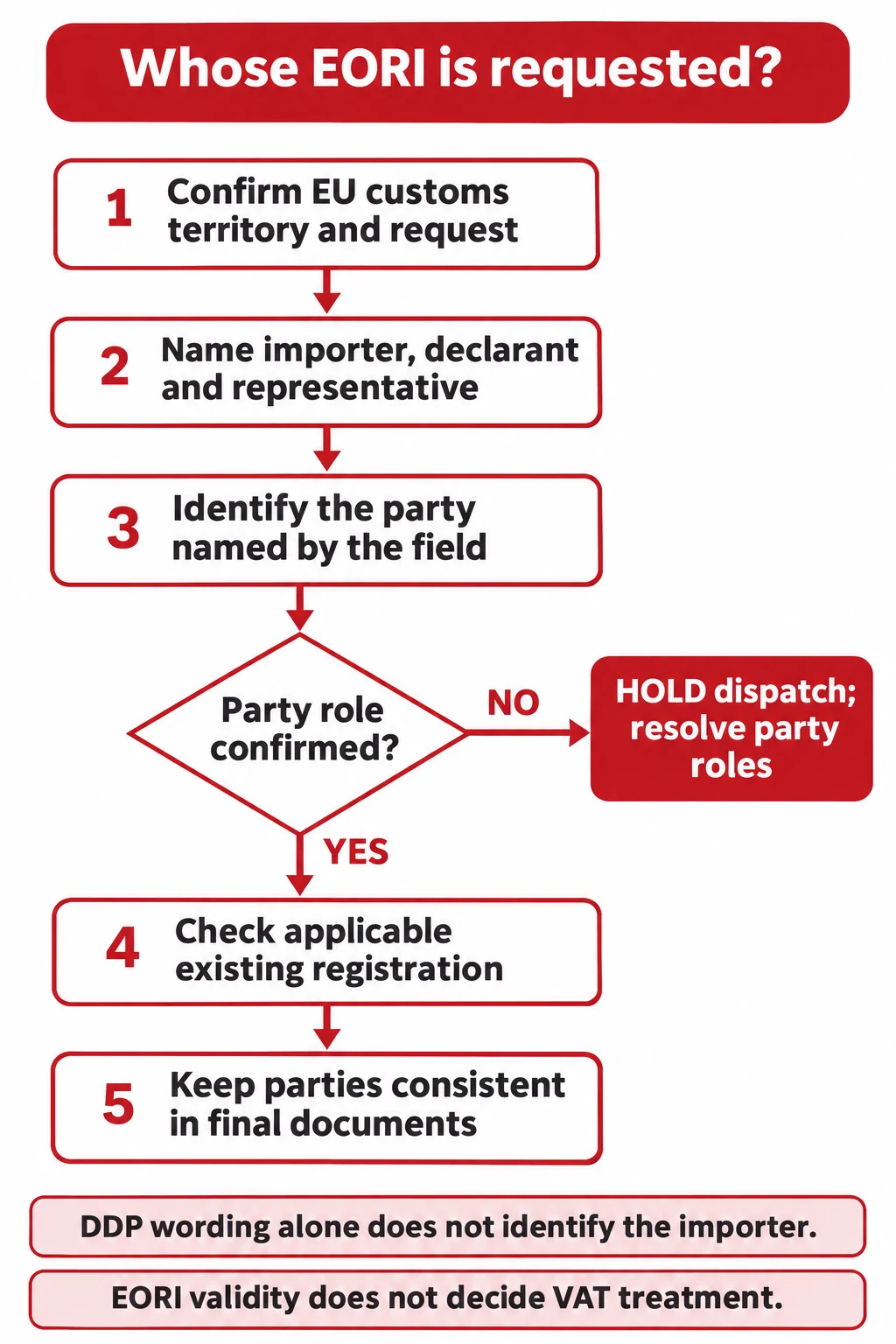
- Confirm the EU customs territory and exact request
- Name importer, declarant and representative
- Whose identifier does the field require?
- Roles unclear: hold dispatch and resolve the plan
- Roles confirmed: check the applicable existing registration
- Keep the party record consistent with final documents
Understand what an EU EORI establishes
The European Commission’s EORI guidance describes an identifier used for customs operations. It states that, at any point in time, a person can have only one valid EORI number. The number identifies the operator or other person; it is not a label that can be borrowed from an unrelated company to fill a blank field.
The same guidance distinguishes operators established in the EU customs territory from operators without an establishment there. An EU-established operator requests registration from the national customs authority of its country of establishment. For an operator without such an establishment, the Commission describes registration through the EU country where the first relevant customs operation is intended. Apply the current national instructions to the actual entity and activity.
Registration is therefore not simply a matter of choosing the country where a container happens to arrive. Nor should an EU-established business assume that using another Member State requires another EORI. Check the existing registration and the applicable authority before submitting a second application.
Use the Commission’s linked validation service and the relevant national authority for registration questions. Retain the validation result with the date and the number checked. A valid result answers a limited identification question. It does not establish that the identified entity has agreed to act as importer, that a representative has authority, or that the goods meet all import requirements.
Keep EORI and VAT questions separate. Do not turn a valid EORI into a statement that import VAT can be recovered or that a VAT registration requirement has been satisfied. Those decisions depend on the actual transaction, parties and national rules. Ask the responsible tax or customs adviser to resolve them where they affect the shipment plan.
Map importer, declarant and representative
Write the full entity name against each role proposed for the shipment. Avoid a single “agent” box that hides whether the person is the commercial sourcing agent, the freight forwarder, the customs representative or the buyer’s separate adviser. One business may perform several services, but those services should still be identified.
The importer and the person lodging the declaration are not always usefully described by the same informal label. The European Commission’s business import guidance explains that imports involve a customs declaration and associated preparation, including identifying and classifying goods and checking applicable restrictions. Employing a representative does not remove the need to understand whose information is being declared.
Ask whether representation is direct or indirect and request the explanation for the particular declaration. Do not infer the answer from the fact that the courier transmits the information. Where the terminology or responsibility is unclear, have the representative identify the basis of the arrangement and any authorization required from your entity.
Then compare the entity names with the order and shipping documents. A supplier’s export identity, the party issuing a commercial invoice, the consignee and the proposed importer may differ for legitimate reasons. That is a reason to document the roles, not to force all the names to match by editing a form. Resolve unexplained differences before the final documents are issued.
| Question | Record needed | What a number alone does not answer |
|---|---|---|
| Who is the importer? | Full entity identity and the proposed role in this movement | Whether that entity has agreed to the arrangement |
| Who lodges the declaration? | Declarant and representation arrangement | Whether the courier acts in its own name or another party’s name |
| Whose EORI is requested? | Exact field and entity to which it belongs | Whether an unrelated valid number may be substituted |
| Which national requirements apply? | Actual territory, operation and competent authority | VAT treatment, product compliance or clearance outcome |
Resolve the DDP handover before dispatch
A DDP quotation and a request for the buyer’s EORI should trigger a clear conversation about execution. It should not trigger an automatic conclusion that the supplier is dishonest, or an automatic conclusion that the buyer will have no customs role. Ask how the agreed delivery arrangement will be implemented and which parties will appear in the customs documents.
Keep the cost promise and the identity record separate. A quotation may describe who expects to pay freight or import charges, while the declaration still needs particular legal entities and authorizations. “All included” does not tell you which number belongs in a declaration field. If the seller’s explanation and the representative’s proposed declaration differ, pause the handover and obtain one agreed description.
Ask what import records will be supplied and to whom. This is particularly important if your accounting process depends on documents naming the correct entity. Do not assume that a tracking page showing “delivered” establishes that the import documentation supports your intended tax or recordkeeping treatment.
Changes should remain visible. If the proposed importer changes after the quote, obtain the revised arrangement and review the consequences with the responsible adviser. Do not simply overwrite the EORI field while keeping the original role assumptions in the order file.
En DDP versus EXW guide addresses the broader quotation comparison. The narrower task here is the identity and declaration handover: who is doing what, which identifier belongs to that party and whether the final documents will describe the agreed movement.
| Record state | Decision | Boundary |
|---|---|---|
| DDP quote, importer still unnamed | Keep the identity question open and request the proposed roles | Do not substitute an available number |
| Entity, role and applicable identifier confirmed | Retain that shipment-specific record with the final documents | This limited identity check is not VAT or product-compliance approval |
Apply the process to two shipment decisions
Illustrative case: an EU-established buyer receives a DDP quote and a message asking for an EORI. The buyer already has a valid EU registration. The responsible representative confirms the buyer’s proposed importer role, explains the representation arrangement and identifies the field requiring the buyer’s number. The buyer checks that this matches the agreed order and obtains any required advice or authorization before supplying the confirmed details.
The result is not “DDP always requires the buyer’s EORI.” It is that a particular request has been tied to a named entity and a confirmed declaration arrangement. The existing registration can then be checked on its own merits. There is no reason in this scenario to invent a new entity or borrow the supplier’s registration.
Change the condition: the supplier says its “shipping agent handles everything,” while the representative asks to use the buyer as importer and cannot explain the authorization or records. The buyer now lacks a coherent arrangement. Hold dispatch on that basis and ask the seller and representative to reconcile their roles. A valid EORI does not resolve the contradiction.
A further variation is an entity with no EU establishment. Do not copy the registration route for the EU-established buyer into that case. Provide the actual establishment and intended operation to the competent national authority or representative, and confirm the applicable registration and representation requirements before proceeding.
Freeze a shipment-specific party record
Keep the order reference, actual destination, customs territory, seller, consignee, proposed importer, declarant and representative in one record. Include the exact identifier request, confirmation source, validation date, authorization status and unresolved questions. Mark information as provisional if the responsible party has not yet confirmed it.
Use the record when checking the final invoice, packing list and shipping instructions. It is a comparison aid, not a substitute for a customs declaration or professional determination. If a different entity appears, ask why and have the responsible representative correct or explain the difference before relying on the documents.
Conclusión
Treat an EORI request as a question about an identifiable party in a specific customs operation. Confirm the territory, roles and representation, validate the applicable registration and check that the documents reflect the agreed arrangement. Keep unexplained entity changes open until the responsible parties resolve them.
PREGUNTAS FRECUENTES
Does DDP mean I never need an EORI?
Do not infer the declaration arrangement from the quote alone. Ask which entity will occupy each customs role and which identifier is required.
Can I use the supplier’s EORI instead of mine?
Only the identifier belonging to the actual required party should be used. Ask the representative to confirm the field and entity.
Do I need a new EU EORI for another Member State?
Check the existing registration and competent authority first. Commission guidance states that a person can have only one valid EORI at a time.
Does an EORI validation confirm VAT recovery?
No. Identification validation does not determine the transaction’s VAT treatment or establish product compliance.
By Justin. Administrative preparation based on current Commission guidance; transaction-specific customs and tax decisions remain for the responsible professionals.