Justin
A covered wool-blend scarf sold in the US needs accurate fiber content, its actual country of origin, and a responsible business identity on its product label.
“Wool blend,” a brand logo and a shipping address do not supply those three disclosures. There is also an easily missed exception: wool must be named with its percentage even when it is less than 5% of the product’s fiber weight. A scarf containing 3% wool cannot hide that wool in an “other fibers” line.
For a small importer buying scarves from China, this is a practical artwork decision. Before the supplier prints labels, you need enough information to write the right words. Below are two completed fictional core-label examples, followed by the records and physical-label checks that make those examples useful. They cover fiber, origin and business identification; care instructions, customs entry and other applicable requirements remain separate.
Key takeaways
- Declare the actual fiber composition rather than using “wool blend” alone.
- Name wool or recycled wool and its percentage even below 5%.
- Use the actual country of origin; buying or shipping in Yiwu does not establish it.
- An eligible full business name can identify the responsible business. An RN is optional.
- Keep the required information readable and accessible on the product.
- Approve the applied label against the actual SKU and composition, while checking care and customs obligations separately.
Cotecna Inspection’s educational overview covers textile fiber labeling in US and EU markets. It is supporting background; the FTC sources govern the US rules used in this article.
Watch on YouTube · Educational background from Cotecna Inspection
Why 3% wool still needs its own line
The FTC’s Textile and Wool Acts labeling guide lists scarves among covered textile products and explains that most products containing any amount of wool fall under the Wool Act and Wool Rules. The rules overlap, but a wool-containing item has an exception you should check before applying a generic textile-label template.
The general fiber-disclosure rule groups fibers below 5% as “other fiber” or “other fibers,” subject to exceptions. Wool and recycled wool are one of those exceptions: disclose the name and percentage even below 5%. Another exception can permit naming a small percentage of a fiber with definite functional significance, such as spandex used for elasticity. That is a different reason from the mandatory wool disclosure.
Consider a simple scarf whose documented composition is 97% acrylic and 3% wool. The content lines are “97% Acrylic” and “3% Wool.” Replacing the second line with “3% Other fibers” loses information the wool rule requires. Nor can the supplier round the product up to “100% Acrylic” merely because the wool share is small.
Keep recycled wool distinct. If the actual material is recycled wool, the disclosure needs to identify it accordingly. Do not change “recycled wool” into “wool” for a cleaner-looking label. Likewise, a sales description such as “cashmere feel” is not evidence that the scarf contains cashmere. Generic fiber names and percentages must follow the actual material, not the texture a customer might associate with it.
Business name, brand name or RN?
A new reseller does not have to obtain an FTC Registered Identification Number just to complete the identity line. The FTC permits the appropriate company name or RN; an RN is an alternative to a name, not a universal prerequisite for US textile sales. RNs are issued to US businesses, not businesses outside the US.
If you use a name, the FTC says it must be the full name under which the company does business—the name appearing on documents such as purchase orders and invoices. A trademark, designer name or decorative brand is insufficient unless it is also that business name.
In the fictional examples below, the importer’s full business name is Harbor Sample Imports LLC, while its consumer brand is Harbor Style. The examples use the full importer name. The brand can still appear elsewhere without crowding out or contradicting the required information. Do not copy a supplier’s RN from an unrelated product: the identity must correspond to a permitted business in the actual distribution chain.
Two completed core-label corrections
Assumptions for both examples: these are fictional, simple, single-section scarves with known fiber percentages by weight. They have no separate fabric sections, ornamentation or recycled fibers requiring a different disclosure. China has been established as the actual country of origin from the manufacturing and processing facts, rather than inferred from the supplier’s location. Harbor Sample Imports LLC is the importer’s true full business name on its purchase orders and invoices. Applicable care information is established separately.
The blocks show the completed fiber, origin and identity portion of a label. They are not complete care-label artwork, customs declarations or approval of every requirement applying to a real shipment.
| Fictional scarf | Incorrect proposed copy | What must change |
|---|---|---|
| 97% acrylic, 3% wool | 97% Acrylic / 3% Other fibers / Harbor Style / Ships from Yiwu | Name the wool; use the permitted full business name and actual origin. |
| 60% acrylic, 40% wool | Wool Blend / Harbor Style | Give both percentages in descending weight order, plus origin and business identity. |
Completed core copy: 97% acrylic / 3% wool
97% Acrylic
3% Wool
Made in China
Harbor Sample Imports LLC
The percentages total 100%. Wool remains named despite falling below 5%. “Made in China” identifies the assumed actual origin; “Ships from Yiwu” would only describe logistics. The full company name supplies the identity without inventing an RN.
Completed core copy: 60% acrylic / 40% wool
60% Acrylic
40% Wool
Made in China
Harbor Sample Imports LLC
Here acrylic comes first because it is the larger share. “Wool Blend” might be a marketing description, but it cannot replace the complete content disclosure. A supplier should not choose the 40% figure because it sounds commercially attractive: it must describe the scarf actually ordered.
If your supplier only knows that the material is a wool blend, neither example supplies the missing percentages. Similarly, a scarf with sections made from different fabrics may need sectional disclosure. The finished examples demonstrate how to use established inputs, not how to infer unknown composition from photographs, price or feel.
Where the information belongs
The FTC permits the three disclosures on one label or separate labels. Required information must be legible, conspicuous and readily accessible. Fiber-content information needs equal size and conspicuousness, with its parts close together; a large “WOOL” headline and tiny acrylic percentage can mislead even when both numbers are technically present.
The country of origin must appear on the front of the label. Fiber content and business identity may appear on the back if the label is attached only at one end so the reverse is accessible. For the examples above, putting all four lines on the front gives the buyer a straightforward arrangement to review. It does not establish a mandatory label size or a universal sewing position for scarves.
Under the FTC guidance, the label must remain securely attached until delivery to the consumer. Customs can impose separate origin-marking requirements, including a sewn-in label in applicable circumstances. Do not assume a detachable hangtag is sufficient for the entire US import merely because it carries the correct words. Check the proposed attachment against the actual product and applicable customs requirements.
A decorative hangtag is also different from the required fiber label. FTC rules permit certain supplementary fiber hangtags without repeating the full content when the required label exists and the hangtag makes the appropriate disclosure directing consumers to that information. The simplest approval is to review the sewn or attached product label, hangtag and selling description together so one does not contradict another.
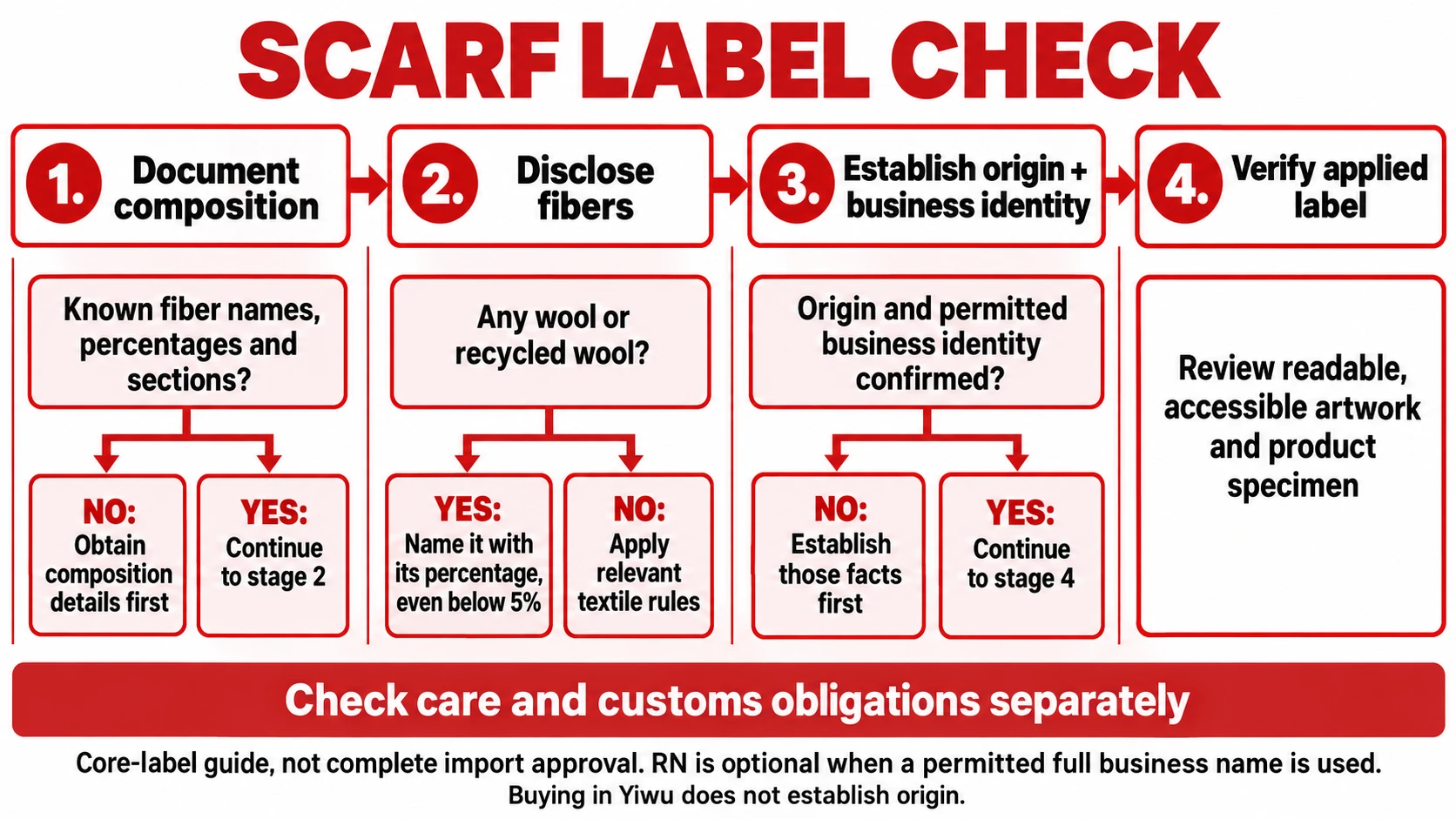
Open the label-check schematic at full size.
- If composition is unknown, obtain fiber names, percentages and section details before writing copy.
- If wool or recycled wool is present, name it with its percentage even below 5%; otherwise apply the relevant textile disclosure rules.
- If actual origin or permitted business identity is unknown, establish those facts first.
- Then review readable, accessible artwork and an applied product specimen. Check care and customs obligations separately.
What to obtain before printing
Start with a composition record tied to the actual scarf SKU and material. It should identify fiber names and percentages, whether any wool is recycled, and whether different sections use different compositions. A supplier’s written declaration is useful input; it is not automatically an independent laboratory result. The FTC reminds importers of their responsibility for proper labeling and recommends periodically checking fiber content through testing.
Next obtain the manufacturing and processing facts needed to establish origin. A China supplier can sell fabric or finished goods produced elsewhere, and buying from a Yiwu stall does not make an item Chinese-origin. Where production crosses countries, do not decide origin by looking at the last shipping address.
Then compare a preproduction artwork proof with an applied-label specimen on the intended scarf. Check the complete wording, actual readability, attachment and visibility after folding or packing. Match the responsible business name to your records. Save the approved version and inspect the production application so an old label design is not used on a new blend.
These are inputs for this label-copy task, not a comprehensive customs-document list. Your invoice, tariff classification, duties, entry requirements and other applicable product obligations need their own checks. Our household product testing guide also explains why product testing and inspection are different activities; correct artwork does not establish material safety or prove a whole batch matches a tested specimen.
Care information needs its own basis. The FTC’s Care Labeling Rule guidance addresses applicable care-label obligations and reliable instructions. Do not invent “hand wash cold,” “dryclean only” or a scarf exemption from the two fiber examples. Determine the care requirements and supported method for the actual item separately.
| Input to verify | Check before label printing |
|---|---|
| Composition | Actual SKU fiber names, percentages, recycled wool and separate sections. |
| Origin | Manufacturing and processing facts, not the Yiwu shipping address. |
| Business identity | Permitted full business name on records or eligible RN. |
| Applied specimen | Readable wording and attachment; care and customs checks separate. |
Coordinate the supplier’s artwork and application
Once the core copy is settled, someone must give the supplier the correct version and verify its application during production. ChineseYiwu’s private-label and OEM coordination service covers branding and packaging work. Discuss the scarf specification, destination, approved wording, artwork and application requirements to confirm the service scope for your order.
This is a request for supplier implementation support. It does not imply that ChineseYiwu holds scarf stock, has tested a particular fiber blend, or can issue regulatory approval or guarantee customs clearance. Confirm any product sourcing, testing coordination or labeling work specifically before ordering.
Conclusion
Write the label from the scarf outward: actual composition, actual origin and a permitted responsible business identity. Keep even a small wool percentage visible by name. The two examples show the completed core copy once those facts are known; the remaining work is to use the right version on the actual product and check care, customs and other applicable obligations on their own terms.
Frequently Asked Questions
Can I write “other fibers” instead of 3% wool?
No. The FTC explicitly requires wool or recycled wool to be named with its percentage even below 5%.
Do I need an RN for my first US scarf order?
Not necessarily. An appropriate full business name can satisfy the identity requirement. A brand alone is insufficient unless it is the full name under which the business operates.
Does buying in Yiwu make “Made in China” correct?
No. Origin follows the applicable manufacturing and processing determination. The buying location and export address are not substitutes.
Can I send these four lines straight to the factory?
Only if the stated assumptions match your actual product and business. Verify the composition, construction and origin, and resolve applicable care and customs requirements separately.
Written by Justin · ChineseYiwu sourcing content