Джастин
Load a wholesale tote bag with four kilograms of groceries and lift. The part most likely to fail is not the canvas. It is the stitch line where the webbing handle meets the body, and it fails long before the fabric tears. Yet that stitch line is the one detail most purchase orders never mention. Tote orders from China come back right or wrong based on four spec decisions: canvas weight, print method, handle attachment, and order quantity. Every supplier quote you receive is a reaction to those four lines.
This guide is for brand owners ordering 100 to 5,000 custom canvas totes. Whether you search it as tote bags wholesale, wholesale canvas bags or wholesale bags and totes, you are buying the same four decisions, and the vocabulary changes nothing about what arrives in the carton. Checkable numbers are cited throughout: tariff rulings, cotton futures prices, conversion arithmetic, published inspection standards. Where no reliable figure exists, the number carries an estimate label. By the end you will hold a spec sheet you can hand any supplier unchanged.
Key Takeaways
- Canvas is quoted in oz per square yard. Multiply by 33.91 for gsm: 10 oz equals 339 gsm, the standard retail tote weight.
- The print method sets the MOQ. Screen printing needs volume to amortise per-colour screens; DTG runs from one piece; heat transfer is cheapest to set up and wears at the film edges.
- Handle-to-body stitching fails before the fabric. Specify a box-X stitch with bartack reinforcement.
- Cotton traded from 62.31 to 80.54 cents per pound between February and June 2026, roughly 29%. Canvas quotes need a written validity date.
- Cotton totes classify as HTS 4202.92.15.00 at 6.3% US general duty, and they are excluded from fibre-content labeling.
- Planning estimates for a 10 oz, one-colour tote: about $3.80-$4.50 per unit at 100 pieces, $1.45-$1.80 at 5,000, FOB China.
The 4 Spec Decisions That Set a Tote’s Price and Failure Rate
Search for wholesale tote bags and you get marketplace listings quoting a unit price with none of the variables behind it. The price is an output. Four inputs produce it, and each belongs in writing before you request a quote.
First, canvas weight in ounces per square yard, running 6 oz to 16 oz for totes. Second, the print method, which decides setup fees and minimum order. Third, the handle attachment, the stitch that survives real loads. Fourth, order quantity, which sets each unit’s share of fixed setup cost.
Notice what is not on that list: the supplier. Buyers usually start by hunting for the right company and treat the specification as something to settle afterwards, in the conversation. That order is backwards, and it is the single most expensive habit in this category. Until those four lines exist in writing, every supplier is answering a different question, so the quotes you collect are not comparable — a $1.90 bag and a $3.60 bag may both be honest replies to a request that never said which bag it wanted.
Write the spec first and the supplier question mostly answers itself. The quantity and the construction you have just written down determine whether a market booth can serve you at all, which is the actual choice this article ends on. Everything else downstream follows from these same four decisions too: the 6.3% US duty on the declared value, the expiry window on the quote, the per-unit ladder below. Our Yiwu bags and luggage sourcing guide covers the wider category; this page owns the tote spec.
Canvas Weight: What 6 oz to 16 oz Actually Means
The ounce figure on a canvas quote is a density, not a bag weight. It means ounces per square yard of fabric. The metric conversion is fixed arithmetic. One ounce is 28.3495 grams; one square yard is 0.836127 square metres; divide and 1 oz/yd2 equals 33.91 gsm. A supplier quoting gsm is describing the same fabric. You can check their number against the ounce figure to two decimal places.
Chinese suppliers actively quote totes at 8 oz, 10 oz and 12 oz; the trade ladder runs wider. Cotton canvas totes are available in a size and grade range spanning roughly 6 oz to 16 oz of fabric weight, in body dimensions from small book totes up to shopper sizes, so the ounce figure is only meaningful next to the dimensions you intend to order. Here is what each step does for a retail bag.
| Canvas weight | Grams per m2 | What it does for a retail tote |
|---|---|---|
| 6 oz | 203 gsm | Giveaway and event bags; liners; light loads only |
| 8 oz | 271 gsm | Light promotional; drapes under load |
| 10 oz | 339 gsm | Standard retail; carries groceries, keeps shape |
| 12 oz | 407 gsm | Premium retail; stiff hand, heavier freight |
| 14 oz | 475 gsm | Structured totes; near upholstery weights |
| 16 oz | 542 gsm | Heavy-duty work bags; overkill for retail |
Weight is the first cost lever: it sets how much cotton sits in every bag. Each step up the ladder adds cotton grams to the same body panels. The cost ladder below does the arithmetic on a flagged fabric-area estimate.
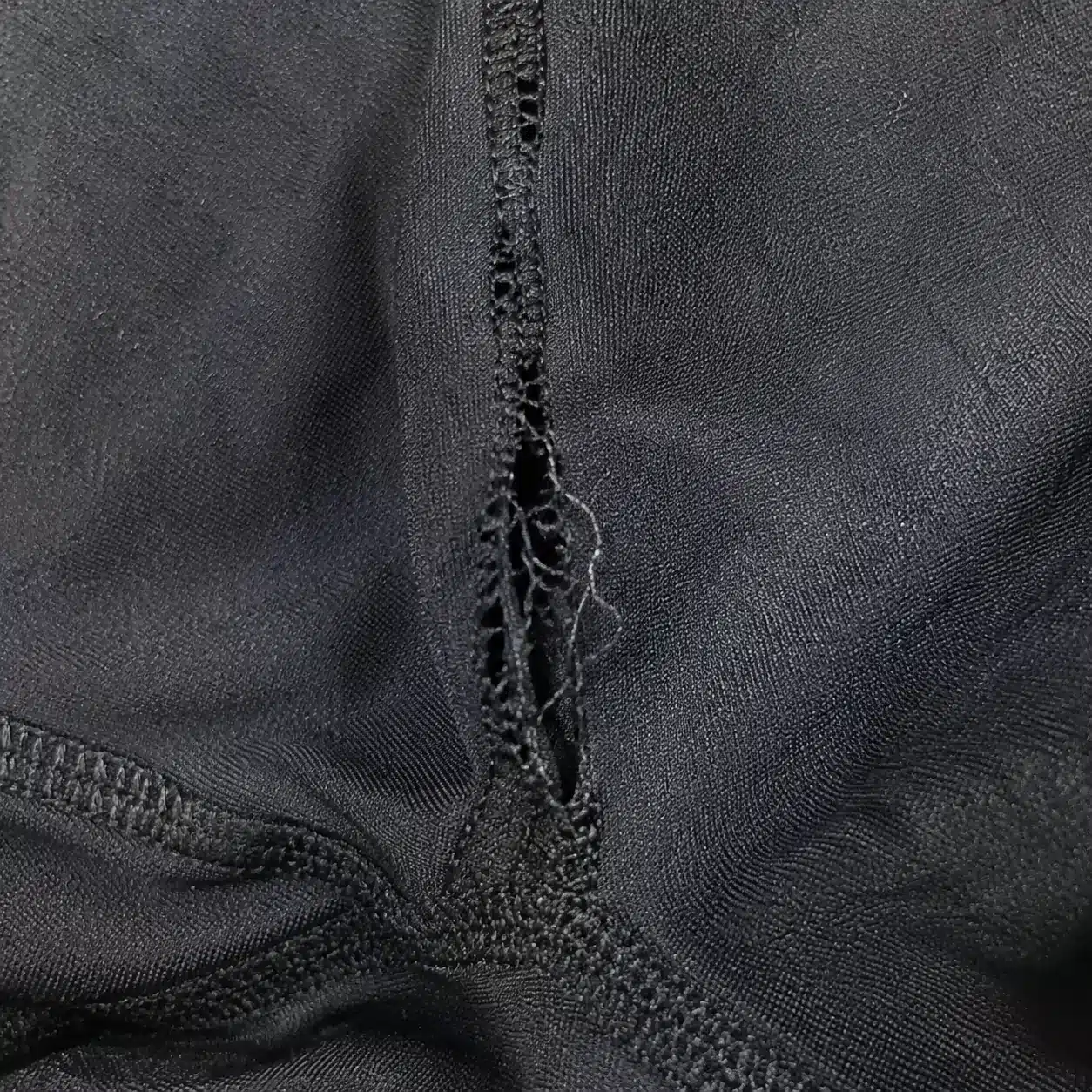
Pick the weight from the use, not the budget line. A retail bag at 6 oz reads as flimsy in the customer’s hand. A giveaway bag at 14 oz burns margin for no positioning gain. For a retail brand’s first run, 10 oz to 12 oz is the band where durability, print quality and unit cost stay in balance.
The 3 Print Methods and the MOQ Each One Forces
The artwork decision is secretly a cost-structure decision. Three methods dominate custom tote production, and each drags a different MOQ behind it. When two suppliers quote the same bag at wildly different minimums, print usually explains it. How MOQ works in practice has its own guide; here is how printing creates it.
Screen printing needs a separate physical screen for every colour in the artwork. Setup costs load up front, then amortise across the run, so the per-unit price drops hard as quantity climbs. The trade-off: screen ink sits on the fabric surface rather than dyeing the fibre. That makes it the most fade- and crack-prone of the three over years of washing.
DTG, direct-to-garment, needs no screens and no setup; it is about as simple as sending an image to a printer, and it can run a single piece. It works best on natural fibres like cotton. Prints survive more than 50 wear-and-wash cycles without cracking when cared for. The per-unit price stays flat, which makes DTG the economics winner on small orders.
Heat transfer prints a design onto carrier film, then presses it onto the fabric. It carries the cheapest setup and handles full-colour artwork, but the structural difference matters: the design sits on the fabric as a separate applied layer rather than as ink carried into the fibre, so wear shows at the film edges and in flexed areas rather than fading evenly. Reserve it for short-life promotional bags, not retail products.
There is a second-order effect worth knowing before you pick. The three methods do not just differ in price and durability — they differ in what a defect looks like, which changes what you can reject at inspection.
Screen misregistration on a multi-colour job shows as a visible offset between colours across the whole run, so it is easy to catch and easy to argue. DTG problems are subtler: under-cured ink looks fine in the factory and fails on the customer’s first wash, weeks after you accepted the goods. Heat transfer fails at the edges, lifting at a corner after handling, which means a lot that passed a visual check on day one can still come back wrong. If you cannot personally inspect, that argues for the method whose failures are visible while the goods are still in China.
| Метод | Setup | Practical MOQ* | Per-unit economics | Wash durability | Best for |
|---|---|---|---|---|---|
| Screen print | One screen per colour | 500-1,000 pcs | Drops sharply with volume | Surface ink; fades/cracks first | 1-3 colour logos at 500+ pcs |
| DTG | None | From 1 pc | Flat; wins small runs | 50+ wash cycles verified | Test runs, full-colour art, sub-300 pcs |
| Heat transfer | Film per design | 100-300 pcs | Cheapest entry | Weakest film layer | Short-life promo bags |
*Practical MOQ bands are planning estimates; factories set their own minimums. Setup mechanics and the DTG wash figure: Shopify’s DTG explainer, Printify’s print comparison.

Screen Print vs DTG: Where the Cost Crossover Sits
The grounded rule is simple. One bag printed DTG can cost significantly less than one bag screen printed, while screen printing’s per-item cost falls below DTG at volume. The crossover is arithmetic, driven by the per-colour screen. Planning figures for that screen fee run roughly $20 to $45 per colour depending on the factory. Treat that band as an estimate; the math it drives is exact.
Take a one-colour logo. A $20-$45 screen spread across 100 units adds $0.20 to $0.45 per bag. Across 500 units it adds $0.04 to $0.09. At 3,000 units it adds under $0.02. Now take a three-colour design at 500 units: three screens at the same band add roughly $0.12 to $0.27 per bag. Every extra colour repeats the charge.
That is the whole decision. Below roughly 300 to 500 pieces, DTG’s flat per-unit price beats a screen setup it never amortises. Above that band, screen printing wins and the margin widens with every thousand pieces. Full-colour photographic artwork shifts the answer toward DTG or transfer regardless of quantity: a screen quote on four-plus colours stacks setup fees fast.
Branding costs do not stop at the print. Labels, hang tags and packaging each carry their own setup fees; our Yiwu private label costs guide itemises those line by line.
The Handle-to-Body Stitch: 4 Anchor Points Where Totes Fail First
A loaded tote concentrates its entire payload into four small anchor points where the webbing meets the body panel. The canvas spreads the load; the stitch line absorbs it. When a bag fails in use, the failure almost always starts at one of those four points, not in the fabric. That makes handle attachment the most valuable line on the spec sheet, and the one most orders skip.
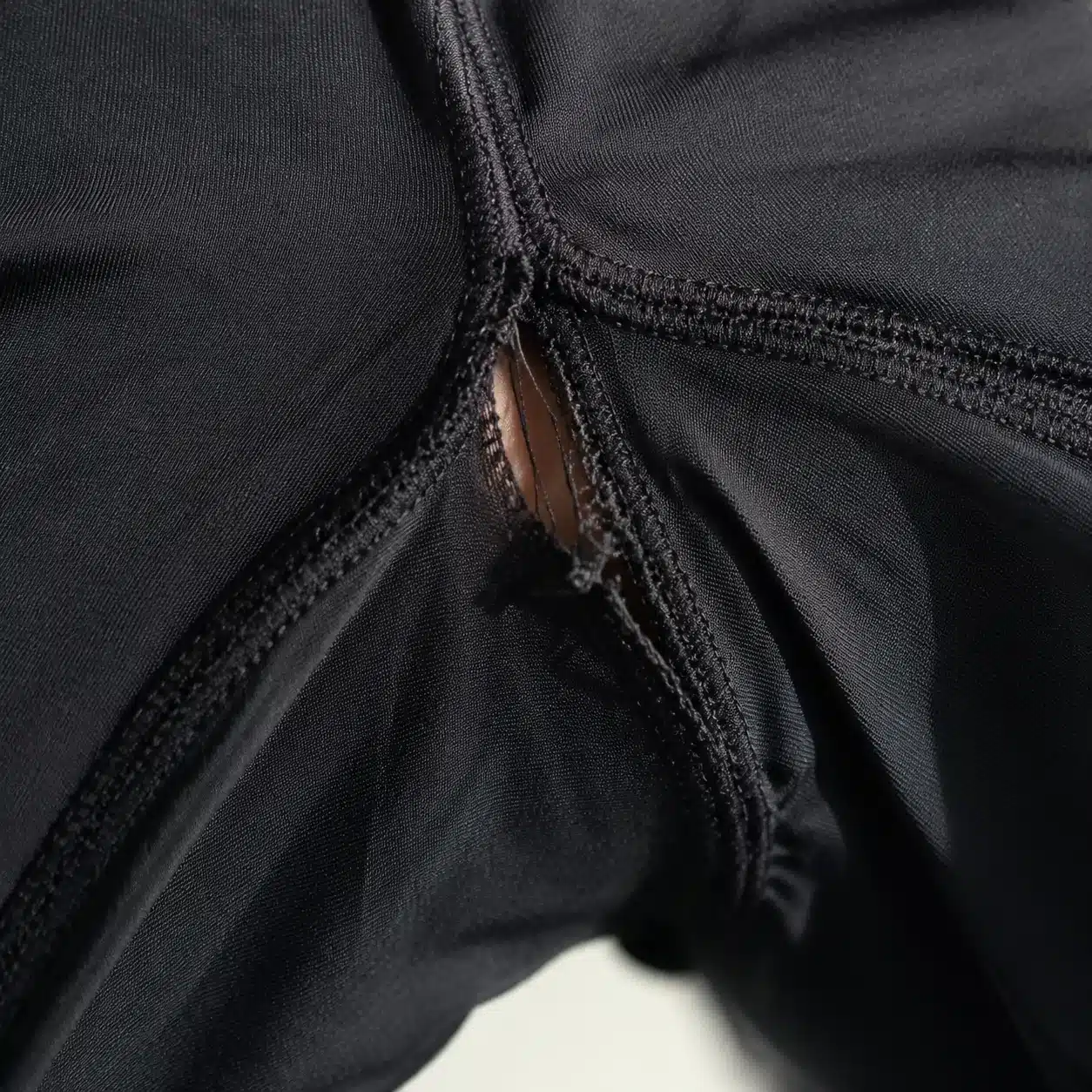
Specify the reinforcement by name so the factory cannot interpret it downward. A box-X pattern stitches a rectangle plus a diagonal cross through the handle base, spreading pull across the whole patch. Bartacks are dense zigzag tacks at the stress corners, the same reinforcement used on belt loops. Together they are the difference between a handle rated for repeated grocery loads and one that tears out in month two.
Write it as a requirement, not a hope: handle attachment in a box-X stitch pattern with bartack reinforcement at all four corners, matching thread weight to the canvas. Then make it inspectable, because a spec nobody checks is a wish.
Which defect class a torn handle belongs to
Get this classification right on the inspection brief, because it decides how many failures your order tolerates. Under the ANSI/ASQ Z1.4 defect definitions this site publishes, a critical defect is a hazardous or unsafe condition — sharp edges, mould. A handle that pulls out is not hazardous; it is a functional failure, which is a major defect at a default tolerance of AQL 2.5.
So do not write “critical” on the brief and assume zero tolerance follows. If a handle failure should stop the shipment outright, say so explicitly: the published note is that strictness levels can be adjusted to your requirements, so a tightened limit on the stitch line is a conversation to have before production, not after the report lands.
Cotton Swung 29% in 4 Months: Why Canvas Quotes Expire in Weeks
Canvas is a cotton product, and cotton trades on futures exchanges. The fabric in your tote reprices with the market whether your supplier warns you or not. Look at 2026 so far. The ICE cotton main contract stood at 62.31 cents per pound on 5 February. The most-active December contract settled at 80.54 cents per pound on 2 June. That is a swing of roughly 29% in four months, in the raw material alone.

Repricing can move faster than the chart suggests. India removed its cotton import duty for five months in late spring 2026 to feed its textile exporters. The policy shift moved trade flows within days of announcement. Mills and bag factories window their quotes off current cotton levels because they must.
Work out what that swing is worth on your own order before deciding it is somebody else’s problem. Raw cotton is roughly $0.18 to $0.21 of a 10 oz bag at the June level, on the geometry estimate used later in this guide. A 29% move on that input is only about five or six cents a bag by itself — small.
The reason it still lands on your invoice is that it moves the whole chain at once: the mill reprices the greige, the dyehouse reprices the finished roll, and the bag factory, which bought neither at your quote date, reprices its fabric line. By the time it reaches a per-unit quote the effect is amplified well beyond the fibre cost, which is why a factory that quoted you in February will not simply honour it in June.
Three habits that keep a quote enforceable
- Require a dated quote with the validity window on its face. Not “valid 30 days” in an email body — on the quotation document, next to the price.
- Carry the same window into the proforma invoice. The PI is the document the deposit is paid against, so a validity window that lives only in the quote has no commercial effect once money moves.
- Re-confirm in writing if production slips past the window. If sampling and approval eat six weeks, the price you agreed is out of date. Treat it as open and settle it before the deposit rather than discovering a “material adjustment” at the balance payment.
A quote with no date is not a quote. It is a snapshot of a moving market, and the person holding the undated snapshot is the one who absorbs the move.
Per-Unit Cost Ladder from 100 to 5,000 Pieces
Read this table as planning estimates, not quotes. No supplier price list sits behind these numbers. They are built from grounded drivers only. Those drivers: the fabric weight conversion (33.91 gsm per oz), the cotton price (80.54 cents/lb on 2 June 2026), the one-screen-per-colour setup mechanic, and the 6.3% US duty rate. Use them to sanity-check real quotes, never to place an order.
Start with the fabric floor. A typical 35 x 40 cm tote, body plus handles, consumes roughly 0.30 to 0.35 square metres of canvas; call that a geometry estimate. At 10 oz (339 gsm) that area weighs about 102 to 119 grams. Cotton at 80.54 cents per pound is roughly $0.18 to $0.21 of raw fibre per bag. Woven fabric costs more on top once spinning, weaving and dyeing are paid for. Fabric is the largest single input, which is why the ounce ladder moves the price so much.
| Quantity | Est. per unit, FOB China | What drives the number |
|---|---|---|
| 100 pcs | $3.80-$4.50 | Screen setup ($0.20-$0.45/unit) and cutting-line minimums dominate |
| 500 pcs | $2.40-$2.90 | Setup amortises; fabric becomes the main cost |
| 1,000 pcs | $2.00-$2.45 | Continuous run; lines settle |
| 3,000 pcs | $1.65-$2.00 | Roll-price fabric; labour efficiency peaks |
| 5,000 pcs | $1.45-$1.80 | Best fabric rates; returns flatten below |
Basis: 10 oz natural cotton canvas, 35 x 40 cm, one-colour screen print one side, FOB China. All figures are flagged planning estimates as of August 2026.
Four variables move the number. Canvas weight: each step up the ladder adds fabric grams to every bag. Colours: each one adds a screen and its fee. Quantity: the curve flattens fast after 3,000. Accessories: pockets, zippers, linings and metal hardware each add operations. Negotiation theatre moves it least; the drivers are structural.
HTS 4202.92.15.00: Duty and Labeling for US Import
US customs classifies cotton canvas tote bags under HTS 4202.92.15.00: travel, sports and similar bags with an outer surface of textile materials, of cotton. That is not a guess. Six published CBP rulings classify these bags the same way. They include ruling B84326 on a canvas tote from China and ruling N059624 on tote bags from China. The decisions span decades and stay consistent.
The column-1 general duty rate on that line is 6.3% ad valorem under the 2026 Harmonized Tariff Schedule. The column-2 rate is 40%, reserved for countries without normal trade relations. Build the 6.3% into landed-cost math early, and build it on the right base.
What the 6.3% is charged on
This is where buyers commonly over-estimate their own duty bill. US duty is assessed on transaction value, and transaction value excludes C.I.F. charges — the customs regulation at 19 CFR 152.103 spells it out in a worked example: on a $2,000 payment made up of $1,850 for goods and $150 for ocean freight and insurance, the freight and insurance are excluded from the dutiable value.
So on a $2,000 FOB tote order the 6.3% falls on the goods figure, roughly $126, and your ocean freight does not get taxed on the way in. If your supplier quotes CIF, ask for the freight and insurance to be shown as separate line items — if those costs cannot be identified and verified separately, the regulation does not let them be deducted, and you pay duty on them.
Additional tariff programs, including any Section 301 overlay on Chinese textiles, change on policy schedules and can dwarf the 6.3% base rate. This page will not fix a moving number in print; confirm the current overlay against your own HTS line with your customs broker before you set a retail price, because that number decides whether the margin you modelled survives.
Here is the compliance surprise most guides miss. The Textile Fiber Products Identification Act requires fibre-content labels on wearing apparel, beddings, towels and a short list of other classes. Bags are not on the list; section 303.45 of 16 CFR Part 303 excludes everything not named. Your totes do not need fibre-content labeling to enter the US market. That removes a cost line and one spec to police at inspection.
Yiwu Booths vs Direct Factory: Where a Tote Order Belongs
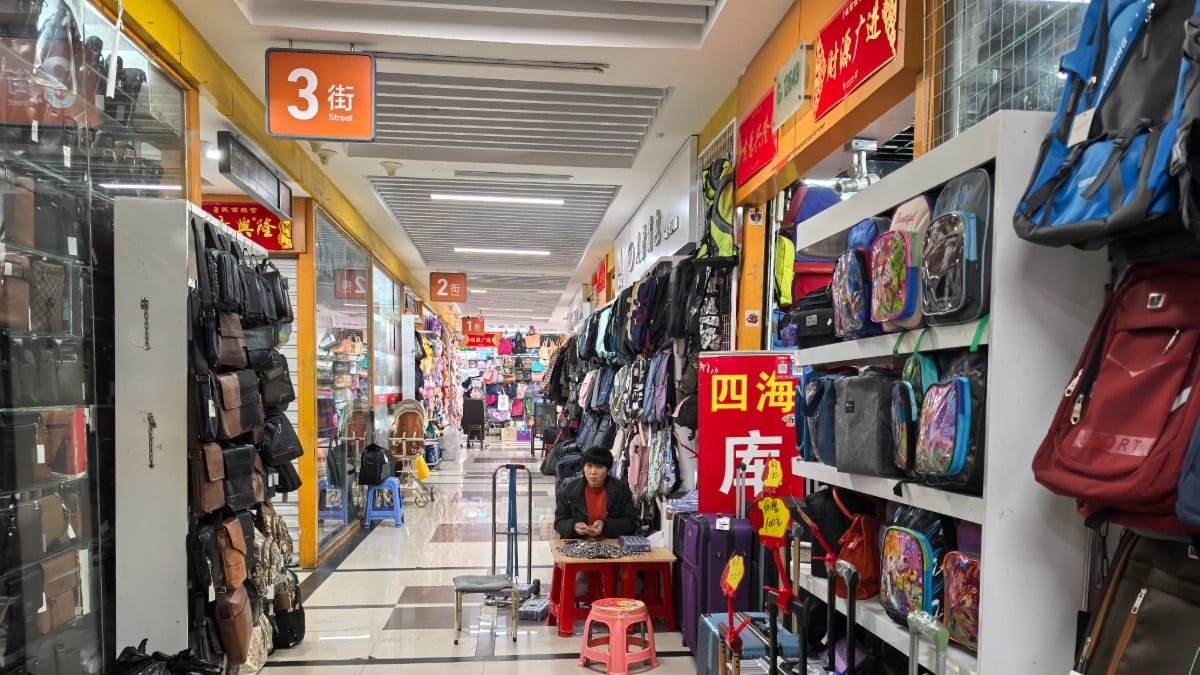
Two routes dominate, and they are not interchangeable. In the Yiwu International Trade City the bags trade sits in District 2, Floor 1 — the Bags and Rainwear zone, where suitcases, backpacks and umbrellas share the aisles with promotional totes. That is the address a buyer walks. The other route never involves the market at all: a dedicated bag factory with its own cutting tables, sewing lines and in-house or contracted print shop.
What each route can and cannot do
A District 2 booth is a trading position first. It carries stock styles it can ship this week, it will put your logo on an existing bag, and its minimum is low because the bag already exists — you are buying into a run that was going to happen anyway. What it cannot do is change the pattern. Ask a booth for a 12 oz body when its stock line is 8 oz, or for a gusset it does not cut, and one of two things happens: it quietly places the order with a factory and adds a layer, or it says yes and delivers the 8 oz bag you did not order.
A factory starts from your spec sheet instead of its shelf. That is why the eight lines above matter more on this route: the factory will build what the document says, including the parts the document gets wrong. The trade-off is minimum quantity and time — cutting a new pattern, ordering fabric to weight and burning screens are all fixed costs that need units to spread across.
The published guidance on this site’s own bags pillar puts numbers on the split: stock bags often start from 100 to 500 pieces, while custom colours, materials or branding raise the minimum toward 500 to 2,000. Read that as the real dividing line. If your order sits under a few hundred pieces and you can live with an existing pattern, the market route is not a compromise, it is the correct tool. Once you are specifying fabric weight and stitch construction, you have left what a booth can honestly promise.

Read across the two routes and the decision falls into three bands. Under 1,000 pieces, start with market booths; their low minimums and stock styles absorb a test run. At 5,000 pieces and above, take the spec to factory lines. Between the two, quote both routes and let the numbers argue. Those thresholds are a working rule of thumb rather than a published standard — but the facts underneath them, on booth depth and factory specialisation, come from the published bags pillar on this site.
Whichever route you pick, execution beats geography. A written spec sheet, comparable quotes from three to five suppliers, and inspection before the balance payment matter more than which district the sewing happens in. If you want that handled for you, our product sourcing service turns a tote spec sheet into comparable quotes and manages the order through inspection.
The Tote Spec Sheet to Send Suppliers (Copy Verbatim)
This is the deliverable of the guide. Copy the block below, replace the sample values with yours, send it unchanged to three to five suppliers. Identical specs produce comparable quotes; vague requests produce quotes you cannot compare. Every line traces to a decision covered above.
Custom Canvas Tote Bag — Request for Quotation
- Fabric: 10 oz / 339 gsm natural cotton canvas, undyed. Weight tolerance +/-5%, verified by weigh-out at inspection.
- Dimensions: body 35 x 40 cm (sample value — set yours), flat bottom or gusset as specified.
- Handles: cotton webbing, 2.5 cm wide, 25 cm drop (sample values). Attachment: box-X stitch pattern with bartack reinforcement at all four anchor points.
- Print: one-colour screen print, one side, artwork to PMS reference supplied. State colours as separate line items.
- Quantity: quote 500 / 1,000 / 3,000 / 5,000 pieces as separate columns.
- Packing: individual polybag, export cartons, carton dimensions and piece count per carton stated.
- Quality: pre-shipment inspection to ANSI/ASQ Z1.4 sampling; acceptance quality limits 0 critical, 2.5 major, 4.0 minor. Handle pull-out to be treated as a major defect and load-tested on the sample draw.
- Commercial: FOB (name port), dated quote with written validity window, sample cost and lead time stated, declared HTS 4202.92.15.00.
Compare replies on three columns only: unit price by quantity tier, quote validity date, sample lead time. Suppliers who cannot quote against a complete spec are telling you how they will handle the order.
Who this is for: brand owners and wholesale buyers who have filled in the eight lines above and are ordering at a real MOQ rather than buying singles. The documented sourcing process sends your spec out as an RFP to 20+ factories, filters it to three candidates, audits them on site or by video, then consolidates their bags into one box for side-by-side comparison. Who it is not for: if you want a few cartons of stock totes off an existing run, the market-agent route is cheaper and faster.
Inspection Before Shipping: The AQL Levels That Matter
A spec sheet is a promise; inspection is the proof. The inspection service this site publishes follows the ANSI/ASQ Z1.4 (ISO 2859-1) sampling tables, with default acceptance limits of 0 for critical defects, AQL 2.5 for major and AQL 4.0 for minor, adjustable to a buyer’s own requirements. Standalone inspections are charged on a flat daily rate, quoted on the service page as an example figure of $199 per man-day rather than a fixed price list. The report is a PDF with hi-res photos, video tests and measurement data, delivered within 24 hours. A failed inspection triggers a Do Not Ship alert, and the final payment is withheld until the factory reworks the goods.
What a tote inspection covers, and where it stops
The documented procedure runs at three points rather than one: during production at 20-50% complete, pre-shipment once the lot is 100% produced and 80% packed, and loading supervision on the day the container is stuffed. The pre-shipment stage is the gatekeeper — if it fails, the shipment stops. What that check covers is quantity, workmanship, function and packing against your written spec, which is precisely why the spec has to be written before anyone inspects against it.
Where it stops is worth being equally clear about. An inspection is a sampling exercise, not a 100% audit: it tells you whether a lot is likely within your acceptance limits, not that every bag is perfect. It does not substitute for laboratory testing — if you need a certified colourfastness or tensile result for a retail customer, that is a lab job with a test report, and it is commissioned separately. And nothing checked at the factory can rescue a specification that was wrong on paper; an inspector confirms the goods match the document, so a document that asked for the wrong stitch produces a passing report on a bag that will still fail.
Four checkpoints that belong in a tote inspection brief

A general inspection checks quantity, workmanship, function and packing. That is the floor. For a canvas tote, four checkpoints deserve their own named lines, because a generic brief will not catch any of them.
- Stitch pull. Load-test sampled handles against the box-X and bartack requirement. This is the checkpoint the rest of the article exists for.
- Fabric weigh-out. Weigh a measured canvas area and confirm the quoted oz/gsm within the tolerance you wrote. Fabric substitution is the quietest way to lose 2 oz between sample and production, and it is invisible to the eye.
- Print adhesion. Rub and flex tests for cracking, with colour checked against the PMS reference rather than against the approved sample’s memory.
- Dimensions and hardware. Body size and handle drop against the spec; on any tote with a zip closure, cycle the slider open and shut repeatedly and check the pull does not detach, since a zipper is a moving part on an otherwise static product.
Budget the check like a cost line, not a luxury. At the published example rate of $199 per man-day, one inspection day spread across a 3,000-piece order adds about $0.07 a bag. Set that against the estimate ladder above — $1.65 to $2.00 a unit, so $4,950 to $6,000 of goods — and the check costs roughly 3.3% to 4.0% of the order. That is a real line, not a rounding error, and it behaves like a fixed fee rather than a levy: the same single day on a 10,000-piece run lands near 1%, so the case for inspecting gets stronger, not weaker, as the order grows. It is also the only step that converts the written spec into pass/fail evidence before the balance clears, and the only one that catches a 10 oz bag shipped as 8 oz before it reaches your customers rather than after. The full procedure is on our pre-shipment inspection service page, with a broader product inspection checklist if you run your own checks.
Check the sampling standard before you sign off on the brief
Useful if you are an importer or wholesale buyer holding a container-bound order and want to see the defect tables, the three inspection stages and a real sample report before you set your own tolerances. Less useful if you have already appointed a third-party inspector — in that case just hand them the four checkpoints above.
Rather compare bags than photographs?
Who this is for: wholesale buyers and importers placing a first branded canvas tote program at a genuine MOQ, who want the shortlist and the factory checks handled rather than run by email. The documented process runs your spec out as an RFP, audits the candidates on site or by video, and consolidates their bags into one box so you can put your hands on the stitch line before a deposit goes anywhere. Who it is not for: buyers taking a few cartons of stock totes off an existing run — that is a market-agent job, not a factory search.
Часто задаваемые вопросы
What is the MOQ for custom tote bags from China?
The print method sets it. Screen printing typically starts around 500 to 1,000 pieces because each colour needs its own screen; DTG runs from one piece; heat transfer sits near 100 to 300. Treat those bands as planning estimates, not quotes.
Which is cheaper for 200 tote bags: screen printing or DTG?
DTG, in nearly every case. At 200 units a one-colour screen setup of $20 to $45 still adds $0.10 to $0.23 a bag, and that fee band is an estimate. Screen printing overtakes DTG in the hundreds of pieces.
How long does a wholesale tote quote stay valid?
Treat it as short-dated unless it says otherwise. Cotton moved from 62.31 to 80.54 cents per pound between February and June 2026. Require a dated quote, carry the validity window into the proforma invoice, and re-confirm in writing if production slips.
Do cotton tote bags need fibre-content labels for US import?
No. The Textile Fiber Products Identification Act’s regulation, 16 CFR 303.45, lists the classes that must carry fibre labels. Bags are not on that list; everything not listed is excluded. That removes a labeling cost and one inspection checkpoint.
What import duty applies to cotton tote bags in the US?
Cotton canvas totes classify under HTS 4202.92.15.00, carrying a 6.3% column-1 general rate in the 2026 schedule, charged on the goods value rather than freight. Confirm any current tariff overlay with your customs broker.
Skip 1 Spec Line, Pay for It Later
Every omitted spec line converts into a bill later. Skip the stitch spec and handle failures surface as customer returns, months after the container is paid for. Skip the dated quote and a market that swung 29% in four months can reprice your order between sample approval and production. Pick the wrong print method and screen setup fees get amortised across 100 units instead of 3,000. Skip the AQL line and the only quality decision left is whether to ship defects or eat them.
None of these costs shows up in the unit price you are comparing right now. That is exactly why the spec sheet has to exist before the quotes do. Copy it, set your values, send it to three suppliers this week. The spread between those three replies will teach you more about the tote market than any listing page ever will.