 Джастин
The test report came back clean, and it named a factory in Chaozhou you have never spoken to.
That is the moment most kitchenware importers discover what they actually bought. The booth you negotiated with, the WeChat contact who sent the samples, the company on the proforma invoice — none of them pressed the clay. Somebody else did, four hundred kilometres away, and you have no relationship with them at all. For a mug that is an annoyance. For a food-contact product entering California under your own brand name, it is a compliance chain with a stranger in the middle of it.
Kitchenware punishes this more than almost any other category, because a single kitchenware order is not one supply chain. It is four. Ceramics, stainless steel, silicone and small electricals are made in different provinces by different kinds of company, and the wholesale market that will happily sell you all four in one afternoon is a genuine maker of approximately none of them.
Key takeaways
- The first decision is channel, not supplier. A trading market and a production cluster are different supply structures, not two grades of the same thing. Choosing wrong is what puts an unfamiliar plant name on your test report.
- Kitchenware routes by material. Ceramics gravitate to Chaozhou and Jingdezhen, stainless drinkware and cookware hardware to Yongkang, silicone and coated cookware to Guangdong and Zhejiang. One buying trip cannot reach all of them.
- The channel decision shows up in duty. US ceramic tableware is dutiable at 28% as hotel or restaurant ware (HTS 6912.00.20.00) against 4.5%–10% on the household lines — the same physical object, a different description.
- Stainless kitchenware enters the US at 2% (HTS 7323.93.00) while enamelled cast iron enters Free (7323.92.00) and coated non-stainless steel pays 5.3% (7323.91.50).
- California AB 1200 does not ban PFAS in cookware. It requires disclosure — and it makes the importer whose name is on the label the responsible “manufacturer”. Several widely-read summaries get this backwards.
- MOQ is structural, not a price list. It moves with who is holding the inventory risk, which is a function of the channel you picked.
On this page
- Who this guide is for, and who should stop reading
- The question behind the question: are you buying from a maker or a reseller?
- Kitchenware category routing: where each material is actually made
- What the channel decision does to your landed cost
- Compliance follows the factory, not the booth
- MOQ, pricing and lead time: how the channel sets the terms
- Eight questions that reveal whether your supplier makes it
- What we check, and where we stop
- Frequently asked questions
Who This Guide Is For, and Who Should Stop Reading
“Kitchenware wholesale suppliers” is two different businesses wearing one search phrase, and it is worth being blunt about which one this page serves.
Type it without a country and the results are American distributors — restaurant supply houses, trade-account catalogues, companies that will ship you a case of hotel pans on Thursday. Add “China” and the results change completely: sourcing agencies, factory rosters, import guides. Same words, opposite logistics.
This guide is for you if
- You are importing kitchenware from China directly, at part-container or container scale.
- You sell under your own brand — private label, marketplace, or a retail programme where your company name goes on the product.
- You need to decide where in China to buy before you decide who to buy from.
Look elsewhere if
- You want stock delivered next week on a domestic trade account. That is a distributor relationship, and the US distributors ranking for the unmodified phrase are the right answer.
- You are buying a handful of units. Nothing below applies at that volume.
- You already know your factory, have a signed compliance file and just want a freight quote.
The rest of this page assumes the first list. It is deliberately not a roster of company names — those age badly and you cannot verify them from a screen. It is the routing logic underneath the roster, which stays true next quarter when you are buying a different product.

The Question Behind the Question: Are You Buying From a Maker or a Reseller?
Buyers usually arrive at this category with the wrong question. They ask which supplier is best, when the thing that will actually determine their year is which kind of counterparty they are dealing with — and those two are not ranked on the same scale.
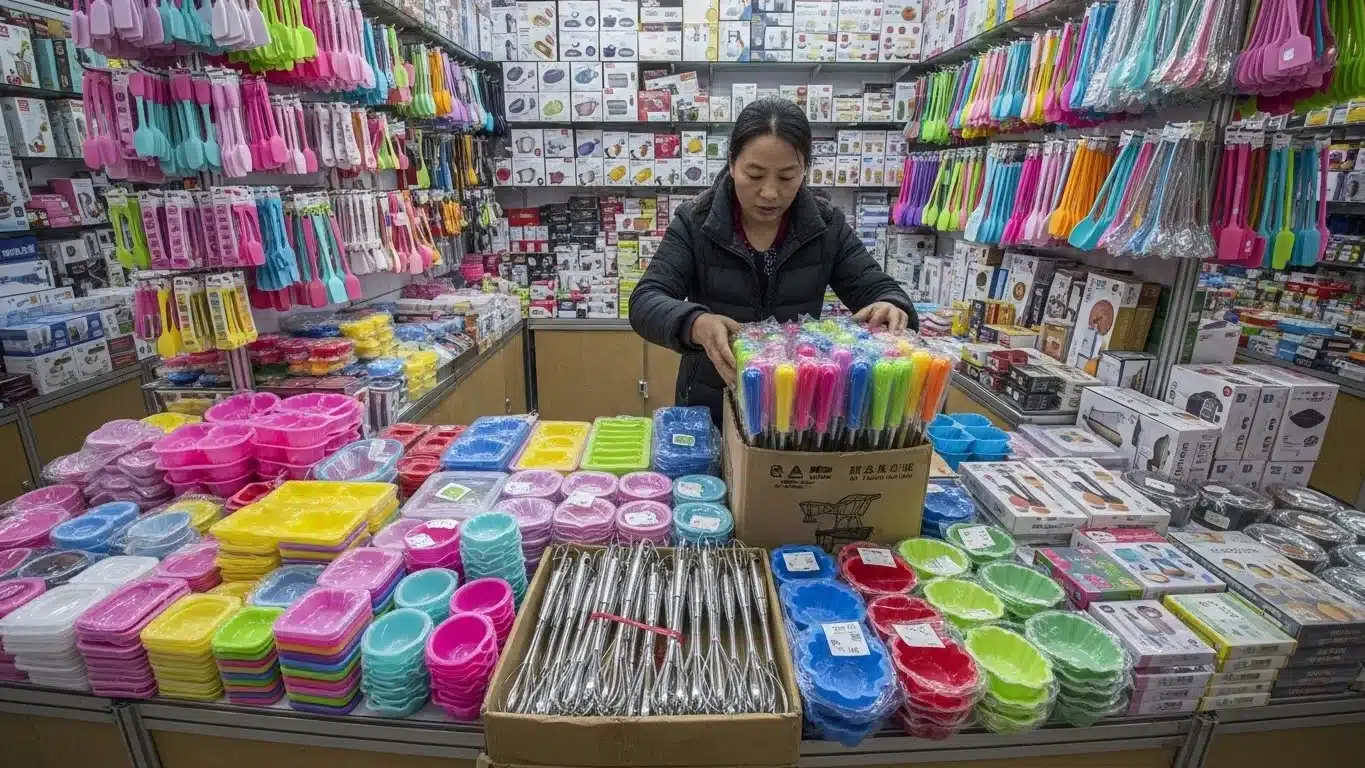
A wholesale trading market is an aggregation layer. Its product is assortment: thousands of SKUs in walking distance, small quantities, immediate stock, and one invoice covering goods from dozens of unrelated producers. Yiwu International Trade City is the extreme version — roughly 75,000 booths across five districts, with District 2 the one carrying hardware and kitchenware. That is a real and genuinely useful commercial function. It is simply not manufacturing.
A production cluster is the opposite trade. One region, one material discipline, deep tooling, and companies that own the process end to end. You get control, traceability and unit economics at volume. You do not get assortment — a cookware plant in a hardware cluster cannot also supply your ceramic mugs, and will not pretend to.
Neither is the “good” option. They are answers to different questions, and the failure mode is buying through one while assuming you are in the other.
| What you are optimising for | Trading market | Production cluster |
|---|---|---|
| Many SKUs, one container | Strong — this is the whole point | Weak — one material discipline per plant |
| Lowest unit cost at volume | Weak — a margin layer sits in the price | Strong |
| Small trial quantities | Strong — stock is already made | Weak — a run has to be scheduled |
| Custom tooling, moulds, your own design | Indirect — brokered to a plant you may not meet | Strong — you are talking to the tool owner |
| Compliance traceability for food contact | Depends entirely on disclosure of the real plant | Direct — the tested plant is the plant |
| Speed to first shipment | Strong | Slower — production is scheduled, not picked |
The practical tell is documentary, not conversational. Ask for the test report and the business licence, then look at whether the name on the report, the name on the licence and the name on your invoice are the same legal entity. When they are not, that is not automatically fraud — plenty of honest trading companies represent plants openly. What matters is whether the gap was disclosed before you asked.
Kitchenware Category Routing: Where Each Material Is Actually Made
This is the section to keep. Once you know where your material is made, most of the other decisions follow automatically.
China’s consumer manufacturing is intensely regional, and the regions are not marketing labels — they are decades of accumulated tooling, skilled labour and supplier depth. Chaozhou in Guangdong was awarded the title “China’s Porcelain Capital” in April 2004; Raoping County within it was designated “Home of China’s daily ceramics export” in February 2006, and a National Characteristic Industrial Base of Daily-use Ceramics was listed there in January 2007. Yongkang in Zhejiang is the recognised hardware cluster, the one behind a large share of the country’s stainless drinkware and cookware hardware. These designations are useful to a buyer for exactly one reason: they tell you where the kiln or the press physically is.
| Категория | Where it is actually produced | Buy through a trading market? |
|---|---|---|
| Ceramic & porcelain tableware | Chaozhou and Jingdezhen kilns | Only for stock designs. Custom glaze or shape belongs at the kiln. |
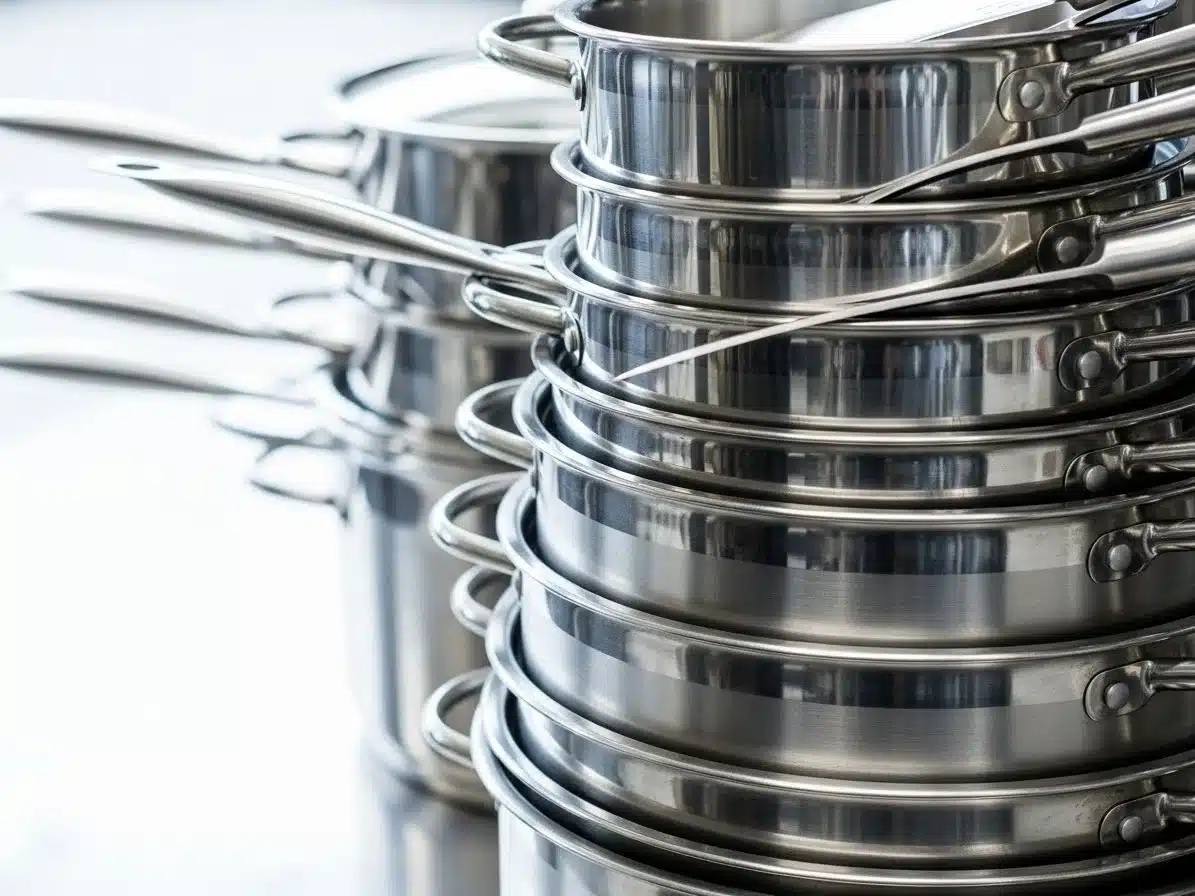
| Stainless cookware, drinkware, flasks | Yongkang and the wider Zhejiang hardware belt | Rarely. Grade verification needs the mill paperwork the plant holds. |
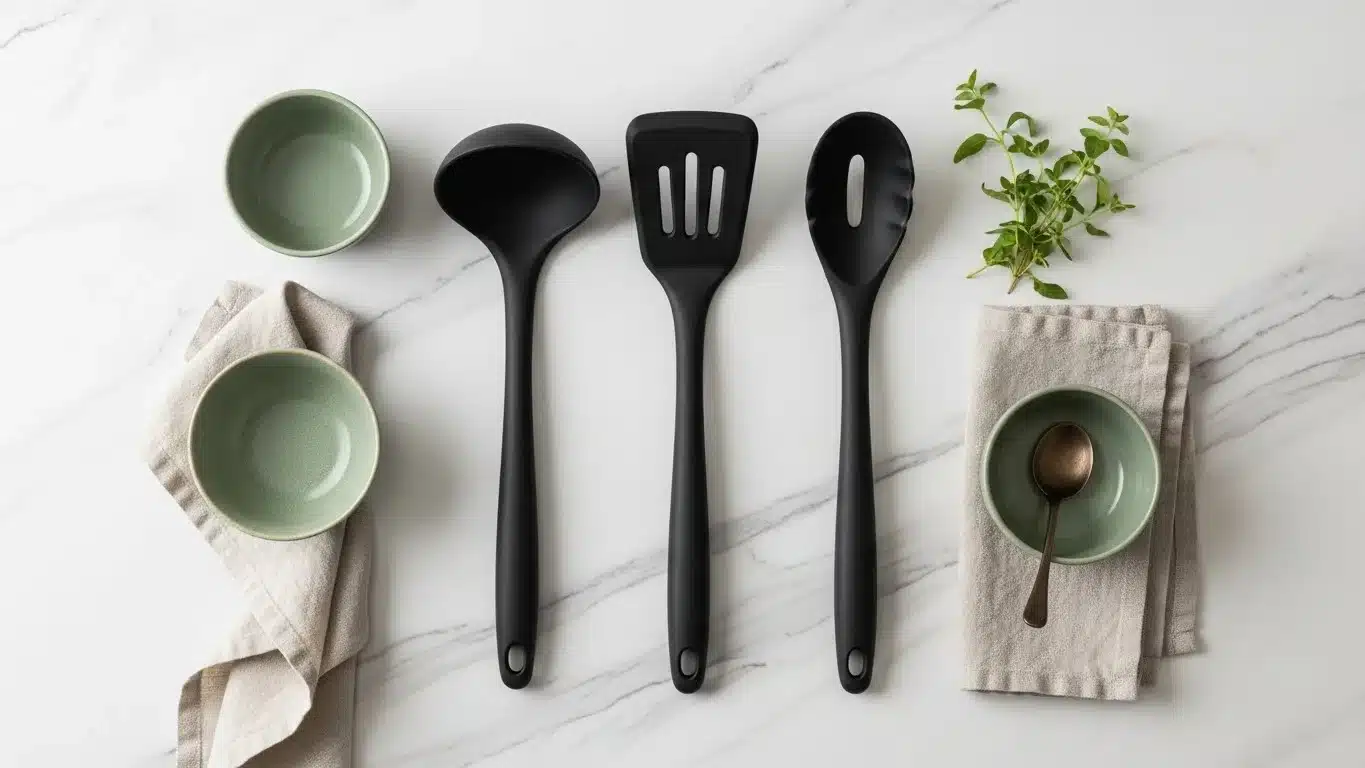
| Silicone bakeware and utensils | Guangdong and coastal Zhejiang compression moulders | Stock yes; anything food-contact and branded, no. |
| Plastic housewares, storage, gadgets | Injection moulders across Zhejiang and Guangdong | Yes — this is the market’s strongest category. |
| Small electrical appliances | Shenzhen, Zhongshan and the Pearl River Delta | No. Electrical safety certification has to trace to the maker. |
| Kitchen textiles — aprons, mitts, cloths | Textile towns across Zhejiang and Jiangsu | Yes — low risk, high assortment value. |
Where the trading market genuinely wins
The routing table reads as a case against the market, so here is the case for it, because it is a real one.
If your programme is twelve low-risk SKUs across four materials at a few thousand units each — storage boxes, cloths, gadgets, a couple of utensil sets — no single factory in China wants that order. A cluster plant would quote you a minimum per item that makes the assortment impossible, and you would be running four supplier relationships to fill one container. The market solves precisely this, and the consolidation is worth paying a margin for. That is a considered decision, not a compromise, and it is the case where buying through an agent in the market beats going direct.
The judgement is per SKU, not per order. Most kitchenware programmes are honestly mixed: the ceramic mug that carries your logo and your compliance exposure should come from the kiln, while the dish cloths that ship in the same container can perfectly well come from a booth.
Food-grade stainless: the material question underneath the routing question
“Food grade stainless” and “304” are claims, not evidence, and every booth in every market will make them without hesitation. What distinguishes a real answer is that it is traceable: the steel arrived on a mill certificate, the plant can produce it, and the number on it matches the number on your purchase order. A positive material identification test on a finished sample can confirm the alloy independently, and for a first order from an unfamiliar source it is money well spent.
Note where this pushes you. Verifying the claim requires reaching the party that bought the raw coil — which is the plant, not the reseller. The material question and the channel question are the same question.
What the Channel Decision Does to Your Landed Cost (US Tariff Lines)
Everything above is procurement theory until it shows up on a customs entry. This section is US import specific — the rates below are from the United States Harmonized Tariff Schedule and do not travel to other markets — but the structural lesson does apply everywhere: how your goods are described determines what you pay, and the description is your legal responsibility no matter which channel supplied them.
Start with steel, because kitchenware buyers routinely assume one rate covers it.
| Product | HTS subheading | General rate |
|---|---|---|
| Stainless steel kitchenware | 7323.93.00 | 2% |
| Enamelled cast iron cookware | 7323.92.00 | Free |
| Enamelled iron or steel, not cast | 7323.94.00 | 2.7% |
| Other coated or plated steel kitchenware | 7323.91.50 | 5.3% |
| Plastic plates, cups, bowls | 3924.10.20.00 | 6.5% |
| Plastic trays | 3924.10.30.00 | 5.3% |
| Silicone and rubber household articles | 4016.99.05.00 | 3.4% |
Four different rates inside one heading, decided by whether the metal is stainless, cast, enamelled or coated. A supplier who describes everything on the packing list as “kitchen utensils” is not helping you. Every rate above is from the USITC Harmonized Tariff Schedule, checked in August 2026 — verify your own lines there before you quote, because rates and special measures change.
“How to Use the Harmonized Tariff Schedule of the United States” — Shipping Solutions. A neutral walkthrough of the schedule the rates above come from.
The ceramic trap: household versus hotel ware
Ceramics carry the most expensive classification decision in the category, and it has nothing to do with quality.
The US schedule splits ceramic tableware by intended use. Non-porcelain ceramic classified as hotel or restaurant ware falls under HTS 6912.00.20.00 at a general rate of 28%. Household lines of the same material sit at 4.5% (6912.00.39), 9.8% (6912.00.35 and 6912.00.48) and 10% for mugs and steins (6912.00.44.00). Porcelain repeats the pattern: 6911.10.10.00 hotel or restaurant ware at 25%, against 8% for household pieces valued not over $31.50 per dozen (6911.10.15.00) and 6% above that (6911.10.25.00).
Read those two sentences again with a commercial eye. A mug can be dutiable at 25% or at 6% depending on how the entry describes its intended use, and the physical object need not change at all. If you sell into the hospitality trade this is a cost you must model from the first quote; if you sell to consumers, it is a misclassification risk that a careless packing list can hand you.
Cutlery has its own rule worth knowing before you build a gift set. Under HTS 8215.10.00.00 and 8215.20.00.00, a set of assorted articles is dutied at “the rate of duty applicable to that article in the set subject to the highest rate of duty” — not an average, and not the rate of the main item. A plain stainless gift set falls under 8215.20.00.00, and the component rates it can inherit sit a long way apart: table forks with wooden handles are 0.3¢ each plus 4.5% under 8215.99.24.00, while spoons valued under 25 cents each carry 14% under 8215.99.30.00. Add one cheap spoon to a boxed set and the whole set can follow it up.
Compliance Follows the Factory, Not the Booth
Food-contact compliance is where the maker-or-reseller question stops being commercial and becomes legal. The obligations below attach to the product and to the company whose name is on it. They do not attach to the booth that sold it to you, and they are not discharged by a PDF someone forwarded on WeChat.
Two anchors matter before the paperwork conversation starts.
In the United States, silicone and rubber articles intended for repeated food contact are governed by 21 CFR 177.2600, and the limits are specific rather than rhetorical. For aqueous food, the finished food-contact surface extracted with distilled water at reflux temperature must yield total extractives “not to exceed 20 milligrams per square inch during the first 7 hours of extraction, nor to exceed 1 milligram per square inch during the succeeding 2 hours”.
For fatty food the same test with n-hexane allows “not to exceed 175 milligrams per square inch during the first 7 hours” and 4 milligrams per square inch over the following 2. The section explicitly does not cover rubber nursing-bottle nipples, which are regulated separately — worth knowing if your range drifts toward baby feeding.
In the European Union, Regulation (EC) No 1935/2004 Article 3 sets the framework duty for every food-contact material regardless of what it is made of: materials must be manufactured so that under normal or foreseeable use they do not transfer constituents to food in quantities that could “endanger human health”, “bring about an unacceptable change in the composition of the food”, or “bring about a deterioration in the organoleptic characteristics thereof”. Article 3 also states that labelling, advertising and presentation “shall not mislead the consumers”.
This site’s kitchenware compliance guide covers the FDA and LFGB testing routes in detail, and household product testing covers the lab process. What follows is the part that bears on your channel decision specifically.
California AB 1200: what it actually says
If you sell cookware into California, this is the most commonly misdescribed rule affecting your product, and the error runs in a direction that will hurt you.
AB 1200 (2021–2022), Chapter 503, was approved on 5 October 2021 and added Chapter 15 to Part 3 of Division 104 of the California Health and Safety Code. Plenty of secondary summaries describe it as a PFAS ban on cookware. It is not. The PFAS prohibition in §109000(b), effective 1 January 2023, applies to plant-fibre food packaging. The cookware provisions are a disclosure regime — which is a lower bar to clear and a much easier one to fail quietly, because nothing gets stopped at the border to tell you.
What the statute requires of cookware:
- Website disclosure from 1 January 2023 (§109012). The manufacturer must post, on the cookware’s website, a list of all chemicals in the product that also appear on the designated list, the names of the authoritative lists that DTSC referenced in compiling it, and links to those lists.
- Product labelling from 1 January 2024 (§109011(a)). Where an intentionally added chemical on the designated list is present in the handle or any food-contact surface, the label must list those chemicals introduced by the phrase “This product contains:”, plus a statement in both English and Spanish reading “For more information about chemicals in this product, visit”, followed by a web address and a QR or other machine-readable code.
- A narrow small-item exemption (§109011(c)). It applies only if the item cannot fit a label of at least two square inches и has no exterior wrapper, tag or attachment that could carry one — and even then the statement must still appear on the online product listing.
- No class-level “free of” claims (§109013). A manufacturer may not claim the cookware is free of a specific chemical if that chemical belongs to a group or class on the designated list, unless no individual chemical from that class is intentionally added.
That last one deserves a moment. The “PFOA-free” sticker your supplier is proud of is a claim about one substance in a class of thousands. Repeat it on your packaging while another PFAS-class chemical is intentionally present, and the statute is not on your side. Suppliers offer these stickers in good faith; the liability is still yours.
Which brings us to the definition that ties this whole page together. Under §109010(d), “manufacturer” includes the person or entity whose name appears on the product label — so a private-label importer is the manufacturer for these purposes. And §109014 provides that non-compliant cookware “shall not be sold, offered for sale, or distributed in the state”. The scope is broader than most buyers assume, too: §109010(a) defines cookware as durable houseware used to prepare, dispense or store food, and expressly “includes pots, pans, skillets, grills, baking sheets, baking molds, trays, bowls, and cooking utensils”.
You cannot answer any of that from a booth. Meeting it requires knowing what was intentionally added to the coating, the handle and the food-contact surface — which is knowledge held by whoever formulated and moulded them. When your compliance file has to name a plant, buying through a channel that will not name one is a structural problem, not a paperwork delay.
Once production is running, inspection is what confirms the goods in the carton match the goods on the report. Our own published inspection standard is ANSI/ASQ Z1.4 (ISO 2859-1) with a default tolerance of zero critical defects, AQL 2.5 major and AQL 4.0 minor, and we run it at 100% produced and 80% packed so a failure still has somewhere to go. The leverage matters more than the report: we hold the 70% balance until a re-inspection passes, which a third-party inspector who files a PDF and leaves cannot do.
MOQ, Pricing and Lead Time: How the Channel Sets the Terms
Buyers ask for the MOQ as though it were a published figure. It is better understood as a question about who is carrying inventory risk — and your channel choice has already answered most of it.
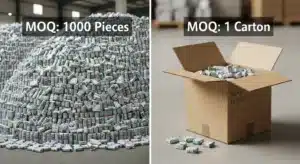
A trading market booth is selling from stock, or from a pooled run it has already committed to. Its minimum reflects a break-pack decision, so it can be low. A cluster factory is scheduling machine time and buying raw material against your order, so its minimum reflects the point at which a production run stops losing money. Neither number is arbitrary and neither is really negotiable in the way buyers hope; what moves is the terms around it.
Three tiers behave differently, whatever the material:
- Stock goods. Existing design, existing packaging, no branding. The lowest minimum available in any channel, and the fastest — but you have no exclusivity and your competitor can buy the identical item next week.
- Brand-tagged. Existing product, your logo, your carton. The minimum rises to cover a print or label setup, and lead time gains a packaging step. This is where most first private-label orders sit.
- Custom tooled. Your mould, your shape, your colour. The minimum is set by amortising tooling, and lead time gains the tooling build plus sampling. This tier only exists at the plant — a booth brokering it is adding a layer to a job that most needs direct contact.
On lead time the honest generalisation is directional: stock ships as fast as it can be inspected and consolidated, brand-tagged adds a packaging and print cycle, and custom-tooled adds tooling and sample approval rounds that are measured in weeks and depend on how many revisions you ask for. Anyone quoting you a universal day count for “kitchenware” is quoting a category that does not exist.
What we are not publishing here, and why. We are not printing per-material MOQ bands or FOB price ranges in this guide. Published bands for kitchenware by material already exist on our Yiwu kitchenware supplier guide, and inventing a second set here would give you two numbers that disagree. Any real minimum is set per project against your actual size and colour mix — so treat it as a question for your first email rather than a figure to plan around, and ask it per SKU tier rather than for the order as a whole.
Eight Questions That Reveal Whether Your Supplier Makes It
None of the above helps unless you can tell, in a conversation, which kind of counterparty you have. These eight questions do that. They are not a trap or an interrogation — an honest trading company answers them comfortably and often volunteers the answers first.
- “Which plant will run this order, and where is it?” The single most informative question you can ask. A maker names a place instantly. A reseller who intends to be straight with you says “we work with a factory in Chaozhou”. A reseller who does not will answer about their own company instead. Listen for whether a place name appears at all.
- “Is the company on the test report the same company on the invoice?” Ask before you see either. The answer tells you whether the compliance chain has a gap in it, and asking early means you are told rather than discovering it later.
- “Which specific SKU was tested, and when?” A report for a “similar product” is not a report for your product. Reports also age, and formulations change between runs.
- “Can I see the mill certificate for the steel, or the raw material spec for the silicone?” This separates people who bought the material from people who bought the finished goods. Only the former can produce it.
- “Which chemicals on California’s designated list are intentionally added to the coating, the handle and the food-contact surface?” If you sell into California you need this answer to comply with §109012 and §109011 at all. A supplier who has never been asked will need to go to the plant — and how quickly they can is itself the answer to question 1.
- “Who owns the mould if I pay for the tooling?” Ask before the tooling invoice, not after. Get it in writing, in your name.
- “What is the minimum for this exact specification, at each of stock, branded and custom?” Asking for all three tiers at once tells you where their real capability sits. A booth’s custom answer is usually vague because it is brokered.
- “Can I inspect before the balance payment, and will you accept a written defect standard?” A supplier who agrees to be inspected against a defect list they have seen in advance is behaving like a manufacturer. Reluctance here is the loudest signal on this list.
Put the answers on the purchase order, not just in the chat log. The plant name, the tested SKU reference, the material specification, the mould ownership clause and the inspection standard are all things that are cheap to write down before production and expensive to argue about after it.

What We Check, and Where We Stop
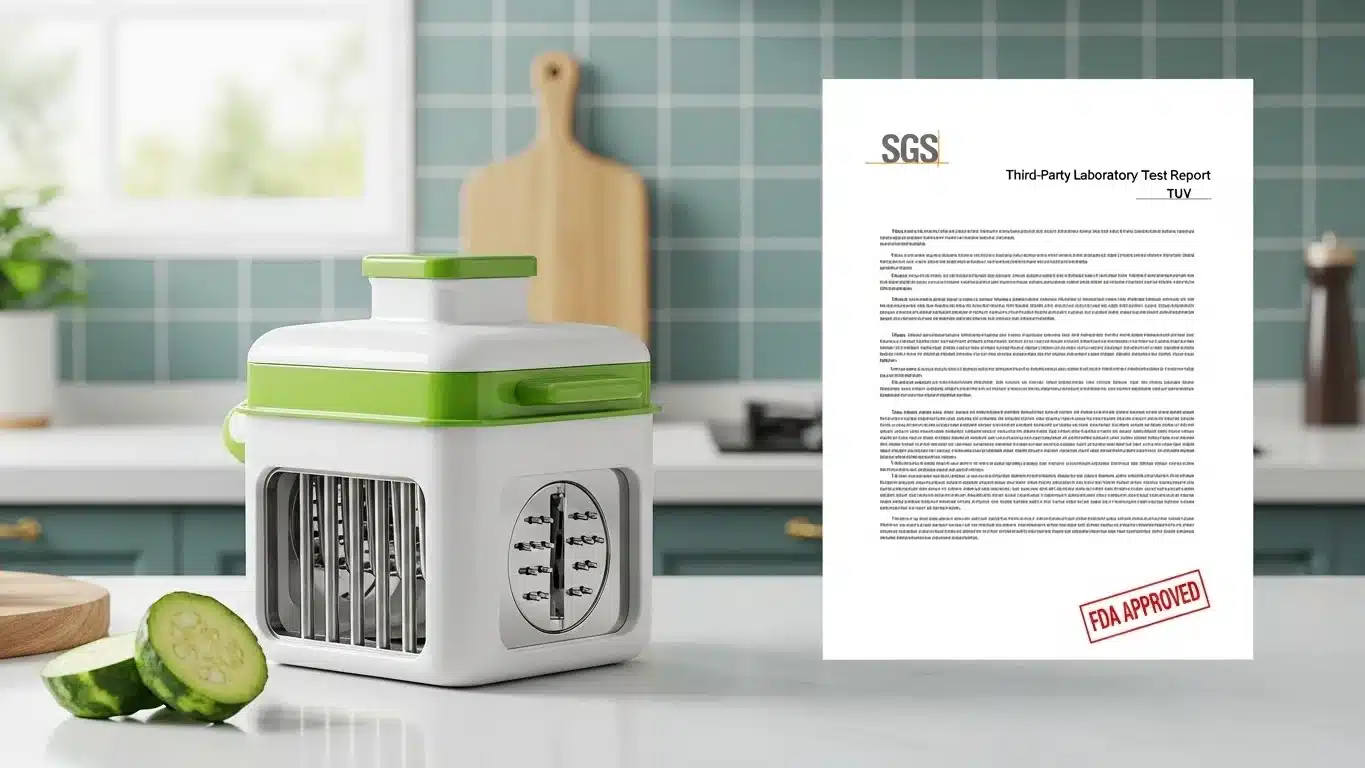
For transparency about where our own involvement helps and where it does not: on the sourcing side we verify a plant’s licence on site or by video audit and check the certificate number directly with the issuing lab, SGS or TUV, rather than accepting a forwarded PDF — that is the specific failure mode question 2 above is designed to catch. On the inspection side we work to ANSI/ASQ Z1.4 with the zero-critical / 2.5 major / 4.0 minor tolerances above, and we rotate inspectors, track them by GPS and body cam, and pay factories a reward for reporting bribery attempts, because an inspector who can be bought makes every number on the report meaningless.
Where we stop is worth saying plainly. We do not run the laboratory testing ourselves — extraction testing against 21 CFR 177.2600 and California designated-list screening are commissioned from an accredited lab, and the report names that lab, not us. We cannot tell you whether a chemical was intentionally added to a coating without the formulator confirming it, which is exactly why question 5 has to reach the plant. And an inspection at 80% packed cannot fix a specification that was wrong at the purchase order stage, which is why the eight questions belong before the deposit rather than after it.
Where to go from here
Work it in this order, because each step narrows the next. Sort your SKU list by material and use the routing table to mark which items belong at a plant and which are honestly fine from a market booth. Take the plant-side items and ask questions 1 to 4 before you discuss price at all. Model duty per line rather than per container, paying particular attention to any ceramic item that could be described as hospitality ware. If California is in your market list, resolve question 5 before you commission packaging artwork, because the label requirement changes what has to be printed. Then, and only then, negotiate minimums per tier.
Часто задаваемые вопросы
Are Yiwu kitchenware suppliers manufacturers or trading companies?
Both operate there, and the market’s function is aggregation rather than production. Ceramics, stainless and small appliances are generally made in other provinces. Ask which plant will run your order and whether that plant’s name matches your invoice and test report.
What is the US import duty on kitchenware from China?
It depends on the material. Stainless steel kitchenware is 2% under HTS 7323.93.00, enamelled cast iron is Free under 7323.92.00, coated steel is 5.3% under 7323.91.50, silicone household articles are 3.4% under 4016.99.05.00, and ceramics vary widely. Verify your own lines in the current schedule.
Why is restaurant ceramic tableware dutied so much higher than household?
The US schedule separates ceramic tableware by intended use. Non-porcelain hotel or restaurant ware is 28% under 6912.00.20.00 against 4.5%–10% on household lines, and porcelain hotel ware is 25% under 6911.10.10.00 against 6%–8% household. Classification follows use, not quality.
Does California AB 1200 ban PFAS in cookware?
No. Its PFAS prohibition covers plant-fibre food packaging. For cookware, AB 1200 imposes disclosure duties: a website listing from 1 January 2023 and product labelling from 1 January 2024. Many secondary summaries state this incorrectly.
If I private-label cookware, who is the “manufacturer” under AB 1200?
The definition includes the entity whose name appears on the product label, so a private-label importer carries the duty. Non-compliant cookware may not be sold, offered for sale or distributed in California. Confirm your position with counsel for your specific range.
What are the FDA extraction limits for silicone bakeware?
Under 21 CFR 177.2600, aqueous-food articles must not exceed 20 mg per square inch of total extractives in the first 7 hours in distilled water at reflux, nor 1 mg per square inch in the following 2 hours. Fatty-food limits in n-hexane are 175 mg and 4 mg respectively.
Can I buy all my kitchenware SKUs from one supplier?
You can buy them on one invoice through a trading market or agent, which is genuinely useful for mixed low-risk assortments. You cannot have them all made by one factory, because ceramics, stainless, silicone and electricals are separate manufacturing disciplines in different regions.
What is the MOQ for wholesale kitchenware from China?
There is no single figure. Minimums are set per project against your size and colour mix, and they rise across three tiers: stock goods, brand-tagged goods, then custom-tooled goods. Ask for all three tiers separately for your exact specification.