Джастин
Yiwu market is the world’s largest wholesale market for small consumer goods — a single complex in Yiwu, China, where tens of thousands of booths sell everything from toys and jewelry to tools and home decor to buyers from around the world. If you have ever bought a cheap everyday product, there is a real chance it passed through Yiwu.
Key Takeaways
- Yiwu market is the world’s largest small-commodity wholesale market.
- It sits in Yiwu, Zhejiang, mainly in the Yiwu International Trade City.
- Tens of thousands of booths are grouped into product districts.
- Most booths are traders representing nearby factories.
- Buyers visit in person or use a local sourcing agent.
- It is built for export — consolidation and shipping are standard.
What Is Yiwu Market?
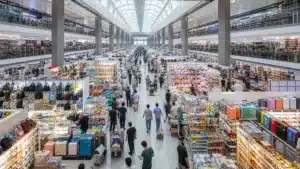
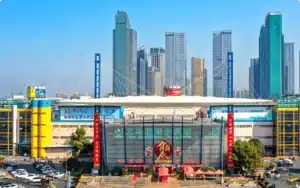
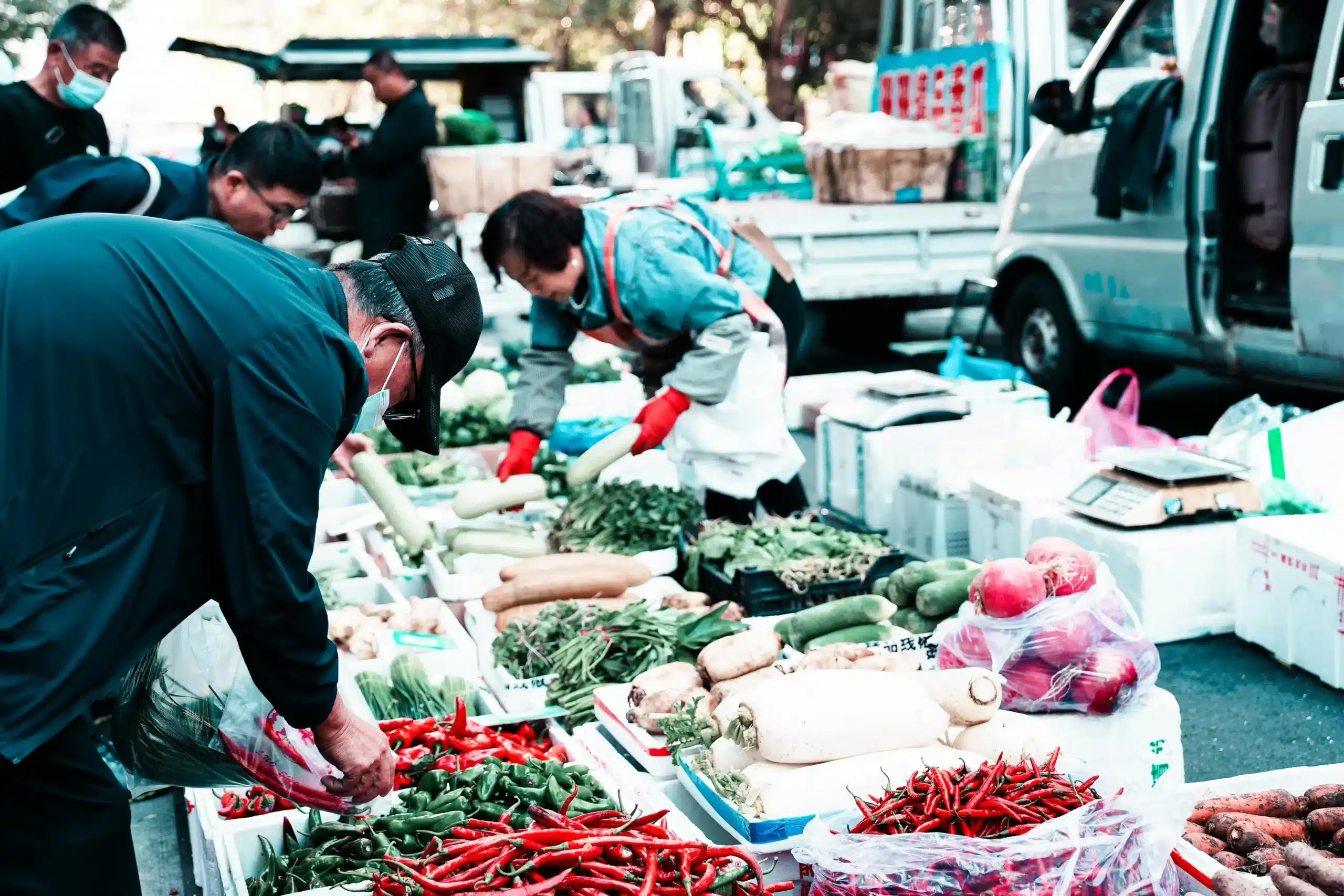
Yiwu market — officially the Yiwu International Trade City (Futian Market) — is a vast, connected wholesale complex that sells small commodities in bulk. It is not a single hall but a series of numbered districts spanning millions of square meters, with tens of thousands of booths. It supplies a large share of the world’s everyday consumer goods, which is why buyers from over 100 countries source there.
How the Market Works
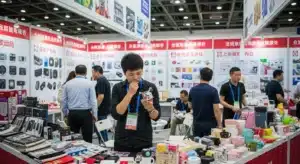
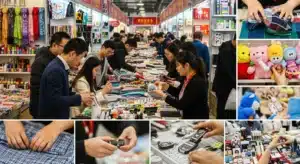
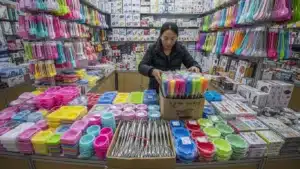
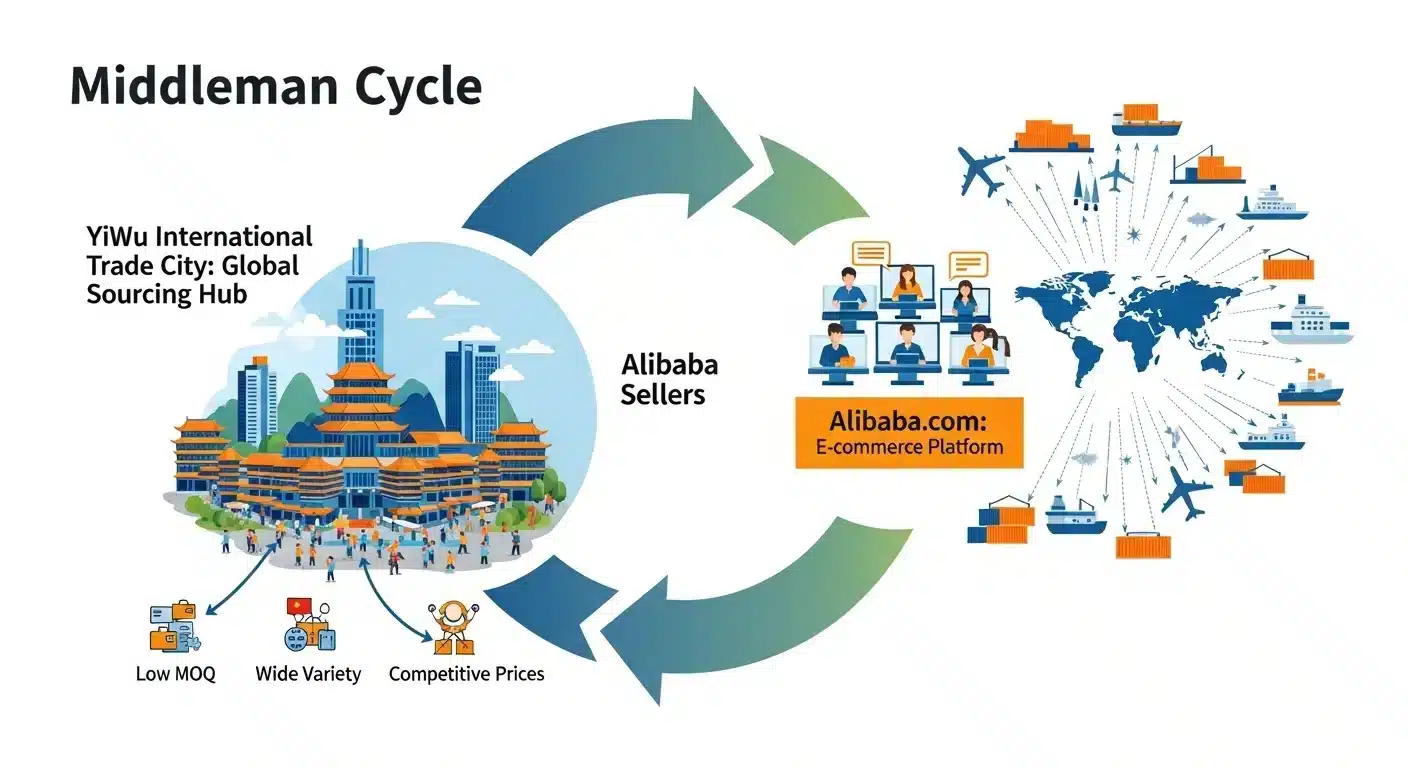
Each district groups related products — toys in one, hardware in another, jewelry in a third — so buyers can compare dozens of suppliers of the same item in a single aisle. Most booths are traders who represent one or more nearby factories rather than the factory itself, which is fine for stock goods and important to know for custom work. Buyers walk the districts, collect samples and quotes, then place orders that an agent or warehouse consolidates into one export shipment.
What You Can Buy There
If it is a small, everyday consumer product, Yiwu probably sells it. The core categories span:
| Category group | Examples |
|---|---|
| Toys & gifts | Toys, party goods, artificial flowers |
| Accessories | Fashion jewelry, hair goods, sunglasses |
| Home & kitchen | Decor, ceramics, kitchenware, storage |
| Hardware & daily | Tools, locks, umbrellas, stationery |
| Newer categories | Beauty, baby, drones and electronics (District 6) |
Who Uses Yiwu Market
Yiwu serves importers, wholesalers, Amazon and online sellers, gift shops, and event buyers — anyone who needs variety at wholesale prices rather than one deep specialist line. It suits buyers building a mixed catalog more than those needing heavy or highly customized manufacturing.
How Yiwu Differs From a Normal Wholesale Market
Scale and export focus. A normal wholesale market serves a city; Yiwu serves the planet, with multilingual support, consolidation warehouses, and shipping built in. The trade-off is that its strength is breadth and speed of small commodities, not deep custom production.
Ready to actually buy? Start with our complete Yiwu sourcing guide, or learn how to visit Yiwu market in person.
How Big Is Yiwu Market?
The scale is hard to overstate. The Yiwu International Trade City spans millions of square meters across its districts and holds tens of thousands of booths carrying well over a million product lines. Buyers from more than 100 countries source there, and the market has its own customs and logistics infrastructure built specifically for export. That scale is why a buyer can fill a 40ft container with twenty different product categories without leaving the complex — something no single factory or normal wholesale market can offer.
How Buying Actually Works
A typical Yiwu purchase follows a simple arc. You walk the district that matches your product, compare the same item across several booths, and collect samples and quotes. You confirm whether the booth is the factory or a trader, agree a price and minimum, and pay a deposit — the standard terms are 30% up front and 70% before shipment. Goods from multiple booths are delivered to a consolidation warehouse, inspected against your approved samples, and loaded into one container. Most foreign buyers run this through a local agent who handles the language, negotiation and logistics.
A Short History of Yiwu Market
Yiwu grew from humble roots: decades ago it was a town of traveling peddlers swapping small goods, and the local government formalized that trade into a market in the 1980s. Successive generations of the market were built ever larger, culminating in the modern Yiwu International Trade City and, most recently, the sixth-generation Global Digital Trade Center. That history matters because it explains the culture: Yiwu was built by traders, for traders, which is why it is optimized for fast, high-variety, low-cost commerce rather than deep single-product manufacturing.
Common Misconceptions About Yiwu
Two myths trip up newcomers. The first is that every booth is a factory — most are traders representing nearby factories, which is fine for stock goods but matters for custom work and pricing. The second is that Yiwu goods are automatically cheap junk; quality spans the full range, from disposable novelties to solid, export-grade products, and the difference comes down to which booth you choose and whether you inspect. Treat Yiwu as a place where good and bad sit side by side, and your job is simply to tell them apart.
Is Yiwu Right for You?
Yiwu fits some buyers far better than others. It is the right starting point if you sell a wide range of low-to-mid-cost consumer goods, want low minimums to test products, or need to fill a mixed container from many suppliers at once — gift shops, online and Amazon sellers, importers and event buyers all thrive here. It is the wrong tool if you need heavy machinery, precision industrial parts, or one deeply customized product at the lowest possible factory price; for those, a specialist factory cluster beats a small-commodity market. Knowing which side you are on saves a wasted trip.
If you do fit, the practical next step is to learn the layout and the process before you commit money. Most first-timers either visit in person or hand the work to a local agent who knows the districts, speaks the language, and consolidates the order — which is exactly what turns the largest market on earth from overwhelming into manageable.
Next steps: see what each hall sells in our Yiwu districts guide, then learn how to visit Yiwu market.
Заключение
Yiwu market is, simply, where the world’s small goods are wholesaled — a connected complex of product districts built for export buyers. Understand that it runs on traders, districts and consolidation, and the largest market on earth becomes easy to navigate.
Часто задаваемые вопросы
What is Yiwu market famous for?
It is the world’s largest wholesale market for small commodities — toys, jewelry, accessories, hardware, home goods and more — supplying buyers in over 100 countries.
Where is Yiwu market located?
In Yiwu, Zhejiang province, China, mainly in the Yiwu International Trade City (Futian Market).
Are Yiwu sellers factories?
Most booths are traders who represent nearby factories rather than the factory itself. That is fine for stock items; for custom work, confirm who actually manufactures.
Can foreigners buy at Yiwu market?
Yes. It is built for export, with multilingual support. Buyers visit in person or use a local sourcing agent to buy and consolidate shipments.
About the author: Written by the ChineseYiwu Sourcing Team — based inside the Yiwu International Trade City since 2005, with 50+ sourcing specialists and QC inspectors serving importers in 100+ countries.