Джастин
A terry towel’s “100% cotton loops” claim does not establish its complete fiber content. For a US order, use verified whole-fabric composition, or disclose both pile and ground compositions with their required relative proportions. If the ground or needed proportions are unknown, hold the fiber artwork instead of guessing.
Key Takeaways
- Loop composition and whole-fabric composition answer different questions.
- Two within-part purity percentages do not provide the parts’ weight ratio.
- The fictional 40% cotton-pile / 60% polyester-ground case yields 60% polyester, 40% cotton.
- A premium-cotton loop claim cannot silently become a whole-towel claim.
- Unknown composition needs a named evidence request before printing.
- Fiber copy is one task within the wider product and import review.
The loops do not describe the whole towel
A soft loop surface can be the most noticeable part of a terry towel, but the proposed fiber statement has to describe the relevant fabric, including its ground. Treat “100% cotton loops” as a statement about a part. It does not establish what the rest contains. Before approving artwork for a US private-label order, establish whether the supplier has supplied whole-fabric composition or only the loop-yarn specification.
This is a real commercial distinction, rather than a hypothetical wording puzzle. In 1998, counsel for Pillowtex sought FTC staff advice about towels with premium-cotton loops and another cotton in the ground. The published staff response addresses that particular request. Its age and case-specific scope matter: the current rule and current FTC guidance, rather than an old letter alone, are the basis for the decisions below.
Use this guide for the fiber-content part of an ordinary US terry-towel artwork review. It does not approve country of origin, responsible-business identity, care information, customs treatment or every other claim on the product. It also does not establish the composition of any towel offered by a supplier. The examples use invented fabric inputs so that the resulting decisions can be checked without pretending to report a laboratory test.
Begin with the exact product and construction. A loop-yarn specification, a photograph of terry cloth and a finished-towel composition record answer different questions. Link the record to the proposed towel SKU and material version. If the supplier changes the ground yarn after the sample review, revisit the fiber statement instead of treating the original approved artwork as permanently valid.
Choose a complete disclosure route
The current 16 CFR 303.24 pile-fabric provision allows a segregated statement that identifies the fiber composition of the pile and base and gives their relative proportions. In practical terms, two separate “100%” claims need the missing relationship between the parts. Part purity and part share are different inputs.
There are two useful ways to organize a supplier response. A whole-fabric record states the final fiber percentages for the relevant fabric. A segregated record states the composition within each part and the ratio between those parts. Do not mix a percentage describing the purity of a yarn with a percentage describing how much of the fabric that yarn represents.
For example, “pile: 100% cotton” tells you that cotton accounts for the pile fibers. It does not say that pile accounts for all the fabric. Likewise, “ground: 100% polyester” describes the ground fibers without revealing how much ground there is. The same two part descriptions can produce different whole-fabric compositions when their weight shares change.
Choose the route that the actual supporting records can substantiate. If the supplier provides a reliable whole-fabric composition, do not invent a pile-to-ground ratio just to obtain more elaborate marketing copy. If the supplier proposes a segregated declaration, request the part compositions and their fabric-weight proportions together. Have the responsible reviewer resolve any real product exclusions or unusual construction before applying the simplified example.
One fictional fabric, two completed fiber statements
Assume a simplified fabric containing only two fiber-bearing parts: pile contributes 40% of the fabric’s fiber weight and consists entirely of cotton; ground contributes 60% and consists entirely of polyester. There are no other parts, fibers or exclusions in this exercise. These are deliberately chosen teaching inputs, not a towel specification, production result or recommended blend.
The cotton contribution is 40% × 100% = 40% of the fabric fiber weight. The polyester contribution is 60% × 100% = 60%. The completed whole-fabric statement for this fictional composition is 60% Polyester, 40% Cotton. The larger contribution appears first. Notice that the first figure came from the ground, even though the cotton loops may dominate the product photograph.
A segregated candidate for the same invented fabric is 100% Cotton Pile / 100% Polyester Ground / (Pile 40% of fabric, ground 60%). This retains the two within-part compositions and the relationship between the parts. Neither “100% Cotton Pile” on its own nor “100% Polyester Ground” on its own communicates the complete fiber-content information.
Compare the two outputs by reconstructing the whole. The segregated statement gives 0.40 × 1.00 cotton and 0.60 × 1.00 polyester, matching the 40/60 calculation above. If an artwork proof instead says “60% Cotton, 40% Polyester,” it reverses the fabric contributions. That is a substantive composition error, not a choice of typography. Send the proof back with the input table and corrected statement attached.
Now change one condition: keep both part compositions but make pile 60% and ground 40% of fabric fiber weight. The whole result becomes 60% cotton and 40% polyester. This second fictional outcome shows why the first ratio cannot be copied into a new towel order. The words describing the yarns stayed the same; the product-level fiber statement changed because their contributions changed.
| Fictional part | Fiber within part | Share of fabric fiber weight | Whole-fabric contribution |
|---|---|---|---|
| Pile | 100% cotton | 40% | 40% cotton |
| Ground | 100% polyester | 60% | 60% polyester |
| Fictional fabric | Cotton pile share | Polyester ground share |
|---|---|---|
| A | 40% | 60% |
| B | 60% | 40% |
A different case needs different reasoning. Assume the fabric is verified as entirely cotton, with Pima cotton in the loops and Upland cotton in the ground. The FTC’s cotton guidance permits a truthful whole-cotton declaration that distinguishes Pima loops. A candidate is 100% Cotton, Pima Cotton Loops. This does not claim that every cotton fiber in the towel is Pima.
Do not shorten that candidate to “100% Pima Cotton” when only the loops are Pima. Removing the ground’s other cotton type from view changes the scope of the claim. Nor does a bare “Pima Cotton Loops” statement replace the complete fiber declaration. Keep the whole-fabric statement and the qualified loop description connected in the artwork review.
The evidence question also changes. A record that supports cotton as the generic fiber does not automatically establish the named premium cotton type. Ask what ties the Pima description to the actual loop-yarn supply for the product. Do not infer it from softness, color, absorbency language or a premium price. Where that identity remains unverified, keep the optional premium claim out of approved copy until the responsible party resolves it.
Keep this case separate from the cotton-pile/polyester-ground calculation. Two cotton types remain the same generic fiber, whereas cotton and polyester are different generic fibers. A reviewer who uses a single rule for both situations can either omit needed part proportions or make an unsupported whole-product premium claim. First classify the inputs; then select the statement.
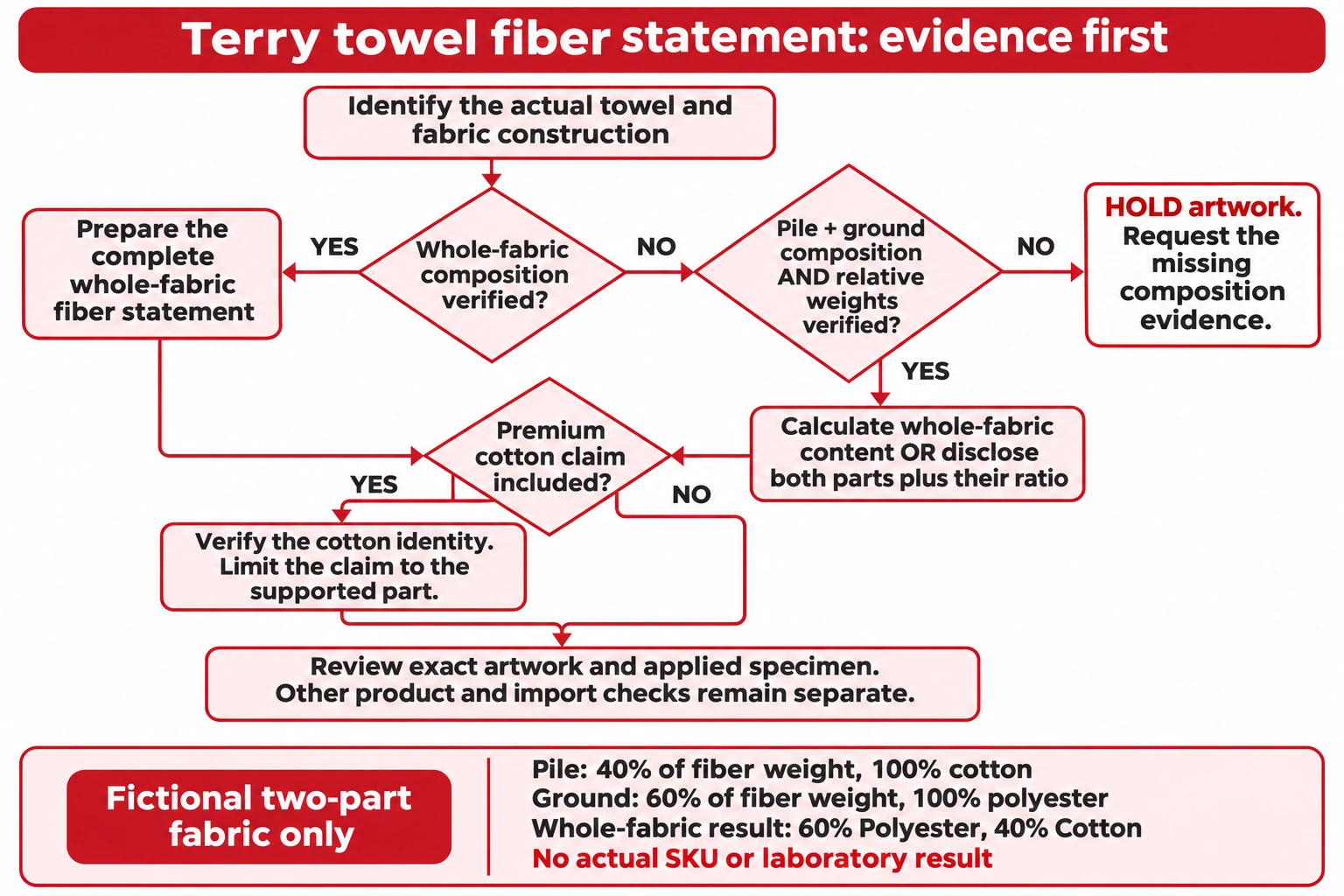
Open the fiber-statement decision map at full size.
- Identify the actual towel and construction.
- Use verified whole-fabric composition if available.
- Otherwise require both part compositions and their relative weights; if unavailable, hold artwork and request evidence.
- Calculate whole content or disclose both parts plus their ratio.
- Verify and bound any premium-cotton claim.
- Review exact artwork and applied specimen; other product and import checks remain separate.
Turn missing evidence into a named print hold
Suppose a supplier reply contains only “100% cotton loops” and a photograph of the towel. The ground fiber and its contribution are unknown. The completed decision is hold the fiber-content artwork, not “assume 100% cotton” and not “use the earlier 40/60 example.” No whole-fabric composition has been established from those inputs.
Make the request specific: “For this SKU and material version, provide the whole-fabric fiber composition, or identify the pile and ground fiber compositions together with their proportions by fabric fiber weight. Identify the record supporting those values.” This asks for the missing information without prescribing a number that the supplier might simply repeat back.
A GSM figure by itself is a fabric mass-per-area value, not a complete composition statement. Neither a yarn count nor a loop-height description alone supplies both the fiber identities and their shares. Do not turn one of those descriptive fields into an unverified weight ratio. If an appropriate test or specialist review is needed, agree its scope and the actual provider rather than calling a supplier declaration a laboratory result.
Save a short disposition with the proof: which inputs are established, which statement is proposed, which point remains open and who must answer it. In the missing-ground example, the open point is material composition, so a sharper print file does not remove the hold. In the reversed-percentage example, the inputs are sufficient and the corrective action is a specific wording revision. Those are different supplier instructions.
A practical handover can pair the approved composition record with the exact artwork version and an applied-label specimen. Check that the supplier has used the agreed wording rather than an older generic towel label. This is a suggested coordination method; it is not evidence that a real shipment has passed inspection. Keep any batch sampling, testing and release responsibilities in the actual order arrangements.
Give the sourcing team a usable artwork brief
Once the fiber decision is supported, supplier implementation becomes a separate task. ChineseYiwu’s private-label and OEM coordination service provides a relevant starting point for discussing branding and packaging work. Ask about the scope for the actual towel project, including whether label artwork communication and application checks are included.
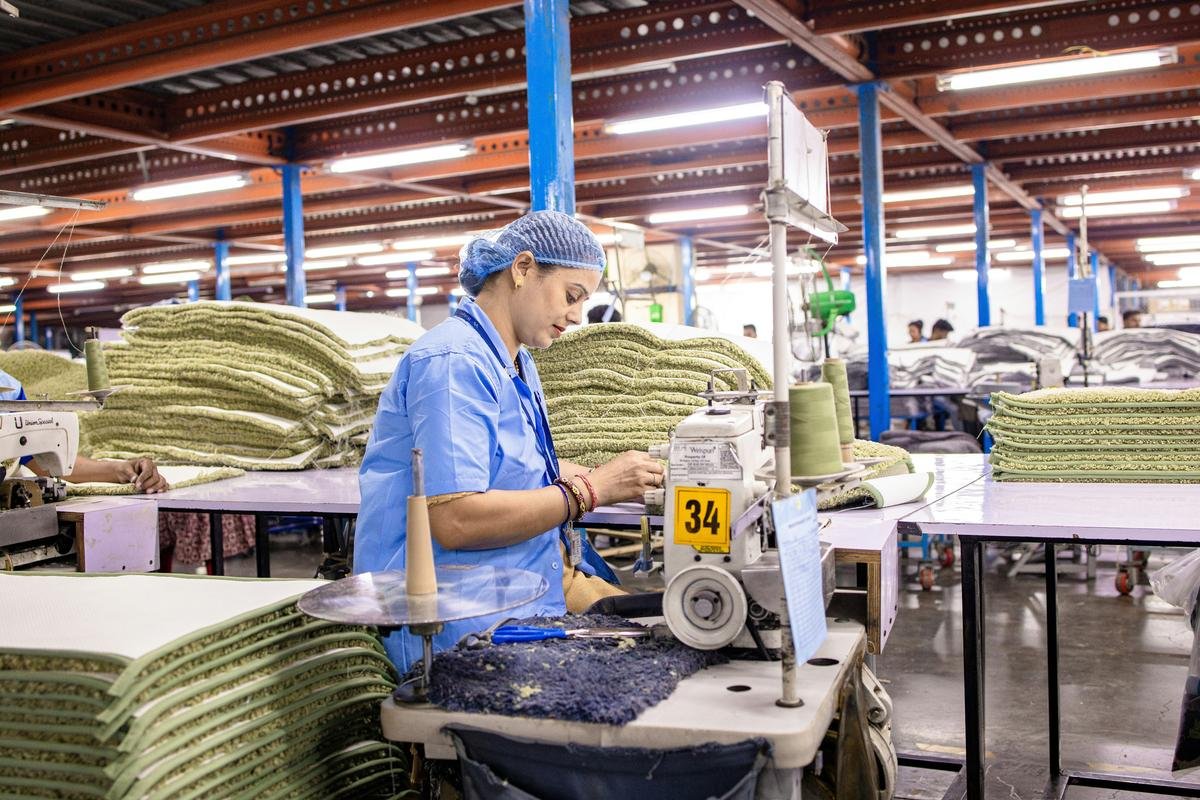
Send the proposed towel specification, destination market, composition records, chosen fiber statement and artwork version together. Identify any missing evidence instead of describing the file as approved. Ask separately about product and label minimum quantities, sample or artwork charges, and the schedule after the required inputs are accepted. No towel-specific price, MOQ or delivery commitment is established by this guide.
If the job also needs independent fiber testing or specialist legal review, identify that provider and responsibility explicitly. Sourcing coordination does not turn ChineseYiwu into the manufacturer, a testing laboratory or a regulatory approval body. Correct wording still has to be applied to the actual product, and other import and labeling obligations remain separate. Our US wool-blend scarf label guide addresses a different fiber-label problem; its wool-specific examples should not be copied onto a towel.
Заключение
For your supplier discussion, bring three things: the construction-specific composition record, the proposed complete fiber statement and the exact artwork version. The fictional 40/60 fabric has two defensible disclosure routes; the missing-ground example has none until its evidence arrives. Keep those outcomes separate and carry the unresolved questions into the order brief.
Часто задаваемые вопросы
Is “100% cotton loops” enough for the towel label?
No. It describes the loops, not the complete fabric. Establish the ground and the appropriate whole-fabric or complete segregated disclosure.
Can I use two separate 100% statements?
For the simplified cotton-pile/polyester-ground case, the segregated declaration also needs the parts’ fabric-weight proportions. Part purity alone does not give the whole composition.
Can all-cotton fabric be called 100% Pima cotton?
Only when that complete claim is truthful. If Pima is confined to the loops and the ground uses another cotton type, qualify the loop claim and retain the whole-cotton statement.
Does the worked example approve my actual towel?
No. The inputs are fictional and cover only the fiber statement. Establish the actual composition and resolve the remaining product, labeling and import obligations separately.
Written by Justin · ChineseYiwu sourcing content