Джастин
A supplier offers free samples from China. Your courier then asks for a value, while the factory proposes writing “sample” on the invoice. Before proposing US sample relief under HTS 9811.00.60, establish what the pieces will actually do in the United States. A supplier charge of zero does not establish their customs value, and an internal evaluation plan does not by itself document use to solicit orders for foreign products.
Begin with the recipient and intended use. Then assemble value and physical-condition evidence for the importer and licensed customs broker. The outcome is a supported review request or a hold for missing facts. It is never an instruction to replace the actual value with $1 or to change the description until an exemption appears to fit.
Key Takeaways
- Record who will receive and use each sample, including any later recipient.
- Separate the supplier’s free-of-charge arrangement from the customs valuation question.
- HTS 9811.00.60 combines an order-solicitation purpose with qualifying value or physical-condition conditions.
- Keep own engineering evaluation, sales presentation and later consumer distribution visible in the use record.
- A marking photograph is evidence to assess alongside the actual item and use.
- Unresolved use, value or condition means obtain the missing facts before dispatch.
Describe the actual use before choosing a sample code
“We need a sample” leaves several different activities unresolved. A buyer might keep a piece in its own engineering room for a fit check. A foreign manufacturer might send product pieces to a US sales representative to show prospective customers and obtain orders. Another parcel might contain finished goods intended for photography and subsequent giveaways. Those descriptions give the broker different facts to assess.
Ask the person who will control the goods to describe the sequence. Who receives the parcel? Who handles the pieces after receipt? What will they demonstrate or test? What happens afterward? Where will any resulting orders be placed, and which foreign products would those orders concern? Record uncertainty openly rather than selecting the most convenient answer.
This question is useful before samples from several suppliers are combined. One receiving address does not establish one intended use. Keep each supplier’s sample identity attached to its purpose so that a prototype for internal evaluation cannot disappear into a carton described collectively as sales samples.
Read the purpose and physical conditions together
Сайт current official USITC description of HTS 9811.00.60, checked on November 7, 2026 in Shanghai, covers relevant samples valued at no more than $1 each, or physically treated so that they are unsuitable for sale or other use beyond being samples. It also requires use in the United States only to solicit orders for foreign products. Samples within the separate beverage and tobacco provisions are excluded from this heading’s description.
Keep both parts of that description in view. Evidence of a qualifying value does not answer the purpose question. Evidence of an intended sales presentation does not answer whether the value or physical condition satisfies the provision. The broker needs the combined facts before deciding whether to propose this treatment.
A free supplier invoice answers who is charging the buyer and how much that supplier requests. It does not establish the value relevant to customs. Retain the no-charge correspondence and ask what records support the proposed value. Do not replace that enquiry with an arbitrary $1 entry. This guide supplies no valuation formula for a no-sale shipment.
Likewise, the word “sample” on an invoice does not show what has happened to the goods. Obtain photographs of the actual item and any marking or physical treatment, together with the intended-use explanation. Ask the broker whether the evidence meets the requirements for this merchandise. Avoid blanket conclusions that every functional item is excluded or that any item becomes eligible once a label is attached.
Use the actual CBP ruling as a check on inconsistent records
In CBP ruling N349646, dated June 26, 2025, the merchandise was photoresist product samples from Japan. The request described providing samples to customers to solicit orders. It also included an intended-use statement describing exclusive internal engineering evaluation, with no sale or customer distribution. The submitted label said “R&D Use Only.”
CBP explained the importance of using the samples to solicit purchase orders for foreign merchandise. It found no indication that the samples were valued below $1 each and found the submitted marking insufficient for the claimed sample treatment. The ruling denied the requested duty-free treatment on those facts.
That is a specific decision about the merchandise and facts submitted. It does not decide the treatment of every Chinese prototype or every research sample. Its practical lesson for a sourcing file is to reconcile the stated purpose with the actual recipient, use and marking before making the request. A covering email about future sales cannot resolve a conflicting instruction that the pieces are exclusively for internal work.
Keep the supplier’s original descriptions. If the plan genuinely changes, document the changed plan and give the full record to the broker. Do not quietly rewrite “internal evaluation” as “order solicitation” while leaving the actual handling unchanged. The person preparing the shipping documents needs an accurate account of the goods’ intended use.
Work through two sample plans before forwarding the carton
The following cases are illustrative. They are not Chineseyiwu customer records, customs decisions or examples of achieved tax savings.
A free prototype will stay with the buyer’s engineering team
Assume a China supplier sends a prototype without charging for the item. The US buyer will use it for internal fit checks and keep it in the engineering department. The invoice describes it as a free sample. No plan to show it to potential customers or solicit orders is documented.
The record supports a no-charge arrangement and an internal evaluation purpose. It does not establish the order-solicitation purpose required by HTS 9811.00.60. Hold the proposal to use that provision. Give the actual use, identity and value evidence to the broker to assess the appropriate entry route. Any potential prototype treatment requires its own applicable conditions to be evaluated.
Now change one fact. A sales representative will receive the item after the fit check. That addition still leaves questions about the full use sequence and the “only” purpose condition. Explain both stages and obtain the broker’s assessment. Do not assume the later sales activity clears the earlier internal use.
A documented sales kit will be used to seek orders
Assume a foreign supplier prepares identified product pieces for its US representative to show prospective buyers and obtain orders for those foreign products. The file identifies the representative, the products being offered and the planned presentations. It also contains photographs of each piece’s actual marking or condition and records supporting the value proposed for review.
This file gives the broker evidence addressing the order-solicitation purpose as well as the value or condition question. Submit it for assessment of HTS 9811.00.60. Do not label the kit automatically duty-free. The broker must still assess the actual merchandise and whether the relevant conditions are satisfied.
Change the plan again. The pieces may be handed out for ordinary use after the presentation. That affects the factual account supporting a sample-only purpose. Pause the dispatch decision and tell the broker about the intended distribution. A presentation itinerary does not answer what will happen to the goods afterward.
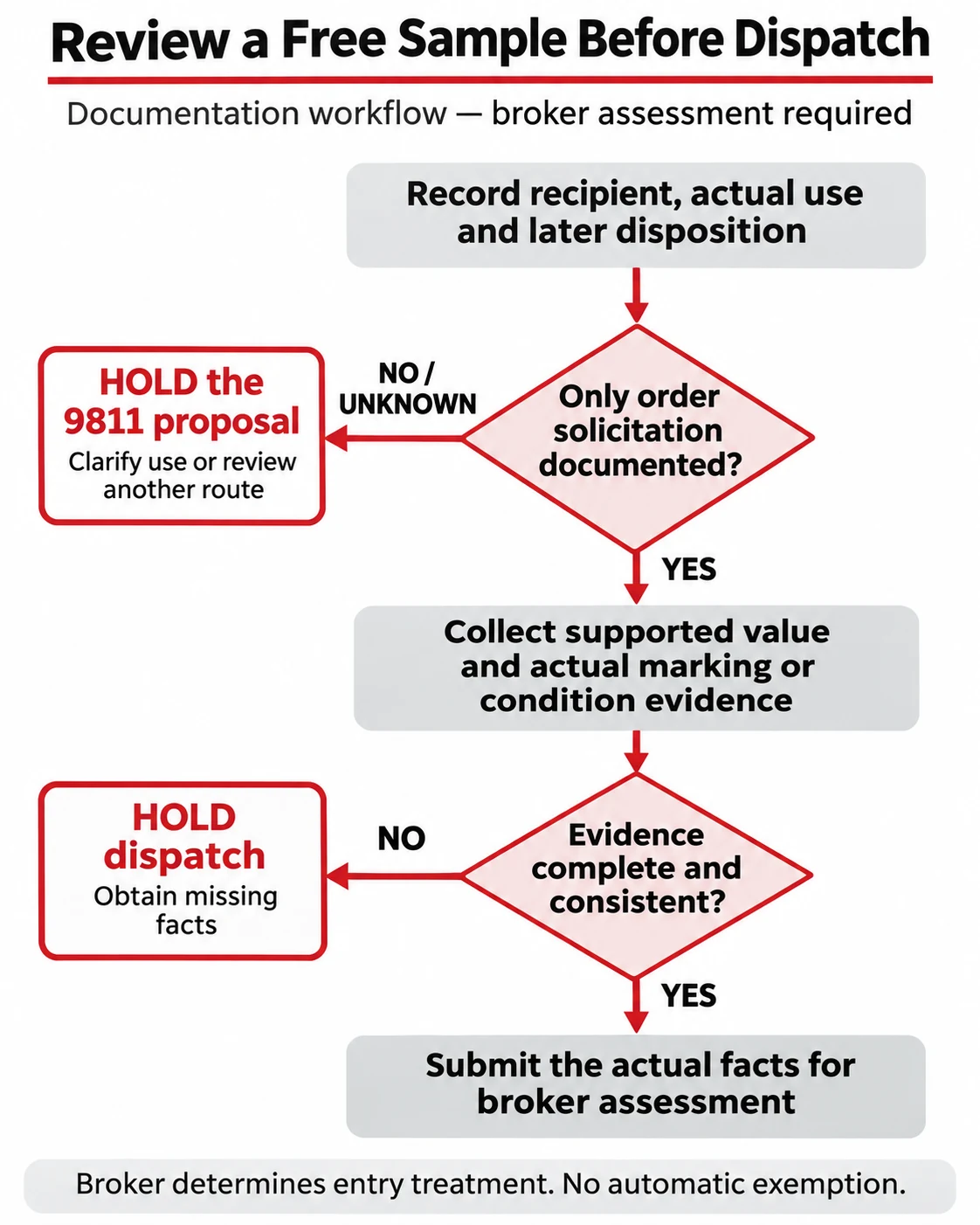
- Record recipient, actual use and later disposition.
- Check whether only order solicitation is documented.
- If no or unknown, hold the 9811 proposal and clarify use or review another route.
- If yes, collect supported value and actual marking or condition evidence.
- If evidence missing or contradictory, hold dispatch and obtain the facts.
- Submit the consistent facts for broker assessment, broker determines entry treatment.
Build a review record that preserves each unresolved fact
A useful file connects the documents rather than accumulating unrelated attachments. Use one sample identifier across the supplier email, photographs, invoice line and intended-use record. Where a field is unknown, record who will obtain the answer and which decision it prevents.
| Record | Question it should answer | Response when missing |
|---|---|---|
| Item identity and quantity | Which actual pieces are in this line and who supplied them? | Reconcile the supplier list and parcel contents. |
| Recipient and use sequence | Who will use the pieces, for what activity and with what later disposition? | Obtain the receiving party’s written account. |
| Foreign products and orders | What products would be ordered through the proposed solicitation? | Explain the relationship before claiming that purpose. |
| Record | Question it should answer | Response when missing |
|---|---|---|
| Payment and value evidence | Why is the supplier charging nothing, and what supports the value proposed? | Keep the no-charge evidence and request valuation instructions. |
| Actual marking and condition | What can the photographs and merchandise demonstrate? | Obtain current images and a factual description. |
| Broker instructions | Which treatment and remaining checks apply to these facts? | Hold dispatch approval until the material questions are resolved. |
Check the record for contradictions before sending it. A sample-code label, a sales-use email and an engineering-only handling instruction should not be treated as interchangeable. Show the inconsistency to the responsible parties and request a corrected factual account. Keep the earlier record alongside the explanation so the review has a clear history.
Separate the sourcing handover from the entry decision
A China-side sourcing handover can collect the item list, supplier correspondence, receiving instructions, parcel facts and photographs. The importer and licensed customs broker assess the US treatment. Confirm which party will provide any missing fact before arranging pickup. A completed comparison sample does not need to be dispatched while its documentation remains unresolved.
Keep product-specific admissibility separate from the sample-duty question. The CPSC’s sample guidance addresses the separate boundary between sample-only products and goods distributed to or used by US consumers. It also distinguishes testing prototypes from samples used to solicit orders. A possible customs sample provision does not settle every product-safety or agency requirement.
Review the actual contents with the relevant provider, particularly if the parcel contains regulated materials or goods. This article does not calculate a duty bill, approve a carrier route or promise clearance. It delivers the use-and-evidence record needed to ask a precise treatment question before shipping.
Заключение
The free-sample decision starts with actual use. Establish the recipient, purpose and later disposition, then connect those facts to supported value and condition evidence. Internal evaluation alone does not document order solicitation. A documented sales-sample plan still needs assessment against the applicable conditions. Completing that record takes effort, but it gives the importer and broker a factual basis for the dispatch decision.
Frequently asked questions
Does a free China sample have a customs value of zero?
A supplier’s no-charge arrangement does not establish customs value. Preserve the payment facts and obtain a supported valuation approach from the responsible importer or broker.
Does writing SAMPLE on the invoice establish eligibility?
No. The actual intended use and relevant value or physical-condition facts still need to satisfy the provision being proposed.
Are functional samples always excluded?
A blanket exclusion is inappropriate. Ask the broker to assess the actual merchandise, purpose and qualifying conditions rather than relying on functionality alone.
Can an internal testing piece use an order-solicitation code?
Internal testing alone does not document order solicitation. Describe the actual use and ask the broker to assess the applicable route without relabeling the activity.