Джастин
Customs clearance fees are not one charge. On a United States import they are two separate families of cost that arrive on the same invoice and behave in opposite ways: statutory fees fixed by regulation, which are identical no matter who files your entry, and commercial charges set by whoever files it, which are not identical at all — and which you can negotiate.
That distinction is the whole game, and almost nobody draws it. Search this term and you will be handed dollar ranges with no country attached, no currency stated beyond an implied dollar sign, and no date. This guide does the opposite. Every figure below carries its jurisdiction, its currency and the month it was read, and every one of them comes from a published instrument you can open yourself: the Federal Register notice that sets the 2026 United States fees, and two named brokers’ own public tariffs.

Key takeaways
- Two families, one invoice. Government fees are set by regulation and are the same at every broker. Brokerage charges are each firm’s own tariff and differ widely.
- The US Merchandise Processing Fee is 0.3464% of net entered value, with a floor of USD 33.58 and a ceiling of USD 651.50 per formal entry for fiscal year 2026.
- The same disbursement service is published at 2% by one carrier and 5% by one broker — a 2.5x spread that tells you exactly which line to negotiate.
- Ocean shipments carry a Harbor Maintenance Fee of 0.125% of cargo value. Air shipments do not.
- UK importers: duty applies above GBP 135, and that relief is being removed by October 2028 at the latest.
On this page
- What you are actually paying for
- The US government fees, and the exact 2026 numbers
- The broker’s own charges: two published 2026 tariffs
- The disbursement line: where the same service costs 2.5x more
- A worked example: one Yiwu load, two value bands
- The UK side, and the threshold that is about to disappear
- How to read a clearance quote before you sign it
- Frequently asked questions
What You Are Actually Paying For When You Pay a Clearance Fee
Start by separating three things that buyers routinely merge. Duty is the tariff on your goods, driven by the HS classification and the country of origin. Tax is VAT or its local equivalent. Clearance fees are neither — they are the cost of the entry being filed, processed and paid for, and they are what this guide covers.
Within that third category the split matters more than any individual number. Some of these charges are written into regulation. When US Customs and Border Protection sets the Merchandise Processing Fee at 0.3464% of net entered value, that rate applies whether your entry is filed by a global integrator or a two-person brokerage in Long Beach. Nobody discounts it, because nobody owns it.
The rest of the invoice is commercial. An entry fee, a document handling charge, a per-classification charge, a disbursement percentage for advancing your duty to the government — every one of these is a price a private company chose and published, and different companies chose very different prices.
Why a quote without a jurisdiction is worthless
A clearance fee quoted without a country attached tells you nothing, because the statutory half of the invoice is defined by the destination’s own law. The United States charges a fee proportional to entered value with a floor and a ceiling. The United Kingdom does not have an equivalent processing fee at all; it has a duty threshold instead. Quoting “customs clearance costs around a hundred dollars” across both is not a simplification, it is a category error.
Scope, stated plainly. This guide carries real line-item numbers for the Соединенные Штаты and threshold-level rules for the Великобритания. It does not quote EU figures, and it does not quote China-side export clearance charges — we could not source either from a primary or named-tariff document at the time of writing, and inventing a plausible range for a cost page is exactly how buyers get misled. Where we have no number, we say so.
The US Government Fees, and the Exact 2026 Numbers
These changed for fiscal year 2026, and the way they changed is widely misreported. CBP adjusts its user fees for inflation under the COBRA statute, and for fiscal year 2026 it determined an adjustment factor of 34.331%, effective for entries required as of October 1, 2025. That is a large number, and it has led to a lot of writing implying the Merchandise Processing Fee itself jumped by a third.
It did not. Read the notice and the footnotes are explicit: only the limitations increased. The ad valorem rate of 0.3464% is unchanged, and has been since 2017. What moved were the floor and the ceiling — the minimum and maximum any single formal entry can be charged.

| Statutory fee (United States, FY2026) | Amount | Applies to |
|---|---|---|
| Merchandise Processing Fee — rate | 0.3464% of net entered value | Formal entries; value excludes duty, freight and insurance |
| MPF — minimum per entry | USD 33.58 | Charged instead of the percentage when the percentage is lower |
| MPF — maximum per entry | USD 651.50 | Caps the percentage on high-value entries |
| Harbor Maintenance Fee | 0.125% of cargo value | Ocean cargo only — not charged on air freight |
| Manual entry surcharge | USD 4.03 | Entries not filed electronically |
| Informal entry — automated | USD 2.69 | Not prepared by CBP personnel |
| Informal entry — manual | USD 8.06 / USD 12.09 | Manual not prepared by CBP / manual prepared by CBP |
| Express consignment fee | USD 1.34 | Per individual waybill through an express hub |
Source: CBP Dec. 25-10, the Federal Register notice adjusting customs COBRA user fees for fiscal year 2026, Tables 1 and 2 (19 CFR 24.22 and 24.23); Harbor Maintenance Fee from 19 CFR 24.24. Figures read August 2026. All amounts are US dollars and apply to United States entries only.
Importers running consolidated Yiwu loads: send us the fee lines from your quote on WhatsApp and we will tell you which of them are statutory and which are the broker’s own.
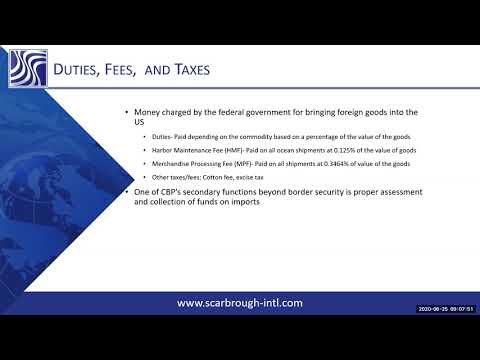
Watch: an independent broker’s explanation of how the Merchandise Processing Fee is assessed on a US entry.
The fee that is not on your invoice
One number gets quoted at importers with some regularity and should not be: the customs broker permit user fee, USD 185.38 for fiscal year 2026. This is an annual fee a licensed broker pays CBP to maintain its national permit. It is a cost of being a broker, not a cost of your shipment, and a line item on your entry invoice naming it is a line item worth questioning.
The Broker’s Own Charges: Two Published 2026 Tariffs, Side by Side
Here the guidance elsewhere collapses into undated ranges — fifty to two hundred dollars, one to three hundred fifty, a hundred to a hundred and fifty. Three sources, three different answers, none of them traceable to a document. So instead of adding a fourth range, here are two actual published tariffs, both current for 2026, both checkable by you.
The first is DHL Express’s Service & Rate Guide 2026 for the United States, a 57-page document whose final page states it is correct as of 1st January 2026. The second is the published pricing page of Clearit US, a customs brokerage that lists its entry prices openly rather than quoting on request.

| Commercial charge (United States, 2026) | DHL Express published tariff | Clearit US published pricing |
|---|---|---|
| Entry / clearance filing | Clearance Processing USD 15.00; Single Clearance USD 35.00 | Ocean USD 149.95; Air USD 129.95; Truck USD 89.95 |
| Disbursement / advancing duty | 2% of fiscal charges, minimum USD 17.00 | 5% of duty, MPF and all payables |
| Extra classification lines | USD 5.00 per line after 5 lines, USD 10.00 minimum | USD 15.00 per additional HTS classification |
| Document handling | Clearance Paperwork USD 20.00; Import Paperwork USD 25.00 per packet or USD 2.10 soft copy | USD 15.00 per additional invoice |
| ISF filing | Not separately listed in the guide | USD 50.00 on time; USD 100.00 late |
| Continuous bond | USD 525.00 minimum per 12-month period | USD 500.00 annual |
| Single-entry bond | Under Bond Guarantee USD 5.00 per USD 1,000 of bond, USD 50.00 minimum | USD 5.00 per USD 1,000 of value plus USD 35.00 prep, minimum USD 40.00 |
| Non-routine / exam handling | Non Routine Entry USD 35.00; Customs Physical Intervention USD 20.00 | Hold and exam coordination USD 200.00 |
| Post-entry correction | Post Clearance Modification USD 90.00 | Post entry CF28 consulting USD 200.00; entry cancellation USD 200.00 |
Sources: DHL Express Service & Rate Guide 2026 (United States), Customs Services tables, pages 21–23; Clearit US published pricing page. Both read August 2026. All amounts in US dollars for United States entries. These are two firms’ own published prices, not a market average — the point of showing them together is the spread, not a benchmark.
Reading the table properly
Do not compare the entry-fee row across the two columns and conclude one is nine times cheaper. They are structured differently: DHL’s low clearance-processing figure sits alongside a stack of separate service lines, while Clearit’s mode-based price bundles more into one number. The comparison that is valid is line-for-line on the same named service — and that is where the next section lives.
Notice also what both agree on. Both publish the same statutory figures: 0.3464%, a USD 33.58 floor, a USD 651.50 ceiling, 0.125% harbour maintenance. Two independent commercial parties, identical government numbers. That is the statutory half of the invoice doing exactly what it should.
The Disbursement Line: Where the Same Service Costs 2.5x More
A disbursement or advancement charge pays for one thing: the broker fronting your duty, tax and fees to the government so your cargo moves before your money arrives. It is a short-term credit facility, priced as a percentage.
DHL publishes it at 2% of fiscal charges with a minimum of USD 17.00. Clearit publishes it at 5% of duty, MPF and all payables. Same service, same country, same year, and the percentage differs by a factor of 2.5.
That spread is the single most useful fact on this page, because it settles an argument buyers keep losing. When a broker tells you a charge is “standard”, the statutory table above is what standard looks like — one number, everywhere, unarguable. A line that two published tariffs price 2.5x apart is not standard. It is a price, and prices are discussable.
Why a percentage with no cap punishes exactly the wrong shipment
The structural problem with percentage-based disbursement is that it scales with your duty bill while the work does not. Advancing USD 40,000 of duty is the same keystroke as advancing USD 4,000; it carries more credit risk, certainly, but not ten times more labour. At 5%, that USD 40,000 advance costs USD 2,000. At 2%, USD 800. On a high-duty consignment the disbursement line can quietly become the largest commercial charge on the entry, larger than the filing fee it sits beneath.
This is why the question to ask is not “what is your clearance fee” but “is your disbursement percentage capped, and at what”. A capped percentage behaves like the MPF — predictable, and plannable. An uncapped one is an open position on your own duty bill.
For importers buying from several Yiwu suppliers at once: goods from 15+ booths collect into one 3,000 sqm warehouse, store free for 30 days, and leave as a single entry instead of five. Our commission is published, not quoted on request — 5% under USD 5,000, 3% from USD 5,001 to 50,000, 1–2% above that — and the DDP quote to the USA, Europe or Australia carries import tax and VAT inside it.
A Worked Example: One Yiwu Consolidated Load, Two Value Bands
Numbers in a table are inert until you run them against a shipment. So take a consolidated ocean LCL load out of Yiwu — several suppliers, one container slot, one US entry — and put it through the statutory fees at two different declared values.

| Statutory line (United States) | Entry A — USD 6,000 declared | Entry B — USD 60,000 declared |
|---|---|---|
| MPF at 0.3464% | USD 20.78 calculated — floor applies | USD 207.84 calculated — percentage applies |
| MPF actually charged | USD 33.58 | USD 207.84 |
| HMF at 0.125% (ocean) | USD 7.50 | USD 75.00 |
| Statutory subtotal | USD 41.08 | USD 282.84 |
| Statutory cost as % of declared value | 0.68% | 0.47% |
Calculated from the FY2026 statutory rates and limits above. Duty itself is excluded — it depends entirely on your HS classification and origin. Commercial brokerage charges are excluded because they vary by provider, as the previous section shows. US dollars, United States entries.
The two breakpoints worth memorising
The floor and ceiling create two thresholds you can calculate yourself, and they are more useful than any average. Divide the floor by the rate: 33.58 ÷ 0.003464 gives roughly USD 9,694. Below that declared value, you pay the flat USD 33.58 regardless of how small the entry is. Divide the ceiling by the rate: 651.50 ÷ 0.003464 gives roughly USD 188,077. Above that, MPF stops growing entirely.
The practical consequence for anyone consolidating: MPF is charged per entry, not per supplier. Five separate small shipments from five Yiwu suppliers means five entries, and each one hits the USD 33.58 floor — USD 167.90 in MPF alone. Combine them into one entry of the same total value and you pay USD 33.58 once, assuming the combined value still sits under the breakpoint.
Above the ceiling the logic inverts. Once a single entry exceeds roughly USD 188,077 in declared value, additional value carries no additional MPF at all, which is the one case where a very large single entry is disproportionately efficient on this line.
One caution before treating consolidation as a pure saving. The statutory side rewards it cleanly, but the commercial side can claw some of that back: a load combining many suppliers carries many distinct HS classifications, and both published tariffs charge per line beyond an included count. Merging five single-product shipments into one entry saves roughly USD 134 in repeated MPF floors, while adding perhaps ten classification lines to that entry costs somewhere between USD 50 and USD 150 depending on whose tariff you are on. The consolidation still wins on this arithmetic, but the margin is narrower than the MPF figure alone suggests — and it narrows further the more supplier variety sits in the container.
The genuinely large saving from consolidating is not on the fee schedule at all. It is that one entry means one disbursement charge, one set of document handling lines, and one bond utilisation instead of five.
The UK Side, and the Threshold That Is About to Disappear
UK importers face a different structure entirely — no percentage-of-value processing fee, but a value threshold that decides whether duty applies at all. For goods sent from outside the UK into Great Britain, customs duty applies where the consignment is worth more than GBP 135. Excise goods — alcohol and tobacco — attract duty at any value, with no threshold.
That GBP 135 relief is on its way out. A gov.uk policy paper published on 13 July 2026 sets out the removal of the Low Value Imports relief, with the legislation to come into force on a day appointed by Treasury regulations, by October 2028 at the latest.
What that means if you sell low-value goods into the UK
If your model depends on consignments landing under GBP 135 duty-free, that model has a defined shelf life. The exact commencement date sits with Treasury regulations rather than being fixed in the paper, so the honest planning assumption is a window that closes no later than October 2028 and possibly sooner. Import VAT is a separate matter and is not what this reform removes.
There is a second-order effect worth planning for now rather than in 2028. Removing the relief does not merely add duty to low-value consignments; it changes which shipments need a full customs declaration at all, and declarations are where brokerage charges attach. A parcel stream that today moves with minimal formality becomes a stream of entries, each capable of carrying its own filing and classification charges. The duty itself may be small. The per-entry commercial charges around it are the part that scales.
Beyond the threshold rules, this guide does not carry UK brokerage figures. Both published tariffs we verified are US-facing, and we are not going to convert a US dollar figure into pounds and present it as a UK price — a converted number is a fabricated number wearing a different symbol.
How to Read a Clearance Quote Before You Sign It
You now have enough to audit a quote instead of accepting it. Work through it in this order.
- Split the lines into statutory and commercial first. MPF, HMF, the manual surcharge and the express consignment fee are government. Everything else is the provider’s price. Only the second group is worth negotiating, and knowing which is which stops you wasting the conversation on the wrong lines.
- Check the statutory figures against the table above. They should match exactly — 0.3464%, floor USD 33.58, ceiling USD 651.50, HMF 0.125% on ocean only. A quote showing HMF on an air shipment is wrong. A quote showing an MPF above USD 651.50 on a single formal entry is wrong.
- Ask whether the disbursement percentage is capped. This is the question the 2.5x spread earns you. Get the percentage, the minimum, and the cap in writing before appointment, not on the first invoice.
- Ask what is not on the quote. Bonds, ISF filing, per-classification charges above the included count, and exam handling are frequently omitted from an initial number and are all real published line items. A consolidated load from many suppliers means many HS classifications, which is precisely where per-line charges accumulate.
- Confirm the currency and the jurisdiction on the document itself. Every figure should state which. If a quote mixes them, that is not a formatting quibble on a customs invoice.
What the broker needs from you before a quote means anything
Half the reason quotes come back vague is that the request was. A broker cannot price an entry without knowing what is in it, and the six things below are what turn a guess into a number you can hold someone to.
| What to send | Why it changes the fee |
|---|---|
| Declared value and currency | Drives MPF and HMF directly, and decides whether the USD 33.58 floor or the USD 651.50 ceiling binds |
| Number of distinct HS classifications | Per-line charges start after an included count — USD 5.00 per line after 5 on one published tariff, USD 15.00 per additional classification on the other |
| Mode: ocean, air or truck | Ocean adds HMF at 0.125%; published entry prices differ by mode |
| Incoterm and who is importer of record | Decides whether these charges are yours at all, and whether a disbursement percentage applies to you |
| Bond position — do you hold a continuous bond | A continuous bond is published at USD 500.00 to USD 525.00 annually; without one, single-entry bonds are charged per shipment |
| Whether any goods need another agency’s clearance | Partner-agency handling and prior notice are separate published line items, each USD 35.00 on one of the two tariffs |
On the things this page cannot give you a number for, here is what governs them instead.
- Minimum order quantity is not a customs concept at all. It is set by each Yiwu supplier against your size and colour mix, and it matters here only because it determines how many classifications land on one entry.
- Lead time for clearance itself is not a fee question, and is covered separately in our transit and clearance timing guide.
- Compliance certification requirements are driven by your product category and destination market, not by the clearance fee schedule — so no certificate list belongs on a cost page.
- Verification before you commit is straightforward: ask any broker for their published tariff document, exactly as the two cited here publish theirs. A provider who will not show you a rate card in writing has told you something useful.
- Sampling and inspection — a pre-shipment inspection at the Yiwu warehouse is worth booking before consolidation rather than after. It is the last point at which a mis-described carton can be corrected on the packing list instead of becoming a post-entry correction, which the same two tariffs price at USD 90.00 and USD 200.00 respectively.
What Our Service Covers, and Where We Stop
The fee-relevant check before a load ships is documentary, not advisory: the packing list reconciled against the commercial invoice, so that the declared value and the classification count — the two inputs driving every percentage above — are correct at source. The asymmetry is what makes it worth doing. A value corrected on the packing list costs nothing, while the same correction after entry is a published USD 90.00 to USD 200.00 line on the two tariffs cited here.
Our own scope is worth stating plainly, because it bounds what this advice is worth. We are a sourcing and consolidation operation, not a licensed US customs brokerage: we do not file your US entry and we do not set any of the brokerage charges discussed above. What we do set is published on this site rather than quoted on request: commission of 5% on orders under USD 5,000, 3% from USD 5,001 to USD 50,000, and 1–2% above USD 50,000, with the 3% tier including 30 days of free warehousing. Cargo insurance runs 0.3% of value.
Where we touch clearance directly is the China-side export declaration, and — on DDP moves to the USA, Europe and Australia — a landed quote with import tax and VAT already inside it. That is the one structure in this article where no disbursement percentage applies, because nobody is advancing your duty on credit. It is also the one where you should ask what the quote assumes about your HS classification, since a landed price is only as good as the code it was built on.
Consolidation changes that arithmetic more than any negotiation does. Fifteen suppliers shipping separately is fifteen entries. The same goods pooled into our 3,000 sqm Yiwu warehouse — held free for up to 30 days while the slowest booth finishes — leave as one consignment: one MPF assessment against the ceiling rather than fifteen against the USD 33.58 floor, and one filing fee instead of fifteen.
Where our numbers came from, and what we could not source
Everything statutory here comes from the Federal Register notice CBP Dec. 25-10 and 19 CFR 24.24. Everything commercial comes from two named public tariffs, both dated 2026, both linked in the sources above. None of the brokerage figures come from a private rate card of ours — we hold none, and the two tariffs above are documents you can open and check yourself, which is the point. The only prices here that are ours are the commission tiers and the insurance rate, and those are published on this site for the same reason.
Three gaps are worth naming rather than papering over. FedEx’s published ancillary clearance fees were not retrievable at the time of writing, so no FedEx figure appears. EU thresholds are omitted because the European Commission’s own pages were unreachable and we will not cite a secondhand restatement on a price page. And China-side export clearance charges at Yiwu and Ningbo — probably the number readers of this site most want — could not be sourced from any published tariff, so they are absent rather than estimated.
For procurement buyers comparing brokers: send the fee lines over and we will mark each against the two published 2026 tariffs cited above — which are statutory, which are the provider’s own price, and which are missing. If you are consolidating Yiwu suppliers, we will also quote the alternative against our published tiers: 5% / 3% / 1–2% by order value, DDP to the USA, Europe or Australia with tax inside the price.
Заключение
The reason customs clearance fees feel unpredictable is that two very different things share one invoice. The statutory half is fixed, published and identical everywhere — 0.3464% between USD 33.58 and USD 651.50, plus 0.125% on ocean cargo, for United States entries in fiscal year 2026. The commercial half is a price list, and two reputable providers publish the same disbursement service 2.5x apart.
Once you can tell them apart, a quote stops being a single number to accept and becomes a document to audit. If you are consolidating Yiwu suppliers into one entry and want a second read on the fee lines, that is a conversation worth having before you appoint anyone.
Часто задаваемые вопросы
Is the customs clearance fee the same as import duty?
- No. Duty is the tariff on the goods themselves, set by HS code and origin. Clearance fees are the separate cost of filing and processing the entry — some fixed by regulation, some charged by your broker.
How much is the US Merchandise Processing Fee in 2026?
- 0.3464% of net entered value, with a minimum of USD 33.58 and a maximum of USD 651.50 per formal entry for fiscal year 2026. The rate did not change; only the minimum and maximum were adjusted.
Who pays the customs clearance fee, the buyer or the seller?
- It follows your Incoterm. Under DDP the seller carries duty and clearance costs; under FOB or EXW the buyer does. Confirm which applies before the goods ship, not after.
Do air shipments pay the Harbor Maintenance Fee?
- No. The Harbor Maintenance Fee of 0.125% applies to cargo moved by commercial vessel. If it appears on an air freight entry, query it.
Can I reduce clearance fees by consolidating shipments?
- Often yes, because MPF is charged per entry. Five small entries each hit the USD 33.58 floor; one combined entry pays it once. Per-classification charges may still apply on a mixed load.
What is a disbursement fee on a customs invoice?
- It is what the broker charges for advancing your duty and taxes to the government before you pay them. Published 2026 tariffs range from 2% of fiscal charges with a USD 17.00 minimum to 5% of all payables.
What is the UK customs duty threshold?
- Customs duty applies to consignments worth more than GBP 135 sent into Great Britain, and to excise goods at any value. That relief is being removed by October 2028 at the latest.
Sources
- CBP Dec. 25-10 — Customs User Fees To Be Adjusted for Inflation in Fiscal Year 2026, Federal Register, 23 July 2025.
- 19 CFR 24.24 — Harbor maintenance fee.
- DHL Express Service & Rate Guide 2026: United States, Customs Services tables.
- Clearit US — published customs brokerage pricing.
- GOV.UK — Tax and customs on goods sent from abroad.
- Reforming the customs treatment of low value imports into the UK, GOV.UK policy paper, 13 July 2026.
Related reading
- Clearance from customs: how the process actually works — the process and liability side of the same subject.
- How long does customs clearance take — timelines and what delay costs per day.
- LCL consolidation vs FCL vs air freight from Yiwu — choosing the mode that decides your entry structure.
- Why the agent invoice and the customs invoice differ — declared value, which drives every percentage fee above.