 Джастин
You’ve just wrapped up sourcing at the Yiwu market. Three suppliers, 500 units each, one pallet of ceramic mugs, two cartons of custom packaging, and a small batch of sample-approved electronics. Now comes the question every brand founder hits: how do you get this stuff to your door without the shipping cost eating your margin or a customs delay killing your launch timeline? A practical Yiwu shipping guide doesn’t just list rates—it walks you through the trade-offs between LCL consolidation Yiwu shipping for mixed orders versus FCL for a full container, or when to pay the premium for air freight.
Key Takeaways
- Your shipment profile determines 80% of your total logistics cost.
- 60% of customs delays trace back to incorrect HS codes — and LCL multiplies that risk.
- FCL only makes sense when you can fill at least 70% of the container volume.
- Air freight shines at 100kg+; express courier caps out around 20kg.
- 60% of customs delays come from incorrect HS codes — we catch those before the container leaves Yiwu.
- 6 in 10 customs delays aren’t from misdeclared goods — they’re from a wrong HS code on the invoice.
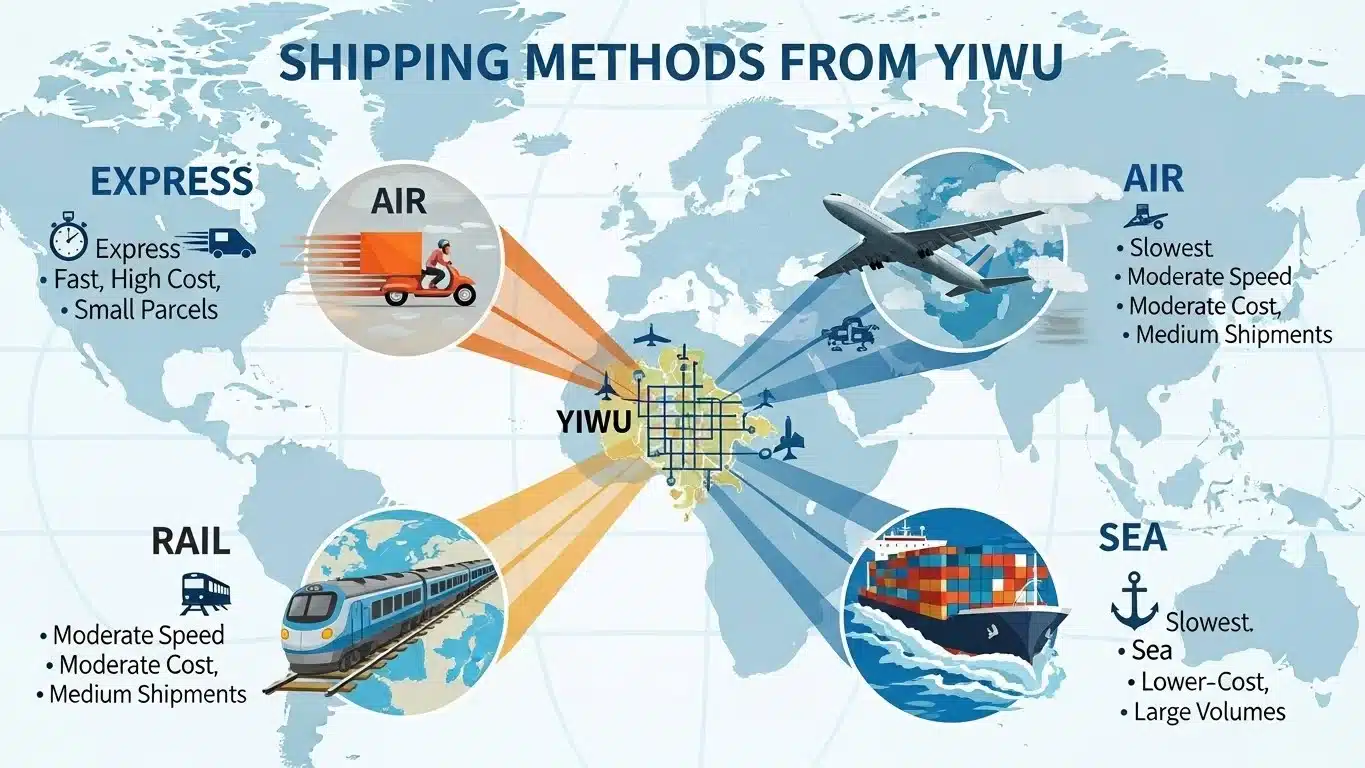
The best method depends on three variables: cargo volume, time pressure, and destination. Sea freight from Yiwu to the US West Coast runs 20-42 days at $50–$150 per CBM for LCL, or $1,550–$2,100 for a 20GP container. Air freight hits $13–$17 per kilo for a 100kg shipment and lands in 6-10 days. But here is the trap most first-time importers miss—the cost per unit drops dramatically when you consolidate orders from 5+ suppliers into one LCL shipment, cutting freight costs by 35-50% compared to shipping each separately. Skip that consolidation step, and you’re paying for three individual air courier bills or minimum LCL charges on half-empty pallets.
The cost of inaction here is real. Without a clear logistics plan, a brand founder can lose 8-12 weeks fixing a customs hold caused by incorrect HS codes—something that hits over 60% of US and EU clearance delays. That missed selling window can crater a seasonal product launch or drain cash reserves from rushed storage fees. Align your method with your real shipment profile from the start, and the difference between a smooth door to door shipping from Yiwu experience and a costly logistics headache comes down to a few smart choices made before the goods ever leave the warehouse.
Understanding Your Shipment Profile
Your shipment profile determines 80% of your total logistics cost.
Ever calculated your per-unit freight cost and realized you’re paying more to ship than to manufacture? That’s not a bad rate — that’s a mismatched shipment profile. I’ve watched brand founders approve a sample that shipped in a compact hand-packed box, then mass production arrived in oversized retail packaging. Volume quadrupled. Their $300 ocean quote became $1,100. The sample approval process shouldn’t just verify quality tolerance — it should flag packaging dimensions and unit weight before your logistics plan is set.
Weight and volume define your shipping tier. Under 20kg total? Express courier (FedEx, DHL, UPS) — 2 to 7 days. Between 20kg and 45kg, you’re in a gray zone where express still works but air freight starts making sense. Above 45kg, air freight becomes cost-efficient: $13 to $17 per kg for a 100kg shipment to the US (2026 rates). Cross 300kg and it drops to $9 to $12 per kg. The mistake I see most: buyers ship 15kg via air freight and overpay because they didn’t know the 45kg minimum threshold makes express the smarter choice under that weight.
Urgency is a budget killer when you don’t plan ahead.Sea freight from Yiwuto the US West Coast runs 20 to 28 days. To Europe, 25 to 35 days. Air freight cuts that to 6 to 10 days. Express courier, 2 to 7 days. The trap: paying air rates on cargo that should have sailed costs 3x to 5x more. Buyers have been seen panicking at $17 per kg for 200kg because a supplier delayed 2 weeks — that’s $3,400 in avoidable spend. Build a 10-day buffer into every timeline. If goods arrive early, the warehouse holds them free for 30 days so you never pay the panic premium.
Destination country dictates your compliance costs — not just transit time. Shipping to the US? FDA registration for food-contact items, CPSC testing for children’s products. Shipping to Europe? CE marking for electronics and toys. Over 60% of customs delays in the US and EU trace back to incorrect HS code classification on the invoice. That’s not a freight problem — that’s a documentation problem. Our team processes customs paperwork with 99.5% first-submission accuracy across 80+ destination countries because we’ve been filing these documents from Yiwu for 20 years. That’s the benchmark your shipping partner should meet.
- Total shipment weight: Determines express (under 20kg), air freight (45kg+), or sea (LCL/FCL). Mixing a 10kg and 200kg order in the same strategy wastes money.
- Total shipment volume (CBM): For LCL, carriers bill on chargeable weight — the higher of actual weight or volumetric weight (1 CBM = 1,000 kg). A lightweight bulky item can cost more than a dense heavy one.
- Time buffer: Build 10 to 14 days of buffer. Factory delay + last-minute air freight booking = 3x premium. Our warehouse holds consolidation goods free for 30 days so you’re never forced into a panic rate.
- Destination compliance: Check FDA, CE, RoHS, FCC requirements before placing your order. Each requires different documentation prepared alongside the commercial invoice and packing list. Missing one document can hold a container 2 to 3 weeks at port.

LCL (Less than Container Load) – Best for Multi-Supplier Consolidation
60% of customs delays trace back to incorrect HS codes — and LCL multiplies that risk.
Most guides tell you LCL is straightforward: book space, pack cargo, ship out. That advice works if you’re sending one product from one supplier. But as a brand founder sourcing five different items from five Yiwu factories — which is the norm, not the exception — that simplicity vanishes. Each supplier uses different packing, different labeling, and often different documentation standards. Combine them without a system, and you’re not saving money — you’re building a delay.
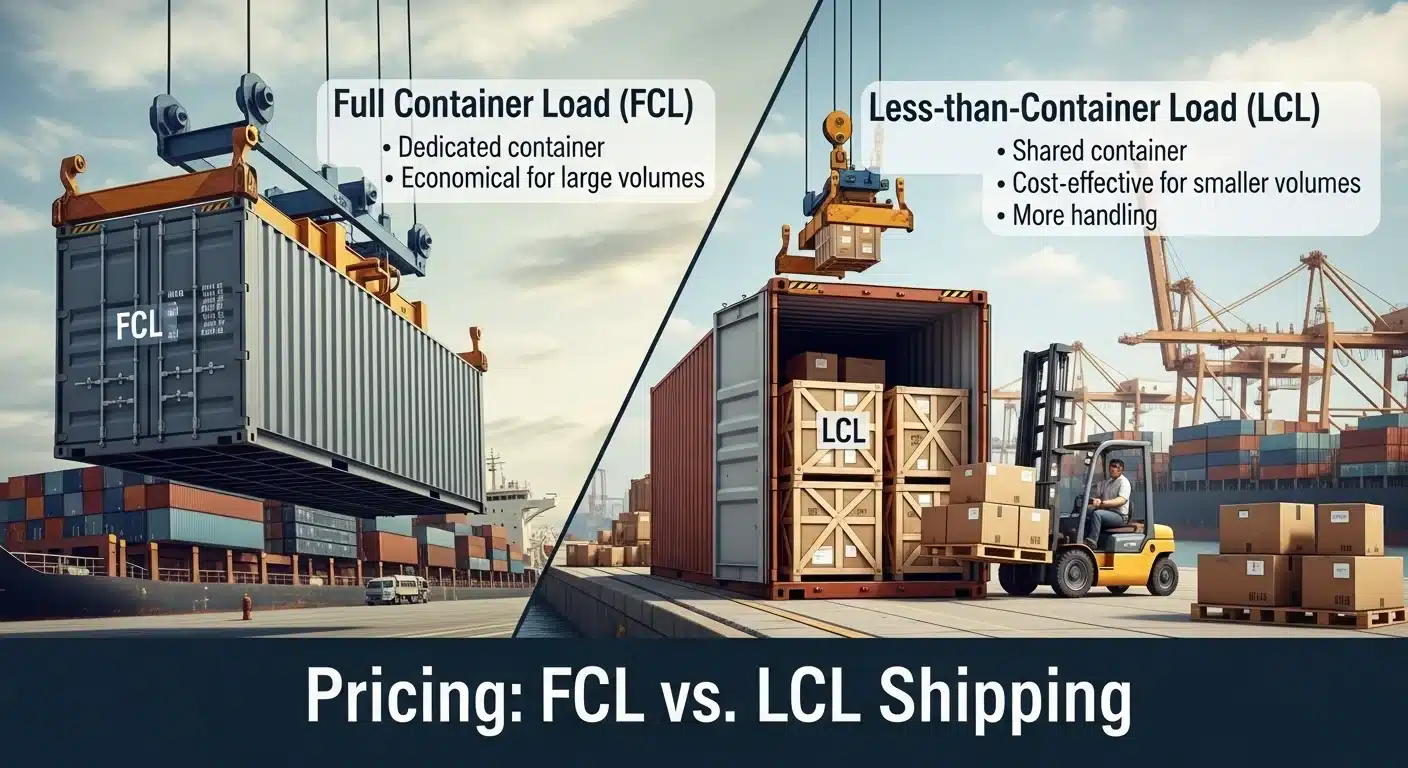
How LCL actually works: your suppliers deliver separately to a consolidation warehouse. Each order is logged, inspected against your purchase order, and staged. When the container loads, only your allocated cubic meters go in — alongside other buyers’ cargo. At the destination port, the container is unloaded, your goods are separated, and a local carrier delivers them to your door.
- Cost per CBM: 2026 market average: $50–$150 per CBM. US West Coast runs $80–$120/CBM; Europe $70–$110/CBM; Australia $90–$140/CBM. Consolidating 5+ suppliers into one LCL shipment cuts total freight costs by 35–50% compared to shipping each parcel separately.
- Minimum threshold: LCL makes economic sense above 2–3 CBM. Below 1 CBM, air freight or express courier is cheaper when you factor in documentation fees, consolidation charges, and destination handling.
- Hidden costs to flag: Consolidation fee, bill of lading amendment fee, destination terminal handling charge. A reliable forwarder quotes these upfront. We do — because our 20-year documentation team pre-checks every line item before submission.
Transit times run 20–42 days. US West Coast: 22–28 days. US East Coast: 28–35 days. Europe: 25–32 days. LCL adds 3–5 days versus FCL for consolidation and deconsolidation. Build that into your launch timeline — don’t promise Amazon stock before the container clears.
The hard truth: over 60% of customs delays in the US and EU are caused by incorrect HS code classification. When you consolidate five suppliers, every product line needs accurate codes. One mistake blocks the entire container. That’s why our owned 3,000m² warehouse includes a dedicated documentation team that reviews every HS code before the container leaves — achieving 99.5% first-submission accuracy. A single customs hold can cost $500–$2,000 in demurrage and storage fees. Pre-checking documentation isn’t overhead — it’s insurance.

FCL (Full Container Load) – For Large Orders
FCL only makes sense when you can fill at least 70% of the container volume.
Once your order volume exceeds roughly 15 cubic meters, moving from LCL to FCL changes the math. You pay a flat rate for the container instead of per cubic meter, so your cost per CBM drops sharply. But the key is utilization — if you only fill half a 20GP, your effective rate per CBM can actually be higher than LCL.
- 20GP container: Internal capacity: ~28 CBM, max payload 28 tons. Typical usable floor space fits 10–11 euro pallets. 2026 rate from Ningbo to US west coast: $1,550–$2,100. Fully loaded cost per CBM: $55–$75.
- 40HQ container: Internal capacity: ~68 CBM, max payload 26 tons. Fits 24–26 pallets. 2026 rate to US west coast: $2,200–$3,200. Fully loaded cost per CBM: $32–$47.
- Cost per CBM comparison: LCL runs $50–$150 per CBM depending on destination and season. A fully packed 40HQ at $2,800 delivers ~$41/CBM — nearly half the best LCL rate. But a half-filled 40HQ jumps to $82/CBM, wiping out the advantage.
Brand founders often over-order on FCL just to justify the container. That’s a mistake. If you’re still testing demand, start with LCL consolidation from multiple suppliers — our 3,000m² warehouse can receive, inspect, and hold those orders for 30 days free, then ship as a full container only when you have enough volume to fill it efficiently.
Air Freight vs. Express Courier
Air freight shines at 100kg+; express courier caps out around 20kg.
You’ve got samples, a product launch that can’t wait 30 days for a container, or an urgent restock. The real decision between air freight and express courier (FedEx/DHL/UPS) isn’t just speed — it’s weight, dimensional weight ratio, and who handles customs.
Express couriers quote door-to-door with full tracking and clear customs on your behalf. That convenience costs. Under 20kg, express wins on simplicity. Cross 45kg, and traditional air freight drops the per-kilo cost by 40–60%. The numbers from Yiwu to the US in 2026 tell the story clearly.
- 2026 air freight rates from Yiwu to US: 100kg at $13–$17/kg; 300kg at $9–$12/kg. Express rates typically land at $25–$45/kg for the same lane.
- Transit comparison: Air freight (consolidated) takes 6–10 days. Express courier takes 2–7 days. The gap narrows when you factor in consolidation — express jumps on the next flight; air freight waits for capacity.
- Weight thresholds: Express works best under 20kg. Air freight minimum from Yiwu is 45kg. Between 20kg and 45kg, you pay air freight minimums and lose the cost advantage.
- When express courier wins: 1–2 cartons, under 20kg total, time-critical samples or replacement parts, and you want door-step tracking without touching customs paperwork.
- When air freight wins: 3+ cartons, 45–500kg, mixed products from multiple suppliers, and you can accept a 4–5 day consolidation window to cut the per-kilo rate by half.
- When neither wins: Over 500kg or beyond 8 CBM — that’s LCL sea freight territory at $50–$150 per CBM, even at 25-day transit.
Here’s the scenario most first-time brand founders miss: you source five products from five different Yiwu suppliers. If each ships via FedEx individually, you’ll pay five separate courier bills with $30–$50 surcharges each and volumetric weight penalties. That’s where consolidation changes the math. We receive everything into our 3,000m² warehouse, inspect, repack, and ship as one consolidated air freight shipment. One freight bill, one customs clearance.
One trap: courier companies re-weigh and re-measure at their hub. A carton showing 18kg on your supplier’s scale can bill at 28kg after dimensional weight recalculation. Air freight consolidators charge on chargeable weight too, but the rate is lower and measurement happens at our warehouse before release — no surprises when the invoice arrives.
Yiwu Warehouse Consolidation Services
60% of customs delays come from incorrect HS codes — we catch those before the container leaves Yiwu.
The pre-production sample you approved in the supplier’s office and the 10,000 units that show up at your warehouse are rarely identical. Fabric shade shifts 5%. Plastic thickness drops 0.3mm. Packaging corners get crushed. This phenomenon has been observed on $50K orders where the buyer never caught the discrepancy until the container arrived at their door — and by then, returning goods to China costs more than the order itself.
That gap between what you approve and what ships is exactly why warehouse consolidation exists. You’re not just combining boxes from five suppliers into one container. You’re creating a single checkpoint where every unit gets verified before it hits the water.
- Receiving protocol: Every incoming carton from your suppliers gets logged against your PO line by line. We weigh each box on a calibrated floor scale — if a carton labeled 12kg reads 10.8kg, we flag it before you even see the discrepancy report.
- Sample-to-production match check: Your approved pre-production sample sits in our QC room as a physical reference. For each production batch, we pull random cartons and compare material color, thickness, print registration, and packaging dimensions against that sample. Anything outside your agreed quality tolerance — typically ±3% for non-critical dimensions — gets quarantined and photographed.
- Repacking and labeling: Suppliers often send goods in loose polybags or mislabeled master cartons. We consolidate into uniform export-ready cartons, apply correct shipping marks, and re-pack partial quantities into mixed-SKU boxes if your LCL consolidation needs it. Every carton gets a unique pallet ID for traceability back to the original supplier batch.
The benchmark you should ask your logistics partner: what is your carton-level inspection rate? Most warehouses spot-check 5-10% of incoming cartons. Our internal standard is 30% random inspection for repeat suppliers and 100% carton-by-carton check for first-time factories. Write that number down — 30% minimum — and ask your next service provider what theirs is.
Customs Documentation Made Easy
6 in 10 customs delays aren’t from misdeclared goods — they’re from a wrong HS code on the invoice.
Every shipping guide tells you to ‘double-check your documents.’ That’s correct but useless. The real problem is that most buyers don’t know which documents they actually need until the container is already sitting at the destination port. I’ve seen a $50K shipment sit for 23 days in Long Beach because the buyer didn’t know their wooden pallets required a fumigation certificate. Let’s walk through the five documents that matter, and the specific errors that get shipments flagged.
The commercial invoice and packing list are the foundation. Customs uses the HS code on the invoice to assess duties. If you classify a LED light strip as ‘lighting fixtures’ (duty rate 3.9%) instead of ‘electronic devices with integrated power supply’ (duty rate 8.7%), you’re either overpaying or underpaying — both trigger audits. The packing list seems trivial, but weight discrepancies between what you declared and what the carrier’s scale shows is the #1 reason containers get pulled for physical inspection. Keep the tolerance under 2% per carton.
- Bill of Lading: This is the title document — it proves ownership. The most expensive error I see is a misspelled consignee name or wrong notify party. A BL amendment costs $150–300 and takes 3–5 business days. A container number error costs $500+ and can delay release by two weeks. Always request a draft BL from your forwarder before they submit the final version. Our team at ChineseYiwu.com reviews every draft against the original purchase order before approval.
- Certificate of Origin (CO): Roughly 80% of first-time buyers don’t need a CO. But the 20% who do — because their destination country has a Free Trade Agreement with China (e.g., Australia, Chile, ASEAN nations) — can save 5–15% in tariff duties. The catch: you must apply for the CO before the vessel sails. Retroactive COs are often rejected. Our 20-year documentation team checks eligibility at the booking stage, not after loading.
- Fumigation Certificate: This is the document that catches even experienced importers. If your shipment uses wooden pallets or crating that isn’t ISPM-15 certified (heat-treated and stamped), customs will quarantine the container until a licensed fumigator treats it. That process takes 2–3 weeks and costs $500–$1,000 in storage fees alone. The fix is simple: specify in your supplier contract that all wood packaging must carry the ISPM-15 stamp, and request photos of the stamp before the container is sealed.
The common thread across all five documents:
Destination Country Clearance Assistance
Over 60% of customs delays are caused by incorrect paperwork, not product issues.
Most first-time brand founders assume that if their product is legal, customs clearance will be straightforward. In reality, a misclassified HS code or missing FDA prior notice can hold your container for three weeks, costing you storage fees and missed Amazon launch dates. We’ve seen it happen on $50K orders because a supplier used a generic HS code from a sample shipment.
- FDA (USA): Requires prior notice for food, cosmetics, medical devices. We pre-check your product classification and file notice via the FDA’s portal before sailing. Missing this adds 20+ days of hold time.
- CE Marking (EU): Mandatory for products like toys, electronics, PPE. We verify your supplier’s technical file and Declaration of Conformity. Many Yiwu factories sell ‘CE-marked’ goods without valid documentation — we spot that before it ships.
- RoHS (EU/China): Applies to any product with electronic components. We request the testing certificate from the supplier and match it to your shipment’s batch number. Inconsistent batch certificates cause immediate EU rejection.
The team has 20 years of experience handling these regulations across 12 destination countries. It maintains a database of updated HS codes for common export categories from Yiwu. The customs documentation achieves 99.5% first-submission accuracy, meaning your clearance starts on time, not after a delay.
Skip this step and you’re betting your next 6–8 weeks of cash flow on a supplier’s single-page CE certificate. We’ve seen Amazon sellers forced to air-freight replacements at $13/kg because customs refused their initial sea shipment. That’s a $5,000–$10,000 mistake for a typical 500kg order — more than our entire booking fee.
Заключение
The difference between a profitable first order and a costly lesson often comes down to three numbers: your shipment volume, your consolidation plan, and your customs accuracy. Consolidating orders from five or more suppliers into one LCL shipment cuts freight costs by 35–50% compared to shipping each separately. And with over 60% of customs delays caused by incorrect HS code classification, relying on a team that pre-checks those codes before submission saves weeks of downtime.
A 35–50% freight cost reduction is the benchmark you should expect from proper consolidation. Write it down. Compare every shipping quote against it. If you want to see how that number applies to your current order mix, take a look at our Cost Optimization page — we’ll run the math on your specific suppliers and volumes.
Часто задаваемые вопросы
How long does it take to ship from Yiwu?
Transit times depend on the method: sea freight to the US or Europe typically takes 25–35 days, while air freight takes 5–8 days. Express courier (DHL/FedEx) can deliver in 3–7 days. Choose based on your urgency and budget for the specific destination.
Какой самый дешевый способ доставки из Иу?
Sea freight via LCL (less-than-container-load) is the most cost-effective option for shipments under 15 cubic meters. For very small parcels (< 2 CBM), compare LCL with express courier consolidation to avoid. Always request a CBM-based quote for LCL versus full container savings.
Do I need a customs broker for Yiwu shipments?
Yes, most international buyers need a licensed customs broker to clear goods in both China and the destination country. The service includes full documentation and customs clearance assistance. It handles all customs formalities so you don’t need to hire a separate broker.
Can I combine air and sea shipping from Yiwu?
Yes, we offer multimodal shipping that combines air and sea legs (e.g., air to a hub then sea to final port) for faster delivery at lower cost than pure air. This works best. Confirm split routing with your account manager before shipping.
What happens if my goods are held at customs?
Customs holds usually result from incorrect HS codes, missing documents, or value mismatches. We will review the hold notice, correct the documentation, and communicate with customs on your behalf to. Share any hold notice with us immediately so we can act fast.