Justin
A Shopify seller I worked with last year ordered 2,000 hardcover notebooks from a Yiwu stationery supplier at $0.45 a unit. The Alibaba quote looked clean. She budgeted $900 for product, but her actual landed cost hit $1,840 after plate fees, DHL sample runs, and sea freight that doubled her per-unit price because notebooks are light but eat container space. She sold through the inventory at a $0.12 loss per unit. That $240 wasn’t a disaster, but it killed her confidence in placing a second order.
Key Takeaways
- 170,000 sq meters, 2,500+ stalls, and a 30/70 factory-to-trader split that directly determines whether you overpay by 15–25% on your stationery order.
- Yiwu stationery FOB spans $0.03 to $1.50 per unit.
- The quoted FOB price is roughly 40–60% of your actual landed cost.
- A quoted 500-piece MOQ in Yiwu District 3 is a starting negotiation position, not a hard floor.
- A $0.15 blank notebook becomes $0.42 branded in a custom box at 500 units.
- At $0.70 landed per unit, Yiwu-sourced notebooks cost 61.1% less than domestic wholesale at $1.80 — freeing $1,100 per 1,000 units before any platform fees are deducted.
We pulled the actual FOB prices, shipping weights, and fee structures from 50 stalls in District 3 over the past two years. This article gives you the math. You’ll see how to calculate your true cost per unit before you send a dollar — covering which stalls charge hidden plate fees, how shipping multiplies your FOB price by 1.5 to 2x, and why asking which city a factory is in tells you more about their margins than any negotiation.

Yiwu Stationery Market Location & Scale
170,000 sq meters, 2,500+ stalls, and a 30/70 factory-to-trader split that directly determines whether you overpay by 15–25% on your stationery order.
Where It Is and How Big
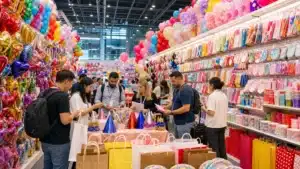
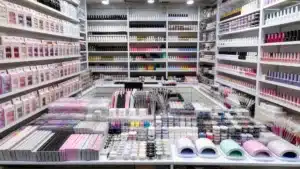
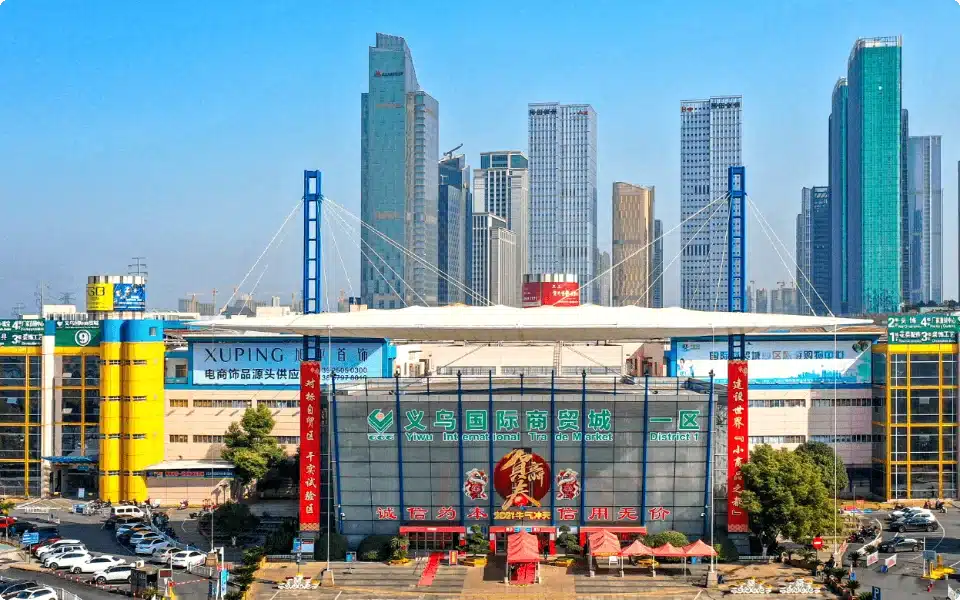
The Yiwu stationery market sits on the 2nd Floor of District 3 inside Cidade de comércio internacional de Yiwu. That single floor covers 170,000 sq meters and holds 2,500+ stalls stocking over 100,000 SKUs. For context, that is roughly 23 football fields of pens, notebooks, folders, and school supply sets arranged in a grid system.
District 3 is not a mixed-use building. The ground floor is hardware, and the upper floors are office supplies and sporting goods. Stationery is isolated to the 2nd floor, which means every stall you walk past is a potential supplier. The density is the point — you can visit 15–20 stalls in two hours and compare FOB prices on hardcover notebooks side by side.
Operating Hours
Stalls operate 09:00–17:00, 365 days a year, with one exception: a 7-day closure during Spring Festival (dates shift annually, typically late January to mid-February). Most vendors start packing up by 16:30, so if you are doing factory-floor price comparisons, arrive before 14:00 to leave time for negotiation rounds.
We have seen first-time buyers fly in on a Friday afternoon and lose a full day because they did not account for the early close. If you are sourcing remotely through us, this window matters less — we pull samples and quote during operating hours and send you the data the same day.
The 30/70 Vendor Split and What It Costs You
Roughly 30% of the 2,500+ stalls are factory-direct representatives. The remaining 70% are trading companies. This ratio is not trivial — it directly affects your unit economics. Factory-direct stalls typically price 15–25% lower on identical FOB items because there is no intermediary margin baked in.
Here is how we separate them on the floor:
- Booth focus: Factory stalls stock 1–3 product lines with deep inventory (e.g., only pens and refills). Trading stalls display 50+ unrelated categories — pens next to staplers next to scissors.
- Business card check: Factory-direct stalls have a business card showing the manufacturer name matching the booth signage. Trading companies list a different entity name or a generic trading Co., Ltd.
- Production evidence: Ask for factory floor photos, not product photos. A factory rep sends them in 10 minutes. A trader stalls or redirects.
Knowing this geography lets you verify whether the FOB quote you received is coming from the actual manufacturer or a middleman marking up the price before it reaches you. For e-commerce buyers working with tight unit margins — where a $0.05 difference per notebook can erase or double your profit — identifying the right stall type on the 2nd Floor of District 3 is the single highest-ROI step before you commit any order volume.
Stationery Categories & Pricing Tiers
Yiwu stationery FOB spans $0.03 to $1.50 per unit. Your real margin battle is DDP sea freight adding 1.5–2x to that base price.
FOB Price Ranges by Category
These numbers come from our verified supplier quotes in District 3, not Alibaba listings. The low end assumes factory-direct stalls; the high end reflects trading company markups of 15–25%.
- Erasers: $0.03–$0.10 per unit
- Ballpoint pens: $0.05–$0.15 per unit
- Paper notebooks (softcover): $0.15–$0.50 per unit
- Hardcover notebooks: $0.40–$0.80 per unit
- Pencil cases: $0.20–$0.60 per unit
- File folders: $0.08–$0.25 per unit
- School supply sets: $0.50–$1.50 per unit
- Art supplies: $0.10–$0.80 per unit (crayons, watercolor sets)
A critical detail most sourcing guides skip: the manufacturing origin drives the price gap within each range. Ningbo factories produce ballpoint pens at 20–30% lower FOB than Wenzhou trading companies selling identical pens. Asking “which city is your factory in?” immediately reveals whether you are talking to a factory rep or a middleman adding margin.
MOQ Reality: 200–500 Pieces Per Design
The standard Yiwu stationery market MOQ is 200–500 pieces per design. This is not negotiable at factory-direct stalls for standard items. But you can mix 3–5 SKUs within the same product category to effectively lower your per-design commitment.
For private label work, add $80–$300 in plate fees depending on print method and color count. This is a one-time cost per design, not per unit. If you are ordering 500 hardcover notebooks at $0.50 FOB with a $150 plate fee, your true unit cost is $0.80 — not $0.50. Most first-time buyers forget to amortize plate fees into their unit economics and wonder why their margins vanish.
Our service negotiates MOQ down to 100 pieces per design for clients, which matters when you are testing 5–10 SKUs on a $500–$1,000 initial budget. The standard market will not accommodate that order size without a sourcing agent acting as the consolidation layer.
E-Commerce Margin Potential by Category
The impulse-buy threshold for stationery on Amazon sits under $12 retail. Items priced above that point see conversion rates drop sharply. Your highest-margin plays sit in two opposite corners of the FOB spectrum.
- Novelty erasers and shaped pencil pouches (under $0.10 FOB): These consistently generate 3–5x higher Amazon conversion rates than standard stationery at 2x the price. A $0.08 animal-shaped eraser lands at roughly $0.20 DDP and retails for $6.99–$9.99. That is a 3,400–4,900% markup on FOB, or roughly 2,400–3,900% on landed cost.
- Hardcover notebooks ($0.40–$0.80 FOB): Land at $0.80–$1.60 DDP. Retail at $12.99–$18.99 on Amazon or Shopify. Net margin after FBA fees (roughly $3.50–$5.00 per unit) sits at $7–$10 per unit on a $1.00–$1.60 cost basis.
- School supply sets ($0.50–$1.50 FOB): Land at $1.00–$3.00 DDP. Retail at $14.99–$24.99. Margin is tighter at 40–55% after platform fees, but average order value is higher.
- Filing supplies ($0.08–$0.25 FOB): Low margin, high volume play. Land at $0.16–$0.50. Difficult to retail above $8.99. Best suited as add-on items to boost bundle value, not standalone listings.
The pattern is clear from our client data: novelty items under $0.10 FOB with strong visual differentiation (animal shapes, food designs, pastel colors) outperform utilitarian stationery on every e-commerce metric. The unit economics favor cheap, visually distinct inventory — not premium quality — for the $500–$5,000 first-order bracket.
One warning on art supplies: if you are selling into the US or EU, crayons and paint sets must meet EN71-3 (heavy metal migration) and ASTM D4236 (chronic health hazard labeling). Non-compliant art supply shipments get flagged by customs at a rate we have seen climb over the past 18 months. Factor $200–$500 in third-party lab testing into your first art supply order, or work through a sourcing partner who pre-vetifies compliance before production starts.
Hidden Costs That Kill Margins
The quoted FOB price is roughly 40–60% of your actual landed cost. The rest hides in samples, plates, labor, and freight.
Sample Costs: The $15–50 Per-Item Trap
Before you place a 500-unit notebook order, you will likely request 3–5 samples to check paper weight, cover material, and print registration. Each sample ships via DHL or FedEx at $15–50 per item depending on weight and destination. That is $45–250 burned before production starts.
Most first-time buyers treat this as a separate expense. It is not. That $45–250 gets divided across your total order quantity, and it directly raises your per-unit cost on small runs.
Custom Printing Plate Fees: $80–300 for Your Logo
Private label stationery requires printing plates. Silk screen plates for a simple 1-color logo on a pencil case run $80–150. Offset or multi-color plates for a hardcover notebook cover hit $200–300. These are one-time tooling costs, but on a 500-unit first order, a $150 plate fee adds $0.30 per unit to a $0.40 FOB notebook.
Suppliers in District 3 rarely volunteer this number upfront. You have to ask specifically: “What is the plate fee for this print method, and is it charged per color or per position?”
Color-Matching Surcharges and Re-Packaging Labor
If you specify a Pantone color for a notebook cover or pen barrel instead of the factory’s stock colors, expect a $50–100 color-matching fee. The factory mixes custom ink batches, and that labor gets billed to you.
Re-packaging labor is the other silent cost. Factory-default packaging is bulk cartons. If you want each pen in a individual blister pack or custom polybag, labor runs $0.02–0.05 per unit. On 1,000 units, that is $20–50 you probably did not line-item in your spreadsheet.
The True Unit Cost Equation
Your actual per-unit cost follows this formula:
- FOB Total: Unit FOB price × order quantity
- Sample Costs: Total courier fees paid before production
- Plate Fees: One-time printing tooling charges
- Color-Match Fees: Custom Pantone mixing charges
- Re-Packaging Labor: Per-unit cost for custom packing
- DDP Shipping: Door-to-door freight including customs and duty
Divide that sum by your total order quantity. That is your true landed cost per unit.
Here is a real example from our order logs: a $0.40 FOB hardcover notebook, 500 units, with $100 in samples, $150 plate fee, $75 color match, $25 re-packaging labor, and $350 DDP sea freight. The math: ($200 + $100 + $150 + $75 + $25 + $350) ÷ 500 = $1.80 per unit. Not $0.40. The FOB price was only 22% of the final cost.
DDP sea freight for stationery typically adds 1.5–2x to FOB because stationery is lightweight but bulky. High cube utilization means you pay for space, not weight. If your supplier only quotes FOB, you are looking at an incomplete number.
| Hidden Cost | Typical Amount | Root Cause | Unit Impact (500pcs) | Our Solution |
|---|---|---|---|---|
| Private Label Plate Fees | $80 – $300 | Custom print setup for logos or packaging | Adds $0.16 – $0.60 per unit | Factored into our 100pc MOQ quotes upfront |
| Courier Sample Fees | $15 – $50 per item | DHL/FedEx shipping from Yiwu before bulk order | Adds $0.03 – $0.10 per unit (testing 3 suppliers) | We inspect samples locally before you pay courier fees |
| Trading Company Markup | 15% – 25% FOB increase | 70% of District 3 stalls are middlemen, not factory-direct | Adds $0.05 – $0.20 per unit on notebooks | We audit factory credentials to access the 30% direct pricing |
| Sea Freight & Duties | 1.5x – 2x FOB price | Lightweight stationery occupies high cube space; hidden tariffs | A $0.20 FOB pen becomes $0.30 – $0.40 landed | Global DDP Shipping quotes include all fees before you order |
| Quality Rejection / Dead Stock | 5% – 10% defect rate | No EN71-3 or ASTM compliance check at the factory | $25 – $50 in unsellable inventory per $500 order | Risk-Free Pre-shipment Inspection to Western standards |
MOQ Reality vs Supplier Claims
A quoted 500-piece MOQ in Yiwu District 3 is a starting negotiation position, not a hard floor. The real minimum is 100 pieces at a 10–15% unit premium — if someone on the ground enforces quality.
Quoted 500 pcs MOQ vs Actual Accepted 100 pcs at 10–15% Premium
Suppliers in District 3 quote 200–500 pieces per design because that batch size covers their setup costs and yields a comfortable margin. It is not a production limitation. We have placed first orders at 100 pieces per design routinely. The cost adjustment is straightforward: expect a 10–15% premium per unit.
For a $0.50 FOB hardcover notebook, that means $0.55–$0.575 per unit. On a 100-piece order, your total extra cost is $5.00–$7.50. Compare that to being stuck with 400 unsold notebooks at $0.50 each — $200 of dead inventory. For an e-commerce first order testing Amazon listing viability, the premium is the rational choice.
Negotiating MOQ Down Without Triggering Quality Drops
Here is the mechanism most buyers miss: the quality risk at 100 pieces is not about batch size. It is about supplier incentive. At 500 pieces, the factory’s profit margin absorbs setup costs comfortably, so they run standard QC. At 100 pieces, that margin compresses, and an unsupervised supplier will offset it by substituting materials — thinner cover board, lower-grade ink, skipping the final inspection pass.
We eliminate this by inserting pre-shipment inspection between production and dispatch. The supplier knows a third party is checking against your approved sample before freight. The incentive to cut corners disappears because rejected units come out of their pocket, not yours. A 100-piece order without this layer is a gamble. A 100-piece order with inspection is a controlled test.
Mixing 3–5 SKUs in One Order to Lower Effective MOQ Per Design
This is the most underused tactic in Yiwu stationery sourcing. Instead of ordering 100 pieces of a single notebook design, you order 100 pieces total across 4 SKUs — 25 units per design. The factory treats this as one production run because the base material and print method are identical. Setup costs (plate fees, machine calibration) get shared across all four designs.
Your effective MOQ per design drops to 25 pieces, which is enough to create differentiated Amazon listings and test which variant moves. The constraint is strict: all mixed SKUs must share the same substrate and printing process. You cannot combine a spiral-bound notebook with a sewn-binding hardcover in one run. Within those limits, mixing 3–5 SKUs is standard practice in District 3 and the fastest way to stretch a $500–$1,000 first order across multiple product tests.
Quality Tiers & Counterfeit Risks
Yiwu stationery has three quality tiers. Paying Grade A prices for Grade C goods is the most common first-order mistake under $2,000.
The Three Quality Tiers in District 3
Grade A is export-standard inventory from ISO 9001-certified factories. These units pass EN71-3 heavy metal migration testing for children’s products. You’ll find this tier at the 30% factory-direct stalls in District 3.
Grade B serves China’s domestic retail market—think mid-tier supermarket shelves. Quality is functional but inconsistent; expect minor printing offsets or thinner plastic walls. FOB pricing runs 15–25% below Grade A.
Grade C is promotional giveaway quality, often running $0.03–$0.10 FOB. Plastic is brittle, ink bleeds, and binding fails within weeks. This tier destroys Amazon reviews if listed as retail-grade.
Spotting Counterfeit Branding
Counterfeit branding is rampant in Yiwu’s stationery section. We’ve seen non-Casio calculators with Casio logos, and generic pens stamped with Parker branding. The penalty for importing counterfeit goods into the US or EU starts at $15,000 per shipment.
Inspection Red Flags
- Ink bleed-through: Text from one page visible on the reverse—indicates low-grade paper stock under 60gsm.
- Brittle plastic: Pencil cases or folders that crack under light thumb pressure at room temperature.
- Misaligned printing: Logo or text not centered, or register colors overlapping—signs of worn printing plates or lack of QC.
Manufacturing Hubs Behind Yiwu Stalls
District 3 stalls are mostly storefronts. The actual factories sit in three cities — and knowing which city produces what determines whether you pay factory FOB or a 15–25% trading company markup.
Ningbo: Pens and Mechanical Pencils
Ningbo accounts for roughly 70% of China’s pen output. If you are quoting ballpoint pens at $0.05–$0.15 FOB, the factory behind that price is almost certainly in Ningbo or its surrounding counties (Fenghua, Beilun). The cost advantage is real: we have seen Ningbo factory-direct FOB prices run 20–30% lower than Wenzhou trading companies selling identical pen designs.
The key distinction for buyers is that Ningbo factories specialize. A pen factory in Ningbo produces pens — not folders, not erasers, not pencil cases. That specialization drives down unit cost through economies of scale on molds and ink refills.
Wenzhou: Plastic Folders, Pencil Cases, and Rulers
Wenzhou dominates injection-molded and blow-molded plastic stationery. File folders ($0.08–$0.25 FOB), plastic pencil cases ($0.20–$0.60 FOB), and rulers all originate here. Wenzhou’s industrial base is plastics processing, so the material cost for PP and PVC stationery is among the lowest in China.
However, Wenzhou also has the highest density of trading companies acting as middlemen. A stall in District 3 showing Wenzhou plastic folders alongside Shantou erasers and Ningbo pens is almost certainly a trading company — not a factory. That mixed-category display is the clearest markup signal you will encounter.
Shantou (Guangdong): School Supply Sets, Art Supplies, and Erasers
Shantou, specifically the Chenghai district, is the epicenter for school supply sets ($0.50–$1.50 FOB), novelty erasers ($0.03–$0.10 FOB), and art supply kits. If your Amazon store targets the back-to-school impulse-buy segment — animal-shaped erasers, food-design pencil pouches — Shantou is your origin city.
For art supplies, Shantou factories typically hold ASTM D4236 certification for chronic health hazard labeling. If a stall cannot produce a lab test report showing ASTM D4236 compliance for crayons or watercolor sets, walk away. Children’s stationery from any of these three hubs also requires EN71-3 heavy metal migration testing — this is non-negotiable for Amazon US and EU marketplaces.
Bypassing Trading Company Markups
Only 30% of District 3 stalls are factory-direct representatives. The remaining 70% are trading companies that add 15–25% to your unit price without adding value. Identifying the factory stalls is not complicated, but it requires asking the right questions rather than browsing product displays.
- City test: Ask “Which city is your factory in?” A factory owner answers immediately. A trading company hesitates or names a city that does not match the product category.
- Business card check: The factory name on the card must match the booth signage. If the card shows a trading company name but the booth says “Ningbo Pen Factory,” you are dealing with a reseller.
- Category depth: Factory stalls stock 1–3 product lines with deep inventory. Trading stalls display 50+ unrelated categories to maximize foot traffic.
- Production photos: Request factory floor photos, not product photos. Factory reps send them within minutes. Trading companies stall or send stock images.
We run this exact identification process before introducing any supplier to our clients. On a 500-unit pen order at $0.10 FOB, cutting out a 20% trading markup saves you $10. On a 5,000-unit school set order at $1.20 FOB, that same 20% becomes $1,200. The city-to-product mapping is not trivia — it is your pricing use.
Private Label Stationery Costs
A $0.15 blank notebook becomes $0.42 branded in a custom box at 500 units. The $0.27 difference is entirely plate fees and packaging — the two line items most e-commerce buyers never calculate before ordering.
The Three-Layer Cost Structure
Layer one is the base unit FOB price. For a standard A5 paper notebook in Yiwu District 3, the blank FOB runs $0.15–$0.50 depending on page count and cover material.
This is the number most suppliers lead with on Alibaba or at their booth. It means nothing for your unit economics until you add layers two and three.
Layer two is the plate fee — a one-time charge per color and per print method. This is non-negotiable and amortized across your order quantity. The method you pick here directly controls whether your private label makes sense at 500 units or only at 5,000.
- Screen print: $80–$120 per color plate. Best for 1–2 color logos on flat surfaces like notebook covers or pen barrels. Setup is fast, per-unit print cost near zero at volume.
- Heat transfer: $150–$250 per design. Handles full-color artwork and gradients, but adds $0.03–$0.05 per unit in transfer film material cost. Only viable if your retail price supports the margin hit.
- Embossing/debossing: $200–$300 per metal die. Premium look on hardcover notebooks and leather pencil cases. No ink cost, but the die fee alone kills profitability under 300 units.
Layer three is custom packaging. A polybag with a barcode sticker adds $0.02–$0.04 per unit. A custom-printed paper box adds $0.08–$0.15.
A rigid box with foam insert adds $0.20–$0.35 per unit. This is where most first-time buyers destroy their unit economics — they spec a premium box without calculating what it does to landed cost per item.
Pricing Walk-Through: $0.15 Blank to $0.42 Branded at 500 Units
Here is the actual cost build for an A5 paper notebook with a 1-color screen-printed logo and a custom printed paper box. Blank notebook FOB: $0.15 per unit.
Screen print plate fee (1 color): $80 flat, which amortizes to $0.16 per unit at 500 pieces. Custom printed paper box: $0.11 per unit.
Your branded unit FOB is now $0.42. The per-unit cost jumped 180% from blank to branded, and you haven’t shipped it yet.
Apply the standard 1.5x DDP sea freight multiplier for lightweight stationery, and your landed cost hits roughly $0.63 per unit. Your $75 blank product order just became a $315 landed order before duties — and that math is exactly why e-commerce sellers who skip the line-item breakdown end up with negative-margin inventory.
| Categoria do produto | Base FOB Range | Customization Plate Fee | Sample / Prototyping Fee | DDP Landed Cost Estimate |
|---|---|---|---|---|
| Hardcover Notebooks | $0.40 – $0.80 | $150 – $300 | $30 – $50 via DHL/FedEx | $0.60 – $1.60 |
| Paper Notebooks | $0.15 – $0.50 | $80 – $150 | $15 – $30 via DHL/FedEx | $0.23 – $1.00 |
| Pencil Cases | $0.20 – $0.60 | $100 – $200 | $20 – $40 via DHL/FedEx | $0.30 – $1.20 |
| School Supply Sets | $0.50 – $1.50 | $150 – $300 | $40 – $50 via DHL/FedEx | $0.75 – $3.00 |
| Standard Ballpoint Pens | $0.05 – $0.15 | $80 – $120 | $15 – $20 via DHL/FedEx | $0.08 – $0.30 |
Landed Cost Calculation Example
At $0.70 landed per unit, Yiwu-sourced notebooks cost 61.1% less than domestic wholesale at $1.80 — freeing $1,100 per 1,000 units before any platform fees are deducted.
The Worked Example: 1,000 Branded Notebooks
FOB price for a custom-branded A5 hardcover notebook from a District 3 factory-direct stall runs $0.40–$0.80. We will use $0.42, a realistic mid-range figure for 80gsm inner pages with a basic logo print. For 1,000 units, your factory cost is $420.
Here is where most first-time buyers get burned: they quote FOB and stop calculating. DDP sea freight for 1,000 notebooks — covering ocean freight, customs clearance, import duties, and last-mile delivery to your door — runs $280 in our experience. Your total outlay is $700, or $0.70 per unit landed.
That $700 total divided by $420 FOB gives a 1.67x landed cost multiplier. For lightweight, high-cube stationery, we consistently see total landed cost fall between 1.5x and 2.0x of FOB. The freight itself is $280 — only 0.67x of FOB — but duties and handling push the total multiplier up. This is structural: notebooks are bulky relative to weight, so you pay for volume, not kilograms.
Comparison to Domestic Wholesale
The same specification notebook from a US or UK wholesale distributor typically lands at $1.80 per unit at comparable order volumes. That is a $1.10 gap per unit, or $1,100 on a 1,000-unit order. If you are buying branded notebooks domestically at $1.80 and retailing under $10, your COGS consumes 18–20% of revenue before a single platform fee, ad click, or shipping label enters the picture.
The $0.70 Yiwu landed cost brings your COGS down to 7.8% of an $8.99 retail price. That is not a marginal improvement — it changes what you can afford to spend on customer acquisition without going negative on the first order.
Margin Analysis at $8.99 Retail
At $8.99 per unit across 1,000 units sold, gross revenue is $8,990. Below is the unit economics split between Yiwu sourcing and domestic wholesale, before platform costs.
- Yiwu COGS: $0.70 × 1,000 = $700 (gross profit: $8,290, margin: 92.2%)
- Domestic COGS: $1.80 × 1,000 = $1,800 (gross profit: $7,190, margin: 79.9%)
- Incremental margin from Yiwu: $1,100
Now subtract platform costs. On Amazon FBA, fulfillment and referral fees for a notebook run roughly $2.50–$3.00 per unit. On Shopify with a $4.50 ship cost and 2.9% + $0.30 payment processing, your per-unit overhead is approximately $5.00. At $5.00 in combined platform and fulfillment costs, Yiwu sourcing leaves $3.29 net profit per unit ($8.99 − $0.70 − $5.00). Domestic wholesale leaves $2.19. Over 1,000 units, that gap is exactly $1,100 — the COGS savings flowing straight to your bottom line.
The takeaway is not that Yiwu sourcing guarantees profitability on its own. Platform economics still dictate your ceiling. The takeaway is that $0.70 COGS gives you enough margin headroom to run paid ads, absorb a 5% return rate, or offer free shipping and remain in the black — something $1.80 COGS makes significantly harder at a sub-$10 retail price point.
| Cost Component | Calculation Detail | Total Cost (USD) | Landed Cost Per Unit |
|---|---|---|---|
| Factory FOB Price | 500 hardcover notebooks @ $0.50/unit | 250.00 | $0.50 |
| Private Label Plate Fee | Custom logo printing setup fee | 150.00 | $0.30 |
| DDP Sea Freight | 1.75x FOB multiplier (lightweight, high cube) | 437.50 | $0.88 |
| Risk-Free Inspection | Pre-shipment quality verification | 50.00 | $0.10 |
| True Landed Cost | All-inclusive sum divided by 500 units | 887.50 | $1.78 |
Conclusão
The math on your first stationery order comes down to one brutal fact: that $0.15 notebook FOB price becomes $0.30 once you pay for sea freight, customs, and local delivery. You cannot guess at DDP costs. If you are only buying 500 units to test Amazon demand, pay a flat all-in price upfront so a bad batch ruins your margins, not your cash flow.
Before you wire a single dollar, demand a factory audit report and a photo of the production floor, not just the product. Trading companies hide behind vague city references. Ask exactly which city their machines sit in—Ningbo pens cost 25% less than Wenzhou pens, and that question alone exposes their real markup.
Perguntas mais frequentes
What are the top 5 stationery items?
Notebooks, pens, registers/ledgers, highlighters, and pencils. In Yiwu District 3, notebooks alone occupy roughly 35% of stall inventory. For e-commerce, notebooks and pens offer the best margin-to-MOQ ratio — a $0.20 FOB notebook retails at $6–12 on Amazon.
What is Yiwu Market China famous for?
Yiwu is known as the world’s capital for small commodities, operating China’s largest wholesale market with over $90 billion in annual trade volume. The stationery section in District 3 is one of five major product districts, alongside jewelry, toys, hardware, and textiles.
Who is the best stationery manufacturer in China?
There is no single ‘best’ — it depends on the product category. Ningbo produces 70% of China’s pens (brands like Deli and M&G source here). Shantou dominates school supply sets and art materials. For Yiwu sourcing specifically, prioritize factory-direct stalls over brand chasing — a Ningbo factory stall in Yiwu will give you better pricing than ordering directly from a brand’s export department.
Can you negotiate prices with Yiwu stationery suppliers?
Yes — standard negotiation range is 10–25% off the first quoted price. Effective use points: committing to 3+ SKUs in one order, offering repeat-order intent, and paying via wire transfer instead of PayPal. Never accept the initial calculator quote without countering.
What are the market hours of Yiwu Stationery Market?
09:00–17:00 daily, year-round. The market closes for 7 consecutive days during Spring Festival (typically late January to mid-February, dates shift annually with the lunar calendar). Arrive before 10:00 for the most attentive service — vendors are fresher and less likely to rush negotiations.