Justin
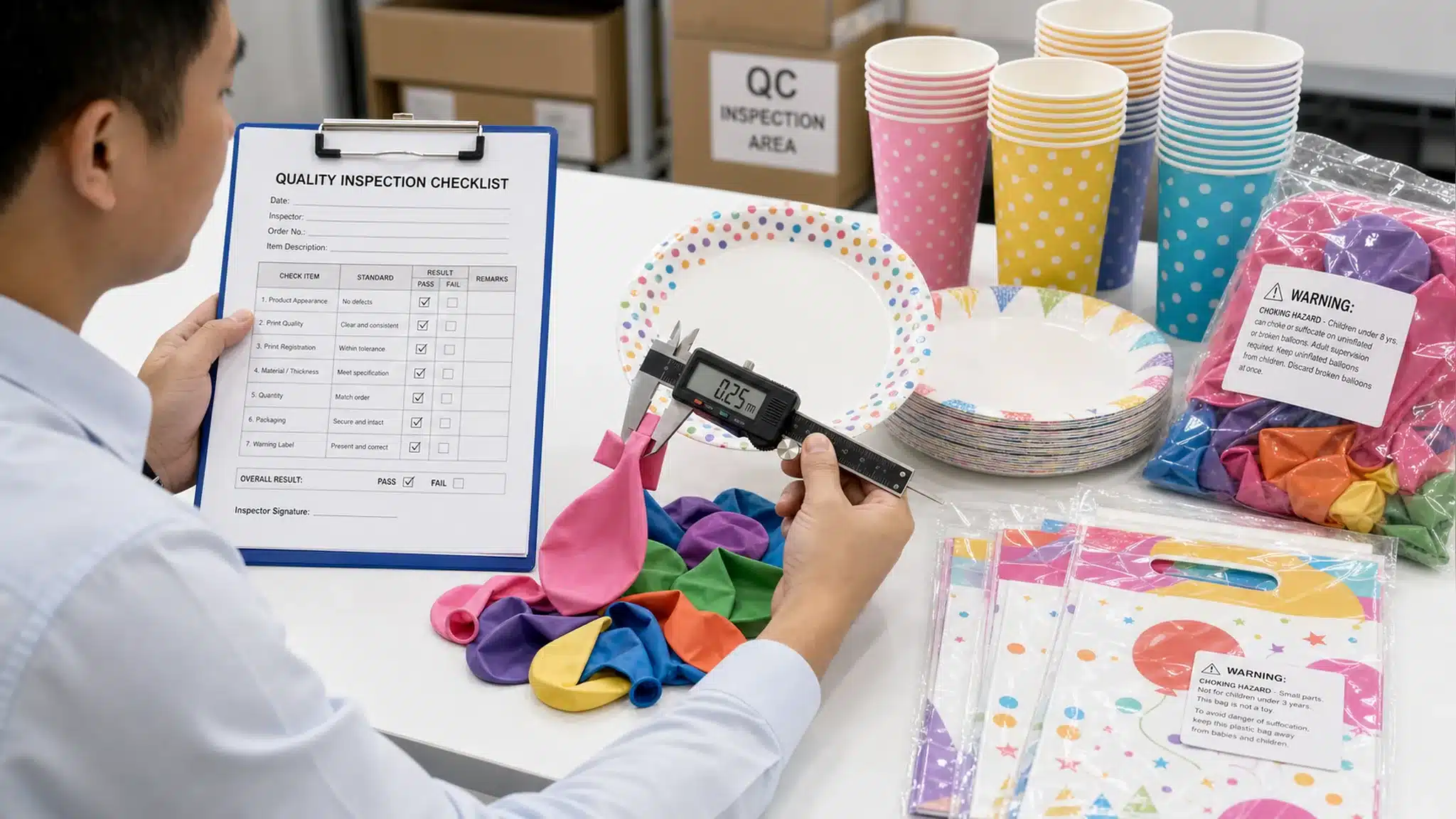
A quality inspection is a decision procedure, not a look around the factory. Someone draws a defined number of items from a finished lot, judges each one against a written standard, counts the failures, and compares that count to a number agreed before production started. Below the number, the lot ships. At or above it, the lot does not. Everything else — the photographs, the tape measures, the man in the blue coat — exists to make that count defensible.
Most buyers meet the procedure backwards. They book an inspection because a shipment went wrong, discover the report says “AQL 2.5, sample 80, Ac 5 / Re 6”, and have no way to tell whether that line protected them or merely documented their loss.
This page takes it in order: what an inspection is, the four stages, how the sampling maths works and where its published tables quietly stop working, and what the market really charges. Then the part almost no generic guide covers — what changes when your “factory” is a market booth in Yiwu that buys its stock from a dozen upstream workshops.
Key takeaways
- The AQL standard changed this year. ISO 2859-1:2026, third edition, dated January 2026, cancels and replaces ISO 2859-1:1999. Reports and contracts still citing the 1999 edition are citing a withdrawn document.
- An AQL is not a quality target. It is the worst average quality that the sampling scheme will routinely accept. Nobody promises you 2.5% defects.
- Inspection level II is the default. Lot size gives a code letter; the code letter plus your AQL gives sample size and the accept/reject pair.
- At small lot sizes the published table contains arrows instead of plans. An arrow means the plan does not exist there and your sample size changes. This is where small-order inspections are most often done wrong.
- China third-party inspection runs roughly $149–$320 per man-day in 2026 depending on service type, with travel often billed on top.
- Yiwu breaks one specific assumption: ISO sampling is defined over items in a lot. A booth order is many suppliers’ goods in one shipment, so carton-level substitution can pass a correctly-run unit-level inspection.
On this page
- What a Quality Inspection Actually Is
- The Four Stages of Inspection, and What Each One Can Still Save
- How AQL Sampling Works — and What Changed in 2026
- Reading the Sampling Table Without Getting It Wrong
- What a Quality Inspection Costs in 2026
- Why a Yiwu Order Breaks Standard Sampling
- The Yiwu Inspection Checklist
- Choosing Your Inspection Posture: What We Check, and Where We Stop
- Writing the Inspection Into Your Order
- Perguntas mais frequentes
What a Quality Inspection Actually Is
A quality inspection is acceptance sampling: you inspect a defined subset of a lot and use the result to accept or reject the whole lot. The alternative — checking every unit — is called 100% inspection, and it is slower, more expensive, and not reliably better — inspection fatigue on repetitive visual tasks is a recognised source of error in 100% inspection, which is why sampling schemes exist at all rather than as a concession to cost.
Three things must be fixed in writing before an inspector travels, or the report is unusable in a dispute.
The lot
The lot is the population the decision applies to. It should be a single product, from a single production run, presented at one time. If you merge three SKUs into “the order” and inspect that, a pass tells you the blend was acceptable — not that any individual SKU was.
The defect classification
Every defect an inspector can find must map to one of three classes agreed in advance. Critical defects are safety or legal failures and normally carry zero tolerance. Major defects are functional: the product does not do what it is sold to do, or a buyer would return it. Minor defects are cosmetic deviations a customer would probably accept.
The classification is the part buyers most often leave to the inspection company, and it is the part that decides outcomes. A loose seam is a major defect if you sell the bag as luggage and a minor one if you sell it as a gift item. Nobody can write that boundary for you.
It also has to survive translation. On booth-sourced goods from Yiwu the person acting on your classification is frequently the booth’s own packer rather than a quality department, so a classification written in abstractions — “poor finish”, “substandard printing” — arrives as an opinion and gets argued about. Written as observable conditions with a threshold attached, it arrives as an instruction: “print misaligned by more than 2 mm from the artwork position = major”. The second version can be enforced by someone who has never read your brand guidelines.
The acceptance quality limit
The AQL is the quality level that the sampling scheme treats as acceptable over a continuing series of lots. It is a property of the scheme, not a promise about your shipment. A plan indexed at AQL 2.5 does not mean you have agreed to receive 2.5% bad units; it means the scheme is built to pass suppliers whose long-run process average sits at or better than that, and it will occasionally pass a worse lot and occasionally reject a better one.
The decision itself is a straight comparison. Under ISO 2859-1, if nonconforming items in the sample are equal to or less than the acceptance number the lot is accepted; equal to or greater than the rejection number, it is not.
| Defect class | What it means | Common AQL setting |
|---|---|---|
| Crítico | Unsafe or illegal to sell — sharp edge, live part, banned substance, missing mandatory marking | Zero tolerance |
| Major | Functional failure or an appearance fault a customer would return | AQL 2.5 |
| Menor | Cosmetic deviation most buyers would accept | AQL 4.0 |
Those two settings — 2.5 for major, 4.0 for minor — are the ordinary consumer-goods convention, and effectively every inspection provider in China quotes them as the default, ours included. They are a convention, not a law, and nobody’s use of them is a differentiator. Raise them and you are buying a cheaper, faster inspection and accepting more risk; lower them and you are paying for a bigger sample. The setting that deserves your attention is the one nobody defaults for you: whether critical defects really are zero-tolerance on your PO, because that is the class that turns into a recall rather than a markdown.
The Four Stages of Inspection, and What Each One Can Still Save
The four inspection stages are not four products to be sold four times. They are four points on a timeline, and the only useful way to compare them is by what is still recoverable when the inspector finds a problem.
| Stage | When | What is still fixable |
|---|---|---|
| Pre-production (PPI) | Before the line starts | Everything. Wrong material or wrong component can still be swapped at supplier cost. |
| During production (DUPRO) | Roughly 20–50% produced | The remaining 50–80%. A tooling or setting error is corrected before it is repeated across the run. |
| Pre-shipment (PSI) | 100% produced, ~80% packed | Your money, not your schedule. Rework means re-making goods that already exist. |
| Loading supervision | Loading day | Only identity and handling — that the cartons loaded are the cartons inspected, stacked to survive the trip. |
Read the right-hand column as a decay curve. PPI is the cheapest hour anyone will ever spend on your order because at that point no wrong thing has been manufactured yet. By PSI the money is already spent; the inspection is protecting your ability to refuse delivery, which is worth a great deal but is not the same as preventing the defect.
One caveat when you are buying through a market booth rather than commissioning a factory run. The first two stages assume there is a production line to visit, and for a booth holding finished stock there may not be one — the goods already exist, made weeks ago by a workshop the booth may not name.
In that situation the honest stage map collapses to two: verify the goods and the cartons before they leave, and watch them load. Paying for a DUPRO on an order that was never made to order buys a stage with nothing to observe.
The stage buyers skip most often is the last, and it is the one that protects the other three. An inspection report certifies goods that were in a specific place on a specific day. Loading supervision is the only step that connects that report to the container you actually receive. If nobody watches the loading, the pass report describes a set of cartons and the shipment contains a set of cartons, and no document links the two.
What “80% packed” is doing in the PSI definition
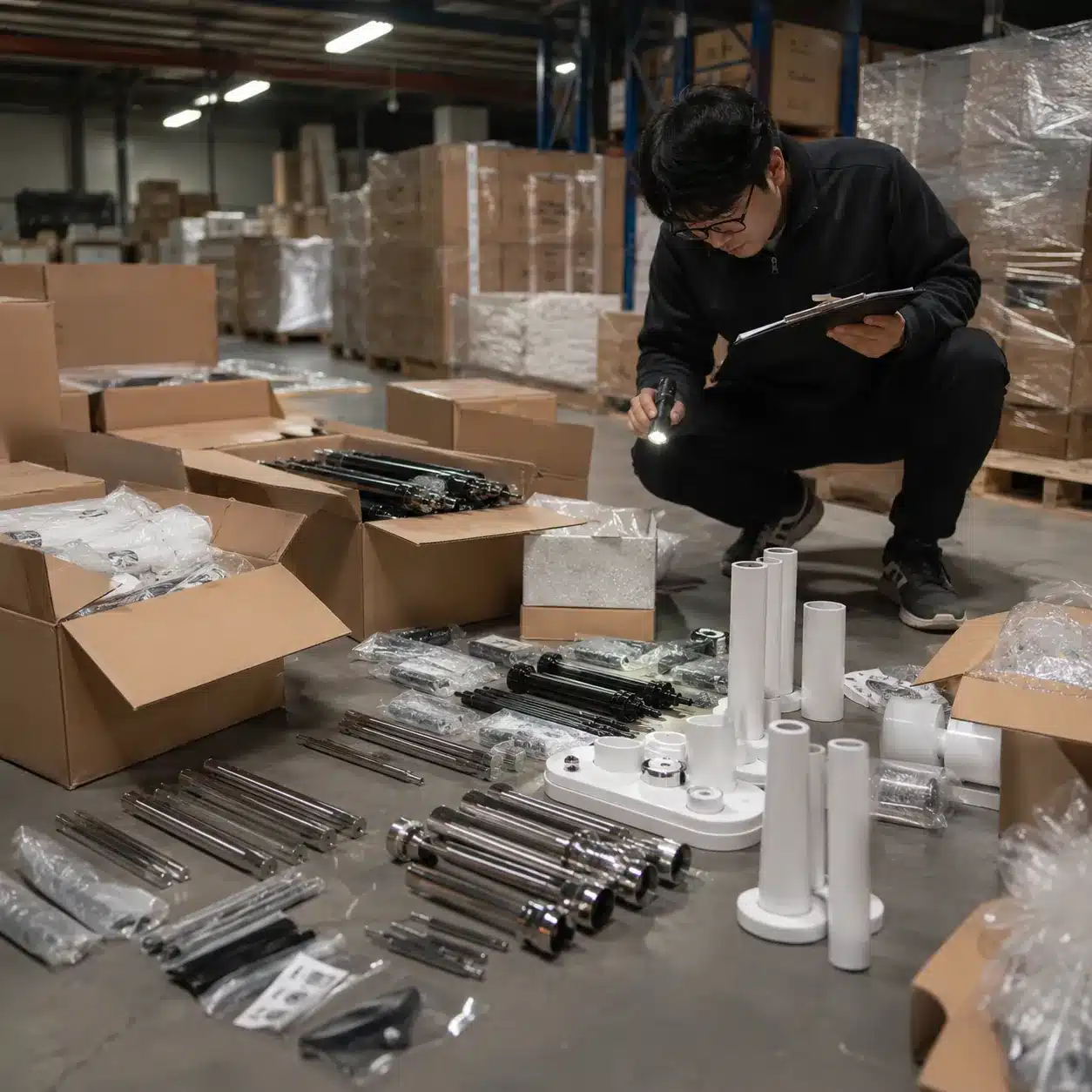
PSI is conventionally called when goods are fully produced and around 80% packed, and that second condition is not arbitrary. Fully packed and sealed means the inspector must break down and re-seal cartons to see anything, which suppliers resist and which costs hours. Loose goods mean packaging, labelling and carton markings — a large share of real-world rejections — cannot be assessed at all. The 80% point is the window where both the product and its packaging exist and can still be looked at.
How AQL Sampling Works — and What Changed in 2026
The sampling scheme almost every consumer-goods inspection runs on is ISO 2859-1. If you have been working from a copy of the standard, or from a guide written against one, check the date on it — because the document changed this year and most of the internet has not caught up.
ISO 2859-1:2026 is the third edition, dated January 2026. In the standard’s own words, it “cancels and replaces the second edition (ISO 2859-1:1999), which has been technically revised”, and it also absorbs the 2011 amendment and the 2001 corrigendum. It was prepared by ISO/TC 69, Applications of statistical methods, subcommittee SC 5 on acceptance sampling.
The revision matters less than it sounds for the everyday accept/reject decision and more than it sounds for anyone writing a QC clause. The listed changes are these:
- A new procedure for switching from normal — or from reduced — inspection into skip-lot sampling, where a qualified supplier’s lots are inspected only intermittently.
- Guidance on the qualification requirements a producer and a product must meet before skip-lot is allowed at all.
- Guidance on when skip-lot actually pays, plus methods for randomly selecting which lots get skipped.
- The per-plan operating characteristic curves have been removed, replaced by methods in Annex E for constructing a given plan’s own OC curve and average sample number curve.
The practical reading: the code letters, sample sizes and accept/reject numbers you use day to day are not what was revised. What was revised is the machinery around them — the rules for relaxing inspection on a supplier who has earned it, and how you demonstrate a plan’s risk profile now that the pre-drawn curves are gone. If your purchase terms say “sampling per ISO 2859-1:1999”, they now cite a withdrawn edition. The fix is a one-line amendment, and it is worth making before a dispute rather than during one.
Normal, tightened, reduced — the part most buyers never switch on
ISO 2859-1 is a scheme, not a single table, and the switching rules are what make it a scheme. A supplier who keeps failing moves to tightened inspection, where the plan is harder to pass. A supplier with a long clean record can move to reduced inspection, and now potentially to skip-lot, where inspections become intermittent. Most importers never invoke any of it and run every lot at normal inspection forever.
That is a real cost. The switching rules are the mechanism by which a good supplier earns cheaper inspections and a bad one is squeezed automatically, without you having to renegotiate anything. Naming them in your terms — even just “normal inspection, with tightened inspection triggered per ISO 2859-1 after two rejected lots in five” — converts a supplier’s quality record into a financial consequence that operates on its own.
There is one place the switching machinery quietly does not apply, and it matters for market buying. Switching rules — skip-lot in particular — are built on a continuing series of lots from the same producer. A Yiwu booth that fills your order from whichever upstream workshop has stock that month is not a continuing series in that sense, even though every purchase order carries the same booth name.
So the clean record you think you are accumulating may belong to three different workshops. Before relaxing inspection on a booth-sourced line, ask who actually made the last three shipments. If the answer changes, stay at normal inspection however many lots have passed.

Reading the Sampling Table Without Getting It Wrong
Two lookups produce an inspection plan. Lot size and inspection level give you a sample size code letter. The code letter and your AQL give you the sample size and the accept/reject pair. General inspection level II is the default and is what you get unless someone specifies otherwise.
| Lot size | Code letter | Sample size | Major, AQL 2.5 (Ac / Re) | Minor, AQL 4.0 (Ac / Re) |
|---|---|---|---|---|
| 91–150 | F | 20 | 1 / 2 | 2 / 3 |
| 151–280 | G | 32 | 2 / 3 | 3 / 4 |
| 281–500 | H | 50 | 3 / 4 | 5 / 6 |
| 501–1,200 | J | 80 | 5 / 6 | 7 / 8 |
| 1,201–3,200 | K | 125 | 7 / 8 | 10 / 11 |
| 3,201–10,000 | L | 200 | 10 / 11 | 14 / 15 |
| 10,001–35,000 | M | 315 | 14 / 15 | 21 / 22 |
General inspection level II, normal inspection, single sampling. Values read from ISO 2859-1 Table 1 and Table 2-A. “Ac” is the maximum number of defective units at which the lot still passes; “Re” is the count at which it fails.
The arrows — where small orders go wrong
Look up a 60-unit lot at AQL 2.5 and the table does not give you a plan. Lot 51–90 is code letter E, and in the AQL 2.5 column code letter E carries an arrow, not a pair of numbers. The same is true at code letters A, B and D. This is the single most-misread feature of the whole standard, and it is where small-order inspections are most often quietly invalid.
An arrow means no sampling plan exists at that combination, and the standard is explicit about what to do. ISO 2859-1 clause 10.3 states that “when no sampling plan is available for a given combination of AQL and sample size code letter, the tables direct the user to a different letter”, and then adds the sentence people miss: “the sample size to be used is given by the new sample size code letter, not by the original letter.”
So your sample size changes. Follow the down-arrow from E to the first plan below it and you land at code letter F — sample 20, Ac 1 / Re 2 — on a lot of only 60 units. You are now inspecting a third of the order. The table’s own legend closes the loop: if the sample size equals or exceeds the lot size, carry out 100% inspection.
What this means when you are ordering small. Below roughly 150 units per SKU, “AQL 2.5” often resolves either to a sample that is a large fraction of your order or to full inspection. If an inspection quote for a 60-piece lot describes a handful of units checked and calls it AQL 2.5, that plan is not in the standard. Ask which code letter was used and why. It is a fair question and a competent inspector will answer it in one line.
This bites hardest on exactly the order profile Yiwu exists to serve. A buyer taking 12 SKUs at 100–200 pieces each — a normal first container out of the market — is not running one lot of 1,800 at code letter K. They are running twelve lots at code letters F and G, and several of them sit close enough to the arrows that the plan has to be resolved rather than looked up. The single-lot reflex is what makes market orders feel like they cannot be inspected economically; the correct reading is that they can, but the quote has to be built per SKU.
It also explains something buyers find counter-intuitive: sample size does not scale with order size. Ten times the goods — 500 units to 5,000 — moves you from sample 50 to sample 200, only four times the work, because confidence depends on how many items you inspect rather than on what fraction of the lot they represent. Inspection cost per unit therefore falls sharply with volume, which is why small orders feel disproportionately expensive to inspect properly.
What a Quality Inspection Costs in 2026
Third-party inspection in China is priced in man-days: one inspector, one working day, conventionally around eight hours on site. A published 2026 rate survey from inspection provider TradeAider puts the overall market at $149 to $320 per man-day, with the spread depending on service type and provider.
| Service | Published 2026 range, per man-day |
|---|---|
| Pre-shipment inspection | $199–$320 |
| During-production inspection | $199–$298 |
| Container loading supervision | $200–$320 |
| Factory audit | $220–$458 |
The headline rate is not the invoice. Travel is commonly billed on top where the inspector is not local, typically adding $50–$200 or more, and weekend or holiday attendance often carries a premium of 50–100%. A quoted $149 day rate with a $180 travel add-on is a $329 inspection. When comparing providers, compare landed cost per visit, and ask specifically whether travel is included.
The number that actually decides the cost: how many man-days
Rate per day is the part buyers negotiate. Days required is the part that moves the bill, and it follows directly from the sampling table. A sample of 200 units with functional tests is not an eight-hour job for one person; a sample of 20 might take three hours. Multi-SKU orders are the real multiplier, because each SKU is its own lot with its own sample.
Work an example. Five SKUs, 400 pieces each, 2,000 pieces total. Treated as one lot it is code letter K, sample 125. Treated correctly as five lots of 400 it is code letter H five times — sample 50 each, 250 units inspected. Twice the work, and the second version is the one that tells you anything, because a per-SKU pass is what you actually need to know.
This is why a quote of “one man-day for the container” against a mixed order deserves a follow-up question. It may be perfectly honest, and it may mean everything was pooled into a single lot. That distinction is worth more than $100 on the day rate.
Geography changes the sum in Yiwu’s favour, which is worth knowing before you accept a travel surcharge. Much of a China inspection’s cost premium is the day an inspector spends reaching a factory in an industrial county and coming back. Yiwu concentrates the goods instead: booth stock is consolidated into warehouses in and around the city.
So if your consolidation is warehoused rather than scattered across workshops, ask for the inspection at the consolidation point after receipt. One visit, several suppliers’ cartons, and the travel add-on stops being charged per supplier.

Why a Yiwu Order Breaks Standard Sampling
Everything above holds when a lot is what the standard assumes it is: units of one product, from one production run, presented together. A Yiwu order frequently is not that, and the mismatch is structural rather than a matter of supplier honesty.
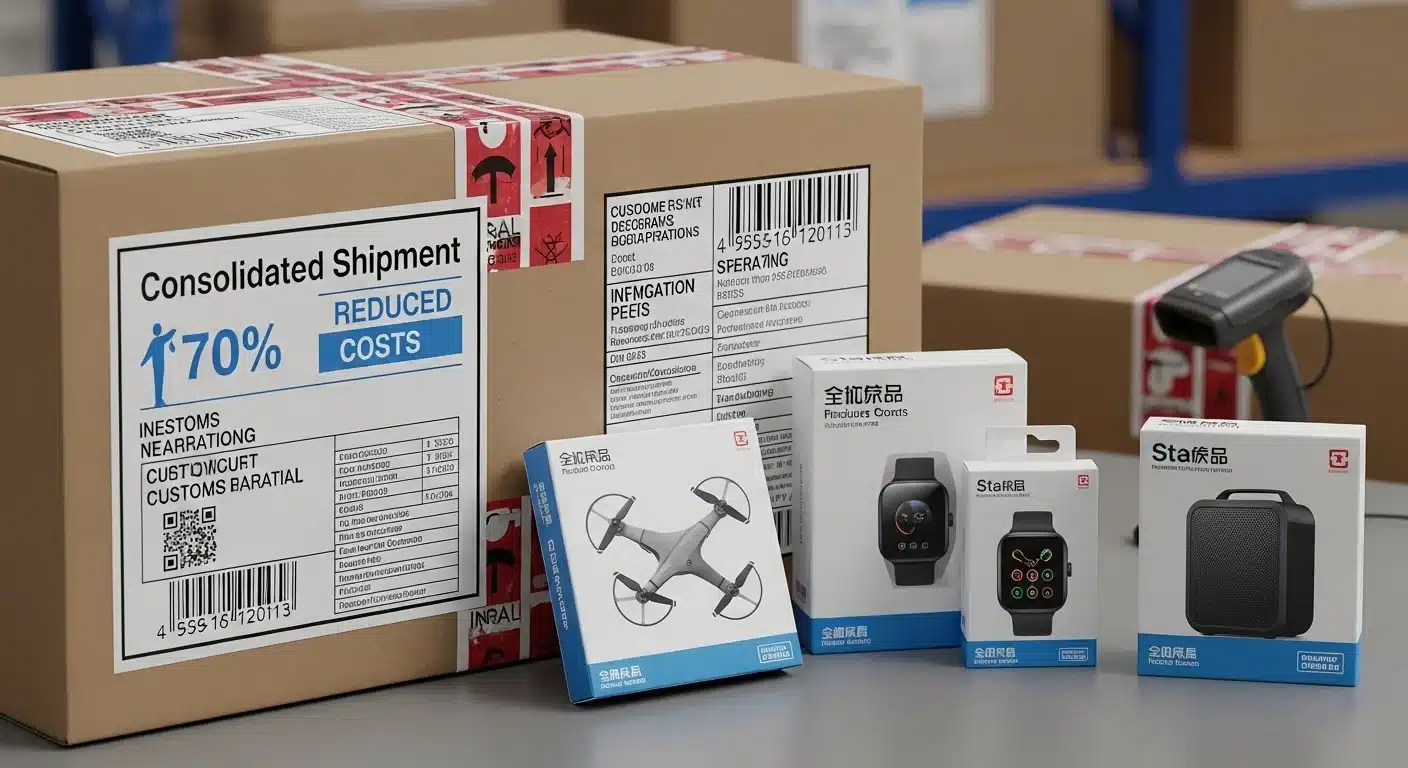
When you buy through Yiwu’s wholesale market, the counterparty is usually a trading booth rather than the workshop that made the goods — the distinction between a factory and a trading company is not a technicality here, it is what decides whether “the production line” is one place or six. The booth’s function is aggregation: it sources from upstream workshops, and for a multi-item order those may be different workshops for different items, or the same item across two workshops when one runs short. The goods are then consolidated into one shipment under one packing list. What arrives at the loading bay is one container of cartons. What it contains is several suppliers’ production, mixed.
Now apply the standard. ISO 2859-1 sampling is defined over items in a lot, and its accept/reject numbers carry their stated risk only when every item had an equal chance of being drawn. The common shortcut on a consolidated shipment — pick a few cartons, then draw units from inside those cartons — is not that plan, because items in the cartons never opened had no chance of selection at all.
An inspector can therefore draw the right number of units, count correctly, and issue a technically tidy report whose arithmetic does not describe the shipment. The sampling frame was cartons; the conclusion was written about units.
The failure mode this permits is specific: a whole carton of the wrong SKU, the wrong colourway, or a substitute workshop’s goods can sit inside a shipment that passed. Not because anyone miscounted, but because carton-level substitution is invisible to a procedure that samples at unit level from a subset of cartons.
The distinction to hold onto. Standard AQL sampling is good at estimating how many units are bad. It is not designed to detect whether a carton contains what the label says. Those are different questions, and a consolidated Yiwu shipment poses the second one much more often than a single-factory order does.
Three consequences that follow, before you spend anything
First, the packing list becomes an inspection document rather than a logistics one. Carton count, carton numbering and SKU-per-carton are the reference the inspection is checked against, so vague markings such as “assorted” defeat the exercise before the inspector arrives.
Second, lot definition has to be per SKU, not per shipment. Six products in one container are six lots. Pooling them is the single most common way a consolidated inspection produces a meaningless pass, as the worked example in the cost section shows.
Third, someone has to physically check carton identity across the shipment — a different, faster task than inspecting units, and the one that catches the failure mode that unit sampling cannot. A booth-sourced order is also where verifying who you are actually buying from stops being paperwork hygiene and starts determining whether the goods in the carton have a traceable maker at all.
The Yiwu Inspection Checklist
This is the part that is specific to buying from a wholesale market rather than a factory. Each item exists because the booth-aggregation model creates a risk that a standard factory checklist does not cover.
1. Fix the reference sample physically, in three copies
A booth’s display sample is a sales tool and is not necessarily from the workshop that will produce your goods. Before production, agree one physical reference and have three identical copies exist: one with you, one held for the inspector, one with the supplier. Every later argument about colour, weight or finish resolves against a physical object rather than a photograph and two memories. This is the point at which what you spend on samples stops being a cost and becomes the evidence base for every inspection that follows.
2. Number the cartons, and put the SKU on the carton
Require sequential carton numbering and one SKU per carton wherever the product allows, with the SKU and quantity printed on the outer carton. This single requirement is what converts carton identity from a guess into something checkable in minutes, and it is normally free if you ask before packing rather than after.
3. Check carton identity across the whole shipment, then draw units within each lot
Treat these as two operations. Verifying that each carton contains the SKU on its label is an identity check across all cartons. Judging whether those units are acceptable is AQL sampling within each SKU lot. Doing only the second is the gap described above; doing only the first tells you nothing about quality.
4. Inspect colour against the retained sample, in consistent light
Colour is the most common cross-workshop variance on booth-sourced goods, because a booth topping up an order from a second workshop will match the item, not the dye lot. Side-by-side comparison against the retained sample under the same lighting catches it; a photograph will not, since white balance destroys exactly the information you are testing.
5. Verify quantity per carton, not just carton count
Shortfall on consolidated orders tends to appear as under-filled cartons rather than missing cartons, because the carton count matches the packing list and stops anyone looking further. Count units in a proportion of cartons and reconcile the total.
6. Photograph and measure, and require it in the report
Insist that the report carries photographs of carton markings, of the goods against the reference sample, and measurement data for whatever dimension matters. For buyers consolidating from multiple Yiwu booths into one container, that photo-and-measurement record is what a pre-shipment inspection with loading supervision is for — it is the only evidence that survives after the container doors close, and it is what any later claim will rest on.
7. Watch the loading
On a consolidated order the inspected cartons and the loaded cartons are the same only if someone confirms it. Loading supervision cross-checks carton numbers against the inspection report as they go into the container. Without it, the carefully numbered cartons in item 2 do their work and then nobody reads them. Where several booths feed one container, the sequencing of the consolidation itself decides whether an inspection is even possible before the doors close — goods that arrive at the warehouse on loading morning cannot be inspected at pre-shipment, whatever the purchase order says.

8. Ask who the inspector’s incentives actually serve
The failure mode nobody puts in a checklist is the inspector who passes a bad lot. It has a local nickname — the red envelope — and it is the reason a clean report from an unknown inspector is worth less than buyers assume. The mechanics are unremarkable: the inspector spends the day alone at a factory that would very much prefer to ship, and the buyer is several thousand miles away with no way to know what was in the cartons that were not photographed.
You cannot audit this directly, so audit the controls instead — ask for all three by name before you book. Does the provider rotate inspectors, or send the same person to the same factory every time? Are visits verifiable by GPS stamp, body cam or timestamped photos, rather than a report that could have been written anywhere? Is there a channel for a factory to report a solicitation without losing the account?
Those three are what our own service runs on. The point is not that they are unique to us — several serious providers do the same — but that a provider who cannot answer any of the three is asking you to trust a stranger’s honesty as your only quality control. On mixed-booth consolidations, where the inspector may be the only person who ever sees all your SKUs in one room, that is the wrong thing to leave undefined.
Watch: how the AQL table produces a sample size and an accept number. A neutral walkthrough of acceptance sampling under ASQ/ANSI Z1.4-2003 — the US national equivalent of ISO 2859-1, and the designation most inspection reports for the American market actually quote — from the CQE Academy quality-engineering channel. Useful if you want to see the two lookups performed rather than described.
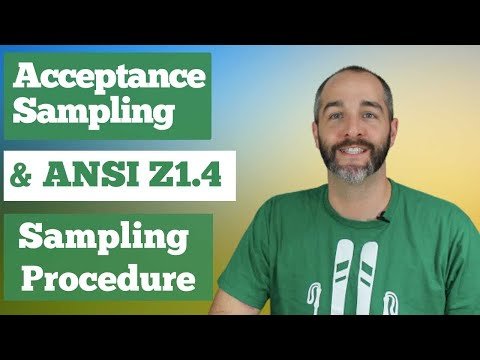
“Acceptance Sampling and ANSI Z1.4 Sampling Procedure Explained” — CQE Academy. Opens on YouTube.
Choosing Your Inspection Posture: What We Check, and Where We Stop
There are three postures a buyer can take, and the honest way to choose between them is by unit value and by what a failed shipment would cost you — not by a defect-rate statistic, because nobody can tell you your defect rate before your goods exist.
| Posture | Rough cost | Best for | Not for |
|---|---|---|---|
| No inspection | $0 | Repeat orders of a proven SKU from a supplier with a record you can point to | First orders, new SKUs, anything going straight into a marketplace fulfilment centre |
| PSI, plus loading supervision | One to two man-days, roughly $200–$320 each | Most consolidated and multi-SKU orders; the default posture for booth-sourced goods | Orders where a defect found at PSI leaves no time to fix anything before the season |
| DUPRO, then PSI, then loading | Three or more man-days | New supplier, new tooling, tight deadline, or any order where rework time does not exist | Low-value repeat goods where inspection cost approaches the margin on the order |
| 100% inspection | Scales with units, quoted per piece or per day | Safety-critical goods, children’s products, high unit value, or a lot already rejected once | General consumer goods at low unit value — the labour usually exceeds what it protects |
The arithmetic that decides it is simple and it is yours, not an industry average. Compare the inspection fee against the value of the units at risk. On a 2,000-piece order at $4 landed, the goods are worth $8,000 and a single man-day is around 2.5–4% of that — cheap insurance. On a 300-piece order at $1.20, the goods are worth $360 and the same man-day costs more than the shipment, so the sensible posture is either to consolidate the inspection across several orders, or to accept the risk deliberately rather than by default.
What tips a marginal case is timing rather than value. If a defect discovered at pre-shipment would leave you no time to remake the goods before the season, the inspection you needed was DUPRO, and paying for PSI alone buys you the right to refuse a shipment you cannot afford to refuse.
What a competent inspection covers — and where it stops
Whoever you book, the scope of a standard pre-shipment visit is reasonably well defined, and knowing its edges prevents both under-specifying and paying for reassurance you are not getting. A visit normally covers quantity against the packing list, appearance and workmanship judged against the retained reference unit, function on whatever the product is meant to do, dimensions and weight where they are specified, packaging, carton markings and labelling, and a barcode scan. That list is the industry’s, not ours — any competent inspector runs it.
What differs between providers is not that checklist but what happens the moment a lot fails. A pure third-party inspector’s authority ends when the report is filed — they can tell you the lot failed, and they have no mechanism to make the factory do anything about it. On our own quality control service the difference is structural rather than procedural: because we hold the 70% final payment on orders we place, a failed lot means the balance does not move until the goods are reworked and re-inspected. Same standard, same tables, different consequence. If you pay your factory direct, that lever does not exist for us either — book on report quality and price instead, and discount anyone claiming leverage they do not hold.
Two things to fix in writing with whoever you book. A stated report turnaround, because a report arriving after the container sails is an archive rather than a decision. And video of the function tests, not only stills: a photograph shows a switch, a clip shows the switch working, and that gap is where remote accept/reject arguments actually happen.
Four things it does not cover, and each has caught buyers out.
- Laboratory testing. Flammability, chemical migration, heavy metals, EN 71, CPSIA — none of it happens at a factory visit. It requires an accredited lab, a separate booking and a longer timeline. An inspector can pull and seal the specimens; they cannot produce the test report.
- Durability over time. An inspection is a snapshot. Wash-after-fade, cycle life, and coating adhesion after weeks are not observable in a day on site.
- Anything outside the sample. This is the whole logic of acceptance sampling. Units not drawn were not inspected, and the accept number is a statistical statement about the lot, never a guarantee about every piece.
- Legal conformity for your market. Whether your product may be sold where you are importing it depends on marking, documentation and substance rules that vary by market and change; an inspector checks against the specification you supplied, not against your national regulations. Confirm those with the relevant authority or a compliance consultant before you rely on them.
When we inspect, we are also holding your 70% final payment — so a failed lot means the balance does not move until the factory reworks it. A standalone inspector writes the report and leaves. Published rate $199 per man-day, PDF back within 24 hours with hi-res photos, video of the function tests and measurement data. For importers whose supplier is paid through us; if you pay your factory direct, book a third-party inspector instead — you will get the report without the leverage.
Writing the Inspection Into Your Order
An inspection is only leverage if the right to reject exists before the goods do. Agreed after production, it becomes a negotiation with a supplier who is already holding your stock.
Six lines in the purchase order carry almost all of the value.
- Standard and edition. “Sampling per ISO 2859-1:2026, general inspection level II, normal inspection, single sampling.” Naming the edition now matters, since the 1999 edition has been replaced.
- AQL per defect class. Critical zero, major 2.5, minor 4.0 — or your own numbers, but stated.
- Lot definition. “Each SKU constitutes a separate lot.” This one line prevents the pooled-lot pass.
- Carton marking. Sequential numbering, SKU and quantity printed on the outer carton.
- Access. The inspector may attend at the stated stage, open cartons, and re-seal them; goods are not shipped before a written pass.
- Consequence of failure. Who pays for rework, re-inspection and delay. Re-inspection cost is the clause suppliers most often push back on, and it is the one that makes a first-round failure genuinely expensive for them.
Buying from a market booth complicates one of those six lines specifically: access. A booth is not the manufacturer, so “the inspector may attend at the stated stage” has to name a place as well as a stage — the consolidation warehouse where the booth delivers, not “the factory”, because the factory may be a workshop the booth will not disclose. Written loosely, this clause is the one that produces the familiar stand-off where the goods are ready, the inspector is in the city, and nobody will say which address to go to.
Two points the clauses above do not settle, because they are not yours to set unilaterally. Booking lead time varies by inspector availability and by how far the goods sit from the inspector’s base — agree it in writing rather than assuming a slot exists, since the PSI window is fixed by the packing schedule and will not move to suit a late booking.
Minimum order quantity is likewise a supplier term, not an inspection term. It is set per project against your SKU and size mix, and it changes what a lot looks like — which is why the lot-definition line matters more on a small mixed order than on a single-SKU run.
Attach the defect classification as a schedule. It is the document that decides borderline calls at the moment they are made, and writing it forces the useful conversation — deciding, in advance and in the calm, which faults you would actually refuse to sell. If a shipment does fail, the strength of your position afterwards comes from what these clauses said beforehand; the practical mechanics of holding payment leverage over defective goods depend almost entirely on having reserved the right to reject before the money moved.
Perguntas mais frequentes
What is a quality inspection?
It is an accept-or-reject decision on a batch of goods, made by drawing a defined sample, judging each item against a written standard, and comparing the defect count to an agreed acceptance number. The sample size and acceptance number come from a published sampling scheme, normally ISO 2859-1.
What are the four types of quality inspection?
Pre-production, during-production, pre-shipment, and container loading supervision. They differ by timing, and therefore by what can still be recovered when a problem is found — from everything at pre-production down to carton identity at loading.
What does AQL 2.5 mean?
It indexes a sampling plan to an acceptance quality limit of 2.5% for that defect class. It is a property of the sampling scheme, not a promise that 2.5% of your goods may be defective. A given lot can be better or worse than its AQL and still be accepted.
Is ISO 2859-1:1999 still current?
No. ISO 2859-1:2026, the third edition dated January 2026, cancels and replaces the 1999 second edition and incorporates its 2011 amendment and 2001 corrigendum. Purchase terms citing the 1999 edition should be updated.
What does an arrow in the AQL table mean?
That no plan exists for that combination of code letter and AQL. You move to the first plan below or above the arrow, and your sample size changes to the new code letter’s sample size. If that sample equals or exceeds the lot size, you inspect 100%.
How much does a quality inspection cost in China?
Published 2026 ranges run about $149–$320 per man-day overall, with pre-shipment inspection typically $199–$320 and factory audits higher. Travel is often billed separately, commonly adding $50–$200 or more.
Can standard AQL sampling miss a whole wrong carton?
Yes, if cartons are sampled and units are then drawn only from opened cartons. Items in unopened cartons had no chance of selection, so the plan’s risk figures do not apply to them. Carton identity needs checking across the shipment as a separate step.
Should each SKU be inspected as a separate lot?
Yes. A lot should be one product from one production run. Pooling several SKUs into one lot produces a pass describing the blend rather than any individual product, and it is the most common reason a consolidated inspection means nothing.