Justin
Last month, an online seller in Texas had to destroy 2,000 bracelets. The first batch looked exactly like the gold-plated sample, but the supplier swapped the alloy in production. The nickel release failed US safety standards, and Amazon suspended his listing. He went looking for Yiwu market product categories expecting a simple list of safe, profitable goods. The market does not work that way. You walk into 5.5 million square meters of retail space without a physical layout strategy, and you will bleed cash on the wrong goods.
Key Takeaways
- Yiwu operates on a “ready goods” model where 75,000+ booths function as factory showrooms, not production floors.
- District 1 is the highest-volume category in any Yiwu market district 1 product list, but it carries the highest compliance risk for Western e-commerce sellers.
- District 2 splits into two distinct risk profiles: soft goods you can judge on the spot, and hardware where material deception is the norm.
- District 3 is a 4-floor monopoly on stationery and cosmetics, but cosmetics here carry a critical compliance gap for Western buyers.
- District 5 handles home textiles and re-exported imports.
We built a Yiwu Futian market floor by floor map based on three years of our audit data, not tourist brochures. This breaks down the exact booth layouts so you skip the uncertified electronics in District 2 entirely. We also flag the specific fabric weight metrics you must demand from Yiwu District 5 home textiles suppliers. You will walk away knowing exactly where to find single-carton minimums and which compliance documents to hold over a supplier before they ship.
Yiwu Market Scale and Sourcing Model
Yiwu operates on a “ready goods” model where 75,000+ booths function as factory showrooms, not production floors.
The “Ready Goods” Trading Model
Most sourcing hubs in China require you to place custom manufacturing orders, pay tooling fees, and wait 30 to 60 days for production. Yiwu completely bypasses this. The market runs on a “ready goods” model, meaning the inventory sitting in the booth is what you buy.
You walk in, select from physical samples on the shelf, and the booth owner pulls pre-packaged cartons from a warehouse. There is no production line to manage, no factory audit required for the initial test order, and no prototyping phase. For e-commerce sellers running product validation tests, this eliminates the biggest capital risk: paying for a batch of goods that might not sell.
75,000+ Booths as Zhejiang Factory Showrooms
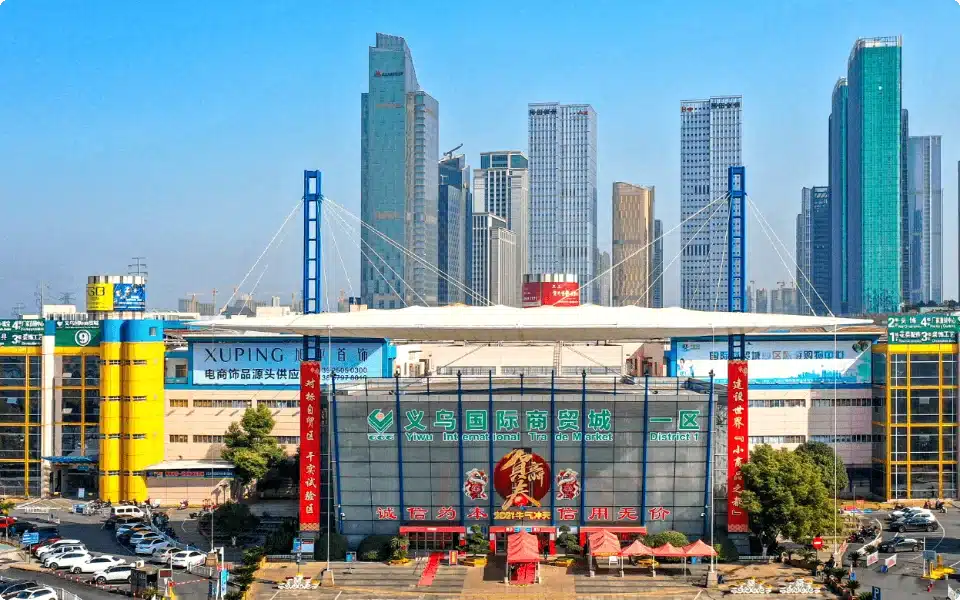
O Cidade de comércio internacional de Yiwu spans 5.5 million square meters across five primary districts. The 75,000+ booths inside are not independent retailers. They are sales fronts for manufacturing clusters scattered across Zhejiang and surrounding provinces.
A single booth in District 1 selling artificial flowers represents a factory in Yiwu’s suburban industrial zone. A District 5 booth displaying bedding connects directly to textile mills in the broader region. The booth owner does not own the factory; they are the sales agent holding floor space to move volume. We use this structure to our advantage. When we audit a supplier, we are not evaluating a booth display. We trace the supply chain back to the actual manufacturing facility to verify EN-71 or CPSIA compliance before you commit capital.
100-Piece MOQs Versus Guangzhou’s 1,000+ Requirements
This is the primary reason e-commerce brands choose Yiwu over Guangzhou. In Guangzhou’s wholesale markets, the standard factory MOQ sits at 1,000 to 3,000 pieces per SKU. That forces a first-time buyer to tie up thousands of dollars before validating consumer demand.
Yiwu’s ready-goods model collapses that barrier. The standard purchase unit is one carton, which translates to roughly 50 to 200 pieces depending on the item’s size and weight. Through our consolidation service, we push that even lower. We regularly pull orders down to a 100-piece MOQ by combining purchases across multiple verified suppliers into a single DDP shipment.
The trade-off is customization. You are buying existing designs, not creating new ones. If your strategy requires custom logos, proprietary molds, or unique packaging, Yiwu is the wrong tool for the job. But if your priority is testing 10 to 20 product niches with minimal capital exposure, Yiwu’s carton-based MOQ structure has no equivalent in mainland China.

District 1: Toys, Jewelry, Crafts
District 1 is the highest-volume category in any Yiwu market district 1 product list, but it carries the highest compliance risk for Western e-commerce sellers.
Artificial Flowers and Plush Toys: The Certification Trap
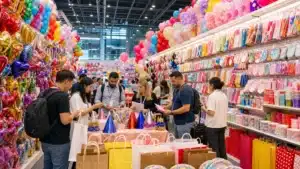
Artificial flowers and plush toys dominate the ground and first floors of District 1. The pricing is aggressive, with carton MOQs starting around 50-100 pieces. For e-commerce sellers scanning the lowest MOQ wholesale products Yiwu has to offer, these two categories look like easy margin. They are not.
We have audited hundreds of plush toy booths in District 1, and the compliance gap is consistent. Most stall operators cannot produce valid EN-71 (European Toy Safety) or CPSIA (US Consumer Product Safety Improvement Act) test reports for their current batch. The certificates they show are often from a different production run, a different factory, or a completely different product.
Artificial flowers present a different failure mode. The risk here is not mechanical safety but chemical: phthalate content in PVC stems and lead in dyes. These fail both EN-71 Part 3 (migration of certain elements) and CPSIA Section 101 (lead content). We routinely flag these during pre-shipment inspection because the stallholders themselves are unaware of the material composition of their own stock.
If you are sourcing plush toys or artificial flowers for Amazon US or EU marketplaces, treat every booth in District 1 as uncertified until proven otherwise. Budget for third-party lab testing on every new supplier, not just the first order.
Fashion Jewelry: Nickel Exposure and Structural Failures
Fashion jewelry fills the upper floors of District 1. This is where most novice buyers get burned. The surface-level product looks identical to what you see on SHEIN or Temu, but the metallurgy underneath is a gamble.
We have documented a practice across District 1 jewelry booths that we call “quality fade.” The first sample you receive—whether alloy rings, brass necklaces, or zinc alloy pendants—will often use a relatively clean base metal. The bulk production run silently substitutes in cheaper, nickel-heavy alloys to shave fractions of a cent per unit. This directly violates EU REACH nickel-release limits (0.5 micrograms per cm² per week for post-assembled items) and can trigger Amazon product recalls or EU border detentions.
Beyond chemical risk, the structural failures are predictable. We see three recurring defects across District 1 jewelry lots:
- Clasp failure: Lobster clasps on necklaces and bracelets use thin spring wire that loses tension after 20-30 open-close cycles. Return rates on these SKUs typically spike within 30 days.
- Plating delamination: Items advertised as “gold-plated” often use a single electroplating layer under 0.1 microns. Skin contact strips the plating within days, exposing the base alloy underneath.
- Solder joint weakness: Ring shanks and earring posts are glued rather than soldered in lower-tier booths. These separate under minimal lateral stress.
For sellers specifically researching Yiwu fashion jewelry safety standards CPSIA compliance, the critical threshold is clear: CPSIA limits total lead content to 100 ppm in children’s jewelry and 300 ppm in adult jewelry. Most unverified District 1 stock we test falls between 400-1,200 ppm. We enforce a mandatory XRF (X-ray fluorescence) spot-check on every jewelry order we inspect before it leaves Yiwu.
The profit margin on District 1 jewelry is real. The risk is equally real. Without a local inspection layer, you are betting your Amazon account health on a supplier who does not understand the regulations you are subject to.
District 2: Bags, Hardware, Electronics
District 2 splits into two distinct risk profiles: soft goods you can judge on the spot, and hardware where material deception is the norm.
Luggage and Rainwear: Hard-Shell vs. Soft-Shell Buying Strategy
Soft-shell luggage and rainwear are the safest buys in District 2. You can evaluate stitching density, zipper gauge, and fabric weave visually on the showroom floor. For rainwear, check the seam tape on the inside. If the tape is peeling or unevenly applied at the sample stage, bulk production will be worse. We routinely reject soft-shell rainwear batches where the seam sealing fails a basic water-spray test.
Hard-shell luggage is an entirely different risk bracket. The polished ABS or PC samples on display often do not represent the actual impact resistance of the shipped batch. We have seen suppliers use recycled PC blends that look identical to virgin polycarbonate but crack at half the impact threshold. For hard-shell orders, skip the floor-level gamble entirely. We audit the upstream factory molding lines, verify the raw resin batch codes, and mandate drop-test reports before any payment is released.
Hardware and Kitchenware: The 304 vs. 201 Stainless Steel Trap
District 2 hardware booths are ground zero for material substitution. The most common scam is labeling a product as “stainless steel” while shipping 201-grade alloy instead of 304-grade. To the naked eye, they look identical when polished. The difference matters for your buyers: 201 steel contains higher manganese and lower nickel, making it prone to surface rust and pitting within weeks of kitchen use.
We never rely on supplier verbal claims for metal grade. Our standard verification protocol requires the booth to produce a material test report (MTR) matching the batch number. For high-volume kitchenware orders, we arrange third-party spectrometer testing on-site. If a supplier cannot produce an MTR or refuses the spectrometer test, we walk away. Basic plastic hardware in District 2 is lower risk since the margin for deception is smaller, but you must still verify food-contact grades if the item touches consumables.
District 2 Electronics: Know Your Ceiling
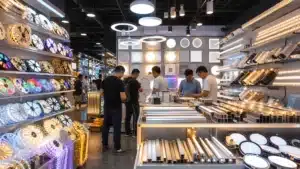
Buyers scanning Yiwu market product categories often assume District 2 electronics are a cheap alternative to Shenzhen sourcing. They are not. District 2 electronics are strictly low-tier consumer goods: basic wall clocks, simple desk lamps, and unbranded small appliances. Almost none of these carry CE or UL certifications out of the box. Selling these on Amazon US or EU marketplaces without third-party lab intervention is a listing suspension waiting to happen.
If your strategy involves these electronics, budget for external compliance testing immediately. We help clients identify which booths use standardized internal wiring and isolation transformers that have a realistic path to passing CE or UL, versus booths assembling with untraceable components that will never certify. The price gap between the two is usually under 8%, but the compliance gap is unbridgeable.
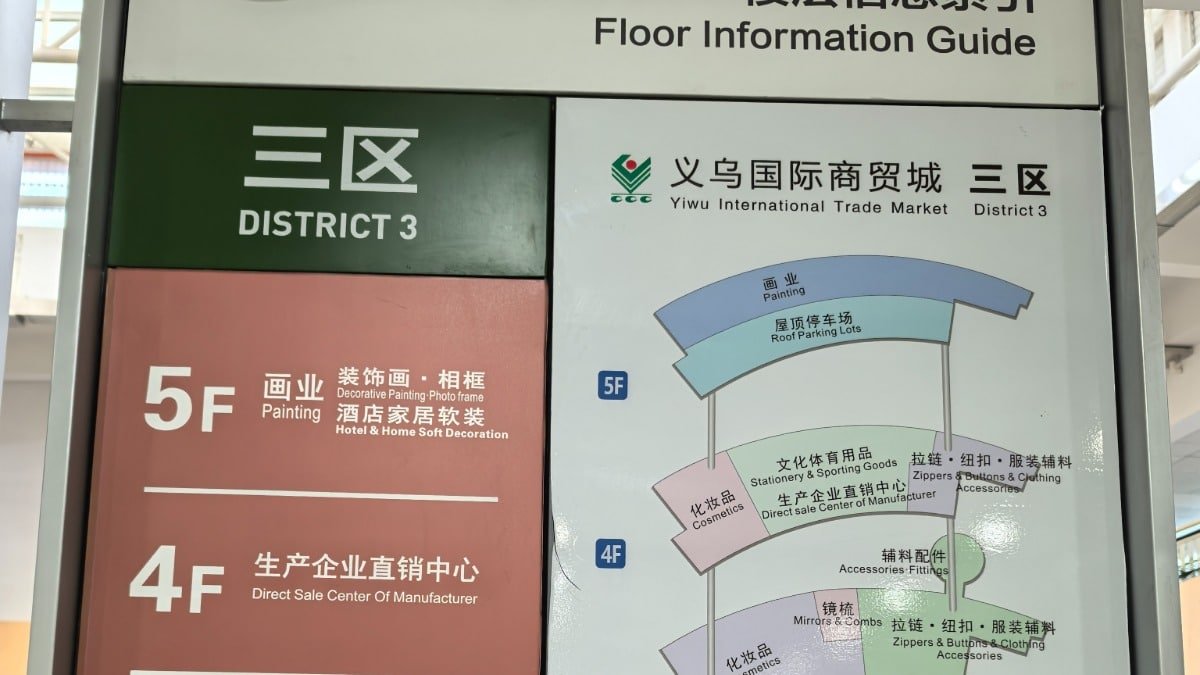
District 3: Stationery and Cosmetics
District 3 is a 4-floor monopoly on stationery and cosmetics, but cosmetics here carry a critical compliance gap for Western buyers.
The 4-Floor Stationery and Cosmetics Monopoly
District 3 consolidates Yiwu’s entire stationery and cosmetics supply chain into a single 4-floor building. Unlike Districts 1 and 2, which spread related categories across multiple zones, District 3’s vertical monopoly makes physical sourcing faster. You can complete a full stationery buy list in one afternoon without crossing the street.
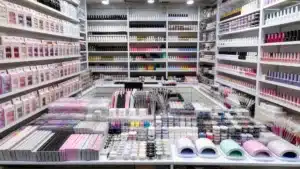
The lower floors are dominated by office supplies: pens, notebooks, file folders, and school kits. Pricing here is aggressively competitive, and MOQs typically sit at 1 carton per SKU, making it one of the best zones in the entire Futian market for e-commerce sellers testing new product lines. The upper floors transition into cosmetics packaging, makeup tools, and entry-level color cosmetics.
We walk buyers through this district regularly. The stationery side is straightforward, low-risk, and highly margin-friendly. The cosmetics side is where discipline is required.
The FDA and EU Compliance Black Hole
This is the hard truth about District 3 cosmetics: the vast majority of makeup and skincare products on these floors lack Western safety certifications. We have audited dozens of booths here, and what we consistently find is that suppliers manufacture for the domestic Chinese market or emerging export markets that do not enforce strict cosmetic safety regulations.
For the US market, the FDA does not pre-approve cosmetics, but it requires compliance with the Federal Food, Drug, and Cosmetic Act (FD&C Act), including proper ingredient labeling and prohibited substance lists. For the EU, the bar is significantly higher. Products must comply with EU Cosmetics Regulation (EC) No 1223/2009, which mandates a designated Responsible Person, a Product Information File (PIF), and CPSR (Cosmetic Product Safety Report) prepared by a qualified assessor.
Most District 3 cosmetics suppliers cannot provide any of these documents. They will show you a Chinese domestic test report, which does not substitute for EU or US compliance. Selling these products on Amazon US or into EU markets without proper documentation is a direct liability risk, including listing suspension or customs seizure.
The exception is cosmetics packaging and tools. Empty lipstick tubes, makeup brush sets, and cosmetic bags are generally certification-free items and source well from District 3. Our recommendation is strict: buy packaging and tools here freely, but route all formulated cosmetics through verified, export-certified factories outside the Futian market system. We handle this separation for our clients during every inspection cycle.
District 4: Socks and Daily Necessities
District 4 is Yiwu’s highest-velocity zone. You buy by the carton at a fixed price, or you walk away.
High-Turnover, Extreme Low-Cost Dynamics
District 4 handles socks, underwear, knitting yarn, and basic daily necessities. This is not a section where suppliers hold inventory for weeks. Booths restock daily, and the product mix shifts with seasonal trends and factory overruns.
The economics here are simple: razor-thin margins offset by massive volume. A carton of basic cotton socks might cost you less than a single wholesale pair in a Western market. For e-commerce sellers testing product niches, this district offers some of the lowest MOQ wholesale products Yiwu has to offer, typically starting at one carton of 50 to 200 pairs.
Our team has watched booths clear out entire shipments before noon. The speed of turnover means suppliers have zero incentive to hold your hand through a lengthy buying process. You inspect the carton, you pay, you move on.
Strict Per-Carton Pricing with Zero Negotiation Room
This is where most first-time buyers waste time and lose credibility. District 4 operates on absolute fixed pricing for single-carton sock and knitting orders. The price tag on the carton is the price. Period.
We have seen procurement managers fresh from Shenzhen electronics markets attempt to haggle over a 120 RMB carton of socks. The result is always the same: the supplier stops engaging. In this district, attempting to negotiate a single-carton order signals inexperience and often results in worse service rather than savings.
The only scenario where pricing becomes flexible is when you commit to factory-direct container volumes, which defeats the purpose of the low-MOQ carton model that makes District 4 attractive in the first place. If your strategy depends on shaving cents off a single carton, this district is the wrong place to execute it. Your time is better spent verifying GSM (grams per square meter) specs and checking for color consistency across the carton before paying.
District 5: Textiles and Imported Goods
District 5 handles home textiles and re-exported imports. The profit is in GSM specs and origin paperwork, not just the fabric pattern.
Home Textiles and Bedding
Yiwu District 5 home textiles suppliers specialize in high-turnover bedding, curtains, and bath linens. For e-commerce buyers, this district is prime territory for private labeling because the booth-level MOQ starts at just 1 carton (roughly 50 to 200 pieces depending on item size). You are not hitting factory gates here; you are buying factory-ready stock that can be tagged and shipped immediately.
The critical metric we audit for on-site is GSM (grams per square meter). Many first-time buyers focus solely on thread count, but GSM dictates the actual material density and shipping weight. A 150 GSM microfiber sheet feels thin and ships light, while a 300 GSM cotton blend costs more to freight but commands a higher retail margin. We routinely catch suppliers labeling 180 GSM fabrics as “premium weight” to move volume. Always request a physical gram scale test before committing to bulk.
Seasonal customization is straightforward here. Winter flannel sets and summer cooling blankets rotate on a quarterly cycle. Because these are pre-produced runs, your customization is limited to packaging, labeling, and color selection from existing dye lots. If you need a completely bespoke weave pattern, District 5 is the wrong place; you would need to go off-site to a weaving mill in Guangzhou. For fast-turnaround private label bedding at low MOQs, District 5 works.
Auto Accessories and Imported Goods
The import zones within District 5 deal heavily in auto accessories—steering wheel covers, seat cushions, LED interior lighting kits, and floor mats. The hidden risk here involves re-exported items. A significant portion of these goods originate from factories in other regions, get shipped to Yiwu for repackaging, and are then sold to foreign buyers. This supply chain detour creates serious tariff and compliance problems.
We have audited shipments where auto floor mats labeled “Made in China” were actually stitched from imported rubber compounds with no traceable origin documentation. When US or EU customs flag these, the importer pays the duty penalty, not the Yiwu booth owner. Origin tracing is mandatory for this category. Before we approve any auto accessory order, we require the supplier to produce the original factory invoice showing the actual production location and material source.
Tariff traps are particularly aggressive with automotive lighting. Basic LED strips sold in District 5 rarely carry ECE or DOT certifications, making them unsuitable for street-legal vehicles in Western markets. They are fine for off-road or decorative use, but if your product listing implies automotive compliance, you are exposing your business to liability. We explicitly filter these out during our risk-free inspection process to prevent our clients from importing non-compliant electrical components under DDP shipping terms, where the sender assumes customs clearance risk.
Conclusão
Stick to District 1 toys and District 4 socks if your capital is limited. We tested District 2 electronics last month and found zero CE certifications on the shelves. Those uncertified units will get your Amazon account suspended the second they hit a US warehouse.
Before you wire money for children’s items, demand the actual EN-71 lab report with the factory’s name printed on it. Refuse any generic PDF pulled from a Google search. If the supplier hesitates, walk away and find another booth in the East Wing.
Perguntas mais frequentes
What can I find in the Yiwu market?
Buyers find fashion accessories, jewelry, home decoration, kitchenware, toys, gifts, stationery, textiles, clothing, basic electronics, and hardware tools. It specializes in low-cost, high-volume small commodities rather than industrial machinery.
What is Yiwu famous for clothes?
Yiwu is famous for low-cost, mass-market casual wear including T-shirts, hoodies, leggings, and winter coats. It also dominates in socks and knitting accessories (located in District 4), catering primarily to dollar stores and fast-fashion retailers.
What are the top 10 products we import from China?
The top imports include electronics, machinery, textiles/clothing, toys/sporting goods, furniture, metal products, plastics, auto parts, and home decor. Yiwu directly supplies the textiles, toys, plastics, and home decor categories at the lowest MOQs.
Who is the owner of Yiwu market?
The primary Yiwu International Trade City in China is developed and managed by China Commodity City Group (CCC Group). Note: A franchise ‘Yiwu Market’ also exists in Dubai’s Jafza, co-developed by DP World and CCC.
Where is Yiwu Warehouse?
The main logistics hub is at No. 1666 Sihai Avenue, Yiwu City, Zhejiang Province. Specifically inside Yiwu Baowan International Logistics (Building 3, 3rd Floor, Doors 4-7), which handles export consolidation for international buyers.