Justin
The carton arrives, you open it, and the defect is obvious in three seconds. It was not on the checklist. The inspector who signed the report was not wrong — he checked every line you gave him, and every line passed. That is the failure mode nobody warns you about: a QC checklist that is complete on its own terms and still lets the one defect through that costs you the reorder.
A QC checklist is the document that tells an inspector exactly what to examine, what limit each check has to meet, and how serious it is when the check fails. Downloaded templates cover categories — quantity, workmanship, function, packing. Your product fails in specific ways, and a category is not a checkpoint. This guide covers how to build the checklist from your own product’s failure modes, sort the checkpoints into five buckets, assign each one a defect class so the sampling numbers downstream produce an actual accept-or-reject answer, and write every line so a QC firm in China executes it without having to guess what you meant.
Key takeaways
- Checkpoints are derived from how your product fails in the buyer’s hands — not copied from a template that was written for someone else’s product.
- Every line needs a defect class. An unclassified checklist produces observations; a classified one produces an accept-or-reject decision.
- The sampling standard those classes feed is ISO 2859-1, now in its third edition, published 2026-01 — it replaced the 1999 edition most importers’ documents still reference.
- Carton drop has a real reference: ISTA Procedure 3A covers parcel shipments of 70 kg (150 lb) or less and requires 9 drops in one test block plus 8 more in another.
- GS1’s minimum barcode quality specification for EAN-13, EAN-8, UPC-A and UPC-E is 1.5/10/660 — “the scanner read it once” is not a check.
- Colour matching has a booth standard: ISO 3668 specifies D65 illumination between 1 000 lx and 4 000 lx, a neutral grey interior, and an observer whose colour vision has been tested.
- Every line states an observable condition, a measurable limit and a method. Anything else gets interpreted on the inspection floor, and interpretation is where disputes start.
Why a Downloaded QC Checklist Fails on Your Product
Open any free QC checklist template and you will find the same six headings: quantity, product specification, visual appearance and workmanship, function and safety, labelling and marking, packing and packaging. Those headings are correct. They are also the reason the document fails, because they describe what an inspection covers rather than what an inspector does.
A category is not a checkpoint
“Check workmanship” tells an inspector holding your product nothing he did not already know. Faced with 200 folding step stools and a line that says workmanship, he looks at the ones in front of him, decides which imperfections seem to matter, and records those. The next inspector, on the next order, decides differently. Neither of them is doing a bad job. You gave them a heading and asked for a judgement.
A checkpoint reads differently: “hinge opens and locks without tool assistance; locked stool supports 120 kg static load for 60 seconds without visible deformation at the hinge.” Now there is nothing to decide. The stool does that or it does not, and two inspectors on two different days reach the same answer.

No classes means no decision
The second structural problem is that a template checklist records findings without ranking them. The inspector finishes with a list: four units with scuffed paint, one with a misaligned label, one whose hinge binds. Is that batch shippable? The document cannot say, because nothing on it distinguishes a cosmetic scuff from a hinge that will fail in a customer’s kitchen. You end up making that call yourself, on a Friday afternoon, over photographs, with a container booked.
The checklist is yours to write
Industry practice is unambiguous about ownership: the importer is responsible for creating the quality control checklist, because it has to reflect your brand’s standards and your customers’ expectations, and the recommended approach is to develop it with the supplier rather than in isolation from them. The inspection agency executes the document. The factory is held to it. Neither of them can write it for you, because neither of them knows which returns you have been eating.
Handing that job to a third party produces a document that protects the third party. Ask an inspection company for a checklist and you will get their standard one — competent, generic, and built to be defensible across every client they serve rather than sharp for yours.
Start From Failure Modes, Not From a Template
The derivation runs in one direction: how the product fails, then what would have caught it, then how you measure it. Start at the inspection end and you get a list of things that are easy to check. Start at the failure end and you get a list of things worth checking.
Write down how this product fails in a customer’s hands
Not how it fails in the factory. How it fails after it ships, because that is what costs money. For a ceramic mug: chips at the rim in transit, handle separates under hot liquid, print rubs off in a dishwasher, colour differs between two mugs in the same set. Write ten or fifteen of these in plain language before you think about inspection at all.
Three sources fill this list, and you already own all three.
- Your returns and complaints history: the highest-value input you have. Every refund is a failure mode a customer already found for you, with the severity attached.
- The sample approval round: everything you asked the factory to change between the first sample and the approved one is a thing that factory tends to get wrong.
- The product’s own assembly points: every joint, weld, seam, hinge, thread, adhesive bond and moving part is a place where a production line can deviate. Count them and you have your dimensional and functional candidates.
Convert each failure mode into a checkpoint
A checkpoint needs three parts, and it is not finished until it has all three: an observable condition, a measurable limit, and a method. Take “handle separates under hot liquid.” Observable condition: handle-to-body bond integrity. Limit: withstands 15 N outward pull at the handle midpoint for 10 seconds with no movement at the bond line. Method: spring gauge, unit at ambient temperature, tested on 5 units per production lot.
| Failure mode (plain language) | Observable condition | Limit and method |
|---|---|---|
| Rim chips during transit | Rim edge condition after packed drop | No chip, crack or glaze loss visible at 50 cm after the packed-carton drop sequence |
| Handle separates when hot | Handle-to-body bond integrity | 15 N outward pull at handle midpoint, 10 seconds, no movement at bond line; spring gauge, 5 units per lot |
| Print rubs off in the dishwasher | Decoration adhesion | No ink transfer after 20 double rubs with a damp white cloth under firm thumb pressure |
| Two mugs in one set do not match | Colour match to approved swatch | Visual match to the signed reference under D65 in a colour-matching booth |
Notice what the middle column does. It converts a complaint into something a person can look at. That conversion is the entire job, and it is the part a downloaded template cannot do for you, because it requires knowing which complaints you actually receive.
When is the list long enough
The stopping rule is not a number of checkpoints. It is coverage: every failure mode on your list has at least one checkpoint that would have caught it, and every checkpoint traces back to a failure mode. A line that traces back to nothing is a line you copied from somewhere, and it costs inspection minutes that should have gone to a real risk.
Inspection time is finite. An inspector working through a 90-line checklist on a 3,000-piece order gives each line less attention than one working through 25 lines that matter. Padding a checklist to look thorough makes the inspection worse, not better.
Sort Every Checkpoint Into Five Buckets
Once you have the checkpoints, sort them into five buckets: dimensional, functional, cosmetic, packaging, labelling. This is not filing for its own sake. The buckets decide the order an inspector works in, and the order decides whether the inspection is physically possible.
What goes where
- Dimensional: anything measured against a drawing or a stated tolerance — length, width, wall thickness, weight, capacity, thread pitch. Requires calipers, scales, gauges.
- Functional: anything the product has to do — switch on, hold weight, seal, fold, lock, resist a pull. Requires operating the unit, which may destroy it.
- Cosmetic: anything judged by appearance against a reference — colour, finish, scratches, print registration, weld appearance. Requires the reference sample and controlled light.
- Packaging: the box, insert, polybag, seal, carton, and how the unit survives inside them. Requires opening cartons and, for drop checks, sacrificing one.
- Labelling: barcodes, country of origin, warnings, care symbols, SKU, batch codes, retail-facing copy. Requires a scanner and the artwork file.
Why the order matters on the floor
Run the buckets in that order and the inspection works. Cosmetic and dimensional checks happen on intact units, so those units go back in the box and ship. Functional checks come next because some of them are destructive — a pull test that reaches 15 N may leave a unit unsaleable, and you want that decided after the non-destructive work is done, not before. Packaging drop checks come last for the same reason: the carton is gone once it is dropped.
Run them in the wrong order and the inspector opens a carton, drops it, and then discovers he needed an intact retail box to check print registration. Now he opens a second carton, and the sample he draws from it is not the sample your sampling plan specified.
The boundary cases that get misfiled
Three checkpoints get filed wrong on nearly every checklist. Barcode verification looks like labelling and behaves like function — a barcode either scans to specification or it does not, and it is measured with an instrument, not read by eye. Colour match looks cosmetic but needs a controlled light source, which makes it an equipment-dependent check that has to be scheduled where the booth is. Unit count per carton looks like packaging but is really a quantity check, and it is the one line most often left off entirely.
Keep packaging and labelling separate rather than merging them into one “packing” bucket, which is how most templates handle it. They fail independently, they are checked with different tools, and merging them is precisely how a correct box with the wrong barcode passes an inspection.
Assign a Defect Class to Every Line
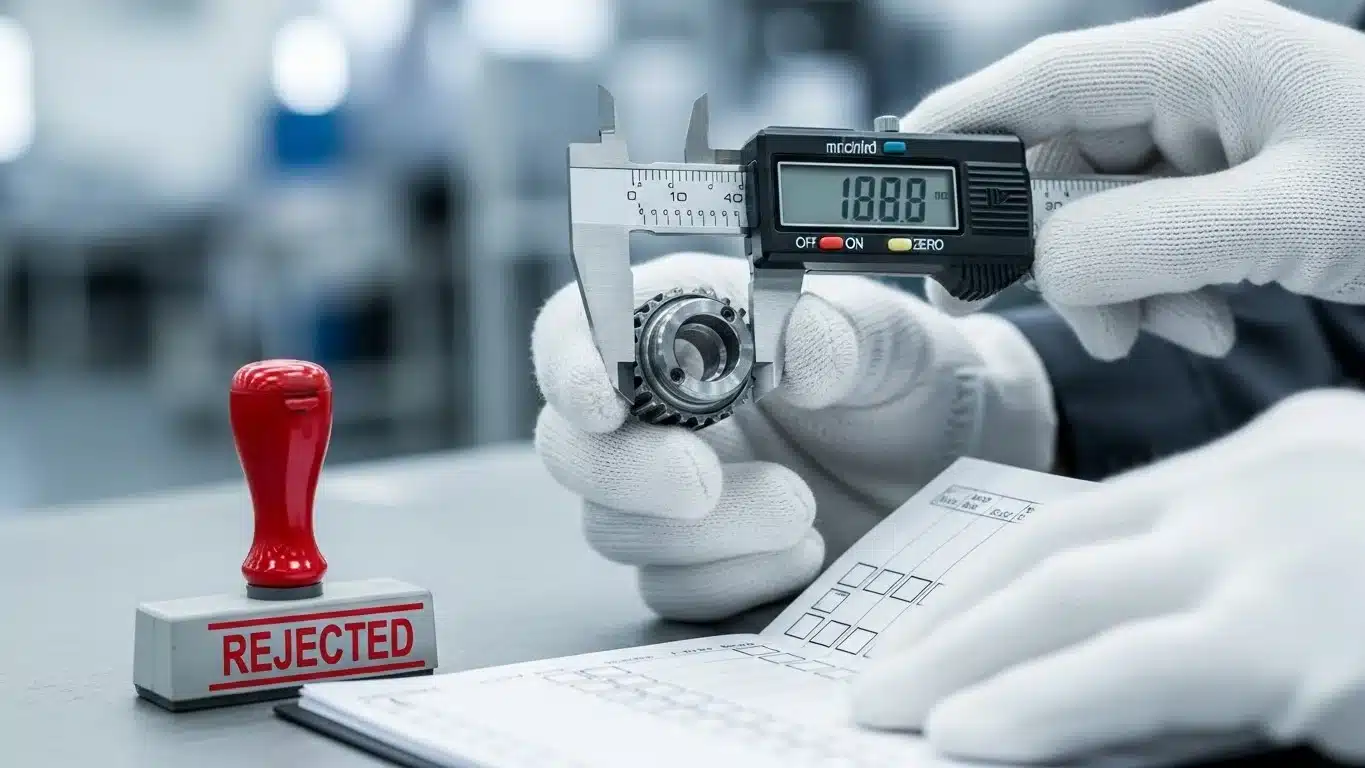
This is the step that turns a list of observations into a decision, and it is the step generic templates skip. Every checkpoint gets a class: critical, major, or minor. Assign it when you write the line, not after the inspector calls you with findings.
The three classes and the test each one turns on
The classification convention used across the inspection industry turns on consequence to the end user, not on how bad the defect looks.
| Class | The test it turns on | Consequence |
|---|---|---|
| Crítico | Could it injure or endanger the end user, or breach a legal requirement? | Normally rejection of the whole batch, immediately |
| Major | Does it affect form, fit, function or saleability enough that the buyer would return it? | Counted against a tight acceptance limit |
| Menor | Is it less than desirable but unlikely to cause a return? | Counted against a looser acceptance limit |
Classify by consequence, not by appearance
A hairline crack in the base of a candle jar is barely visible and is critical, because the jar holds a flame. A 4 cm scuff across the front of a gift box is impossible to miss and is minor, because the box is discarded and the product inside is fine. The visible one is cheap; the invisible one is a liability claim. Anyone classifying by how obvious a defect looks gets both of these backwards.
Where a defect sits on a scale, put the threshold in the line rather than leaving it to argument. A gap between two components at 3 mm or less is minor; the same gap above 3 mm is major. Write both numbers into the checkpoint and the class assigns itself at the moment of measurement.
What the classes actually feed
Classes exist because sampling plans consume them. An inspector examines a sample drawn from the lot, counts defects by class, and compares each count against an acceptance number for that class. No class on the line means the defect cannot be counted, which means the sampling plan produces no verdict at all — which is exactly how you end up making the call yourself over photographs.
The standard those acceptance numbers come from is ISO 2859-1, Sampling procedures for inspection by attributes — Part 1: Sampling schemes indexed by acceptance quality limit (AQL) for lot-by-lot inspection. It matters that you reference the current one. The third edition was published 2026-01 and replaced the 1999 edition that most importers’ quality documents still cite. Among its changes, the 2026 edition brings skip-lot sampling inspection into the standard, with normative procedures for randomly selecting which lots to inspect or skip and requirements for qualifying and disqualifying a producer — relevant to any importer whose supplier has earned a lighter inspection regime and who wants that arrangement anchored in the standard rather than in an email.
The sampling tables themselves, the code letters, and how lot size drives sample size are a separate subject with its own arithmetic. Our Yiwu quality inspection checklist guide works through the AQL tables and the inspection stages in detail; this guide stops at the point where your checklist hands the classes over.
One practical note on what your classes will be measured against. Our quality control and inspection service runs a published default tolerance of 0 allowed on critical, AQL 2.5 on major and AQL 4.0 on minor, adjustable per client. Those three numbers are what your classification work actually feeds, so it pays to know them before you decide whether a borderline defect belongs in the major column or the minor one — the difference is not academic when a lot sits close to its acceptance number.
For importers and e-commerce sellers running repeat orders out of Yiwu: we run your classes against a published default of 0 critical / AQL 2.5 major / AQL 4.0 minor, and because we hold the 70% final payment to the factory, a fail stops the money rather than just producing a report.
Watch: how AQL tables turn your defect classes into a verdict
Once every line carries a class, the sampling table is what converts counted defects into an accept-or-reject answer. The video below covers reading those tables step by step.

Master AQL Tables: Quality control & Inspection Guide (Step by Step) — Knowledge Factory-Lean Six Sigma
The Five Checkpoints Generic Templates Leave Out
These five cause more post-arrival argument than anything else on a consolidated shipment, and templates omit all five. Each one has a published reference standard behind it, which means you can specify it by name instead of describing what you want and hoping.
1. Carton drop
A product that passes every unit-level check still arrives broken if the carton cannot survive the trip. The reference here is ISTA Procedure 3A, which covers packaged products for parcel delivery system shipment at 70 kg (150 lb) or less — the profile that matches most e-commerce goods out of Yiwu.
What makes 3A useful on a checklist is that it is specific about quantity. Its required shock sequence is not one drop: Test Block 3 calls for 9 drops at heights that vary with packaged-product weight, and Test Block 9 calls for a further 8 drops including a drop onto a hazard. A checklist line reading “carton drop test performed” invites a factory to drop one box once, from waist height, onto a concrete floor, and report a pass.
Whether your package counts as small also has hard thresholds. ISTA 3A defines a SMALL packaged product as one whose volume is less than 13,000 cm3 (800 in3), e whose longest dimension is 350 mm (14 in) or less, e whose weight is 4.5 kg (10 lb) or less — all three at once. The standard also fixes minimum corrugated performance for its own dunnage containers: C-flute board meeting either a burst test of 1380 kPa (14 kg/cm2, 200 lb/in2) or an ECT value of 7.0 kN/m width (40 lb/in width). Those numbers give you something concrete to write into a board specification when a factory proposes a lighter carton to save a few cents.
Full ISTA certification is lab work, and most orders do not justify it. What belongs on the checklist is the reference and the observable outcome: carton conditioned and dropped per the ISTA 3A sequence, then contents examined for any damage that would generate a customer return.

2. Barcode scan verification
“The barcode scanned” is not a check. A barcode that reads on a handheld scanner in a well-lit Yiwu warehouse can fail at a retail till or in an Amazon fulfilment centre, because those readers work faster, at worse angles, under worse light.
Barcode print quality is graded against ISO/IEC standards — ISO/IEC 15416 for linear symbols, ISO/IEC 15415 for two-dimensional ones. GS1‘s own symbol specification table gives the minimum quality specification for EAN-13, EAN-8, UPC-A and UPC-E as 1.5/10/660: a symbol grade of 1.5, measured with a 10-mil aperture at a 660 nm wavelength. That is the number to put on the line.
Two more values from the same GS1 table catch the failures a grade alone misses. The X-dimension for those retail symbols runs from a minimum of 0.495 mm (0.0195″) to a maximum of 0.660 mm (0.0260″), with 0.660 mm the target — which is what a printer violates when he scales artwork to fit a smaller panel. And the quiet zones are asymmetric: EAN-13 needs 11X clear on the left and 7X on the right, where X is the module width. A designer who centres a barcode neatly in a box, leaving equal white space each side, has just built a symbol that may not read, and it will look perfect in every proof.

3. Colour match to an approved swatch under D65
Colour is the most-argued defect in consumer goods, and almost always because both sides looked at the product under different light. A grey that matches in the factory’s fluorescent-lit QC room shifts under the warehouse’s LEDs and shifts again in daylight.
ISO 3668 sets the conditions for visual colour comparison in a booth, and its specifications are what a checkpoint should name. Illumination approximates CIE standard illuminant D65 — the daylight simulator — and the level at the colour-matching position must sit between 1 000 lx and 4 000 lx, with the upper end preferred for dark colours. The booth interior is specified too: matt neutral grey with a* and b* each below 1,0 and a lightness L* of about 45 to 55 for general use, going lighter (L* about 65 or higher) when comparing near-white colours and matt black (L* about 25) for mainly dark ones.
The part that surprises buyers is the observer requirement. ISO 3668 states that observers “shall have normal colour vision and shall be selected carefully because a significant proportion of people have defective colour vision,” noting that an Ishihara test reveals severe defects while a Farnsworth 100 hue test or anomaloscope measurement confirms suitability. “The QC person said it matched” is not a result if nobody has ever tested that person’s colour vision.
On the checklist, the line names the signed reference sample, the illuminant, and the booth — not an adjective. Colour described in words is colour that will be argued about.
4. Retail-ready packaging integrity
Most checklists check that the export carton is intact and stop. If your goods go onto a shelf or into a fulfilment centre, the retail unit is a product in its own right and it has its own failure modes: a printed sleeve that scuffs where it rubs the unit beside it, a hanging tab that tears at the die-cut, a window film that lifts at the corner, a resealable flap whose adhesive has already been opened and reclosed during the factory’s own inspection.
The checkpoint is the state of the retail unit after it has been through everything that happens to it — packed, stacked, shipped, unpacked. Specify it as a condition on units drawn from the middle and bottom layers of a carton, not the top, since compression damage concentrates where the load sits.
5. Unit count per carton
The quantity line on most checklists verifies the total shipment against the PO. That catches a shortfall of 200 pieces. It does not catch cartons that each contain 46 units where the label says 48, which is a different problem: your total may reconcile against the packing list while every individual carton is short, and you discover it when a customer counts one.
Consolidation is where this breaks. Goods from several Yiwu suppliers are repacked into export cartons, sometimes by a third party working from a packing list rather than from the goods, and a carton marked 48 gets filled to a line worker’s count. The checkpoint is a physical count of units in a stated number of randomly selected cartons, verified against the carton label and the packing list as two separate comparisons — because the carton label and the packing list can agree with each other while both disagree with what is inside.
Write Each Line So It Cannot Be Interpreted
Your checklist will be executed by an inspector in China reading your English. Every word that requires interpretation gets interpreted, and it gets interpreted by someone who has never seen your customer’s complaint emails.
The test for every line: could two inspectors who have never spoken to each other reach the same verdict on the same unit? If not, the line is not finished.
The abstractions that do not survive
Certain words carry no information across a language boundary, and they are exactly the words that feel most natural to write.
| Do not write | Write instead |
|---|---|
| Good workmanship / no poor finish | No scratch longer than 5 mm visible at 50 cm under normal room lighting on any outward-facing surface |
| Sturdy / durable construction | Supports 120 kg static load for 60 seconds with no visible deformation at the hinge |
| Correct colour | Visual match to signed reference sample REF-2026-014 under D65 illumination in a colour-matching booth |
| Packaging in good condition | Retail sleeve free of creases, scuffs and lifted film on units drawn from the middle and bottom carton layers |
| Barcode correct and scannable | Symbol meets GS1 minimum quality specification 1.5/10/660; quiet zones 11X left and 7X right on EAN-13 |
The reference sample is part of the line
Any checkpoint judged against an appearance needs a physical reference, identified by number on the line itself, with one copy sealed at the factory and one held by you. A reference sample sitting in a drawer that no line points to is decoration. Where the approved sample came from a first-run approval, name that run — our guide to first article inspection covers how that approval is documented so the checklist can cite it.
Build it bilingually
Issue the checklist with both languages side by side, one column each, rather than sending English and letting the agency translate it in the room. The translation then exists once, gets reviewed once by you and the supplier together, and stops being a variable that changes with whoever is on shift.
The structure carries most of the load here. A line built as observable condition plus measurable limit plus method translates cleanly, because numbers, units, tools and standard designators pass through a language boundary unchanged — 15 N is 15 N, D65 is D65, and 1.5/10/660 does not need translating at all. A line built out of adjectives has to be re-created in the second language, and that is where meaning goes missing. Writing to the three-part structure is not just good checklist practice; it is what makes the bilingual version faithful.
Keep the defect class in its own column in both languages, and keep the class words consistent across every checklist you issue. Critical, major and minor have established meanings in Chinese QC practice; inventing a fourth category, or using “serious” in one document and “major” in another, undoes that.
Put the Checklist Together and Keep It Alive
The finished document is a table, not a prose brief. One row per checkpoint, and the columns do the work.
| Column | What it holds |
|---|---|
| Ref | A stable line number that survives revisions, so a report can cite it |
| Bucket | Dimensional, functional, cosmetic, packaging or labelling — sets the running order |
| Checkpoint | Observable condition, measurable limit, method — in both languages |
| Class | Critical, major or minor, assigned before inspection, never during |
| Tool | Caliper, scale, spring gauge, scanner, booth, reference sample — so the agency arrives equipped |
| Sample basis | How many units, drawn from where, and whether the check destroys them |
| Reference | The drawing, artwork file, standard designator or signed sample the limit comes from |
Attach it to the purchase order
A checklist emailed to an agency binds the agency. A checklist referenced by revision number in the PO, and acknowledged by the supplier before production starts, binds the supplier — which is the point, because the supplier is the one who can prevent the defect rather than find it. Reference it by name and revision so there is no argument later about which version was in force.
This is also the moment to agree what happens on a fail: rework, sort, discount, or reject. Deciding that after an inspection report lands, with a vessel booked, is deciding it from the weakest position you will ever be in. If a batch does fail and you are working out what leverage you still hold, we cover the commercial side of that in our guide to handling defective goods and protecting payment leverage.
Update it from every report and every return
Each inspection report and each customer complaint is a test of the checklist itself. A defect that arrived and was not on the list means a missing line. A line that has passed on every unit across several orders may be a line worth retiring, or a limit set so loose it cannot fail. Both are worth ten minutes after each shipment.
The review that matters most comes after the first production run, when you have real inspection findings against a real batch instead of assumptions. That is when the classes get corrected — usually because something you wrote as minor turned out to generate returns, or something marked critical was over-specified and is costing you rejected batches over a defect no customer would notice.
A stable checklist against a stable supplier also opens the door to lighter inspection over time, which is the practical reason the 2026 edition of ISO 2859-1 matters: skip-lot procedures and producer qualification are now part of the standard, so reduced inspection on a proven supplier can be structured rather than improvised. That only works when the checklist itself has stopped changing — which is the goal, and it usually takes two or three orders to reach.
What to have ready before you commission the inspection
Once the checklist exists, booking someone to execute it takes four pieces of information, and having them ready is the difference between a same-week booking and a week of emails.
- The size range and grade options the checklist covers: which SKUs, sizes, colourways and material variants are in this lot. Write the dimensional limits out per size — a checklist built around one SKU with a 300 mm to 450 mm size run behind it is unusable at the factory until each size carries its own tolerance, and that is the most common reason a checklist arrives and cannot be executed.
- Lot size and where the goods are: the sampling plan is driven by lot size, and a consolidated order sitting across several Yiwu suppliers is a different job from one factory holding everything. The inspection lead time is set by the factory’s own production schedule rather than by the agency — during-production inspection happens at 20–50% produced, pre-shipment at 100% produced and about 80% packed, so book against those milestones with enough lead time, particularly in peak season when agencies fill quickly.
- Your reference samples and artwork files: signed samples, barcode artwork and any drawing the limits reference. Colour and print checkpoints cannot run without them, and an inspector who arrives without the reference simply skips those lines.
- What happens on a fail: agreed in advance with the supplier, as above.
On cost and minimums, be wary of any figure quoted before those four are known. Inspection price structure is per man-day, and the cost driver is how many man-days your lot actually needs: lot size, how many SKUs are in it, how many sites the goods sit across, and how many of your checkpoints are slow ones — a functional test at 5 units per lot and a barcode verification are not the same minute-per-unit.
Our own published standalone rate is $199 per man-day, and where an order already runs through our full sourcing service, basic inspection is generally included rather than billed separately — worth checking before you commission a standalone visit on goods we are already handling. Ask any provider for the man-day rate and the estimated man-days as two separate numbers; a single bundled figure quoted before lot size is known is the one that gets revised later.
There is no MOQ on an inspection in the sense that there is a minimum order on goods — the minimum is one man-day, so a very small lot pays for a full day regardless. That is worth knowing before you split a 3,000-piece order across three suppliers and discover you have commissioned three inspections instead of one. Where your goods sit in one place, one visit covers them; where they do not, consolidation before inspection is usually the cheaper sequence.
What a checklist settles, and where we stop
A well-built checklist decides what gets checked and how a failure is classified. It does not decide how many units get examined — that comes from the sampling plan and your lot size — and it does not by itself satisfy any market’s regulatory requirements. Product safety rules, testing obligations and labelling requirements vary by product category and destination market, and they may apply regardless of what your checklist says; confirm current requirements for your category with a testing laboratory or the relevant authority in your destination market before relying on an inspection alone.
The other thing a checklist cannot do by itself is guarantee that the person holding it stays on your side. A checklist executed by an inspector who accepted a red envelope produces a clean report on a bad lot, and you will not find out until the container is open. That risk is answered by controls on the inspector, not by better wording on the line — ours are three: no inspector is sent to the same factory twice, inspectors carry GPS tracking and body cameras, and factories are paid a reward for reporting any attempt to bribe one. Whoever runs your checklist, ask what their version of those three controls is before you ask their day rate.
For importers whose checklist is written but who need someone in the factory to execute it: standalone inspections run at a published $199 per man-day, PDF report with photos, video tests and measurement data inside 24 hours, and a Do Not Ship alert that holds payment until re-inspection passes.
Perguntas mais frequentes
Who is responsible for writing the QC checklist — me or the inspection company?
You are. The checklist has to reflect your brand’s standards and your customers’ expectations, which only you know. Best practice is to develop it together with the supplier, then have the inspection agency execute it.
How many checkpoints should a QC checklist have?
There is no target number. The test is coverage: every known failure mode has a checkpoint that would catch it, and every checkpoint traces back to a failure mode. Padding the list dilutes the inspector’s attention across lines that do not matter.
What is the difference between a critical, major and minor defect?
Critical means it could injure the end user or breach a legal requirement, and normally rejects the batch. Major affects form, fit, function or saleability enough that a buyer would return it. Minor is undesirable but unlikely to cause a return.
Which AQL standard should my checklist reference?
ISO 2859-1. Its third edition was published in January 2026 and replaced the 1999 edition that many quality documents still cite. The 2026 edition also adds skip-lot sampling inspection and producer qualification procedures.
Does my QC checklist need to be in Chinese?
Issue it bilingually, with both languages side by side. That way the translation is reviewed once by you and the supplier, instead of being redone in the room by whichever inspector is on shift.
What barcode quality should I specify on the checklist?
GS1’s minimum quality specification for EAN-13, EAN-8, UPC-A and UPC-E is 1.5/10/660. Specify the quiet zones too — EAN-13 needs 11X on the left and 7X on the right, which centred artwork often breaks.
When should I update the checklist?
After every inspection report and every customer return. The most valuable revision is the one after the first production run, when you can correct classes against real findings rather than assumptions.