Justin
Household product testing is the laboratory work that proves a product is legal to sell in your market — chemical, mechanical, flammability or electrical tests run against a named standard, ending in a test report and a certificate you sign. It is not the same as the inspection you already pay for before shipping, and for most non-toy household goods entering the United States it does not have to be done by a third-party laboratory at all. That last sentence contradicts most of what page one will tell you, so the rest of this article shows you where it comes from.
Key takeaways
- Testing and inspection answer different questions. A laboratory test asks whether the design is legal. An inspection asks whether the lot you are about to pay for matches the sample you approved. Passing one tells you nothing about the other.
- Third-party labs are mandatory for children’s products, not for general-use household goods. US general-use products are certified on a General Certificate of Conformity based on a test of each product or a reasonable testing program — CPSC’s own certificate form lets you write “N/A” in the third-party laboratory field.
- US importers have been filing certificate data electronically since 8 July 2026. The obligation to test did not change; the moment the paperwork must exist did.
- EU importers carry duties of their own under Regulation (EU) 2023/988: verify the manufacturer’s risk assessment and technical file, and keep documentation for 10 years.
- A supplier’s test report is only worth what its four key fields say — product identified, standard and clauses, date, and the laboratory’s accreditation scope. Genuine reports for the wrong SKU are the common problem, not forged ones.
On this page: What testing actually means · What the law requires · The 2026 paperwork clock · Checking a supplier’s report · Where goods actually fail · Building it into the order · Perguntas frequentes
What household product testing actually means for an importer
Three different documents get called “the test” in supplier conversations, and buyers lose money by treating them as interchangeable. A test report is a laboratory’s record of what happened when a specimen was subjected to a named standard’s procedure. A certificate — a General Certificate of Conformity in the US, or the declaration behind a CE mark in the EU — is the importer’s own signed statement that the product complies, resting on that testing. An inspection report is a record of what a person saw when they opened cartons on a factory floor.
The distinction that matters commercially: testing is about the design, inspection is about the lot. Test a coffee mug’s glaze for lead release and you learn something about that glaze formulation. It tells you nothing about whether the 4,000 mugs on the pallet were made with that glaze, fired properly, or packed without chips.
Inspection is where the second question gets answered, and it is answered statistically. Under ISO 2859-1, the sampling standard the trade runs on, a lot of 3,201 to 10,000 pieces at General Inspection Level II gives sample size code letter L — 200 pieces inspected. At an AQL of 2.5, the plan accepts the lot at 10 defective pieces and rejects it at 11. At AQL 4.0, the accept and reject numbers are 14 and 15.
Why a passed inspection is not evidence of compliance
Read those numbers again with a compliance eye. An inspector can find ten defective units in a 200-piece sample and still hand you a passed report, because that is what the contract said passing means. Now imagine the defect is not a scuffed handle but a cadmium-bearing pigment in the glaze. The sampling plan was never designed to find it, the inspector has no instrument to see it, and a chemical hazard is not “2.5% acceptable” in any market on earth.
This is the single most expensive misunderstanding in sourcing household goods: the buyer has an inspection booked, feels covered, and has bought no compliance protection whatsoever. The two instruments are complementary, not substitutable. If you want the sampling mechanics themselves — levels, defect classes, what an inspection costs and when to book it — that is a separate subject covered in our guide to AQL inspection stages and costs.
| Laboratory testing | Pre-shipment inspection | |
|---|---|---|
| Question answered | Is this design legal to sell? | Was this lot built like the approved sample? |
| What is examined | A few specimens, destructively, against a standard | A statistical sample, visually and functionally |
| Typical output | Test report with measured values and pass/fail per clause | Photo report with defects counted against accept/reject numbers |
| Catches | Banned substances, structural failure modes, wrong materials | Wrong quantity, poor workmanship, wrong packing or labels |
| Misses | Whether production matched the tested specimen | Anything chemical or invisible to the eye |
Which tests the law actually requires for your category
Here is where the search results mislead people. Roughly half the pages ranking for testing queries are published by laboratories, and a laboratory has no commercial reason to clarify when you do not need one. The regulation is clearer than the marketing.
United States: the children’s / general-use split
For children’s products, testing must be done by a CPSC-accepted third-party laboratory, and the importer is responsible for ensuring that happened even though manufacturing took place overseas. Certification is on the first production batch, with periodic retesting at least once a year for most firms. There is no way around this one.
For general-use products — non-children’s goods subject to a consumer product safety rule — section 14(a) of the CPSA, codified at 16 CFR part 1110, requires a written General Certificate of Conformity “based on testing or a reasonable testing program.” CPSC states plainly that no specific template need be followed as long as the seven required elements are present:
- Identification of the product covered by the certificate
- Citation to each CPSC product safety rule the product is certified to
- Identification of the domestic manufacturer or importer certifying compliance — name, full mailing address, telephone
- Contact information for the individual maintaining records of test results
- Date and place of manufacture — at least month and year, and the city, state where applicable, and country of final assembly
- Date(s) and place(s) of testing
- Identification of any third-party laboratory that conducted the testing
Element seven is the one to read twice. CPSC’s own guidance says this section “may state ‘N/A’ for a GCC because third-party laboratory testing is not a requirement for general-use products” — while adding that if you do rely on a third-party lab’s results to issue your certificate, you must then identify that lab. So a supplier telling you that your storage baskets legally require an accredited lab report for the US market is, for a general-use product, overstating the position. What the law requires is that you can show the testing behind your certificate was reasonable.
Where this bites in practice. “Not legally required” is not the same as “not worth doing.” If your certificate rests on a factory’s own bench results and a customs officer or a plaintiff’s lawyer later asks what made that program reasonable, the answer has to be more than trust. The judgement call is yours to make deliberately — not one to have made for you by a supplier’s sales pitch in either direction.
European Union: the importer becomes an economic operator
Regulation (EU) 2023/988, the General Product Safety Regulation, has applied to products placed on the market since 13 December 2024, and it puts duties on you, not only on the factory. Under Article 11 the importer must ensure the product complies with the general safety requirement and that the manufacturer has carried out an internal risk assessment and drawn up technical documentation. The documentation must be kept for 10 years from the date the product is placed on the market. Under Article 16, a product may only be placed on the EU market if there is a responsible economic operator established in the Union.
The practical consequence for a small importer is unglamorous but decisive: you need the factory’s technical file, in your possession, in a form you can hand to a market surveillance authority nine years from now. A supplier who will not release the risk assessment behind a product is a supplier who cannot be legally imported into the EU by you.
Food-contact goods are their own regime
Kitchenware, tableware and food-storage items — a large share of what moves out of Yiwu — sit under separate food-contact rules rather than general consumer product safety rules. In the US, materials like melamine-formaldehyde resin used in molded articles are regulated under 21 CFR 177.1460, which sets extraction limits by reference to the food-type and time-and-temperature tables at 21 CFR 175.300(d). The mechanism to understand is that compliance depends on what food touches the item and how hot it gets — the same plastic can be compliant for a dry-goods container and non-compliant for hot, acidic contents.
| Your goods | US regime | EU regime | Document you must hold |
|---|---|---|---|
| Toys, and goods designed for children under 12 | Third-party CPSC-accepted lab, mandatory | Toy Safety Directive plus GPSR duties | Children’s Product Certificate + lab report |
| General household goods — storage, cleaning tools, decor, textiles | GCC where a safety rule applies; testing or a reasonable testing program | GPSR: risk assessment and technical file | GCC, or the EU technical file kept 10 years |
| Kitchenware, tableware, food storage | FDA food-contact rules by material, e.g. 21 CFR 177.1460 | Food-contact materials framework plus GPSR | Material compliance statement tied to food type and temperature |
| Anything mains-powered or with a battery | Applicable safety rule plus market expectation of a recognised lab mark | Low Voltage and EMC directives, CE marking | Test report plus EU Declaration of Conformity |

The paperwork clock: what changed for US importers on 8 July 2026
On 8 July 2026 the CPSC’s final rule on Certificates of Compliance took effect. Importers of CPSC-regulated consumer products now file their certificate data electronically with Customs and Border Protection at the time of entry, through the Automated Commercial Environment as a Partner Government Agency message set. The rule was published on 8 January 2025 at 90 FR 1800 — published 8 January 2025, effective 8 July 2026, roughly eighteen months of notice. Goods entered from a foreign trade zone for consumption or warehousing come under the requirement later, on 8 January 2027.
Read carefully, the rule changes an administrative process rather than a substantive one. It does not add a single test to anybody’s obligations, and it does not convert general-use goods into third-party-lab goods. What it changes is when the paperwork has to exist.
Why a filing rule is a sourcing problem
Before, a thin certificate was a problem you discovered if you were audited. Now the data elements have to be filable at the moment the entry is made — which means they must be assembled while you still have leverage over the factory, not while a container sits at the port. An importer who cannot name the place of manufacture to city level, or produce the date and place of testing, has an entry problem rather than a filing-cabinet problem.
For anyone buying through the Yiwu market this is a specific and awkward change, because two of the seven certificate elements — date and place of manufacture, and date and place of testing — are exactly the facts a booth-based trading relationship tends to blur. The seller in the booth may not be the party who moulded the goods, and often prefers not to say who did.
How to tell whether a supplier’s test report covers your goods
Ask a supplier for testing and you will usually receive a PDF within the hour. That speed is itself informative: the report already existed, which means it was made for something, and the only question that matters is whether that something is what you are buying.
The four fields to read before anything else
- The product identified. Model number, material, colour and size on the report must match your item. A report on a white 12 cm melamine bowl does not cover the red 18 cm one, because the pigment is usually the part under suspicion.
- The standard and the clauses. A report is only evidence for the clauses actually run. A document headed with a standard’s number may cover two of its twelve clauses.
- The date. Testing describes the material as it was on that day. A report from three years ago describes a formulation the factory may have changed twice since, usually to save money.
- The laboratory and its accreditation scope. Accreditation is granted for specific test methods, not as a general status. A lab may be genuinely accredited and still outside its scope for the test on your report.
Notice what is not on that list: forgery. Outright fakes exist, but the ordinary failure is duller — a real report, from a real laboratory, describing a real product that is not quite yours. It passes a glance precisely because everything on it is true.
The Yiwu-specific problem: whose report is it?
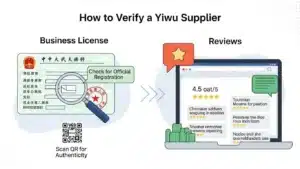
In a market built on trading booths rather than factory sales offices, a test report has a provenance question attached that a direct factory purchase does not. The booth may source the same item from more than one workshop depending on price and season. A report obtained from workshop A remains a genuine document when your goods are quietly produced by workshop B — and nothing about the transaction will tell you that has happened.
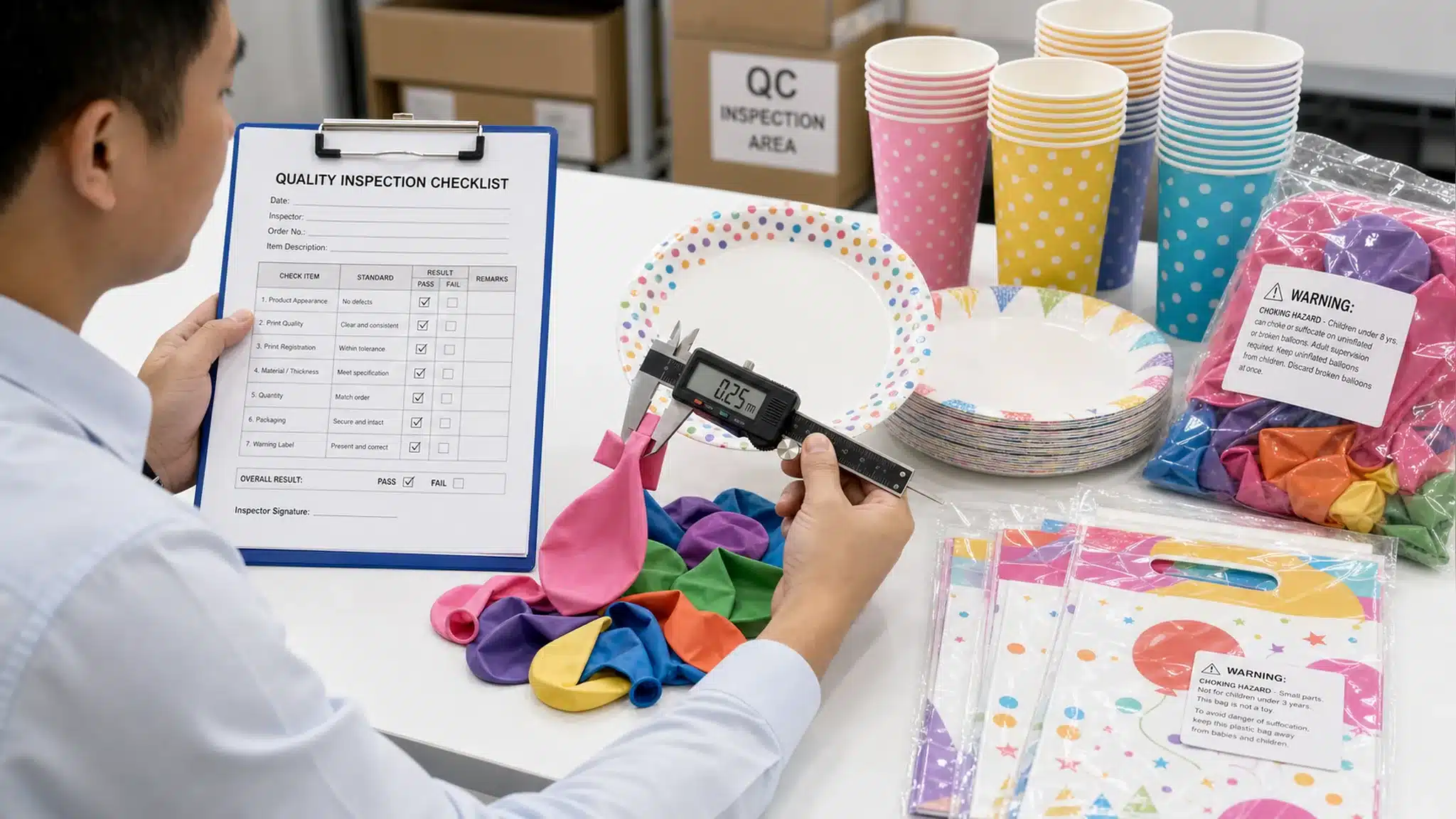
This is where an agent on the ground earns the fee, and the mechanism is unremarkable: match the report to the production. A mismatch found before the cartons seal costs a conversation. The same mismatch found at a port costs the container.
What we check on the ground — and where the checking stops
Worth being precise about the division of labour, because buyers routinely assume an inspection agent is also a compliance service. The useful question is not what an agent promises but which of the seven certificate elements above a person standing in the workshop can actually observe — and on what published terms.
Our own inspection scope is set out in full on our quality control page, and the numbers on it are the ones to argue with. Sampling runs to ANSI/ASQ Z1.4 (ISO 2859-1) with default tolerances of zero critical defects, AQL 2.5 major and AQL 4.0 minor, adjustable by agreement before the visit. Standalone inspection is quoted at a flat day rate — the published example is $199 per man-day — and is often folded in when the sourcing is ours. The report is a PDF within 24 hours, carrying photographs, video of function tests and measurement data.
Those tolerance numbers are the part buyers most often leave undecided. “AQL 2.5 major” means a defined number of major defects is acceptable — so a lot can fail your expectations while passing a standard you never actually named. Fix the three numbers in the PO and the inspection produces a verdict; leave them out and it produces an opinion.
Timing is booked against production, not against the calendar: pre-shipment when the lot is 100% produced and 80% packed, during-production at 20–50% produced where a defect can still be corrected before the run finishes, and loading supervision on the day the container is stuffed.
The during-production slot is the one most buyers skip and most often need: a pre-shipment rejection on a finished lot leaves only rework, replacement or a discount, while the same defect caught at 30% is still a line adjustment. A visit at any of those points also settles whether the material and colourway running today match the ones named on the report you were sent — a report is issued against one specimen, and the line can change between orders.
Two structural things follow from being the buyer’s agent rather than a report vendor, and both are on that page. We hold the 70% final payment, so a failed inspection is not merely documented — the money stays put until the factory reworks the goods, which is the leverage a third-party inspector who files a report and leaves does not have. And because the standing fear is that an inspector accepts a red envelope to pass a bad lot, three controls exist against it: inspectors are rotated rather than sent back to the same factory, visits are GPS-tracked and body-cam recorded, and factories are rewarded for reporting an attempted bribe.
Where the checking stops
What no site visit can establish is the part that most often makes a lot illegal. Chemical composition is not visible. Neither is a phthalate level, a lead level, or a migration limit under the food-contact rules above. Those are laboratory findings, and a person with a camera and a sampling plan cannot substitute for them — which is precisely why the AQL numbers above answer a different question from the certificate. Zero critical defects is a statement about what came off the line that week; it says nothing about the resin.
The same boundary applies to the paperwork: issuing a test report, accrediting a laboratory, classifying your product and filing your certificate data at entry belong to a laboratory, a customs broker and you as the certifying importer. An agent offering all of it from one desk is describing something other than an inspection.
Where household goods actually fail, by category
The European Commission’s Safety Gate system validated 4,671 alerts in 2025, on what the Commission describes as an ascending line since the exchange of information began in 2003. The breakdown is the useful part for a buyer deciding where to spend a testing budget: chemical risk accounted for 53% of notified risks, injuries 14% and choking 9%. By category, cosmetics led at 36%, toys at 16% and electrical appliances and equipment at 11%. Reporting on the same report put products of Chinese origin at 2,006 of those 4,671 alerts.
The lesson in that 53% is that the dominant risk in consumer goods is not the one buyers instinctively check for. Chemical failures are invisible on a factory floor, cannot be caught by any amount of careful looking, and are the reason lab testing exists as a separate instrument at all.

What goes wrong, by product group
- Coated and painted goods — decorative metal, painted wood, ceramics with decorated rims. Heavy metals in pigments and glazes. Invisible to inspection; found only by chemical analysis.
- Plastics and food-storage — regrind content varies between production runs, and a food-contact material that complied on the tested specimen may not comply when the workshop switches to cheaper resin mid-order.
- Textiles and soft home goods — azo dyes, formaldehyde in finishes, and flammability, which for some categories is a mandatory US rule rather than a nice-to-have.
- Small electricals — the mains side of the product is where the recognised-lab expectation is strongest, and where a market that has never sold into your jurisdiction is least equipped.
- Anything with small detachable parts — if the item could plausibly be treated as a children’s product, the strict third-party regime applies and the general-use argument above does not.
The pattern is consistent: inspection catches the things that went wrong on the day, and testing catches the things that were wrong from the start. Buyers who have only ever been burned by the first kind tend to under-buy the second.
Building testing into the order instead of the crisis
Testing gets expensive when it is remembered late. Decide the regime before the deposit leaves, and it becomes a line item; discover it when the goods are made, and the options are re-work, re-manufacture or a container you cannot enter.
A workable sequence
- Classify before you order. Establish which regime the item falls under for your destination market, and whether the item could be construed as a children’s product. That single question changes whether a third-party lab is optional or mandatory.
- Put it in the PO. Name the standard, name who pays for testing, and require that reports identify the exact SKU, colourway and material. A report requirement written after production is a request; written into the PO, it is a term.
- Approve a golden sample and lock the material. Sign off the physical sample and the material specification together, since the material is what the test result actually describes.
- Submit for testing from production material, not from a hand-made showroom sample. This is the step most often skipped, and it is the step that makes the report true. Build the turnaround into your schedule rather than assuming it: laboratory lead time is quoted per standard and per sample count, and it runs in parallel with nothing — production cannot be signed off against a report that has not come back yet.
- Inspect the lot against the approved sample before the balance is paid, using an agreed sampling plan and accept/reject numbers.
- File the documents where you can find them in nine years. EU importers are required to keep technical documentation for 10 years; US certificate elements include contact details for whoever holds the test records, which presumes those records still exist.
Best for: importers and private-label buyers placing repeat orders of non-toy household goods, who need to know which paperwork is genuinely required before committing to a supplier. Not for: anyone importing regulated children’s products, where the third-party laboratory route is mandatory and there is no reasonable-testing-program alternative to weigh up — and not a substitute for advice from a customs broker or compliance professional on your specific classification.
If your immediate problem is the lot rather than the design — goods already made, and you need to know whether they match what you approved — the next step is pre-shipment inspection against an agreed sampling plan. If the goods have already arrived wrong, the leverage question is covered separately in our guide to protecting payment leverage on defective goods. And if you are sourcing anything that a regulator might treat as a toy, the stricter regime is set out in the three tests toy buyers must demand.
Frequently asked questions
Do I legally need a third-party lab report for household products?
For US general-use products, no. A General Certificate of Conformity may rest on a test of each product or a reasonable testing program, and CPSC’s form allows “N/A” in the third-party laboratory field. Children’s products do require a CPSC-accepted lab.
Is a pre-shipment inspection enough to prove compliance?
No. An inspection samples a lot for visible and functional defects against accept/reject numbers. It cannot detect banned chemicals, and a lot can pass inspection while being illegal to sell. The two documents answer different questions.
What changed for US importers on 8 July 2026?
Certificate data must now be filed electronically with CBP at time of entry, via ACE. The testing obligations themselves are unchanged. Goods entered from a foreign trade zone for consumption or warehousing follow from 8 January 2027.
How long must I keep test documentation?
EU importers must keep technical documentation for 10 years from the date the product is placed on the market, under Regulation (EU) 2023/988. US certificates require contact details for whoever maintains the test records, so those records must remain retrievable.
My supplier sent a test report immediately. Is that a red flag?
Not necessarily, but it means the report predates your order. Check that the product identified, the standard clauses, the date and the laboratory’s accreditation scope all match your item. Genuine reports issued for a different SKU are the common problem.
What does testing cost?
It is driven by the number of standards and clauses, the number of materials and colourways, and whether an accredited lab is required. Ask for a quotation per SKU and per standard rather than a blanket figure.