Justin
The canton fair vs yiwu decision usually shows up after a buyer has already burned a trip, missed a season, or discovered that the sample and the production lot did not match. That is the expensive part. I have seen teams fly in for a fair, get strong quotes, then realize the order size was too large, the lead time was too rigid, and the landed cost looked very different once freight, packing, and customs were added.
Key Takeaways
- For procurement teams, Yiwu wins on year-round access, lower MOQs, and mixed-SKU buying.
- Choose Yiwu when MOQ control, mixed-SKU buying, and pilot speed matter more than broad factory access.
- For low MOQ, mixed-SKU replenishment, and year-round restocking, Yiwu is usually the better procurement tool.
- Yiwu is stronger on MOQ and assortment flexibility, but the tradeoff is higher execution risk unless coordination, paperwork, and QC are controlled tightly.
- Use Yiwu when MOQ control, mixed-SKU containers, and year-round replenishment matter.
If you need small batches, mixed SKUs, or faster replenishment, Yiwu usually makes more sense. If you need deeper factory access and broader English support, the fair can be easier to manage. We break down the real tradeoffs here: order size, supplier type, buying schedule, communication friction, and the controls that protect you from batch drift, vague quotes, and avoidable disputes. The point is simple. Pick the sourcing path that protects margin and keeps stock moving.
Venue Overview
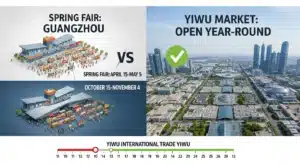
For procurement teams, Yiwu wins on year-round access, lower MOQs, and mixed-SKU buying. Feira de Cantão wins when you need broader manufacturer access and can handle a biannual schedule.
Yiwu Market Scope
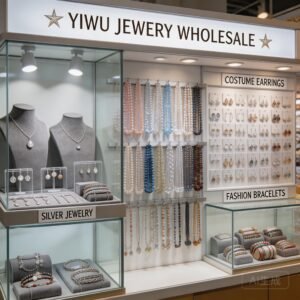
Mercado de Yiwu is a permanent wholesale market built for small commodities. It is useful when the buying job is assortment testing, retail replenishment, or filling a container with many related SKUs instead of one large order.
For a procurement manager, that matters because it reduces waiting time and supports faster replenishment. Yiwu is also the better fit when you want to control working capital and keep order sizes closer to market demand.
Canton Fair Scope
Canton Fair is a biannual trade fair, held in spring and autumn. It gives stronger access to larger manufacturers and trading companies, which is useful when you are building supplier depth or comparing export-ready vendors at scale.
The tradeoff is planning burden. If your buying cycle misses the fair window, you wait months for the next round, which can slow sourcing decisions and create avoidable replenishment risk.
Procurement Comparison
- MOQ range: Yiwu typically supports dozens to a few hundred units; Canton Fair suppliers usually expect larger orders.
- Supplier type: Yiwu is strongest for small commodities and mixed-SKU wholesale; Canton Fair is stronger for larger manufacturers and trading companies.
- Operating schedule: Yiwu is accessible year-round except for the Chinese New Year shutdown; Canton Fair runs twice a year.
- Language friction: Canton Fair is often easier for buyer communication; Yiwu frequently benefits from a local sourcing agent to reduce quote ambiguity.
- Product breadth: Yiwu is better for small commodities, retail assortments, and mixed containers; Canton Fair is better for deeper factory access in more industrial categories.
- Typical buyer fit: Yiwu suits retail replenishment and low-MOQ sourcing; Canton Fair suits supplier scouting and larger-volume procurement.
- Sourcing controls: Use sample approval, pre-shipment inspection, consolidation options, and clear Incoterms before you commit.
The practical difference is execution risk. Yiwu gives more flexibility for assortment planning and lower inventory exposure, while Canton Fair gives broader factory discovery but requires tighter travel and meeting coordination.
When We Would Choose Yiwu
We would choose Yiwu when the sourcing brief is mixed-SKU wholesale, low MOQ, or faster replenishment for retail. It is also the better path when the team wants to test demand before committing to larger volumes.
That said, Yiwu works best with disciplined RFQs, sample approval, and a local sourcing agent. Without that coordination, weak export-language fluency can turn small communication gaps into pricing errors, spec drift, or avoidable disputes.
When Canton Fair Fits Better
We would lean toward Canton Fair when the priority is finding larger manufacturers, comparing export-oriented suppliers, or building a broader vendor shortlist in one trip. It is better suited to teams that can plan around the event calendar and negotiate larger order commitments.
For procurement teams, the key tradeoff is cadence versus access. Canton Fair can widen supplier choice, but Yiwu usually gives better operational control if your real problem is fill rate, replenishment timing, or small-batch buying.
Best Use Cases
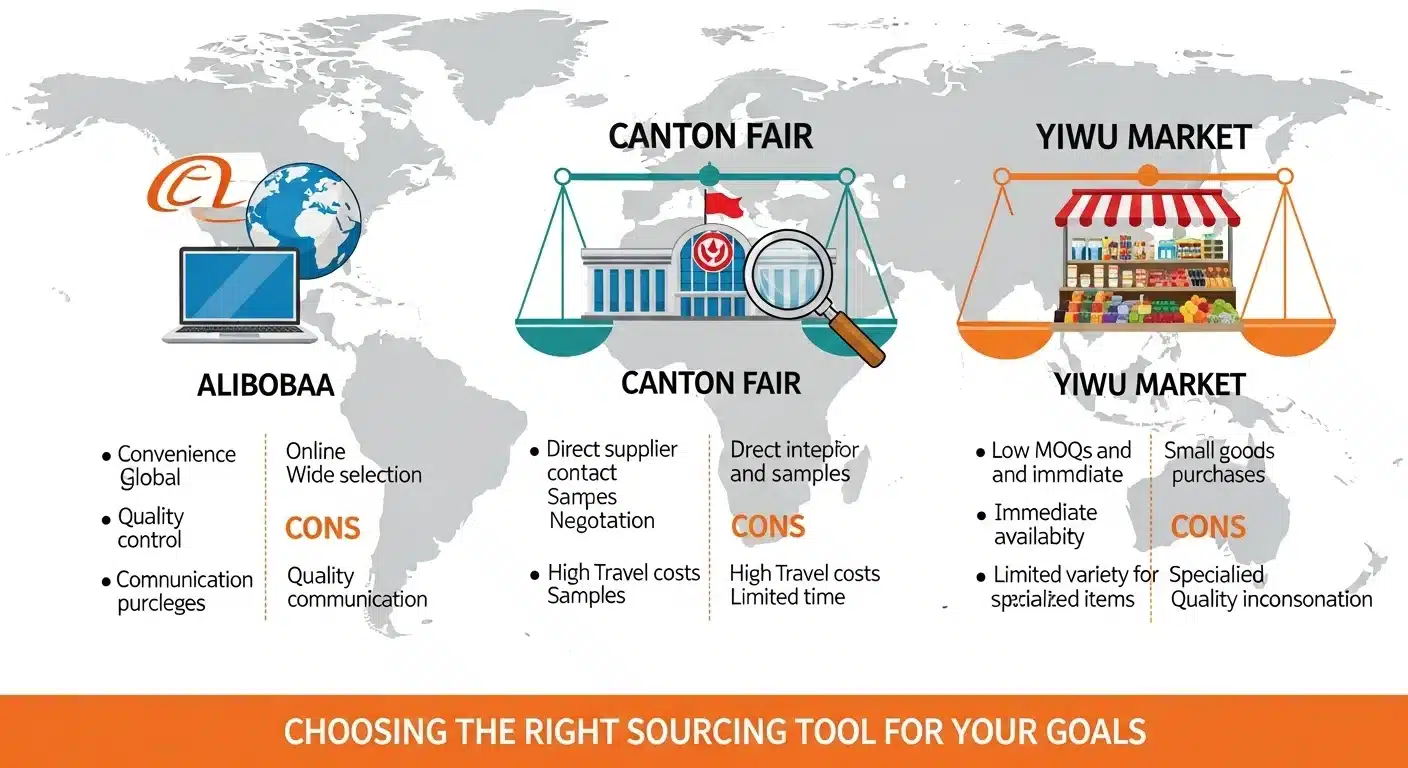
Choose Yiwu when MOQ control, mixed-SKU buying, and pilot speed matter more than broad factory access. Choose Canton Fair when the program is larger, language friction must stay low, and you want deeper manufacturer coverage.
Low MOQ sourcing
We would choose Yiwu for test orders, assortment breadth, and fast pilot launches. The real advantage is not just lower MOQ; it is the ability to buy dozens to a few hundred units across multiple SKUs without locking up too much cash.
That makes Yiwu a better fit for procurement teams that need to validate demand before committing to a larger replenishment plan. It also works when the buying team wants to launch quickly and learn from the first shipment instead of waiting for a biannual trade fair cycle.
Procurement fit
Yiwu is the safer path when the buying process starts with sampling, then moves into phase-in orders. Lower upfront volume reduces working capital risk, which matters when batch consistency, landed cost, and supplier communication are still being tested.
In practice, we treat Yiwu as a sourcing control tool. It is useful when the team needs to prove the assortment, tighten the RFQ, and confirm trade documents before scaling the order.
Large volume sourcing
For larger programs, Canton Fair usually has the edge because it draws more manufacturers and larger trading companies. That can be better when the buying team wants to consolidate categories, negotiate deeper programs, and build longer supplier relationships.
Yiwu can still support volume, especially for mixed-SKU containers, but the structure is different. It is stronger for category spread and retail assortment planning than for a single large factory-led program.
Stable demand and multi-quarter plans
Yiwu makes more sense when demand is stable and the buying plan stretches across multiple quarters. Year-round access helps buyers avoid the gap between spring and autumn fairs, which reduces replenishment lead-time risk for retail programs.
That matters for teams managing repeat orders, seasonal inventory, and fill-rate targets. If the category needs continuity instead of one-off deal hunting, Yiwu gives you more frequent sourcing windows.
Procurement decision summary
- MOQ range: Yiwu usually supports dozens to a few hundred units; Canton Fair suppliers often expect much larger orders.
- Supplier type: Yiwu is stronger for small commodities and mixed-SKU buying; Canton Fair is stronger for larger manufacturers and trading companies.
- Operating schedule: Yiwu is year-round except for the Chinese New Year shutdown; Canton Fair runs twice a year in spring and autumn.
- Language friction: Canton Fair is usually easier for direct buyer communication; Yiwu often benefits from a local sourcing agent.
- Product breadth: Yiwu is better for mixed-SKU wholesale and assortment testing; Canton Fair is better when supplier depth and factory scale matter more.
- Sourcing controls: Use sample approval, pre-shipment inspection, consolidation options, and clear Incoterms to reduce execution risk.
Our read is simple: if the buying job is to test, phase in, and control working capital, Yiwu is the better sourcing path. If the job is to secure a larger program with broader factory access, Canton Fair is usually the stronger venue.
Comparison Table
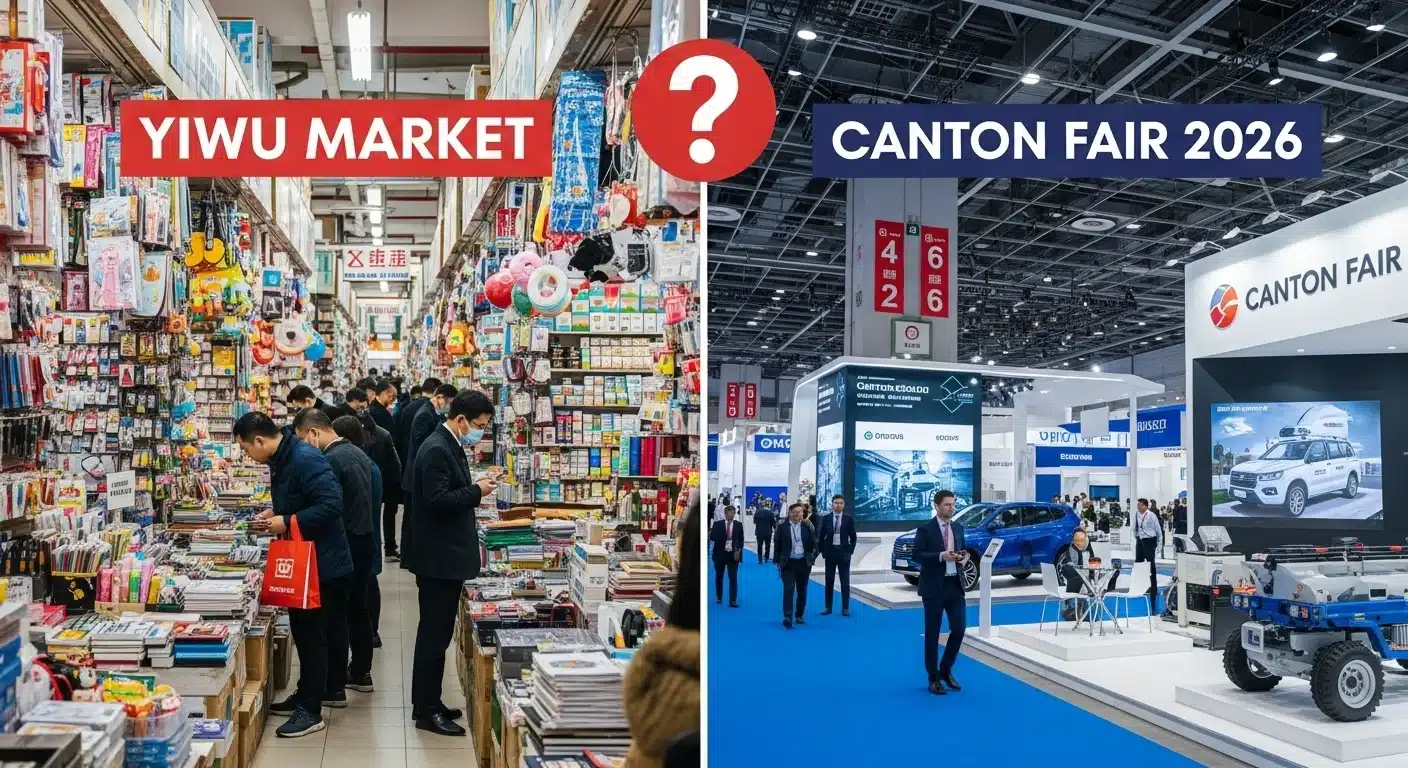
For low MOQ, mixed-SKU replenishment, and year-round restocking, Yiwu is usually the better procurement tool. Canton Fair fits larger order discovery, but it is less flexible for urgent, small-batch buying.
MOQ and pricing
If your team is comparing canton fair vs yiwu for low MOQ sourcing, the real difference is order structure. Yiwu suppliers are built for dozens to a few hundred units, mixed-item baskets, and tighter working-capital control. Canton Fair suppliers more often expect larger opening orders, which can improve unit price only when volume is already committed.
Yiwu also gives buyers more room to negotiate on product mix than on pure unit price. That matters when the goal is to test assortment, not just chase the lowest quoted number. In practice, the best source for mixed SKU wholesale in China is the one that lets you keep margin intact without overbuying slow movers.
- MOQ range: Yiwu usually supports low hundreds or less; Canton Fair suppliers often push higher opening volumes.
- Price flexibility: Yiwu tends to reward mixed baskets and repeat ordering; Canton Fair pricing is more volume-driven.
- Product mix: Yiwu is stronger for assortment buying across many SKUs; Canton Fair is better for deeper single-SKU commitments.
- Supplier type: Yiwu is dominated by traders and market-linked suppliers; Canton Fair draws more manufacturers and larger trading companies.
- Negotiation style: Yiwu negotiation usually centers on bundle pricing, sample terms, and mixed-container economics rather than aggressive scale discounts.
Procurement KPIs
For a procurement manager, the question is not which venue looks bigger. It is which venue reduces landed cost without inflating inventory risk. Yiwu usually wins when the KPI is total cost of ownership across testing, packaging, and replenishment, because smaller buys reduce cash tied up in slow stock.
Canton Fair can work when the buyer already has validated demand and can absorb larger inbound quantities. Yiwu is stronger when reorder flexibility matters, because you can refresh SKUs without waiting for the next biannual fair cycle. That difference directly affects fill rate and stockout control.
- Landed cost: Yiwu helps control landed cost through lower commitment per SKU and easier consolidation.
- Inventory risk: Yiwu lowers exposure to dead stock when product-market fit is still being tested.
- Reorder flexibility: Yiwu supports smaller follow-on orders, which is better for fast-moving retail and e-commerce replenishment.
- Supplier controls: Use sample approval, pre-shipment inspection, consolidation options, and clear Incoterms to keep disputes down.
- Compliance discipline: Ask for factory audit records, QC checklists, and trade documentation instead of relying on verbal promises.
Logistics and timing
Yiwu is open year-round except for the Chinese New Year shutdown, so it works better for buyers who miss a fair window or need urgent restocks. Canton Fair runs only in spring and autumn, which is fine for planned sourcing rounds but weak for sudden replenishment needs. If your business depends on fast recovery after a sell-through spike, the calendar alone makes Yiwu more practical.
Travel commitment also changes the economics. Canton Fair is easier for English communication, so the visit can be smoother for some teams. Yiwu often benefits from a local sourcing agent because quote details, packing terms, and consolidation instructions need tighter coordination.
- Seasonality: Yiwu is year-round except Chinese New Year; Canton Fair is limited to two annual sessions.
- Visit timing: Yiwu supports off-cycle buying; Canton Fair forces planning around fixed exhibition dates.
- Buyer travel commitment: Yiwu can be more efficient when the buyer needs district-level sourcing and repeat visits.
- Replenishment speed: Yiwu is the better fit for urgent restocks because sourcing does not stop after a fair closes.
- Language friction: Canton Fair usually has less communication friction; Yiwu often needs a sourcing agent to reduce quote ambiguity and execution errors.
Year-round access for urgent restocks
For retail replenishment, year-round access is the main operational advantage Yiwu has over Canton Fair. It gives procurement teams a live sourcing path when an item sells faster than planned, a supplier misses a delivery, or a seasonal line needs a quick top-up. That is why we would choose Yiwu when speed, assortment control, and lower travel waste matter more than exhibition scale.
The practical rule is simple: use Canton Fair for broader supplier discovery when you can wait, and use Yiwu when the buying problem is execution. For procurement teams focused on fewer disputes, lower batch risk, and faster replenishment, Yiwu is usually the better working model.
| Caraterística | Yiwu | Feira de Cantão | Why it matters |
|---|---|---|---|
| Best fit for procurement teams | Year-round sourcing for mixed-SKU buying, retail replenishment, and low-MOQ testing | Seasonal sourcing event for broader manufacturer access and larger-order development | Choose Yiwu when you need faster replenishment and smaller working-capital exposure; choose Canton Fair when you can plan around biannual buying cycles |
| MOQ range | Often dozens to a few hundred units | Commonly higher MOQs and more commitment per SKU | Yiwu supports assortment testing and first-order risk control; Canton Fair is better when volume is already validated |
| Supplier type | Strong for traders, small factories, and market-based suppliers | Stronger access to larger manufacturers and export-oriented trading companies | Yiwu is useful for sourcing breadth and speed; Canton Fair often suits deeper factory-level development |
| Operating schedule | Open year-round except Chinese New Year shutdown | Held twice per year in spring and autumn | Yiwu reduces missed-window risk and supports ongoing replenishment planning; Canton Fair requires tighter event timing |
| Language friction | Higher communication risk; local sourcing agent often improves quote accuracy and follow-up | Generally easier buyer communication due to broader English familiarity | Yiwu needs tighter RFQs, clearer specs, and stronger local coordination to avoid ambiguity |
| Product breadth | Best for small commodities, mixed categories, and container consolidation across many SKUs | Better for deeper sourcing in specific product lines and larger production runs | Yiwu is stronger for retail assortment building and mixed-load containers |
| Risk controls to require | Sample approval, pre-shipment inspection, consolidation plan, clear Incoterms, and trade documents | Sample approval, factory audit records, QC checklist, clear Incoterms, and trade documents | Both channels need buyer-side controls, but Yiwu usually benefits more from inspection and coordination support |

Risk Factors
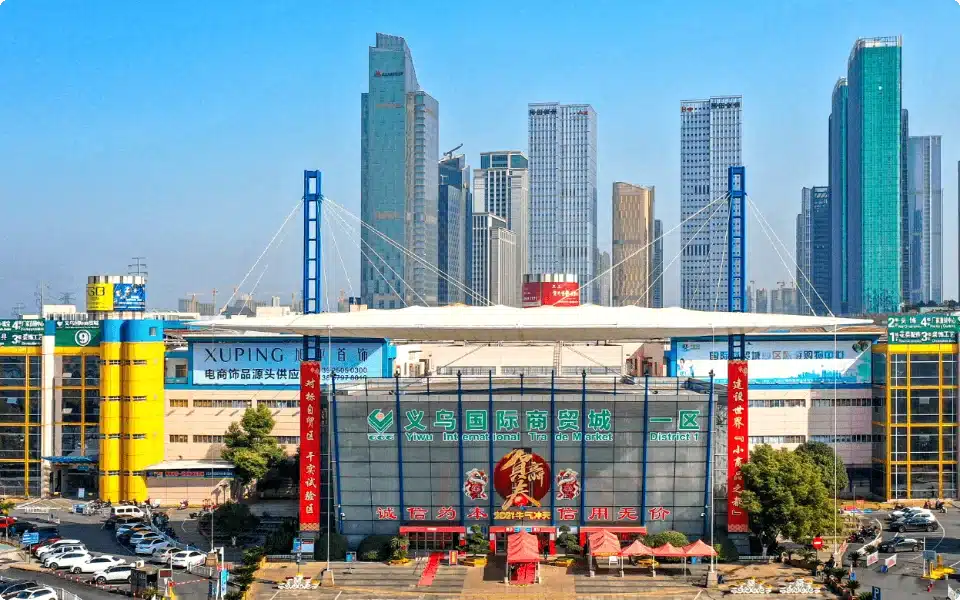
Yiwu is stronger on MOQ and assortment flexibility, but the tradeoff is higher execution risk unless coordination, paperwork, and QC are controlled tightly.
Communication Gaps
Yiwu often needs a stronger local coordination layer than Canton Fair. Many suppliers are set up for domestic or trading-side communication, not polished export handling, so quote wording and follow-through can slip if your RFQ is loose.
For a procurement team, that means a Yiwu sourcing agent is not a nice-to-have. It reduces ambiguity, closes gaps faster, and keeps the buying team from losing time on back-and-forth that should have been captured in the first quote.
Quote Accuracy and Follow-Through
The main risk is not the headline price. It is the mismatch between the first quote, the final specification, and the documents that support shipment. If the supplier does not confirm materials, packing method, carton count, lead time, and Incoterms in writing, landed cost gets messy fast.
- Quote scope: Confirm product spec, unit price, packaging, and carton details in the same RFQ.
- Documentation: Match the proforma invoice, packing list, and shipping terms before any deposit is paid.
- Follow-through: Require a written commitment on sample timing, production timing, and shipment handoff.
This is where Canton Fair can feel cleaner, because broader export experience often improves quoting discipline. In Yiwu, you get more flexibility, but only if your process is tighter than the supplier’s default habit.
Quality Variance
Yiwu has a wider quality spread because entry barriers are lower and supplier depth is broader across small commodities. That is useful when you are testing assortment, but it also means you cannot assume one sample represents the full batch.
For procurement, the right response is not to avoid Yiwu. It is to narrow the risk with sample approval, factory-side clarification, and batch-level QC requirements before you scale the order.
Batch Inspection and Sample Approval
At scale, sample approval is still the first gate, not a formality. If the approved sample is not locked against the production run, batch variation can show up in finish, sizing, labeling, or packing consistency.
- Sample approval: Approve one reference sample before mass production starts.
- Batch inspection: Inspect production lot consistency before shipment, not after arrival.
- QC records: Keep checklists, photos, and defect notes tied to each supplier and order.
If your KPI is fewer disputes and a steadier fill rate, these controls matter more in Yiwu than in a fair-only buying trip. That is why we treat Yiwu as a sourcing system, not just a shopping venue.

Buying Framework
Use Yiwu when MOQ control, mixed-SKU containers, and year-round replenishment matter. Use Canton Fair when you need broader factory outreach and seasonal benchmarking.
Decision Checklist
For procurement teams, the real question is not venue popularity. It is whether the sourcing path protects margin, fill rate, and landed-cost clarity. We would choose Yiwu when the order needs low MOQ, assortment mixing, and faster re-buy cycles. We would choose Canton Fair when the brief needs wider factory reach, stronger seasonal scouting, and more direct manufacturer comparison.
- MOQ: Yiwu is built for dozens to a few hundred units; Canton Fair suppliers usually expect larger opening orders.
- Target margin: Yiwu is better when you need to test demand without locking too much working capital.
- Compliance: Ask for factory audit records, QC checklists, and trade documents before you chase the lowest quote.
- Sample policy: Confirm sample approval terms early so batch quality is not left to verbal promises.
- Lead time: Year-round Yiwu sourcing helps when you cannot wait for the next fair window to replenish.
- Consolidation: Yiwu is stronger for mixed containers and retail assortment planning, which reduces shipment fragmentation.
- Incoterms clarity: Lock this down before approval, because unclear freight responsibility destroys landed-cost accuracy.
If the team cannot answer these points cleanly, the trip is premature. A sourcing agent helps most in Yiwu because coordination, quote cleanup, and supplier follow-up usually need more local management.
Internal Review Use
This framework works well in internal stakeholder reviews because it turns a travel decision into a buying decision. Procurement can use it to compare risk, cost control, and replenishment fit without getting lost in venue hype.
For finance, the key issue is working-capital exposure. For operations, it is fill-rate stability and supplier responsiveness. For compliance, it is whether the supplier can produce documents and pass buyer-side checks without delays.
When Yiwu Wins
Yiwu is the better fit for low MOQ sourcing, mixed-SKU wholesale, and year-round sourcing for retailers. It is also useful when the buyer wants to test multiple categories in one container instead of placing a single large bet.
That makes Yiwu practical for assortment testing and replenishment control. The tradeoff is that communication can be rougher, so a local sourcing agent is often the difference between a clean order and a messy one.
When Canton Fair Wins
Canton Fair is stronger when the procurement team needs larger manufacturer outreach and seasonal supplier benchmarking. It gives broader access to factories and trading companies, which helps when the buyer is validating supply depth or comparing multiple production options at scale.
It is also easier for many buyers to communicate there because English familiarity is generally broader. That does not remove due diligence, but it does reduce quote ambiguity and speeds up early-stage negotiation.
Practical Recommendation
If the buying problem is low MOQ, mixed containers, or steady replenishment, start with Yiwu. If the problem is broader market coverage, larger factory outreach, or seasonal comparison, start with Canton Fair.
For procurement teams, that is the cleanest split: Yiwu is a risk-control tool for assortment and cash flow, while Canton Fair is a discovery tool for wider supplier benchmarking.
Conclusão
I would choose Yiwu for a buyer who needs low-risk replenishment, mixed-SKU cartons, and tighter working capital control. Canton Fair makes sense only if you want larger factory runs and can wait for the spring-or-autumn window; for fast retail turns, year-round access wins.
Ask for two quotes on the same item set, then compare sample approval, landed cost, and delivery timing before you book anything. If you want to reduce mistakes, use a Yiwu sourcing agent, demand pre-shipment inspection, and confirm the district list first so you only visit suppliers that fit your order size.
Perguntas mais frequentes
What is the difference between Yiwu and Canton Fair?
Yiwu Market is a permanent wholesale hub where buyers can source directly from thousands of suppliers every day, making it ideal for ongoing purchasing, small to medium orders, and fast sampling. Canton Fair is a large seasonal trade exhibition that brings together manufacturers from across China for a limited period, which is better for discovering new suppliers and comparing products at scale. In the YOUR TRUSTED EYES IN YIWU MARKET model, Yiwu is especially strong for verified suppliers, low MOQ starting from 100 pieces, risk-free inspection, and DDP shipping support. If you want practical sourcing with local factory pricing and Western quality standards, Yiwu is usually the more efficient choice.
Which is the biggest trade fair in China?
The Canton Fair is widely recognized as the biggest trade fair in China and one of the largest sourcing events in the world. It attracts a broad range of exporters, manufacturers, and international buyers across multiple industries. But being the biggest does not always mean it is the best fit for every sourcing need. For buyers focused on fast product selection, lower minimum orders, and direct access to verified Yiwu suppliers, Yiwu Market can be more practical than a large exhibition.
Is Yiwu Market worth visiting?
Yes, Yiwu Market is absolutely worth visiting for buyers who want variety, speed, and direct sourcing opportunities. It is one of the world’s largest wholesale markets, offering a huge range of products across many categories in a single location. Through YOUR TRUSTED EYES IN YIWU MARKET, buyers can reduce sourcing risk with supplier verification, risk-free inspection, and support for Western quality expectations. It is especially valuable for businesses that need low MOQ orders, efficient sourcing, and global DDP shipping solutions.
How far is Yiwu Market from Canton Fair?
Yiwu Market and the Canton Fair are in different cities, so the distance is significant rather than a short local transfer. Yiwu is in Zhejiang Province, while the Canton Fair is held in Guangzhou, which means the journey typically requires a flight or a long train ride. For sourcing trips, many buyers choose to plan each destination separately because they serve different purposes and schedules. If you are combining them in one trip, it is best to allow enough time for travel, inspection, and supplier meetings.
What is the difference between Yiwu and Canton Fair?
Yiwu Market operates year-round as a permanent wholesale marketplace, while the Canton Fair is a scheduled trade fair that happens in specific phases during the year. Yiwu is best for hands-on sourcing, repeat purchasing, and lower MOQ orders, while Canton Fair is stronger for discovering a wide network of manufacturers in one exhibition setting. With YOUR TRUSTED EYES IN YIWU MARKET, buyers gain access to verified suppliers, inspection support, and DDP shipping, which makes sourcing simpler and less risky. If your priority is reliable purchasing at local factory prices, Yiwu often delivers a more direct and efficient sourcing experience.