 Justin
Alibaba payment terms are where a lot of first orders go wrong. A buyer agrees to a 30/70 split, wires the deposit, and then starts finding problems only after the supplier has the money. That is usually when the story turns ugly: sample quality does not match the bulk run, the shipment gets held up, or the final balance arrives with surprise bank fees and a supplier who is suddenly hard to reach. It is a bad way to learn how fast trust can disappear.
Key Takeaways
- Payment terms control cash flow and risk; payment methods control speed, fees, and protection.
- For a first Alibaba order, protection matters more than chasing the lowest fee.
- Ask for stronger Alibaba payment terms only after the supplier is verified, the first order is clean, or repeat volume is real.
- For a first order, protect cash first and chase better terms later.
- For a first Alibaba payment terms negotiation, protect the order first.
Here is the practical version. You need to know what each payment setup really means, which ones protect a first order, and which ones only make sense after you have proof the supplier can deliver what they promised. I will break down 30/70, 50/50, and net terms in plain English, show the tradeoff between speed, cost, and protection, and give you a simple rule for when to pay, when to hold back, and when to push for better terms after the first shipment clears inspection.

Payment Terms Basics
Payment terms control cash flow and risk; payment methods control speed, fees, and protection. For a first order, protection should come before term length.
Terms vs. Methods
In Alibaba payment terms, the term is the split and timing of the money, while the method is the rail used to send it. That difference matters because a bank transfer, card payment, or escrow-style setup changes cost, speed, and dispute use.
If you mix the two up, you can end up choosing a cheap transfer that gives weak protection, or a protected method that costs more than the order can justify. For low MOQ wholesale supplier China orders, that tradeoff is usually the real decision, not just the headline deposit.
Common Payment Structures
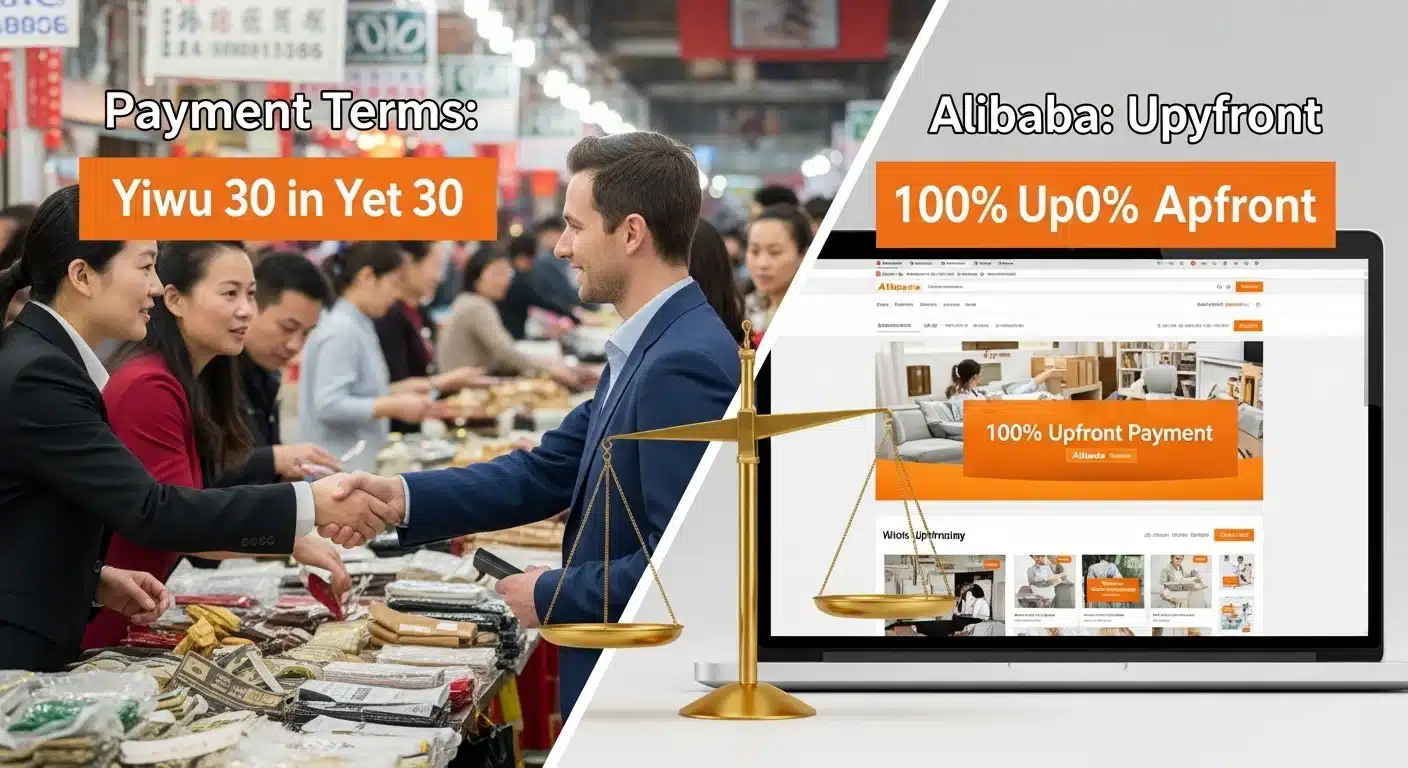
The usual structures are simple. Alibaba-style sourcing often uses 30/70, 50/50, 100% upfront, and net terms for buyers with proven history. The right choice depends on whether you are protecting a first order or buying again from a verified supplier in Yiwu market.
- 30/70: Pay 30% deposit first, then 70% before shipment or release. This is common for new orders because it balances supplier commitment with some buyer protection.
- 50/50: Split the order in half, usually before production and before shipment. It gives the supplier more working capital, but it increases buyer risk compared with 30/70.
- 100% upfront: Pay the full amount before production. This is the weakest buyer-protection structure and should only be used when trust is already established or the order is very small.
- Net terms: Pay after delivery, often net 15, net 30, or similar. These terms are usually reserved for repeat buyers with clear specs, strong payment history, and low dispute risk.
In practice, better terms are earned, not asked for casually. If you want to reduce upfront payment on Alibaba, show clear specs, place a clean sample order, and prove that your bulk order will not turn into a dispute.
Risk by Buyer Type
First-order buyers carry the highest counterparty risk because they do not know whether the supplier can hit the sample-to-bulk consistency China sourcing buyers need. That is why protected payment and inspection matter more than chasing a small deposit discount.
- New buyer: Best fit is 30/70 with verification, written specs, sample approval, and inspection before final balance.
- Repeat buyer: Best fit is stronger net terms after trust is established, especially if order volume is predictable.
- High-volume buyer: Can usually negotiate better terms by trading forecasted volume for flexibility on timing and deposit size.
For a buyer focused on yiwu market sourcing risk management, the rule is simple: protect the first order, then negotiate harder after you have a delivery record. That is how you keep cash flow under control without paying for avoidable mistakes.
How to Negotiate
Ask early, before the supplier assumes you will accept standard terms. Start by verifying the supplier, checking sample consistency, and confirming whether the payment route offers Trade Assurance payment options or another protected structure.
Then anchor higher than your target. If you want lower upfront exposure, ask for better terms in exchange for repeat volume, a clearer specification sheet, or a tighter acceptance process after inspection.
The best payment method for Alibaba suppliers is not always the cheapest one. For first orders, safe payment methods for Chinese suppliers are the ones that give you traceability, dispute use, and a clean release point tied to inspection or acceptance.
Alibaba Payment Options
For a first Alibaba order, protection matters more than chasing the lowest fee. Trade Assurance, card payments, and controlled bank transfers are the core options worth comparing.
Protected Payment Options
The safest Alibaba payment terms usually start with Trade Assurance. It is the cleanest option for a new buyer because payment is tied to the platform’s order flow, which gives you more use if the supplier misses specs, delivery dates, or agreed terms.
Card payments are useful when speed matters and the order value is still manageable. They are convenient, but the processing fee is often higher than a bank transfer, so they make more sense for first samples, smaller launches, or buyers who value dispute support over saving a few points on fees.
Bank transfer is common for deposits and larger bulk orders, especially when the supplier is verified and the buyer has already checked sample consistency. It is usually cheaper than card payment, but it gives less built-in protection, so it should be used carefully on the first order.
- Trade Assurance: Best for first orders, lower-risk deposits, and buyers who want platform-backed dispute handling.
- Card payment: Best for fast checkout, sample orders, and buyers who want convenience plus chargeback-style protection where available.
- Bank transfer: Best for established suppliers, larger deposits, and repeat buyers who have already verified quality and factory legitimacy.
- Platform-supported options: Best when the supplier page clearly shows eligibility, payment flow, and order protection terms before money moves.
If you are sourcing from Yiwu or anywhere else in China, do not treat the cheapest rail as the best rail. The real question is whether the payment structure reduces the chance of losing money on a bad supplier, a fake factory, or a sample that does not match bulk production.
Method Comparison
The comparison below is the practical way to judge Alibaba payment terms: speed, fees, and protection. That is the tradeoff that matters on a first order, not theory.
- Trade Assurance: Speed is moderate, fees are usually built into the platform flow, protection level is high, best for first orders and risk-managed bulk buying.
- Card payment: Speed is fast, fees are typically higher, protection level is medium to high depending on the card network and platform rules, best for samples and low-friction small orders.
- Bank transfer: Speed is fast to moderate depending on banks and cross-border routing, fees are usually lower than card payments, protection level is low to medium, best for repeat suppliers with clear written specs.
- Escrow-style platform support: Speed is usually moderate, fees vary by order setup, protection level is high when payment release is tied to order acceptance, best for buyers who want a pay-after-check structure.
For new buyers, the rule is simple: verify the supplier first, ask for Trade Assurance early, and keep the first payment tied to clear specs or inspection. If the supplier pushes for a larger upfront deposit without giving traceable company details, that is a warning sign, not a negotiation win.
For repeat orders, you can negotiate better Alibaba payment terms by showing volume, low dispute risk, and stable reorders. That is when 30/70 deposits, 50/50 splits, or even net terms become realistic, because the supplier has proof that you pay on time and your specifications do not create unnecessary claims.
How to Negotiate
The clean sequence is straightforward: verify the supplier, ask about payment terms early, anchor with a safer structure, and then trade flexibility for volume or repeat business. Do not wait until the last message to bring up payment, because by then the supplier has already framed the deal.
A buyer who can show written specs, sample-to-bulk consistency, and inspection willingness has more room to reduce upfront payment on Alibaba. Suppliers respond better when they see a low-dispute order and a path to larger follow-on volume.
If the supplier offers net 30 payment terms in China sourcing, treat it as a relationship benefit, not a default expectation. That is usually reserved for established buyers with history, not first-order accounts trying to save cash flow on day one.

Negotiation Use
Ask for stronger Alibaba payment terms only after the supplier is verified, the first order is clean, or repeat volume is real. New buyers should buy protection first, then negotiate flexibility.
When to ask
The best time to ask is before contract drafting, while the supplier is still competing for the order. That is when you have the most use to shape deposit size, balance timing, and inspection-linked release.
After a successful order, the request gets easier because the supplier has proof that you pay on time and issue fewer disputes. Once a relationship is established, you can push for better terms such as a lower deposit, a faster sample-to-bulk flow, or net terms on repeat volume.
Do not waste your strongest ask after you have already accepted the supplier’s standard terms. If you wait until the order is nearly closed, you are negotiating from weakness.
What suppliers value
Suppliers do not give better terms because a buyer sounds aggressive. They relax terms when the buyer looks easy to work with, pays consistently, and creates low risk.
- Order consistency: repeated orders matter more than one-time promises.
- Professional communication: clear messages reduce back-and-forth and delays.
- Clear specs: written dimensions, materials, packaging, and acceptance rules cut dispute risk.
- Repeat business: suppliers will trade flexibility for future volume.
- Low dispute risk: fewer claims, fewer chargebacks, and fewer arguments over defects.
If you want better payment terms, show that you are organized enough to be profitable and calm enough to be low-maintenance. That is what moves the supplier from cautious to flexible.
How to negotiate
Start by verifying the supplier, confirming sample consistency, and defining acceptance criteria in writing. Then ask for the term you want, but tie it to volume, repeat business, or a cleaner inspection milestone.
For a first order, the smarter move is usually protected payment and clear inspection steps, not chasing the longest possible term. For a repeat order, you can trade certainty for flexibility because the supplier already knows your payment history.
If the supplier offers a weak structure, ask what would justify improvement. In practice, that often means larger quantities, faster reorder planning, fewer change requests, or a cleaner dispute record.
Common payment structures
These are the structures buyers see most often when comparing Alibaba payment terms and direct supplier deals. The right choice depends on how much risk you can absorb on the first order.
- 30/70 deposit: 30% upfront, 70% before shipment or after inspection release, depending on the agreement.
- 50/50 split: half paid upfront, half paid later; common when the buyer and supplier are still building trust.
- Net terms: payment after delivery or after an agreed period, usually reserved for established buyers with a solid record.
The headline number is not the whole story. A lower deposit looks attractive, but it is only useful if the payment rail, inspection timing, and dispute process still protect the buyer.
Perguntas frequentes
What are the payment terms on Alibaba?
Most buyers see structures like 30/70 deposits, 50/50 splits, and sometimes net terms for established accounts. The exact term depends on supplier trust, order size, and how much protection the buyer requires.
What is the safest payment method for first orders?
The safest option is usually the one that gives you the best mix of verification, dispute use, and payment protection. For a first order, do not optimize only for low fees; protect the money first, then worry about shaving cost.
How do I reduce upfront payment on Alibaba?
Ask after verification, not before you have shown seriousness. Then trade better terms for repeat volume, cleaner specifications, and lower dispute risk instead of asking for a discount with no commercial reason.
When can I ask for net 30 payment terms in China sourcing?
Net 30 is usually a repeat-buyer conversation, not a first-order demand. You need payment history, stable volume, and a supplier that trusts your process before that request has any real chance.

Risk Controls
For a first order, protect cash first and chase better terms later. Verify the supplier, inspect before final balance, and treat payment terms as a risk-control tool, not just a price point.
Avoiding scams
The safest starting point is simple: verify the supplier before any meaningful payment leaves your account. That means checking the company name, business scope, factory address, trade history, sample consistency, and whether the seller can support written specs without changing the story after the order starts.
For small orders, the biggest mistake is paying too early because the quote looks good. A fake factory, a middleman hiding behind a real address, or a sample that does not match bulk production will cost more than a slightly higher unit price from a verified supplier in Yiwu market.
- Supplier verification: confirm the legal entity, factory status, and trading role before you send a deposit.
- Sample checks: compare the sample against the written spec, not against a verbal promise.
- Inspection timing: inspect before final payment, not after the shipment is already moving.
- Milestone payments: release money in stages so each payment is tied to a clear production step or acceptance point.
If the supplier resists basic checks, that is a signal, not a negotiation tactic. Good suppliers understand that first-order buyers need protection, and they are usually more willing to work with written specs, sample approval, and inspection-based payment release.
Payment terms and cash flow
Alibaba payment terms matter because they affect both risk and working capital. A 30/70 structure means 30% upfront and 70% due later, while a 50/50 split pushes more cash out earlier; net terms can help established buyers, but they are rarely the starting point for a new account.
For SMB planning, the key question is not “What is the longest term available?” It is “How much cash leaves now, what protection do I get, and how much room do I have if the first batch needs correction?” Better terms usually come after repeat volume, clear specifications, and a low-dispute history.
- New buyer priority: protection first, term length second.
- Repeat buyer priority: use volume and payment history to push for better timing.
- Best use points: clear specs, fast decisions, and low-dispute behavior.
- Bad use points: vague requirements, constant changes, and rushed approvals.
If you want stronger Alibaba payment terms, ask early and anchor higher than the outcome you want. Suppliers negotiate more seriously when they see repeat potential, simple production, and a buyer who can pay on time without creating extra work.
Landed-cost checklist
A real landed cost is more than unit price. It includes the deposit, payment fees, freight, consolidation costs, duties, and any surprise charges that show up when the shipment clears customs or gets moved between handlers.
This is where DDP shipping can help, but only if the quote is genuinely complete. If the seller hides fees inside weak wording, the “cheap” offer becomes expensive once you add shipping, duties, and last-mile handling.
- Deposit percentage: confirm how much is due upfront and what triggers the balance.
- Payment fees: check bank transfer costs, card convenience costs, or escrow-style protection costs.
- Shipping charges: verify whether freight is included, estimated, or only a placeholder.
- Duties and taxes: ask who pays them and whether the quote is DDP or not.
- Inspection and rework risk: budget for fixes if sample to bulk consistency is not tight.
For first orders, the safe move is to protect the deposit, inspect before final balance, and demand a written landed-cost breakdown. Once trust is established, you can trade lower risk for better terms, but you should never do it the other way around.

New Buyer Playbook
For a first Alibaba payment terms negotiation, protect the order first. For repeat orders, push for better timing only after supplier verification and sample consistency are clean.
First order rules
New buyers should treat the first order as a risk check, not a pricing contest. Verify the supplier, compare terms across at least a few quotes, and ask for samples before you commit to bulk.
Use protected payment where possible, then keep the first transaction small. That is the cleanest way to test if the factory, the paperwork, and the sample-to-bulk consistency actually hold up under pressure.
- Verify supplier: Check the legal entity, factory address, and whether the seller can show real production capability, not just a polished listing.
- Compare terms: Review deposit percentage, balance timing, and dispute handling before you focus on unit price.
- Order samples: Confirm finish, dimensions, packaging, and basic consistency before any bulk commitment.
- Use protected payment: Favor payment rails with buyer protection over the cheapest transfer option.
- Keep it small: A first order should prove reliability, not lock cash into a supplier you have not tested.
This is the part most first-time buyers miss: the cheapest payment method is not always the safest one. If the supplier is real, the sample is stable, and the first shipment is controlled, you can scale with less friction later.
Payment structure comparison
Common Alibaba-style structures usually include 30/70 deposits, 50/50 splits, and, for established buyers, net terms. The right choice depends on speed, fees, and how much protection you need on the first order.
- 30/70 deposit: Pay 30% upfront and 70% before shipment or after agreed milestones; common for standard bulk orders and usually easier for suppliers to accept.
- 50/50 split: Pay half up front and half later; this gives the supplier more comfort, but it raises your cash exposure on an untested relationship.
- Net terms: Payment happens after delivery or after a set period, such as net 30; this is usually reserved for buyers with repeat volume and a clean payment history.
- Bank transfer: Fast and common for suppliers, but protection is limited once funds leave your account.
- Card or escrow-style protection: More convenient and safer for first orders, though fees and processing costs are usually higher.
If you are asking what are the payment terms on Alibaba, the real answer is simple: the structure matters less than the protection level. For a first order, choose the setup that gives you the best recovery path if the supplier misses spec, delays shipment, or changes the deal.
Veteran buyer moves
Experienced buyers stop negotiating like shoppers and start negotiating like account managers. They ask early, anchor higher, and trade flexibility for repeat volume, clearer specs, and lower dispute risk.
If you want better Alibaba payment terms, do not ask for easier terms before the supplier trusts the order. Show a clear forecast, a stable SKU list, and a realistic reorder path, then ask for improved timing or smaller deposits.
- Negotiate better terms: Use repeat volume and clean communication as use, not vague promises.
- Request net days: Ask for net 15 or net 30 only when the supplier already sees you as a low-risk account.
- Link final payment to inspection: Hold the balance until the goods pass inspection or the agreed milestone is accepted.
- Use written specs: Fix product details in writing so the supplier cannot quietly swap materials, sizing, or packaging.
- Trade terms for volume: Better payment timing usually comes when the supplier can see larger or repeat orders coming.
The cleanest move is pay-after-check. Tie the last payment to inspection or milestone acceptance, and you reduce the chance of paying in full for a shipment that fails basic quality checks. That is how serious buyers protect cash flow without killing supplier cooperation.
Conclusão
For a first order, I would take protected payment and a real inspection over chasing better Alibaba payment terms. If the supplier wants 30/70 or 50/50, fine, but I would only release the final balance after the sample matches the bulk goods and the inspector signs off. New buyers lose money on bad product and hidden fees far more often than they lose it on a slightly less friendly deposit.
Ask for a sample, a written spec sheet, and the exact payment trigger before you send a cent. Then compare one quote with Trade Assurance or escrow-style protection against one quote that asks for a bigger upfront deposit, and pick the one that lets you pay after checks, not before them.
Perguntas mais frequentes
What are the payment terms on Alibaba?
Alibaba payment terms usually depend on the supplier, order size, and whether the deal is handled through Alibaba Trade Assurance. Common structures include full upfront payment for sample or small orders, a deposit with balance before shipment, or milestone-based terms for larger production runs. For buyers working through the YOUR TRUSTED EYES IN YIWU MARKET network, we help match you with verified Yiwu suppliers who offer clear, negotiated terms that fit your order size, inspection needs, and DDP shipping requirements. This reduces risk while keeping payment conditions practical for low MOQ sourcing and Western quality expectations.
What is 30 70 payment terms?
A 30/70 payment term means the buyer pays 30 percent of the order value before production starts and the remaining 70 percent after the goods are ready, usually before shipment. This is one of the most common B2B structures for factory orders because it gives the supplier working capital while protecting the buyer from paying everything upfront. In the YOUR TRUSTED EYES IN YIWU MARKET process, we use inspection and supplier verification to make this arrangement safer by checking quality before the final balance is released. It is especially useful for custom or higher-value orders where production risk needs to be controlled.
What are the payment options on Alibaba?
Alibaba typically supports several payment options, including bank transfer, credit card, debit card, Trade Assurance payments, and in some cases online wallet or local payment methods depending on the seller and country. Trade Assurance is the most commonly recommended option because it provides a more structured payment process and helps protect the buyer if order terms are not met. For clients sourcing through the YOUR TRUSTED EYES IN YIWU MARKET network, we guide them toward secure payment setups that align with inspection, supplier verification, and DDP logistics. That approach is ideal when you want low MOQ flexibility without sacrificing control over quality or delivery.
What is the best payment method for Alibaba?
The best payment method on Alibaba is usually Trade Assurance, especially for first-time buyers or anyone sourcing from a new supplier. It creates a documented transaction path and gives buyers more confidence that the agreed terms, quality standards, and delivery timeline will be followed. For YOUR TRUSTED EYES IN YIWU MARKET clients, we prefer payment structures that pair Trade Assurance with verified suppliers and pre-shipment inspection, which adds an extra layer of protection. When DDP shipping is involved, having a clear payment record also makes coordination across product, logistics, and customs simpler.
What trade terms should I use on Alibaba?
The best trade terms depend on your order type, but for most importers, FOB, EXW, and DDP are the most relevant options. FOB is useful when you want the supplier to manage export-side shipping, EXW can work for experienced buyers who control their own logistics, and DDP is often the simplest choice when you want an all-in delivered price. At YOUR TRUSTED EYES IN YIWU MARKET, we typically recommend trade terms based on inspection needs, MOQ, and destination country, so buyers can choose the most cost-effective and low-risk option. For many global brands sourcing from Yiwu, DDP is especially attractive because it combines convenience with predictable landed costs.