 Justin
Agent commission looks cheap until the numbers hit your margin. I watched one ecommerce buyer in the home goods space save 2% on paper, then lose more than that through supplier kickbacks, sample swaps, and a last-minute freight bill he never saw coming. He thought he had a clean deal. He got a worse unit cost, a messy inspection, and a reorder delay that cost him his peak-season window.
Key Takeaways
- For ecommerce buyers, the safest fee model is the one that protects landed cost, not the one with the lowest headline rate.
- The real cost driver is not the headline commission.
- The lowest agent commission is not the safest deal.
- Agent commission only matters if it protects landed cost and reorder margin.
- Before you compare agent commission, define the fee base, demand rebate disclosure, and assign QC and DDP responsibility in writing.
We pulled apart the fee structures buyers actually run into: percentage-based commissions, fixed project fees, and hourly support. You will see what sourcing agent commission usually costs, where the hidden charges hide, and why the cheapest quote often gives you the weakest protection. We also show what to ask in writing so you can compare agent commission vs fixed fee on landed cost, not on a headline rate that means very little once sampling, inspection, consolidation, and DDP shipping enter the picture.
Modelos da Comissão
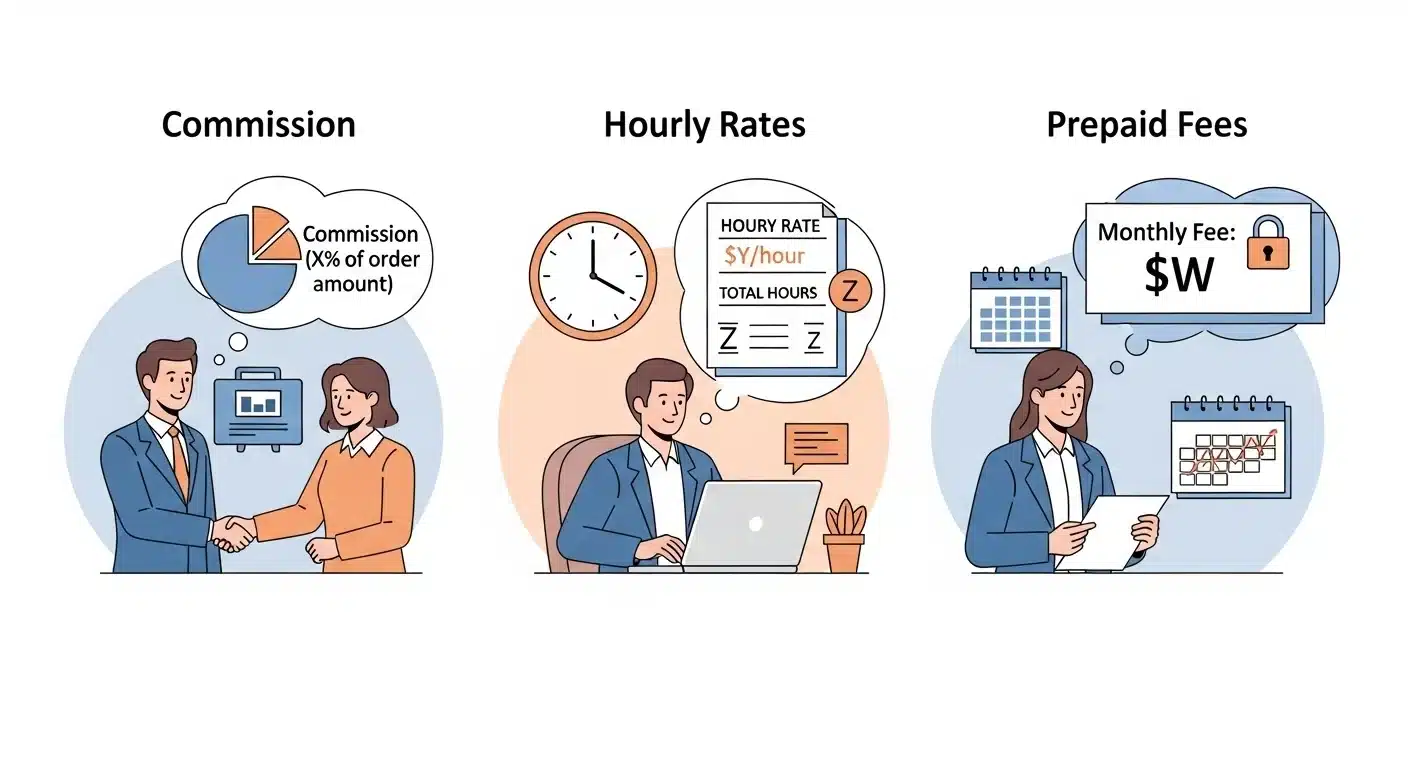
For ecommerce buyers, the safest fee model is the one that protects landed cost, not the one with the lowest headline rate. Transparency on commission basis, inclusions, and rebates matters more than the percentage itself.
Percent Commission
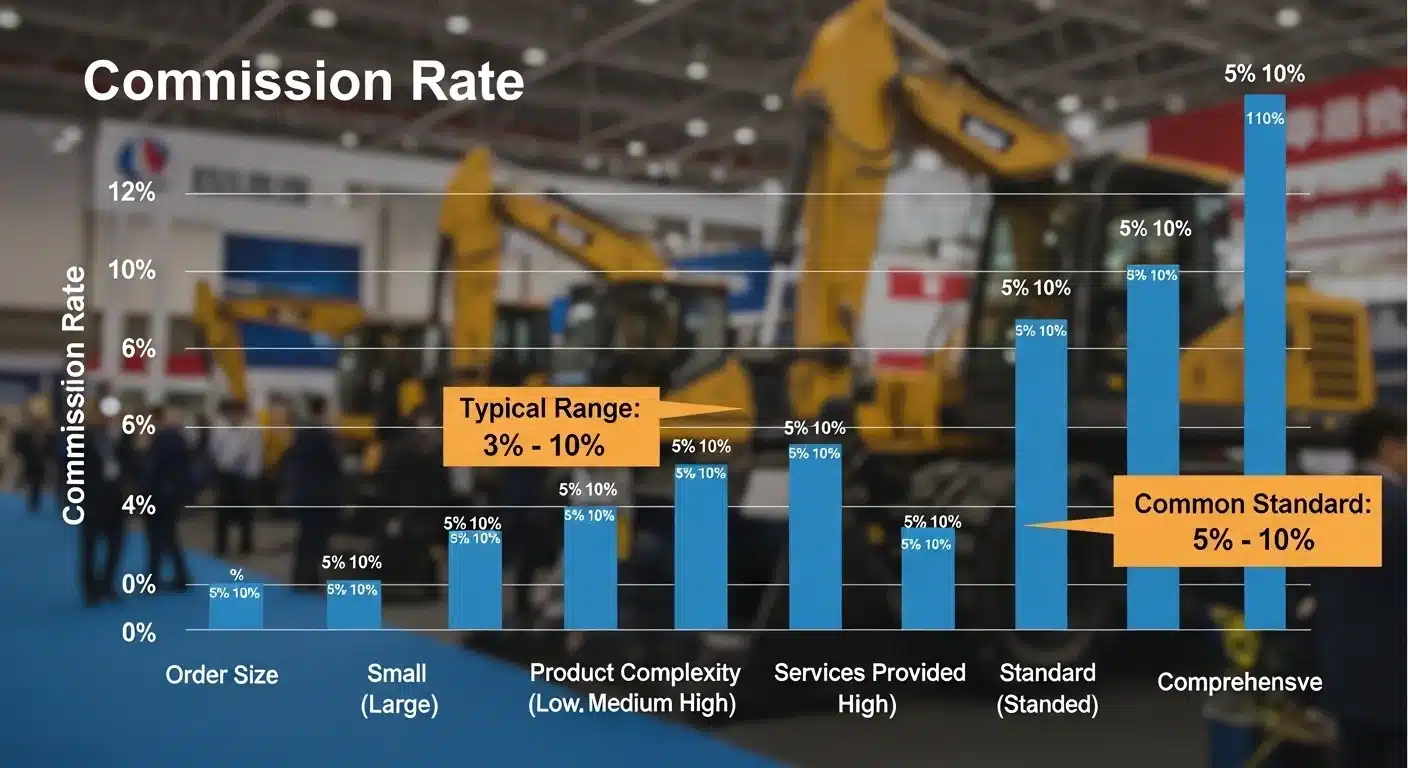
Percent commission is the common model in China sourcing. Typical sourcing agent commission runs from 3% to 10% of order value, and the rate usually rises when the order is small, complex, or requires more hands-on coordination. For ecommerce buyers, this model can work well when the supplier list is unclear and the agent is doing real sourcing, sample follow-up, and QC coordination.
The problem is simple: the percentage only looks cheap until you define the base. If the commission is calculated on EXW, FOB, or landed cost, the total changes a lot. We recommend asking for the exact base in writing, plus confirmation on whether sampling, inspection, consolidation, and customs support are included.
Flat Fee
Flat-fee sourcing is usually the cleanest pricing model for buyers who want control. In practice, it often ranges from about $500 to $3,000 per project, depending on scope and service depth. This model is easier to compare against agent commission vs fixed fee because the cost does not move with order size in the same way.
Flat fee works best when the project scope is clear: a defined product brief, a set number of supplier contacts, a known QC process, and a limited delivery timeline. It creates less incentive to pad the supplier price, which is exactly why many buyers prefer it for procurement risk management China.
Hybrid Pricing
Hybrid pricing mixes a smaller fixed fee with a lower commission rate. This is often the most practical structure for low MOQ sourcing risk because it gives the agent a base payment for work already done, while keeping the upside tied to order execution. It also gives ecommerce buyers more predictability when they are moving from sample to bulk consistency problem territory.
The hybrid model works best when the buyer wants both responsiveness and cost discipline. It is also the easiest model to scale if the agent agrees to cap the commission as order value grows. That cap matters, because a pure percentage model can become expensive fast once the order scales.
When Each Model Works Best
Use percent commission when the sourcing job is messy, the product is hard to match, and the agent is genuinely reducing search time. Use flat fee when the scope is fixed and you want transparent sourcing agent pricing with fewer surprises. Use hybrid pricing when you expect repeat orders, want a cleaner path to bulk, and need the model to stay efficient as volume rises.
- Percent commission: Best for complex sourcing, unclear supplier pools, and high-touch coordination.
- Flat fee: Best for defined scopes, repeatable work, and buyers who want predictable cost control.
- Hybrid pricing: Best for low MOQ orders that may scale into repeat purchases.
How Fees Scale and the Risks They Create
This is where many buyers get burned. A 2% difference in commission may look small, but on small-to-mid ecommerce orders it can wipe out a meaningful share of gross margin. The bigger risk is not the advertised fee itself; it is hidden factory kickbacks, silent markups, and supplier rebates that distort the real price.
We found that the lowest commission can still be the most expensive option if the agent is paid through undisclosed supplier incentives. That is why the right question is not how much do sourcing agents charge, but how the fee structure affects total landed cost, defect rate, and reorder reliability. If the model does not disclose rebates, markups, and volume-based incentives, the buyer is guessing.
- Percent commission risk: Can scale up quickly as order value rises, especially if the base is not defined clearly.
- Flat fee risk: Can under-serve complex projects if the scope is too broad or poorly specified.
- Hybrid risk: Can become expensive if the fixed part is high and the commission is not capped.
- Risco de custos ocultos: Supplier kickbacks, inspection gaps, and DDP shipping hidden costs can make a cheap fee structure look better than it really is.
What to Verify in Writing
Before you accept any agent commission rate China quote, lock down the scope in writing. Ask what the commission is based on, what services are included, and whether the agent receives any supplier rebates or markups. If the goal is warehouse delivery, ask for DDP shipping clarity too, because logistics ambiguity is where hidden costs multiply.
- Commission base: Confirm whether the fee is calculated on EXW, FOB, or landed cost.
- Included services: Sampling, inspection, consolidation, and customs support must be stated clearly.
- Disclosure: Require written disclosure of supplier rebates, markups, and volume incentives.
- QC checkpoints: Sample approval, pre-production check, inline inspection, and pre-shipment review should be defined.
- Âmbito da logística: Confirm whether DDP shipping is included or priced separately.
For ecommerce buyers, that checklist is what protects margin. If a sourcing agent will not answer those points directly, the fee structure is not transparent enough for serious procurement. That is usually the first warning sign in a Yiwu market sourcing guide search.

Real Cost Drivers
The real cost driver is not the headline commission. It is the fee base, service scope, and whether hidden rebates distort landed cost.
Order Value
Commission pricing looks small on paper, but the order value changes the math fast. A 5% fee on a $2,000 order is $100. On a $20,000 order, it is $1,000. For small ecommerce buys, that difference can wipe out margin if the agent is also charging for samples, inspections, or consolidation.
We recommend asking one direct question: is the commission capped, tiered, or flat? If the seller is pushing a percentage-only model on a low MOQ order, you are usually paying more for the same coordination work. That is where fixed-fee sourcing or a capped commission often protects profit better.
Product Complexity
Simple commodity orders sit near the low end of the 3% to 10% range. Complex products, custom packaging, multiple SKUs, or sample-to-bulk consistency problems move the fee up because the agent has to spend more time managing risk, checking specifications, and chasing factory alignment.
This is where cheap pricing can become fake savings. If an agent does not control color matching, packaging accuracy, or pre-shipment checks, the first bad bulk run can cost more than a higher commission ever would. For procurement risk management in China, the fee only matters if the output is consistent.
Service Scope
You need the scope in writing. The quote should say whether sampling, factory negotiation, china sourcing quality inspection, consolidation, customs support, and DDP shipping are included. If those items are excluded, a low commission is just a partial price.
We found that buyers get burned when the commission is tied to sourcing only, while logistics and QC are billed separately later. That structure makes comparison impossible. For ecommerce buyers, the correct comparison is total landed cost, not the advertised agent commission rate China.
Why 3% vs. 10%+ Pricing Happens
A 3% fee usually reflects simpler work, higher order value, or lighter support. A 10%+ fee is more common when the order is low volume, the product is technical, the buyer needs more hand-holding, or the agent is acting as a full-service China sourcing partner. The percentage alone does not tell you whether the quote is fair.
The bigger problem is misaligned incentives. A low commission can still be expensive if the agent is earning supplier kickbacks, silent markups, or undisclosed volume rebates. That is why transparent sourcing agent pricing matters more than a discount headline.
- Ask for written disclosure of supplier rebates, markups, and any volume-based incentives.
- Confirm whether the quote is based on FOB, EXW, or landed cost.
- Require QC checkpoints: sample approval, pre-production check, inline inspection, and pre-shipment review.
- If you sell ecommerce, push for tiered or capped commission as order volume scales.
This is the cleanest way to avoid low MOQ sourcing risk. A buyer who verifies the fee base and the incentive structure usually finds the real cost faster than a buyer chasing the lowest quoted percentage.
FOB Basis vs. Logistics-Inclusive Pricing
FOB basis pricing covers the goods up to the export port. Logistics-inclusive pricing, including DDP shipping, adds freight, duties, and delivery to the final warehouse destination. Those are not the same quote, and comparing them directly is a common mistake.
If you compare a 5% FOB-based commission with a 3% logistics-inclusive commission, you are not comparing like for like. The lower percentage may hide freight coordination, customs handling, or margin added inside shipping. For verified Yiwu suppliers, the only fair comparison is: what does the buyer pay, delivered and cleared?
- FOB basis: better for buyers who want separate control over freight and customs.
- Logistics-inclusive pricing: better when the goal is simpler warehouse delivery and fewer hidden costs.
- DDP shipping hidden costs: watch for handling fees, documentation charges, and destination surcharges.
- Best practice: compare total landed cost, then test whether the sample to bulk consistency problem is actually controlled.
If you only remember one thing, make it this: commission is a line item, landed cost is the business result. That is the filter that keeps margin intact when sourcing from Yiwu.
What to Verify Before You Sign
Do not approve a commission model until these points are written down. We recommend asking for the fee base, scope, QC ownership, logistics scope, and rebate disclosure in the same document. If the agent refuses, the pricing is not transparent enough for procurement risk management China.
- Fee basis: FOB, EXW, or landed cost.
- Included services: sampling, inspection, consolidation, and customs support.
- Commercial disclosures: supplier rebates, markups, and volume incentives.
- QC checkpoints: sample approval, pre-production, inline, and pre-shipment.
- Delivery terms: whether DDP shipping is included or billed separately.
| Cost Driver | What It Includes | Why It Matters | Buyer Impact | Related Keyword |
|---|---|---|---|---|
| Supplier verification and factory trust | Yiwu supplier verification, business license checks, factory audits, and legitimacy screening | Reduces fraud, misrepresented capacity, and weak supplier reliability | Protects cash flow and lowers the risk of failed orders | verified yiwu suppliers |
| Sample to bulk consistency | Pre-production sample approval, material matching, color tolerance, and defect control | Prevents the sample-to-bulk consistency problem that hurts resale quality | Protects margin by reducing returns, complaints, and replacement costs | sample to bulk consistency problem |
| Low MOQ sourcing risk | Small-order pricing premiums, limited negotiation use, and less stable production priority | Low MOQ orders often cost more per unit and can hide setup fees | Raises unit cost and makes it harder to reach target gross margin | low MOQ sourcing risk |
| China sourcing quality inspection | Inline QC, pre-shipment inspection, defect checks, and corrective action before shipment | Catches issues before goods leave China and avoids expensive after-sales losses | Improves defect rate, reorder reliability, and time saved on supplier communication | china sourcing quality inspection |
| DDP shipping hidden costs | Freight, customs clearance, duties, delivery charges, and unclear surcharge handling | A low quote can become expensive if DDP scope is incomplete or poorly defined | Keeps landed cost predictable and protects final margin | DDP shipping hidden costs |

Hidden Fee Risks
The lowest agent commission is not the safest deal. For small ecommerce orders, hidden kickbacks, silent markups, and unclear FOB or EXW bases usually cost more than the fee itself.
Factory Kickbacks and Undisclosed Supplier Rebates
Factory kickbacks are the most dangerous hidden cost because they distort the quote before you ever see the real price. An agent can advertise a low commission rate and still earn more through supplier rebates, supplier-paid incentives, or volume-based side deals.
We recommend asking one direct question: does the agent receive any payment, rebate, or non-cash benefit from the supplier? If the answer is unclear, the quote is not transparent enough for procurement risk management in China.
Markup Models That Quietly Erase Margin
A commission based sourcing agent fee is only useful if the commission base is defined. In practice, the base can be FOB, EXW, or even an inflated internal reference price, and that changes the final landed cost materially.
- FOB base: Commission is charged on the export price before international freight and destination handling.
- EXW base: Commission is charged on the factory gate price, which can look cheaper but may exclude pickup and export handling.
- Landed-cost base: Commission is tied to the full delivered cost, which is usually easier to compare for ecommerce margin planning.
- Silent markup: The agent adds margin inside the supplier quote instead of showing a clean fee line.
For buyers comparing agent commission vs fixed fee, the cheapest headline rate is often irrelevant. The real question is whether the quoted structure preserves margin after freight, inspection, consolidation, and destination charges.
Scope Creep: The Fee Looks Small Until the Work Expands
Scope creep is where a simple sourcing assignment turns into a moving target. Sampling, supplier communication, quality inspection, consolidation, customs support, and DDP shipping coordination can all become extra charges if they are not defined in writing.
This is why flat-fee sourcing often works better for buyers who need predictable cost control. Typical flat-fee sourcing ranges from about $500 to $3,000 per project, but only if the service scope is locked down before work starts.
FOB vs EXW vs Landed Cost Confusion
FOB, EXW, and landed cost are not just shipping terms. They change who pays for pickup, export handling, freight, customs support, and final delivery, which means they change your gross margin.
If the agent only quotes a commission percentage without stating the cost base, you cannot compare offers cleanly. That is where low MOQ sourcing risk gets worse, because small orders have less room to absorb hidden logistics fees.
How to Protect Margin on Small-to-Mid Ecommerce Orders
We found that the fastest way to reduce sourcing risk is to force every fee into one clean written structure. Ask for the commission rate, the commission base, any supplier rebates, and every service included in sampling, inspection, and logistics.
- Ask for disclosure: Require written confirmation of supplier rebates, hidden markups, and volume incentives.
- Define the base: State whether commission is calculated on FOB, EXW, or landed cost.
- Lock the scope: Clarify whether samples, QC checkpoints, consolidation, and customs support are included.
- Use QC checkpoints: Require sample approval, pre-production check, inline inspection, and pre-shipment review.
- Prefer capped pricing: For scaling ecommerce orders, a tiered or capped commission is easier to model than open-ended percentage fees.
For verified Yiwu suppliers, transparency beats a low advertised rate every time. If the model is clear, supports low MOQ, and makes DDP shipping hidden costs visible up front, the buyer can judge the real landed cost instead of guessing.


Margin Protection
Agent commission only matters if it protects landed cost and reorder margin. A low headline fee is useless when hidden markups, rebate deals, or DDP charges erase the savings.
Landed Cost Comes First
For ecommerce buyers, the real number is not the commission rate. It is the full landed cost after product price, sampling, inspection, freight, customs support, and delivery are all added in.
That is why commission base matters. Ask whether the fee is calculated on EXW, FOB, or landed cost, because the same percentage can produce very different economics depending on the base.
MOQ Pressure And Cash Flow
Low MOQ sourcing can look affordable and still strain cash flow. If the agent pushes frequent samples, rework, or split shipments, the buyer pays more before the first bulk order is profitable.
We recommend treating commission as part of working capital planning. On small-to-mid orders, even a 2% fee difference can wipe out a large share of margin if the order is already tight.
How Commission Affects Gross Margin And Reorder Economics
Typical sourcing agent commission ranges from 3% to 10% of order value. Higher rates are common when the order is complex, low volume, or requires heavy coordination across supplier verification, sample approval, and quality control.
- 3% to 10% commission: Common for commission based sourcing agent fees, but the base must be defined clearly.
- $500 to $3,000 flat fee: Often better for buyers who want predictable cost and clean comparison against agent commission vs fixed fee.
- $50 to $100 hourly support: Usually fits advisory, audit, or short-term sourcing tasks, not full order management.
- Reorder impact: A fee that looks small on the first order can become expensive if it raises the unit cost on every repeat purchase.
The hidden trap is incentive misalignment. A low commission can still cost more if the agent is paid through undisclosed supplier kickbacks, silent markups, or volume rebates that never show up in the buyer’s quote.
Tiered Or Capped Pricing Protects Scale Margins
For growing ecommerce brands, tiered or capped commission usually protects scale better than a flat percentage forever. Once order values rise, a capped structure prevents the sourcing fee from eating the gains from larger buys.
This is especially useful when working with verified Yiwu suppliers and DDP shipping. You want transparent pricing that supports low MOQ sourcing risk without turning every reorder into a margin leak.
What To Verify In Writing Before You Pay
If you want procurement risk management in China, insist on a written fee scope. We recommend asking for full disclosure on what the commission includes and what gets billed separately.
- Fee base: Confirm whether the commission is based on EXW, FOB, or landed cost.
- Fee scope: Confirm whether sampling, inspection, consolidation, and customs support are included.
- Rebate disclosure: Require written disclosure of supplier rebates, markups, and volume-based incentives.
- QC checkpoints: Ask for sample approval, pre-production check, inline inspection, and pre-shipment review.
- DDP clarity: Confirm what is included if the goal is simplified warehouse delivery and fewer hidden costs.
That checklist is not busywork. It is how buyers avoid sample-to-bulk consistency problems, reduce China sourcing quality inspection risk, and stop a low headline fee from becoming an expensive sourcing mistake.
Lista de controlo do comprador
Lista de controlo do comprador
Before you compare agent commission, define the fee base, demand rebate disclosure, and assign QC and DDP responsibility in writing. That is how you protect margin on a small-to-mid ecommerce order.
The cleanest sourcing agent fee structure is the one you can audit. A 3% commission can be cheaper than a flat fee, or more expensive, depending on whether it is calculated on FOB, EXW, or landed cost, and whether sampling, inspection, consolidation, and customs support are included. We recommend asking these questions before you sign anything.
Quick comparison for buyers
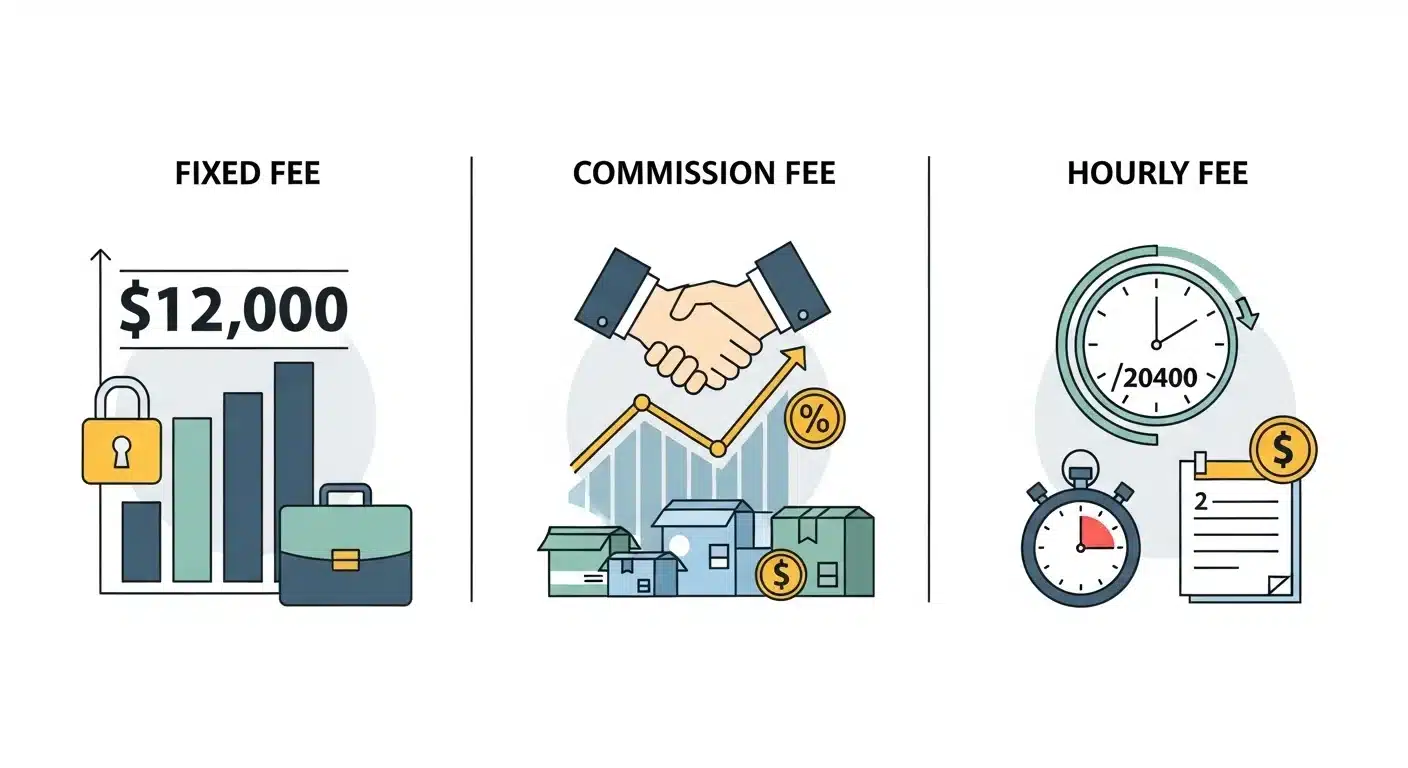
- Commission model: Usually 3% to 10% of order value; can work well if the base is clearly defined and incentives are disclosed.
- Flat fee model: Commonly about $500 to $3,000 per project; better when scope is fixed and you want predictable cost.
- Hourly support: Often about $50 to $100 per hour; useful for advisory, audit, or short-term procurement risk management China tasks.
Ask These Questions
Start with the questions that expose hidden cost layers. If an agent cannot answer these clearly, the quote is not transparent enough for ecommerce buying.
- What is the commission base: FOB, EXW, or landed cost?
- Are supplier rebates, markups, and volume-based incentives disclosed in writing?
- Does the fee include sampling, QC, consolidation, and customs support, or are those billed separately?
- Who owns sample approval, pre-production check, inline inspection, and pre-shipment review?
- If DDP shipping is offered, what exactly is included and what can still be billed later?
The key issue is incentive alignment. A low headline commission can still produce a worse total landed cost if the agent is paid through undisclosed supplier kickbacks or silent markups. We found that this is where most novice buyers lose margin, not on the visible fee itself.
Set Fee Terms
Lock the pricing model before the search starts. For small orders, a capped commission or a fixed fee is usually easier to compare against gross margin targets than an open-ended percentage.
- Use a written fee base so the commission cannot shift later.
- Require a cap if the order may scale across reorders.
- Separate sourcing fees from sampling and logistics charges.
- Ask for a side-by-side quote showing commission vs fixed-fee alternatives.
For ecommerce buyers, the real comparison metric is total landed cost, not headline commission percentage. If a 2% fee difference erases most of your profit buffer, the cheaper-looking quote is not cheaper.
Verify Support
Support matters because fee structure and execution are tied together. If the agent does not cover supplier verification, china sourcing quality inspection, and coordination across sampling and production, you are paying for introductions only.
- Confirm verified Yiwu supplier screening is part of the service.
- Ask for sample-to-bulk consistency controls to reduce the sample to bulk consistency problem.
- Require documented QC checkpoints before shipment.
- Check whether the agent can handle low MOQ sourcing risk without pushing you into unnecessary volume.
A support gap usually shows up after the sample is approved. If the agent is weak on QC or supplier follow-through, you end up paying twice: once in fees and again in defects, delays, or rework.
Commission basis and supplier rebate disclosure
This is the non-negotiable part. Demand written disclosure of every rebate, markup, and incentive tied to the supplier relationship.
- State whether commission is calculated on EXW, FOB, or landed cost.
- Ask whether the agent receives any supplier rebate or factory kickback.
- Require disclosure of any hidden markups on product price, packaging, or freight.
- Prefer transparent pricing over a low advertised rate with unclear economics.
Hidden factory kickbacks can make a seemingly low commission materially more expensive than a transparent fixed-fee engagement. That is why commission transparency is a procurement risk management china issue, not just a pricing issue.
Sampling, QC, and DDP/shipping responsibility
Write down who owns each step from sample to warehouse delivery. If the scope is vague, the buyer absorbs the delays and the surprise costs.
- Sampling: confirm who pays for sample procurement, domestic shipping, and sample revisions.
- QC: confirm sample approval, pre-production check, inline inspection, and pre-shipment review.
- Shipping: confirm whether DDP shipping is included and whether customs, duties, and final-mile delivery are covered.
- Responsibility: define what happens if defects appear after inspection or during transit.
If the goal is simplified warehouse delivery, DDP shipping must be explicit, not implied. The best sourcing-agent cost structure for small orders is the one that protects landed cost, clarifies QC ownership, and removes ambiguity before money moves.
Conclusão
I would take a transparent commission model over a cheap-looking fixed fee that hides rebates. A 3% to 10% charge is normal, but the real test is whether the base is FOB, EXW, or landed cost, because that choice changes your margin fast.
Ask for the commission in writing, plus sample costs, inspection checkpoints, and any supplier rebate disclosure. Then compare that quote against one flat-fee option using the same order size and DDP shipping terms, so you can see the true landed cost before you commit.
Perguntas mais frequentes
How much commission do sourcing agents charge?
Most sourcing agents charge about 3% to 10% of the order value. For simple repeat orders, rates can sit near the low end; for complex or low-volume sourcing, the fee is usually higher.
O que é a comissão de sourcing?
Sourcing commission is the fee an agent earns for finding suppliers, negotiating prices, managing communication, and often coordinating quality control or shipping. It should be clearly tied to a defined base such as FOB order value.
O que significa a taxa de agência 20%?
It means the agent charges 20% of the value they manage, which is significantly above the common sourcing range. For buyers, that level usually signals either a specialized service scope, a different industry model, or a pricing structure that needs closer review.
How much do sourcing agents make?
Income varies widely by market, deal size, and service model. In sourcing, what matters more than salary benchmarks is whether the agent’s fee structure creates alignment with your target price, quality standard, and delivery timeline.
What are the red flags in a modeling contract?
In sourcing terms, the red flags are vague fee bases, hidden supplier rebates, unclear ownership of samples, no QC scope, and no written delivery terms. If the contract does not define how the agent gets paid, the buyer may absorb unexpected cost inflation.