Justin
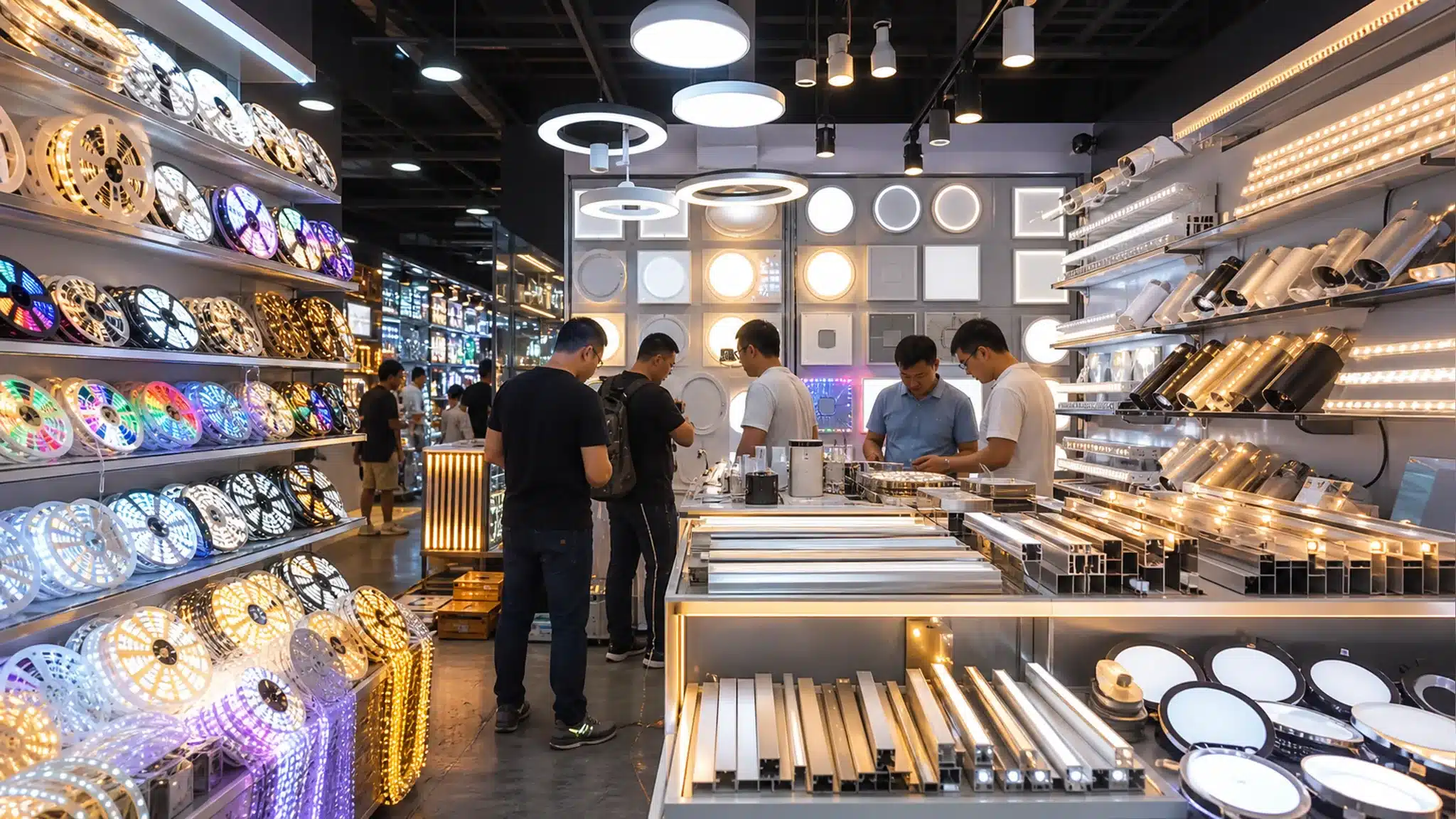
Buying wholesale LED strip lights from China looks like the easiest sourcing decision you’ll ever make: the product is cheap, the suppliers are everywhere, and every reel photo looks identical. That’s exactly the trap. Two reels quoted at $0.90 and $2.40 a meter can look the same on a screen and behave completely differently on a wall — one holds its color for years, the other shifts pink and dims by a third inside eighteen months. The gap isn’t luck; it’s spec, and spec is invisible unless you know which numbers to read. This guide is the operator’s version: how to decode a strip’s real quality, which US and EU compliance marks actually gate your shipment, and what the 2026 tariff math does to your landed cost — so you buy the reel that survives, not the one that photographs well.
“LED strip lights wholesale” also isn’t one product. It spans flexible SMD tape, high-density COB strip, addressable RGB, and the rigid fixtures buyers add to the same order — panels, downlights and linear tubes. Each has a different spec language, a different certification path, and a different HTS code at customs. Below, we take them in the order that actually protects your margin: what you’re buying, how to judge it, what it must be certified to, and what it truly costs to land.
Inside a Chinese factory: how COB LED strip lights are actually made — the FPC, the SMD line, and the free-cut points.
Key Takeaways
- Price tracks spec, not markup. LED density (LEDs/m), chip type (2835 vs 5050 vs COB), CRI, copper weight and the driver are where cost — and quality — actually live. A cheap strip usually cut one of them.
- Two numbers separate good from junk: CRI ≥90 with R9 >0 for color accuracy, and SDCM ≤3 (3-step MacAdam binning) so reel-to-reel color actually matches. Most bottom-tier strips are CRI 70–80 and unbinned.
- Certification gates your shipment, not just your conscience. For the US, LED strip systems are evaluated to UL 8750 / UL 2108 / UL 1598 and the driver needs an FCC Part 15B declaration. For the EU it’s CE + Ecodesign (EU) 2019/2020, an energy label, and EPREL registration.
- 2026 duty reality: finished LED luminaires classify under HTS 9405.42; base duty runs about 3.9% plus Section 301 List 3 at 25% — roughly a 29% stack on Chinese-origin goods. The temporary 10% Section 122 surcharge lapsed by law on 24 July 2026.
- Direct-from-China wins on volume and spec control, but for a few cartons of a regulated product, a distributor or an agent-managed order often beats flying blind on certification.
What “wholesale LED strip lights” actually covers
Suppliers lump a lot under one keyword. Before you compare prices, pin down which product you’re actually quoting — the spec sheet, the certification, and the customs code all change with it. The four families below cover the overwhelming majority of what a China lighting supplier sells as “strip”:
| Type | What it is | Best for | Watch out for |
|---|---|---|---|
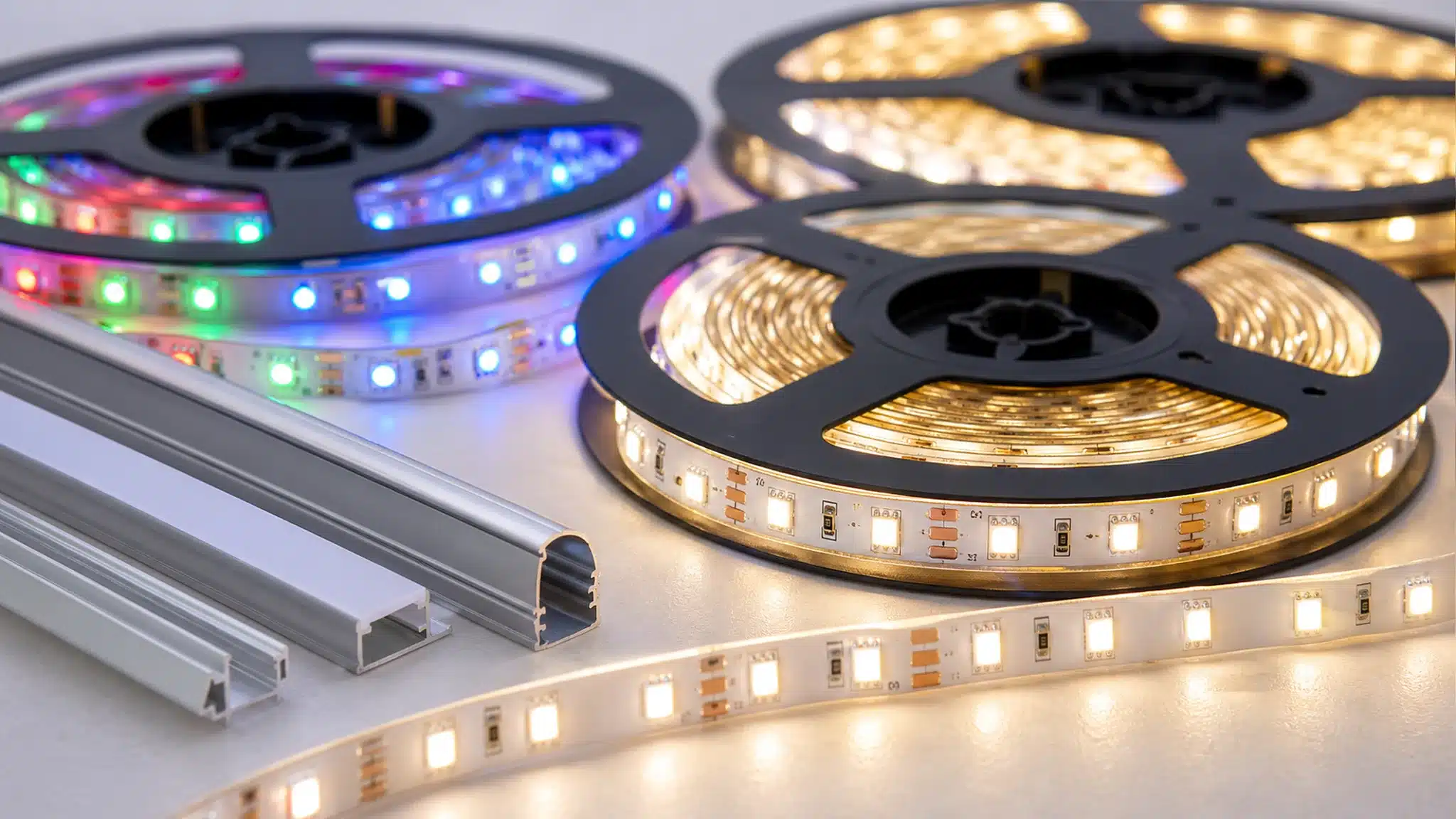
| SMD tape (2835 / 5050) | Discrete surface-mount LED chips on a flexible PCB; the classic “strip” | Cove lighting, signage, general accent; the volume workhorse | Visible “dots” at close range; low-density versions look spotty |
| COB strip | Chip-on-board — a continuous line of tiny LEDs under phosphor, no visible dots | Premium, dot-free lines; retail, hospitality, close-viewing installs | Runs hotter per meter; thermal management and copper weight matter more |
| Addressable RGB / RGBW / RGBIC | Per-pixel controllable strip (WS2812/SK6812 class ICs) | Gaming, entertainment, “smart” retail; higher price and margin | Controller/protocol compatibility; clone ICs that fail early |
| Rigid fixtures (add-ons) | LED panels, downlights, linear tubes, aluminum-channel profiles | Rounding out a lighting order; higher unit value than tape | Different HTS lines and often stricter safety certification |
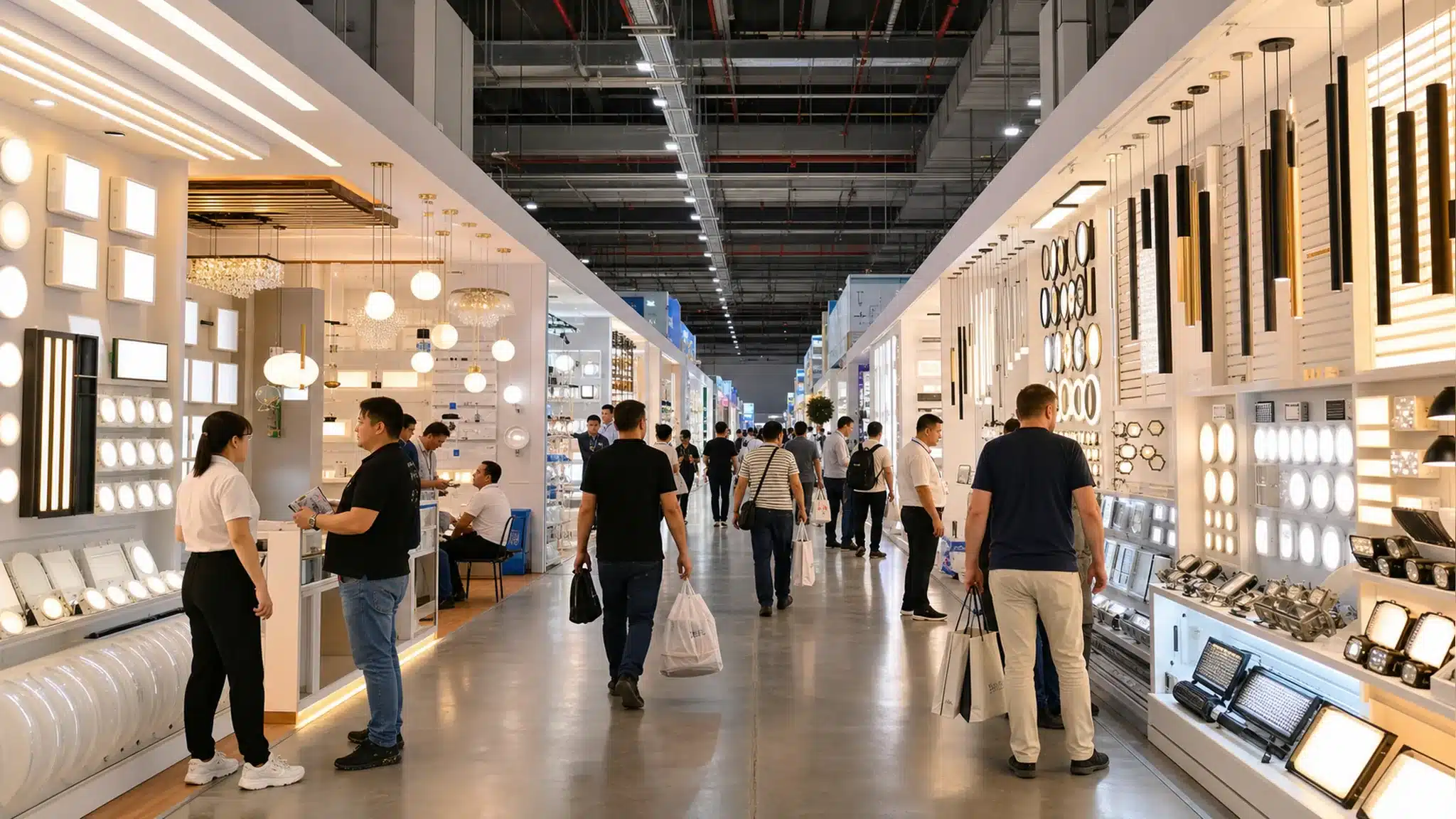
If you’re building a broader lighting catalog rather than one SKU, it helps to see where strip sits inside the wider China sourcing map — our complete guide to China’s wholesale markets covers which cities and platforms lead each product family, and Yiwu’s electronics-and-lighting zone is walked in the Yiwu electronics sourcing guide.
How to read an LED strip spec sheet (the anti-junk decoder)
This is the section that separates a buyer who gets burned from one who doesn’t. Every complaint you’ll ever hear about cheap Chinese strip — “it changed color,” “it dimmed,” “the ends were darker than the middle” — traces back to a spec line the buyer never checked. Here’s what each number means and where corners get cut.
Color quality: CRI, R9 and binning
CRI (Color Rendering Index) measures how faithfully the light shows color, on a 0–100 scale. Bargain strips are often CRI 70–80; a serious strip is CRI ≥90, and you want R9 >0 (ideally >50) because R9 is the deep-red value that makes skin and food look right — it’s the first thing cheap phosphor drops. There’s an honest trade-off here: pushing CRI above 90 broadens the spectrum and typically costs 10–15% of peak efficacy versus a CRI-80 strip, so a premium strip is both dimmer per watt and dearer. That’s physics, not a supplier scam — but it’s why a “CRI 90, super-bright, super-cheap” quote is usually two of those three at best.
Then there’s binning, the spec buyers skip and regret. Color consistency is measured in SDCM (Standard Deviation of Colour Matching), expressed as MacAdam “steps”: SDCM ≤3 means reel-to-reel color differences are barely perceptible; unbinned or ≥5-step strip will show visibly mismatched whites when you butt two reels together on the same ceiling. For reference, the ANSI C78.377 white-color standard defines its chromaticity quadrangles at roughly a 7-step ellipse — so “meets ANSI” is a floor, not a promise of tight matching. Always ask for the SDCM figure in writing.
Density, chip and the PCB underneath
LED density (chips per meter — 60, 120, 240, or COB’s continuous line) drives both brightness and how “dotty” the strip looks. Low-density tape is cheaper and fine hidden in a channel, but it looks spotted on a visible edge. The spec that’s easiest to hide is the copper weight of the flexible PCB: a 2oz-copper board carries current and sheds heat far better than a thin 1oz board, which is where voltage drop and early failure start. Ask for copper weight and PCB width — a supplier who won’t answer is telling you something.
Voltage, efficacy and lifespan
Quality strip runs at 12V or 24V DC; 24V generally suffers less voltage drop over a run, so long lengths stay even end-to-end. Efficacy (lumens per watt) is the honest efficiency number — good high-CRI strip lands around 100–120 lm/W under proper thermal management; a strip that claims huge brightness at low wattage is usually overdriving cheap chips, which shortens life. For lifespan, the credible claim is backed by LM-80 test data and quoted as an L70 figure (hours until output falls to 70% — e.g. L70 > 30,000h). “50,000 hours” with no LM-80 behind it is marketing.
Finally, the IP rating (ingress protection, per IEC 60529) tells you where the strip can live, and buyers routinely over- or under-buy it. IP20 is bare, dry-indoor tape — fine inside an aluminum channel, wrong anywhere damp. IP65 adds a silicone coating that’s dust-tight and survives low-pressure water jets — the sensible default for kitchens, bathrooms and covered outdoor runs. IP67 withstands temporary immersion (roughly 1m for 30 minutes) for genuinely wet or in-ground use. Higher IP costs more and dims slightly through the coating, so spec the grade the install actually needs rather than the highest number on the sheet.
| Spec | Economy strip | Mid tier | Premium / spec-grade |
|---|---|---|---|
| CRI / R9 | 70–80 / unstated | 80–90 / R9 >0 | ≥90 / R9 >50 |
| Binning (SDCM) | Unbinned / ≥5-step | ≤4-step | ≤3-step |
| PCB copper | 1oz, narrow | 1.5–2oz | 2oz, wide trace |
| Efficacy | Overdriven, unstated | ~90–110 lm/W | 100–120 lm/W, thermally managed |
| Lifespan proof | Marketing hours | Stated L70 | LM-80 data + L70 |
The buyer’s move: put every one of these on the purchase spec in writing, then confirm the received goods against it with a sample burn-in and a third-party check — the same discipline our AQL inspection guide lays out for any product category.
The compliance moat: what your market legally requires
This is where importers who did their homework quietly beat the ones who chased the lowest price. LED strip is an electrical product, and the destination market — not the supplier — sets the certification it must carry. Buy uncertified goods and you’re not just risking a customs hold; you’re taking on product-liability exposure the moment they’re installed. The two big markets diverge:
| Requirement | États-Unis | European Union / UK |
|---|---|---|
| Electrical safety | UL/ETL listing to UL 8750 (LED equipment), UL 2108 (low-voltage systems), UL 1598 (luminaires) as applicable | CE marking under the Low Voltage Directive + relevant EN/IEC standards; UKCA for Great Britain |
| Electromagnetic (EMI) | FCC 47 CFR Part 15 Subpart B — driver is an unintentional radiator; usually a Supplier’s Declaration of Conformity (SDoC) | EMC Directive (CE) |
| Energy / efficiency | Voluntary: ENERGY STAR, DLC (needed for most utility rebates). California Title 20 mandatory; Title 24 JA8 for new-build/remodel | Mandatory: Ecodesign (EU) 2019/2020 + energy label (EU) 2019/2015; EPREL database registration |
| Substances | RoHS (state-level), California Prop 65 warning exposure | RoHS 2011/65/EU, REACH |
Three things matter operationally. First, UL 8750 is the safety standard for the LED equipment itself — the modules, arrays, controllers and drivers — and it’s used in combination with UL 1598 when a finished luminaire is certified; a strip system typically also touches UL 2108 for the low-voltage side. Second, the FCC obligation lands on the importer: under 47 CFR Part 15 Subpart B the responsible party (which can be you) must be able to show the driver meets the emission limits, normally via an SDoC rather than full certification. Third, in the EU an importer must register the product in the EPREL database and supply the energy label before placing goods on the market — a step that catches first-time importers who assumed “CE on the box” was the whole job.
On quality bands: ENERGY STAR expects CRI ≥80 with R9 ≥0; California Title 20 requires CRI ≥82 for covered lamps; and Title 24 JA8 high-efficacy demands CRI ≥90, low flicker and dimmability for residential new construction. Match the certification to where the goods will actually be sold and installed — a strip fine for a hobbyist on Amazon may be illegal to spec into a California remodel.
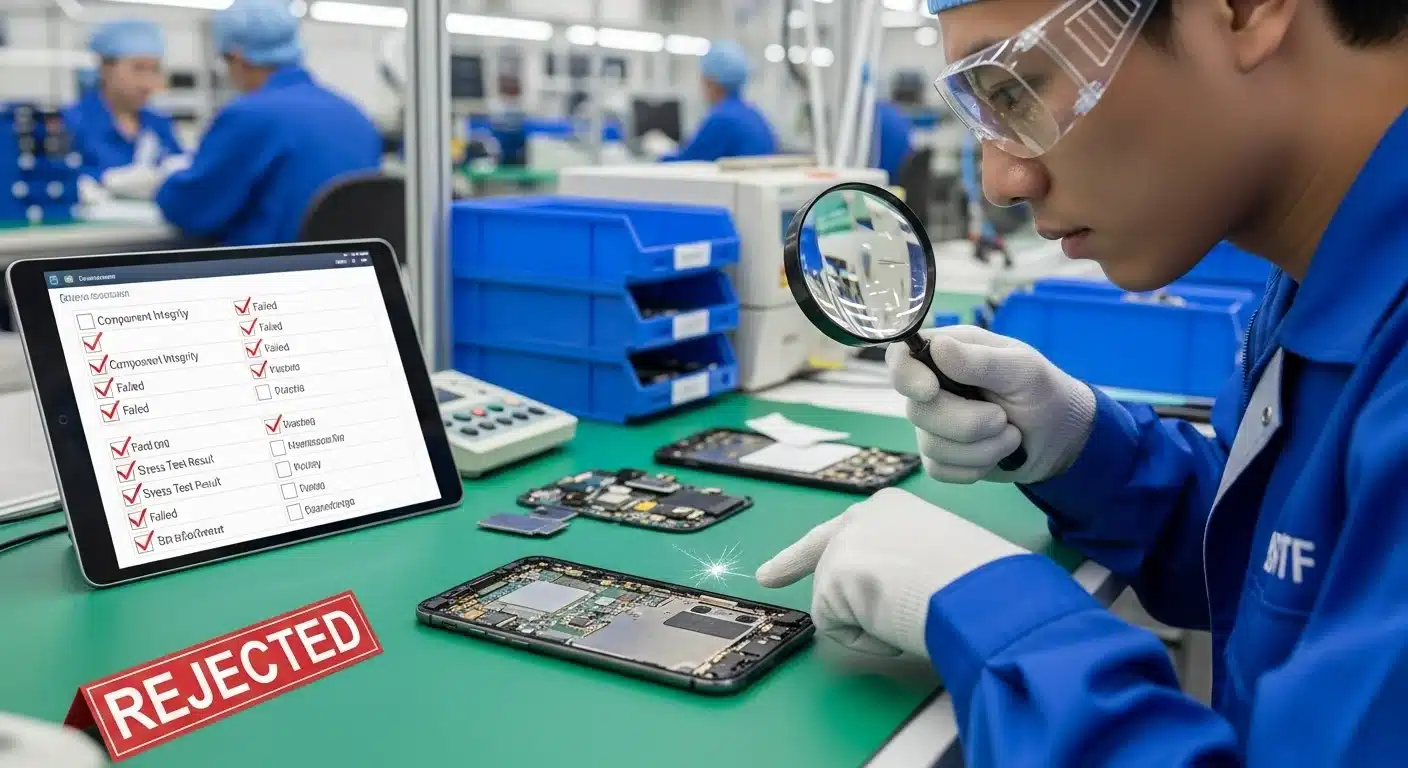
The certificate trap: a UL or CE logo printed on a reel means nothing on its own. Ask for the certificate number and the test report, then verify the number against the issuing body’s public database. Plenty of Chinese lighting suppliers hold genuine listings — but the file often covers one specific model, not the cheaper variant they’re quoting you. Confirm the certified model is the model you’re buying.
The 2026 landed-cost and tariff reality
The sticker price per meter is the smallest part of what a reel actually costs you. For US buyers, three tariff facts define the real math in 2026, and they’ve moved this year:
Classification. Finished LED luminaires and lighting fittings designed to work solely with LED sources classify under HTS heading 9405.42; LED lamps/bulbs sit under 8539.52. The exact 10-digit line — and the base duty — depends on the product and material, so confirm yours on the official USITC Harmonized Tariff Schedule before you commit. Base (MFN) duty on common LED luminaire lines runs around 3.9%, with some lines free.
Section 301 is the big one, and it survived. Most Chinese-origin lighting under heading 9405 carries a Section 301 List 3 additional tariff of 25%, stacked on the base duty — so a typical LED fixture lands near a ~29% combined rate. The Federal Circuit upheld Lists 3 and 4A on 25 September 2025, and the February 2026 Supreme Court ruling that struck down the separate IEEPA tariffs did not touch Section 301 — a different legal authority. In other words, the “China tariff” most lighting importers actually pay is still fully in force.
The temporary surcharge just lapsed. A 10% Section 122 global surcharge applied to virtually all imports from 24 February 2026; by its own 150-day statutory limit it expired by operation of law at 12:01 a.m. ET on 24 July 2026, and the President can’t extend it unilaterally. But watch the replacement: USTR has proposed a new Section 301 action (from its forced-labor investigation) that would apply roughly 10–12.5% to dozens of countries — including China at 12.5%, potentially stacked on the existing 25% — timed to fill the gap the Section 122 surcharge leaves. Unlike Section 122, a Section 301 measure has no rate cap and no 150-day clock. As of late July 2026 it was proposed, not finalized, so if you’re filing entry right after this guide publishes, confirm both that Section 122 has lapsed and whether the new 301 layer has taken effect for your entry date — this is the one line most likely to have changed the week you read this.
A worked landed-cost example
Say you order 3,000 meters of 24V CRI-90 strip at a market price of $1.80/m. Here’s what actually lands in your warehouse (figures illustrative — run your own HTS line and freight lane):
| Cost line | Amount | Note |
|---|---|---|
| Goods (3,000 × $1.80) | $5,400 | FOB / market price |
| Base duty (illustrative ~3.9%) | ~$211 | Depends on your exact HTS code |
| Section 301 List 3 (25%) | ~$1,350 | Stacks on the base duty |
| Ocean freight + consolidation (LCL est.) | ~$600 | Varies by lane and season |
| Agent commission / inspection | ~$300 | If using a sourcing agent |
| Landed cost | ~$7,861 → ~$2.62/m | ~46% above the sticker price |
The lesson is the same one that catches every first-time lighting importer: the 25% Section 301 line, not the freight, is what moves your break-even — so a $0.20/m saving on a junk reel is meaningless if it fails inspection or arrives uncertified. Our landed-cost formula guide gives you the full worksheet, and the HS-code strategy guide helps you classify a mixed lighting container correctly.
China-direct vs. a distributor: which fits you
Sourcing strip straight from China isn’t automatically right. It rewards volume and spec control and punishes small, one-off, compliance-heavy buys. Match yourself honestly to a column:
Best for buying direct from China
- You order in the thousands of meters or reels, or reorder regularly
- You need a specific spec (CRI 90, 24V, tight binning) a distributor won’t stock
- You want private-label or custom length/PCB and can commit to an MOQ
- You can verify certification yourself or through an agent on the ground
Better off with a distributor / agent-managed buy
- You need a few cartons — freight and 25% duty erase the unit saving
- The product must be UL-listed and spec’d into a code-regulated install
- You can’t verify certificates or run a sample burn-in remotely
- You need it in weeks, not the 4–8 of production plus ocean transit
The middle path most volume buyers land on: source direct for price and spec, but route the order through someone who can vet the factory and verify the listing. That’s the gap between a cheap reel and a reel you can legally sell.
How to source LED strips from China without getting burned
The mechanics are the same whether you buy in a lighting market or on a platform. Every step below exists because a buyer once skipped it and paid for it.
- Separate factories from traders. Many “manufacturers” are middlemen. A real strip factory can talk copper weight, binning and LM-80 data without stalling; a trader forwards your question and adds a margin. Our guide on factory vs. trading company sourcing shows how to tell them apart. For the domestic-price route, sourcing on 1688 reaches the factories directly — through an agent.
- Write the spec, then order a sample and burn it in. Put CRI/R9, SDCM, density, copper weight, voltage, IP rating and L70 in writing. Then run the sample lit for days, not minutes — color shift and early dimming show up under heat, not in a 30-second demo.
- Verify the certification, not the logo. Get the UL/CE certificate number and test report, confirm it in the issuing database, and confirm it covers the exact model you’re buying.
- Negotiate MOQ and terms. Strip MOQs flex, especially if you consolidate colors or commit to reorders. Our supplier negotiation guide covers the levers.
- Inspect before the balance. A pre-shipment check against your written spec — measuring lumens, checking bin codes, powering a full reel — is the one moment you still hold payment leverage.
- Consolidate and ship. Combine strip, fixtures and drivers into one shipment and plan the customs entry around your HTS lines. The shipping methods and costs guide lays out FCL vs. LCL vs. air.
Nearly every step here is verification you can’t do from another continent — reading a real factory from a trader, judging a burned-in sample, confirming a listing, catching a bin mismatch before the balance clears. That on-the-ground layer is exactly what a Yiwu sourcing agent provides, and if you’re building a lighting line rather than buying one reel, our product sourcing service handles the factory vetting, certification checks and consolidation end to end. For deep electronics-and-lighting supply specifically, Yiwu’s District 2 hardware and electronics zone is the place to walk.

Putting it together
Wholesale LED strip lights reward the buyer who reads the spec sheet and the rule book, not the one who chases the lowest per-meter quote. Lock the numbers that decide quality — CRI ≥90 with R9, SDCM ≤3, real copper weight, 24V, LM-80-backed L70 — get them in writing, and verify them with a burned-in sample and a certificate check. Match the certification (UL 8750/2108/1598 + FCC for the US; CE + Ecodesign and EPREL for the EU) to where the goods will actually sell. Then run the 2026 landed-cost math, where a 25% Section 301 line, not freight, sets your break-even. Do that, and direct-from-China strip beats a distributor decisively on volume. Skip it, and the savings vanish into failed inspections, customs holds and reels that shift color on the wall.
Sourcing LED strip lights from China and want the spec and certification checked before you pay?
We’re on the ground in Yiwu — we vet the factory, verify the UL/CE listing covers your exact model, run a sample burn-in, and consolidate strip, drivers and fixtures into one entry. Transparent commission, no hidden markup.
Frequently asked questions
What specs actually separate good LED strip from cheap junk?
Five numbers: CRI (aim for ≥90) with R9 above 0 for color accuracy; SDCM binning of 3 steps or fewer so reels match; LED density suited to the install; copper weight of the PCB (2oz beats 1oz for heat and voltage drop); and an LM-80-backed L70 lifespan figure. A strip that won’t state these — especially copper weight and SDCM — is usually hiding a corner it cut.
What certification do LED strip lights need to sell in the US?
For electrical safety, a UL or ETL listing evaluated to UL 8750 (LED equipment), UL 2108 (low-voltage systems) and/or UL 1598 (luminaires) as applicable. The driver also needs to meet FCC Part 15 Subpart B emission limits, normally via a Supplier’s Declaration of Conformity for which the importer can be the responsible party. Energy programs like ENERGY STAR and DLC are voluntary but often needed for rebates, and California adds Title 20 and Title 24 (JA8) rules. Always verify the certificate number covers the exact model you’re buying.
What is the import duty on LED lights from China in 2026?
Finished LED luminaires generally classify under HTS heading 9405.42, with a base (MFN) duty around 3.9% on common lines (some free). On top of that, most Chinese-origin lighting under heading 9405 carries a Section 301 List 3 additional tariff of 25%, for roughly a 29% combined rate. Section 301 survived the February 2026 Supreme Court ruling on IEEPA tariffs, and the temporary 10% Section 122 surcharge expired on 24 July 2026. Confirm your exact 10-digit code and current rates on the USITC Harmonized Tariff Schedule before filing.
Is 12V or 24V better for wholesale LED strip?
24V is generally the better choice for longer runs because it suffers less voltage drop, so brightness stays even from one end of the strip to the other. 12V is fine for short lengths and some automotive or battery applications. Either way, match the driver’s wattage to the strip’s load with headroom, and confirm the strip’s stated voltage on the spec sheet rather than assuming.
What is a good MOQ for LED strip lights from a China supplier?
MOQs vary widely. Strip ships on reels — 5m is the standard reel, with 10m and 20m options — and a stock SMD strip may sell from a few hundred meters, while custom COB, custom PCB, custom color temperature or private-label runs push minimums into the thousands of meters. MOQs are negotiable, especially if you consolidate colors or commit to reorders. Also confirm the cut interval (strip can only be cut at marked points, often every 25–100mm), since it limits how you can size runs. Order and burn-in a paid sample before any volume commitment, and price the sample as cheap insurance rather than a cost.
Do I need to visit China to buy LED strip lights wholesale?
No. Many buyers never travel — you can source online via 1688 or Alibaba, or use a sourcing agent who inspects the factory, verifies certification, runs a sample burn-in, and consolidates your shipment. Visiting helps for large or spec-sensitive orders and for building supplier relationships, but the verification steps that protect you can all be done on your behalf by someone on the ground.