Justin
The percentage at the top of your agent’s quote is the least informative number in the whole arrangement. Two agents can both say “5%” and one of them costs you materially more, because the percentage tells you nothing about what it is calculated on, what it excludes, or whether a second payment is moving from the factory to your agent on the same order.
That second payment is the part most buyers never price. A commission paid to an intermediary is perfectly lawful in China — but only under conditions that are written into the statute, and that most fee conversations never test. This guide consolidates what China Yiwu previously published across several separate pages on agent commission, flat-rate pricing, retainers and kickbacks into one reference: what the three fee models actually buy, what rates are normal at your order size, the arithmetic that decides between them, and the legal test that separates a commission from a bribe.
Key takeaways
- Three models, three risk transfers. Commission ties the agent’s income to your spend. A flat fee makes the cost predictable and the effort finite. A retainer buys capacity. They are not three prices for one service.
- Published rate cards cluster at 3%–10% of FOB value, falling as order value rises. China Yiwu’s own published tiers are 5% up to USD 5,000, 3% from USD 5,001–50,000, and 1–2% above USD 50,000.
- The calculation base matters more than the rate. A 5% commission on FOB and a 5% commission on CIF are different numbers, and the gap grows with freight.
- The legal line is documentary, not moral. Under Article 8 of China’s amended Anti-Unfair Competition Law, in force since 15 October 2025, a commission to an intermediary is lawful when it is paid openly and recorded truthfully in both parties’ account books. Money that fails either condition is commercial bribery.
- Since the 2025 amendment the recipient is liable too, not only the payer — with fines of CNY 100,000 to CNY 1,000,000, rising to CNY 1,000,000–5,000,000 in serious cases.
- Run the break-even yourself. The commission-versus-retainer crossover depends on your own volume and quoted rate; any universal threshold you read is someone else’s arithmetic.
On this page
- The Three Fee Models, and What Each One Actually Buys
- What Sourcing Agents Actually Charge by Order Value
- Commission vs Flat Rate vs Retainer: A Decision Table
- Run the Break-Even Before You Sign
- Kickbacks: How the Money Actually Moves
- The Legal Test: When a Commission Becomes a Bribe
- How to Audit an Agent’s Fees Before You Commit
- Questions fréquemment posées
The Three Fee Models, and What Each One Actually Buys
Agents in China price their work three ways, and the choice between them is a choice about where risk sits — not a hunt for the cheapest headline number.
Commission on order value
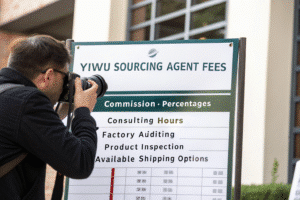
The agent takes a percentage of what you spend with the factory. Published rate cards across sourcing companies cluster between 3% and 10% of FOB value, with the percentage falling as the order grows. The model’s appeal is that you pay nothing until you buy something, which is why it dominates for first-time buyers and irregular orders.
Its weakness is structural and worth stating plainly: the agent’s income rises with your spend. An agent on commission has no financial reason to negotiate your unit price down, and a small reason not to. That does not make commission agents dishonest — it makes the incentive worth naming before you sign, and it is the reason the audit questions later in this guide exist.
Flat fee per order or per project
A fixed amount, agreed before work starts. Published figures run roughly USD 100–500 for a single small order or per SKU, and around USD 300–2,000 for a project covering several suppliers. Treat these as published price ranges rather than a market survey — they come from agents’ own rate cards, and scope drives them more than any average does.
The flat fee decouples the agent’s pay from your spend, which removes the incentive problem entirely. What it introduces instead is a scope boundary. The agent has agreed to a finite amount of effort, so the questions that decide whether the fee is good value are: how many supplier quotes are included, how many samples, how many factory visits, and what happens when the first three suppliers do not work out.
Monthly retainer
You pay a fixed monthly amount and the agent reserves capacity for you. Published retainers run roughly USD 500–3,000 per month depending on scope. This is a model for buyers with continuous flow rather than occasional orders: you are buying an ongoing relationship, priority handling, and someone who already knows your specifications.
The retainer only makes sense above a volume where the fixed monthly cost undercuts what commission would have taken. That crossover is arithmetic, and it is personal to your numbers — the break-even section below sets it out so you can run it on your own.

What Sourcing Agents Actually Charge by Order Value
The single most useful thing to know before you negotiate is whether the rate you have been quoted is normal for an order your size. Commission percentages move inversely to order value, because the agent’s workload on a USD 60,000 order is not twelve times the workload on a USD 5,000 one.
The bands below are drawn from published rate cards across sourcing companies serving Chinese wholesale markets. They describe what agents advertise, not an audited market statistic — but they are enough to tell you whether a quote sits inside normal practice or outside it.
| Order value (FOB, USD) | Commission band seen on published rate cards | China Yiwu’s published tier | What usually drives the rate |
|---|---|---|---|
| Under 5,000 | 7%–10%, or a flat fee instead | 5% | Fixed handling effort spread over a small base; many agents decline or switch to flat fees here |
| 5,000–50,000 | 5%–8% | 3% | Multi-supplier consolidation, sample rounds, inspection scope |
| Above 50,000 | 3%–6% | 1%–2% | Repeat volume, container-level orders, established specifications |
We publish our own tiers on the Yiwu market agent page — 5% up to USD 5,000, 3% from USD 5,001 to USD 50,000, and 1–2% above USD 50,000 — so you can hold this article to the same standard as anyone else’s. Use the table to interrogate a quote, including ours.
Ask what the percentage is calculated on
This is where quotes that look identical stop being identical. A commission on FOB is charged on the goods value at the port of loading. A commission on CIF is charged on goods plus freight plus insurance — so the same headline percentage is applied to a larger base, and the agent earns more when freight rises, which is a strange thing to reward.
On a USD 30,000 FOB order carrying USD 4,000 of freight and insurance, a 3% commission on FOB is USD 900. The same 3% on CIF is USD 1,020. The rate did not change; the base did. Get the calculation base written into the agreement, and prefer FOB.
What is normally excluded
Commission usually covers supplier search, negotiation, order follow-up, consolidation and export paperwork. Items typically billed on top are sample costs and sample freight, third-party laboratory testing, international freight and duties, and any inspection beyond the agent’s standard check. None of this is hidden — but it is only itemised if you ask for it to be, which is the difference between a quote and a fee schedule.
Commission vs Flat Rate vs Retainer: A Decision Table
Ignore which model sounds fairest and start from your own order pattern. Two variables decide this almost entirely: how much you buy per order, and how often you buy. Everything else is negotiation.
Work it as a short decision tree. If you are buying occasionally and your orders are small, commission is the right default — you carry no fixed cost, and the percentage applied to a small base is a small number. If you are buying occasionally but your orders are large, the commission percentage starts working against you, because a 5% charge on USD 60,000 buys you no more agent effort than 5% on USD 20,000 did; this is where a flat project fee or a negotiated tier belongs. If you are buying continuously across several SKUs, you are paying for availability rather than transactions, and the retainer arithmetic in the next section decides it.
The one pattern that consistently costs buyers money is staying on a commission agreed during their first order after volume has multiplied. The rate was appropriate to a buyer who did not yet exist. Rates are usually renegotiable at exactly the moment nobody thinks to renegotiate them, which is when your orders become worth keeping.
The table below sets out the same decision as best-for and not-for, with the contract clause that protects you under each model.
| Model | Best for | Not for | The clause that protects you |
|---|---|---|---|
| Commission | First orders, irregular buying, unproven product ideas, buyers who want zero cost until something ships | High-value repeat orders where the percentage compounds against you with no extra work performed | Rate charged on FOB; written exclusivity that no other payment is received on your orders |
| Flat fee | Defined projects, single-SKU sourcing, buyers who want the agent’s pay disconnected from their spend | Open-ended searches, or any brief likely to change scope mid-way | A written scope: number of suppliers quoted, samples handled, and what triggers a new fee |
| Retainer | Continuous monthly flow, multiple live SKUs, buyers needing reserved capacity and priority | Seasonal or occasional buyers — you pay in the quiet months too | Defined monthly deliverables and a notice period; a break-even review at an agreed date |
| Hybrid | Buyers scaling out of commission but not yet at full retainer volume | Anyone who has not modelled both components — two levers are easier to obscure than one | Both components stated separately, and the reduced percentage genuinely reduced |
If an agent offers only one model and will not discuss the others, that is information rather than a dealbreaker. Ask why. A specialist with a genuine reason is fine; an agent who cannot explain their own pricing structure is telling you something about how the rest of the relationship will run.
Run the Break-Even Before You Sign
The commission-versus-retainer question has an exact answer, and it is different for every buyer. The crossover is the monthly order value at which a fixed retainer costs the same as a percentage of your spend:
Break-even monthly FOB value = monthly retainer ÷ commission rate
Below that figure, commission is cheaper. Above it, the retainer is. Both sides of that equation are numbers you have: the retainer is quoted to you, and the commission rate is the one you would otherwise be charged.
A worked example you can re-run
Take a buyer offered a USD 1,200 monthly retainer, whose alternative is a 5% commission. The break-even is USD 1,200 ÷ 0.05 = USD 24,000 of monthly FOB purchasing. At USD 12,000 a month, commission costs USD 600 and the retainer costs USD 1,200 — commission wins by USD 600. At USD 40,000 a month, commission costs USD 2,000 against the same USD 1,200 — the retainer wins by USD 800, or USD 9,600 across a year.
Change either input and the answer moves. The same buyer offered a 3% rate has a break-even of USD 40,000, not USD 24,000. That is why a universal threshold is not worth quoting: swap in your own retainer figure and your own rate, and the number that comes out is the only one that applies to you.
What the arithmetic leaves out
Three things routinely overturn the raw calculation. First, seasonality — if your buying is concentrated in four months, compare against the annual total, not a peak month. Second, scope: a retainer covering QC coordination on eight live SKUs is not the same product as commission on one. Third, growth. If you are on the edge of the crossover and volume is rising, the model that wins today is the wrong one to sign a year of.
Where your orders involve inspection scope rather than pure purchasing volume, the boundary between agent fees and quality control charges is worth settling in the same conversation — it is a common place for two quotes to look different when the underlying service is the same.

Kickbacks: How the Money Actually Moves
A kickback is a second payment. You pay your agent a commission you agreed to; the factory pays your agent an additional amount you were never told about, usually calculated as a percentage of the order and built into the unit price you were quoted.
The mechanism is worth understanding precisely, because it is invisible in the documents you receive. Your invoice shows a unit price and your agreed commission. Both are accurate. What the invoice cannot show is that the unit price was set high enough to fund a payment flowing the other way. You are not overcharged on any line item — you are overcharged on the line item’s size, agreed before you ever saw the quote.
This is also why it distorts more than price. An agent receiving payments from a particular factory has a reason to keep you with that factory, whether or not it is the right one for your product, and a reason to discourage you from talking to it directly. The cost is not only the margin skimmed; it is the supplier you were steered away from.
How common this is, nobody can honestly tell you — there is no dataset, and any percentage you see quoted is invention. What can be stated exactly is the mechanism above, the detection questions further down, and the legal test that follows, which is objective enough to apply to a real agreement.
Signals worth noticing
- Resistance to factory contact. There are legitimate reasons an agent protects supplier relationships. There is no legitimate reason you cannot know the manufacturer’s identity on goods carrying your brand.
- Quotes that arrive without breakdown. A single all-in number, repeatedly, with unit cost and agent margin never separated.
- The rate looks too low to be viable. An agent working a full sourcing scope at 1% on small orders is being paid by someone. Ask who.
- Reluctance to put exclusivity in writing. The single most useful clause in the whole agreement, and the one that is refused for only one reason.
The Legal Test: When a Commission Becomes a Bribe
Most discussions of kickbacks stop at disapproval. Chinese law is considerably more specific, and the distinction it draws is documentary rather than moral — which makes it something you can actually test in a contract.
China’s Anti-Unfair Competition Law was amended by the Standing Committee of the National People’s Congress on 27 June 2025, with the revised law taking effect on 15 October 2025. Article 8 governs commercial bribery, and it expressly permits paying an intermediary. The statute provides that a business operator may explicitly pay a discount to a transaction counterparty or a commission to an intermediary — and that the payment “shall be recorded truthfully in its account books”, with the party receiving it required to book it truthfully as well.
One detail worth getting right, because much of what is written about this online is out of date: in the current text the bribery provision is Article 8. Article 7 governs confusing conduct — passing goods off as another company’s — which is a different offence entirely. Guidance still citing “Article 7” for kickbacks is working from the pre-2025 numbering.
That yields a two-part test. A payment to your agent is a lawful commission when it is paid openly, and when it is truthfully recorded in the account books of both the payer and the recipient. A payment that fails either limb is not a grey area or an industry custom. It is commercial bribery under Article 8.
The practical consequence: a factory-to-agent payment is lawful if it is disclosed and booked by both sides. The same payment, off the books or concealed from you, is not. Openness and bookkeeping are the whole distinction — which is why the audit questions below ask for written confirmation rather than reassurance.
The 2025 change that matters to your agent
The amended law extends liability to the party accepting a bribe, not only the one offering it. Commentary from international firms describes this as a shift to dual investigation of both giving and taking, closing the chain so that an intermediary or a counterparty’s staff member who accepts an improper payment is directly exposed rather than merely a witness to someone else’s offence.
Penalties under Article 24 are confiscation of illegal gains plus a fine of not less than CNY 100,000 and not more than CNY 1,000,000. Where circumstances are serious, the fine runs from CNY 1,000,000 to CNY 5,000,000, and the business licence may be revoked.
What this means for a foreign buyer
You are not the enforcement target, and this guide is general information rather than legal advice on your specific agreement — take advice on a contract that matters. But the test is useful to you regardless of enforcement, for a practical reason: it gives you an objective standard to write into your agreement. You are no longer asking an agent to promise good behaviour. You are asking them to confirm in writing that any payment they receive in connection with your orders is disclosed to you and booked — which is the same standard the statute already applies to them.
Buyers subject to the US Foreign Corrupt Practices Act or the UK Bribery Act have their own reasons to care about what their agent receives, since an intermediary’s conduct can reach back to the company that appointed them. If either regime applies to you, this clause is worth having your counsel draft rather than copying from an article.

How to Audit an Agent’s Fees Before You Commit
Everything above turns into five questions and three clauses. Put the questions in writing — email is enough — because the answers are more informative in text than on a call, and because a written answer is one the agent has had to think about.
The five questions
- Is your fee calculated on FOB or CIF, and what exactly is included in the base? A clean answer names the basis without being asked twice.
- Do you receive any payment, rebate, discount or commission from the factories on my orders? The statute’s own standard. A compliant agent can answer this directly; the answer you want is either “no” or “yes, and here it is”.
- What is billed on top of the fee? Samples, sample freight, laboratory testing, inspections beyond standard, logistics coordination, warehousing past the free period.
- Will you disclose the manufacturer’s identity? If not now, then at what point in the relationship — and in writing.
- What happens to the fee if the order is cancelled, halved, or fails inspection? Rarely asked, and the answer tells you how the agent behaves when things go wrong.
The three clauses
- Calculation base. “Commission is X% of FOB value, excluding freight, insurance and duties.”
- Exclusive remuneration. “The agent confirms it receives no other payment, rebate or commission from suppliers in connection with the buyer’s orders, and will disclose and book any such payment.” This is the Article 8 test, in your contract.
- Fee schedule. An itemised list of chargeable extras with amounts, attached to the agreement rather than quoted ad hoc.
What we can and cannot tell you in advance
Start with what the fee actually spans. A Yiwu-based agent’s product scope is the general-merchandise range the market itself carries, available in grades from promotional-budget to mid-market retail quality: houseware and kitchenware, stationery, toys, hardware and tools, textiles and accessories, seasonal and promotional goods — sourced across many small suppliers and consolidated into one shipment. That breadth is what the commission pays for.
Order sizes served run from a part-container LCL position of a few cubic metres up to multiple full 40ft high-cube containers, each rated at roughly 76 CBM nominal. The fee model that suits you tracks that range closely — the smaller your position, the more likely a flat fee beats a percentage.
Breadth is also the boundary. Heavily regulated or highly engineered categories — electrical goods needing destination-market certification, or medical products — want a specialist rather than a general market agent, and an agent who claims every category with equal confidence is worth a second question.
Two figures buyers reasonably ask for cannot honestly be published as a single number. MOQ is set by the individual factory and the product — a Yiwu supplier’s minimum on a printed item differs from the same supplier’s minimum on a plain one — so it is quoted per SKU against your specification, not per agent. Lead time is driven by production plus consolidation plus your chosen freight mode, and the consolidation window depends on how many suppliers are in the shipment. Both are answerable once a specification and a supplier list exist; neither is answerable from a rate card, and an agent who gives you a confident number before seeing your spec is guessing.
Compliance: whose cost, whose responsibility
Be precise about whose job it is. Certification and testing to your destination market’s requirements — CE marking for the EU, FCC or CPSC requirements in the United States, UKCA in Britain — are a cost of the goods, not of the agency, and are normally billed as third-party laboratory testing on top of any fee model. What the agent owes you is coordination and the paperwork trail: arranging the test samples, obtaining the reports from the factory, and making sure the export documents match what was actually shipped. Agree in writing which of you is responsible for specifying the applicable standard, because that is the gap where non-compliant goods reach a port.
What we do publish is the fee side: our commission tiers by order value, and the terms attached to them — consolidation across suppliers into one shipment, and 30 days of free warehousing on orders above USD 5,000. Those are our own published terms rather than independently audited figures, and you should treat them the way this guide has asked you to treat everyone else’s: as a starting point for the questions above. Sample and inspection arrangements are handled per order through the product sourcing service, since what a meaningful sample looks like depends entirely on the product.
Conclusion
Work the decision in this order. Establish which of the three models you are being offered and what it does to the agent’s incentive. Check the rate against the bands for your order size, and pin the calculation base to FOB. Run the break-even on your own volume rather than anyone’s published threshold. Then apply the Article 8 test — paid openly, booked truthfully by both sides — and get it into the agreement as an exclusive-remuneration clause.
An agent who answers all five audit questions in writing has told you more about the next two years than any percentage could. If you want a second opinion on a fee schedule in front of you, we are happy to read it.
Questions fréquemment posées
How much do sourcing agents charge in China?
Published rate cards cluster between 3% and 10% of FOB order value, with the rate falling as order value rises. Flat fees run roughly USD 100–500 per small order and USD 300–2,000 per project; retainers roughly USD 500–3,000 per month. China Yiwu publishes 5% / 3% / 1–2% by order value band.
Is a sourcing agent commission from the factory legal in China?
Yes, if it meets Article 8 of the Anti-Unfair Competition Law in force since 15 October 2025: paid openly and recorded truthfully in both parties’ account books. A payment failing either condition is commercial bribery, and since the 2025 amendment the recipient is liable as well as the payer.
Should commission be calculated on FOB or CIF?
Prefer FOB. A CIF-based commission applies your rate to goods plus freight plus insurance, so the agent earns more when freight rises. On a USD 30,000 order with USD 4,000 freight and insurance, 3% on FOB is USD 900 against USD 1,020 on CIF.
At what volume does a retainer beat a commission?
Divide the monthly retainer by the commission rate. A USD 1,200 retainer against a 5% commission breaks even at USD 24,000 of monthly FOB purchasing; at a 3% rate the same retainer breaks even at USD 40,000. Use your own quoted figures — there is no universal threshold.
Are sourcing agent fees negotiable?
The percentage usually is, particularly as order value rises or when you commit to repeat volume. The more valuable negotiation is over structure: the calculation base, the itemised list of extras, and a written exclusive-remuneration clause.
What does a 20% agency fee mean?
It means the agent adds 20% to the order value, which is far outside the published bands for sourcing agency work. At that level you are likely dealing with a trading company reselling goods at a marked-up price rather than an agent charging a service fee — ask whether they buy and resell, or represent you.