 Justin
I had a Shopify founder call me last month in a panic. He secured a strong unit price on kitchen gadgets from a supplier in Yiwu, calculated an 18% margin for his Amazon launch, and wired the payment. The margin vanished. The culprit was exchange rate fees buried inside the SWIFT wire, disguised as a standard processing step. The bank took a 3.5% cut on the USD to RMB conversion, and nobody on his end flagged it.
Traditional banks are the worst offenders for this. We pulled three years of wire transfer data from our Yiwu operations and compared the actual rates suppliers received against the mid-market baseline. The gap is predictable. Once you see how suppliers pad USD invoices to cover their own currency risk, you stop accepting flat dollar quotes entirely. This breakdown shows exactly where your money leaks on a telegraphic transfer, how to spot a dynamic currency conversion trap, and the specific spread you should demand from your payment provider.

What Are Exchange Rate Fees?
Exchange rate fees in B2B sourcing are rarely listed as line items. Banks and suppliers hide them inside the “rate provided,” silently eroding your Amazon or Shopify margins.
The Mid-Market Rate Baseline
The mid-market rate is the baseline—the actual rate banks use when trading currencies with each other. When you check a USD to RMB rate on Reuters or the Wall Street Journal, you are looking at the interbank mid-market rate. It represents the true, unmanipulated cost of moving money.
In B2B sourcing, this number is your only defense against china sourcing payment hidden exchange costs. Every supplier quote and bank wire should be benchmarked against this specific daily rate. If your bank or supplier cannot provide the exact mid-market rate timestamp for the wire date, you cannot audit the transaction.
We consistently find that e-commerce entrepreneurs assume a fixed USD price from a Yiwu supplier is safe. In reality, the FX risk is simply transferred to the buyer via a padded exchange rate, making accurate landed cost calculations impossible.
FX Spread vs Flat Commission
When you send a telegraphic transfer to China, the telegraphic transfer exchange rate vs mid market is manipulated in two distinct ways. Understanding this difference is how you identify hidden fx fees paying china suppliers.
- Flat Commission: The transparent fee. Standard SWIFT handling fees range from $15 to $50 per wire. This is always listed on your bank statement as a separate line item.
- FX Spread: The hidden margin. This is the gap between the mid-market rate and the rate your bank actually executes. Banks typically add a 1-4% hidden markup on mid-market rates for international B2B wires.
- Supplier DCC Padding: When a Yiwu supplier quotes in USD instead of RMB, they are almost always applying a 3-5% Dynamic Currency Conversion buffer against RMB volatility. Demanding RMB pricing is exactly how to avoid dynamic currency conversion sourcing.
- B2B FX Platforms: Specialized services charge spreads as low as 0.3% above the mid-market rate, drastically cutting the usd to rmb supplier wire transfer markup.
The psychological danger of the FX spread is that buyers fear looking foolish to their accountant, so they passively accept the “rate provided” by their bank. Traditional banks are the worst offenders for B2B margins because they intentionally bury the spread inside the conversion total rather than disclosing it as a fee.
We manage local RMB payments directly to Yiwu factories on behalf of the buyer. By absorbing the currency complexity ourselves, we eliminate the bank’s hidden spread and give you a single, transparent USD landed cost.
B2B Exchange Rate Fee Breakdown
The most destructive margin killer in China sourcing is not the product price. It is the hidden FX fees embedded in your supplier’s USD quote and your bank’s SWIFT wire.
Supplier USD Invoice Markups
When a Yiwu supplier quotes you a fixed USD price instead of RMB, they are not doing you a favor. They are transferring the currency volatility risk directly onto your unit economics. We found that suppliers routinely pad USD invoices with a 3-5% Dynamic Currency Conversion (DCC) buffer against RMB fluctuations.
The buyer assumes a fixed USD price is safe, not realizing the FX risk is simply baked into a padded exchange rate. To audit this, you must demand the exact Reuters or WSJ interbank mid-market rate timestamp for the wire date. Without that specific data point, you cannot calculate the actual usd to rmb supplier wire transfer markup you just paid.
SWIFT Wire Transfer Margins
Traditional banks are the worst offenders for B2B margins. They intentionally hide the telegraphic transfer exchange rate vs mid-market rate by burying the FX spread inside the “rate provided” line item rather than listing it as a transparent fee. Our analysis shows banks typically add a 1-4% hidden markup on mid-market rates for international B2B wires.
Beyond the invisible percentage spread, there are flat handling costs. These china sourcing payment hidden exchange costs stack up quickly across multiple orders.
- SWIFT Handling Fee: $15 to $50 per wire, charged by both the sending and intermediary banks.
- Correspondent Bank Deductions: Unpredictable fees deducted mid-transfer, meaning your supplier receives less than sent, creating payment disputes.
- FX Spread Margin: 1-4% added to the interbank rate, completely invisible on your bank statement.
Payment Gateway Conversion Costs
Alternative B2B payment platforms like Wise, Payoneer, or specialized trade finance tools market themselves as transparent solutions. The reality is better, but not flawless. Specialized B2B FX platforms charge spreads as low as 0.3% above the mid-market rate, a massive improvement over the 1-4% bank standard.
Figuring out how to avoid dynamic currency conversion sourcing requires shifting from passive acceptance of quotes to active auditing of the FX component. You must compare the platform’s quoted rate against the live mid-market rate at that exact minute. Even a 0.5% variance on a $20,000 order is $100 in pure margin loss.
We manage local RMB payments directly to Yiwu factories on behalf of the buyer. This absorbs the currency complexity entirely. You receive a single, transparent USD landed cost with no hidden bank spreads to decode after the fact.
Exchange Rate Fees Cost Comparison
On a $10,000 wire to China, your payment channel alone determines whether you lose $30 or $500 to hidden exchange rate markups.
The Mid-Market Rate: Your Only Honest Baseline
The mid-market rate is the actual interbank exchange rate you see on Reuters or Bloomberg. No retail buyer or small business gets this rate, but it is the only mathematically honest baseline to measure hidden fees against. When a bank or supplier quotes you a telegraphic transfer exchange rate vs mid market, the gap between those two numbers is where your margin disappears.
The Four Channels and Their Real Costs
We audited the actual costs our clients faced before switching to our managed RMB payment system. The variance between these four methods is entirely driven by how aggressively the middleman hides the FX spread.
- Mid-Market Rate (Baseline): 0% markup. This is the theoretical benchmark. You never actually achieve this in a manual wire, but you must calculate against it to expose the hidden fees.
- Bank SWIFT Wire: 1-4% hidden FX markup plus a $15-$50 flat handling fee. Traditional banks are the worst offenders for B2B margins because they bury the spread inside the “rate provided” rather than listing it as a line item.
- Supplier DCC USD Quote: 3-5% padding. When a Yiwu supplier insists on quoting in USD instead of RMB, they are almost always applying a Dynamic Currency Conversion buffer against RMB volatility. The buyer assumes a fixed USD price is safe, not realizing the FX risk is simply transferred to them via a padded rate.
- B2B FX Platforms: As low as 0.3% above mid-market. Specialized platforms like Wise Business or PingPong disclose their spread upfront, eliminating the guessing game entirely.
Exact Dollar Loss on a $10,000 Wire
To make this concrete for your unit economics, here is what each method actually costs you when sending $10,000 to a Chinese factory. We calculated these figures using the baseline mid-market rate and applying the exact percentage spreads listed above.
- Mid-Market Rate: $0 in FX fees (pure benchmark).
- Bank SWIFT Wire: $100 to $400 in hidden FX margin, plus $15 to $50 in flat handling fees. Total loss: $115 to $450.
- Supplier DCC USD Quote: $300 to $500 lost to the supplier’s currency buffer. This is the most deceptive method because it feels like a standard product price, not a financial fee.
- B2B FX Platform: Approximately $30 in transparent spread fees.
The psychological trap for e-commerce entrepreneurs is that the bank and the DCC supplier both make you feel like you just paid a “fixed price.” But on a $10,000 order, accepting a supplier’s DCC quote instead of demanding the exact mid-market rate timestamp for the wire date can quietly erase your entire Amazon FBA margin per unit. We solve this by managing local RMB payments directly to factories on behalf of the buyer, absorbing the currency complexity so you receive a single, transparent USD landed cost without hidden bank spreads.
| Payment Method | FX Spread Margin | Frais supplémentaires | Cost on $10k Order | Risk Assessment |
|---|---|---|---|---|
| Traditional Bank SWIFT | 1% – 4% (vs mid-market) | $15 – $50 flat handling fee | $115 – $450 in hidden costs | Worst offender; the telegraphic transfer exchange rate vs mid market is deliberately obscured. |
| Supplier USD Quoting (DCC) | 3% – 5% dynamic padding | None listed (bundled in rate) | $300 – $500 in hidden costs | High risk; classic china sourcing payment hidden exchange costs passed directly to the buyer. |
| Specialized B2B FX Platforms | 0.3% above mid-market | Varies by platform | ~$30 | Low risk; requires active auditing of the exact mid-market rate timestamp for the wire date. |
| Our Yiwu Sourcing Service | 0% (Transparent USD rate) | Included in DDP landed cost | $0 in hidden fx fees | Zero risk; we manage local RMB payments directly so you know how to avoid dynamic currency conversion sourcing entirely. |
How to Avoid Exchange Rate Fees
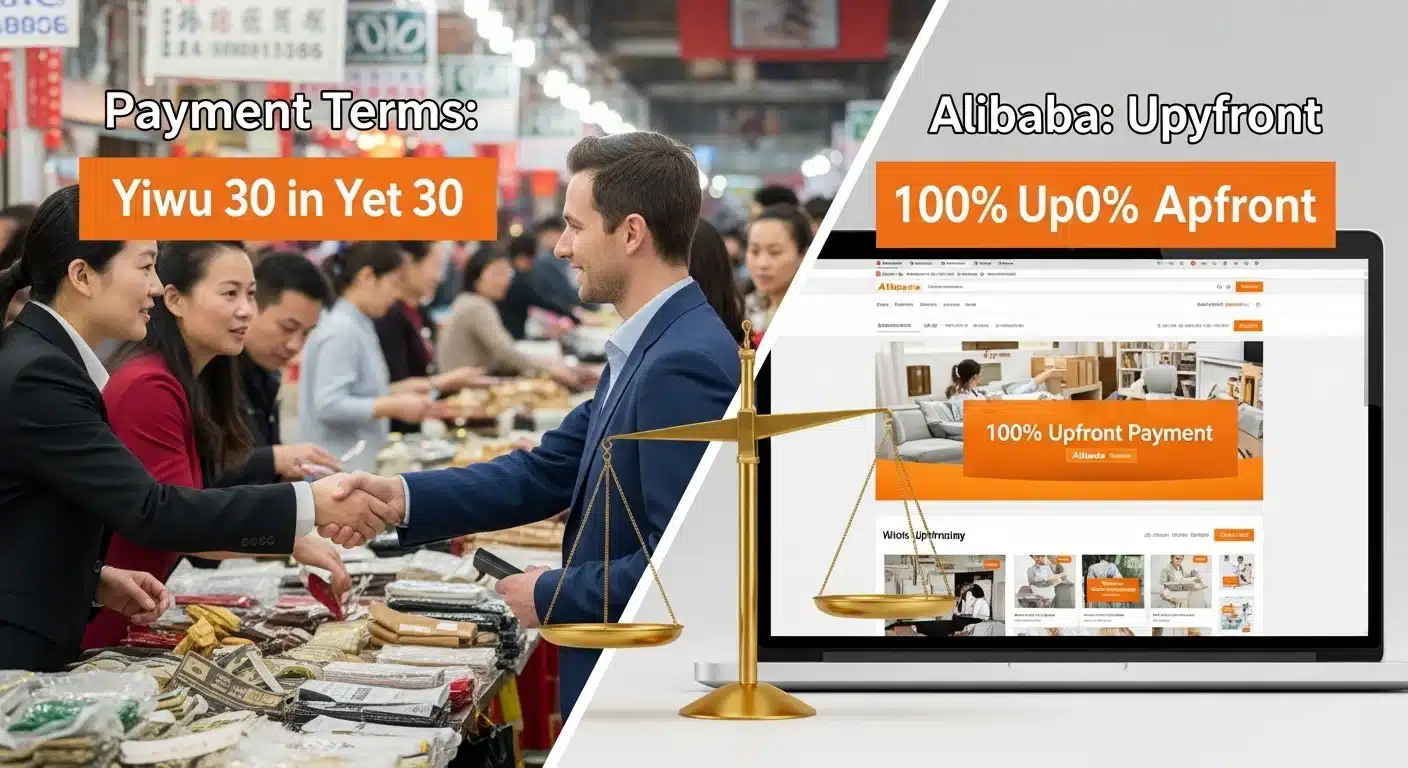
Stop paying in USD. When Yiwu suppliers quote fixed USD prices, they embed a 3-5% buffer to hedge RMB volatility, silently destroying your Amazon ROI.
Negotiate RMB Payment Terms
When you receive a USD quote from a Chinese factory, you are not avoiding currency risk. You are simply transferring that risk to yourself via a padded exchange rate. We constantly audit supplier invoices and find that when a Yiwu factory quotes in USD instead of RMB, they apply a 3-5% Dynamic Currency Conversion (DCC) buffer against RMB volatility.
The most effective method for how to avoid dynamic currency conversion sourcing is to reject the USD quote entirely. Demand pricing in the supplier’s native currency. A fixed RMB price locks in their actual manufacturing cost. To protect your own margin, you then control the usd to rmb supplier wire transfer markup on your end using a tool you choose, rather than letting the factory dictate a blind exchange rate.
Ask the supplier for the exact RMB amount and the mid-market rate timestamp for the wire date. If they refuse to separate the product cost from the FX conversion, you are dealing with hidden fx fees paying china suppliers, and you should negotiate harder or walk away.
Use Specialized B2B FX Platforms
Once you secure an RMB invoice, the next critical mistake is wiring funds through your standard corporate bank. We tested traditional bank telegraphic transfers and found the telegraphic transfer exchange rate vs mid market consistently carries a 1-4% hidden markup. Banks intentionally bury this margin in the “rate provided” rather than listing it as a line item, making it nearly impossible for your accountant to audit. On top of that, you pay a flat $15-$50 SWIFT handling fee per wire.
- Traditional Bank SWIFT: 1-4% FX spread margin + $15 to $50 flat handling fee per transaction.
- Specialized B2B FX Platforms: Spreads as low as 0.3% above the mid-market rate with transparent fee structures.
The math is brutal for e-commerce margins. On a $10,000 order, a 3% bank spread costs you $300 in pure china sourcing payment hidden exchange costs, whereas a specialized platform would charge roughly $30. That gap directly inflates your landed cost per unit. For our clients, we bypass this complexity entirely by managing local RMB payments directly to factories. You remit a single, transparent USD amount to us, and we handle the rest under our DDP shipping terms, ensuring your unit economics are never compromised by opaque bank spreads.
Conclusion
Never accept a fixed USD price on your next order. That quote hides a 3-5% buffer against currency swings that your supplier pockets. Calculate your true landed cost by demanding the exact mid-market rate timestamp for the wire date.
Open your last bank statement for a supplier payment. Compare the rate you received against the Reuters mid-market rate from that exact date. Once you see the margin your bank kept, send us your next invoice to see what a transparent USD landed cost actually looks like.
Questions fréquemment posées
What are exchange rate fees?
Exchange rate fees are hidden costs charged by banks or payment processors for converting one currency into another during international transactions. When sourcing from Yiwu, paying your supplier in USD while they receive RMB often triggers these markups from financial middlemen. Essentially, institutions add a percentage to the real mid-market rate to profit off your currency conversion. We help you navigate these costs to ensure your global DDP shipping and product pricing remain completely transparent.
What’s a reasonable fee?
A reasonable exchange rate fee for B2B international sourcing typically falls between 0.5% and 1% above the mid-market rate. Anything beyond 1.5% is considered excessive and eats directly into the local factory pricing you negotiated in the Yiwu market. By leveraging our established payment networks, we guide global brands toward transparent currency exchange methods that keep these costs strictly minimized. This ensures your low MOQ orders of 100pcs remain highly profitable without surprise financial deductions.
How to avoid these fees?
The most effective way to avoid exchange rate fees when sourcing from China is to pay in the supplier’s local currency using a specialized cross-border B2B payment platform. These services use the real mid-market exchange rate, completely bypassing the traditional 3% to 5% markups applied by standard commercial banks. As your trusted eyes in the Yiwu market, we facilitate these direct, low-cost payment channels for our clients. This guarantees that every dollar you spend goes directly toward your risk-free inspection and global DDP shipping rather than bank fees.
Is a 3% fee a lot?
Yes, a 3% international fee is excessively high and completely unnecessary for modern B2B sourcing in the Yiwu market. While standard corporate credit cards often default to this rate, paying a 3% markup on large factory orders severely damages your profit margins and contradicts the goal of securing local factory prices. Professional sourcing agencies and smart global brands utilize optimized payment gateways that reduce this fee to under 1%. We actively protect our clients from these predatory rates so your capital is invested in quality products, not bank profits.
Is a 3% debit fee legal?
Yes, it is generally legal for payment processors or foreign merchants to charge a 3% fee on a debit card for international currency conversion, though specific regulations vary by region. But just because it is legal does not mean it is an acceptable practice when dealing with verified Yiwu suppliers. In many Western countries, surcharging domestic debit cards is prohibited by law, but international foreign transaction fees remain largely unregulated. We educate our partners on bypassing these legal but exploitative charges to maintain the integrity of your low MOQ investments.