Justin
QIMA publishes its rate card in the open: product inspections from $419 USD per man day, supplier audit programmes from $669 USD per man day. That is a 1.60x premium for the audit, and the gap is the most honest description of the difference between the two services you will find anywhere. An inspection prices the effort of counting your cartons. An audit prices the effort of judging whether a company can build your order at all.
Most buyers commission their first factory audit without knowing which of those they bought. They receive a PDF with a score, a set of photographs and a recommendation, and they file it as proof. It is not proof. A factory audit is a sampled, time-boxed opinion produced under a guidance document that explicitly is not a certification scheme — and the moment you understand which document that is, the report becomes far more useful than the score on its cover suggests.
Key takeaways
- The audit you commission is a second-party audit. ISO 19011:2018, the guidance document behind it, covers internal and supplier audits; third-party certification runs under a different standard, ISO/IEC 17021-1:2015. Your audit produces a report, never a certificate.
- QIMA’s published rates are $669 USD per man day for supplier audit programmes against $419 USD per man day for product inspections, with auditor transport, meals and accommodation included in the figure.
- Most QIMA manufacturing audits finish in one day on site, report a few business days later. AQI schedules its extensive audit over one or two days with the report one working day after.
- Un amfori BSCI social audit is a different product entirely: 81 questions across 13 Performance Areas, graded A to E, on a two-year cycle. It tells you nothing about whether the factory can hold your tolerance.
- The certificate-checking advice on most pages is now out of date. IAF ceased operations on 01 January 2026; Global Accreditation Cooperation Incorporated took over and launched its own MRA the same day. Existing accreditations stay recognised through the transition.
- A clean audit describes a system on one day. It cannot detect what a factory subcontracts after your PO is signed — which is why the audit belongs before the order and an inspection belongs during it.
What the audit you are paying for is actually governed by
Search the phrase and you get a dozen service pages describing what auditors look at. Almost none of them name the document the exercise runs on. That omission matters, because the document defines the limits of what your report can claim.
The relevant standard is ISO 19011:2018, Guidelines for auditing management systems, now in its third edition. Read the title carefully: guidelines. It sets out principles of auditing, how to manage an audit programme, how to conduct an audit, and how to evaluate auditor competence. It does not issue a pass mark, and no factory can be certified to it.
Second-party is the category you are buying
Audits split three ways by who runs them. A factory auditing itself is first-party. A customer auditing its supplier is second-party. An accredited certification body auditing a factory in order to issue a certificate is third-party. ISO 19011 concentrates on the first two. The third has its own standard — ISO/IEC 17021-1:2015, Conformity assessment — Requirements for bodies providing audit and certification of management systems — Part 1: Requirements — and note the difference in wording: requirements, not guidelines.
When you hire an inspection firm to visit a factory on your behalf, you are commissioning a second-party audit and paying a third party to execute it for you. The output is a report addressed to you. It confers nothing on the factory. A supplier who later tells a different buyer that he is “audited” is describing your commercial exercise as though it were a certification, and that is a distinction worth policing in your own supply chain. The wider question of which party you are in any given verification exercise is covered in our guide to what a supplier audit proves when your supplier has no factory.
The practical consequence: never accept “we passed a factory audit” as a supplier credential. Ask who commissioned it, under what scope, and on what date. An audit belongs to the buyer who paid for it.
What ISO 9001 does and does not tell you
A factory holding ISO 9001 has been through a third-party certification audit under ISO/IEC 17021-1. That is real, and it is checkable. What it establishes is that the factory operates a documented quality management system — that procedures exist, records are kept, non-conformities are handled through a defined route. It does not establish that the factory can hold your dimensional tolerance, that it owns the machine your part needs, or that it will not subcontract your order. Those are capability questions, and they are what your own audit is for.

Which audit to commission, and when a factory audit is the wrong purchase
Provider websites list ten or twelve audit types. A buyer placing one order needs a decision rule across four, and needs to know that one of the four is not an audit at all.
| What you buy | The question it answers | When to commission it | What it will not tell you |
|---|---|---|---|
| Capability / quality-system audit | Can this company build my product, at my volume, to a repeatable standard? | Before the first PO, while you still have two or three candidates | Whether the goods in your specific carton are acceptable |
| Social / ethical scheme audit (e.g. amfori BSCI) | Does the site meet a buyer-coalition code on labour and conditions? | When your customer, retailer or importer contract requires it | Anything about production capability or product quality |
| Security / supply-chain audit | Is the cargo chain controlled from packing to container seal? | When a customs or trade-partnership programme demands it | Whether the product conforms to your spec |
| Product inspection (not an audit) | Are the goods actually produced against this PO acceptable? | During or at the end of production, per shipment | Whether the company is viable for a second and third order |
Buyers routinely accept an amfori BSCI report as evidence of a good factory. It is evidence of something else. By amfori’s own published description of the scheme, a full amfori BSCI audit consists of 81 questions, each rated Yes, No, Partial or Not applicable, mapped to 13 Performance Areas drawn from the amfori BSCI Code of Conduct. The outcome is a grade from A to E.
The cycle matters as much as the grade. A full amfori BSCI audit runs on a two-year cycle. Grade A or B and the site is not due another full audit for up to two years. Grade C, D or E and a follow-up audit is required between two and twelve months later — and that follow-up does not re-ask the 81 questions; it examines evidence of improvement in the specific areas that failed.
So a supplier waving a grade-A certificate may be showing you a snapshot taken twenty-two months ago, and a supplier with a recent follow-up report is showing you a partial re-examination rather than a fresh full audit. Check the date and the audit type before you read the letter.
When you should not buy an audit
- You are buying from a market booth, not a factory. There may be no production site to audit, and the trading entity and the manufacturing entity are frequently different companies. That is a different verification problem.
- Your order is a one-off at low value. At $669 per man day for an audit programme, a single small order rarely justifies the capability question. Spend the money on inspecting the goods instead.
- Your real worry is this shipment. An audit run in March says nothing about the cartons packed in September. Inspection is the instrument for goods; see our breakdown of inspection stages, AQL levels and costs.
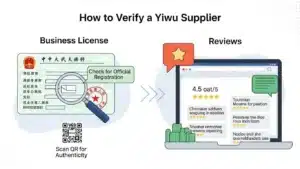
- You have not yet confirmed the company legally exists. Registry and licence checks cost nothing and come first — start with verifying the business licence.
One more distinction worth settling before you book anything: whether your counterparty is a manufacturer or a trading company changes what an audit can even look at. Our guide to telling a factory from a trading company covers the desk checks that come before the site visit.
For importers comparing two or three Chinese factories before a first container order. Where a third-party inspector reports a problem and leaves, we hold the final 70% of your payment until the factory reworks the goods. Standalone inspection is a flat $199/man-day and the PDF report lands within 24 hours.
What a factory audit costs, and what the man-day actually buys
Most pages answering this question quote a man-day figure and attribute it to nobody — no provider, no rate card, no date. Treat an unattributed price as no price. Go instead to a large provider that publishes an open rate card, and the picture is both checkable and higher than the blog consensus.
| Service (QIMA published rate card) | Published price | Basis |
|---|---|---|
| Product inspections | from $419 USD | per man day |
| Supplier audit programmes | from $669 USD | per man day |
| Ratio, audit against inspection | 1.60x | derived from the two published figures |
QIMA states that its published man-day price includes the auditor’s transport, meals and accommodation, plus overtime, weekend and holiday service. That inclusion is the detail to check in every competing quote you receive, because a lower headline rate with travel billed separately can land higher — a Yiwu-area factory is a straightforward day trip, but a site three hours inland is not.
Why the audit costs more than the inspection
The 1.60x gap is not a margin decision. An inspector executes a defined sampling plan against a defined specification and records what he finds. An auditor has to form a judgement about an organisation — read management records, interview staff, evaluate whether a documented procedure is actually the procedure being followed — and that requires a more experienced person. Provider man-day rates rise further when the audit needs a specialist rather than a generalist, which is worth flagging in your scope if your product turns on a process a generalist cannot assess.
How many man-days, and how fast the report lands
Duration is quoted by the provider, not fixed by the industry. QIMA states that most of its manufacturing audits are completed in one day on site, with the report typically delivered within a few business days after the visit. AQI schedules its extensive factory audit over one or two days at the manufacturer’s premises, with the report available one working day after the audit. Take those as the shape of a normal engagement: a single auditor, one to two days, a report inside a week. Multi-module scopes and large multi-building sites run longer, and a provider who cannot tell you the man-day count before the visit has not understood your scope.

What happens on the audit day, in the order it happens
An audit is a structured process, and knowing its shape lets you write a scope that gets you something useful rather than a generic template report. ISO 19011 organises an audit into activities that run in a fixed order — initiation and preparation, the opening meeting, the collection and verification of information, the generation of findings, the closing meeting, and the report. In a one-day factory visit that compresses into roughly this sequence.
Opening meeting
The auditor confirms the agreed scope with factory management, states the method, and sets expectations about access. This is where a badly written scope surfaces. If your brief said “quality audit” and you meant “confirm they own injection moulding capacity in-house”, the auditor and the factory will agree a plan that never answers your question.
The floor walk
The productive part. Machinery condition, line layout, material storage, in-process checks, the state of the incoming goods area, the finished goods area. The value here is that these things must be observed rather than asserted — a factory can claim a capability on a company profile in an afternoon, but it cannot conjure a machine it does not own onto a floor an auditor is standing on. Name in your scope the two or three things you most want physically confirmed.
Documents and records
The business licence, the certifications claimed, calibration records for measuring equipment, non-conformity and customer-complaint records, and the production records for a recent order. Records are more revealing than certificates. A quality manual that describes a corrective-action process, sitting beside an empty corrective-action log, is a finding.
Closing meeting
The auditor summarises preliminary findings with factory management before leaving. Ask your provider to send you the preliminary findings the same day. The written report arrives days later, and if it contains a serious problem you would rather know before your supplier does.
Announced or unannounced
The default is announced, because access has to be arranged and someone has to produce records. The trade-off is real: an announced audit shows you a factory that had notice, and what it demonstrates is partly how well that factory prepares for audits. An unannounced or short-window visit shows the ordinary state of the floor but risks being refused entry, and refusal is itself information. For a first engagement, announced is usually right — you need documents, and you need cooperation. Keep the unannounced option for a supplier you already work with and have started to doubt.
Reading the report: the 2026 accreditation change that breaks the old advice
Your report will list certificates the factory holds. Every guide tells you to verify them rather than trust the scans. That advice is right, and the instructions attached to it are now out of date on nearly every page still giving it.
The International Accreditation Forum ceased operations on 01 January 2026. A single successor body, Global Accreditation Cooperation Incorporated, took over the work of both IAF and ILAC and commenced full operations that same day, including the launch of its own Multilateral Recognition Arrangement.
This does not invalidate anything your supplier holds. Existing accreditations issued under the ILAC MRA or the IAF MLA continue to be recognised as the arrangements transition to the new MRA, and the IAF MLA and ILAC MRA marks remain valid for as long as required until the new mark is fully adopted. What changes is the mental model. If a page tells you to confirm that a certificate sits under “the IAF MLA” as though that were the current and permanent arrangement, that page has not been updated in at least eight months — which is a reasonable proxy for how carefully the rest of its advice has been maintained.
What a certificate lookup actually confirms
A lookup in the accredited-certification database returns more than a yes or no. It shows the certificate’s validity and current status, the standard and scheme it was issued against, the scope of the certification, the certified locations, the certification body that issued it, and the accreditation body that accredited that certification body.
Two of those fields do the real work, and they are the two buyers skip. Scope tells you what the certificate covers — a quality management system certified for “trading and distribution” is not a manufacturing certification, and that wording alone has settled many factory-or-trader arguments. Certified locations tells you which site is covered. A group with a certified plant in one province and an uncertified workshop in another will show you the certificate for the first while your order runs in the second.
Check the legal entity, not just the certificates
China operates a free public registry, the National Enterprise Credit Information Publicity System at gsxt.gov.cn. Every registered mainland entity carries an 18-digit Unified Social Credit Code, in use since 2015 and printed on the business licence and on official invoices. A lookup against that code returns the registered name, legal representative, registered capital, establishment date, business scope, registered address and current operating status.
Compare three things across the audit report and the registry: the name on the business licence, the name on the certificates, and the name on the proforma invoice you were sent. When those three are not the same entity, you have found the most common structural risk in Chinese sourcing before it costs you anything. A fuller walkthrough sits in our supplier verification checklist.

Sofeast, a QC firm that publishes buyer education rather than marketing, walks through the same decision this section covers — which audit type answers which question:
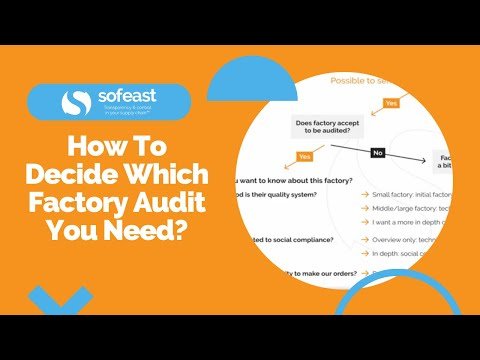
“How To Decide Which Factory Audit You Need?” — Sofeast. Opens on YouTube.
What a factory audit cannot detect, and how to commission one that helps
A provider selling audits will tell you what one catches. The more useful list is what one structurally cannot catch, because that list is what your remaining risk is made of.
- Subcontracting decided after your PO. The audit records the site as it was on the audit date. A factory that takes an order beyond its capacity and places part of it elsewhere does so weeks later, and nothing in the report anticipates it.
- Your specific goods. An audit assesses the organisation, not the cartons. The instrument for goods is an inspection against a sampling plan, and the two are complements, not alternatives.
- Material substitution downstream. Raw material approved on the audit day tells you the factory can buy the right material, not that it will on your run when the input price moves.
- Financial stability. Audits look at production systems. A factory that is technically excellent and financially failing passes an audit and still misses your delivery.
- What a scheme audit was never scoped for. A grade-A social report says nothing about tolerance control, and an expiring capability audit says nothing about labour conditions. Read the scope line, not the letter grade.
The scope checklist to send before booking
Most disappointing audit reports are the result of a scope written in one line. Send your provider these six items and the report changes character.
- The decision you are making. “Choosing between two candidates for a first 20ft order” produces a different report from “annual review of an existing supplier”.
- The two or three capabilities to physically confirm. Name the machine, the process step or the in-house department you are paying to have someone stand in front of.
- The entity names to cross-check. Give the auditor the name on the proforma invoice so he can compare it to the licence on the wall.
- The certificates to verify at source. List them, and ask for the certificate number and issuing body in the report, not a photograph of a wall plaque.
- The man-day count and what is included. Confirm travel and accommodation treatment in writing before booking.
- Same-day preliminary findings. Ask for a short note on the day, ahead of the formal report.
On commercial terms, expect the audit to be quoted per man day rather than per order, and expect no minimum order quantity to attach to it. Audits are usually booked as a standalone service and priced by the day and the scope, so the number of factories you audit is a budget decision rather than a volume threshold.
Lead time in practice is the visit plus a report window of one working day to roughly a week — an audit commissioned today informs a PO placed next week, not one placed tomorrow. If your production slot is already booked, the honest answer is that you are past the audit window and should be spending the money on inspection instead.
For a first Yiwu order, the sequence that works is: registry and licence check, then audit for the capability decision, then first article inspection once the first production units come off the line, then a pre-shipment inspection against the AQL plan.
If you would rather not manage that sequence from another time zone, our factory sourcing service runs the audit step as part of shortlisting. Where we differ from a pure audit house is the inspection that follows: we sample to ANSI/ASQ Z1.4 (ISO 2859-1) at a default tolerance of zero critical, AQL 2.5 major, AQL 4.0 minor, and we hold your final 70% payment until any failure is reworked. A report has no leverage over a factory that has already been paid.
On the bribery question every importer eventually asks: we never send the same inspector twice, inspectors carry GPS and body cams, and we pay factories a reward for reporting a bribe attempt. Standalone inspection is $199 per man-day with the PDF inside 24 hours — the full method is on our quality control and AQL inspection page.
Treat a clean audit report as a licence to proceed with ordinary caution, not as a transfer of risk. The report tells you a company was capable of building your product on the day someone looked. Everything after that date — the subcontract nobody mentioned, the material swapped when copper moved, the line reassigned to a bigger customer — is outside what you bought, and it is where orders actually go wrong.
Frequently asked questions
How much does a factory audit cost in China?
QIMA publishes supplier audit programmes from $669 USD per man day, against $419 USD per man day for product inspections. That published rate includes the auditor’s transport, meals and accommodation. Rates vary by provider and by whether a specialist auditor is required.
How long does a factory audit take?
QIMA states most of its manufacturing audits finish in one day on site, with the report a few business days later. AQI runs its extensive factory audit over one or two days, with the report one working day after. Larger sites and multi-module scopes take longer.
What is the difference between a factory audit and a product inspection?
An audit assesses the company — capability, systems, records — and informs whether to order at all. An inspection assesses the goods produced against one purchase order, using a sampling plan. You buy the audit before the order and the inspection during or after production.
Which standard governs a factory audit?
ISO 19011:2018, Guidelines for auditing management systems, covers internal and supplier (second-party) audits. It is guidance, not a certifiable requirement. Third-party certification audits run under ISO/IEC 17021-1:2015 instead.
Does a factory audit give the supplier a certificate?
No. An audit you commission is a second-party audit and produces a report addressed to you. Only an accredited certification body operating under ISO/IEC 17021-1 can issue a management-system certificate such as ISO 9001.
Is an amfori BSCI audit the same as a quality audit?
No. amfori BSCI is a social audit: 81 questions across 13 Performance Areas, graded A to E, on a two-year cycle. It assesses labour and working conditions, not production capability or product quality.
How do I verify the certificates listed in an audit report?
Look the certificate up in the accredited-certification database rather than trusting a scan. Check the scope wording and the certified locations, not just validity. Note that IAF ceased operations on 01 January 2026 and Global Accreditation Cooperation Incorporated now runs the arrangement.
Should the audit be announced or unannounced?
Announced for a first engagement, because you need document access and cooperation. Unannounced suits an existing supplier you have begun to doubt — it shows the ordinary state of the floor, and a refusal of entry is itself a finding.