 Justin.
First-time Amazon FBA buyers usually guess their sourcing agent fees China, and that guesswork costs them thousands. Last month, a new seller sent us his order paperwork from a Yiwu trip. He thought he was paying a standard 5 percent commission to his local contact. In reality, he was paying closer to 13 percent. The agent collected a hidden kickback from the supplier and calculated their cut on the total shipping cost instead of just the factory price. That single miscalculation wiped out his entire projected margin.
We ran the actual math on commission versus retainer structures across 300 recent shipments to find the exact point where your agent’s pricing model starts hurting your unit economics. You will walk away knowing the precise $15,000 monthly threshold where a flat retainer damages your bottom line. We also break down how to force your contact to calculate their percentage strictly on the FOB price—the factory gate cost before shipping and insurance are added—and the exact questions to ask to expose hidden supplier rebates before you wire a single dollar.

Commission-Based Fee Model
Standard commission ranges from 5% to 8% on FOB value, but hidden factory rebates can inflate total buyer costs to 10% to 13% if agents calculate on landed costs or collect dual commissions.
Percentage-Based Structure Calculated on Factory FOB Price
FOB stands for “Free on Board,” meaning the price covers goods delivered to the port and loaded onto the vessel, excluding ocean freight and insurance. Your agent’s commission should be calculated exclusively on this FOB factory price, not on the total landed cost.
We have seen competitors exploit what we call “Base Calculation Exploitation.” Some agents quote a seemingly low 5% but apply it to the total landed cost, which includes shipping, insurance, and customs duties. This inflates the actual fee by 15% to 20% compared to a clean FOB-based calculation. Always verify the mathematical base before signing any agreement.
Typical Commission Rate Tiers
The average China sourcing agent commission rate varies based on order volume and complexity. For first-time Amazon FBA buyers placing orders between $5,000 and $20,000 FOB value, the standard range falls into three tiers:
- 3% to 4%: Reserved for high-volume, repeat wholesale distributors moving over $50,000 monthly. First-time buyers rarely qualify for this tier.
- 5% to 8%: The industry standard for $5,000 to $20,000 FBA orders. This is the realistic baseline for seasonal party and festival importers sourcing mixed categories from Yiwu.
- 8% to 10%: Applied to low-value, high-SKU orders under $5,000 where the agent’s coordination cost per unit is disproportionately high.
When evaluating a sourcing agent retainer vs commission for FBA, we calculated that the break-even threshold sits at $15,000 monthly FOB value. Below that number, a flat retainer of $500 to $1,500 damages first-time buyer economics compared to a straight percentage.
The Hidden Factory Kickback Trap
This is where first-time e-com buyers lose the most money. Most agents in Yiwu operate a dual-revenue model. They charge you a 5% commission on the front end while simultaneously collecting a 5% to 8% rebate kickback from the factory on the back end. The factory simply raises the quoted FOB price to absorb this kickback, meaning you pay for it without ever seeing it on an invoice.
This is the hidden kickback fee structure Yiwu sourcing agents use. Your effective total margin paid to the agent becomes 10% to 13%, not the 5% you agreed to. The only way to neutralize this is to demand transparent factory invoices. We require every factory to issue a formal commercial invoice directly to the buyer with our commission line item visibly separated. If an agent refuses to show you the raw factory invoice, walk away immediately.

Retainer Fee Model
A retainer model only beats a 5% commission when your monthly FOB volume crosses a specific mathematical threshold. For a $750/month retainer, that number is exactly $15,000.
Flat Monthly Fee Structure ($500-$1,500/Month)
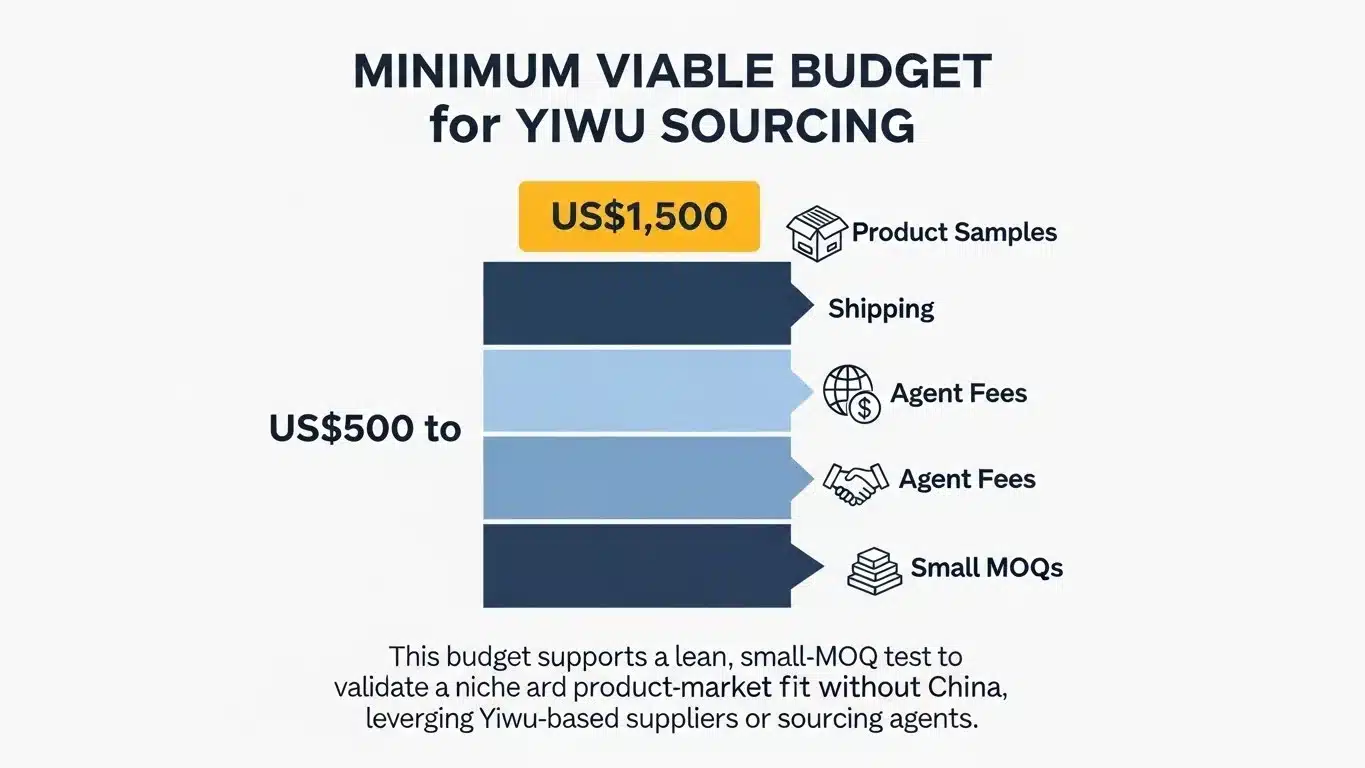
Under a retainer model, you pay a fixed monthly fee instead of a percentage commission on your FOB (factory gate) value. The typical range in Yiwu is $500 to $1,500 per month, depending on the agent’s claimed service scope. The appeal is obvious: predictable costs that do not scale with your order value.
However, predictability does not equal savings. The math is unforgiving. A $500/month retainer breaks even against a 5% commission at $10,000 FOB. A $750 retainer breaks even at $15,000. A $1,500 retainer requires $30,000 in monthly FOB volume before you save a single dollar compared to standard commission rates.
Viability Threshold for Established Buyers ($15,000+ Monthly)
We calculated the $15,000 threshold because it represents the crossover point for a mid-range $750 retainer against our standard 5% commission. At $15,000 FOB, a 5% commission costs exactly $750. Below this volume, the retainer model forces you to overpay for sourcing capacity you are not fully utilizing. Above it, the retainer starts generating net savings.
This is precisely why retainers are designed for established importers running consistent, high-volume FBA replenishment cycles. First-time Yiwu buyers rarely hit $15,000 FOB in their first month. If you are testing products or building initial supplier relationships, a retainer locks you into a fixed cost while your actual sourcing activity is still ramping up. Commission aligns the agent’s incentive with your actual spend; a retainer does not.
Service Scope Creep Risk and Hidden QC/Sample Charges
This is where the retainer model becomes genuinely dangerous for first-time buyers. Agents market retainers as “all-inclusive” or “unlimited sourcing,” but the contract fine print almost always carves out critical exceptions.
- QC Inspection Fees: $100 to $300 per man-day, typically not included in the retainer. A 2-day pre-shipment inspection adds $200 to $600 directly to your cost.
- Sample Charges: Factory sample fees and domestic courier costs are routinely excluded, even though securing samples is the most labor-intensive phase for first-time buyers.
- Logistics Coordination Fees: $100 to $300 per shipment for booking, customs declaration, and documentation handling, often presented as a separate line item.
We have seen first-hand how these add-ons erode the supposed predictability of a flat fee. A first-time buyer paying a $750 retainer, plus $300 for a QC visit, plus $150 for shipping coordination, is now at $1,200 for the month. At that total cost, the effective break-even against a 5% commission jumps to $24,000 FOB. Your true effective rate is no longer flat. It is a percentage fee disguised as a fixed one, with less transparency than an honest commission structure.

Commission vs Retainer Cost Comparison
At exactly $15,000 monthly FOB value, a 5% commission costs $750—identical to a basic retainer. The math below this number favors commission; above it, the economics flip.
Mathematical Comparison for $10K and $50K Buyers
Most first-time e-com buyers compare agent fees by looking at headline rates. The real test is running the actual numbers for your order volume. We break down the two most common entry points we see from Amazon FBA sellers sourcing from Yiwu.
For a $10,000 FOB monthly order, using a standard 5% commission means the agent fee is $500. A typical retainer for that service scope runs $500 to $1,500 per month. At this volume, commission keeps your cash flow tighter to the actual goods. You pay proportionally for the work performed.
At $50,000 FOB monthly, that same 5% commission jumps to $2,500. A $1,500 retainer now saves you $1,000 per month. For established importers moving serious volume, the retainer model makes clear financial sense. The risk shifts to the agent: if they underperform, you are still locked into a fixed cost.
- $10K FOB/Month: 5% commission = $500 | Retainer = $500–$1,500 | Commission wins by $0 to $1,000
- $50K FOB/Month: 5% commission = $2,500 | Retainer = $500–$1,500 | Retainer wins by $1,000 to $2,000
These calculations assume a clean 5% on the FOB factory price. In practice, we routinely find first-time buyers getting hit with “Base Calculation Exploitation”—agents quoting commission on the total landed cost including shipping and insurance instead of the FOB price alone. That single trick inflates your fee by 15% to 20% without you noticing.
Break-Even Analysis at $15,000/Month FOB Value
We calculated the precise crossover point where the two models cost the same. At $15,000 monthly FOB value, a 5% commission produces a $750 fee. That matches the lower end of the standard retainer range. This $15,000 mark is the decision line.
Below $15,000 FOB per month, commission protects your working capital. You are not overpaying for services you are not yet using at scale. Above $15,000, a percentage-based fee starts eating into your per-unit margin in a way that becomes structurally problematic as you grow.
The complication most guides ignore is the Yiwu-specific dual commission structure. Some agents advertise a low 1% to 2% buyer commission to win your business, then collect a separate 5% to 8% kickback from the factory. Your effective agent cost becomes 10% to 13% of the true factory price. At $15,000 FOB, that hidden margin costs you $1,500 to $1,950 per month—double what you expected.
Our internal rule is straightforward: we calculate commission strictly on the FOB factory invoice, and we provide that invoice directly to the buyer. When you can see the factory’s actual number, the break-even math becomes impossible to manipulate. For first-time FBA sellers, that transparency matters more than whether the fee structure is percentage-based or flat.
| Modelo de precios | Typical Rate | Mathematical Threshold | Hidden Cost Risks for FBA |
|---|---|---|---|
| Commission-Based (Calculated on FOB) | 5% – 8% (Standard for $5,000-$20,000 FBA orders) | More economical than retainers below $15,000 monthly FOB value | Vulnerable to ‘Dual Commission’ scams (5% from buyer + 5-8% factory kickback = 10-13% total) and ‘Base Exploitation’ (calculating on Landed Cost instead of FOB inflates fee by 15-20%). |
| Monthly Retainer (Flat Fee) | $500 – $1,500 per month | Break-even point is exactly $15,000 monthly FOB value | Damages first-time buyer economics if order volume drops; you pay fixed costs for unused capacity while still learning the Yiwu wholesale market guide. |
| Flat Project Fee | $500 – $3,000 per project | Only cost-effective for highly consolidated, high-value orders | Incentivizes rushed sourcing; QC ($100-$300/man-day) and Yiwu shipping to Amazon FBA coordination ($100-$300/shipment) are usually billed as separate hidden extras. |
See our verified physical sourcing model.

Hybrid Fee Structures
A hybrid fee structure only saves you money above $16,667 in monthly FOB value; for first-time buyers ordering $5,000 to $15,000, it actively inflates your per-unit cost.
Base Retainer ($500/Month) Plus Reduced Commission (2-3%)
The hybrid model sounds rational on paper: you pay a fixed monthly retainer of $500 to $1,500 depending on service scope, and in exchange, the agent drops their commission rate from the standard 5-8% down to 2-3% on FOB value. The pitch is that you “buy down” your variable cost with a fixed cost.
The math tells a different story for first-time FBA buyers. We ran the numbers on a typical hybrid structure—$500/month base retainer plus a 2% commission on FOB factory price. Here is how it compares against a straightforward 5% commission at different order volumes:
- $5,000 FOB order: Standard 5% commission costs $250. The hybrid costs $600 ($500 retainer + $100 commission). You overpay by 140%.
- $10,000 FOB order: Standard 5% costs $500. The hybrid costs $700 ($500 + $200). You overpay by 40%.
- $15,000 FOB order: Standard 5% costs $750. The hybrid costs $800 ($500 + $300). You still overpay by 6.7%.
- Break-even point: $16,667 FOB. Only above this threshold does the $500 hybrid structure become cheaper than a flat 5% commission.
If the retainer sits at $1,000 per month—a common midpoint in the industry—the break-even threshold jumps to $33,333 in monthly FOB value. For a first-time buyer testing product viability with initial orders between $5,000 and $15,000, a hybrid structure is straightforwardly bad economics. You are paying a fixed premium for capacity you do not yet need.
Aligning Agent Availability with Buyer Success
The theoretical justification for the retainer is availability. Agents argue that a guaranteed base fee ensures you get priority response times, dedicated account management, and faster turnaround on factory negotiations. For a high-volume distributor moving $50,000 monthly, that alignment makes commercial sense.
For a first-time Yiwu buyer, the alignment works in reverse. Your success depends on the agent caring about your order closing and your goods shipping correctly so they get paid. A pure commission model—where the agent earns 5% only when your FOB value materializes—creates a direct financial incentive for the agent to find you the right factory, negotiate the actual price down, and push the shipment through. Their income is literally tied to your landed cost performance.
With a hybrid model, the agent collects $500 regardless of whether your shipment clears customs on time or your factory delivers acceptable quality. The retainer decouples agent compensation from buyer outcomes at exactly the stage—your first order—where you need that alignment the most. We have seen first-time buyers locked into $1,000/month retainers receive the same response times as our commission-only clients, because the retainer bought access, not accountability.
The practical takeaway: stick to percentage-based commission for your first $15,000 in cumulative FOB orders. Once your monthly purchasing volume consistently exceeds $16,667 in FOB value, revisit the hybrid math with your agent. Until then, commission-only pricing keeps your agent’s incentives aligned with your per-unit landed cost—a critical advantage when you are still learning how to source from Yiwu market.

How to Negotiate Agent Fees
Base your commission strictly on the FOB factory price, not the landed cost. Cap logistics coordination fees at $150 per shipment to prevent margin erosion.
Negotiate Commission Against FOB Price, Not CIF
The single most expensive mistake first-time Yiwu buyers make is agreeing to a commission calculated on the total Landed Cost instead of the FOB factory price. When an agent quotes a seemingly low percentage but applies it to a CIF value that includes ocean freight, insurance, and local trucking, you are effectively inflating their fee by 15% to 20% for work they did not do.
We call this “Base Calculation Exploitation,” and it is rampant in Yiwu. You must explicitly lock the commission percentage to the FOB value—the exact price printed on the factory’s commercial invoice—before any shipping quotes are discussed. This isolates the agent’s sourcing fee from their logistics markup.
Even with an FOB baseline, remain vigilant against the Yiwu-specific “Dual Commission” scam. This occurs when an agent charges you a 5% buyer commission while simultaneously collecting a 5% to 8% hidden rebate from the factory. We solve this by requiring factory invoice transparency, ensuring you only pay the agreed 5% to 8% standard rate for $5,000 to $20,000 FBA orders, with zero double-dipping.
Cap Extra Charges for Logistics Coordination
Sourcing agents frequently blur the line between order management and freight forwarding to justify tacking on logistics coordination fees. Our logistics team found that industry-standard extra charges range from $100 to $300 per shipment simply for booking containers and communicating with forwarders.
You need to cap this fee before signing the service agreement. If your agent is already earning a 5% commission on your FOB value, they should not be charging you an additional $300 to send emails to a shipping line. Negotiate a hard cap of $150 per shipment for basic coordination, or demand that standard communication with your designated forwarder is included in the base commission.
If you are scaling your Amazon FBA shipments and considering a monthly retainer model—averaging $500 to $1,500 depending on service scope—logistics coordination must be explicitly listed as an included service. Remember the mathematical boundary we established: the break-even threshold where a retainer beats a 5% commission is exactly $15,000 in monthly FOB value. Beyond that point, paying a flat fee plus per-shipment logistics coordination penalties destroys your unit economics.
Conclusión
For your first shipment, demand a 5% commission calculated strictly on the FOB factory price. Period. Retainers only save you money if you push past $15,000 in monthly orders, which you won’t do on day one.
Before signing, ask your agent point-blank if they collect factory rebates. If they hesitate or refuse to show the raw supplier invoice, walk away. You can verify their math by checking that factory receipt against the quoted FOB price.
Preguntas frecuentes
How much do sourcing agents charge in China?
Commissions typically range from 5% to 10% of the factory FOB price. For fixed-fee structures, expect $500 to $1,000 per project. Always verify if the percentage applies to the factory cost or your total landed cost.
What is sourcing commission?
A percentage-based fee calculated on the total value of the goods sourced (the PO value). It aligns the agent’s payout with your order size, incentivizing them to secure better factory pricing.
What does 20% agency fee mean?
A 20% agency fee usually applies to creative or temp staffing, not product sourcing. In import terms, if a factory quotes ‘$100 plus 20% agency fee’, the factory is paying the agent $20 out of your $100—meaning you are likely overpaying for the goods.
What is the difference between a fee and a commission?
A fee is a fixed flat rate (e.g., $500 per project) regardless of order size, offering budget predictability. A commission is a variable percentage (e.g., 5%) that scales directly with your order volume.
Are sourcing agent fees negotiable?
Yes. Commission rates drop to 3-4% for orders exceeding $50,000. You can also negotiate to remove logistics coordination fees or sample handling costs by committing to a minimum monthly order volume.