 Justin
AI-driven customs audits are becoming standard in 2026. Ensure your documentation survives digital scrutiny with these facts:
- Invoice Validity: An Alibaba Proforma Invoice is not a legal document. Only a Commercial Invoice is valid for VAT and customs clearance.
- HS Code Consolidation: Professional agents can consolidate multiple items under a single 6-digit HS code (universal WCO standard) to simplify duty assessment.
- Sample Risk: Declaring functional goods as “samples” to avoid duty is a high-risk red flag. CBP requires mutilation or <$1 value for duty-free samples.
- VAT Refund: Correct paperwork alignment secures the 13% China VAT refund—a critical margin protector for volume importers.
If you’re importing from China, the invoice you receive can be the difference between a smooth customs clearance and a costly delay. Many buyers don’t realize that a standard Alibaba proforma invoice is just a preliminary quote—it lacks the binding tax details and accurate HS codes required by customs authorities, putting your shipment at risk of audits and penalties.
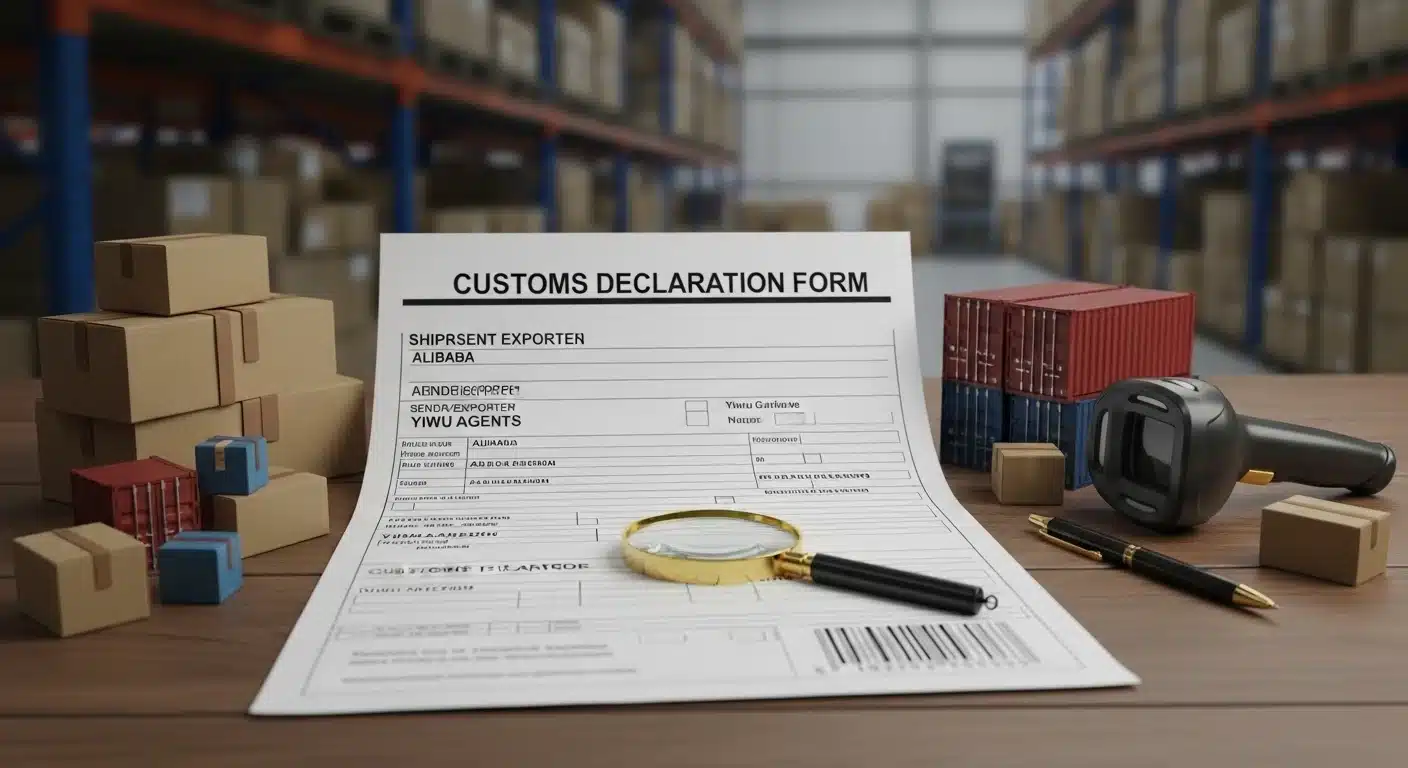
This article breaks down the critical differences between an Alibaba supplier’s invoice and one issued by a Yiwu-based sourcing agent. We’ll explain why agents can consolidate multiple items under a single HS code to simplify duty, how they secure China’s 13% VAT refund for factories by ensuring perfect paperwork alignment, and the specific documents you need to keep for a minimum of five years to audit-proof your imports.
The Problem with Alibaba “Proforma Invoices”
Proforma invoices from Alibaba are preliminary quotes, not legal documents. They outline terms like price and Incoterms but lack binding tax details and cannot be used to pay VAT or clear customs. Relying on them for official declarations risks customs delays, audits, and penalties due to mismatched or missing information.
| Document Type | Primary Purpose | Legal Status for Customs & Tax |
|---|---|---|
| Proforma Invoice | Non-binding preliminary quotation to confirm product specs, price, and terms. | Not valid. Cannot be used for VAT payment or final customs clearance. |
| Commercial Invoice | Legally binding record of sale issued after shipment. | Mandatory. Required by customs with full tax details and accurate HS codes. |

What a Proforma Invoice Is (and Isn’t)
A proforma invoice from an Alibaba supplier is a preliminary document. Its main job is to serve as a non-binding quotation to lock in product specifications, price, and delivery terms before you issue a formal purchase order.
You’ll typically find key deal points listed: detailed product descriptions, unit price, total amount, quantity, agreed Incoterms like FOB or CIF, payment terms, and estimated shipping dates. This makes it useful for internal approval and initial logistics planning.
However, it lacks legal validity for official government processes. You cannot use a proforma invoice to pay value-added tax (VAT) or as the final document for customs clearance. This is the critical difference from a commercial invoice, which is a binding legal document issued after shipment and contains the complete tax details authorities require.
The Compliance Gaps and Import Risks
Attempting to use a proforma invoice for official purposes creates immediate compliance problems. For U.S. Customs, the declared value, HS codes, and tax information on the final commercial invoice must exactly match the data in your entry summary. A preliminary proforma often lacks this precision or contains estimates, creating a mismatch that can trigger an audit.
These discrepancies lead to customs delays, inspections, and potential financial penalties. The informal nature of a proforma also complicates logistics and financing; freight forwarders and banks processing letters of credit require binding commercial documents.
You are left vulnerable if the supplier’s final commercial invoice has different terms, prices, or product descriptions than the proforma you agreed to. Without a proper contract aligning both documents, resolving such disputes becomes difficult and can disrupt your supply chain and payment schedules.
Why Agents Can Consolidate HS Codes (Simplify Duty)
Agents can consolidate HS codes because the system’s first six digits are uniform globally. This allows a single classification to cover shipments of multiple related items, such as sets or composite goods, reducing the number of line items on customs entries and streamlining duty assessment.

The Universal 6-Digit Foundation of the HS
The Harmonized System (HS) is built on a universal 6-digit code structure. This framework classifies over 5,000 commodity groups and is used by more than 200 countries, covering about 98% of all internationally traded merchandise.
These first six digits are identical worldwide, providing a consistent base for classification across all borders. Countries only add their own national digits for further specificity after this shared 6-digit subheading. This global standardization is what makes consolidation possible.
Applying the Rules for Sets and Composite Goods
The technical mechanism for consolidation is found in the General Rules of Interpretation (GRI), specifically Rule 3. This rule governs the classification of composite goods, mixtures, and sets.
For example, Rule 3 allows a sourcing agent to classify a shipment containing multiple related items—like a textile and apparel set—under a single, appropriate 6-digit HS code. By correctly applying these World Customs Organization (WCO) rules, agents can minimize the number of line items on a customs entry.
This practice reduces classification errors and simplifies the duty calculation process for the importer. The uniform interpretation provided by WCO tools like the Explanatory Notes ensures this consolidation is recognized by customs authorities globally, preventing disputes and streamlining the entire customs declaration.
Declaring Value: The Risk of “Sample” labeling
U.S. Customs and Border Protection (CBP) does not accept vague ‘sample’ labels to avoid duties. Legitimate duty-free entry for samples is strictly limited to items valued at $1 or less or that are physically mutilated. Functional goods declared as samples risk full duty assessment, shipment delays, and legal penalties for misdeclaration.

Why “Sample” Labels Don’t Work for Customs
CBP determines what you owe based on the tariff classification, the actual transaction value, and the country of origin of your goods. The description on your commercial invoice, like “samples,” does not override these legal criteria.
Official customs forms, such as the PS Form 2976-R, explicitly require detailed item descriptions. An entry like “samples” will be rejected. You must provide specifics, such as “men’s cotton shirts,” to allow for proper tariff classification.
U.S. law provides a narrow exception for duty-free samples under HTS 9811.00.60. To qualify, each individual item must have a value of $1 or less, or it must be physically mutilated (e.g., drilled, cut, or permanently marked) to render it unfit for sale.
Labeling a finished, functional product as a “sample, not for resale” does not change its nature for customs purposes. If the item exceeds the $1 value threshold and is not mutilated, it is treated as regular merchandise and is fully dutiable.
The Consequences of Mislabeling
The most immediate consequence is a financial one. CBP will assess duties and taxes based on the good’s actual commercial value, not the nominal “sample” value on the invoice. Any attempt to save costs through mislabeling will fail.
Shipments declared as samples often face delays for inspection and verification. This can lead to storage fees at ports and disrupt your supply chain, causing further downstream costs and complications.
A significant discrepancy between a low-value commercial invoice and the higher value declared on the CBP entry summary is a red flag. This mismatch can trigger a customs audit or a broader investigation into your import practices.
Penalties for fraudulent or negligent declarations are severe. They can include monetary fines, prosecution, and the seizure of goods. CBP may also demand the goods be exported or destroyed at the importer’s expense.
Separate from duty evasion, mislabeling often leads to violations of country of origin marking rules under 19 CFR Part 134. Failure to properly mark goods with their country of origin in English can result in an additional 10% duty on the value of the goods.
Your Guide Through the World’s Largest Market

Export Licenses: Do Alibaba Sellers Have One?
An export license is a mandatory legal document issued by China’s State Administration of Foreign Exchange (SAFE). It authorizes a company to export goods and receive foreign currency payments. Not all Alibaba sellers have one; reputable suppliers provide them, but smaller entities may avoid the process, relying on third-party agents instead.

What a Valid Chinese Export License Contains
A legitimate Chinese export license is issued by the State Administration of Foreign Exchange (SAFE). It contains an 18-digit registration number, the company’s official name and address, and the legal representative’s information.
The document also lists the company’s business scope, date of establishment, registered capital, and expiry date. A key security feature is a QR code that links directly to China’s National Enterprise Credit Information System for official verification of the company’s details.
When Licenses Are Required and the Risks of Not Having One
An export license is mandatory for exporting restricted or controlled goods, such as electronics, chemicals, and dual-use items. It is often required alongside other compliance certificates like CCC, CE, or FDA.
Sellers operating without the proper license risk customs holds, shipment seizures, and fines at the border. To avoid the bureaucracy and cost, smaller suppliers sometimes skip obtaining their own license. Instead, they use third-party trading agents for a fee, typically around 1% of the export value, to handle the legal export process on their behalf.
VAT Refunds: How Agents Help Factories Claim 13%
Agents help factories secure VAT refunds by ensuring precise paperwork alignment between customs declarations and supplier invoices, which is critical for China’s 13% refund. They also manage complex EU refund claims for non-EU businesses under directives like 2008/9/EC, handling multi-state rules, deadlines, and audits to prevent costly rejections.

The Core Challenge: Precision in Paperwork for China’s 13% Refund
In China, the VAT Model B system applies a standard 13% rate on exports for both manufacturing and trading companies. The refund process is strict: approval is granted only when the customs declaration document perfectly matches the supplier’s invoice in every detail. This includes exact alignment of company names, product quantities, and units of measurement.
Even a minor discrepancy, such as a typo or a different unit of measure, results in immediate rejection or significant processing delays. Agents mitigate this risk by meticulously verifying all documents before submission to customs authorities.
Furthermore, agents often source products directly from factories rather than through trading companies. This direct approach avoids the traceability issues and extra layers of inspection that can arise when multiple intermediaries are involved, streamlining the compliance process for high-volume manufacturing.
For VAT refunds in the European Union, non-EU businesses typically file claims under either the 13th Directive, which requires a reciprocal agreement between countries, or Directive 2008/9/EC. Claims are submitted electronically through the business’s home tax authority, accompanied by invoices, VAT numbers, and proof of export.
Agents manage the complex variations in rules across EU member states. For instance, Germany’s processing time can take 4 to 8 months, while Spain enforces a minimum invoice threshold of €1,000 for claims. Agents are responsible for tracking strict annual deadlines, such as the September 30 cutoff for claims from the previous calendar year, and can secure interest payouts for administrative delays by tax authorities.
A critical part of an agent’s role is preparing for and defending against post-refund audits. EU tax authorities can review claims years after payment and reverse them if non-compliance is discovered. Agents ensure all documentation and procedures withstand this scrutiny, protecting the factory’s financial recovery.
Audit Proofing Your Imports
Audit proofing involves maintaining a consistent, version-controlled set of import documents for a minimum of five years. This prevents penalties by ensuring your commercial invoices, HS code classifications, and declared values align perfectly with official filings in the CBP’s Automated Commercial Environment (ACE).
| Document Type | Purpose | Retention Period |
|---|---|---|
| Commercial Invoice & Packing List | Verifies declared value, quantity, and description of goods. | 5 years minimum |
| HS Code Classification Notes | Justifies tariff classification and duty rate applied. | 5 years minimum |
| CBP Form 7501 (Entry Summary) | Official record of entry; must match commercial documents. | 5 years minimum |
| Country of Origin / USMCA Certifications | Supports claims for duty-free treatment under trade agreements. | 5 years minimum |
| Importer Security Filing (ISF) | Required for ocean shipments; part of security data. | 5 years minimum |

The Core Documents You Must Keep
The foundation of a defensible import record is a complete, organized set of mandatory paperwork. U.S. Customs and Border Protection (CBP) requires importers to maintain all entry documents for at least five years from the date of entry. This retention period allows CBP to conduct audits on past shipments.
Critical commercial documents include the commercial invoice and packing list, which detail the value, quantity, and description of your goods. Alongside these, you must keep your internal HS code classification notes that justify the tariff code you declared. This is a primary audit target.
Essential control documents include certificates of origin and any supporting paperwork for trade programs like USMCA. These prove your goods qualify for preferential duty rates. For ocean freight, your Importer Security Filing (ISF) documents are a mandatory part of the record. Finally, the official CBP Form 7501, the entry summary, must be kept and routinely checked for consistency against your commercial paperwork. Any mismatch is a compliance risk.
Conducting a Proactive Self-Audit
Testing your own records before a formal audit is the most effective way to identify and correct errors. This process involves sampling past shipments to check for inconsistencies, which mirrors CBP’s own audit methodology.
Start by reviewing HS code classifications across similar product entries. Inconsistency here is a major red flag for CBP. Next, compare declared values on entry summaries against the actual commercial invoices to spot any patterns of potential undervaluation.
Verify that all required control documents, like origin certificates, are present and correctly filled out. Then, map your internal records directly to your official filings in the Automated Commercial Environment (ACE) system. This direct comparison helps spot discrepancies early. If you find errors, you can use the ACE system to file post-summary corrections proactively, fixing mistakes before they trigger penalties in an audit.
Final Thoughts
The choice between an Alibaba supplier’s invoice and a Yiwu agent’s invoice comes down to a trade-off between initial simplicity and long-term compliance. An Alibaba proforma invoice is a useful tool for locking in a quote, but it’s not a substitute for the legally binding commercial invoice required for customs. Relying on it for official declarations invites delays, audits, and penalties due to mismatched information. An agent’s invoice, backed by their role in the transaction, is designed from the start to meet customs requirements, ensuring the declared value, HS codes, and other details are accurate and defensible.
Ultimately, an agent provides more than just a piece of paper; they offer a layer of compliance management. They handle the complexities of HS code consolidation, ensure proper valuation to avoid “sample” mislabeling risks, verify export licenses, and secure VAT refunds through precise paperwork. This proactive approach audit-proofs your imports by maintaining consistency across all documents. For importers focused on building a reliable, penalty-free supply chain, the structured support and expertise embedded in an agent’s service often justify the choice over navigating the procedural gaps of a direct supplier relationship alone.
Frequently Asked Questions
Does Alibaba provide a commercial invoice?
Yes, Alibaba provides VAT invoices for orders where it collects tax at checkout. However, the complete commercial invoice for customs clearance should come directly from your supplier. This document must include 10-15 specific data points like seller and buyer details, a unique invoice number, product description with HS Code, quantity, unit price, total value, country of origin, shipping Incoterms, and the supplier’s signature. Always request this from your Alibaba supplier to ensure smooth customs processing.
How is customs value declared for imports from China?
The primary method is the transaction value, which is the price paid for the goods plus costs like transportation and insurance to the port of entry. Customs officials can require alternative valuation methods if they doubt the declared price. For shipments with a declared value over RMB 5,000, or those under this threshold but exceeding quantity limits, accurate documentation including product descriptions, HS codes, and Incoterms is critical. Providing insufficient detail can lead to delays, duty adjustments, and penalties.
Do I need an export license when using a sourcing agent?
The sourcing agent itself does not need a specific export license. The legal requirement falls on the U.S. Principal Party in Interest (USPPI)—the exporter who controls the shipment. This party must determine if an export license is needed based on the item’s Export Control Classification Number (ECCN), destination country, end user, and end use, following U.S. Bureau of Industry and Security (BIS) regulations. License processing can take up to 3-6 months depending on various factors.
Can I undervalue goods on customs declarations to save on duties?
No, undervaluing goods is illegal and constitutes customs fraud. Importers must declare the true transaction value—the price actually paid or payable—on CBP Form 7501 and the commercial invoice. Penalties for falsifying invoices or using other methods to lower declared value include significant fines, potential imprisonment, and increased duty assessments. This rule applies regardless of value, even for shipments under the $800 duty-free threshold.
What is the China VAT refund for exporters?
China’s VAT refund is an export rebate system where manufacturers can claim back a portion of the Value-Added Tax paid on inputs during production. The refund rates vary by product category, ranging from 0% to a maximum of 13%. The system is designed to keep Chinese exports competitive by not burdening them with domestic tax costs. Factories use this mechanism, and a sourcing agent can help ensure all documentation is correct to facilitate the claim.
Sourcing from 1688? Don’t use low-quality stock photos. Boost your sales with professional China-based photography.