

 Justin
Most ZGYW latch installation mistakes are not latch problems at all. They are fastener problems, substrate problems and handing problems, and they get diagnosed as “defective hardware” because the latch is the only part of the assembly with a brand name on it. If you are holding a carton of latches that bind, rattle or refuse to catch, the fault is usually recoverable on site with a driver and a shim — and the ones that are not recoverable were decided months earlier, at the factory, before the carton was sealed.
This guide is written for the importer or reseller who has to answer for a lot of latches, not for a homeowner fixing one gate. It merges everything this site previously published across several overlapping ZGYW latch articles into one page, and in doing so it corrects them. The earlier versions circulated confident figures — a 73% warping rate, a 50,000-cycle bench test, a 10 ft-lb torque spec — that we could not substantiate against any published source.
The first two have been removed rather than restated. The third was worse than unsupported: a torque number quoted with no fastener class attached, which makes it meaningless on half the hardware it was aimed at. That one is corrected below against the published table, not deleted.
Key takeaways
- Torque is a published number, not a feeling. An M6 property class 8.8 fastener is specified at 10.5 Nm dry and 7.9 Nm lubricated. The “10 ft-lb” figure this site published previously equals 13.6 Nm — about 30% over the dry figure, and applied to fasteners two classes softer it is far worse than that.
- Dry and lubricated are different installs. The nut factor moves from roughly 0.20 dry to 0.15 lubricated, so the same wrench setting produces a materially different clamp load.
- The pilot-hole chart you found optimises the wrong thing. The American Wood Council’s 70%/90% root-diameter ratios target withdrawal strength, and explicitly not split resistance.
- “Passes salt spray” is an incomplete claim by construction. ASTM B117 defines the apparatus and procedure and deliberately sets no pass/fail duration.
- Handing errors are a labelling failure upstream, not installer carelessness, and they are caught at sample approval — not at the gate.
Jump to what you need: fastener mistakes · pilot holes · gate sag · sliding doors and tracks · lubricant and corrosion · handing · factory-side causes · troubleshooting · specifying the next order · FAQ
Why Most ZGYW Latch Installation Mistakes Are Fastener Mistakes
A gate latch is a plate, a bolt and a spring held against a moving frame by four or six small fasteners. Nearly every field failure that gets blamed on the latch traces back to how those fasteners were set. The mechanism is simple: overtighten the mounting screws and the plate deforms around the bolt holes, which moves the bolt centreline relative to the strike, which is exactly the misalignment the installer then tries to fix by tightening further.
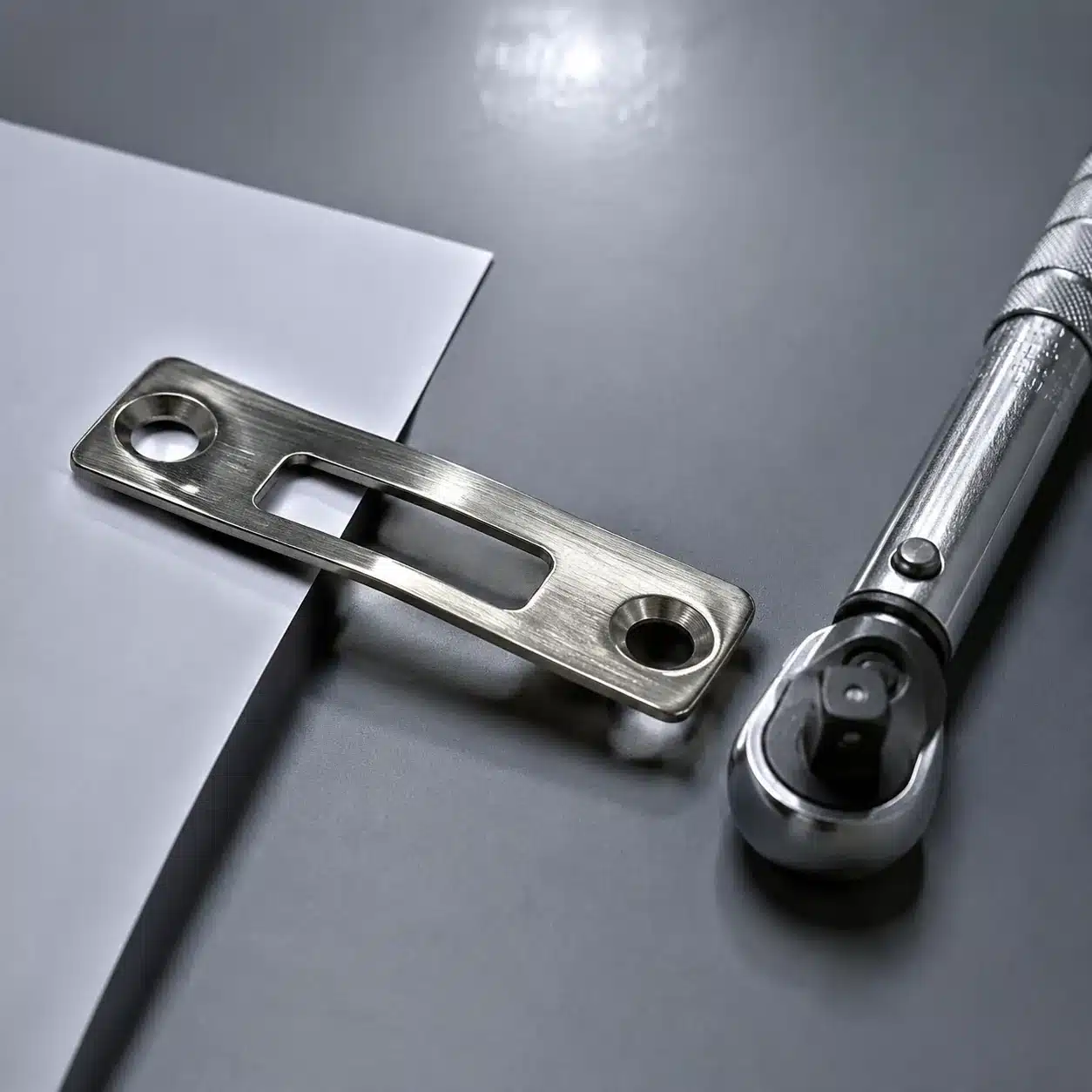
The number almost nobody installing a latch has seen
Latch mounting hardware is typically M5 or M6, and the figure you need depends on which property class you were actually shipped. Fastenal’s published torque-tension table for ISO 898-1 metric fasteners puts a class 8.8 M6 at 10.5 Nm dry and 7.9 Nm lubricated, and a class 8.8 M5 at 6.2 Nm dry. The same table puts a class 4.6 M6 — ordinary mild-steel hardware, which is what a lot of budget latch kits actually contain — at 4.1 Nm dry.
That is the line worth re-reading: the correct torque for the same M6 hole varies by a factor of 2.5 depending on a marking stamped on the bolt head, and nothing in the feel of the driver tells you which one you are holding.
A correction, stated plainly. Earlier articles on this site specified 10 ft-lb ± 0.5 for latch mounting bolts, with no fastener size or property class attached to it. That is 13.6 Nm. Against a class 8.8 M6 it is roughly 30% over the published dry figure — an overtorque, but a survivable one on a good bolt. Against the class 4.6 M6 hardware that ships in a lot of latch kits, the same 13.6 Nm is more than three times the 4.1 Nm published figure, and it exceeds that bolt’s entire clamp-load budget.
So the original spec was not merely too high. It was unusable, because a torque figure quoted without a size and a class is not a specification at all — it is a number that happens to be safe on some of your stock and destructive on the rest. If your installers were working to it, expect exactly the pattern you are probably seeing: most plates fine, a subset badly cupped, with no correlation to who installed them.
| Size | Class 8.8 dry | Class 8.8 lubricated | Class 8.8 clamp load | Class 4.6 dry |
|---|---|---|---|---|
| M5 | 6.2 Nm | 4.6 Nm | 6,177 N | 2.4 Nm |
| M6 | 10.5 Nm | 7.9 Nm | 8,744 N | 4.1 Nm |
| M8 | 25.5 Nm | 19.1 Nm | 15,921 N | 9.9 Nm |
Why the same setting gives two different results
Before any of those numbers are usable, someone has to read the bolt head. Class 8.8 is marked “8.8”; class 4.6 is often unmarked, which is itself the answer — treat an unmarked head as low-class until a mill certificate says otherwise and torque it to the 4.6 column. No installation sheet on the market asks for that ten-second check; it is the highest-value line you can add to yours.
Then there is the lubricant. Torque relates to clamp load through T = K × D × F, where K is the nut factor: about 0.20 for a dry fastener and 0.15 lubricated. That difference is roughly 25%, and it runs in the direction people do not expect. Lubricate a thread and the same torque setting drives more clamp load into the joint, not less, because less of your input is being burned as friction. An installer who oils a stiff screw and then torques it to the dry figure has quietly overloaded the joint while doing everything he was told.
This matters for a shipment more than for a single gate. If half your installers oil the threads and half do not, you get a bimodal failure pattern across one lot — some plates fine, some cupped — which reads exactly like inconsistent product quality and is nearly impossible to argue with a supplier after the fact.
Recovering a plate you have already crushed
- Back every mounting fastener out completely. Do not attempt to correct by loosening a quarter turn — you need the plate unloaded to see whether it has taken a set.
- Lay a straightedge across the plate face. Visible daylight under it, or a plate that rocks on a flat surface, means it is deformed and will not return.
- If it is flat, refit and tighten in a cross pattern to the figure for your fastener size, dry, in two passes — roughly half, then full.
- If it is cupped, replace the plate. A deformed plate re-tightened to the correct torque still holds the bolt off-centre.
Skipping the Pilot Hole in Hardwood
The second recurring failure is a split post, and it produces the most expensive kind of complaint because the damage is to the customer’s gate rather than to your product. It is also the mistake most likely to be made by a competent installer working from a chart, because the widely circulated pilot-hole ratios are solving a different problem than the one he has.
The chart optimises withdrawal strength, not split resistance
The American Wood Council’s NDS guidance, tabulated here with the underlying root diameters, is a pilot at 70% of root diameter in softwood and 90% in hardwood. Read the basis and the caveat matters more than the number: those ratios maximise how much load the screw will hold before pulling out, and they are explicitly not concerned with whether the wood splits or how hard the screw is to drive. In oak, ipe or teak near an edge, the split-resistant pilot is the larger one — you are trading a little withdrawal capacity for a post that survives installation.
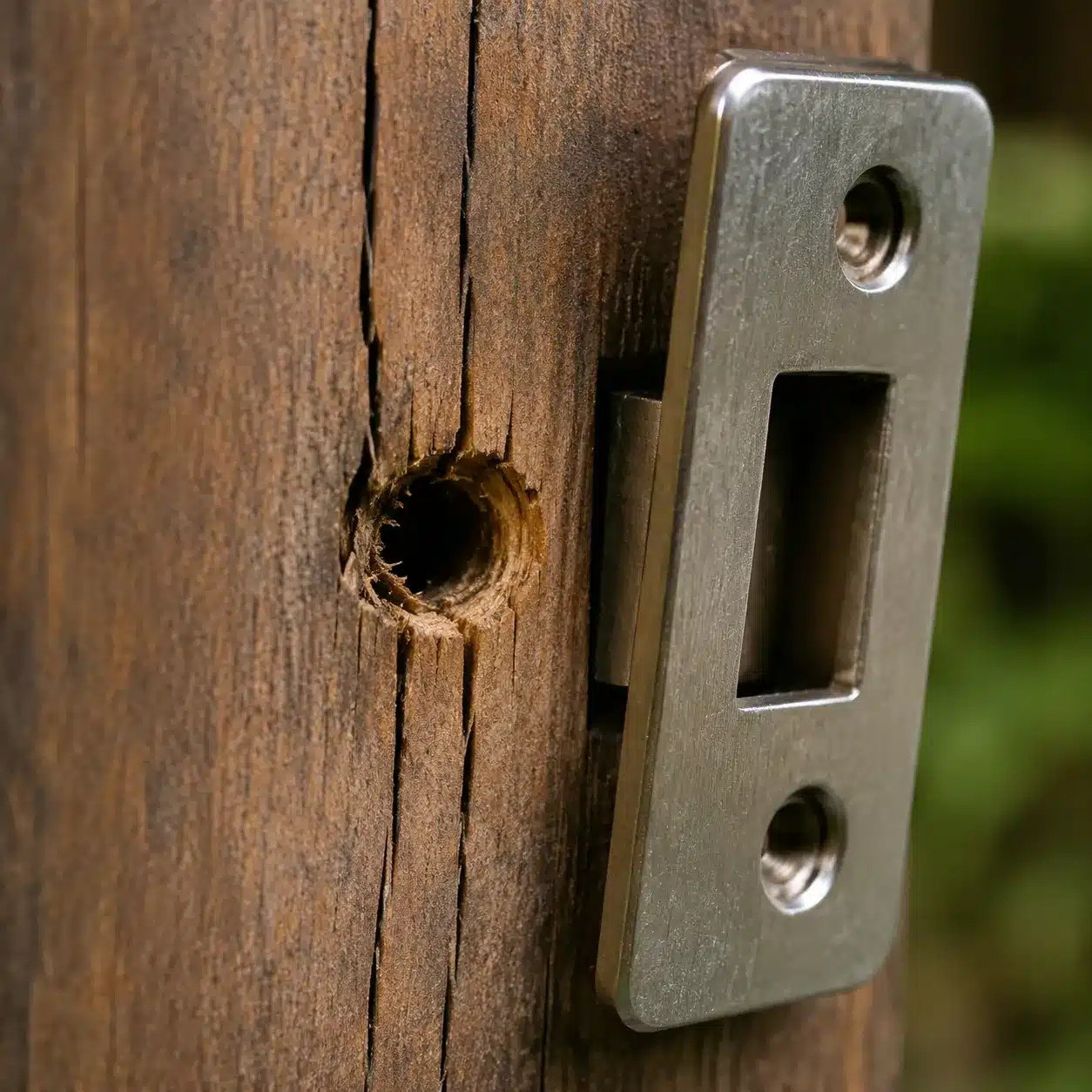
For a #8 wood screw, the conventional pairing is a 7/64 inch (2.8mm) pilot in softwood and 1/8 inch (3.2mm) in hardwood. The practical rule that follows from the AWC basis: in dense hardwood, size the pilot to the screw’s root diameter itself rather than to a percentage of it, and drill 1–2mm deeper than the screw will reach so the tip is not compacting sawdust into a wedge at the bottom of the hole.
- Always drill in hardwood. There is no screw gauge small enough to be safe near the end grain of an oak post.
- Centre-punch first. A bit that wanders on dense grain enlarges the hole oval, and an oval hole lets the plate shift under load.
- Keep the bit perpendicular. An angled pilot pulls the plate out of square as the screw seats, which shows up later as strike misalignment.
- Finish by hand. Drive the last two turns with a manual driver so you feel the head seat instead of discovering it through a stripped head.
Fighting Gate Sag Instead of Fixing It
When a latch stops meeting its strike a few weeks after a clean installation, the latch has not moved. The gate has. Timber gates take up moisture, hinges bed into their fixings, and the leading edge drops. The instinctive repair — move the strike plate down to meet the bolt — locks the fault in and guarantees a second call-out once the gate drops again or dries back.
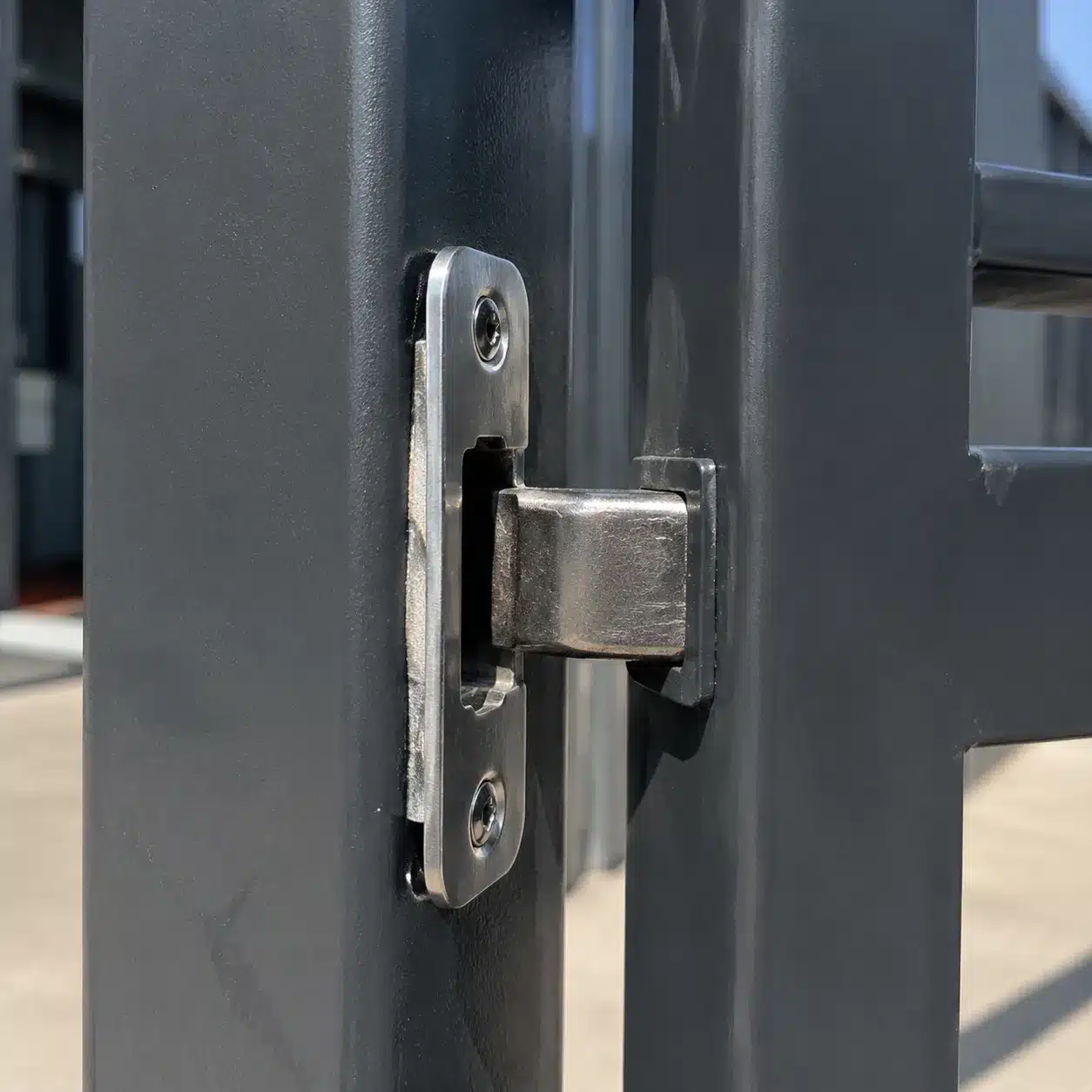
Diagnose the frame before you touch the latch
- Close the gate and put a spirit level on the top rail. Out of level means the problem is the frame, full stop.
- Lift the leading edge by hand. If the latch suddenly lines up, you have confirmed sag and nothing else needs diagnosing.
- Check the hinge fixings before adjusting anything — a loose hinge lag is the cheapest possible fix and the most commonly missed one.
- Only once the gate closes square should you set the strike plate, and then only once.
Where the frame is square and the offset is genuinely small, shim washers behind the strike plate are the correct tool, and stainless is worth specifying so the shim does not become the corrosion site. Keep the stack shallow: past two or three thin shims the fastener loses effective thread engagement in the post and the plate begins to flex under load rather than sit against it. If you need more offset than that, the frame is still wrong and shimming is postponing the real repair. Sourcing the right hardware for a mixed gate spec is exactly the kind of variance our China product sourcing service is built to control at the factory rather than in the field.
When the Latch Rolls: Sliding Door and Track Derailment
Rolling latches and sliding-door hardware get returned as “defective” for the same reason swing-gate latches do: the moving part is the only component with a brand name on it, so it takes the blame for a track that was never level. If a door works in the shop and jumps the track a few days after installation, start with the track and the door, and touch the latch last.
Check in this order
- Track level. Put a spirit level on the track surface along the door’s full travel, not just at the ends. A self-centering wheel set can absorb a small amount of tilt; it cannot absorb a track that runs downhill, and the door will walk to the low end every cycle. Shim the low side at the bracket, loosen the bracket screws only as far as needed, and re-check with the level before tightening.
- Debris in the groove. Grit, paint drips and swollen sealant in the channel lift the wheel at the same spot every time, which reads as a rhythmic bump. Clear the full length of the channel before adjusting anything else.
- Wheel flat spots. Rotate each wheel by hand. A catch, or a visibly flattened patch, means the wheel has been dragged rather than rolled — usually because the door was forced over debris or a mis-set stop. A flat-spotted wheel cannot be shimmed back into round.
- Housing cracks. Die-cast housings do not tolerate a crack. Any crack visible to the naked eye propagates under the door’s weight until the assembly lets go. There is no shim for this.
Replace the assembly only for the last two. On most sealed rolling latches the wheels are not individually serviceable, so a flat spot or a crack means the whole unit — confirm that with the supplier before ordering spares, and put it on the specification if you want serviceable wheels. Everything else on the list is a track fix, and the same fastener rule from the top of this guide applies to the track brackets: torque them to the published figure for the screw’s property class, because a bracket that has been cranked until it “feels solid” is the most common way to put a new tilt into a track that was level a minute ago.
The Wrong Lubricant and the Corrosion You Cannot See
A sticking latch gets sprayed with whatever is in the van. Usually that is a penetrating oil, which is formulated to creep into seized threads and displace water — not to stay in a moving joint and carry load. It frees the mechanism for a few weeks, then washes out and leaves the bolt drier than before, which is why the second complaint about the same latch usually arrives faster than the first.
What actually determines outdoor life
For a latch that lives outdoors, the alloy matters more than the spray. The difference between 304 and 316 stainless is molybdenum: 316 carries roughly 2–3% of it, 304 essentially none. That feeds the Pitting Resistance Equivalent Number, PREN = Cr + 3.3Mo + 16N, on which 304 lands at approximately 18–20 and 316 at approximately 23–28. In chloride exposure — coastal air, pool enclosures, de-iced roads — that gap is what separates a latch that stains in a season from one that does not.
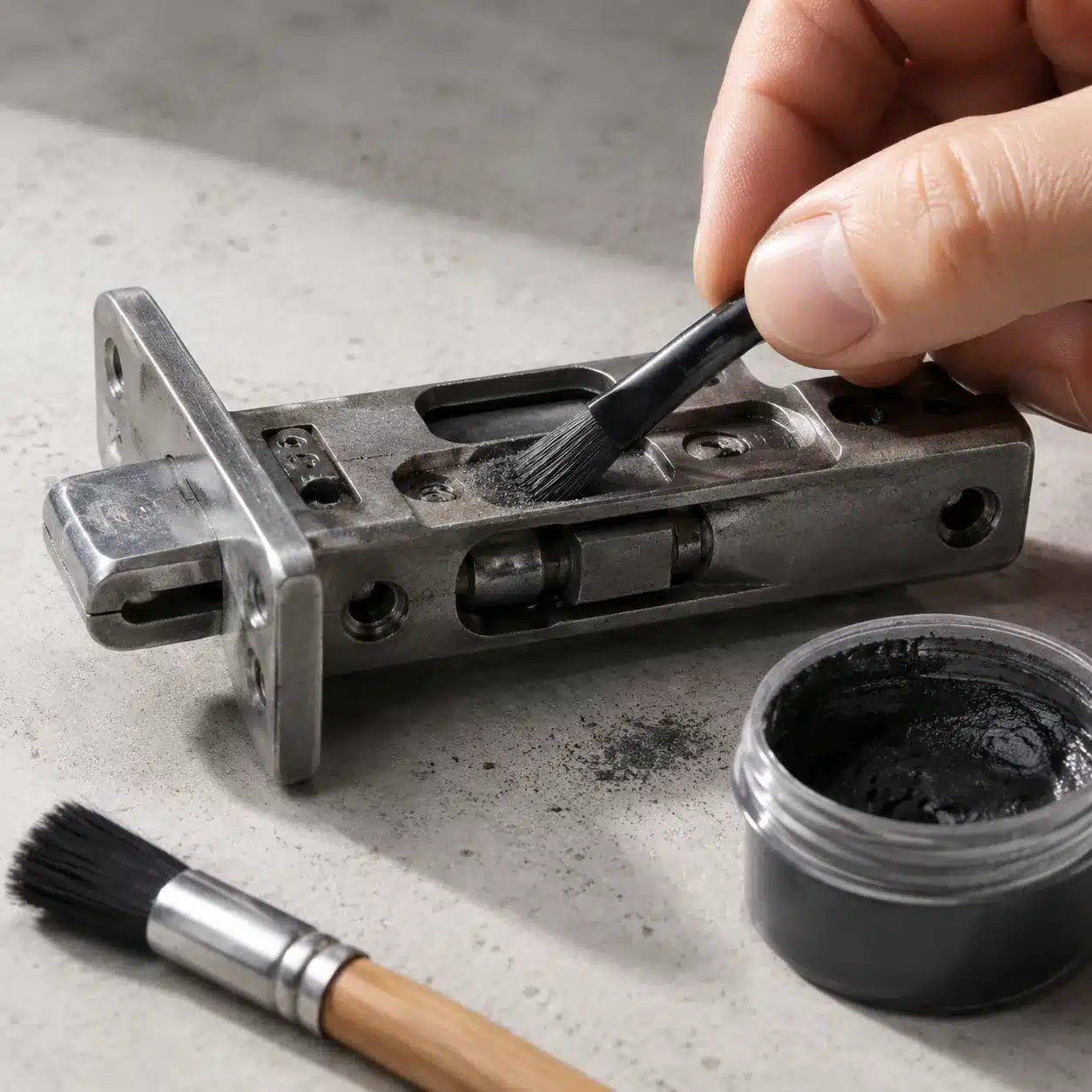
Why “passes salt spray” tells you almost nothing
Suppliers quote salt-spray performance as if it were a durability rating. ASTM B117 defines a neutral salt spray test — 5% sodium chloride, pH 6.5 to 7.2, 35°C, with 1.0 to 2.0 mL of solution collected per 80 cm² per hour — but it specifies the apparatus and procedure only. It sets no pass/fail duration at all; that has to come from the applicable product standard. So “passes salt spray” is structurally incomplete: passes for how many hours, judged against what criterion?
For plated rather than solid stainless parts, published figures put conventional electroplated zinc at 9 micrometres with a yellow chromate at under 5% red rust after 96 hours, with plain zinc holding roughly 120 hours. Treat those as typical published values rather than guarantees. The failure criterion is worth knowing regardless of the number: red rust means the zinc is locally depleted and the steel underneath is exposed, so a part showing red is not partly protected, it is unprotected at that spot.
The service routine that actually extends outdoor life
Most budget gate latches are zinc die-castings, and a zinc body pressed against a steel strike plate in the presence of moisture is a galvanic couple: the zinc is the sacrificial side and corrodes first, at exactly the contact face that carries the load. That is why a latch can look fine on the housing and still bind at the pawl. The routine that slows it down is short and has nothing to do with the spray can:
- Lubricate with a dry-film PTFE or silicone product, applied thinly to the spring, pivot pin and pawl face. Penetrating oils and general-purpose petroleum sprays hold grit and trap moisture at the interface, which accelerates the very corrosion they were meant to prevent.
- Rinse salt off. Within sight of the sea, a fresh-water wipe of the latch and strike face on a regular cadence removes the chloride that drives pitting. It costs nothing and it is the single most effective step on a coastal gate.
- Read the surface. White powdery deposits on a zinc casting are the coating giving way; a blistered or lifted finish means the base metal underneath is already gone. Clean and re-lubricate the first; replace the second — painting over a blistered zinc casting traps moisture and finishes the job faster.
- Do not mix metals at the fixings. Stainless screws into a carbon-steel frame, or plated screws into a stainless plate, add a second galvanic couple. Match the fastener to the plate.
None of this rescues a latch that was the wrong alloy for the site. For coastal, pool-side or wash-down installations the durable fix is the one in the specification section below: 316 on the purchase order, for the body, the strike plate and the spring, not just the visible housing.
What to ask instead. “Salt spray hours to first red rust, per ASTM B117, with the acceptance criterion stated, on the finish you are actually shipping me.” A supplier who can answer that is testing. A supplier who repeats “passes salt spray” is quoting a brochure.
Mounting the Latch Backwards: A Handing Problem, Not a Reading Problem
Some latches are handed — left or right — and some are reversible with the cam flipped. A backwards installation is obvious the moment the gate swings, and it is invariably logged as installer error. It usually is not. It is a labelling failure that happened before the box was taped shut, and it is worth separating the two because they have completely different fixes.
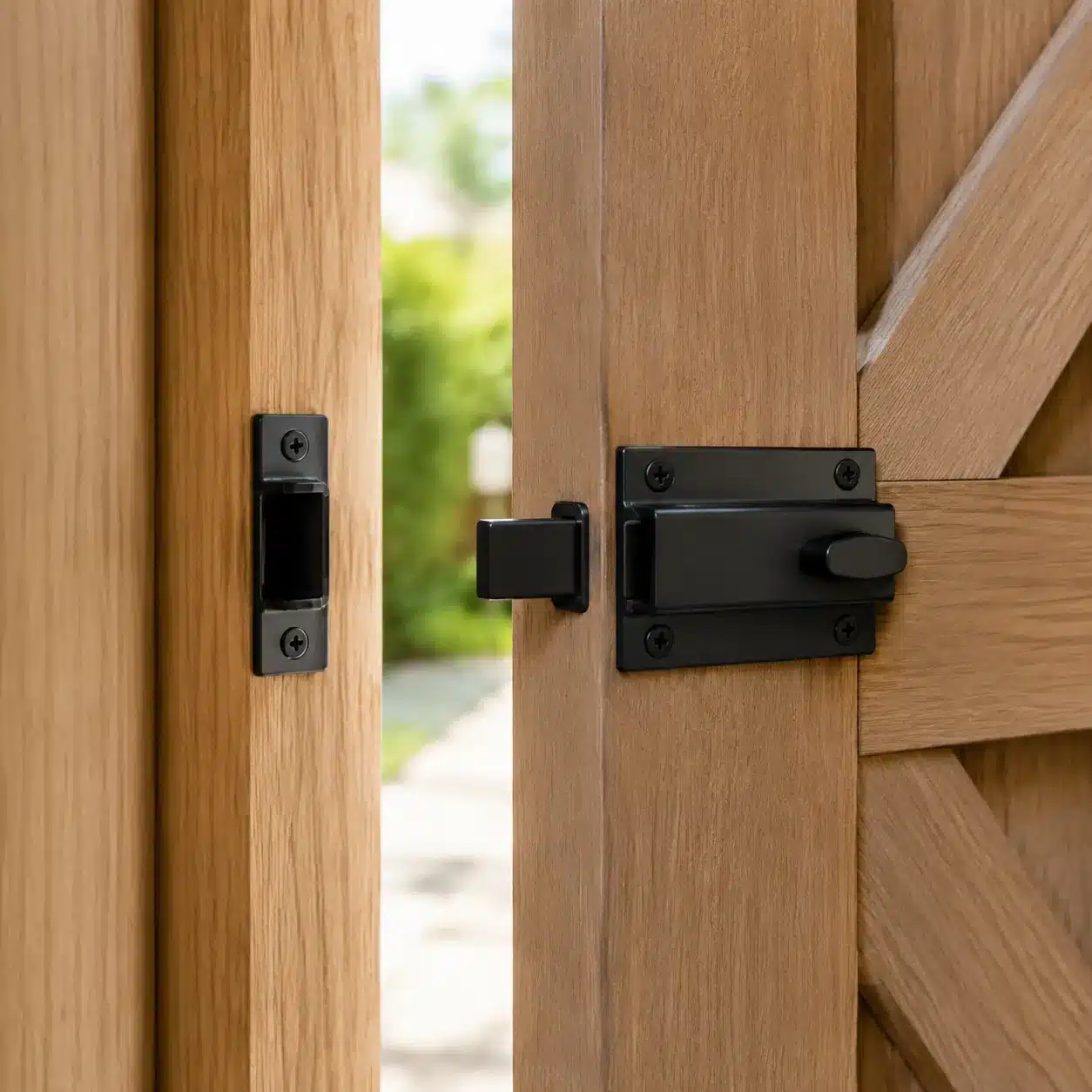
The 30-second test before you drill
- Hold the latch against the closed gate in its intended position without fixing it.
- Work the bolt by hand. It must retract away from the direction the gate swings toward you, and drop cleanly under its own weight or spring.
- If it binds, fouls, or must be forced, flip the cam if the model allows it, or you are holding the opposite hand of what this opening needs.
- Only then mark and drill. A handing error discovered after drilling costs a post, not a latch.
The upstream version of this problem is what makes it a sourcing issue rather than a training issue. Orientation is often indicated by a small cast or etched arrow on the body — and a powder-coat or plating pass applied after casting can fill or obscure it entirely. The installer is then guessing, at scale, on a pallet where left and right units are visually identical. That is not something a site briefing fixes.
What Actually Went Wrong at the Factory
Everything above is recoverable on site. This section is about the failures that are not, because they were built into the carton — and it is the part a general hardware guide cannot write, because it requires having stood on the production side of the transaction rather than the installation side.
Four upstream causes that present as installation error
- The wrong variant was picked. Hardware workshops run near-identical SKUs down one line — same casting, different bolt throw, different handing, different finish. Picking is visual and manual. A mixed pallet is not a defect the factory registers as a defect, because every unit on it passes its own spec.
- Tolerance drift between production runs. Your first order and your reorder can come off differently worn tooling. Both lots are within the factory’s internal tolerance; the strike plates are no longer interchangeable between them. Installers who did nothing differently see a sudden run of binding latches.
- Handing marks lost to finishing. The arrow survives the casting stage and disappears under coating, as above. The parts are correct and unidentifiable.
- Finish variance changing fit. Coating thickness is a dimension. A heavier-than-usual plating pass on a bolt or a strike channel closes clearance that the design assumed, and the assembly binds without a single part being out of material spec.
The common thread is that none of these produce a unit that fails an incoming visual check. They produce a carton that is internally inconsistent, and inconsistency only becomes visible when it is measured across a sample rather than inspected one piece at a time. That is why the control has to sit at the factory and be defined numerically before production, not applied at your warehouse afterwards.
What we check on a latch order, and where we stop
Our published inspection terms use the ANSI/ASQ Z1.4 (ISO 2859-1) sampling tables with default tolerances of 0 critical, AQL 2.5 major and AQL 4.0 minor. For latch hardware the useful move is to write handing and bolt-throw consistency into the major category rather than leaving them as cosmetic, because a mixed-handing pallet is a functional failure at the customer’s gate even though each unit works. Inspections are run at three points — during production at 20–50% complete, pre-shipment at 100% produced and 80% packed, and loading supervision on the day — and the during-production visit is the one that catches variant mixing while there is still time to re-pick. Our AQL inspection guide explains how the sampling maths works.
Where we stop, stated plainly: we do not run salt-spray chambers or torque-tension rigs ourselves. An inspector on a hardware line measures bolt throw, checks handing against the signed sample, and counts defects against the AQL tables — he does not certify a coating’s corrosion life. If your spec turns on a B117 result, that is a third-party lab test written into the PO and paid for separately, and any supplier who tells you their in-house QC covers it is describing a brochure, not a test.
Troubleshooting Walkthrough: The Latch Still Will Not Catch
This is the sequence for a latch that is already mounted and still will not work. Run it in order — each step rules something out, and skipping ahead is how people end up filing a bolt that was never the problem.
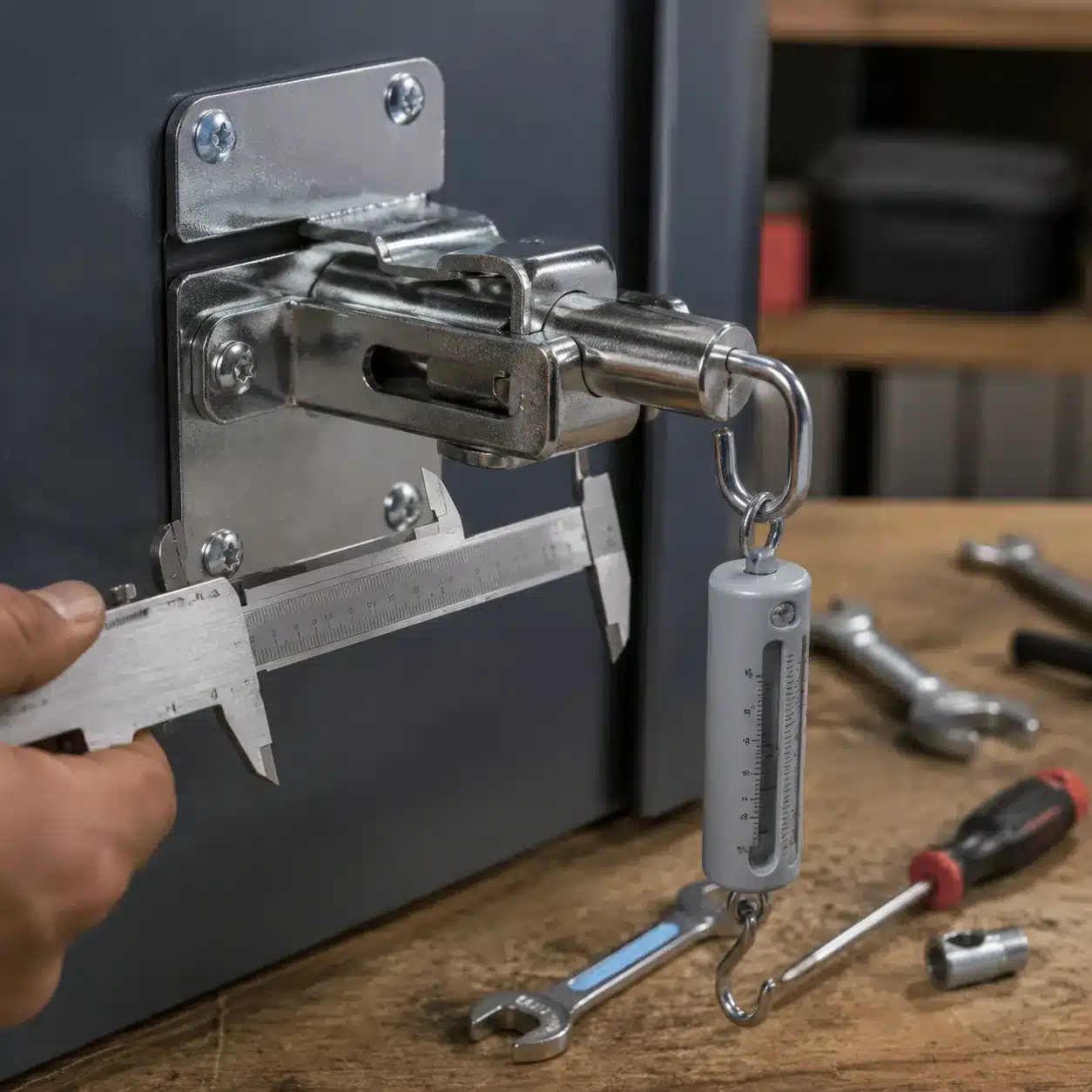
The five-minute diagnostic
- Push the bolt by hand with the gate open. Sticky or gritty with the gate out of the equation means the fault is in the mechanism, not the alignment — go to the lubricant step and stop.
- Close the gate and watch where the bolt tip lands. High, low or short of the strike opening tells you which axis is wrong. Mark it with a pencil rather than trusting your memory of it.
- Back off the mounting fasteners half a turn and re-close. If it now catches, the plate was distorted by torque and you are in the first section of this guide, not this one.
- Lift the leading edge of the gate and re-close. If that fixes it, the fault is sag and belongs to the hinges.
- Only if all four are clean is the strike plate itself genuinely mispositioned, and only then should you move it.
Adjust the plate — never file the bolt
Move the strike plate, enlarge the strike opening slightly if you must, or shim behind it. Do not file the bolt. The bolt is the hardened, corrosion-protected component; filing it removes the surface treatment, exposes bare substrate at precisely the point that sees the most wear and moisture, and converts an alignment complaint into a corrosion complaint three months later. It also ends any warranty conversation with the supplier, which matters when you are the one holding the stock.
When to stop adjusting and swap the unit
Stop if the plate is visibly cupped, if the bolt does not return under its own spring with the latch off the gate, or if you are on your third shim. At that point the labour cost of another visit exceeds the unit cost of the hardware, and on a multi-unit rollout the right decision is to swap the assembly and quarantine the rest of that carton for inspection before your installers meet it. Sibling issue: if the failure is on a sliding rather than swing installation, see the sliding door track levelling fix.
Specifying the Next Latch Order So This Does Not Repeat
Everything above is a field remedy. The durable fix is written into the purchase order, because every one of the factory-side causes is preventable at a cost of a few lines of specification and one inspection visit.
| Put this on the PO | Because |
|---|---|
| Alloy stated as 304 or 316, not “stainless” | PREN differs by roughly 5–8 points; it decides coastal service life |
| Salt-spray hours to first red rust per ASTM B117 + acceptance criterion | B117 sets no duration, so an unqualified claim is unfalsifiable |
| Handing marked legibly AFTER finishing, not cast before it | Coating fills cast arrows and makes correct parts unidentifiable |
| Mixed handing on one pallet = major defect, not cosmetic | Moves it inside AQL 2.5 where the sample size will actually catch it |
| Fastener size AND property class, with heads marked | Class decides the torque: the same M6 is 10.5 Nm at 8.8 and 4.1 Nm at 4.6 |
| Retained signed sample against reorders | The only defence against tolerance drift on the second run |
On commercials, the honest answer on MOQ is that it is set per project against your size and finish mix rather than published as one number, and the same applies to lead time, which moves with finishing capacity more than with casting.
What is published: inspection is offered at a flat daily rate given as $199 per man-day for standalone requests, with the report — photos, video tests and measurement data — delivered within 24 hours. We hold the final 70% of payment until any rework passes re-inspection, which is the practical leverage that makes a factory re-pick a mixed pallet instead of arguing about it. For a wider view of the category, see our Yiwu hardware and tools sourcing guide.
Best for: importers, resellers and installers handling latch hardware in quantity, who need to separate a site-fixable fault from a lot-level one before authorising returns.
Not for: a homeowner adjusting a single gate — steps 1 to 4 of the diagnostic will resolve almost every one-off case, and the sourcing sections will not apply to you.
Frequently Asked Questions
How tight should latch mounting bolts be?To the published figure for that bolt’s property class. A class 8.8 M6 is 10.5 Nm dry; a class 4.6 M6 is 4.1 Nm. Read the head marking first, then tighten in a cross pattern.
Why does my latch bind after a few weeks?Usually gate sag rather than the latch. Lift the leading edge and re-close: if it catches, fix the hinges first and set the strike plate afterwards.
Can I file the latch bolt to make it fit?No. Filing removes the surface treatment and exposes bare substrate where wear and moisture are highest. Move or shim the strike plate instead.
Is 316 stainless worth paying for on gate latches?In chloride exposure, yes. 316 carries 2–3% molybdenum and a PREN around 23–28 against 304’s 18–20. Inland and indoors, 304 is usually sufficient.
What pilot hole should I drill in a hardwood post?For a #8 screw, 1/8 inch (3.2mm) in hardwood against 7/64 inch (2.8mm) in softwood. Drill 1–2mm deeper than the screw reaches.
Half my pallet mounts backwards. Is that an installer problem?Usually not. Cast handing arrows get filled by coating, leaving correct parts unidentifiable. Specify legible marking applied after finishing and classify mixed handing as a major defect.