Justin
Last October, an e-commerce seller from Austin landed in Yiwu, showed his taxi driver a saved screenshot of the Yiwu Fair exhibition halls, and ended up at the permanent wholesale market 15 minutes away. He wasted two full days walking permanent storefronts looking for suppliers who were actually set up at the temporary Expo Center across town. He flew home with four business cards from middlemen and a $4,000 flight bill that produced zero usable contacts. That exact mistake happens every year because search results blend the permanent 5-district Trade City with the 14-hall Expo Center like they are the same place.
Key Takeaways
- The Yiwu Fair and Yiwu Market are different physical locations, 15 minutes apart by taxi.
- The Yiwu International Expo Center stacks 14 halls across three floors.
- You cannot walk all 14 halls in one day with any real sourcing value.
- Yiwu International Trade City operates 5 permanent districts daily, year-round.
- The permanent Trade City holds 100,000+ suppliers across 5 districts year-round.
- Factories use the Yiwu Fair to debut new lines and lock in show-only pricing.
I have walked both venues for 15 years, and this guide separates them before you book your hotel. You get a floor-by-floor breakdown of the Expo Center so you know exactly which of the 14 halls stock your product category and which ones to skip entirely. I am also giving you the daily routing plan to pull 5 to 10 verified contacts per day, plus the travel math between Yiwu and Canton so you can decide if the trip makes financial sense before you buy a ticket.

Yiwu Fair vs Yiwu Market: Critical Distinction
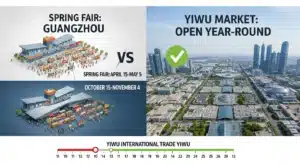
The Yiwu Fair and Yiwu Market are different physical locations, 15 minutes apart by taxi. Booking near the wrong one wastes half a day.
Purpose: Annual Trade Fair vs. Permanent Wholesale Market
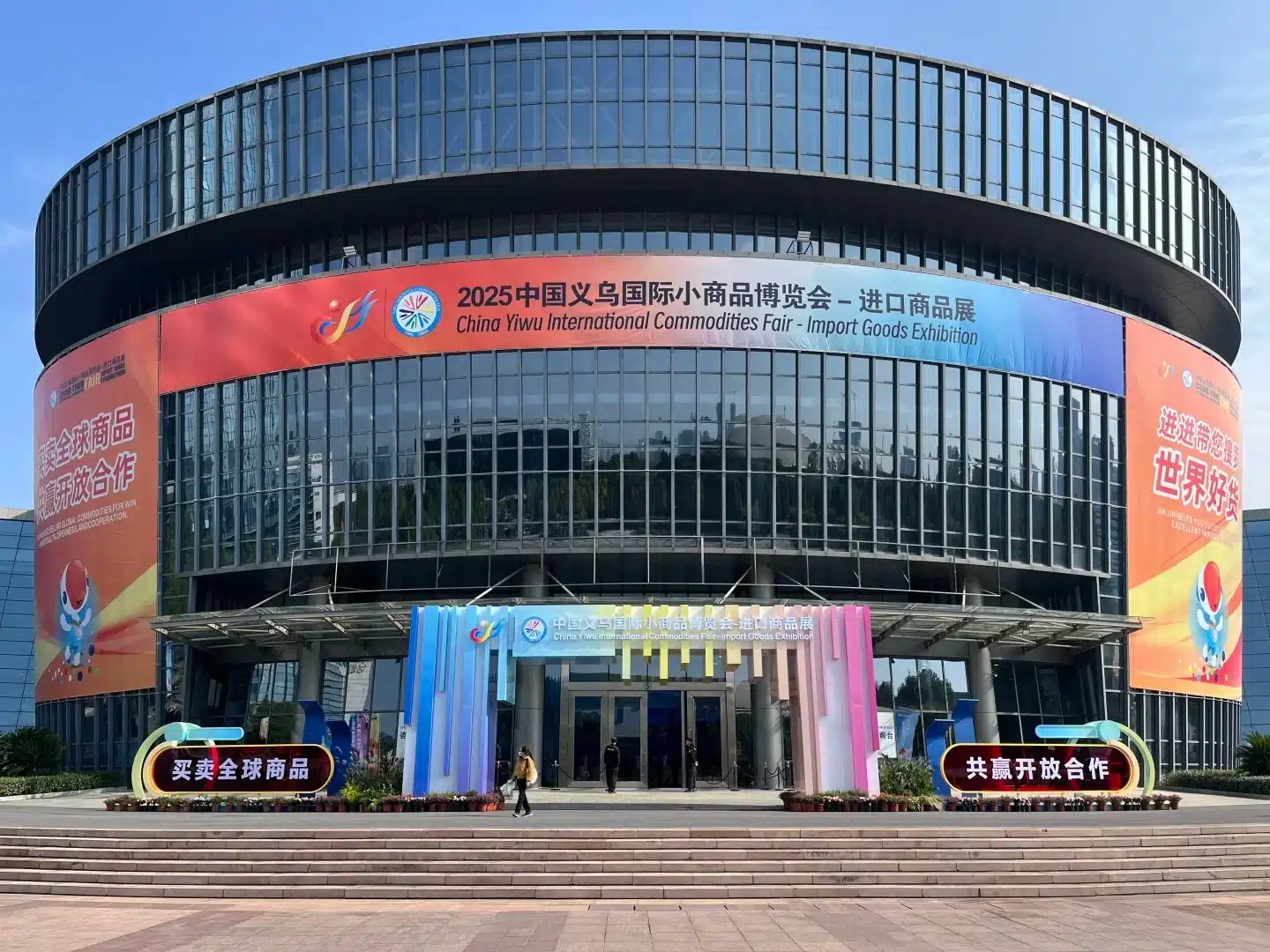
The Yiwu International Expo Center hosts the Yiwu Fair — a government-backed annual trade exhibition built to showcase export-ready manufacturers. Booths are temporary structures assembled for the event, and exhibitors are primarily factories pitching bulk orders to international buyers.
Yiwu International Trade City is a permanent wholesale complex across five districts. Traders rent fixed booths and operate year-round as a physical marketplace. Many of those booths are run by trading companies rather than factories — a distinction that directly affects your margins if your goal is sourcing direct from the factory floor.
Operating Schedule: 4 Days vs. Year-Round
The Yiwu Fair runs for exactly 4 days, typically in October. You have a hard window to walk the halls, collect contacts, and open negotiations. There is no option to return next week — the booths are torn down the day after closing.
The Trade City operates 365 days a year, roughly 9:00 AM to 5:00 PM. You can visit any business day, revisit suppliers, place test orders as low as 100 pieces, and coordinate samples at your own pace. For first-time buyers who need time to compare and verify, the permanent market is where orders actually get moving.
Scale: 240,000 m² vs. 2,100,000 m²
The size gap is not incremental — it is an order of magnitude.
- Yiwu International Expo Center (Fair): 240,000 m² main exhibition area, 14 halls, 5,300 standard booths
- Yiwu International Trade City (Market): 2,100,000 m² total area, 5 districts, 75,000+ booths, 100,000+ suppliers
With 4 fair days, the 5,300 Expo Center booths are manageable at roughly 45 minutes per hall. The 75,000+ booths at the Trade City cannot be covered in one trip. Without a district routing plan, you will burn entire days walking aisles irrelevant to your product category.
Location: Jiangdong E Rd vs. Futian District
The Expo Center sits on Jiangdong E Road, about 15 minutes by taxi from the Trade City. Arriving via Yiwu Station by high-speed rail, the Expo Center is roughly a 20-minute drive.
Yiwu International Trade City is in Futian District, which is also where most sourcing agents and export logistics companies operate. If your priority is building a long-term supplier pipeline rather than hitting the October event, base yourself in Futian — not near the Expo Center.
One common trap: older guides still reference the Meihu Exhibition Center as the main fair venue. That site was superseded by the current Expo Center in 2009 and now functions as a secondary facility. If your ride drops you at Meihu, your morning is gone.
Yiwu Expo Center: 14 Halls Breakdown
The Yiwu International Expo Center stacks 14 halls across three floors. Floors 1 and 2 hold the core product exhibitions; the ground floor handles niche and cross-border zones.
Three-Storey Building Layout
The venue spreads its 240,000 m² main exhibition area across three distinct levels. Floors 1 and 2 each contain five exhibition halls, housing the bulk of the 5,300 standard booths. The ground floor sits partially below grade and holds four additional halls. This vertical split matters because your routing strategy changes entirely depending on which floor you are on. Upper floors are high-density product browsing. The ground floor is relationship-building and trend-scouting territory.
Floors 1 and 2: Main Exhibition Halls (Halls 1-10)
These ten halls are where you will spend 70-80% of your day. They are organized by broad product verticals, though exact zoning shifts slightly each fair cycle. For a first-time buyer hunting for a China wholesale supplier with low MOQ, these halls are your primary target zone.
- Hardware and Tools: Hand tools, power tools, locks, and hardware accessories. Booth density is high, and most suppliers are factory-direct.
- Electronics and Electrical: LED lighting, consumer electronics, mobile accessories, and smart home devices. This is where low-MOQ negotiations are most common.
- Consumer Goods: Daily necessities, kitchenware, home decor, and general merchandise. The widest variety per square meter in the entire venue.
Plan roughly 45 minutes per hall on these floors. If you try to rush through all ten in a single day, you will collect business cards but not meaningful contacts. Prioritize two to three verticals based on your product niche and skip the rest entirely.
Ground Floor: Specialty Halls
The four ground-floor halls serve a fundamentally different purpose than the upper levels. They are smaller in total booth count but higher in strategic value for scaling buyers. You will find three core zones here: imported goods pavilions showcasing non-Chinese products, cross-border e-commerce supplier matchmaking areas, and regional industrial exhibition zones hosted by specific Chinese provinces.
If you are a first-time e-commerce entrepreneur, the cross-border e-commerce zone is worth 60-90 minutes of your time. Suppliers here are pre-vetted for DDP shipping capability and low-MOQ flexibility because they serve the same cross-border channel you do. The imported goods hall is generally skippable on a first trip unless you are specifically sourcing non-Chinese origin products for arbitrage. The regional exhibition halls rotate by province and fair cycle, so check the current floor plan before committing time to this level.
Product Categories by Hall Zone
Hall zoning shifts slightly each year. Treat this as your routing baseline, not a guaranteed floor plan.
Hardware & Electronics Zone
Hardware and electronics typically occupy the ground-floor halls at Yiwu International Expo Center. These are the highest-traffic halls because the margin potential attracts experienced buyers. Plan 60 minutes minimum per hall here — booths are dense and suppliers expect detailed technical questions.
- Typical location: Ground floor, 2-3 of the 4 ground-level halls
- Core products: Power tools, fasteners, locks, LED lighting, cables, small household appliances
- MOQ reality: Many hardware suppliers still quote 500-1,000pcs at the Fair. If you need 100pcs test orders, flag this immediately — some will refuse, others will redirect you to their Trade City district booth where lower MOQ is standard
- Skip signal: If a booth only displays catalog photos without physical samples, move on — they are trading companies resourcing from the actual factories present in the same hall
Daily Consumer Goods Zone
This is the largest category by booth count and the most overwhelming for first-time buyers. It spans both floors and bleeds into adjacent zones. The mistake most newcomers make is trying to walk it linearly. You will not finish it. Pick your sub-category, locate the relevant hall cluster, and ignore everything else.
- Typical location: Floors 1-2, 3-4 halls total, usually mid-building
- Core products: Kitchenware, cleaning tools, storage containers, plastic housewares, pet supplies
- Buyer priority: Kitchenware and storage products have the highest repeat-order rate for e-commerce. Pet supplies have the highest margin but also the most compliance friction (material safety certs for EU/US markets)
- Time allocation: 45 minutes per hall if you are pre-filtered by sub-category. Do not attempt a full walk-through
Stationery & Sports Zone
Stationery and sporting goods are usually grouped together in 1-2 upper-floor halls. This zone is more navigable than consumer goods and tends to have a higher concentration of direct factory reps rather than trading intermediaries. It is a strong hunting ground for e-commerce entrepreneurs because packaging customization is readily available and MOQs skew lower.
- Typical location: Floor 1 or Floor 2, 1-2 halls
- Core products: Office supplies, art materials, school kits, fitness equipment, outdoor recreation gear, yoga mats
- Advantage for first-time buyers: Stationery suppliers are accustomed to small-batch custom packaging — many will do 100pcs with your logo as a Fair-specific trial order
- Watch out: Sports equipment with moving parts (resistance bands, jump ropes) has wide quality variance between suppliers who look identical on the surface. Always request a factory audit or let us inspect before committing to bulk
Textiles & Clothing Zone
Textiles usually claim 2-3 halls and are split between raw fabric suppliers and finished garment manufacturers. First-time buyers often confuse these two. Fabric mills sell by the roll with 500-meter minimums. Garment factories sell finished pieces with style-specific MOQs. Know which one you need before entering the hall, because the booth layout does not always separate them clearly.
- Typical location: Floors 1-2, 2-3 halls, often positioned near the Daily Consumer Goods cluster
- Core products: Fabrics (cotton, polyester, blends), socks, hats, scarves, basic casualwear, home textiles (towels, bedding)
- MOQ reality: Finished garments at the Fair typically start at 200-300pcs per color per style. Fabric rolls start at 500 meters. If your target is 100pcs finished pieces, you will have better luck at District 4 of the permanent Trade City than at the Fair
- Priority action: Bring physical fabric swatches of your target quality. Yiwu textile suppliers respond faster to touch-and-compare than to verbal descriptions
Cosmetics & Beauty Zone
Cosmetics occupies 1-2 halls and is one of the fastest-growing categories at the Fair. The product mix has shifted noticeably toward skincare tools (jade rollers, ice globes, LED devices) and away from bulk color cosmetics. This matters because skincare tools have lower regulatory barriers in Western markets compared to liquid or powder cosmetics, which require full ingredient disclosure and lab testing per destination country.
- Typical location: Floor 1 or Floor 2, 1-2 halls, usually adjacent to Daily Consumer Goods
- Core products: Makeup brushes, skincare tools, cosmetic bags, nail care tools, hair accessories, packaging containers
- Regulatory flag: Any supplier offering liquid cosmetics (lipstick, foundation, serum) should be able to produce MSDS and CPSR compliance documents on request. If they cannot, walk away regardless of pricing
- E-commerce opportunity: Private-label skincare tool sets (roller + gua sha + storage box) are the sweet spot for 100pcs MOQ with custom packaging. This is one of the few categories where the Fair MOQ aligns with our minimum order threshold
Imported Goods Pavilion
This is a smaller section, typically 1 hall, showcasing products that Chinese companies have sourced from outside China for re-export. It sounds counterintuitive — why fly to Yiwu to buy imported goods — but the Pavilion serves a specific function. It is where you find products from Southeast Asia, South Asia, and Africa that are difficult to source directly due to language barriers, payment infrastructure gaps, or unstable logistics in those origin countries.
- Typical location: 1 hall, usually positioned at the periphery of the Expo Center layout
- Core products: Handicrafts, natural materials (rattan, jute, coconut shell products), specialty foods, gemstones, ethnic textiles
- Who should visit: Only buyers whose product strategy specifically requires non-Chinese origin materials or aesthetic. If you are sourcing standard consumer goods, skip this hall entirely — it will consume 45 minutes with zero relevant contacts
- Reality check: The Chinese intermediary in this pavilion adds their own margin on top of the origin cost. You are paying for logistics consolidation and payment security, not for lower prices. Factor that into your margin model before negotiating
Time Allocation Per Hall
You cannot walk all 14 halls in one day with any real sourcing value. Pick 5-7 halls and allocate time by floor level.
Floors 1-2: 40-50 Minutes Per Hall
The ten halls across Floors 1 and 2 carry the dense product categories — hardware, electronics, toys, cosmetics, and household goods. Booth density is high, and most suppliers have catalogues, sample tables, and at least one English-speaking staffer. You need that 40-50 minute window to verify MOQs, confirm pricing tiers, and collect business cards with real intent. Rushing through in under 40 minutes means you leave with a stack of flyers and zero actionable contacts.
Ground Floor: 25-30 Minutes Per Hall
The four ground-floor halls typically host larger-footprint displays — machinery, outdoor equipment, or bulk commodity sections. Booths are fewer but physically bigger, and product ranges are narrower. A faster sweep works here because you can assess relevance from the aisle in seconds. If the category does not match your sourcing list, you move on without sitting down.
Full Sweep: 9-11 Hours
Walking all 14 halls back-to-back takes roughly 9 to 11 hours, including transitions between floors, elevator waits, and short breaks. That is not a productive sourcing day — it is a reconnaissance march. You will finish exhausted with a bag of brochures and no supplier relationships to show for it. First-time buyers who try to “see everything” consistently walk away with fewer verified contacts than those who committed to a focused route.
The Actual Strategy: Pre-Select 5-7 Halls
Before you land in Yiwu, pull the official Yiwu Fair exhibition hall layout map and cross-reference it against your product category. Mark 5 to 7 halls that directly match what you need to source. At 40-50 minutes each, that is a focused 4.5 to 6 hour working day — enough time for proper conversations, sample requests, and follow-up scheduling. Anything beyond those selected halls is optional overflow if you finish early. If you are working with a local sourcing team, give them your hall shortlist before the Fair opens so they can pre-scout booth positions and flag the low-MOQ suppliers who actually accept small first orders.
How Many Districts in Yiwu Market
Yiwu International Trade City operates 5 permanent districts daily, year-round. This is not the Yiwu Fair Expo Center — the two venues sit 15 minutes apart by taxi.
Understanding the district layout before you land determines whether you walk out with 10 verified supplier contacts or waste a full day in irrelevant halls. The permanent market spans 2,100,000 m² with over 75,000 booths and roughly 100,000 suppliers. Each district concentrates specific product categories. Map your route by district, not by wandering.
District Breakdown
- District 1: Toys and jewelry. The highest foot traffic district. Best starting point for e-commerce buyers sourcing small, lightweight products with low per-unit shipping costs.
- District 2: Hardware and electronics. Floor 5 houses a Centralized Purchasing Center used by mega-buyers like Walmart and China Telecom — direct factory access without booth-by-booth negotiation. Critical for scaling buyers.
- District 3: Stationery and cosmetics. Compact district, faster to cover in a single afternoon. Strong fit for private-label cosmetics buyers testing low MOQ production runs.
- District 4: Textiles and clothing. Largest floor area per booth. Plan extra time here — fabric sampling and pattern verification slow every visit down compared to hard goods.
- District 5: Imported goods and auto parts. Smallest district by booth count. Skip entirely unless your product line specifically requires imported materials or automotive components.
All five districts open daily with no admission fee. If you are a first-time buyer with only four days on the ground, prioritize Districts 1 and 2 for the highest supplier density relevant to e-commerce margins, then allocate remaining time based on your exact product category. Do not split your first day across all five — you will cover nothing in depth.
What Can You Find in Yiwu Market
The permanent Trade City holds 100,000+ suppliers across 5 districts year-round. The Fair compresses roughly 2,000 exhibitors into 14 temporary halls over 4 days.
Fashion Accessories, Home Decoration, and Kitchenware
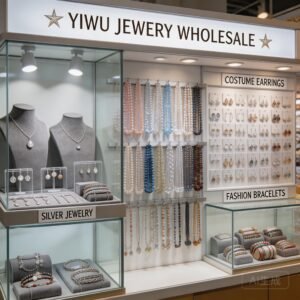
District 1 of the permanent Trade City is ground zero for fashion accessories — hair clips, jewelry, scarves, and sunglasses by the container load. Home decoration runs heavy in District 1 and spills into District 2, covering everything from ceramic vases to artificial flowers. Kitchenware clusters primarily in District 2, where you will find stainless steel utensils, silicone bakeware, and melamine tableware spread across hundreds of booths.
At the annual Yiwu Fair, these same categories get consolidated into a handful of Expo Center halls. The advantage here is density — you can walk 50 booths in an hour versus hunting across multiple Trade City floors. The tradeoff is selection depth. If you need a very specific kitchenware SKU or an unusual home decor material, the permanent market will have more options than the Fair.
Toys, Gifts, Stationery, and Office Supplies
Toys dominate District 1’s upper floors in the permanent market, while gifts and promotional items are scattered across Districts 1 and 2. Stationery and office supplies sit in a dedicated zone within District 2 — pens, notebooks, file organizers, and desk accessories. For e-commerce sellers building a product catalog around impulse-buy price points, this cluster is one of the most productive areas in the entire market.
During the Fair, toys and gifts typically occupy two or three dedicated halls. Stationery gets folded into a general consumer goods hall. Hall zoning shifts slightly each year, so confirm the current floor plan before you arrive. If your sourcing trip is focused purely on toys, the Fair gives you faster supplier discovery. If you need to compare 30 different pen factories on price per unit, the permanent market wins.
Textiles, Clothing, Electronics, and Tools
Textiles and clothing are concentrated in District 4 and District 5 of the Trade City — fabrics by the meter, ready-made garments, socks, and underwear. Electronics (LED lights, cables, small consumer gadgets) occupy District 2 and parts of District 4. Hand tools, hardware, and power accessories live in District 4. These categories are physically separated from the gift and accessory districts, so do not assume you can walk between them in ten minutes.
The Fair typically assigns electronics and tools to one or two halls, with textiles getting limited representation compared to the permanent market. If textiles are your core category, the Fair alone will not justify your trip. You need to allocate time for Districts 4 and 5 regardless of whether you attend the Fair or not.
Year-Round Availability vs. Temporary Fair Consolidation
This is the distinction that trips up most first-time buyers. The Yiwu International Trade City is a permanent wholesale complex open 365 days a year, with 2,100,000 square meters of floor space across 5 districts. Every supplier has a fixed booth. You can return in March and find the same vendor in the same spot. MOQs start as low as 100 pieces, and pricing is factory-direct because most booths are operated by the manufacturers themselves.
The Yiwu Fair, held annually at the Yiwu International Expo Center, is a temporary event running roughly 4 days. It packs 5,300 standard booths into 14 halls across 240,000 square meters. Exhibitors are a curated subset — not every Trade City vendor participates. The Fair’s value is speed: you meet more decision-makers per hour because booth staff are prepared for serious wholesale conversations, not casual retail browsing.
The critical logistics point: these are two different physical locations, 15 minutes away by taxi. If you book a hotel near the Expo Center thinking you can walk to the permanent market, you will lose an hour of sourcing time each day on transit. Plan your accommodation and daily routing around which venue matters more for your product category, not which one has a bigger name on Google.
Yiwu International Commodities Fair Products
Factories use the Yiwu Fair to debut new lines and lock in show-only pricing. These deals disappear the day the exhibition ends.
Featured Categories Across the 14 Halls
The five core product categories dominating the fair floor are hardware tools, perfumes, cosmetics, small home appliances, and clothing. Hall zoning shifts slightly each year, but these five consistently occupy the largest footprint across the 14 halls at the Yiwu International Expo Center.
Hardware and tools typically fill the ground-floor halls due to shipping weight. Perfume and cosmetics clusters tend to group together for buyer convenience, often sharing floors with packaging suppliers. Clothing occupies multiple halls and overlaps with textiles and accessories. Small appliances sit adjacent to electronics, creating a natural sourcing path if you walk the halls sequentially.
Show-Only Discounts and New Product Launches
Suppliers bring two things to the fair: new product lines not yet listed on Alibaba or Made-in-China, and show-only pricing tiers. The discount structure is straightforward. Volume commitments made at the booth receive a lower unit price than any post-fair inquiry. In our experience inspecting orders from past fairs, show pricing runs 8-15% below standard wholesale rates.
The catch is immediacy. Suppliers expect a deposit or at minimum a signed letter of intent before the fair closes. If you walk away planning to follow up next week, you will receive the standard catalog price. First-time buyers should treat the fair as a closing event, not a browsing event.
Lower Trial-Order MOQs for First-Time Buyers
Exhibitors know most first-time fair visitors are testing the waters. Many factories reduce their standard MOQ by 30-50% for orders placed during the four exhibition days. A supplier that normally requires 500 pieces may accept 200-250 as a fair-specific trial order. This is a deliberate strategy to convert new accounts.
For buyers who still find these thresholds too high, we negotiate a flat 100-piece MOQ across our verified supplier network. This applies to trial orders sourced through our inspection service whether you walk the fair with us or we source on your behalf. The 100-piece floor covers all five major fair categories including cosmetics and clothing, where standard factory MOQs are often the steepest barrier for new e-commerce brands.
Yiwu Market to Canton Fair Distance
Yiwu and Guangzhou sit 1,470 km apart by air. The fastest route takes roughly 6.5 hours and costs between ¥1,100 and ¥2,400.
The Fastest Route: Flight Plus Bus Connection
No commercial flight lands directly at Pazhou, where the Canton Fair operates. The fastest practical route is a domestic flight from Yiwu Airport (YIW) to Guangzhou Baiyun International Airport (CAN), followed by a ground transfer to the exhibition complex.
The flight portion runs about 2 hours. From Baiyun, a taxi or airport shuttle to the Pazhou complex takes 45 to 60 minutes depending on Guangzhou traffic. Factor in check-in, security, and terminal transit, and your real door-to-door travel time lands around 6.5 hours.
Estimated Travel Cost
Budget ¥1,100 to ¥2,400 for a one-way trip. This covers an economy-class flight booked one to two weeks in advance plus the ground transfer from Baiyun to Pazhou. During the Canton Fair’s opening week, expect fares to push toward the upper end of that range as seats fill fast and airlines apply peak pricing.
Conclusion
Skip the permanent Trade City districts during the four-day Fair window. You have 14 temporary exhibition halls to cover, and walking them blindly burns your entire trip. Map your top three product categories, hit those specific halls first, and ignore everything else until day three.
Send me your product list before you book flights. My team walks the Expo Center floor plan to pre-vet suppliers matching your exact specs, so you arrive with scheduled meetings instead of guessing. We handle the 100-piece test runs and door-to-door shipping, removing the risk from your first trip.
Frequently Asked Questions
How many districts does Yiwu have?
The permanent Yiwu International Trade City features five distinct districts spanning 2.1 million square meters with over 75,000 booths. But the annual Yiwu Fair is a separate event held at the Yiwu International Expo Center, which features 14 specialized exhibition halls. We guide our clients through both the permanent market and the temporary fair venues to ensure they connect with the right verified suppliers.
What products are in the Yiwu Market?
The permanent Yiwu Market is a sprawling hub for fashion accessories, jewelry, home decoration, kitchenware, toys, and textiles. Operating year-round across its five districts, it also houses extensive sections for stationery, clothing, electronics, and tools. As your trusted eyes on the ground, we help you navigate these massive product categories to source items that strictly meet Western quality standards at local factory prices.
What’s at the Yiwu Fair?
The Yiwu International Commodities Fair showcases specialized categories like hardware, perfumes, cosmetics, small appliances, and headgear. You will also find dedicated exhibition halls for electronics, office supplies, and clothing, often with exclusive show-only discounts. We use our presence at this annual event to negotiate lower trial MOQs—often starting at just 100 pieces—on your behalf while conducting risk-free inspections.
How far is Yiwu from Canton Fair?
The distance between the Yiwu Market and the Canton Fair is 1,470 kilometers by air and 1,149 kilometers by road. While the fastest route combining a flight and a bus takes about 6.5 hours, it is not practical to combine both massive sourcing trips into a single journey. Instead, we recommend focusing your sourcing efforts with our team in Yiwu, where you can secure low MOQs and reliable global DDP shipping without the logistical hassle.
What is the main Yiwu market called?
The primary wholesale venue is the Yiwu International Trade City, recognized globally as the largest small-commodity wholesale market. It is crucial to note that this permanent market is distinct from the annual Yiwu Fair, which takes place separately at the Yiwu International Expo Center on Jiangdong East Road. Whether you are visiting the main market or the Expo Center, we provide on-the-ground inspection services to guarantee your brand’s quality requirements are met.