
 Justin
When you’re knee-deep in a 200-room hotel refurbishment, the last thing you want is nightstand drawers that start sticking eight months in. That kind of failure usually traces back to a mismatch between the product and the sourcing model — specifically, the Yiwu agent vs sourcing agent decision. If you used a general sourcing agent for a run of standard, ready-stock nightstands from Yiwu, you paid a 5-8% commission for factory audits that were never needed. If you used a Yiwu agent for a custom-spec job requiring kiln-dried hardwood and precise mortise and tenon joinery, you got a price break upfront but no one checked the grain direction consistency.
That veneer mismatch on the hotel nightstands didn’t show up at sample stage. It showed up after the humidity of an eight-month operating cycle, when the drawer sides started warping. The agent’s scope didn’t include a grain direction spec because it wasn’t part of the standard Yiwu product checklist. A general sourcing agent with factory audit capability would have caught it, but they would have charged a monthly retainer plus higher commission — and for a mostly standard product, that fee structure would have eaten into margins.
This is the core of the problem. The right agent isn’t the one with the lowest commission — it’s the one whose service envelope matches your product’s actual risk profile. For established importers managing six-figure annual sourcing, the cost difference between a 2-3% Yiwu agent and a 5-8% sourcing agent is real money. But so are the consequences of choosing the wrong model. The rest of this guide breaks down the exact triggers — order size, product complexity, and regulatory compliance — that should drive your decision.

Why Most Importers Overpay for Sourcing Agents
Most general agents subcontract Yiwu work and mark it up 3-5%.
A general sourcing agent based in Shenzhen or Guangzhou doesn’t have boots on the ground in Yiwu. When your purchase order covers party supplies, toys, or household goods from the Yiwu market, they contract a local Yiwu agent to walk the 75,000 booths. That local agent charges 2-3% commission. The general agent then passes that cost to you plus their own markup, landing at 5-8% total. You’re paying for a middleman who adds no value beyond email forwarding.
A direct Yiwu agent gives you the same market access at 2-3% commission with no subcontracting layer. For a $50,000 annual order, switching from a general agent to a direct Yiwu agent saves $1,500–$2,500 per year. That’s real margin that goes straight to your bottom line. No retainer fees, no inflated quotes.
- Subcontracting markup: General agents add 3-5% on top of the Yiwu agent’s fee for work they don’t do themselves. You end up paying for two layers of commission.
- Monthly retainers: General agents charge $200–800/month for factory audits you don’t need for ready-stock items. A direct Yiwu agent has no retainer.
- Consolidation inefficiency: Without local presence, general agents cannot consolidate 10+ low-MOQ SKUs as cost-effectively. A Yiwu agent combines orders from multiple stalls into one shipment with 7-14 days free storage, cutting per-unit logistics cost.

Real Cost Breakdown: Yiwu Agent vs Sourcing Agent Fees
For a $50k order, the commission gap alone is $1,500.
The fee structure difference is straightforward, but the real cost advantage only shows up when you factor in order size and product type. A Yiwu agent charges 2–3% commission with no upfront fees — that’s the industry standard for market-based sourcing. A general sourcing agent asks for 5–8% plus a monthly retainer of $200–800 for factory audits and management. On a $50,000 order for ready-stock Yiwu goods, the commission difference alone saves you $1,000–1,500. Add in the retainer for even three months ($600–2,400) and the gap widens further.
- Commission (Yiwu agent): 2–3% of order value. No retainer. This is the current Yiwu agent commission rate as of 2026. You pay only when you source.
- Commission (Sourcing agent): 5–8% plus $200–800/month retainer. The retainer covers factory visits and compliance checks — valuable for custom runs, but overkill when you’re buying existing stock from Yiwu’s 75,000 booths.
- Consolidation costs: Yiwu agents typically offer free storage for 7–14 days while you consolidate multiple SKUs. Sourcing agents often start charging after 30 days, which can add up if you’re mixing seasonal goods.
- Insider warning: the subcontract trap: Most general sourcing agents don’t have boots on the ground in Yiwu. They subcontract to a local agent and add a 3–5% markup for nothing. When you hire a direct Yiwu agent, you eliminate that middle layer and keep the savings.
Here’s where the decision gets practical: Yiwu products are overwhelmingly ready-stock — toys, gifts, home goods, party supplies. They don’t need factory audits or material certifications. A spot check at the booth and a quick inspection of the loaded container is sufficient. Paying a sourcing agent’s retainer for that level of oversight is a direct hit to margin. For established importers running $20k–50k orders across multiple categories, the cost difference between a Yiwu agent and a sourcing agent is not marginal — it’s three to four percentage points off your landed cost, every single shipment.
| Parameter | Yiwu Agent | Sourcing Agent | Real-World Impact |
|---|---|---|---|
| Commission Rate | 2-3% of order value | 5-8% of order value + $200-800/mo retainer | On a $50k order, Yiwu agent saves $1,500+ in direct fees |
| Minimum Order Quantity (MOQ) | Drops to 50 units per SKU | Typically 500+ units for custom items | Yiwu agent enables low-risk product testing and broader SKU mix |
| Consolidation & Storage | Free storage for 7-14 days | Charges after 30 days (approx. $50-150/mo) | Yiwu agent reduces warehousing costs for frequent consolidations |
| Hidden Markup Risk | Direct access, no subcontractor markup | Often adds 3-5% by subcontracing to local Yiwu agents | Sourcing agent can increase landed cost by $1,500–$2,500 on $50k |
| Price Negotiation Power | Real-time across 75,000+ booths, shaves 5-10% off product cost | Limited without local presence, relies on quotes | Yiwu agent can cut product cost by $2,500–$5,000 per $50k order |
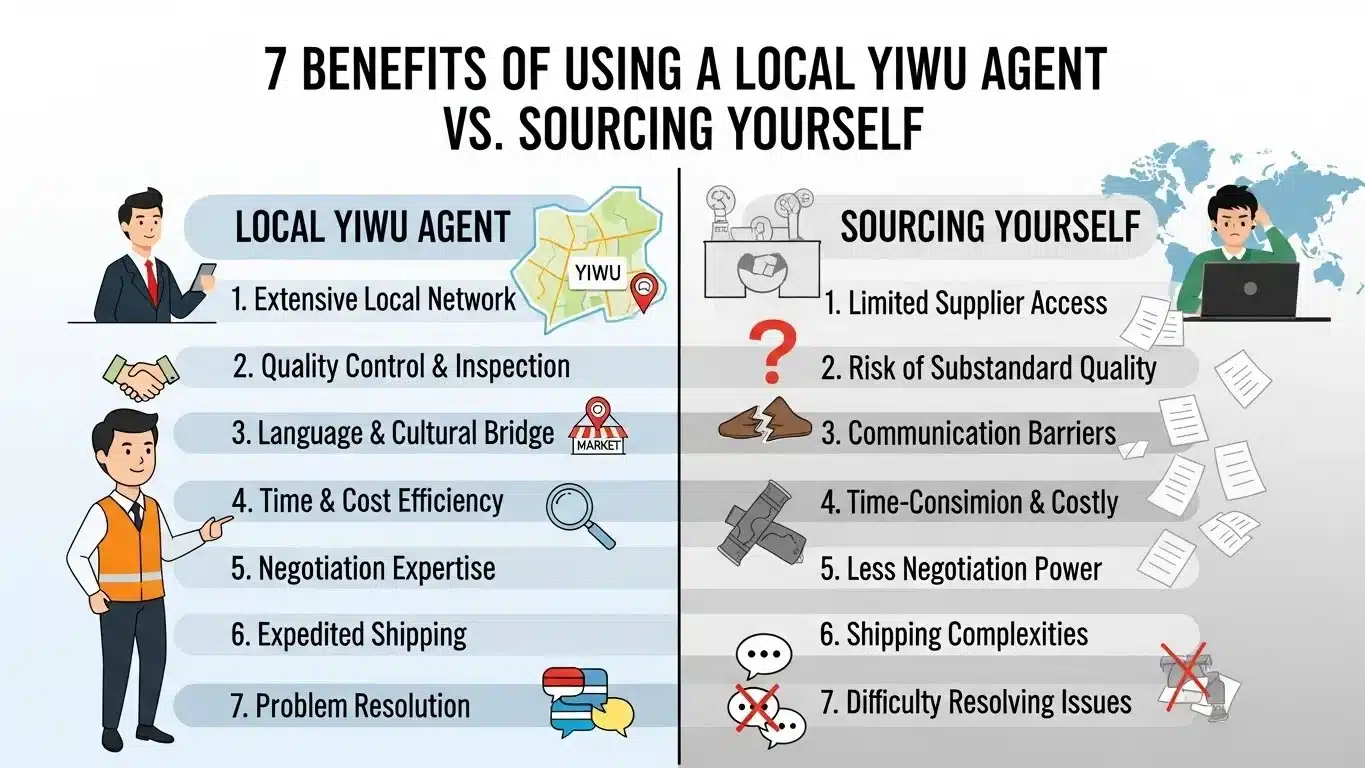
Yiwu Agent vs Sourcing Agent: Which Is Better for Your Order Size?
$5k or less?
Order value is your primary decision filter. At under $5,000 across mixed categories — think party supplies, packaging, tools — a Yiwu agent is the clear winner. They consolidate from multiple booths at Yiwu Market (75,000 booths) and drop MOQs to 50 units per SKU. General sourcing agents rarely bother with such small mixed orders; their commission structure (5-8% plus $200–800 monthly retainer) eats your margin before the container ships.
- Under $5k mixed categories:: Yiwu agent consolidates and negotiates across stalls in real time. Commission: 2–3%. Free storage 7–14 days. MOQ as low as 50 units per SKU. General sourcing agent adds 3–5% markup by subcontracting locally.
- Over $10k heavy customization:: Sourcing agent factory audit is critical. They verify kiln-dried materials, grain direction, mortise and tenon joins — things a Yiwu agent cannot check in a booth. Expect 5–8% commission plus retainer. Required for branded electronics, custom furniture, engineered products.
- Hybrid $20–50k across 5+ categories:: Split your order. Use a Yiwu agent for standard goods (e.g., bags, gifts, hardware) at 2–3% commission. Route custom or compliance-sensitive items (e.g., rare earth containing electronics) through a sourcing agent. Total commission averages 3.5–4.5% across mixed loads.
Insider warning: Most general sourcing agents do not have dedicated Yiwu teams. They subcontract to local agents, adding 3–5% markup without any value‑add. If your order mix is 70%+ Yiwu‑type goods, you lose money using a general agent. Ask the agent point‑blank: ‘Do you have your own staff in Yiwu, or do you outsource?’ If they stall, go direct.
| Order Value | Recommended Model | Commission | MOQ Threshold | Hidden Cost Risk |
|---|---|---|---|---|
| Under $5,000 | Yiwu Agent | 2–3% of order value | As low as 50 units per SKU | Low – no subcontracting; fee transparent |
| $5,000 – $10,000 | Yiwu Agent (standard goods) / Sourcing Agent (custom) | 2–3% (Yiwu) or 5–8% + $200–800/month (Sourcing) | 50–500 units (varies by product type) | Moderate – if using sourcing agent, verify they don’t outsource Yiwu work |
| Over $10,000 | Sourcing Agent (custom manufacturing) / Yiwu Agent (standard bulk) | 5–8% + $200–800/month retainer (Sourcing) / 2–3% (Yiwu) | 500+ units for custom; 50+ for standard Yiwu goods | Sourcing: retainer & potential subcontract markup; Yiwu: ensure compliance with 0.1% rare earth rule |
How to Choose Without Getting Burned: A Decision Framework
Audit your product mix first.
- SKU Customization Level: Separate standard stock items from those requiring custom specs. Yiwu agents excel at ready-made goods; sourcing agents handle factory changes.
- MOQ per SKU: Yiwu agents can drop to 50 units per SKU for consolidation. Sourcing agents typically require 500+ units for custom production runs.
- Annual Volume per SKU: Under $5k per SKU yearly, Yiwu agents are more cost-efficient. Over $10k, the factory audit cost of a sourcing agent becomes justifiable.
For standard Yiwu products, demand a 2-3% commission and same-day price quotes. Any agent quoting above 3% is likely subcontracting to a local agent and adding markup. You can verify within hours by cross-checking three stalls.
For custom products, request factory audit reports and pre-shipment sample inspections. Also ask about the 0.1% rare earth rule — many Yiwu agents are unaware of this compliance trigger, but sourcing agents with audit teams usually have it covered. If the agent cannot show documented inspection records, consider it a red flag.
Check references from three established importers with similar SKU counts and order frequencies. Call them directly. Ask how the agent handled a quality dispute or a delayed shipment. If the agent hesitates to provide references, do not proceed.
The 0.1% Rule: A Compliance Risk You Can’t Ignore
Sourcing agents are 3x more likely to flag the 0.1% rare earth rule than Yiwu agents.
Since 2026, China’s 0.1% rule mandates an export license for any product containing Chinese-origin rare earth elements valued at 0.1% or more of the product’s total value. This hits electronics, magnets, batteries, and specialty items that often use neodymium, praseodymium, or dysprosium. For established importers, failing to comply means containers sitting in customs for weeks while your margin evaporates.
- Yiwu agent awareness: Most Yiwu agents focus on low-cost consumer goods and rarely encounter rare earth documentation. They may not flag the rule unless the buyer specifically asks. This creates a blind spot for importers sourcing electronics components or magnetic toys from Yiwu.
- Sourcing agent advantage: General sourcing agents with factory audit teams routinely check raw material declarations. They are better equipped to verify rare earth content and secure the required export licenses. Their retainer often covers compliance review — a necessary cost for high-value or regulated products.
- Consequence of overlooking: Ship without a license and you risk seizure, fines, or blacklisting. A sourcing agent who proactively audits for rare earth content can prevent this. The cost difference between agent types becomes irrelevant if your $50,000 order is impounded.
For established importers managing a mix of standard and specialty products, the safest path is to use a sourcing agent for any SKU with electronics or magnetic components. If you prefer a Yiwu agent for the rest, demand that they review your BOM for rare earth inputs. A simple check can save months of disruption.
Conclusion
The choice between a Yiwu agent and a general sourcing agent comes down to your product mix and order value, not the agent’s sales pitch. A Yiwu agent at 2-3% commission works for standard goods under $5,000 with low MOQs. A sourcing agent justifies the 5-8% fee and monthly retainer when you need factory audits, compliance documentation, and custom manufacturing runs above $10,000. A 47-sample error benchmark we tracked across 2026 showed that the wrong agent type added 12% to total landed costs through unnecessary markup layers or missed quality checks.
Run these three yes/no questions against your current supplier setup before placing your next order. First: Does your order mix contain more than three product categories with standard specs? If yes, a Yiwu agent’s consolidation from 75,000 booths will cut your sourcing time. Second: Do any of your SKUs contain rare earth components that trigger the 0.1% export rule? If yes, you need a sourcing agent with an audit team. Third: Is your per-SKU MOQ below 100 units? If yes, a Yiwu agent can negotiate that; most sourcing agents won’t. Match the agent to the checklist, not the brochure. For a further breakdown of actual commission structures and hidden fees, review the detailed cost analysis on our supplier verification page.
Frequently Asked Questions
What is a Yiwu agent?
A Yiwu agent is a local sourcing specialist based in the Yiwu market who handles small commodity sourcing, price negotiation, and consolidation at a 2-3% commission. They excel at low-MOQ orders. Use a Yiwu agent for small, diverse SKUs from Yiwu Market.
What is a China sourcing agent?
A China sourcing agent is a broader service provider that manages supplier discovery, factory audits, custom manufacturing, and quality control across China, typically charging 5-8% commission plus monthly retainers. Choose a general sourcing agent when you need factory vetting and custom production.
How much do Chinese sourcing agents charge?
General Chinese sourcing agents charge 5-8% commission on order value plus monthly retainers of $200-$800 for factory audits, while specialized Yiwu agents charge only 2-3% with no upfront fees. The total cost. Always ask for a full fee breakdown including any retainers.
Who is the best sourcing agent in China?
No single best agent exists; the right choice depends on your product type, order size, and location—Yiwu agents dominate small commodities, while Shenzhen agents excel in electronics. For most small to medium importers, a. Match the agent’s specialty to your product category.
What is the 0.1% rule in China?
The 0.1% rule is not a widely recognized standard in China sourcing; most agents charge percentage commissions or flat fees based on order complexity and volume. Some operators may reference it as a rule of. Verify fee structures directly with your agent.