Джастин
A supplier in Yiwu tells you the goods are ready. Your customer’s bank tells you the letter of credit calls for an inspection certificate. Your freight forwarder tells you the destination customs authority wants a Clean Report of Findings. All three of them said “pre-shipment inspection”, and they meant three different things — one of which you can book with a phone call, one of which you cannot book at all, and one of which your supplier may be quietly signing himself.
This page separates them. It is written for importers and procurement staff who have a PO on the table and a shipment date to defend, and who need to know what the document is worth before they pay for it.
Key takeaways
- Two regimes share one name. A government-mandated pre-shipment inspection is governed by the WTO Agreement on Preshipment Inspection and covers quality, quantity, price and customs classification. A commercial pre-shipment inspection is a service you buy, governed only by your purchase agreement.
- If your credit just says “inspection certificate”, your supplier can sign it. UCP 600 sub-article 14(f) tells banks to accept such a document as presented when the credit does not stipulate the issuer.
- A report is not a certificate. ICC Official Opinion R197 upheld a discrepancy for exactly that substitution.
- A passed inspection is not a certificate of compliance. From 8 July 2026, CPSC-regulated goods entering the US need certificate data filed electronically with CBP.
- Under a mandated inspection the agency owes you deadlines — five working days to a Clean Report of Findings or a written explanation — and it may not demand your manufacturing costs or profit levels.
What this article covers
- Two different things are called a pre-shipment inspection
- What a mandated inspection obliges the agency to do
- The certificate is a payment document first
- What the inspection does not cover: US certification after 8 July 2026
- When to book one, and when it is the wrong purchase
- What we check, and where we stop
- Frequently asked questions
Two Different Things Are Called a Pre-Shipment Inspection
International law contains a definition of this term, and it is much wider than the one the inspection industry uses. The WTO Agreement on Preshipment Inspection, Article 1.3, defines the activities as “all activities relating to the verification of the quality, the quantity, the price, including currency exchange rate and financial terms, and/or the customs classification of goods to be exported to the territory of the user Member.”
Read that list again. Quality is one of four items. Price, currency terms and customs classification are the other three, and they have nothing to do with whether the stitching is straight. That is because the Agreement was not written to help buyers get better goods. It was written to discipline a customs practice: governments hiring private firms to check what importers declare.

Regime one: the government asked for it
The Agreement applies, per Article 1.1, to PSI activities “whether such activities are contracted or mandated by the government, or any government body, of a Member.” Article 1.2 calls that government a “user Member”. A number of countries run these programmes to verify import valuations and prevent under-invoicing at the border.
The defining feature for you: nobody asked your opinion. The destination government contracted the inspection entity, the entity’s client is that government, and the party being inspected is your supplier. You are a spectator to a process whose output — a Clean Report of Findings — your goods need in order to clear customs at the other end.
Regime two: you asked for it
A commercial pre-shipment inspection is a service purchase. You engage a third-party firm, or your sourcing agent, to send an inspector to the factory or warehouse and check the goods against your specification before you release the balance payment. No treaty governs it. Your purchase agreement and your inspection brief are the only documents that decide what “pass” means.
The confusion matters because it changes who you complain to when something goes wrong, and what leverage you have.
| Question | Mandated PSI | Commercial PSI |
|---|---|---|
| Who appoints the inspector | The destination government | You, or your agent |
| What it verifies | Quality, quantity, price, currency terms, customs classification | Whatever your inspection brief says |
| Governing rules | WTO Agreement on Preshipment Inspection | Your purchase agreement only |
| Output document | Clean Report of Findings, or a note of non-issuance | An inspection report, usually with photos |
| If you disagree with it | Treaty appeal path, then independent review | Your contract with the inspection firm |
| Can you skip it | No — the goods will not clear | Yes, at your own risk |
The one-step test: ask who is paying the inspector. If the answer is a government agency or the fee appears on a customs schedule at destination, you are in regime one and your job is compliance. If you are paying, you are in regime two and your job is writing a brief good enough to be worth the money.
What a Mandated Inspection Obliges the Agency to Do
If you are in the mandated regime, the Agreement is worth reading once, because it hands the exporter a set of rights that inspection agencies do not volunteer. Your supplier in Yiwu almost certainly does not know these exist, and an importer who does can unblock a stalled shipment with one email.
Where and against what
Article 2.3 requires that all activities, including issuance of a Clean Report of Findings or a note of non-issuance, are “performed in the customs territory from which the goods are exported” — or, where the products are too complex or both parties agree, in the territory where they were manufactured. An agency cannot insist on inspecting after arrival.
Article 2.4 decides the standard: quantity and quality inspections must follow “the standards defined by the seller and the buyer in the purchase agreement and that, in the absence of such standards, relevant international standards apply.” That sentence puts your purchase agreement above the inspector’s house rules — but only if the purchase agreement says something. Leave the spec silent and you have delegated the definition of acceptable to a default you never chose.
The five-working-day clock
Article 2.16 obliges the entity, after receiving the final documents and completing the inspection, to issue within five working days either a Clean Report of Findings or “a detailed written explanation specifying the reasons for non-issuance.” If it is the latter, the exporter must be given the opportunity to present its views in writing and, on request, a re-inspection at the earliest mutually convenient date.
That is the most useful clause in the document for a stalled shipment. “The inspection agency has gone quiet” is not a state the Agreement contemplates: either the report issues, or written reasons issue, within five working days of the inspection and final documents.
What they may not ask your supplier for
Article 2.12 sets a closed list of things an inspection entity may not request. Suppliers hand these over anyway because a stranger with a clipboard asked, and every one of them is a competitive disclosure:
- Manufacturing data related to patented, licensed or undisclosed processes, or processes with a patent pending
- Unpublished technical data, other than data necessary to demonstrate compliance with technical regulations or standards
- Internal pricing, including manufacturing costs
- Profit levels
- The terms of contracts between the exporter and its own suppliers — unless the inspection genuinely cannot otherwise be conducted, and then only what is necessary
Article 2.13 adds that the exporter may release any of it voluntarily to make a point. The rule forbids the demand, not the disclosure.
How price is allowed to be challenged
Where the mandated inspection questions your invoice value, Article 2.20(b) confines the comparison to “the price(s) of identical or similar goods offered for export from the same country of exportation at or about the same time, under competitive and comparable conditions of sale.” Article 2.20(e) then rules four bases out entirely:
- The selling price in the country of importation of goods produced in that country
- The price of goods for export from a country other than the country of exportation
- The cost of production
- Arbitrary or fictitious prices or values
An importer told their Yiwu price is “too low compared to what this sells for in our market” has just been given an invalid basis under 2.20(e)(i), in writing. Article 2.21 requires the entity to keep designated officials available during normal business hours at each city or port where it has an administrative office to receive and decide grievances. Two working days after a grievance is submitted, Article 4 lets either party escalate to independent review by a three-member panel — one nominated from the inspection-entity list, one from the exporter list, chaired by an independent trade expert.
The Certificate Is a Payment Document Before It Is a Quality Document
Now the half of this subject that almost nothing on the open web addresses, and the reason many people search this term at all. The inspection certificate is often a condition of getting paid, and the rules that govern it are banking rules, not quality rules.
Under a documentary credit, banks do not look at your goods. UCP 600 sub-article 14(a) requires them to examine a presentation “on the basis of the documents alone” to decide whether the documents “appear on their face to constitute a complying presentation.” Nobody at the bank knows whether the toys are safe. They know whether the paper matches.
The clause that lets your supplier certify himself
Here is the trap. UCP 600 sub-article 14(f) provides that if a credit requires a document other than a transport document, insurance document or commercial invoice “without stipulating by whom the document is to be issued or its data content, banks will accept the document as presented if its content appears to fulfil the function of the required document and otherwise complies with sub-article 14(d).”
An inspection certificate is exactly such a document. So a credit whose document list reads simply “Certificate of inspection” has stipulated no issuer — and a certificate the seller typed and signed will be accepted by the bank, because it appears to fulfil the function. You paid against a document your counterparty wrote about his own goods, and the bank did nothing wrong.
The fix is in the credit, not in the inspection. Name the issuer and the data content in the documentary-credit clause itself: who issues it (a named independent third party, or “an independent inspection company other than the beneficiary”), what it must state, and what it must be called. Sub-article 14(f) only applies where the credit is silent. Fill the silence and it stops applying.
Call it what the credit calls it
The word on the document is not cosmetic. In ICC Official Opinion R197 a credit called for “a ‘certificate duly signed by the captain’s vessel stating the cleanness of the tank steamer'”. What arrived was an inspection report. The conclusion was that “since a report instead of a certificate was presented, there was justification for claiming a discrepancy under the doctrine of strict compliance.”
Read that against what commercial inspection firms actually deliver, which is nearly always titled a report. If your credit says certificate and your inspector’s deliverable says report, you have manufactured a discrepancy — and a discrepancy hands the applicant a free option to refuse or to renegotiate while your container sits.
Sub-article 14(d) closes the third gap: data in a document “need not be identical to, but must not conflict with, data in that document, any other stipulated document or the credit.” An inspection certificate showing a carton count that disagrees with the packing list is a discrepancy even when both numbers are individually defensible. Whoever drafts your inspection document should be reading the packing list while they do it.
What the Inspection Does Not Cover: US Certification After 8 July 2026
An importer who has just read a passing inspection report feels covered. For US-bound consumer goods that feeling is now expensive, because a rule that took effect this summer moved certification from a filing cabinet into the customs entry itself.
The dates, exactly as published
The US Consumer Product Safety Commission’s final rule “Certificates of Compliance” — document number 2024-30826, published 8 January 2025 — implements electronic filing of certificates with US Customs and Border Protection via a Partner Government Agency Message Set. Its dates section reads: “For all CPSC regulated consumer products and substances subject to the Final Rule and required to be certified, except for products and substances imported into a foreign trade zone (FTZ) and subsequently entered for consumption or warehousing, the Final Rule is effective on July 8, 2026. For CPSC regulated products and substances entered from an FTZ for consumption or warehousing, the Final Rule is effective on January 8, 2027.”
Two dates, not one. If you route through a foreign trade zone, your obligation starts on 8 January 2027; everyone else was already inside the rule when this page was published.
The certificate is yours, not the inspector’s
This is the distinction that costs money. Section 14 of the CPSA, codified at 16 CFR part 1110, requires domestic manufacturers and importers of children’s products to certify in a written Children’s Product Certificate, “based on test results from a third-party, CPSC-accepted laboratory,” that the products comply with the applicable children’s product safety rules. A children’s product means one designed or intended primarily for children 12 years of age or younger. The CPC and its supporting test reports must be in English.
The certifying party is the importer. Not the factory, not the sourcing agent, and not the inspection company. An inspector who counts cartons and checks workmanship against your brief has not tested anything to a CPSC-accepted laboratory standard, and their report cannot become your CPC. These are two separate purchases that people routinely believe are one.
What has to be on the certificate
CPSC states that no specific template or format need be followed as long as the seven required elements are present and accurate:
- Identification of the product covered, described in enough detail to match the certificate to each product it covers and no others
- Citation to each CPSC children’s product safety rule to which the product is being certified
- Identification of the domestic manufacturer or importer certifying compliance — name, full mailing address, telephone number
- Contact information for the individual maintaining records of test results — name, full mailing address, e-mail address, telephone number
- Date and place of manufacture — at least month and year, and at least the city or administrative region, state where applicable, and country
- Date(s) and place(s) of testing
- Identification of any third-party CPSC-accepted laboratory that conducted the testing — at least name, full mailing address and telephone number
Element 5 is the one that reaches back into your sourcing. “Place of manufacture” means where the finished product was actually assembled, and CPSC adds that if the same manufacturer operates more than one location in the same city, you provide the factory street address. A buyer who purchases through a Yiwu market booth without ever establishing which factory made the goods cannot complete element 5 honestly. That is a sourcing-transparency problem wearing a paperwork costume, and it is worth settling through a documented factory audit long before the entry is filed.
Note also that these obligations sit alongside destination rules elsewhere. Requirements outside the United States differ, are revised on their own timetables, and should be confirmed against the current text of the destination market’s own legislation rather than assumed to mirror the US position.
When to Book One, and When It Is the Wrong Purchase
Everything above is about what the document does. This section is about whether to buy one on the order in front of you.

Best for, and not for
Worth booking when: the balance payment is large enough that discovering a problem after it clears is unrecoverable; the goods are consolidated from several Yiwu suppliers so no single factory is accountable for the whole load; you are buying a repeat item where a silent material substitution is the realistic failure; the credit or the customer contractually requires the document; or the destination market applies rules whose breach is a customs event rather than a customer complaint.
Not the right purchase when: you have not written a specification, in which case buy the specification work first, because Article 2.4’s logic applies commercially too — an inspection against nothing produces a document that proves nothing; when the real question is whether the supplier is a factory or a trading booth, which is an audit question, not an inspection question; when the risk is a first-run tooling or print error, which a first article inspection catches weeks earlier and cheaper; or when the order value genuinely sits below the cost of sending a person to look at it.
The 80 percent convention
Inspection firms conventionally schedule a pre-shipment inspection once production is around 80 percent complete and export-packed. This is a booking convention set by the industry, not a requirement of any standard — the number exists because it is the earliest point at which a random sample is representative of the finished lot while there is still time to rework. Treat it as scheduling guidance rather than a rule. What is fixed, in the mandated regime, is the place: Article 2.3 puts the inspection in the customs territory of export, so “we will check it when it lands” is not an option there.
What sets the price
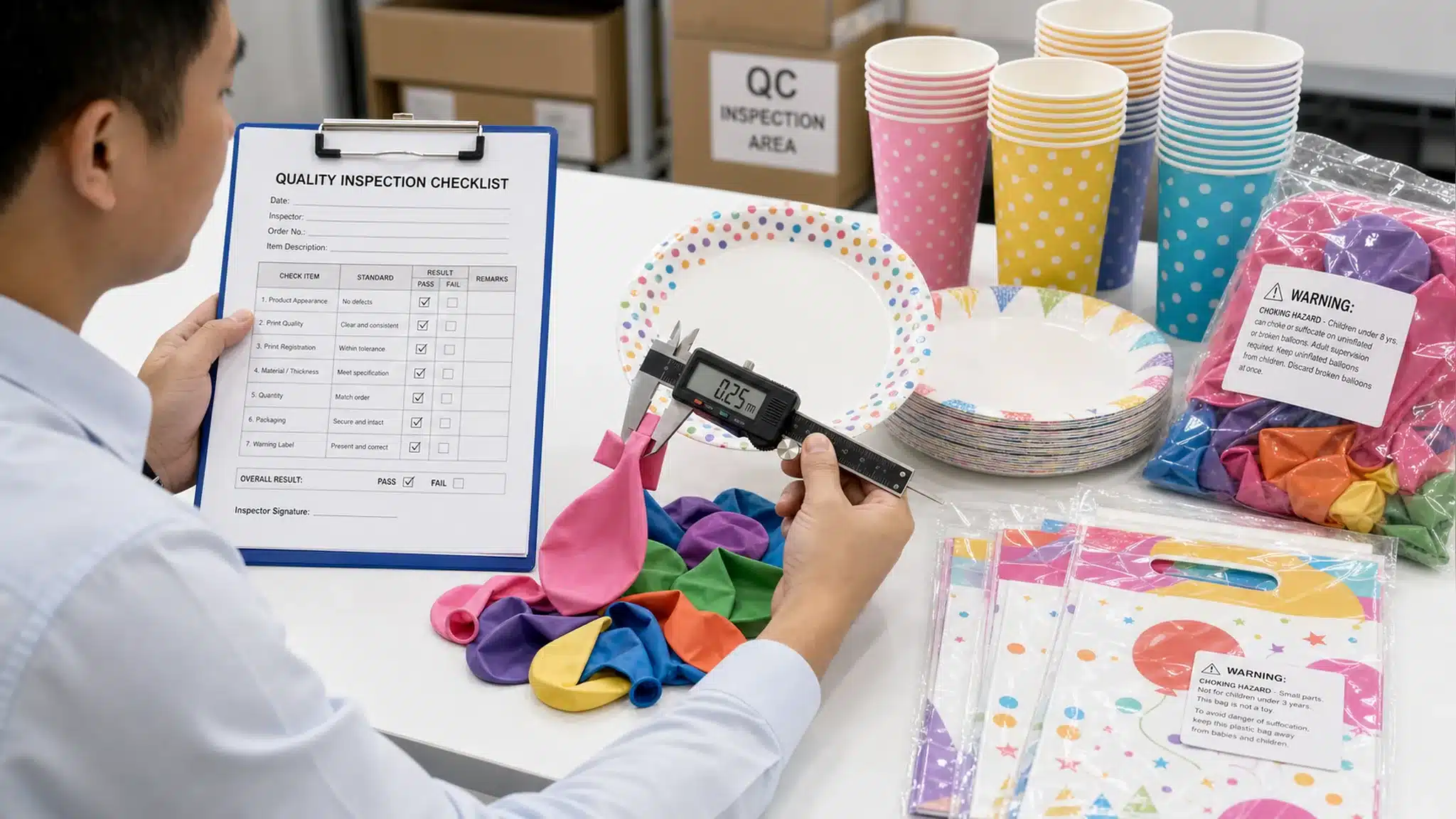
Commercial inspections are quoted per man-day, and four things move the number: how many days the sample size and the product’s check complexity actually require; where the factory is relative to the inspector’s base, since travel is billed; whether any function or safety testing happens on site; and how fast you need the report.
For a standalone booking our own quality control service page publishes $199 per man-day as the example rate, and when the inspection runs inside our full sourcing service it is often included rather than billed separately. We inspect to zero critical defects, AQL 2.5 on major and AQL 4.0 on minor by default, adjusting those levels if your buyer demands stricter, and the PDF report — hi-res photos, video of the function tests, measurement data — lands within 24 hours of the inspector leaving the floor. What no inspection quotation includes is third-party laboratory testing; that is a separate lab engagement, and it is the one that feeds a certificate of compliance.
The reason we can act on a failure rather than merely document it is the payment position. On orders we source, we hold the 70% balance ourselves, so a “Do Not Ship” alert lands while the factory is still unpaid — that is leverage, not correspondence. An inspector engaged in isolation from the payment terms has no such lever, which is how a buyer ends up holding an accurate report and a container he has already paid for.
Two more things a first enquiry usually needs, stated plainly rather than left silent. On lead time: there is no published turnaround in the commercial regime, so it is set by your booking agreement — ask for the report deadline in writing when you book, because the only place a deadline is fixed by rule is the mandated regime, where Article 2.16 gives the entity five working days.
On scope and minimums: there is no unit MOQ on an inspection, since it is sold by the day rather than by the piece. What sets the number of days is the lot size, the number of SKUs, and how many checks each one carries. If your order consolidates many small SKUs from different Yiwu suppliers, expect the day count to be driven by SKU count rather than by carton count.
Where this sits among the four checks
A pre-shipment inspection is one stage in a sequence, and the commonest error is buying this one when the risk actually lives in a different stage.
| Stage | When | The risk it actually removes |
|---|---|---|
| Factory audit | Before the order | You do not know who is actually making the goods |
| First article inspection | First units off the line | The interpretation of your spec is wrong before it is wrong 10,000 times |
| Pre-shipment inspection | Production largely complete and packed | The finished lot does not match what you bought, while you still hold the balance |
| Container loading supervision | Loading day | Inspected goods and loaded goods are not the same goods |
The sampling itself is governed by ISO 2859-1, “Sampling procedures for inspection by attributes — Part 1: Sampling schemes indexed by acceptance quality limit (AQL) for lot-by-lot inspection”, whose US national counterpart is ANSI/ASQ Z1.4. Both index sample size to lot size and inspection level, and set accept and reject numbers from the AQL applied to each defect class. The mechanics — which level, which AQL against critical, major and minor defects, and what each stage costs — are worked through in detail in our guide to AQL inspection stages and costs, and the checkpoint-by-checkpoint construction of the brief the inspector works to is covered in our QC checklist for China suppliers.
One closing caution about what a passing report transfers, which is less than most buyers assume. It records that a sample drawn on a given day, in a given place, matched a written brief. It does not follow the goods: if the lot is repacked, topped up or consolidated afterwards, the report describes a population that no longer exists, which is the specific gap container loading supervision exists to close. Nor does it move liability — the inspector’s contract with you is not your supplier’s contract with you, and a report is evidence in a claim, not a substitute for having one.
What We Check, and Where We Stop
Since the whole article turns on what the document does and does not carry, it is only fair to state our own scope in the same terms. We trigger a pre-shipment inspection at 100% produced and 80% packed. Set that against the industry booking convention described earlier — around 80 percent complete — and the difference is a deliberate one: that convention allows a fifth of the order to still be in production on inspection day, whereas our trigger requires every unit made and most of them already in export cartons.
On the floor the inspector covers four things: quantity, workmanship, function and packing, sampled against AQL. The tolerances are zero critical defects, AQL 2.5 on major and AQL 4.0 on minor, and we adjust those levels to your specific requirements if your own customer works to a stricter limit. You get the PDF within 24 hours — hi-res photos, video of the function tests, measurement data — and if the lot fails we issue a “Do Not Ship” alert rather than a score.
Where we stop matters more. We do not run laboratory testing, so nothing we issue can discharge a CPSC certificate or any other regulatory obligation described earlier in this article — that needs an accredited lab, and it is a separate engagement you book yourself. We do not audit the supplier: if the open question is whether your Yiwu contact is a factory or a market booth reselling somebody else’s production, that is an audit and this inspection will not answer it.
We do not follow the goods after the inspection date, which is why loading day is a separate visit rather than an extension of this one. And we are not a party to your letter of credit; if your credit calls for a certificate, the wording is a drafting question to settle with your bank before the inspection is booked, not something an inspector can fix afterwards.
The trade-off, stated plainly
A pre-shipment inspection buys you one thing: information at the last moment when your money is still leverage. It does not buy compliance, it does not buy a payment guarantee, and it does not buy a supplier relationship. Spend on it when the balance payment is the thing you cannot get back; spend on an audit, a first article, or a properly drafted credit clause when it is not.
Часто задаваемые вопросы
Is a pre-shipment inspection mandatory?
Only where the destination government mandates one. Those programmes are governed by the WTO Agreement on Preshipment Inspection and cover price and customs classification as well as quality. Everywhere else it is a voluntary service you choose to buy.
Who issues the inspection certificate under a letter of credit?
Whoever the credit names. If the credit does not stipulate an issuer, UCP 600 sub-article 14(f) tells banks to accept the document as presented — which can include one the seller signed. Name the issuer in the credit clause.
What is a Clean Report of Findings?
The output document of a government-mandated inspection. Under Article 2.16 the entity must issue it, or a detailed written explanation of non-issuance, within five working days of completing the inspection and receiving final documents.
Does a passed inspection satisfy US CPSC certification?
No. A Children’s Product Certificate is issued by the importer or domestic manufacturer, based on testing at a third-party CPSC-accepted laboratory. An inspection report is neither of those things and cannot substitute for it.
Can the inspection agency demand my supplier’s costs?
Not in the mandated regime. Article 2.12 bars requests for internal pricing including manufacturing costs, profit levels, and undisclosed process data. Your supplier may volunteer it under Article 2.13, but cannot be compelled.
What happens if my invoice price is rejected as too low?
Article 2.20 confines the comparison to identical or similar goods exported from the same country at about the same time. Retail prices in the importing country, and cost of production, are expressly excluded bases.
When should the inspection be scheduled?
Conventionally at around 80 percent production and export packing — early enough to rework, late enough for the sample to represent the lot. That is convention, not a standard. In mandated programmes, Article 2.3 fixes the place: the customs territory of export.