Justin
Wholesale plush toys look like the easiest category in China to buy. The samples are cheap, the market booths are stacked to the ceiling, and every supplier says yes to everything. Then the first real order lands and the category shows its teeth: a shipment held because the safety eyes pulled out under test, a reorder that came back with visibly thinner filling at the same price, a licensed character line that was never licensed at all. Plush is soft goods with a children’s-product compliance regime bolted on top, and that combination is what separates buyers who reorder profitably from buyers who quietly exit the category after one bad container.
This guide is written for the person placing the order — an importer, a distributor, a stocking wholesaler, or a private-label brand deciding where their plush line gets made. Where a number here is a legal limit, it is cited to the statute or the standard it comes from. Where the market does not publish a reliable number, the guide says so instead of inventing one.

Key Takeaways
- Toys enter the US duty-free under HTS 9503.00.00 (General rate: Free), but textile pet plush is classified separately at 6307.90.75.00 and carries a 4.3% MFN rate — a classification mistake that quietly costs money on every pet-plush shipment.
- For the US, ASTM F963-23 has been the mandatory toy standard for toys manufactured on or after 20 April 2024, sitting alongside the CPSIA limits of 100 ppm total lead and 0.1 percent for eight named phthalates.
- Any plush component that fits entirely inside a cylinder 2.25 inches long by 1.25 inches wide is a banned small part in a toy intended for children under 3 — and detached parts are re-tested after use-and-abuse testing, which is exactly how safety eyes fail.
- For the EU, EN 71-2 clause 4.5 caps surface flame spread on soft-filled toys at 30 mm/s unless the toy self-extinguishes, and Regulation (EU) 2025/2509 replaces the old Toy Safety Directive from 1 August 2030 with a mandatory Digital Product Passport.
- Yiwu suits assorted, ready-made, low-MOQ plush buying; Chenghai and Yangzhou factories suit custom designs with tighter compliance control. Choosing the wrong route is the single most expensive early decision in this category.
- Nobody can quote a credible plush unit price without your size, pile weight, face construction and packing spec. Treat any supplier who quotes before asking those as a reseller, not a maker.
On this page
- What You Are Actually Buying When You Buy Plush
- Yiwu Market or a Chenghai Factory: Which Route Fits Your Order
- Safety Compliance Is the Order-Killer: EN 71, CPSIA and ASTM F963
- The EU Rules Are Changing: What 2025/2509 Means for Your Plush Line
- How to Verify a Plush Supplier Before You Wire Anything
- What Drives Your Plush Unit Price and Your MOQ
- Classification, Duty and the Pet-Plush Trap
- A Worked Example: 3,000 Bears From Quote to Cleared Entry
- What We Check on a Plush Order — and Where We Stop
- Who This Category Suits — and Who Should Stay Out
- Perguntas mais frequentes
What You Are Actually Buying When You Buy Plush
A plush toy is four purchases pretending to be one. There is the shell fabric, the filling, the hard components, and the labour that joins them. Suppliers quote you a single number, which is precisely why two quotes that look 30 percent apart are often not comparable at all. Understanding the four layers is what lets you interrogate a quote instead of just accepting or rejecting it.

The shell is almost always polyester — short-pile “super soft” velboa, longer-pile fur, or a corduroy-style ribbed plush. What matters commercially is pile height and fabric weight in grams per square metre. A heavier, denser fabric feels more expensive in the hand because it is more expensive: more fibre per unit area, more of the cost that actually differentiates a premium plush from a market-grade one. When a reorder “feels thinner” than the sample, this is usually where it happened, and it is invisible unless your specification names the fabric weight rather than just the colour.
The filling is normally polyester fibre, commonly called PP cotton in Chinese factories. Grade and quantity both move independently of the shell, and both are easy to cut.
A bear stuffed to a firm, upright posture uses meaningfully more fill than the same pattern stuffed soft, and the pattern is identical, so a photograph will not reveal the difference. Here EN 71-1 sets a floor that is worth quoting to a supplier verbatim: clause 4.1 of EN 71-1 requires that “Toys and material used in toys shall be visually clean and free from infestation.” That clause exists because recycled and reclaimed filling has historically been a real problem in low-cost soft toys, and it gives you a standards-based reason to demand virgin fill rather than a preference you have to argue for.
The hard components — safety eyes, noses, plastic joints, rattles, zips, and any bead or pellet weighting — are where nearly all of the regulatory risk concentrates. They are also the cheapest line in the bill of materials, which is exactly the problem: the incentive to substitute a cheaper eye is high and the visual difference is nil. Everything in the compliance section below is, in practice, mostly about these parts and the seams holding them.
Labour is the fourth layer and the least discussed. Plush resists automation because fabric is floppy: panels are machine-sewn but turning, stuffing, closing the stuffing hole, and attaching facial features involve hand work on nearly every unit. That is why plush unit costs fall more slowly with volume than injection-moulded toys do, and why a factory quoting an unusually flat price curve across quantity tiers is worth a second look — it often means they are quoting a trading margin, not a production cost.
Yiwu Market or a Chenghai Factory: Which Route Fits Your Order
This is the decision that determines everything downstream — your MOQ, your compliance exposure, your lead time, and whether you can fix a quality problem or only complain about it. Most buyers get it wrong by defaulting to whichever route they encountered first.

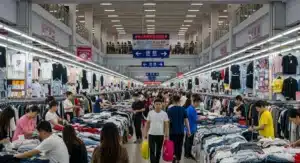
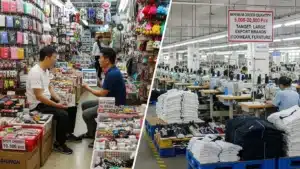
The Yiwu route means buying from the wholesale market ecosystem. Plush suppliers there are listed on floor 1 of International Trade Mart District 1, with booth addresses in the form the market operator publishes — F1-093, 1F, Gate 6, or 1721/1722, 1F, Gate 8. The critical thing to understand is that most of those booths are trading offices for factories located elsewhere, not the factories themselves. That is not a scam; it is the market’s function. It is why you can buy 30 different plush SKUs in an afternoon at low per-SKU quantities and consolidate them into one container, which no single factory would ever agree to.
The consequence is that the Yiwu route optimises for assortment and low commitment, and pays for it in traceability. When a booth sells you a ready-made design, you are buying an existing production run. You did not specify the fabric weight, you did not choose the safety eye, and the test report you are shown — if one exists — belongs to a batch that may or may not be the batch you receive. For dollar-store buyers, claw-machine operators, party-goods distributors and gift wholesalers, that trade is often correct and rational. For anyone putting their own brand name on the label, it is a structural problem, because the liability sits with you and the specification control does not.
The factory route — Chenghai in Shantou for toys generally, Yangzhou and parts of Jiangsu and Shandong for plush specifically — inverts the trade. You get a named production line, a specification you wrote, the ability to nominate materials and components, and a test report that belongs to your order. You pay for it with a real MOQ per design and per colourway, a tooling-and-sampling phase before anything is produced, and a lead time measured from pattern approval rather than from payment. This is the route that makes a private-label plush line defensible.
| Decision factor | Yiwu market route | Chenghai / Yangzhou factory route |
|---|---|---|
| What you buy | Existing designs from stock or short runs | Your design, your specification, your run |
| Order shape | Many SKUs, small quantity each, mixed container | Few SKUs, real quantity per design and colour |
| Material control | Take it as made; substitution hard to detect | Nominate fabric weight, fill and components |
| Test reports | Often a supplier’s older batch report | Can be commissioned against your production batch |
| Best for | Dollar stores, party goods, claw machines, gift assortments | Private label, retail brands, licensed and character lines |
| Not for | Anyone whose brand name goes on the sewn-in label | Buyers testing 12 designs to see what sells |
There is a hybrid that experienced buyers use and beginners rarely consider: prove demand on the market route, then move the winners to the factory route. Buy the assortment cheaply, find the three designs that actually sell through, and re-tool only those as specified production with proper testing. It converts the market’s weakness — no specification control — into an acceptable cost of market research, and stops you paying factory MOQs on nine designs that were never going to move.
For importers, distributors and private-label brands buying plush at wholesale volume: send your design, target size and quantity per colourway, and we will tell you whether the market route or a factory run gives you the better landed cost — including when the honest answer is that your quantity is too small for a factory.
Safety Compliance Is the Order-Killer: EN 71, CPSIA and ASTM F963
Plush toys fail compliance in a small number of highly predictable ways, and every one of them is cheaper to prevent at specification stage than to discover at a port. The thresholds below are the actual legal figures, cited so you can quote them into a purchase order rather than paraphrasing them at a supplier who will simply agree and change nothing.

Start with the small parts rule, because it is the one that destroys plush orders most often. The US Consumer Product Safety Commission’s regulatory summary of 16 CFR Part 1501 defines a small part as “any object that fits completely into a specially designed test cylinder 2.25 inches long by 1.25 inches wide that approximates the size of the fully expanded throat of a child under three years old.” That rule applies to “all toys and other articles intended for use by children under 3 years (36 months)” under 16 CFR 1501.2.
The detail that catches plush suppliers is what happens next: parts that break off during the use-and-abuse testing of 16 CFR 1500.51 and 1500.52 are then placed into the cylinder one at a time, with paper, fabric, yarn, fuzz, elastic and string excluded from consideration. A safety eye that survives the shelf but pops out under pull testing is a failed product, not a cosmetic defect.
This is why the eye-and-nose attachment method — properly locked washers on a moulded shank, not glue, not a decorative sewn-on button — is the single most important line in a plush specification for the under-3 market.
If your plush contains small parts but is aimed at older children, you are not automatically clear. The same CPSC summary states that toys “intended for use by children from 3 to 6 years old must be labeled to warn purchasers not to buy them for children under 3 years old because those children could choke on the small parts.” That is a labelling obligation which has to be specified before printing, and hang tags printed without it become a relabelling job at destination.
On chemistry, two CPSIA limits govern. Total lead content in children’s products is capped at 100 parts per million by weight under 15 U.S.C. 1278a, and the same statute directed the lead-in-paint limit down to 0.009 percent — 90 ppm — in 16 CFR 1303.1. Usefully for plush, the statute exempts “any component part of a children’s product that is not accessible to a child through normal and reasonably foreseeable use and abuse of such product,” which is why an internal rattle housing is treated differently from a surface embellishment.
Separately, 16 CFR 1307.3 prohibits children’s toys containing more than 0.1 percent of any of eight named phthalates: DEHP, DBP, BBP, DINP, DIBP, DPENP, DHEXP and DCHP. In plush, phthalate exposure almost never comes from the fabric — it comes from printed plastisol appliqués, PVC accessories, and soft moulded features.
Above all of that sits ASTM F963-23, which became the mandatory US toy safety standard for toys manufactured on or after 20 April 2024, incorporated by reference at 16 CFR Part 1250. Compliance is not self-declared: children’s products require testing at a CPSC-accepted third-party laboratory and a Children’s Product Certificate issued on the basis of that testing. If a supplier offers you a certificate they wrote themselves, that document has no standing.
For the EU, the plush-specific clause that surprises buyers is flammability. EN 71-2 clause 4.5 requires that for soft-filled toys “the rate of spread of flame on the surface shall not be more than 30 mm/s or the toy shall self-extinguish.” Long-pile fur is materially riskier here than short-pile velboa, because loose surface fibre carries flame across a surface far faster than the bulk material burns. The same clause excludes toys which “present a maximum unhindered vertical soft-filled height of 150 mm or less” — so a small keyring plush and a one-metre sitting bear are genuinely not in the same regulatory position, and a supplier who has only ever made keyrings may have no relevant test history at all.
| Requirement | Threshold | Source |
|---|---|---|
| US small part (under-3 toys) | Fits wholly in a cylinder 2.25 in long × 1.25 in wide | 16 CFR 1501.4 / CPSC compliance summary |
| US total lead content | 100 ppm by weight, accessible parts | 15 U.S.C. 1278a(a)(2) |
| US lead in surface coating | 0.009 percent (90 ppm) | 15 U.S.C. 1278a(f); 16 CFR 1303.1 |
| US phthalates (8 named) | Not more than 0.1 percent each | 16 CFR 1307.3 |
| US mandatory toy standard | ASTM F963-23, toys made on/after 20 Apr 2024 | 16 CFR Part 1250 |
| EU flammability, soft-filled | Flame spread not more than 30 mm/s, or self-extinguishing | EN 71-2 clause 4.5 |
| EU material cleanliness | Visually clean and free from infestation | EN 71-1 clause 4.1 |
Treat this as the compliance skeleton, not a legal opinion. Standards are revised, national enforcement differs, and features such as sound modules, batteries or cosmetics pull in requirements not listed here. Confirm the current position with an accredited laboratory before committing to a production run.
The EU Rules Are Changing: What 2025/2509 Means for Your Plush Line
Most plush sourcing guides still describe the EU regime purely as Directive 2009/48/EC plus the EN 71 series. That description now has an expiry date on it, and buyers planning multi-year private-label programmes need to know the timetable before they commit to packaging artwork and supplier agreements.
Regulation (EU) 2025/2509 on the safety of toys was published in the Official Journal on 12 December 2025 and applies from 1 August 2030. The shift from a directive to a regulation is not cosmetic: a directive requires each member state to transpose it into national law, whereas a regulation applies directly and identically across the bloc, which removes the national-variation defence some suppliers have historically leaned on.
Two dates matter for planning. The Toy Safety Directive is repealed from 1 August 2030, and EC type-examination certificates issued under it remain valid until 1 February 2031. If you are commissioning a plush line in 2026 that you expect to still be in catalogue at the end of the decade, the certification you are buying now has a defined shelf life, and that is worth writing into the supplier agreement rather than discovering later.
The change with the largest operational footprint is the Digital Product Passport. Under the new Regulation, manufacturers must create a digital product passport for each toy model, carrying a statement of the toy’s compliance and associated data, accessed through a data carrier such as a QR code. In practice that replaces the physical Declaration of Conformity with a data obligation, and it lands on the party placing the toy on the EU market — which, if you are importing under your own brand, is you rather than the Chinese factory. A plush supplier who has never produced for a DPP-ready customer will not have the data discipline for it, and that gap is easier to assess now than in 2030.
The practical read for a buyer in 2026: nothing forces you to act immediately, but two things are worth doing on your next plush programme. Ask suppliers what per-model technical documentation they can produce and in what format, because DPP readiness is fundamentally a records question. And avoid signing multi-year exclusive arrangements that assume the current certification regime persists unchanged, because for toys it demonstrably will not.
How to Verify a Plush Supplier Before You Wire Anything
Supplier verification in plush is mostly about establishing one thing: whether the entity you are paying controls the production, or is passing your order to someone who does. Neither answer is disqualifying. Not knowing which one you are dealing with is.

Work through this sequence in order. Each step is designed so a supplier who cannot pass it reveals that early, while the cost of walking away is still zero.
- Check the business licence against what they claim to do. Ask for the Chinese business licence and read the registered scope and the registered capital. A company whose scope is wholesale and retail trade is a trading company, whatever the website says. That is fine for market-route buying and a problem if you were promised a factory.
- Ask which specific standard they have tested to, and for which market. The useful question is not “do you have EN 71?” — everyone says yes — but “which parts, tested by which laboratory, on which date, for which product?” A supplier with genuine test history answers with a lab name and a report number. A supplier without one changes the subject to price.
- Read the test report, not the certificate image. Check that the product described in the report is the product you are buying, that the report date is recent enough to be relevant, and that the tested parts include the components on your item. A report covering a different colourway or a different size of the same family is common and is not coverage.
- Pull-test the sample yourself. You do not need a laboratory to catch the most common failure. Grip the safety eye and the nose and pull firmly and steadily. Tug seams at the limb joints. Anything that shifts, loosens or detaches under hand force will not survive formal use-and-abuse testing, and you have learned it before placing the order rather than after.
- Cut one sample open. Buy two, keep one intact, and open the second along a seam. You are checking that the filling is clean, uniform virgin fibre rather than lumpy reclaimed material, that the fill is distributed rather than packed into the head, and that internal seam allowances are properly stitched rather than raw.
- Verify the licence chain on any character product. If a design references a recognisable character, ask for the licensing documentation naming the factory as an authorised producer. Unlicensed character plush is abundant in the Chinese wholesale market, it is seized at destination, and the importer of record — not the seller — carries that liability.
- Book a pre-shipment inspection against a written AQL standard. Specify the acceptable quality level and the checkpoints in advance: measurements against the approved sample, fill weight, eye and nose pull, seam integrity, colour against the approved swatch, labelling, and carton markings. An inspection without a pre-agreed standard is a photo album.
- Keep a sealed, signed golden sample. Both parties keep one sealed approved sample. It is the only reference that settles a reorder dispute about fabric weight or fill density, and it costs one unit.
The insider warning most plush buyers learn the expensive way
The risk in plush is rarely the first order. It is order three. The initial run is made carefully because the supplier is winning your business; the reorder is where fabric weight drops, fill is reduced, and a cheaper safety eye appears. All three changes are invisible in a photograph and obvious in the hand. This is exactly why the sealed golden sample and a written fabric weight in grams per square metre matter more in this category than in almost any other — without them, you have no way to prove the goods changed, and the supplier has every incentive to insist they did not.
For importers and stocking wholesalers at container volume who need someone on the ground: send the supplier’s test report and the item photos on WhatsApp and we will tell you what the report actually covers, what it does not, and which checkpoints belong in a pre-shipment inspection for that specific item.
What Drives Your Plush Unit Price and Your MOQ
A straight answer first, because it is more useful than a fabricated range: no honest party can give you a plush unit price without your specification, and this site does not publish one. Plush pricing moves with fabric weight, size, face construction, component count, packing and quantity simultaneously, and any published “plush costs X dollars” figure is either a specific quote for someone else’s product or marketing. What you can be given is the structure that generates the number, which is what lets you read a quote and negotiate against it.

Size drives cost non-linearly, and this is the variable buyers most often misjudge. Doubling a plush toy’s height roughly quadruples its surface area and increases fill volume by more still, so a 40 cm bear is nowhere near twice the cost of a 20 cm bear in the same fabric. If your target retail price is under pressure, reducing the size by a few centimetres usually moves cost more than any amount of haggling over the rate.
Fabric specification is the second lever. Pile height and grams per square metre set the material cost and are also what the customer feels. Face construction is the third and is a genuine fork: embroidered features cost more per unit and hold up in the wash, while printed or heat-applied faces are cheaper and are also where phthalate and small-parts risk concentrates. Component count is the fourth — every added element, from a ribbon to a sound module, adds a part, a labour step and a compliance surface.
On MOQ, the structural point is that plush minimums are set per design e per colourway, not per order, because each colour is a separate dye lot and each design is a separate pattern and sample cycle. A buyer asking for 500 units across five colours is asking for five runs of 100, which most factories price very differently from 500 of one colour.
Ready-made market goods behave differently again: because the trading company has already absorbed the production risk, per-style minimums drop to carton quantities. If you need a firm minimum for your own mix, it has to be quoted against your specific size-and-colour breakdown — that is a per-project number, and any supplier quoting a universal MOQ before seeing your mix is quoting a slogan.
| Cost / MOQ driver | How it moves the number | What to do about it |
|---|---|---|
| Finished size | Surface area rises with the square of height; fill volume rises faster still | Largest single lever. Trimming a few cm beats negotiating the rate |
| Fabric pile & weight (g/m²) | Sets material cost and the perceived quality the customer feels | Name the g/m² in the spec, or a reorder can be thinned invisibly |
| Face construction | Embroidery costs more per unit; printed/heat-applied is cheaper | Embroidery also removes the under-3 small-parts failure mode |
| Component count | Every ribbon, joint, rattle or sound module adds a part and a labour step | Each addition is also a new compliance surface to test |
| Colourways | Each colour is a separate dye lot, so MOQ is per design AND per colour | 500 units in 5 colours is five runs of 100, priced differently |
| Licensing | Character rights carry royalty and authorised-producer documentation | Unlicensed goods are seized at destination; liability sits with the importer |
| Packing volume | Plush is light and bulky; ocean freight is volume-constrained | Compression packing often saves more than a unit-price discount |
| Amostragem | Pattern making and sample rounds are real work billed before production | A supplier who waives all sampling cost is usually a trader, not a maker |
Two costs that are invisible in a unit price and routinely wreck plush margins: packing volume and sampling. Plush is light and bulky, so ocean freight on plush is almost always volume-constrained rather than weight-constrained — you pay for cubic metres of air, and compression packing versus loose boxing can change your landed cost per unit more than a supplier discount does. Sampling is the other: pattern making and sample rounds are real work, and a factory that waives all sampling cost on a custom design is either amortising it into your unit price or not making it themselves.
Classification, Duty and the Pet-Plush Trap
Duty on plush is where a lot of otherwise careful buyers carry a wrong assumption, partly because a great many sourcing articles still cite a tariff subheading that no longer reflects how the current US schedule is laid out.
Queried live against the US International Trade Commission’s Harmonized Tariff Schedule, toys sit at heading 9503.00.00 — “Tricycles, scooters, pedal cars and similar wheeled toys; dolls’ carriages; dolls, other toys” — with a General (MFN) rate of Free and a Column 2 rate of 70%.
Note the shape of that: the current schedule carries the statistical detail in suffixes that split by age band, 9503.00.00.11 for “Under 3 years of age” and 9503.00.00.13 for “3 to 12 years of age,” rather than in the 9503.41 stuffed-toy subheading that older guides quote. The age-band suffix is not a duty question — it is Free either way — but it is a declaration question, and it is one more place where the age grading you chose at design stage follows the product all the way to the entry filing.
Now the trap. Plush made for animals is not a toy in tariff terms. Textile pet toys classify at 6307.90.75.00, “Toys for pets, of textile materials,” at a General rate of 4.3%. A buyer who adds a pet-plush line to an existing toy programme and assumes the duty-free treatment carries over is under-declaring, and the error compounds silently across every shipment until someone reviews the entries. If your assortment mixes children’s plush and pet plush in the same container — a genuinely common Yiwu consolidation — those lines must be classified separately on the entry.
One caution on the wider picture: the MFN rates above are the schedule rates. Trade-remedy measures, country-specific surcharges and temporary actions sit on top of the schedule and change far more often than the schedule itself does, so the total payable on a Chinese-origin plush shipment is not simply the General rate. Those overlay rates move with policy and should be confirmed with your customs broker for your entry date rather than taken from any guide, including this one. What you can rely on from this section is the classification logic — children’s plush and pet plush are different goods to customs — and that is the part buyers get wrong.
A Worked Example: 3,000 Bears From Quote to Cleared Entry
Here is the sequence applied end to end, in the order the decisions actually arrive. The scenario: a European gift distributor wants 3,000 units of a 25 cm sitting bear in three colourways, own brand, sold to children’s retail. It is illustrative rather than a record of a specific order, but every decision point is real and every threshold cited is the legal one.
Weeks 1–2, specification before shortlisting. The buyer writes the spec first: 25 cm seated height, short-pile velboa at a stated grams per square metre, virgin polyester fill at a stated weight, embroidered eyes and nose rather than plastic safety eyes, sewn-in label, polybag with a printed warning. The embroidered-face decision is made here deliberately — the product is aimed at young children, and embroidery removes the small-parts failure mode entirely rather than managing it. That single choice eliminates the most common cause of plush test failure before a supplier has been contacted.
Weeks 2–4, route and shortlist. Own brand and children’s retail push this to the factory route, not the market route. Three suppliers are shortlisted; business licences are checked and one turns out to be a trading company with a wholesale scope, which is not rejected outright but is repriced as an intermediary. Each is asked for a specific EN 71 report — which parts, which laboratory, what date, which product. One produces a report for a 12 cm keyring. Given the EN 71-2 clause 4.5 exclusion for soft-filled height of 150 mm or less, that report tells the buyer almost nothing about a 25 cm bear, and the supplier’s confusion on that point is itself the answer.
Weeks 4–7, samples. Two samples per supplier. One is opened along a seam to check fill uniformity and internal seam finish. The intact one is hand pull-tested at the limb seams and the embroidered features. The 3,000 units split across three colourways is understood correctly as three dye lots of 1,000, and quoted that way; a supplier who quotes it as one run of 3,000 has not read the specification. A golden sample is sealed and signed by both parties.
Weeks 7–8, compliance commissioning. Testing is commissioned against the production batch, not accepted from the supplier’s archive, covering EN 71-1 mechanical and physical properties, EN 71-2 flammability against the 30 mm/s soft-filled limit, and EN 71-3 migration of certain elements. Because this line is destined for the EU under the buyer’s own brand, the buyer is the party placing the toy on the market and therefore carries the conformity obligation — a point worth internalising now, given that Regulation (EU) 2025/2509 will convert that documentation duty into a Digital Product Passport per model from 1 August 2030.
Weeks 8–12, production and pre-shipment inspection. Inspection is booked against a written AQL with named checkpoints: seated height against the golden sample, fill weight, embroidery pull, seam integrity at limb joints, colour against the approved swatch across all three lots, label content, polybag warning text, and carton markings. Colour consistency across dye lots is the checkpoint people forget, and with three lots of the same design it is the most likely defect on this particular order.
Weeks 12–14, shipping and entry. Cartons are cubed before booking, because 3,000 bears at 25 cm is a volume shipment and the freight cost is set by cubic metres, not kilos. On the entry, the goods are declared as toys with the correct age-band detail, supported by the test reports and the conformity documentation. Had the buyer added a pet-plush line to the same container to fill space — a very tempting move on a volume-constrained shipment — that line would have needed separate classification at 6307.90.75.00 with its 4.3% rate rather than riding along duty-free.
The instructive part is how much risk was removed in weeks 1 and 2, before money moved. Embroidery over safety eyes, fabric weight written into the spec, and a sealed reference unit cost nothing and pre-empted the three defects that most often turn a plush reorder into a dispute.
For wholesale and private-label buyers running plush at carton or container volume: inspection runs to ANSI/ASQ Z1.4 at critical 0 / major AQL 2.5 / minor AQL 4.0, at 100% produced and 80% packed, with the report back as a PDF within 24 hours. If your order is a handful of cartons of ready-made market stock, say so — the inspection cost may not be worth it, and we will tell you that.
What We Check on a Plush Order — and Where We Stop
The verification steps above are the buyer’s side. What follows is the published specification of this site’s own inspection service, applied to a plush order. These are contract terms a buyer can hold us to and compare line by line against any other agent’s — not a description of industry good practice.
Sampling follows ANSI/ASQ Z1.4 (ISO 2859-1), and the default tolerances are published rather than negotiated case by case: critical defects zero allowed, major at AQL 2.5, minor at AQL 4.0, adjustable by agreement before the order runs.
Those three numbers matter more in plush than in most categories, because plush defects sort cleanly across the boundary. A safety eye that pulls out is critical and carries no allowance at all. Thin or lumpy filling is major. A slightly crooked seam on a decorative patch is minor, and a buyer who tries to reject a container over AQL 4.0 cosmetic drift will lose that argument — which is exactly why the levels are agreed in writing before production rather than after a disappointing sample lands.
Timing is triggered by production progress, not by the calendar. A during-production check runs at 20-50% produced, which in plush is the only point where a systemic fault is still cheap: fill weight drifting light, or a dye lot coming off shade, is a rework of a few hundred pieces at that stage and a rework of the whole order at the end. Pre-shipment inspection runs at 100% produced and 80% packed — packed matters here, because polybag warning text and carton markings cannot be verified on loose goods. The report is a PDF within 24 hours with hi-res photos, video tests and measurement data, which is the window that decides whether you can still stop a booking.
The mechanism behind the report is the part most worth comparing. A third-party inspector reports a problem and leaves; the factory still holds your goods and your leverage is gone. On orders run through this service the final 70% payment is held, and if QC fails, that money is not released until the factory reworks the goods and re-inspection passes.
Against the bribery risk — the “red envelope” that quietly passes a bad lot — the published controls are inspector rotation (never the same inspector twice), GPS and body-cam recording, and a whistleblower reward paid to factories that report a bribe attempt. Standalone inspection is charged at a flat daily rate, published at $199 per man-day, and is often included in a full sourcing engagement.
On the supplier-identity side the published position is equally specific, and it is the one that decides a plush price before any inspection happens: 60-70% of “factories” on B2B platforms are trading companies, adding a 15-30% margin over the factory price, so licences are verified on site. Certificates are not taken at face value either — a certificate number is verified directly with the issuing lab (SGS, TUV) to confirm it is valid and actually belongs to that factory, which is the check that catches the borrowed EN 71 report described earlier. Where sourcing runs beyond the Yiwu market, the fee is open-book: the manufacturer’s original invoice is visible to you and the service fee is a pre-agreed 5-10%.
Several checkpoints are graded against published thresholds rather than opinion, which is what makes them arguable with a supplier. Any component that detaches under pull-testing is measured against the 2.25 inch by 1.25 inch small-parts cylinder of 16 CFR 1501.4. Hang-tag and polybag text is checked for the choking-hazard warning that 16 CFR 1500.19 requires on small-parts toys graded 3 to 6 years.
Filling is checked against the EN 71-1 clause 4.1 requirement that materials be visually clean and free from infestation. And where the item is destined for the EU above 150 mm of unhindered soft-filled height, the file is checked for an EN 71-2 flammability result against the 30 mm/s clause 4.5 limit, because below that height the clause does not apply and a supplier’s existing report may be irrelevant to your item.
Where the check stops — stated deliberately
An inspection is not a laboratory. Nobody on a factory floor can measure lead content, phthalate concentration or flame-spread rate by hand, and any party who says otherwise is selling you false comfort. Those figures come only from an accredited laboratory testing your production batch, and the certificate of conformity is issued on the basis of that testing — not on the basis of an inspection report. Nor does an inspection make anyone else the responsible party: if you are the importer placing the goods on the market, that obligation is yours, and choosing a supplier or an agent does not transfer it.
Who This Category Suits — and Who Should Stay Out
Plush rewards some buyer profiles and punishes others, and the difference is not capital. It is whether your business model can absorb specification control and compliance overhead.
Plush works well for you if you sell assorted gift or novelty goods where design turnover is the point and per-SKU volumes stay small — the Yiwu route was built for exactly this. It also works if you are a brand with a defined range willing to commit real quantity per design and pay for testing against your own batch, because then the factory route gives you a product competitors cannot simply reorder from the same booth. Claw-machine and amusement operators are a third natural fit: high volume, low unit value, age grading typically above the under-3 threshold, and durability mattering more than finish.
Plush is a poor fit if you want a custom design at market-route quantities. That combination is what generates most disappointment in this category — buyers who want 200 units of their own bear with proper testing and discover that the sampling and testing cost alone exceeds the goods value.
It is also a poor fit if your route to market cannot carry compliance cost at all, because for children’s plush that cost is not optional, and a business plan that only works if testing is skipped is a business plan with a recall in it. And if you are drawn to licensed character plush because it sells fast, be clear that unlicensed goods are widely available in the wholesale market and that the liability for importing them sits with you.
If you are still deciding between plush and an adjacent category, it is worth comparing against how the same market handles goods with lighter compliance loads — our overview of wholesale toys and baby products covers the neighbouring segments, and the Yiwu versus Shantou comparison goes deeper on the geography of the two sourcing routes described above.
If your concern is specifically the failure modes rather than the buying, the three tests that prevent costly toy recalls is the closest companion piece to this guide. Buyers going the own-brand route will want to read how private label and OEM production is structured before committing to a first run, and Amazon sellers specifically should read the agent-cost guide for Amazon toy sourcing, which covers the fee side this article does not.
Conclusão
Wholesale plush is a category where the decisions that determine your outcome are made before you talk price. Pick the route that matches your order shape, write a specification that names fabric weight and face construction, choose the components that design the compliance risk out rather than manage it, and verify the test report against the actual product you are buying. The legal thresholds are public and specific — 100 ppm lead, 0.1 percent for the eight phthalates, the 2.25 by 1.25 inch cylinder, 30 mm/s flame spread on soft-filled toys — and a supplier’s reaction to being asked about them tells you most of what you need to know.
If you would like a second pair of eyes on a plush quote or a supplier before you commit, that is the kind of check worth doing while walking away is still free.
Perguntas mais frequentes
Do I need EN 71 and ASTM F963 testing if I only sell online?
Yes. The obligations attach to placing a toy on the market, not to the sales channel. Selling through a marketplace does not transfer the duty, and most major marketplaces now request the test report or certificate directly.
Can I label a plush toy “3+” to avoid the small-parts rule?
Not by labelling alone. Age grading must reflect the product’s real intended and recognised use, and toys with small parts sold for ages 3 to 6 still require a choking-hazard warning under 16 CFR 1500.19.
Are embroidered faces always better than safety eyes?
For the under-3 market they remove a whole failure mode, which is why they are standard on baby plush. For older age grades, properly locked safety eyes are compliant, cheaper and give a sharper look.
Is long-pile fur riskier than short-pile plush?
On flammability, yes. Loose surface fibre carries flame faster than the bulk material, which matters against the EN 71-2 clause 4.5 limit of 30 mm/s surface flame spread on soft-filled toys.
How long does a custom plush order usually take?
Plan in phases rather than one number: pattern and sampling rounds, then production, then shipping. Sampling is the phase buyers underestimate, and it starts from design approval, not from deposit.
Does the new EU Toy Safety Regulation affect orders I place in 2026?
Not immediately. Regulation (EU) 2025/2509 applies from 1 August 2030, and certificates issued under the old Directive stay valid until 1 February 2031 — but long-life product ranges should plan for it now.
Why is my plush freight cost so high relative to the goods value?
Because plush is bulky and light, so shipments are volume-constrained rather than weight-constrained. Compression packing and carton cubing usually save more than negotiating the unit price does.