Justin
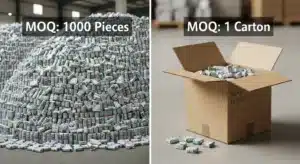
MOQ stands for minimum order quantity — the smallest amount a supplier will sell you in one order. That is the whole definition, and it takes ten seconds to learn. The reason buyers keep searching for it is that the definition does not survive contact with a real quotation. You ask one factory for its MOQ and get “500 pieces.” You ask a booth in Yiwu and get “one carton.” You ask about printed bags with your logo and the number jumps to several thousand. Same two words, three unrelated answers.
They are unrelated because they are not the same minimum. A single order is governed by three or four separate floors at once, set by different parties for different reasons, and only some can be negotiated. This page explains what each one is, which are real constraints and which are opening positions, and one change in US customs rules that quietly raised the floor for every small importer.
Key Takeaways
- MOQ means minimum order quantity. The confusion comes from several of them applying to one order, not from the term itself.
- A trading MOQ (what a booth will break) is soft. A production MOQ (one dye lot, one mould setup) is hard. A packaging MOQ is usually what blocks a private-label launch.
- Freight imposes a fourth minimum: LCL bills on the revenue ton — the greater of 1 CBM or 1,000 kg — with a 1 CBM minimum charge.
- The US $800 de minimis exemption was suspended for all countries on 29 August 2025 under Executive Order 14324, so small test orders no longer clear duty-free.
What MOQ Actually Means
Minimum order quantity is the smallest quantity a supplier is prepared to sell in a single transaction. It is expressed in pieces, cartons, kilograms, metres, or occasionally in order value rather than units — “$1,000 minimum” is an MOQ too, just denominated in money. Suppliers set one because almost every cost of filling an order is fixed rather than per-unit: quoting, sampling, setting up the line, cleaning it afterwards, inspecting, invoicing and paperwork. Spread those over 5,000 pieces and they vanish into the unit price. Spread them over 50 and they are the unit price.
This is why “can you do a smaller quantity?” is often answered with a higher unit price rather than a refusal. The supplier is telling you what the fixed costs look like divided by a smaller number. So stop asking whether the MOQ can drop and start asking what the price is at your quantity — that turns a favour into a quote, and often produces a workable number where the first question produced a wall.
The second source of confusion is that buyers assume they are talking to a manufacturer when they usually are not. Yiwu International Trade City runs roughly 75,000 shops with more than 200,000 people working the market, and most behind those counters are traders, distributors and factory sales agents rather than the factory. That decides whether your quoted number is negotiable at all: a trader holding stock can sell any quantity they physically have, while a factory quoting a production run cannot sell less than one run without eating the setup cost. So the first question is never “can you lower it” but “is this stock you are holding, or a run you would start for me?”
For an official reference on what moves through that market, the Yiwu Index — published by the Yiwu-China Small Commodities Index Editorial Office — is free to read, and put Yiwu’s import-export volume at 701.19 billion yuan for the first ten months of 2025, up 25.2 percent. It gives no per-product MOQ, but it is a real official reference in a market where most published numbers are marketing.
The Soft Floor and the Hard Floor
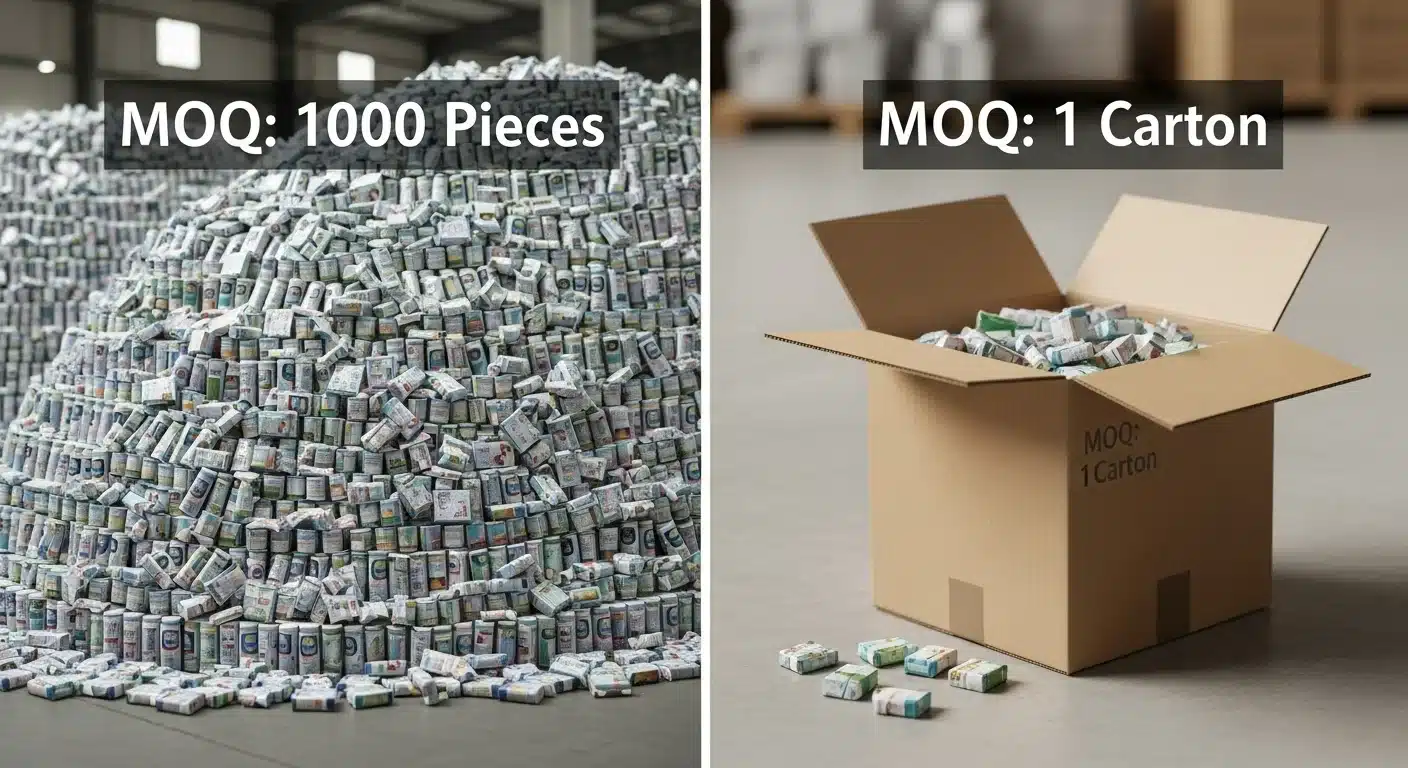
The first two minimums look identical in an email and behave nothing alike. The trading MOQ — the number from a booth or trading company — is the softest of the four. In Yiwu it is usually quoted by the carton rather than the piece, because the carton is the physical unit of trade: how goods arrive at the booth, stack in the consolidation warehouse and count into a container. Nobody in that chain wants to open a sealed carton and repack a partial one, so the carton becomes the default quoting unit.
That also explains where the flexibility lives. A trading MOQ bends when you make the handling worth it: more SKUs from the same supplier, stock colours instead of ones they would have to request, whatever is already sitting in their warehouse instead of the newest catalogue item. What it does not bend to is “I am small.” Every buyer in that market is small relative to the factory. The buyers who get flexibility are the ones who reduce the supplier’s work, not the ones who explain their budget.
O production MOQ is the hard one, and it is hard for a physical reason rather than a commercial one. It is set by the smallest batch a process can economically run once — one dye lot, one injection-mould setup, one print run. These are not divisible. You cannot run a third of a mould setup or half a dye bath and get a proportionate result.
Textile dyeing shows why this matters beyond cost. Fabric dyed in separate batches comes out in slightly different shades even under an identical formula, because temperature, water quality, dye composition and fibre absorbency all shift between runs. Where a colour is built from several dyes, each component exhausts at its own rate, making precise reproduction across lots genuinely difficult. So when a factory says its minimum is one dye lot, splitting your order across two does not just cost more — it risks delivering two visibly different products under one SKU. That is a real risk to a listing, not a negotiating tactic.
The workaround for a hard production MOQ is almost never to argue it down. It is to avoid triggering it: a stock colour instead of a custom one, the supplier’s existing mould instead of a modified one, the standard specification instead of a tweak. Each of those moves your order back from “production run” into “stock”, where the trading MOQ’s flexibility applies again.
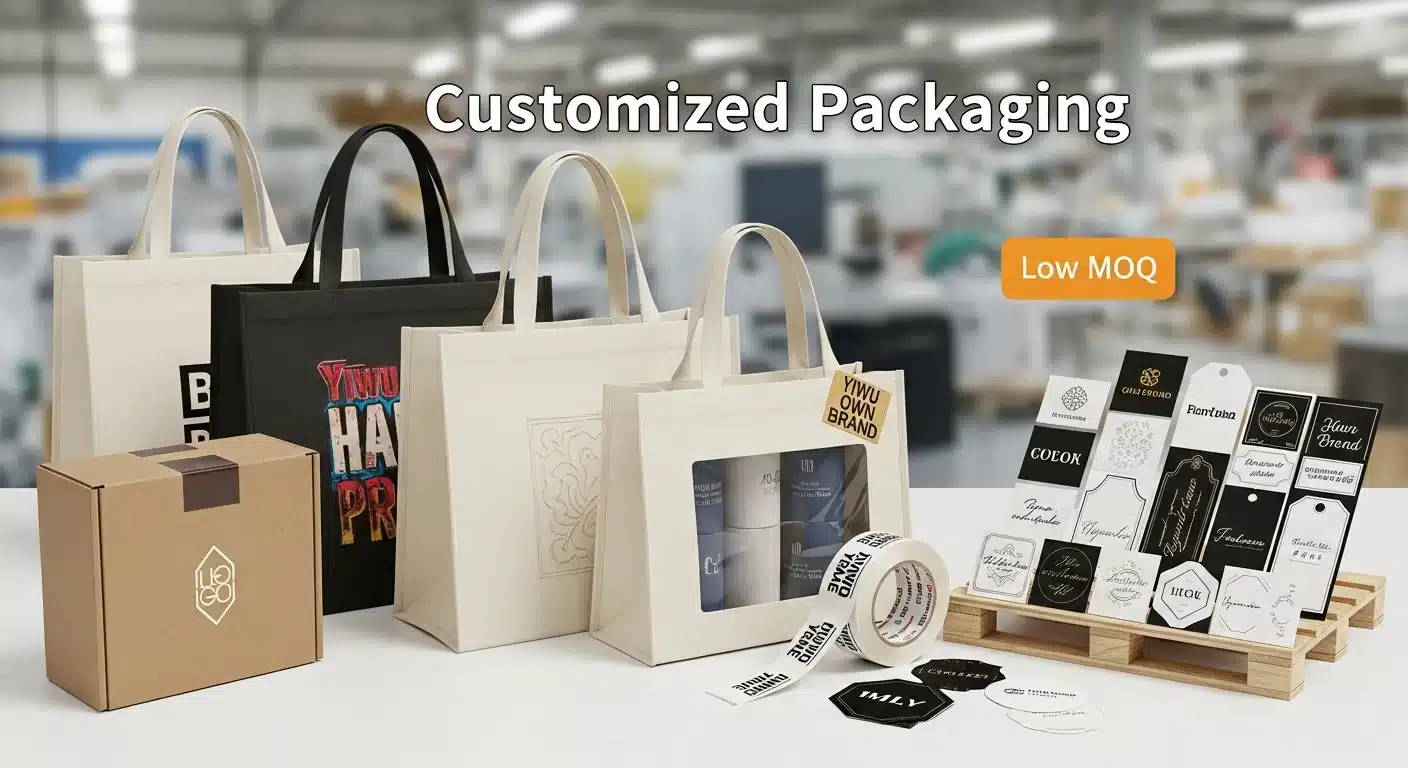
The Third MOQ Nobody Quotes You: Packaging
This is the minimum that ambushes private-label buyers, because it is not part of the product quotation at all. Your supplier quotes a workable product MOQ, you agree, and then you mention you want your logo on the bag. The packaging is a separate manufactured item from a separate supplier with its own minimum — and printed packaging minimums are typically far higher than product minimums.
The mechanism is the printing plate. In flexographic and rotogravure printing, each colour in your artwork needs its own physical plate or cylinder, cut for your design and useless to anyone else, and that cost lands before the first bag is printed. For published scale rather than hearsay: one US flexible-packaging converter, Sorbent Systems, lists a minimum order quantity of 6,700 pouches and a charge of $240.00 per printing plate. Those are that converter’s own published US terms, not a Chinese price — your own supplier will quote differently. What transfers is the structure: a per-plate setup charge plus a minimum run, multiplied by the number of colours in your design.
Which points at the two real levers. Cut the colour count — a one-colour logo on a stock-coloured bag costs a fraction of a four-colour photographic print. Or separate branding from packaging entirely: printed labels, sleeves, hang tags and stickers applied to plain stock bags carry far lower minimums than printed film, because you are printing paper rather than cutting cylinders. Most first private-label runs should use the second approach, and most buyers discover it only after being quoted for the first — our guide to private label packaging with low MOQs works through that trade-off.
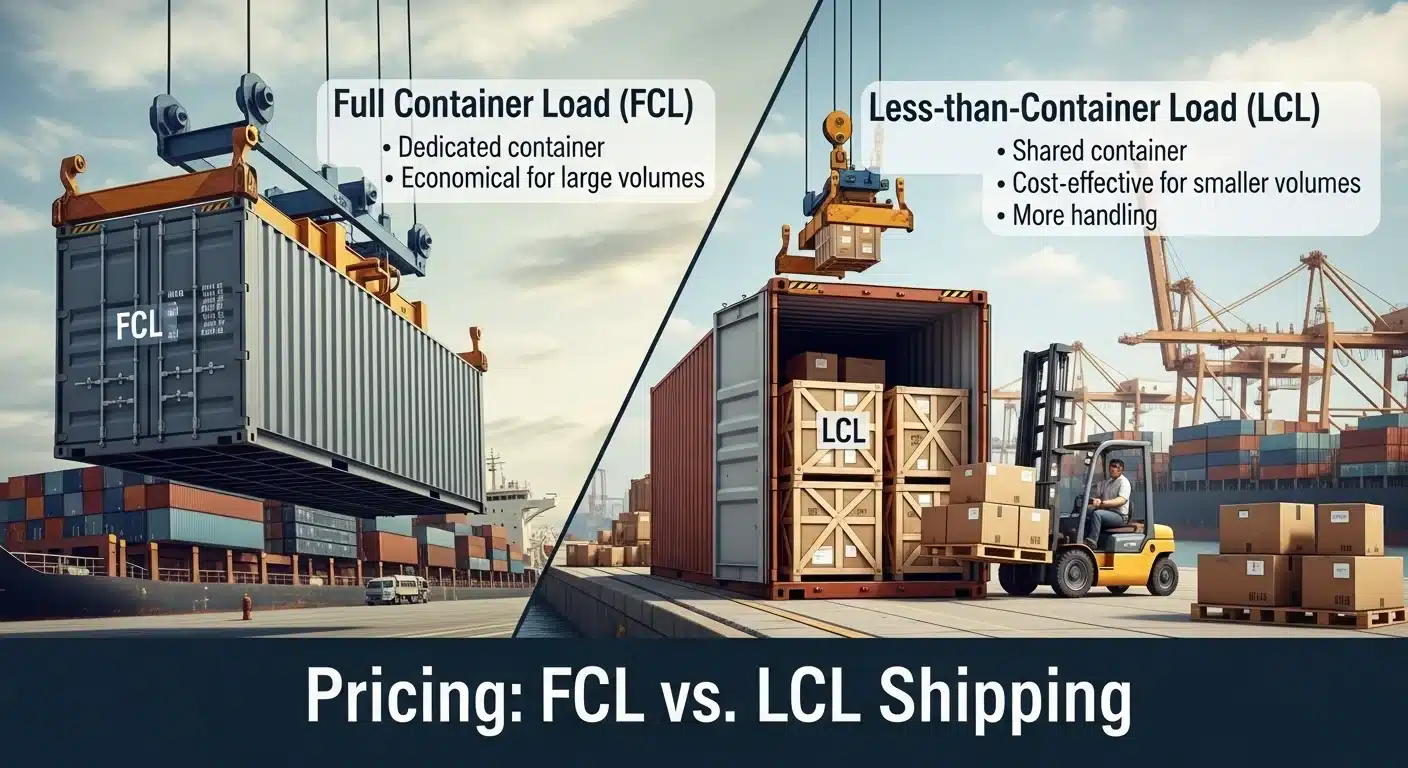
The Freight MOQ: The One Nobody Calls an MOQ
There is a fourth floor no supplier will ever mention, because it is not theirs. Ocean freight has its own minimum, and it is often what makes a technically-achievable small order uneconomic.
LCL — less than container load — is billed on the revenue ton under the W/M rule, meaning weight or measurement, whichever is greater: one cubic metre or 1,000 kilograms. On top of that, forwarders on major trade lanes apply a minimum charge of 1 CBM. As Dedola Global Logistics puts it in its own LCL shipping guide, anything below that threshold is rounded up. So half a cubic metre of goods pays for a full cubic metre of freight, and on a very small order the freight per unit can quietly exceed the goods themselves. The same forwarder notes that above roughly 15 CBM a full container is often better, while cautioning that this is not a fixed rule and the real crossover moves with rates.
So “what is the MOQ?” is the wrong question in isolation. What matters is the quantity that gets your landed cost per unit to a number you can sell at — a curve shaped as much by the 1 CBM freight floor as by the supplier’s minimum. Our comparison of Yiwu shipping methods, costs and transit times shows where those crossovers sit by mode.
Why Your MOQ Math Changed This Year
If you are importing into the United States on advice written before late 2025, the arithmetic underneath it is out of date. The de minimis exemption that let shipments valued at $800 or less enter duty-free was suspended for all countries by Executive Order 14324, published in the Federal Register at 90 FR 37775 on 5 August 2025.
US Customs and Border Protection set out the consequences in its own message to trade, CSMS # 66065494: effective 12:01 a.m. on 29 August 2025, filers must submit a formal or informal entry type in ACE and pay all applicable duties, taxes and fees, with paper informal entries no longer permitted. Goods are ineligible, in CBP’s words, “regardless of their value, country of origin, mode of transportation, or method of entry.” A Federal Register document published on 24 June 2026 made the suspension indefinite for merchandise arriving through all modes other than the international postal network.
For MOQ decisions this matters specifically. The old habit of ordering a sub-$800 test batch to bring in duty-free is gone, and every shipment now carries entry filing on top of duty. Because entry costs are largely fixed per shipment, they behave exactly like a supplier’s setup cost: they punish small orders. Informal entry does remain available for shipments not exceeding $2,500 in value under 19 CFR 143.21, a meaningfully lighter filing path than a formal entry, and that threshold is now one of the real numbers shaping how much to order at once. This summarises published rules and is not customs advice — thresholds and duty rates move, so have your broker confirm the current position for your HS codes before committing to a quantity.
Every Floor Under Your Order, Side by Side
The four MOQs above are the ones a supplier or forwarder will name; the table adds a fifth row for the entry cost floor, which is not a quantity minimum at all but behaves like one. Read it from the right-hand column inward: every workable answer to “the minimum is too high” is a change to what you order or how it ships, never a request for a smaller number.
| Minimum | Set by | Why it exists | Negotiable? | How to get under it |
|---|---|---|---|---|
| Trading MOQ | Booth, trader, stockholding agent | Handling and repacking effort; the carton is the unit of trade | Yes — the softest of the four | Take more SKUs, stock colours, existing inventory |
| Production MOQ | The factory running the process | One dye lot, one mould setup, one line changeover — physically indivisible | Rarely | Don’t trigger it: stock colour, existing mould, standard spec |
| Packaging MOQ | A separate packaging converter | One printing plate or cylinder per colour, cut for your artwork | Only by changing the design | Fewer colours; or labels and sleeves on stock bags |
| Freight MOQ | Forwarder and carrier tariff | Revenue-ton billing with a 1 CBM minimum charge | No — but it can be shared | Consolidate with other cargo so the floor is spread |
| Entry cost floor | Customs authority and your broker | Filing and duty are charged per shipment, so they behave like a fixed setup cost | No | Order less often in larger quantities; check the informal-entry threshold with your broker |
The buyers who get moving are the ones who identify which row they are stuck on, then change the variable that row actually responds to.
How an Agent Changes the Arithmetic
Once you can see the four minimums separately, the case for a Yiwu agent stops being about discounts and becomes about which floors an agent can actually move. An agent moves the trading MOQ, because the booth is weighing handling effort and repeat business rather than your order size in isolation. An agent moves the freight MOQ, and this is the most underrated part: consolidating several buyers’ cartons into one shipment spreads the 1 CBM floor and the fixed per-shipment charges across more cargo than any one buyer could fill alone. That is arithmetic, not persuasion.
What an agent does not move is the production MOQ. No relationship makes a dye lot divisible. Any agent promising to halve a genuine production minimum is either quietly switching your supplier, splitting the order across lots without saying so, or has misunderstood which minimum you were quoted.
The agent’s own fee is a fixed cost spread over your order, so it belongs inside this arithmetic — which is why the terms should be in writing before you compare quantities. Ours are published, not quoted on request. Our China product sourcing service page states the model as “Service Fee: You pay a pre-agreed fee (5-10%) for project management,” alongside an open-book commitment that “You see the original invoice from the manufacturer.” That matters for MOQ decisions specifically: a percentage fee on a visible factory invoice scales with your order, while a hidden markup buried in the unit price tells you nothing about where your real floor sits.
Inspection is the other cost forgotten when deciding how much to order at once. Our refund and compensation policy states that unless a different standard is agreed in writing, “all inspections are conducted based on the international standard ANSI/ASQ Z1.4 (AQL 2.5 for Major Defects, 4.0 for Minor Defects),” and that a claim requires notice “within 7 days of cargo arrival at the destination port/warehouse.” Those are checkable commitments, and the kind worth demanding from whoever you use — including if that is not us. Read it alongside our breakdown of low MOQ Yiwu products and their real costs.
For importers stuck between the booth’s carton and a container
If you are buying mixed goods from several Yiwu booths and none of them individually fills enough volume to ship economically, consolidation is the lever that changes your per-unit landed cost — not a lower quoted MOQ. See how the sourcing and consolidation process is structured, including how mixed-supplier cartons are combined into one shipment.
Conclusão
MOQ means minimum order quantity, but treating it as one number is what costs importers money. There are four floors under any order — trading, production, packaging and freight — and they behave completely differently. The trading minimum bends to effort. The production minimum does not bend at all, only gets avoided. The packaging minimum quietly kills private-label launches, and responds to design changes rather than negotiation. The freight minimum belongs to nobody in your supply chain, and is the one consolidation actually solves.
Work out which one you have hit before you start negotiating, and check your entry costs against the current de minimis position rather than pre-2025 advice. If you want a second opinion on which floor is really blocking your order, that is a conversation worth having before you commit to a quantity.
Perguntas mais frequentes
What does MOQ stand for?
MOQ stands for minimum order quantity: the smallest quantity a supplier will accept in a single order. It can be expressed in pieces, cartons, kilograms, metres, or as a minimum order value in currency.
What is a typical MOQ when buying from China?
There is no single typical figure, and any source quoting one is generalising across products that have nothing in common. The number depends on whether you are buying stock from a trader or commissioning a production run, and on how many colours and specifications you need.
Does MOQ mean per SKU or per order?
Usually per SKU, but confirm it explicitly. Some suppliers apply the minimum to the total order, which lets you split it across colours or sizes — a difference that can decide whether an order is viable.
Can I still import a small test order into the US duty-free?
No. The $800 de minimis exemption was suspended for all countries effective 29 August 2025 under Executive Order 14324, and CBP now requires a formal or informal entry in ACE with duties paid. Confirm current rules with your customs broker.
What is MOQ in dropshipping?
Dropshipping suppliers typically advertise no MOQ because they ship single units from existing stock. The trade-off is a much higher unit price, since you are paying someone else to have already absorbed a minimum order.