Justin
FCA terms in Incoterms 2020 hand your goods to a carrier you nominate, at a place you name, with export clearance already done by the seller. From that exact spot, the cargo is yours — the freight bill, the insurance gap, the damage, all of it. The ICC rule text puts it in one sentence: the named place “identifies where risk transfers to the buyer and the time from which costs are for the buyer’s account.”
That sentence is where most FCA contracts quietly go wrong. Not because buyers misunderstand the definition, but because they write a city name into the contract instead of an address.
Under FCA A2, if you never notify a precise point inside the named place, the seller “may select the point that best suits its purpose.” Write “FCA Yiwu” and you have handed a supplier the right to decide where your risk begins. In a market of roughly 75,000 booths across five districts, that is not a technicality — it is an unpriced liability, and this guide shows you exactly where it lands.

Key Takeaways
- Risk and cost both transfer at the same moment: when delivery is completed under FCA A2. Not at departure, not at the port, not on board the vessel.
- FCA has two delivery scenarios. At the seller’s premises, delivery happens when goods are loaded onto transport you arranged. Anywhere else, delivery happens when goods arrive on the seller’s truck ready for unloading — and the unloading is on your side.
- The seller clears export and pays those duties and taxes. You clear import and transit, and pay everything from the delivery moment forward. That is the whole cost split, codified at A9/B9.
- Neither party is obliged to insure the cargo. FCA A5 and B5 both say “no obligation” — so an uninsured FCA shipment is the default, not an accident.
- Incoterms 2020 added an optional on-board bill of lading mechanism at FCA A6/B6, for the first time. You instruct the carrier, at your own cost and risk, and the carrier may still refuse.
- If you never name a precise point, the seller picks it — and ICC warns the seller may choose “a point just before the point at which goods are lost or damaged.”
- Buying from multiple Yiwu booths, no single vendor can be your FCA loading party. The named place has to be a consolidation warehouse address, not the word “Yiwu.”

What FCA Means, and the Exact Moment Risk Changes Hands
FCA stands for Free Carrier. The seller delivers goods, cleared for export, to a carrier or another person that you nominate, at a place you name. The ICC Incoterms 2020 rules allow it for any transport mode, and for shipments that use more than one mode — road to a rail terminal, truck to an airport, van to a container yard. That flexibility is why it has become the default term for containerised trade.
The definition everybody quotes is the easy half. The half that decides who pays for a crushed pallet is the delivery test in A2, and it has two branches that produce very different outcomes.
Branch one: the named place is the seller’s premises
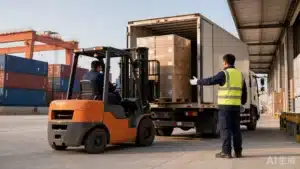
Here delivery is completed “when the goods have been loaded on the means of transport provided by the buyer.” The seller does the loading, and the seller carries the risk while the loading happens. If a forklift punctures a carton halfway onto your truck, that is still the seller’s loss. Delivery has not occurred yet.
Branch two: the named place is anywhere else
Now delivery is completed when the goods “are placed at the disposal of the carrier or another person nominated by the buyer on the seller’s means of transport ready for unloading.” Read that carefully, because it reverses the loading question. The goods stay on the seller’s truck. They are delivered the moment that truck arrives and is ready to be unloaded — and the unloading is not the seller’s job. If your forwarder’s crew drops a pallet taking it off the seller’s truck at a container yard, you own that damage. Delivery already happened.
The transfer of risk clause is blunt about the consequence. Under A3 the seller bears all risk of loss or damage “until they have been delivered in accordance with A2,” and under B3 you bear all risk “from the time they have been delivered under A2.” There is no grace period, no shared zone, and no reference to the vessel. A6 only requires the seller to give you “the usual proof that the goods have been delivered” — proof of the handover, not proof of arrival.
The clause that catches buyers who use the seller’s own truck
A common assumption is that risk passes when the seller hands goods to whichever truck shows up first. It does not. ICC settles it in the introduction to the rules: “even if a seller engages a road haulier to take the goods to the agreed delivery point, risk would transfer not at the place and time where the seller hands the goods over to the haulier engaged by the seller, but at the place and time where the goods are placed at the disposal of the carrier engaged by the buyer.”
The relevant carrier is your carrier. Everything before that is still on the seller’s account, which is exactly why ICC follows that sentence with a warning that naming the place as precisely as possible “is so important in FCA sales.”
One more consequence catches buyers off guard. FCA is a shipment sale, not an arrival sale. ICC states that the seller “will have performed its obligation to deliver the goods whether or not the goods actually arrive at their destination.” A container that leaves the named place correctly and then sinks has been delivered. You still owe the price.
Risk can transfer even when nothing moves
B3 contains a trap that costs money in peak season. If you fail to nominate a carrier or give notice under B10, or if the carrier you nominated fails to take the goods into its charge, you bear all risk from the agreed date — or from the end of the agreed delivery period if no time was notified — “provided that the goods have been clearly identified as the contract goods.”
Picture it. Your booking rolls, the truck never arrives, the cargo sits in the seller’s yard over a humid August week — and the risk is already yours. B9 adds the matching cost rule: any additional costs from that failure are on your account too.
Who Pays What Under FCA, Line by Line
Incoterms 2020 made this easier to audit than the 2010 edition did. Every cost for a given rule now sits in one article: “All costs associated with a given Incoterms rule now appear at article A9/B9 of that rule, allowing users to see the full list of expected costs at a glance.” Before that change, costs were scattered across several articles and buyers routinely missed one.
The pivot for every line is the same A2 delivery moment. The seller pays all costs relating to the goods until delivery under A2, plus the cost of providing you the usual proof of delivery, plus — where applicable — “duties, taxes and any other costs related to export clearance.” You pay everything from delivery onward, plus duties, taxes and costs of transit and import clearance. That is the entire split, and it is why fixing the delivery point precisely also fixes the invoice.
The obligations that surprise people
Four lines in the FCA rule regularly get assumed backwards, and each one has a specific article behind it.
- Carriage (A4): the seller “has no obligation to the buyer to make a contract of carriage.” Booking the main leg is your job. Ask the seller to book it and they do so “at the buyer’s risk and cost.”
- Insurance (A5, B5): both articles open with “no obligation.” Neither side has to insure anything.
- Packing (A8, B8): checking, packaging and marking appropriate for transport sit with the seller at the seller’s cost, while B8 says flatly “the buyer has no obligation to the seller.”
- Clearance (A7): export is the seller’s, but the seller “has no obligation to clear the goods for import or for transit through third countries, to pay any import duty or to carry out any import customs formalities.”
The insurance line is the one that costs real money. Your risk starts early and runs the entire main carriage, so an FCA shipment with no cargo policy is a fully exposed shipment — and that is the default state unless you actively buy cover.
| Item | Seller (A articles) | Buyer (B articles) |
|---|---|---|
| Export packing, checking, marking | Pays (A8) | No obligation (B8) |
| Export clearance, duties and taxes | Pays (A7a, A9c) | Assists only (B7a) |
| Loading at seller’s premises | Loads, holds risk (A2a) | Provides the vehicle |
| Unloading at another named place | No obligation (A2b) | Unloads, holds risk (B3) |
| Main carriage booking and freight | No obligation (A4) | Contracts and pays (B4) |
| Cargo insurance | No obligation (A5) | No obligation (B5) |
| Import and transit clearance, duty | Assists only (A7b) | Carries out and pays (B7b, B9c) |
What “FCA Yiwu” Actually Means When Your Goods Sit in Twenty Booths
Every FCA explainer online assumes one seller with one warehouse and one loading dock. Sourcing from the Yiwu market breaks that assumption on the first order. You are not buying from a factory with a shipping department. You are buying from a set of independent booth operators inside Yiwu International Trade City, each invoicing separately, each with a van and a driver at best. FCA A2 asks a question none of them can answer alone: which one of you is the party that loads, and at whose risk?

The scale is not incidental. In the first nine months of 2025, exports from Yiwu through the market procurement trade channel reached 458.38 billion yuan, a rise of 29.4 percent, and accounted for 82.7 percent of the city’s total exports, contributing 92.1 percent to overall export growth, according to figures released by Yiwu Customs. Yiwu’s full-year 2025 foreign trade hit a record 836.5 billion yuan. The overwhelming majority of goods leaving this city do not leave under a conventional factory-to-buyer contract at all. They leave under a customs regime built specifically for multi-vendor consolidation — and that regime changes what an FCA contract can sensibly say.
The customs mode that makes multi-booth FCA possible
China’s market procurement trade mode, customs supervision code 1039, was authorised for Yiwu by eight central ministries — Commerce, Development and Reform, Finance, Customs, Taxation, Industry and Commerce, Quality Inspection and Foreign Exchange — on 18 April 2013. The National Development and Reform Commission’s notice on the reform describes the framework as permitting “small batches, multiple varieties, multiple shipments, and multiple trading entities consolidating cargo,” and allowing qualified operators to handle export customs clearance at the place of purchase. It raised the maximum value of a single shipment to USD 150,000.
Exports under this mode carry a VAT exemption. The pilot has since expanded well beyond Yiwu — as of a People’s Daily Overseas Edition report, 39 pilot units operate across 21 provinces, regions and municipalities.
Two consequences follow directly, and neither appears in a generic Incoterms article. First, “multiple trading entities consolidating cargo” is the legal permission that lets twenty booth invoices become one export declaration — so a single FCA delivery event for a twenty-vendor order is possible — but only at whatever address the consolidation physically happens.
Second, the VAT treatment under this mode is exemption without refund, which is why the export VAT rebate conversation that dominates factory-direct sourcing usually does not apply to market purchases at all. Many booth vendors typically cannot issue a special VAT fapiao in the first place, which is the practical reason buyers hit that wall before they reach the regulatory one. Either way, do not price an FCA quote from a Yiwu booth as if a rebate were sitting behind it.
Why “FCA Yiwu” as a contract term is defective
Now apply A2’s default rule to a city. If no specific point has been notified by you under B10(d) within the named place, and several points are available, “the seller may select the point that best suits its purpose.” Yiwu has districts, a hardware market at Wuai, a clothing market at Huangyuan, dozens of forwarder yards, a rail terminal and an inland container depot. Every one of them is arguably a point within “Yiwu.”
ICC spells out where that leads: the buyer “may incur the risk that the seller may choose a point just before the point at which goods are lost or damaged,” and concludes it is “best for the buyer therefore to select the precise point within a place where delivery will occur.”
So the named place in an FCA contract covering Yiwu market goods should be a street address — the consolidation warehouse where the cartons are actually received, counted and staged. Not the city. Not “Yiwu Futian Market.” A door. When an agent is arranging the freight and the export paperwork together, that warehouse address is the only point in the whole chain where a single party genuinely takes physical charge of every vendor’s cargo at once, which makes it the only honest candidate for the delivery point. Everything upstream of it is twenty separate domestic movements that no Incoterm was written to govern.
The Handover Nobody Writes Down: Booth Van to Consolidation Warehouse
Here is the gap that costs buyers real money, and it is invisible in every standard FCA diagram. A booth vendor loads your 40 cartons into a small van and drives them across town to a consolidation warehouse. Who bears the risk of that van ride?
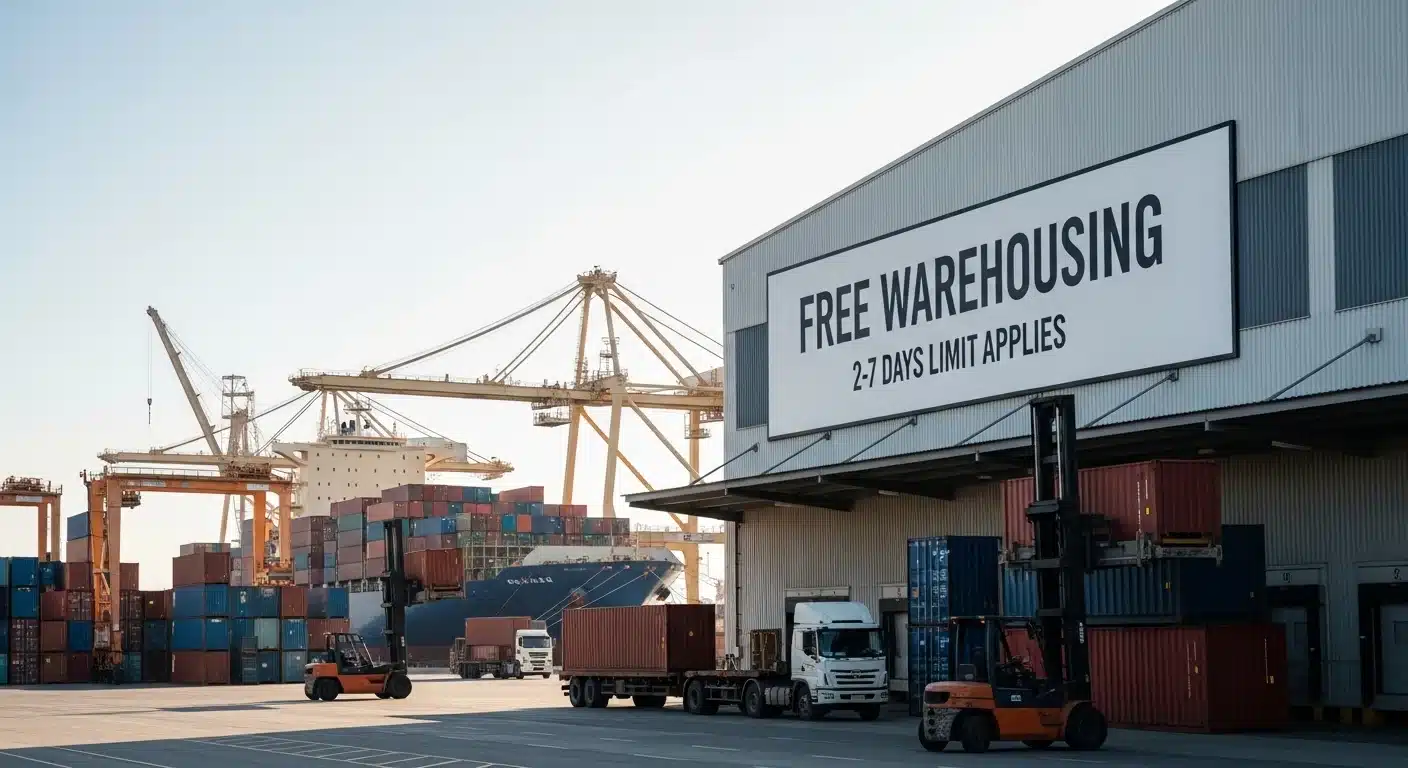
The ICC rule answers it cleanly, and the answer depends entirely on who the warehouse operator is acting for. If the consolidation warehouse belongs to the agent, and the agent is acting as your nominated person, then delivery occurs when the van arrives at that warehouse ready for unloading — and the vendor’s van ride is at the vendor’s risk, because risk transfers “at the place and time where the goods are placed at the disposal of the carrier engaged by the buyer.” The vendor’s own driver never triggers the transfer.
If instead the agent is buying in its own name and reselling to you, the answer flips. The agent is now your seller, the warehouse is the seller’s premises, and delivery only happens later when goods are loaded onto the truck you arranged — at which point the seller carries the loading risk under A2(a).
Those two structures produce opposite answers to “who eats the damaged carton discovered on arrival at the warehouse,” and buyers rarely ask which one they are in. The document that settles it is the invoice: if the vendor invoices you directly and the agent charges a service fee, the agent is your nominated person. If the agent invoices you for the goods, the agent is the seller. It is worth reading how whose name goes on the invoice changes the customs position too, because the same choice drives both.
Who physically loads, and the practical answer to the loading question
In the agent-as-your-nominee structure, no booth vendor is ever the FCA loading party in the A2(a) sense, because the named place is not their premises. Their obligation ends when their van arrives at the warehouse ready for unloading. Unloading the van is on your side of the line — in practice, the warehouse crew, working for the agent, working for you. That is not a loophole; it is A2(b) operating exactly as written.
Which is why the receiving check at that warehouse matters more than buyers assume. It is the last moment where a carton shortage is still somebody else’s problem. Goods inspected before the cartons are sealed are the only ones where a claim against the vendor is realistic.
FCA to the agent’s warehouse versus EXW at the booth
For a fifteen-vendor consolidation, the practical difference is not philosophical. Under EXW at the booth, each vendor’s obligation ends with goods sitting at their stall, and everything after that — the pickup, the van, the domestic leg, the export clearance — is formally yours, multiplied by fifteen. You now own fifteen separate risk transfers happening at fifteen addresses on fifteen different days, with export clearance sitting on the party least equipped to do it.
Under FCA to a single consolidation warehouse address, you own one risk transfer at one address, and export clearance sits where the rule puts it: with the seller. ICC does not hedge on this comparison. On EXW it says plainly that “the seller would be better advised to sell under the FCA rule,” because EXW “may cause problems for the seller and the buyer, respectively, with loading and export clearance.” The one place EXW still holds an edge is a single small sample pickup you are collecting in person, where the paperwork overhead of FCA buys you nothing.
The Document Set, and Why Your Bank May Reject an FCR
Under FCA A6 the seller owes you “the usual proof that the goods have been delivered in accordance with A2.” That is a low bar. For a consolidated Yiwu shipment, the usual proof is very often a forwarder’s certificate of receipt, or FCR — a document the consolidating agent or forwarder issues confirming it has received your goods. It is the natural fit for FCA, because FCA delivery genuinely does complete at a warehouse, long before any vessel exists. If you are paying by telegraphic transfer against documents, an FCR works fine and the story ends here.
If you are paying under a letter of credit, it does not. The FCR sits outside the transport-document articles of the ICC’s UCP 600 rules for documentary credits. Forwarders’ certificates of receipt and cargo receipts “do not reflect a contract of carriage and are not transportation documents as defined in UCP 600 articles 19-25.”
So a bank examines an FCR under sub-article 14(f) instead. Where a credit requires a document other than a transport document, insurance document or commercial invoice “without stipulating by whom the document is to be issued or its data content, banks will accept the document as presented if its content appears to fulfil the function of the required document.”
So an FCR can be accepted — but only if your credit was written to call for it in those loose terms. A credit that calls for a full set of on-board ocean bills of lading will not accept an FCR, and the presentation gets refused. And unlike a bill of lading, an FCR is generally not treated as a document of title, so it does not control release of the goods the way an original B/L does.
The Incoterms 2020 fix, and its three catches
ICC saw this collision coming. FCA A6/B6 in Incoterms 2020 carries, for the first time, an optional mechanism: if the parties have so agreed, you must instruct your carrier to issue to the seller, “at the buyer’s cost and risk, a transport document stating that the goods have been loaded (such as a bill of lading with an onboard notation),” and the seller must then pass that document to you, typically through the banks. ICC is candid about the awkwardness, calling it a “somewhat unhappy union between an on-board bill of lading and FCA delivery” that nonetheless “caters for a demonstrated need in the marketplace.”
Three catches ride along with it, and all three are in the rule text. The mechanism only exists if you wrote it into the contract — it is not automatic. The carrier may simply decline, since the carrier “is only bound and entitled to issue such a bill of lading once the goods are actually on board,” and the cost and risk of the request are explicitly yours.
The third catch is the one that bites under a credit, and it is ICC’s own closing warning: “the dates of delivery inland and loading on board will necessarily be different, which may well create difficulties for the seller under a letter of credit.” Your FCA delivery date at a Yiwu warehouse and your on-board date at Ningbo can easily be a week or more apart, and a credit with a tight latest-shipment date does not care which one you meant.
There is a simpler exit that ICC points at directly, and most buyers never consider it: the mechanism “becomes unnecessary, of course, if the parties have agreed that the seller will present to the buyer a bill of lading stating simply that the goods have been received for shipment rather than that they have been shipped on board.”
If you control the credit application, asking your issuing bank for a received-for-shipment B/L instead of an on-board one removes the entire problem before it starts. Whether the bank agrees depends on the bank and on your credit history with them, so raise it at application, not at presentation. For the mechanics of what the carrier’s document itself controls, our guide to the bill of lading and what importers must check covers the fields that get presentations refused.
FCA Against EXW and FOB: What ICC Actually Recommends
Most comparison articles present EXW, FCA and FOB as three neutral options. ICC does not. It takes a position on all three, and the positions are worth quoting because they are the opposite of what many China suppliers quote by default.

On EXW, the rules state that traders “should consider alternative rules” to EXW and DDP for international contracts, and that with EXW “the seller has to merely put the goods at the buyer’s disposal,” which “may cause problems for the seller and the buyer, respectively, with loading and export clearance.” The recommendation is explicit: “the seller would be better advised to sell under the FCA rule.”
ICC repeats it from the buyer’s side twice. Where the buyer wants loading risk off its own account, it “ought to consider choosing the FCA rule,” under which the seller owes an obligation to load with the loading risk staying on the seller. And where the buyer “anticipates difficulty in obtaining export clearance,” it “would be better advised to choose the FCA rule, under which the obligation and cost of obtaining export clearance lies with the seller.” For a foreign buyer with no Chinese entity, that second point is not theoretical — export clearance is the obligation you are least able to perform yourself.
On FOB, ICC asks and answers its own question about containers: does it remain true that where containerised goods are handed to a carrier before loading onto a ship, “the seller is well advised to sell on FCA terms rather than on FOB terms? The answer to that question is Yes.”
FOB puts the risk transfer on board the vessel, but your container leaves your control days earlier at the yard. That gap — container yard to ship’s rail — belongs to nobody in an FOB contract until something goes wrong in it. FCA closes the gap by putting the transfer where the physical handover actually happens. The 2020 revision did not change that recommendation; it only gave FCA sellers a way to still get an on-board document when a bank insists on one.
Where each term actually fits
| Term | Risk transfers | Best used when |
|---|---|---|
| EXW | At the booth or gate, before loading | One small pickup you collect yourself |
| FCA (seller’s premises) | When loaded onto your vehicle | One factory with a real loading dock |
| FCA (named warehouse) | On arrival, ready for unloading | Multi-vendor market consolidation |
| FOB | On board the vessel | Bulk or breakbulk, seller books the ship |
If you want the full head-to-head on the terms Yiwu suppliers actually quote, our comparison of EXW, FOB and DDP for Yiwu buyers works through each one against a real consolidation flow.
A Worked Example: Fifteen Vendors, One Container, One Named Place
This walkthrough is illustrative, not a specific customer’s order, and it is written so you can reuse the structure on your own contract. A buyer orders 15 SKUs from 15 different booths in Yiwu International Trade City — party goods, kitchen items, small hardware — for one 40ft container to a European port, paid by telegraphic transfer.
Step 1 — write the named place as an address. The contract says FCA followed by the full street address of the consolidation warehouse, not “FCA Yiwu.” Under B10(d) the buyer notifies “the point where the goods will be received within the named place of delivery.” One line of text closes the A2 default that would otherwise let a seller pick its own point.
Step 2 — decide the invoice structure, because it decides the risk line. If each booth invoices the buyer and the agent charges a service fee, the agent is the buyer’s nominated person and each vendor’s van ride is at the vendor’s risk until arrival. If the agent invoices the goods, the agent is the seller and delivery moves later, to loading onto the buyer’s nominated truck.
Step 3 — receive and check at the named place. Cartons arrive across several days as each booth completes. Each delivery is counted and checked on arrival, because after unloading, a shortage is the buyer’s problem under B3. Carton marks and the packing list are reconciled to each vendor’s invoice at this point, while the vendor is still reachable.
Step 4 — insure from the named place, not from the port. A5 and B5 impose no insurance obligation on anyone. Cover is arranged to attach at the warehouse address, because that is where risk attached. A policy that starts at the port of loading leaves the inland leg — the one crossing a congested export corridor — uncovered.
Step 5 — export clearance sits with the seller. Declaration goes out under the market procurement mode, with the multi-vendor consolidation the mode is designed for, and the single-declaration value kept under the USD 150,000 ceiling. Under A7(a) and A9(c), the export formalities and their costs are the seller’s, not the buyer’s.
Step 6 — take the right document for the payment method. On telegraphic transfer, an FCR from the consolidator is sufficient proof of A2 delivery. Had this order been under a letter of credit calling for on-board bills, step 1 of the contract would also have needed the A6/B6 on-board option written in, and the credit’s latest-shipment date set against the on-board date rather than the warehouse date. Getting the goods consolidated into one container is the easy part; matching the document to the payment instrument is what actually gets the money released.
What We Check at the Named Place, and Where We Stop
Everything above is the rule text. This section is the operating detail on our side of it, because an FCA named place is only as good as the address behind it and the receiving discipline at that address. The figures here are the published terms of our own service, not industry averages — read them as the specification you would be contracting to, and compare them against whichever agent you end up using.
The named place we write into contracts is never “Yiwu”. It is a receiving door at unit level inside a named district of the Yiwu market — the exact unit is confirmed to you in writing on the order, so the address on the contract is one a courier could deliver to unaided, which is exactly the test the A2 default is asking you to pass. Behind that door sits a 3,000 sqm warehouse where booth deliveries are received, counted and staged. That address is the single point where every vendor’s cargo comes under one party’s physical charge, which is what makes it the honest candidate for the delivery point rather than a convenient fiction.
Storage there is free for 30 days. That number does real work in an FCA structure, and it is worth being explicit about why: a fifteen-booth consolidation does not arrive in one afternoon. Cartons land across days or weeks as each vendor finishes, and the free window is what lets the last booth deliver without the first booth’s cartons accruing storage while they wait. Bulky retail packaging is removed at this stage to cut cubic volume, which changes your freight bill rather than your risk position — a cost lever, not a liability lever, and the two get confused often enough to be worth separating.
Receiving checks happen before cartons are sealed, on the reasoning the earlier section already set out: after unloading at the named place, a shortage is yours under B3. Where a formal inspection is commissioned, sampling follows ANSI/ASQ Z1.4 (ISO 2859-1), with critical defects at zero allowed, major at AQL 2.5 and minor at AQL 4.0 as the default tolerances, adjustable by agreement.
Timing is set against production, not against the calendar. Pre-shipment inspection runs at 100% produced and 80% packed; a during-production check runs at 20-50% produced, early enough that a defect can still be reworked rather than argued about. The report is a PDF within 24 hours carrying photos, video tests and measurement data. Standalone inspections are charged at a flat daily rate, quoted on the service page at $199 per man-day, and are often included in a full sourcing engagement.
On the freight side the published transit windows are 3-7 days by air express, 8-12 days by air cargo, 18-25 days by rail to Europe, and 30-45 days by sea on LCL or FCL. Cargo insurance is quoted at 0.3%. Under FCA that insurance question is not a formality — A5 and B5 impose no cover obligation on either party, so if you do not buy it, nobody has, and the exposure starts at the warehouse door rather than at the port.
Where we stop matters as much as what we do, and three limits are worth stating plainly. We can issue an FCR confirming receipt of your goods, and for telegraphic-transfer payment that is sufficient proof of A2 delivery. But an FCR is not a document of title and will not satisfy a credit written for on-board bills, and no agent can change that by relabelling the paperwork.
The second limit is the carrier’s. Whether a carrier will issue an on-board bill under the A6/B6 option is the carrier’s decision, not ours, and the rule text says as much. The third is jurisdictional: the customs treatment of your specific goods, the duty position at destination and the wording your bank will accept are questions for a licensed broker and your issuing bank. We can tell you what mode the declaration goes out under, not what your importing country will do with it.
A note on the numbers above. Every figure in this section is a published term of our own service, quoted from our service pages rather than estimated. Transit windows are typical ranges for the lane, not guarantees — actual times move with sailing schedules, customs and peak season. Inspection pricing is the standard rate and varies with scope and location. Ask for current terms in writing against your specific order before you rely on any of them in a contract.
What to Check Before You Sign an FCA Contract
Every item below maps to a specific article of the FCA rule, so you can point at the text in a negotiation rather than argue about custom. Run the list before the contract is signed — after the cargo moves, every one of these becomes a claim instead of a clause.
- A street address, not a city (A2, B10d): the named place must be a specific point. If you cannot post a letter to it, it is not precise enough.
- Which branch of A2 applies: is the named place the seller’s premises, or another place? One puts loading and its risk on the seller; the other puts unloading and its risk on you.
- Who your nominated person is (A2, B10a): name the carrier or agent who takes charge on your behalf, in writing, with enough notice for the seller to deliver on time.
- Insurance attaching at the named place (A5, B5): neither side owes cover, so confirm your policy starts where risk starts, not at the port.
- The on-board B/L option, if a credit is involved (A6, B6): it applies only “if the parties have so agreed,” so it must be written into the contract before shipment.
- Latest-shipment date measured against the right event: under the on-board option, the inland delivery date and the on-board date differ; make sure the credit refers to the one you can meet.
- Who unloads at the named place: A2(b) leaves it with you. Confirm the receiving party has the labour and dock time booked.
- Your notice obligations (B10): carrier name, collection time, mode of transport, and the exact receiving point. Missing these can shift risk to you before the goods move.
Rules on export documentation and customs treatment change, and the position varies with the product, the destination and the role each party plays in the transaction. Confirm current requirements with a customs broker, your freight forwarder and your bank before you commit contract language, particularly where a letter of credit is involved.
Is FCA Right for Your Order?
FCA earns its place when you have a real forwarder relationship and you want control of the main carriage without inheriting Chinese export clearance. It is a poor fit when you have neither, because the term hands you the freight decision on day one. Being honest about which side of that line you are on matters more than the term itself.
| Best for | Not ideal for |
|---|---|
| Multi-vendor market consolidation into one container | First-time buyers with no forwarder in place |
| Buyers with their own freight contract and rates | Credits demanding on-board B/Ls with tight dates |
| Air, rail or multimodal moves, not just ocean | Buyers who want a landed, duty-paid price |
| Buyers who will actually arrange cargo insurance | Single small sample pickups |
If you want a landed price with duty and delivery included, FCA is the wrong tool and DDP is the conversation — a different allocation with its own traps, which our breakdown of DDP against EXW works through. If you are sourcing mixed categories from several booths and are not yet sure whether your agent is acting as your nominated person or as your seller, settle that question before you agree a delivery term, because it changes every line in the cost table above.
Conclusão
FCA is the most useful Incoterm available to a container buyer sourcing from a market rather than a factory, and it fails in exactly one predictable way: an imprecise named place. The rule gives the seller the right to choose the point when you do not, and it moves risk and cost together at that point regardless of where the goods physically are. Fix the address, fix the invoice structure, and the rest of the allocation follows the A9/B9 text without argument.
Before your next order, read the delivery clause in the contract you already have and ask whether it names a door or a city. If it names a city, that one edit is the cheapest risk reduction available to you this quarter.
Perguntas mais frequentes
Does FCA include shipping costs to my country?
No. Under FCA B4 you contract and pay for carriage from the named place. The seller’s price covers goods, export packing and export clearance only, so main freight, terminal charges and import duty are all yours.
Who unloads the truck under FCA?
It depends on the named place. At the seller’s premises the seller loads your vehicle. At any other place the goods are delivered on the seller’s truck “ready for unloading” — meaning the unloading, and its risk, fall to you.
Can I use FCA for air freight or express shipments?
Yes. ICC states FCA may be used irrespective of the transport mode, including where more than one mode is employed. Naming an air cargo terminal or a courier depot as the delivery point works exactly the same way.
What does “or procure goods so delivered” mean in FCA A2?
It covers string sales. ICC explains the wording “caters for multiple sales down a chain,” common in commodity trades, where a seller buys goods already delivered rather than delivering them itself.
Is FCA the same as FCA Incoterms 2010?
The delivery test is materially unchanged, but Incoterms 2020 added the optional on-board bill of lading mechanism at A6/B6 and moved all costs into a single article, A9/B9. Always state which edition your contract uses.
Can a supplier refuse to issue an on-board bill of lading under FCA?
The mechanism only binds if agreed in the contract, and even then the carrier may decline. ICC notes the carrier is bound to issue such a document only once goods are actually on board, at your cost and risk.