 Justin.
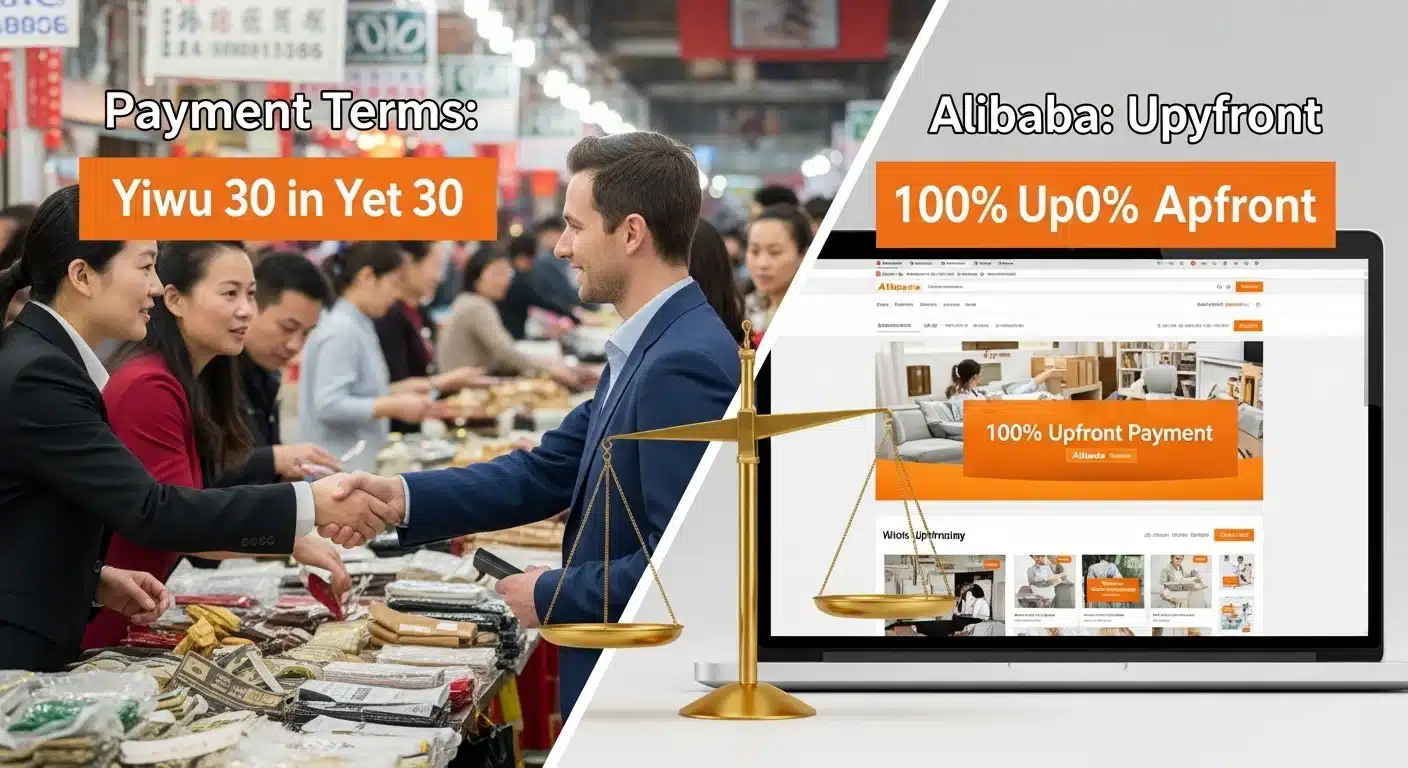
If you’re sourcing from China, your payment terms directly impact your cash flow and risk. The standard 30% deposit, 70% before shipment model on Alibaba ties up your capital for weeks, while the Yiwu market offers a different path with its deposit-inspect-pay sequence and the potential for extended credit.

This article breaks down the realities of both systems. We’ll compare the standard Alibaba terms with the agent-led process in Yiwu, explain how sourcing agents can help you qualify for interest-free Net 30 or Net 60 terms, and show you how these Open Account structures can save you money by avoiding expensive short-term financing.
Alibaba Payment Reality: 30% Deposit, 70% Before Ship
The standard payment term on Alibaba is a 30% deposit upon order confirmation, followed by a 70% balance payment before shipment. The deposit covers the supplier’s initial production costs and secures buyer commitment, while the final payment provides leverage to ensure quality and on-time delivery before goods are released.

The Purpose of the 30% Deposit
The 30% deposit is paid after you confirm the order or sign the contract. This initial payment covers the supplier’s upfront expenses for raw materials, labor, and setting up the production line.
It also serves as a commitment from you, the buyer, which helps prevent last-minute order cancellations. When you use a service like Alibaba Trade Assurance, this deposit is held securely in escrow until the supplier provides proof that your goods have shipped.
Timing and Leverage of the 70% Balance
The remaining 70% is typically paid just before the shipment leaves the factory. Another common method is to pay “against the Bill of Lading,” where you send the final payment after the goods have shipped but before you receive the title document needed to claim them at the destination port.
This timing is crucial for your protection. It gives you the opportunity to verify product quality through a pre-shipment inspection before releasing the full payment. This approach ensures the supplier gets paid for the completed order while significantly reducing your risk of paying in full for goods that are never delivered.
Yiwu Market Reality: Deposit -> Inspect -> Pay
The standard Yiwu sourcing process follows a three-step sequence: pay a deposit to confirm the order, wait for the agent to inspect the consolidated goods, then pay the balance before shipment. This structure protects both buyer and supplier by linking payments to verified progress, with agents managing consolidation and quality checks across multiple suppliers.
| Payment Milestone | Typical Terms | Key Purpose |
|---|---|---|
| Deposit | 30% upfront or $150-$300 for large agent orders | Confirms the order, authorizes production or goods collection. |
| Final Balance | 70% due before shipment, or 10-15 days after goods are shipped for large orders. | Released only after buyer approves the agent’s quality inspection report. |
| Agent Commission | Typically 3-10% of total order value. | Covers consolidation, inspection, and export coordination services. |

The Standard Payment Milestones
A 30% deposit is standard upfront to confirm orders and begin production or goods collection from suppliers. This deposit secures the commitment from both sides.
The 70% balance is due before goods are shipped, often triggered by the presentation of the Bill of Lading or after a final quality inspection. This milestone payment ensures the buyer only pays the full amount once goods are verified and ready for export.
For larger orders managed by agents, deposits can range from $150 to $300, with the balance due 10 to 15 days after shipment. This slight variation offers flexibility for established relationships and larger transaction volumes.
Payments to agents are typically made via T/T bank transfer, while small, in-person stock purchases in the market require immediate payment in Chinese Renminbi (RMB) cash. The payment method aligns with the order size and procurement method.
Agent-Led Consolidation and Inspection Flow
After the deposit is received, agents collect goods from multiple suppliers across Yiwu International Trade City, consolidating them for a single shipment. This service is central to the agent’s value proposition.
Agents perform quality inspections at consolidation, which include checking goods against samples and documenting condition with photos or videos for buyer approval. This visual proof is critical before releasing the final payment.
This process often operates under China’s Market Procurement Trade Method (Customs Code 1039), simplifying export for consolidated shipments valued under USD 150,000. The 1039 method uses a unified commercial invoice based on small purchase receipts from the market.
The final balance payment is released only after the buyer approves the inspection report, ensuring quality before the container is loaded and shipped. This checkpoint directly ties financial release to satisfactory quality control.
Earning “Net 30/60” Terms with Agents
Net 30/60 terms are interest-free trade credit where you pay an invoice 30 or 60 days after it’s issued. Sourcing agents can help you qualify for these terms by leveraging their established credit and relationships with suppliers, which improves your cash flow for inventory financing.
| Prazo | Payment Due | Typical Use Case |
|---|---|---|
| Net 15 | 15 calendar days from invoice | Short-term credit |
| Net 30 | 30 calendar days from invoice | Small to medium B2B transactions, freelancers, suppliers |
| Net 45 | 45 calendar days from invoice | B2B extension beyond Net 30 |
| Net 60 | 60 calendar days from invoice | Larger purchases, established clients, project-based work |
| Net 90 | 90 calendar days from invoice | Big corporations, government contracts, high-volume deals |
| 2/10 Net 30 | 2% discount if paid within 10 days, else full at 30 days | Incentivizing early payment |

How Net Terms Work as Trade Credit
Net 30 means payment is due 30 calendar days from the invoice date. This is the most common term for small to medium B2B transactions.
Net 60 extends the due date to 60 calendar days, typically used for larger purchases or with established clients. This helps manage cash flow for project-based work.
These terms act as an interest-free loan from the supplier to the buyer. This financing is specifically useful for covering the cost of inventory before it’s sold to your customers.
A sourcing agent with a strong track record can negotiate these terms on your behalf. An agent with 18+ years of experience and $50M+ in annual order volume uses their proven creditworthiness to secure terms that individual buyers might not qualify for.
Qualifying for and Negotiating Extended Terms
Suppliers approve Net terms based on credit history, order volume, and the strength of the relationship. The buyer’s credit is key, but an agent can substitute their own. Terms like Net 90 are usually reserved for large corporations.
Common variants include Net 15 for short-term credit. The 2/10 Net 30 term offers a 2% discount for payment within 10 days, otherwise the full amount is due at 30 days.
An agent’s operational scale reduces supplier risk, making them more likely to extend favorable terms. For example, an agent managing consolidation in a large warehouse demonstrates stability and volume, which suppliers value.
Longer terms like Net 60 tie up the supplier’s working capital. To secure them, agents often need to demonstrate a reliable payment history. A common model that builds trust is paying a 30% deposit with the order and the remaining 70% after quality control is passed.

The Cost of Capital: Why OA Terms Save You Money
Open Account terms, where you pay after receiving goods, conserve your cash flow. This avoids expensive short-term financing like credit cards or loans to pay suppliers upfront, directly lowering your overall cost of capital and increasing purchasing power.

How Payment Terms Act as Hidden Financing
Standard payment terms often require you to finance your inventory before you can sell it. A typical 30% deposit locks your capital into the production phase, creating a financing gap for weeks or months.
When the remaining 70% balance is due before shipment, you need the full purchase price available upfront. This strains your cash reserves, forcing many buyers to seek external funding.
Using personal credit cards or short-term loans to cover these payments adds significant cost. Interest rates on these options typically range from 15% to 25% APR, which becomes a direct addition to your product’s landed cost.
Open Account terms reverse this model. You only pay after the goods are received and inspected. This aligns your cash outflow with your ability to generate revenue from selling the inventory, eliminating the need for costly pre-financing.
Calculating the Real Savings from OA Terms
The savings from OA terms equal the interest cost you avoid by not borrowing money to pay suppliers early. For example, on a $50,000 order, avoiding a 20% APR loan for a 60-day payment delay saves approximately $1,644 in interest.
This saving directly improves your gross margin. On that $50,000 order, the $1,644 saved represents a 3.3% reduction in the effective landed cost of your goods.
Trusted sourcing agents enable these terms by leveraging their established credit and on-ground oversight to guarantee quality and shipment. They assume the financial risk during production, allowing you to defer payment without increasing your own risk.
The value extends beyond simple interest savings. The preserved cash flow can be reinvested into marketing, used to place larger orders for better unit pricing, or kept as a financial buffer against market fluctuations, making your business more resilient and agile.
“Sinosure” (Credit Insurance) for Big Buyers
Sinosure is China’s state-backed export credit insurer. For major buyers, it provides insurance that covers up to 95% of a supplier’s credit risk, allowing for payment terms of 2 to 15 years on contracts over $1 million. This lets importers finance large inventory or project purchases while their Chinese supplier’s bank carries the secured risk.

How Sinosure Buyer Credit Insurance Works
Sinosure insures the commercial and political risk of non-payment on behalf of Chinese exporters or their financing banks.
For a buyer, this means a supplier can offer extended credit (like ‘net 360 days’) because their bank is willing to provide a loan backed by Sinosure’s guarantee.
The insurance primarily supports medium- to long-term deals for electromechanical products and overseas projects, not routine short-term trade.
Coverage can reach 95% for buyer credit risks, protecting against buyer bankruptcy, payment default, or sovereign actions like war or currency transfer restrictions.
Eligibility, Terms, and Practical Application
Deals typically require a minimum contract value of $1 million and must have at least 60% Chinese content in the goods or services.
Payment tenors range from 2 to 15 years for export credit, with equity investment coverage extending up to 20 years.
A down payment of at least 15% from the buyer is standard, with the remaining amount financed and insured.
In practice, a large buyer works through an agent with an established credit line. The agent uses Sinosure-backed terms to purchase goods, then extends shorter payment terms (e.g., 30-60 days) to the end-buyer, effectively leveraging the insurance without the buyer applying directly.
Why Alibaba Trade Assurance Holds Your Cash
Alibaba Trade Assurance acts as a secure escrow service. Your payment is held by Alibaba in a designated bank account, not sent directly to the supplier. The funds are only released to the supplier after you confirm the goods are received and meet the agreed-upon terms for quality, quantity, and timeliness. This system protects you from non-delivery, major defects, and shipping delays.

The Escrow Mechanism: How Your Payment is Secured
When you pay for an order with Trade Assurance, your money is held in escrow by Alibaba. It is not sent directly to the supplier until the order terms are fully met. For protection, your initial payment is typically sent to an Alibaba-designated CITIBANK virtual account via a T/T wire transfer.
The funds are only released to the supplier after you, the buyer, confirm you have received the goods and are satisfied with the product’s quality, quantity, and that it was shipped on time. If the agreed terms are not met, Alibaba steps in to mediate the dispute. They work to arrange a refund or compensation for you before any funds are released to the supplier.
Rules, Fees, and Coverage Limits
There are specific financial rules and limits to understand. Suppliers typically pay a transaction fee of 2-3%, which is often capped between $100 and $350. If you pay by credit card, a fee of 2.99% applies per transaction, with a limit of $12,000.
Making an insufficient payment can void your protection. This is defined as paying less than the agreed amount by more than 5% or by more than $100. You must activate Trade Assurance coverage when you place the order; it cannot be applied retroactively to an existing order.
Protection is also limited by the supplier’s eligibility, which is based on their sales history and track record, as well as specific order values or product categories.
Considerações finais
The choice between Alibaba’s standard terms and Yiwu’s agent-led model comes down to control versus cash flow. Alibaba’s 30/70 split with Trade Assurance offers direct supplier interaction and a clear escrow safety net, ideal for straightforward orders where you can manage quality control yourself. The Yiwu model, built around a deposit-inspect-pay sequence, delegates consolidation and inspection to your agent, adding a layer of service that protects quality but requires finding a reliable partner.
The real strategic advantage emerges when you leverage an agent’s relationships to access Open Account or Net terms. Shifting from financing inventory with expensive credit to using supplier credit acts as a direct boost to your margins. For significant orders, tools like Sinosure can transform payment structures entirely. Your optimal payment strategy isn’t just about risk mitigation—it’s a key lever for improving your cost of capital and scaling your purchasing power efficiently.
Perguntas frequentes
Can I get credit from Chinese suppliers?
Yes, credit terms are negotiable. The standard is a 30% deposit before production and 70% before shipment. For repeat or high-volume buyers, more favorable splits like 20-30% deposit, 40-50% after inspection, and 20-30% after delivery are common. With export credit insurance, net terms of 90 to 120 days are possible.
What is O/A payment term?
Open Account (O/A) is a payment method where the seller ships goods before receiving payment. The buyer agrees to pay within a set credit period, typically 30, 60, or 90 days from the invoice or shipment date. It’s a trust-based arrangement that improves cash flow for buyers but carries high non-payment risk for sellers, making it best for established relationships or when backed by credit insurance.
What are the fees for paying Alibaba with a credit card?
Alibaba charges a 2.99% processing fee for credit card payments through its online checkout. Additional fees from your card issuer, such as foreign transaction fees (up to 3%) or chargeback fees ($15–$25), may also apply.
What are the options for financing Amazon inventory?
Options include Amazon Lending (invite-only, up to $750,000), term loans, revenue-based advances, and lines of credit. Most require a minimum of 12 months of sales history on Amazon, along with financial statements and a good account standing. APRs typically range from 6% to 27% depending on the product.
What is Sinosure?
Sinosure is a Chinese state-owned export credit insurance company. It provides insurance to exporters against the risk of non-payment by foreign buyers, covering both commercial and political risks. Key products include short-term insurance (up to 2 years) and medium/long-term insurance (2-15 years), with coverage up to 95% of the insured value.