 Justin
A yiwu kitchenware wholesale suppliers shortlist that skips the FDA 21 CFR extraction test or the LFGB VOM cap will produce a container of otherwise beautiful kitchen tools that Amazon delists inside the first 30 days. The catch is that both certifications exist as paperwork in Yiwu; the question is whether the paperwork traces back to an actual food-contact-grade production run or to a similar SKU the factory tested three years ago. Amazon FBA compliance rejection on kitchenware is the single most common category-level takedown for first-time private-label sellers.
Key Takeaways
- Yiwu kitchenware concentrates in Districts 2 and 4 — District 2 for pans, ceramic tableware, silicone baking mats, gadgets, and small appliances; District 4 for larger textile and utility crossover items.
- FDA 21 CFR (U.S.): food-contact materials require extraction testing under 21 CFR Parts 175–177. Silicone kitchenware falls under 21 CFR 177.2600 (rubber articles for repeated use). Test cost USD 300–650 per material family.
- LFGB (EU-Germany): the strictest global food-contact standard. Includes sensory inspection, VOM (volatile organic matter) capped at 0.5%, and PAH testing. Test cost EUR 350–850 per SKU.
- 2026 EU regulatory updates: 12 additional restricted substances added to food-contact materials list (limits 0.01–0.5 mg/kg). FDA digital compliance guidelines took effect May 5, 2026. Confirm current specifics with a licensed food-contact compliance consultant.
- Realistic first-order timeline: 70–100 days from concept to U.S. warehouse for stock kitchenware; 110–140 days for custom-branded with dual FDA + LFGB testing.
- Amazon Q4 restock policy tightens for kitchenware — plan Q3 orders to arrive by early October or risk restock-limit blockage during peak holiday demand.
This guide is written for Amazon FBA sellers and food-service importers sourcing kitchen gadgets, silicone bakeware, ceramic tableware, non-stick pans, or small kitchen appliances from Yiwu at 500–20,000 units per SKU. It covers the District 2 / District 4 map, the FDA + LFGB compliance stack, the 2026 regulatory changes, the 6-step vetting run before deposit, and the reorder cadence that keeps FBA listings in stock through Q4.
TL;DR — When Yiwu Kitchenware Works
| Best for | Not ideal for |
|---|---|
| Silicone bakeware and kitchen gadgets at 500–5,000 units per SKU with FDA / LFGB test reports | High-end cast iron cookware (needs Foshan or Zhejiang cookware cluster) |
| Ceramic tableware and dinner sets with Prop 65 + FDA extraction reports on file | Ceramic under EU anti-dumping measures (verify tariff exposure) |
| Non-stick pans with PFOA-free coating certification per SKU | Pressure cookers, IH-induction cookware needing UL / ETL certification for U.S. |
| Small kitchen appliances with existing FCC + UL certificates verified at the lab | Small appliances without FCC or UL (auto-delisting on Amazon) |
| Multi-SKU launches consolidating 6–20 kitchen SKUs into one container | Sharp-edge cutlery (regulatory friction on airline cargo) |
Where Kitchenware Lives in Yiwu (District 2 and District 4)

Yiwu kitchenware sourcing splits across two districts. District 2 handles the volume — over 5,000 suppliers spread across multiple floors dedicated to household goods, dominated by non-stick pans, ceramic tableware, silicone baking mats, kitchen gadgets, and small smart appliances. District 4 handles the crossover categories: kitchen textiles (aprons, oven mitts, dish towels), utility items, and larger cookware. The District 4-5 sourcing guide covers the textile side in detail.
| Localisation | Primary categories | Typical FOB / piece |
|---|---|---|
| District 2 — 1F | Hardware crossover: measuring tools, cutting boards, storage containers | USD 0.50–4.20 |
| District 2 — 2F | Ceramic tableware, dinner sets, coffee sets, tea sets | USD 0.80–8.50 |
| District 2 — 3F | Silicone bakeware, silicone gadgets, non-stick pans | USD 0.60–6.40 |
| District 2 — 4F | Small kitchen appliances (blenders, choppers, coffee makers) | USD 3.20–24.80 |
| District 4 (crossover) | Kitchen textiles, aprons, oven mitts, table linens | USD 0.40–3.60 |
Amazon FBA private-label kitchenware typically sources from District 2 2F–3F for the food-contact core SKUs, then adds District 4 textiles for gift-set upsells. District 2 4F for small appliances is a separate category with FCC/UL testing overhead — only worth walking if the brief includes electric SKUs.
FDA 21 CFR vs LFGB: The Food-Contact Compliance Split

Food-contact materials are among the most regulated categories in kitchenware — and the U.S. and EU frameworks are meaningfully different. A supplier that quotes “FDA-certified” without specifying the sub-regulation and the tested extraction fluids is quoting marketing language, not compliance.
| Standard | Marché | What it tests | Typical cost / material |
|---|---|---|---|
| FDA 21 CFR 175–177 | États-Unis | Extraction test (distilled water, n-hexane); GRAS threshold for total migration | USD 300–650 |
| FDA 21 CFR 177.2600 (silicone) | États-Unis | Rubber articles for repeated food-contact use; specific extraction limits | USD 350–650 |
| LFGB (Germany / EU baseline) | EU (Germany is strictest) | Sensory + VOM (≤ 0.5%) + PAH — strictest global standard | EUR 350–850 |
| EU 1935/2004 Framework | All 27 EU states | Framework regulation; declaration of compliance required | Included with LFGB |
| Prop 65 (California) | California residents | Lead / cadmium in ceramics; separate warning label required | USD 250–400 |
Confirm current specifics with a food-contact compliance consultant before major SKU launches — the 2026 EU regulatory update added 12 restricted substances with limits ranging 0.01–0.5 mg/kg, and the FDA digital compliance guidelines took effect May 5, 2026. Regulations shift year-over-year on this category.
The “FDA vs LFGB” question most first-time sellers get wrong
LFGB is stricter than FDA in nearly every test dimension. A silicone bakeware SKU that passes LFGB will also pass FDA 21 CFR 177.2600. A SKU that only passes FDA does not automatically pass LFGB — the VOM cap and sensory test have no U.S. equivalent. Practical implication: if the SKU roadmap includes any EU market, test to LFGB from the start. The extra cost is USD 100–200 per material and it covers both markets in one report.
Minimum-Order Reality by Material Type
| Material / SKU type | Stock minimum | Brand-tagged minimum | Custom-colour minimum |
|---|---|---|---|
| Silicone bakeware / gadgets | 100–500 pcs | 500–1,000 pcs | 2,000–5,000 pcs |
| Ceramic tableware | 100–300 sets | 500–1,000 sets | 2,000–5,000 sets |
| Non-stick pans | 500–1,000 pcs | 1,000–2,000 pcs | 3,000–5,000 pcs |
| Small electric appliances | 300–500 pcs | 1,000–2,000 pcs | 3,000–5,000 pcs + FCC/UL retest |
| Kitchen textiles | 300–500 pcs | 500–1,000 pcs | 1,000–3,000 pcs |
The 6-Step Vetting We Run Before Wiring a Deposit
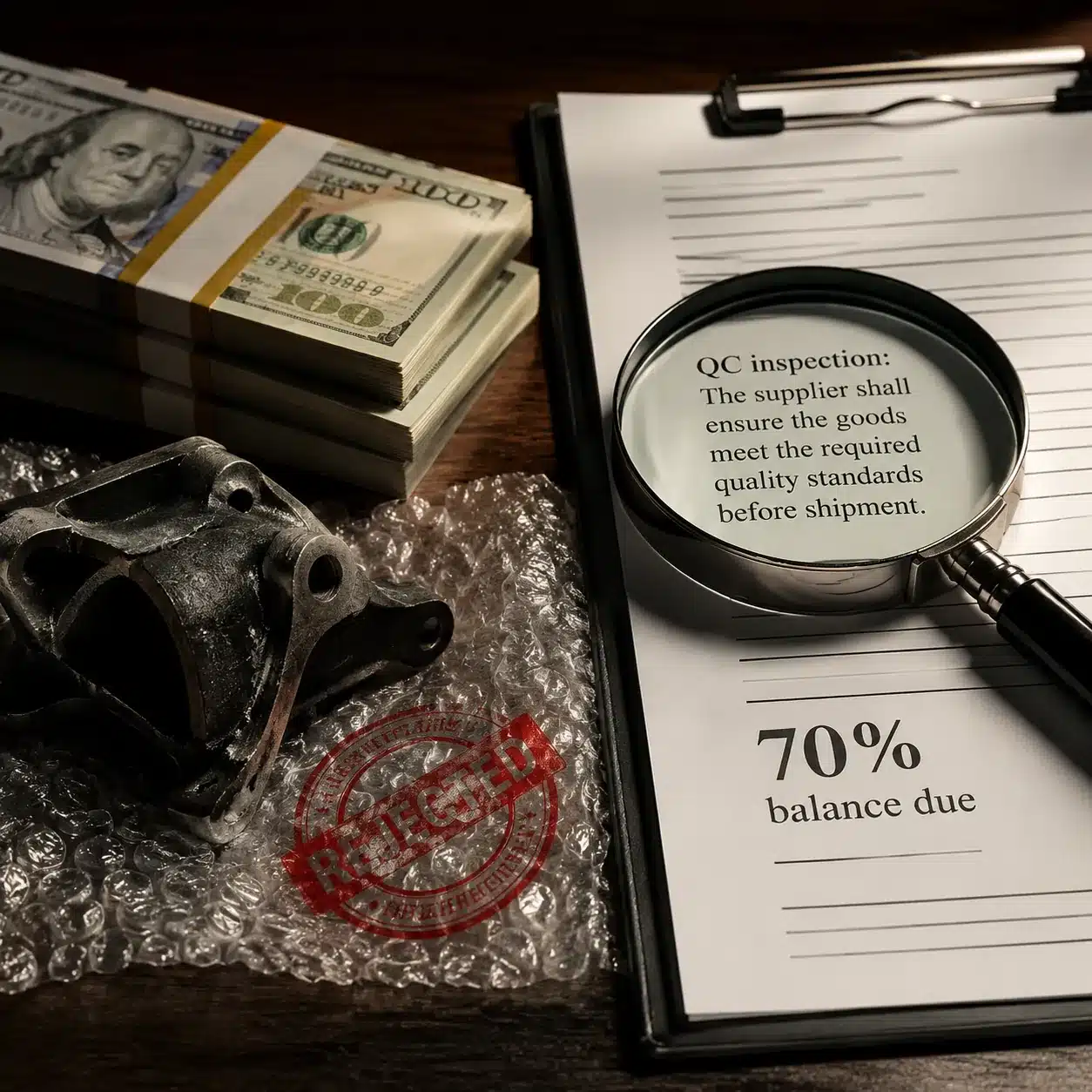
- Business licence + bank account match — see the business licence verification guide.
- FDA / LFGB report for the exact SKU material — not “similar product”. Report serial verified with SGS / Intertek directly. Ask for the extraction fluid list; a valid FDA report names distilled water and n-hexane.
- Actual production plant named for food-contact SKUs. Many District 2 3F silicone booths route production to Guangdong or Zhejiang coastal plants; ceramic booths on 2F often route to Chaozhou or Jingdezhen. The plant that ran the compression mould has to be the plant on the test report.
- PFOA / PFAS-free certification for non-stick. Non-stick pan coatings sold in the U.S. must be PFOA-free; California specifically bans PFAS in cookware from 2028 (planning ahead matters). Ask for the coating manufacturer name and PFOA-free letter.
- Master carton drop-test on ceramic. 1.2 m six-corner drop test protocol written into the PO. Ceramic breakage in transit is the largest returns driver — verified packaging drops breakage from 3–7% to under 0.5%.
- Pre-shipment AQL with kitchen-specific defect list — chips, glaze cracks, coating scratches, seal integrity, weight variance, drop-test verified. See the AQL inspection guide for thresholds.
Amazon FBA Q4 Reality for Kitchenware
Kitchenware is one of Amazon’s most tightly-restocked categories in Q4 because the holiday cooking / gifting demand spike is predictable. Restock limits typically compress in October, and receiving windows can stretch to 2–3 weeks. Practical implication for a Yiwu source: for an FBA-bound Q4 launch, the container needs to gate-in at Ningbo by mid-October at the latest.
Le Yiwu to Amazon FBA guide covers the FNSKU labeling and prep specifics; kitchenware carries a heavier prep overhead than most categories because ceramic and glass require carton dividers and fragility labels. Reorder cycles run 60–90 days on proven SKUs, so Q3 reorders locked in by August typically make it in for Q4 selling.
Example: An 8-SKU Silicone Bakeware Line for Amazon US
Illustrative scenario, not a specific customer case. A U.S. Amazon FBA seller launches an 8-SKU silicone bakeware line: 3 baking mat sizes, 2 muffin trays, 1 loaf pan, 2 gadget pieces (spatula, brush). Target 2,000 units per SKU, custom colour palette (terracotta + sage), full FDA + LFGB dual-market compliance for U.S. plus EU expansion planned Q2.
Week 1–2: buyer walks District 2 3F silicone bakeware section, shortlists 3 suppliers. Two source silicone raw material from the same Guangdong producer; one from a coastal Zhejiang alternative. NNN signed with the two shortlisted after sample selection.
Week 3–6: samples in custom colour. Approve colour match against a physical Pantone chip written into the PO. Booking dual FDA 21 CFR 177.2600 + LFGB test at SGS Shanghai for USD 4,800 total across the 8 SKUs (grouped by material — one silicone base pass covers all 8). Test results Week 6.
Week 7–10: production run in Guangdong. Mid-run photo inspection Week 9. Week 11 pre-shipment AQL at the Yiwu consolidation warehouse with drop-test verified. Week 12: gate-in Ningbo, ocean freight to LA. Week 17: FBA receiving completes late August, on-shelf by Labor Day. Total elapsed: 119 days. Total cost including dual-market testing, freight, and consolidation: USD 39,600 for 16,000 units, weighted unit FOB USD 2.10.
Questions fréquemment posées
Which district in Yiwu has kitchenware?
District 2 handles the core kitchenware volume — over 5,000 suppliers across multiple floors covering pans, ceramic tableware, silicone bakeware, gadgets, and small appliances. District 4 covers kitchen textiles (aprons, mitts, table linens) as a crossover category. Skip District 1 for anything food-contact.
Do I need both FDA and LFGB certification?
If the roadmap includes both U.S. and EU sales, yes. LFGB is stricter, so an LFGB-passed SKU typically covers FDA as well — testing to LFGB from the start saves duplicate testing costs. U.S.-only sellers can stay on FDA 21 CFR alone.
How much does FDA testing cost per SKU?
FDA 21 CFR extraction testing runs USD 300–650 per material at SGS, Intertek, TÜV, or Bureau Veritas. Multiple SKUs sharing the same material family can be tested as a group, dropping per-SKU cost significantly. Silicone (21 CFR 177.2600) typically runs USD 350–650.
What does LFGB test that FDA doesn’t?
LFGB adds sensory inspection (taste and smell) and caps VOM (volatile organic matter) at 0.5%, plus PAH (polycyclic aromatic hydrocarbon) testing. FDA focuses on extraction and total migration limits. LFGB catches silicone off-gassing and adhesive contamination that FDA does not flag.
Are Yiwu ceramic tableware suppliers safe for Amazon US?
Ceramic tableware from Yiwu is safe when the supplier holds a valid FDA lead-leaching test report per SKU and a California Prop 65 lead-in-glaze test. Verify report serial numbers with the issuing lab. Amazon US may delist listings for Prop 65 non-compliance in California-flagged categories.
What are the 2026 changes to food-contact regulations?
The EU added 12 restricted substances to the food-contact list with limits of 0.01–0.5 mg/kg. FDA digital compliance guidelines took effect May 5, 2026. Confirm current specifics with a licensed food-contact compliance consultant before committing to a large launch.
Do Yiwu suppliers make the kitchenware themselves?
Most District 2 3F silicone booths route production to Guangdong plants; ceramic booths on 2F often route to Chaozhou or Jingdezhen. Small appliance suppliers on 4F usually route to Shenzhen or Zhongshan for electronics. Verify the actual production plant on the PO for compliance traceability.
Can I ship electric kitchen appliances from Yiwu?
Yes, but FCC Part 15 and UL certification is required for U.S. sales; CE marking + LVD + EMC for EU. Yiwu appliance suppliers on District 2 4F can quote fixtures with pre-existing certificates — verify serial numbers with the issuing lab before signing PO.
How do I avoid ceramic breakage in ocean freight?
Write a 1.2 m six-corner drop test into the master-carton spec and require internal foam or corrugated dividers. Breakage without proper packaging: 3–7% on Yiwu ceramics; with verified drop-test packaging: under 0.5%. Include drop-test verification in the pre-shipment AQL.
What’s Amazon’s Q4 restock reality for kitchenware?
Kitchenware sees tight Q4 restock limits — Amazon typically compresses category-level storage from October through December. Receiving windows can stretch to 2–3 weeks. Practical: land inventory at FBA by early October for holiday cooking demand, or expect restock-limit blockage during peak.
Conclusion
Yiwu kitchenware sourcing works for Amazon FBA and food-service importers who treat District 2’s food-contact SKUs as regulated products rather than commodity items. FDA 21 CFR extraction reports, LFGB VOM caps, Prop 65 lead-in-glaze tests, and PFOA-free certifications are all achievable at Yiwu — but only when the vetting names the actual production plant, the report tracks to that plant, and the PO carries the specific extraction fluid and testing regime the SKU material demands.
If you are planning a kitchenware line for U.S. or dual-market EU launch and want the FDA / LFGB routing set, the food-contact plant traced, and the AQL kitchenware-specific defect list built into the PO before deposit, an on-the-ground team maps the shortlist in a single week that would take a founder six.
Written by the ChineseYiwu.com team
A Yiwu-based sourcing partner since 2017, walking District 2 kitchenware floors weekly and running FDA 21 CFR extraction testing coordination, LFGB dual-market compliance, and pre-shipment AQL for silicone bakeware, ceramic tableware, and Amazon FBA kitchen private-label shipments out of Ningbo to U.S., U.K. and EU brands.