Justin
FCA in Incoterms 2020: Risk Transfer, Costs, and FCA vs FOB
Your supplier’s quote says “FCA Yiwu.” The goods are packed, a truck is booked, and nobody has written down who loads it or when the risk stops being theirs. That gap is the whole FCA rule in miniature: free carrier, delivered to a carrier you name, at a place you both specify.

FCA in Incoterms 2020 is one of the 11 ICC trade rules and the one the International Chamber of Commerce’s own academy pushes buyers toward when goods cross a border. This guide covers the exact delivery points, the moment risk changes hands, the 2020 on-board bill of lading option, and how FCA compares with FOB and EXW for China imports.

Key Takeaways
- FCA means Free Carrier: the seller delivers goods, cleared for export, to a carrier nominated by the buyer at a named place.
- Two delivery branches: at the seller’s premises the seller loads; at any other named place the goods are placed ready for unloading and the buyer unloads.
- Risk transfers at delivery: at the named place, before the goods reach a vessel.
- FCA vs FOB: the ICC Academy names FCA the appropriate rule for containers, pallets, and multimodal cargo; FOB fits bulk port-to-port shipments.
- 2020 change: parties may agree that the buyer arranges an on-board bill of lading, but the carrier is not compelled to comply.
- FCA vs EXW: the ICC Academy strongly encourages FCA over EXW when goods cross a border, because export clearance stays with the seller.
What FCA Means in Incoterms 2020
FCA stands for Free Carrier. Under the ICC’s Incoterms 2020 rules, the seller delivers the goods to a carrier or another person nominated by the buyer, at a named place, cleared for export. The buyer names the carrier and the place; the seller gets the goods there and handles the export formalities.
Incoterms 2020 contains 11 trade rules split into two groups. Seven work for any mode of transport: EXW, FCA, CPT, CIP, DAP, DPU, and DDP. Four apply only to sea and inland waterway transport: FAS, FOB, CFR, and CIF. FCA sits in the any-mode group, which is why it appears in air, road, rail, and multimodal contracts as easily as ocean freight.
The rules have been published by the ICC since 1936, and Incoterms 2020 is the current edition. FCA itself first appeared in Incoterms 1980, absorbing the older FOR, FOT, and FOB Airport rules. The 2020 revision added one FCA-specific mechanism for sea carriage, covered later in this guide.
A plain-English test: if a supplier quotes FCA, they are saying “I will clear the goods for export and hand them to your carrier at the agreed point. Everything after that is yours.” That point, not the port and not the vessel, is where their responsibility ends. The official ICC guidance for choosing between EXW and FCA is available in the ICC Academy’s EXW or FCA explainer.
The Two Delivery Points Under FCA
FCA has two delivery branches, and the loading obligation flips between them. This is the clause most buyers skim, then regret.
Branch One: The Seller’s Premises
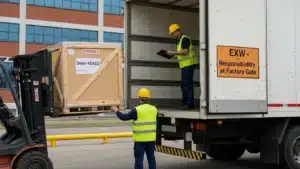
When the named place is the seller’s own premises, the seller fulfils delivery by loading the goods onto the buyer’s collecting vehicle. The buyer’s truck pulls up, the seller loads, and only then is delivery complete. Until the load is on the truck, the seller still owns the risk of loss or damage.
Branch Two: Any Other Named Place
When the named place is anywhere else, the seller delivers the goods ready to be unloaded from the seller’s transport. The buyer, or the buyer’s carrier, does the unloading. The seller is not responsible for unloading at that location. A warehouse, a container yard, a freight forwarder’s depot all work as the named place, provided the contract says exactly where.
When Risk Actually Changes Hands
Risk transfers at the delivery point: when the goods are handed to the carrier or the buyer’s nominated person. That moment comes before the goods reach the port and long before they sit on a vessel. The Canadian export agency EDC spells out the same mechanics in its FCA rule explainer. It includes a case where a loading delay meant delivery was not completed and the seller bore the cost.
Write the named place with the precision of an address, not a city. “FCA Yiwu” leaves both branches open. “FCA, Seller’s Warehouse, Unit 12, Futian Market District, Yiwu” closes the question. The same rule appears in the ICC Academy’s FCA or FOB guidance, which is the primary source for this article’s comparison sections.
Who Handles Customs and Cost Under FCA
The obligation split under FCA is clean: the seller clears the goods for export, and the buyer handles import formalities, duties, and taxes at the destination. The buyer also arranges and pays for the main carriage, because the seller’s job ends at the named place.
Insurance is not required under FCA. The seller carries the risk until delivery; the buyer carries it after. Neither party is obliged to insure, which means the buyer should decide on cargo cover from the named place onward. Export-licensing work, inspections, and security-related formalities sit with the seller, and their costs follow the same allocation under the rule’s cost articles.
| Task | Who Handles It | Who Pays |
|---|---|---|
| Export clearance | Seller | Seller |
| Loading at seller’s premises | Seller | Seller |
| Unloading at another named place | Buyer or buyer’s carrier | Buyer |
| Main carriage and freight | Buyer | Buyer |
| Cargo insurance | Not required; buyer decides | Buyer if arranged |
| Import clearance and duties | Buyer | Buyer |
| Risk before delivery | Seller | Seller |
| Risk after delivery | Buyer | Buyer |
FCA vs FOB for Container Shipments
This is the decision most China importers actually face. FOB has long been a common default, yet the ICC Academy’s guidance is specific. FCA is the appropriate rule when goods move in containers or pallets across multiple modes. FOB is the appropriate rule when goods move in bulk between ports by sea or inland waterway.
The reason is the risk-transfer point. Under FOB, risk passes once the goods are loaded on board the vessel at the named port of shipment. Under FCA, risk passes earlier, when the goods are delivered to the carrier at the named place. A container handed over at an inland depot has already changed hands under FCA. Under FOB, the seller’s risk keeps running until the box sits on the ship.
The practical result: for a 20ft container of goods collected from several Yiwu suppliers and consolidated before export, FCA matches the physical handover far better than FOB. This is an illustrative example, not a specific shipment. The trade-off is that FCA puts more coordination on the buyer, who must name the carrier and the place. Buyers who want the origin side handled end to end often route this step through the site’s China logistics and shipping service.
| Attribute | FCA | FOB | EXW |
|---|---|---|---|
| Transport modes | Any mode, including multimodal | Sea and inland waterway only | Any mode |
| Delivery point | Named place, before the vessel | On board the vessel at port | Seller’s premises, no loading |
| Risk transfer | At delivery to carrier | When goods are on board | When goods are made available |
| Export clearance | Seller | Seller | Buyer |
| ICC guidance for containers | Appropriate for containers and pallets | Appropriate for bulk port-to-port | Not recommended for cross-border |
FCA vs EXW and the ICC Recommendation
EXW, Ex Works, is the other end of the spectrum. The buyer collects the goods at the seller’s premises, handles loading, and takes on export formalities. Under EXW the buyer also handles export clearance. That can be a genuine problem for a foreign importer filing paperwork in a country where they have no presence.
The ICC Academy states the position plainly: traders are strongly encouraged to consider FCA instead of EXW where the goods are crossing a border. The reason is the export side. Under FCA the seller clears the goods for export; under EXW that duty falls on the buyer.
Some suppliers still quote EXW because it removes every loading and clearing responsibility from their side. That is their convenience, not your advantage. If a supplier offers EXW but the goods will cross a border, ask for an FCA price at their premises. Cost differences depend on the shipment and the services the seller includes; model your quote before choosing. The export paperwork stops being your problem.
The 2020 On-Board Bill of Lading Option
FCA has one well-known friction point: banks financing letters of credit often want an on-board bill of lading, a document proving the goods are loaded on a vessel. Under FCA, delivery happens inland, so a standard FCA document set may not carry the on-board notation a bank demands.
Incoterms 2020 added an optional mechanism for this. The parties may agree that the buyer, at the buyer’s own cost and risk, instructs the carrier to issue a transport document with an on-board notation to the seller. The seller then tenders that document to the buyer, often through the banks. This is one of the headline changes in the 2020 revision; the full set is covered in the site’s Incoterms 2020 changes guide. The ICC’s official summary of the 2020 revision describes exactly this scenario in its Incoterms 2020 overview.
The catch: the carrier is not compelled to comply with the buyer’s instruction. The mechanism exists because the parties agreed it, not because the carrier must issue the document. Trade publications such as Incoterms Explained note this limitation and suggest that, where possible, the bank accepts a received-for-shipment bill of lading instead. If your LC depends on an on-board document, put the agreement in writing before the contract is signed, and confirm the carrier will act on it.
A related note: the seller has no general obligation to put the goods on board a vessel under FCA. The on-board document mechanism is the exception, and only when agreed.

When FCA Is the Right Term
FCA suits any mode of transport, which makes it a practical fit for China sourcing in several common situations.
- Consolidation and LCL: goods from several suppliers gathered at one warehouse before export. FCA matches the handover point at that warehouse.
- Air and express freight: the buyer’s forwarder or courier collects at origin; the named place can be a depot or the seller’s door.
- Buyer-controlled origin freight: when you already have a freight contract or an agent at origin, FCA lets you use it cleanly.
- Multimodal routing: truck to rail to ship, or truck to air, without renegotiating the delivery point at each leg.
FCA is less attractive when you cannot name a precise place or have no forwarder at origin. If the seller insists on handling export logistics, a delivered term fits better. A term such as DAP or DDP shifts that work to the seller, and the price typically rises to cover it.

Common FCA Mistakes Importers Make
Four mistakes repeat across FCA contracts. Each one maps to a specific rule, and each has a concrete consequence.
An Imprecise Named Place
“FCA Yiwu” is not a delivery point. It is a city. Without a precise place, the two branches stay open and the loading obligation becomes negotiable after the fact. The fix is an address-level named place in the contract, and it costs nothing to write.
Assuming the Seller Loads at a Non-Premises Place
The seller loads only when the named place is the seller’s premises. At any other named place, the buyer unloads the seller’s vehicle. If your team expects the supplier to forklift the pallets at the consolidation warehouse, the cost and the risk both sit with you.
Expecting an On-Board Bill of Lading Without Agreement
An on-board document under FCA requires the agreed A6/B6 mechanism, arranged by the buyer at the buyer’s cost. Without that agreement, and with a carrier who will not act on it, a bank may reject the document set and hold the payment. The document flow itself is explained in the site’s bill of lading guide.
Confusing FCA Risk Transfer With FOB
Under FCA, risk passes at the named place, not when the container hits the deck. An importer who assumes FOB-style timing will carry risk they did not budget for during the inland leg. Confirm the moment in writing and insure accordingly.
Checklist Before You Sign an FCA Contract
Run this list before you accept an FCA quote. It is short enough to paste into an email to the supplier.
- Named place: an address-level delivery point, and which branch applies there.
- Loading split: who loads, who unloads, and who pays for each.
- Export clearance: the seller’s scope, and the document set they must produce.
- On-board bill of lading: the A6/B6 agreement, in writing, if an LC needs it.
- Risk transfer: the exact moment, stated in the contract, not assumed.
- Cost allocation: origin charges, freight, insurance, and destination costs, line by line.
Conclusión
FCA in Incoterms 2020 is often the more appropriate rule for containerized and multimodal shipments. The seller clears the goods for export and delivers them to your carrier at a named place, and risk transfers there. The two delivery branches decide who loads, and the 2020 on-board bill of lading option fixes the LC gap only when the parties agree it in writing.
Before you sign, pin down the named place, the loading split, and the document set. Then compare the FCA mechanics against your order size and freight setup. If your goods are consolidated from several Yiwu booths, read the deep dive on FCA terms for multi-booth orders.
Preguntas frecuentes
Does FCA include customs clearance?
The seller clears the goods for export under FCA. The buyer handles import formalities, duties, and taxes in the destination country.
Who unloads the truck under FCA?
If the named place is the seller’s premises, the seller loads the goods onto the buyer’s vehicle. At any other named place, the buyer unloads.
Is FCA the same as FOB?
No. FCA transfers risk at the named place to a carrier and works for any mode. FOB transfers risk when goods are loaded on board a vessel and applies only to sea or inland waterway transport.
Can FCA be used for air freight?
Yes. FCA works for any mode of transport, including air, road, rail, sea, and multimodal shipments.
What does the 2020 on-board bill of lading change mean for FCA?
Parties may agree that the buyer instructs the carrier to issue an on-board transport document to the seller, often for letters of credit. The carrier is not compelled to comply, so confirm it in the contract.
Is FCA better than EXW?
The ICC Academy strongly encourages FCA over EXW where goods cross a border, because the seller handles export clearance instead of leaving it to the buyer.