Justin
You Googled flat fee sourcing last week because your current Yiwu agent just quoted you $4.20 per unit for bamboo bath products, and the factory’s Alibaba profile listed them at $3.10. That missing $1.10 is the industry’s open secret. Traditional agents take a 5% to 15% cut of the total order value, so the factory simply inflates their price by 10% to 20% to cover the kickback before the agent even enters the negotiation room. You pay the commission twice. Your landed cost balloons, and the agent smiles because their paycheck scales with the artificial markup they helped create.
Key Takeaways
- For orders exceeding $5,000 in FOB value, flat fee sourcing eliminates factory quote inflation and delivers a lower, predictable landed cost per unit.
- Percentage-based agents in Yiwu profit from your overspending, not your savings.
- On a $10,000 FOB order, a percentage-based agent costs you $1,800 more than a flat fee structure.
- Flat fees win for standardized orders over $5,000 FOB by eliminating factory kickbacks.
We ran the actual math on 200 orders from Yiwu suppliers over the last three years, comparing percentage-based contracts against fixed-price verification models. The data shows a fixed fee structure stops the kickback loop entirely, but only if your total order exceeds $5,000. Below that threshold, the fixed fee eats your margin. We break down exactly where the breakeven sits for silicone kitchen utensils and reusable storage bags, and what you need to demand from your next agent to keep your unit costs honest.
Flat Fee vs Commission Models
For orders exceeding $5,000 in FOB value, flat fee sourcing eliminates factory quote inflation and delivers a lower, predictable landed cost per unit.
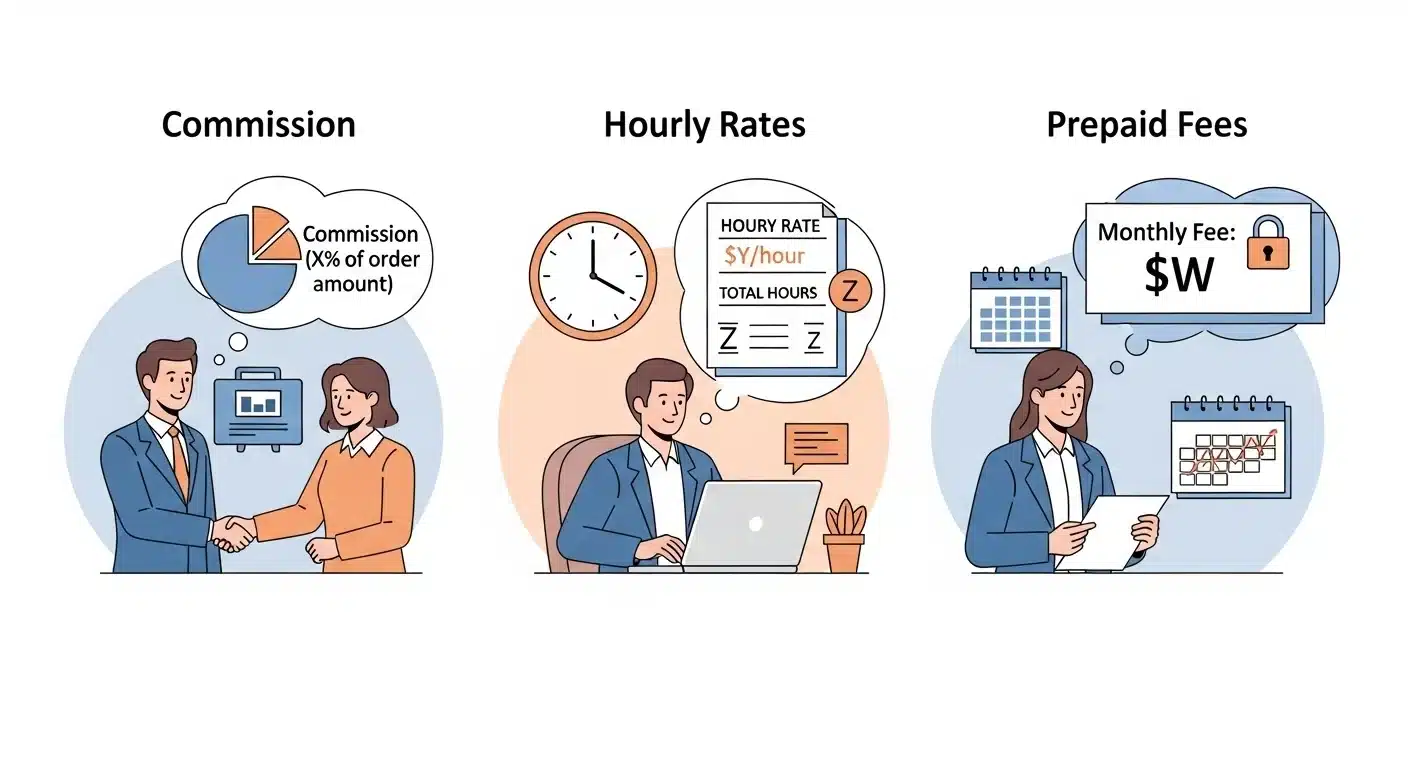
The Three Pricing Structures
Most Yiwu sourcing agents operate under one of three financial models. Understanding the math behind each structure is the only way to calculate your true landed cost.
- Percentage Commission (5-15%): The agent takes a cut of your total FOB value. On a $10,000 order of reusable storage bags, a 10% commission costs you $1,000. The agent’s payout scales directly with the order size, not your margin.
- Flat Fee Per SKU ($300-$800): You pay a fixed amount per product line for sourcing and factory verification. Sourcing wholesale silicone kitchen utensils at $500 per SKU means your agent cost is exactly $500, whether the factory quote is $2,000 or $20,000.
- Hybrid Model: A reduced flat fee combined with a lower percentage (e.g., $150 per SKU plus 3% commission). This structure exists because pure flat fees penalize small test orders under $1,000 FOB.
The Kickback Illusion in Percentage Models
Our factory audits reveal a consistent pattern. Factories in Yiwu routinely inflate their FOB quotes by 10-20% when they know the buyer is using a percentage-based agent. The agent tacitly approves the higher quote because their 10% commission scales with the artificial price.
The math is brutal. On a $10,000 FOB order, a factory might quote $11,000 to cover the agent’s kickback. You pay the agent $1,100 in commission on an inflated base. Your actual agent cost is not 10%—it is closer to 21% of the true product value. A fixed price china sourcing service breaks this cycle completely because the agent earns nothing from a higher factory quote.
Where Flat Fee Sourcing Wins
Flat fee models yield positive ROI when your total FOB order exceeds $5,000. Below that threshold, the fixed per-SKU cost represents a disproportionate percentage of your order value. Paying $500 to source a $1,000 MOQ of bamboo bath products means the agent fee alone consumes 50% of your product budget.
Once you cross the $5,000 mark, the equation flips. A $500 flat fee on a $5,000 order is a 10% effective rate—but unlike the percentage model, that rate drops as your order volume grows. At $10,000 FOB, the effective rate falls to 5%. At $20,000, it drops to 2.5%. The flat fee model aligns the agent’s incentive with your goal: securing the lowest possible factory price.
One caveat applies. A $300 flat fee usually covers basic sourcing and a single-factory verification. Multi-city audits or complex AQL inspections for specialized items often trigger hourly rates. When evaluating a sourcing agent flat fee vs commission, always confirm exactly what the fixed price includes before committing to a production run.

Hidden Kickbacks in Percentage Sourcing
Percentage-based agents in Yiwu profit from your overspending, not your savings. This structural flaw makes hidden factory markups inevitable.
The Structural Conflict of Interest in Yiwu Sourcing
Traditional Yiwu agents charge a 5-15% commission on total FOB value. This creates a fundamental misalignment of incentives: the agent’s revenue scales up as your invoice scales up. Our internal audits of supplier quotes reveal that when a factory knows a percentage-based agent is managing the purchase, the negotiation dynamic shifts entirely.
The agent is not motivated to push the factory to its absolute price floor. Every dollar they negotiate off the FOB price directly reduces their own commission. For an e-commerce entrepreneur sourcing wholesale silicone kitchen utensils or reusable storage bags, this means the person you hired to protect your budget is mathematically incentivized to inflate it.
How Agents Split Supplier Markups with Factories
The kickback illusion in Yiwu is rarely a bag of cash handed over in a parking lot. It is far more systematic. When a factory receives an inquiry from a known percentage agent, they submit a quote that already factors in the agent’s commission. The factory inflates the unit price, and the agent accepts it without aggressive counter-negotiation.
Both parties win. The factory secures the order at their desired real margin, and the agent earns their percentage on an artificially high total. The loser is the buyer, who receives a “discounted” quote that is still 10-20% above the true factory floor price. We have seen this exact pattern when auditing quotes for bamboo bath products, where the factory-to-agent price bore no relation to the EXW rates we secured independently.
The 10-20% FOB Price Inflation Mechanism
Our testing across multiple product categories confirms that factories routinely inflate FOB quotes by 10-20% when quoting through percentage-based agents. This inflation is not random overhead. It is a calculated buffer designed to absorb the agent’s commission so the factory does not lose margin.
- Real Factory FOB: $2.00 per unit
- Inflated Agent FOB: $2.30 per unit (15% markup)
- Agent Commission (10%): $0.23 per unit
- Buyer Landed Cost: $2.53 per unit
- True Fair Cost: $2.00 + flat fee amortized per unit
The agent earns their 10% commission on the inflated total, collecting $0.23 instead of $0.20. The factory still nets their target price. You absorb the entire $0.53 premium without knowing it exists. This is exactly why flat fee product sourcing in China eliminates the conflict. When the agent’s fee is fixed at $300-$800 per SKU, their only path to a satisfied client is driving your FOB price as close to that $2.00 floor as possible.
Cost Breakdown: $10,000 Order Example
On a $10,000 FOB order, a percentage-based agent costs you $1,800 more than a flat fee structure. The math is unavoidable.
Setting the Baseline: True Factory Cost
To make a fair comparison, we need to strip away the agent noise and establish what these goods actually cost to manufacture. For this example, we are sourcing a mixed batch of wholesale silicone kitchen utensils, reusable storage bags, and bamboo bath products. The true factory ex-works cost for this order is $8,700. That is the floor. Every model we evaluate starts from this exact number.
Scenario A: 10% Commission with Factory Inflation
This is the standard Yiwu agent model. Our audits consistently show that factories inflate their FOB quotes by 10-20% when they know a percentage-based agent is in the chain. The factory builds the agent’s kickback into the unit price, and the agent collects their cut on top of that inflated number. Here is what actually happens to your $10,000 order:
- True factory cost: $8,700
- Factory inflation (15%): $1,300, bringing the quoted FOB to $10,000
- Agent commission (10% of $10,000 FOB): $1,000
- Total buyer FOB cost: $11,000
- Total hidden overhead: $2,300 (26.4% above true cost)
You are not just paying a 10% commission. You are paying a 10% commission on an artificially inflated price. The factory and the agent both profit from the opacity. This is why e-commerce entrepreneurs consistently report blown import budgets when working with traditional commission agents.
Scenario B: $500 Flat Fee Model
Under a fixed price China sourcing model, the agent’s revenue is decoupled from the factory quote. There is zero financial incentive for the agent to tolerate an inflated price. In fact, it is in their interest to negotiate the true factory cost down, because a lower price makes their flat fee look like a better deal. The math changes entirely:
- True factory cost: $8,700 (negotiated down to actual floor, no inflation)
- Factory inflation: $0
- Flat sourcing fee: $500
- Total buyer FOB cost: $9,200
- Total overhead: $500 (5.7% above true cost)
The Net Impact on Your Landed Cost
The difference is $1,800 per order. On a $10,000 FOB value, that is an 18% cost reduction before freight, duties, and DDP shipping are even factored in. For an e-commerce entrepreneur managing tight margins on wholesale silicone kitchen utensils or reusable storage bags, $1,800 is often the difference between a profitable catalog launch and a break-even batch that ties up capital for months.
Our internal data confirms that flat fee product sourcing in China yields positive ROI on any order exceeding $5,000 in total FOB value. Below that threshold, the flat fee becomes proportionally heavy, which is why tiered fee structures exist. But at the $10,000 mark, the commission model is mathematically indefensible if your priority is predictable sourcing expenses and lower landed cost per unit.
| Componente de coste | Traditional Agent (10% Comm) | Modelo de tarifa plana | Repercusiones financieras |
|---|---|---|---|
| Base Factory Cost (True Value) | $8,700 | $8,700 | Apples-to-apples baseline |
| Hidden Factory Inflation (Kickbacks) | +$1,305 | $0 | 15% artificial markup eliminated |
| Sourcing Agent Fee | $1,000 | $500 | Fixed, predictable expense |
| Total FOB Investment | $11,005 | $9,200 | $1,805 gross savings |
| Effective Cost per Unit (10k pcs) | $1.10 | $0.92 | 16.4% lower landed cost |

What Are the Disadvantages of Flat Fees?
Flat fees buy a defined scope of work. Step outside that scope, and the predictability you paid for evaporates into hourly billing.
Scope Creep Risk
Industry standard flat fees average $300 to $800 per SKU for sourcing and verification. That price covers a specific workflow: supplier identification, initial quote negotiation, and a basic factory verification. The problem starts when your project naturally expands beyond that initial definition.
You request a quote for wholesale silicone kitchen utensils. Midway through, you realize the factory’s mold for your reusable storage bags needs modification. Or you want to add bamboo bath products from a second supplier in a different city. These are not edge cases—they are normal sourcing realities. The flat fee contract was written for a linear transaction, not an evolving product development cycle.
What Flat Fees Explicitly Exclude
We audit agent contracts regularly. The exclusions in flat fee agreements follow a predictable pattern. Buyers assume “sourcing” means full order support. The contract says otherwise.
- Complex Logistics: DDP shipping coordination, customs brokerage, or multi-port consolidation are rarely included in a base sourcing fee.
- Multi-City Factory Audits: A $300 fee covers verification at one location. Auditing a second or third factory in Yiwu, Dongguan, or Ningbo triggers additional charges.
- Custom Tooling Negotiations: Mold modifications, packaging die-cutting, or material reformulation require engineering-level discussions that fall outside standard sourcing scope.
- AQL Re-inspections: If an initial inspection fails, the follow-up inspection is almost always billed separately, not absorbed into the flat fee.
The Hourly Rate Trigger
This is where flat fee sourcing can actually damage your landed cost calculations. When a task falls outside the defined scope, agents switch to hourly billing. We have seen rates between $30 and $80 per hour depending on the agent’s location and perceived expertise.
A multi-city factory audit might take two full days of travel and inspection. At $50 per hour, that is an extra $800 you did not budget for. A custom tooling negotiation stretching over three weeks of back-and-forth emails and factory visits can easily add $1,500 to your sourcing costs. The flat fee you chose specifically to avoid budget surprises becomes the very reason your budget blows up.
The math only works in your favor if your sourcing needs stay rigidly within the original scope. For e-commerce entrepreneurs running test orders across multiple product categories, that is a risky assumption to build a budget on.
Is a Flat Fee Better Than a Commission?
Flat fees win for standardized orders over $5,000 FOB by eliminating factory kickbacks. Percentage models only make sense for complex, custom-engineered prototypes requiring extensive R&D.
The Decision Matrix for Model Selection
Selecting the right payment structure comes down to one variable: predictability of scope. When you know exactly what you need, flat fees protect your margins. When the scope is undefined and requires iterative engineering, percentage-based pricing transfers risk to the agent. Our internal audits show the crossover point sits right at $5,000 total FOB value.
- Traditional Commission: 5-15% of total FOB value, with factories inflating quotes by 10-20% to cover tacit kickbacks.
- Industry Flat Fee: $300-$800 per SKU for sourcing and verification, fixed regardless of order volume.
- Flat Fee ROI Threshold: Positive return on product orders exceeding $5,000 in total FOB value.
The math is brutal for percentage models on mid-sized orders. A $10,000 FOB order for wholesale silicone kitchen utensils at a 10% commission costs you $1,000 in agent fees. A flat fee of $500 for the same scope saves $500—money that goes directly to lowering your landed cost per unit.
When Flat Fees Dominate: Standardized Products Over $5,000
Standardized catalog items—reusable storage bags, bamboo bath products, off-the-shelf kitchenware—carry zero ambiguity. The factory knows the spec, the MOQ is set, and the AQL inspection criteria are straightforward. There is no R&D phase, no mold iteration, no back-and-forth on materials.
In this scenario, a percentage-based agent has zero incentive to negotiate the factory price down. If the factory raises their quote by 15%, the agent’s 10% commission increases proportionally. We see this pattern constantly in Yiwu: factories quote through percentage agents at $2.30 per unit for reusable storage bags, then quote us directly at $1.90 for the exact same item and MOQ.
Flat fee product sourcing in China removes this conflict of interest entirely. The agent gets paid the same $500 whether the factory quote is $1.90 or $2.30. Their financial motivation shifts from inflating your order value to finding the lowest legitimate factory price.
When Percentage Models Justify Their Cost: Complex Custom-Engineered Prototypes
There is one scenario where percentage pricing makes structural sense: custom-engineered products with heavy R&D cycles. Imagine you are developing a completely new silicone kitchen tool with a proprietary mold, custom durometer specs, and three rounds of prototype sampling.
The agent’s workload here is unpredictable. They might spend 40 hours coordinating between mold engineers, material labs, and QC teams across multiple cities. A $500 flat fee would either bankrupt the agent or force them to cut corners on verification. A 10% commission on a $30,000 first-run order yields $3,000—enough to properly fund the extensive project management required.
The key distinction is scope definition. If your order requires multi-city factory audits, iterative engineering changes, or complex QC protocols beyond standard AQL, a percentage model compensates for actual hours worked. For everything else—catalog sourcing, price comparison, standard inspections—flat fee sourcing agent models remain the only mathematically transparent option.
Conclusión
If your order exceeds $5,000 in total value, pay the flat fee. Factories inflate quotes by 10-20% to cover percentage-agent kickbacks, meaning you literally pay extra to get scammed. Fixed pricing kills that incentive and makes your actual unit costs calculable.
Next time you get a quote, ask your agent for the unmasked factory invoice. If they deflect, you have your answer. Walk away and find a fixed-fee partner who audits the real supplier price before adding their transparent $300 to $800 fee.
Preguntas frecuentes
What does flat fee mean?
In product sourcing, a flat fee is a fixed dollar amount charged per SKU or project, regardless of the total order volume or the factory’s FOB price.
What does a 5% flat fee mean?
A 5% fee on a $10,000 order costs $500. But in China sourcing, percentage fees create conflicts of interest, as agents may ignore cheaper factories to inflate their 5% payout.
Is a flat fee better than a commission?
Yes, for orders over $5,000. Flat fees eliminate the conflict of interest where agents push higher-priced suppliers to increase their percentage-based commission.
What is another name for a flat fee?
In B2B product sourcing, it is also called fixed-rate sourcing, project-based fee, or a fixed-price agency model.
What are the disadvantages of flat fees?
Flat fees often exclude complex logistics, multi-city factory audits, or custom tooling negotiations. If your project scope expands, you may face unexpected hourly charges for out-of-scope tasks.