Justin
Finding a truly cost-effective supplier on Alibaba requires knowing who actually makes your goods. Most listings hide a middleman behind a factory facade. You need hard data to filter them out.
- Over 85% of general merchandise suppliers on Alibaba are Yiwu market resellers, not actual manufacturers. This middleman setup destroys your quality control. You pay a markup for zero factory oversight.
- Real factories set minimum order quantities between 500 and 1,000 units to cover machine setup costs. If a supplier offers 10 to 50 units, they are pulling from pre-made Yiwu stock. That off-the-shelf stock often lacks the durability you need for long-term sales.
- Suppliers promising a 7 to 15 day turnaround on customized goods are lying. Real production takes 30 to 45 days. Those fast shipments are just drop-shipped from existing Yiwu International Trade City inventory.
- You can bypass the guesswork by checking their 18-digit Unified Social Credit Code. Run that number through China’s official NECIPS database. The registration must explicitly state manufacturing as their business scope.
- If you want the actual factory price, hire a localized Yiwu market agent. They walk the physical booths and force resellers to reveal their real upstream factories. It is the only reliable way to cut out the markup without visiting China yourself.
That cheap supplier on Alibaba probably just buys from the Yiwu wholesale market. You think you found a direct factory, but you are paying a trader’s markup. This hidden layer destroys your profit margins and strips away your control over quality.

Over 85% of the shops in Yiwu are just resellers. You can spot them by the red flags: minimum orders of 10 pieces or guaranteed 7-day lead times. Real factories take longer to tool up, but they give you a truly cost-effective unit price and direct communication.
The Supply Chain Map: Factory -> Yiwu -> Alibaba -> You
Goods move from factories in Zhejiang to Yiwu’s massive wholesale market, where 75,000 booths aggregate over 400,000 products. Booth operators then list these goods on Alibaba, creating a digital storefront. Buyers receive products through this chain, which can involve multiple layers unless they specifically target factory outlets within the market.

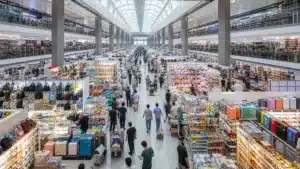
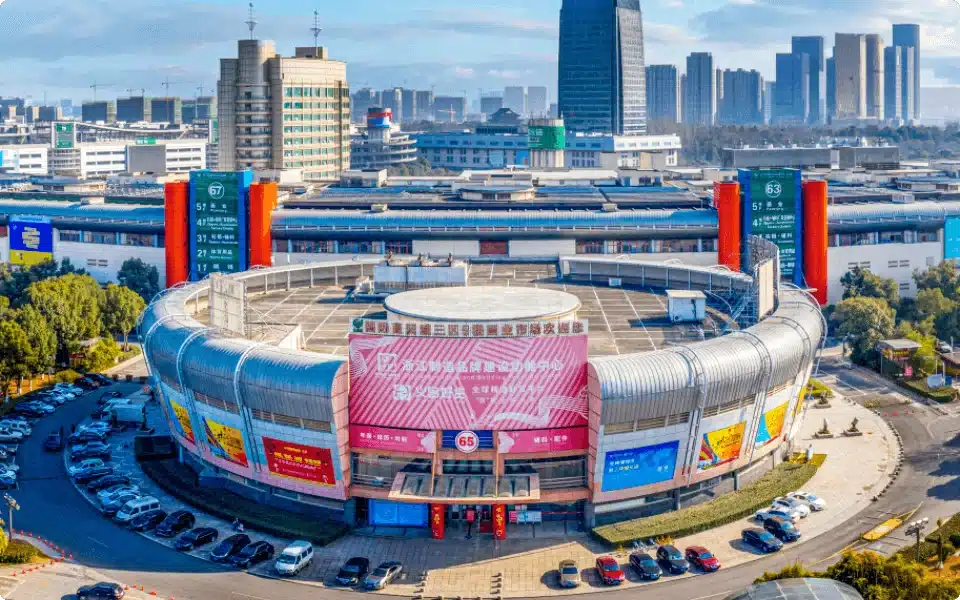
Yiwu International Trade City spans 4 million square meters. It holds 75,000 booths split across five districts. Treat it as a massive wholesale sorting hub, not a manufacturing site.
Each district moves a specific category. District 2 handles hardware and kitchenware, while District 3 pushes office supplies and cosmetics. District 4 moves textiles, and District 5 covers auto parts alongside a top-floor e-commerce hub.
Ground-floor booths are almost always middlemen. Real factory outlets hide on the upper floors, like the 600 manufacturers on floors four and five of District 3. Buying directly from these upper-floor booths is the only reliable way to verify product durability and cut out the trader markup.
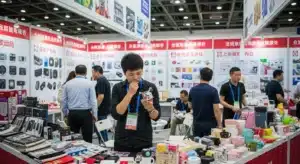
You can find almost anything here. The trap is assuming the person quoting you is the actual maker. If you want pricing that is actually cost-effective, you have to dig past the resellers to find the real factory reps.
The Digital Link: How Goods Move from Booth to Alibaba to You
Walk through District 5 and you will see booth operators uploading photos straight to Alibaba. A single web storefront often acts as a catalog for fifty different small workshops. You think you are buying from one supplier, but your goods come from a dozen different places.
Once you pay, the middleman goes to work. They chase down the items from their network, box them up, and hand the mess off to a freight forwarder. You are paying for their logistics hustle, not factory oversight.
You cannot verify a factory from a computer screen. That blurred line hurts your pricing and destroys your quality control. Real sourcing means flying out or hiring a local inspector to confirm the seller actually has a factory floor, not just a market stall.
Signs Your Alibaba “Factory” is a Yiwu Reseller
A supplier is likely a Yiwu reseller if they offer very low MOQs (like 10-50 pieces), promise fast 7-15 day lead times, have a broad catalog of unrelated products, and avoid detailed factory discussions. Real manufacturers typically have higher MOQs, specialize in a product category, and can provide deep technical knowledge for customization.
| Sign of a Yiwu Reseller | What It Looks Like | Contrast with a Real Factory |
|---|---|---|
| Extremely Low MOQ | Offering 10-50 pieces per item, or pricing by the carton. Allows mixing different products to meet a minimum. | Requires higher MOQs, often 100+ pieces per item or thousands for large-scale production. |
| Unrealistically Fast Lead Time | Promising 7 to 15 days for standard, ready-made goods. | Lead times are longer, tied to production schedules, raw material sourcing, and capacity. |
| Broad, Unrelated Product Catalog | Selling toys, jewelry, stationery, and home goods all from one “factory.” Samples are diverse and not from a single production line. | Specializes in a specific product category. Samples and catalogs are focused and demonstrate deep expertise in that niche. |
| Vague or Evasive on Factory Details | 99% claim to be a factory when asked, but provide generic addresses (e.g., “Yiwu Market”) and avoid specifics about machinery, capacity, or the production process. | Provides a detailed factory address, often in an industrial zone. Willing to discuss technical processes and show evidence of production capability. |
| Limited Customization Ability | Slow or unable to handle custom designs, molds, or material changes. Focus is on selling existing stock. | Can discuss customizations in detail, provide engineering input, and manage the development of new products or modifications. |
| Standardized Yiwu Payment Terms | Insists on 30% deposit, 70% balance before shipment as a standard, non-negotiable term. | Payment terms may be more flexible or structured around production milestones, especially for larger, custom orders. |

Yiwu is a trading hub, not a manufacturing zone. Roughly 85% of the shops are just middlemen pushing finished goods from nearby workshops. This setup gets you low minimums, but you sacrifice the durability checks that happen on an actual factory floor.
How the Yiwu Reseller Model Works
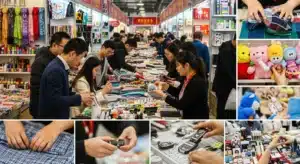
These suppliers act as massive retailers. You order 50 toys and 30 necklaces, and they run around the region collecting from different workshops. They pack everything into a single LCL shipment—a shared container for smaller loads—to give you fast turnaround, but you get zero control over the actual production line.
Resellers handle off-the-shelf orders well, but they put a wall between you and the production floor. Ask for a custom material or logo, and they relay it back to the shop. That back-and-forth kills lead times and invites miscommunication.
Identifying a Real Manufacturer
Real manufacturing plants operate in dedicated industrial zones like Shenzhen or Ningbo, focusing on a single discipline. A plastic injection molder does not sew garments. You spot them by their gritty technical knowledge—they will talk your ear off about machine tonnage, cycle times, and which material grade maximizes durability.
Sales reps answer technical questions on the spot because they walk the production floor daily. Their catalogs look narrow, showing dozens of variations of the same core item. Custom specs are standard daily work for them, which is how you actually maintain strict quality control.
Buying straight from a specialized industrial zone beats a Yiwu trading desk for custom work. The starting order size and initial lead times might sting. But that direct line to the engineers makes the entire operation far more cost-effective over a three-year contract.
Location Check: Is the Alibaba Company in Jinhua/Yiwu?
Alibaba Group is headquartered in Hangzhou, not Jinhua or Yiwu. Its corporate offices are at 699 Wang Shang Road, Binjiang District and 969 West Wen Yi Road, Yuhang District. When you see a supplier listing from Yiwu on Alibaba.com, you are connecting with an independent local company, not Alibaba itself.
| Alibaba Group Headquarters | Address | Key Function |
|---|---|---|
| Primary Corporate Campus | 699 Wang Shang Road, Binjiang District, Hangzhou 310052 | Coordinates global e-commerce, cloud, and media operations. |
| Secondary Corporate Campus | 969 West Wen Yi Road, Yuhang District, Hangzhou 311121 | Serves as a major hub for the multinational technology conglomerate. |

Alibaba’s Actual Headquarters: The Hangzhou Hub
Alibaba Group’s main headquarters is in Hangzhou, Zhejiang Province. The company operates from two major corporate campuses in the city, not from Yiwu or Jinhua.
The primary corporate address is 699 Wang Shang Road, Binjiang District, Hangzhou 310052. A second major corporate campus is at 969 West Wen Yi Road, Yuhang District, Hangzhou 311121. From these locations, Alibaba coordinates its global e-commerce, cloud computing, and digital media operations.
Alibaba runs the website from Hangzhou. They are a tech company, not a physical trading firm sitting in Yiwu. Knowing this stops you from confusing the digital platform with your actual supplier.
Why Yiwu and Jinhua Appear on Supplier Listings
Yiwu is a massive physical marketplace packed with thousands of independent factories and trading offices. Buyers go there to find cost-effective goods, and these local businesses just use Alibaba as a digital storefront to reach you. The platform does not own them.
A Yiwu address on a supplier profile simply shows where their actual office sits. Companies like “Yinsu Sports Goods” operate independently in that region. That location tag has zero connection to Alibaba’s corporate headquarters.
You need this separation clear before you send any inquiries. It tells you exactly who you are paying: a real factory, a trading company, or a middleman. You are never buying directly from Alibaba Group.
Your Direct Line to Yiwu. Zero Headaches.
Product Photos: Stock Images vs. Showroom Photos
Stock images are generic photos used by many sellers, often signaling a reseller. Showroom or custom photos are taken in a controlled environment, typically by a factory or a professional service, and are essential for meeting platform rules and building customer trust. The difference can affect your listing’s approval, return rates, and sales performance.

Why Stock Images Are a Red Flag
Stock photos are recycled images shared by dozens of sellers, and they score a miserable 19% trust rating with buyers. Amazon flatly rejects them as main listing photos if they lack a pure white background or fail to fill 85% of the frame. Relying on these generic shots instantly signals poor quality control to your end customers.
Generic photos cause a 22% return rate because the shipped item never matches the picture. That kills your seller metrics. If a supplier cannot shoot their own factory photos, they are a middleman with zero control over the actual durability of the products they sell.
How Showroom Photos Validate a Real Factory
We shoot custom photos in a controlled studio using focus stacking to show exact textures and assembly quality. You get 360-degree views to verify the true size and build before placing an order. This removes the guesswork from your purchasing decisions.
Real product images drive 35-40% higher ad conversions compared to generic stock photos. Suppliers offering 1600×1600 pixel high-resolution shots usually have direct access to the production line. You can zoom in on these images to inspect material durability before committing to a large order.
Why “Trading Companies” add Value (Sometimes)
Trading companies add value by managing the complex, non-manufacturing inputs that make up roughly half of a product’s gross trade value. They handle logistics, quality control, and supplier coordination, which allows factories to focus on core production. This specialization is quantified in trade data, where a significant portion of trade deficits reflects these intermediate services, not just finished goods.

The Value-Added Gap in Global Trade
Value added measures the actual money a factory creates by turning raw materials into a finished product. It strips out the cost of parts bought from outside suppliers. This metric shows what the manufacturer truly built, rather than just assembled.
OECD data shows over half of the US manufacturing trade deficit from 2015 to 2019 came from embedded services. Logistics, design, and packaging make up this hidden 51.75% margin drain. Trading companies specialize in managing these exact service costs.
The real manufacturing gap is much smaller than the gross trade deficit implies. Expanding domestic factory output by just 21.5% would theoretically erase the imbalance. Traders handle the remaining gap by efficiently sourcing these intermediate services across borders.
Practical Value for Buyers and Factories
Trading firms combine orders from smaller buyers to meet factory minimum order quantities. This bulk buying approach keeps unit prices down for individual buyers. It makes small production runs cost-effective for manufacturers who would normally reject them.
On-site AQL Level II inspections catch defects before goods leave the dock. They also handle customs paperwork, stopping the border fines that kill your margins. This hands-on quality control is the only way to avoid paying for someone else’s shipping mistakes.
Letting middlemen handle supplier coordination keeps your factory floor running. US manufacturing output jumped from $2.860T to $2.951T in a single quarter using this exact split. It is the most cost-effective way to scale, letting you spend capital on machines instead of supply chain headaches.
How to Bypass the Middleman
Bypassing the middleman involves identifying and contacting factories directly, which requires specific verification steps and communication strategies. This approach aims to secure better pricing and control over production, but demands more due diligence from the buyer.

Identifying and Verifying Direct Factories
Skip the general retail marketplaces when looking for real factories. Specialized industrial directories actually list production floors instead of resellers. You need that direct access to guarantee the durability of the final product.
Pull their business license and verify the exact physical address. I always view factories located far outside trading hubs like Yiwu as a positive sign. Trading companies rent offices in city centers, not industrial parks on the outskirts.
Ask for factory audit reports and real production capacity numbers. True manufacturers hand over proprietary product catalogs without hesitation. If they stutter or delay, you are talking to a trading house.
Demand proof of in-house tooling. If they own the product molds and have an actual R&D department on the payroll, you found a real factory. Traders just show you pictures of someone else’s machines.
The Direct Sourcing Process and Pitfalls
Send detailed spec sheets with your initial inquiry. A factory cannot price a part accurately from a smartphone photo. Showing up without dimensions or material grades just wastes everyone’s time.
Real manufacturing plants need volume to keep production lines cost-effective. Expect minimum runs of 1,000 units or more. Trading companies will gladly take smaller orders, but you will pay for that flexibility.
Cutting out the middleman means you own the quality checks outright. You must hire your own inspectors before the goods leave the dock. Nobody else is going to catch a bad batch of materials for you.
Plant managers usually do not speak fluent English. You will need to rely on exact CAD drawings and material codes to avoid expensive misunderstandings. Skip the vague emails and stick to hard data.
Reflexiones finales
Most Alibaba listings for small goods are just digital storefronts for Yiwu wholesale booths. This setup gets you fast shipping and low order counts, but kills your pricing transparency. Recognizing this middleman loop keeps you from overpaying for generic stock.
Buy from Yiwu resellers if you just need a few hundred stock items fast. For custom tooling or strict durability standards, track down the actual factory floor. The extra effort pays off when your product stops failing in the field.
Preguntas frecuentes
Are Alibaba sellers real factories?
No, not all sellers claiming to be factories are actual manufacturers. Many are trading companies. A critical loophole allows traders to post factory pictures and claim to be manufacturers if they have a long-term cooperation agreement, meaning Alibaba’s ‘Verified Supplier’ badge only confirms the pictured location is real, not that it belongs to the seller. To verify, check the supplier’s verification video for ‘Supplier’s Associate Company’ labeling, which indicates a trader, and request documents like a Chinese business license for cross-checking on the National Enterprise Credit Information Publicity System (NECIPS).
How do I find a real manufacturer on Alibaba?
Use Alibaba’s supplier directory, not the product search. Filter for suppliers with the ‘Verified Supplier PRO’ badge, which requires a minimum of five years in the industry, and ‘Trade Assurance’. Then, conduct due diligence by requesting their business license, tax registration, and export license. Cross-check the Chinese company name and address on China’s official NECIPS database to confirm the details match their Alibaba profile and that they are a registered manufacturing entity, not a trader.
What is the difference between a trading company and a factory?
A trading company acts as a middleman, sourcing products from various factories without owning production facilities. This typically adds a 15-25% price markup and can lead to inconsistent quality and communication delays. A factory owns its production equipment, like CNC machines and assembly lines, allowing for direct cost control (offering 10-30% savings), consistent quality, and better customization support. But factories usually require higher minimum order quantities, often starting at 1,000 pieces or more.
Why is sourcing from Yiwu often cheaper than using Alibaba?
Yiwu offers lower prices primarily because you buy directly from wholesalers and manufacturers concentrated in one market, eliminating middleman markups common on Alibaba. This direct access allows for negotiation and lower per-unit costs. Also, having all suppliers in one location enables order consolidation, which significantly reduces shipping expenses compared to coordinating separate shipments from dispersed Alibaba suppliers. For small to medium orders, this model provides greater cost efficiency and flexibility with lower minimum order quantities.
How can I avoid middlemen when sourcing from China?
To ensure you are dealing directly with a factory, verify their credentials thoroughly. Request and validate their business license, export license, and relevant certifications like ISO 9001. Conduct on-site inspections or hire a third-party service to audit the production facility. Implement formal quality control checks during production, using Acceptable Quality Limit (AQL) standards—such as 0% for critical defects, 2.5% for major defects, and 4.0% for minor defects—to confirm manufacturing capability and product quality before shipment.
Sourcing from 1688 is a cost-effective strategy, but those default factory photos will destroy your perceived quality. Buyers see a blurry catalog image and immediately assume the product lacks durability. Hire a local studio to reshoot the actual inventory before you put it on your site.