 Justin
Sourcing baby products from Yiwu offers competitive prices, but the real cost of a mistake is a recall, a lawsuit, or worse. Between 2010 and 2022, infant support cushions alone were linked to 79 infant deaths. For B2B buyers, navigating the complex safety landscape is not just about compliance—it’s about protecting your brand and the families you serve.
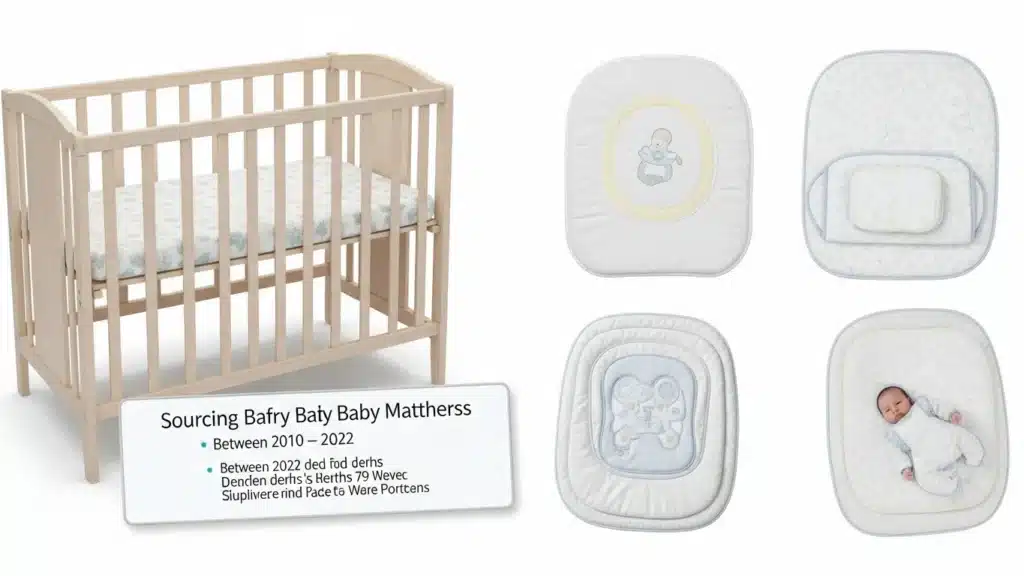
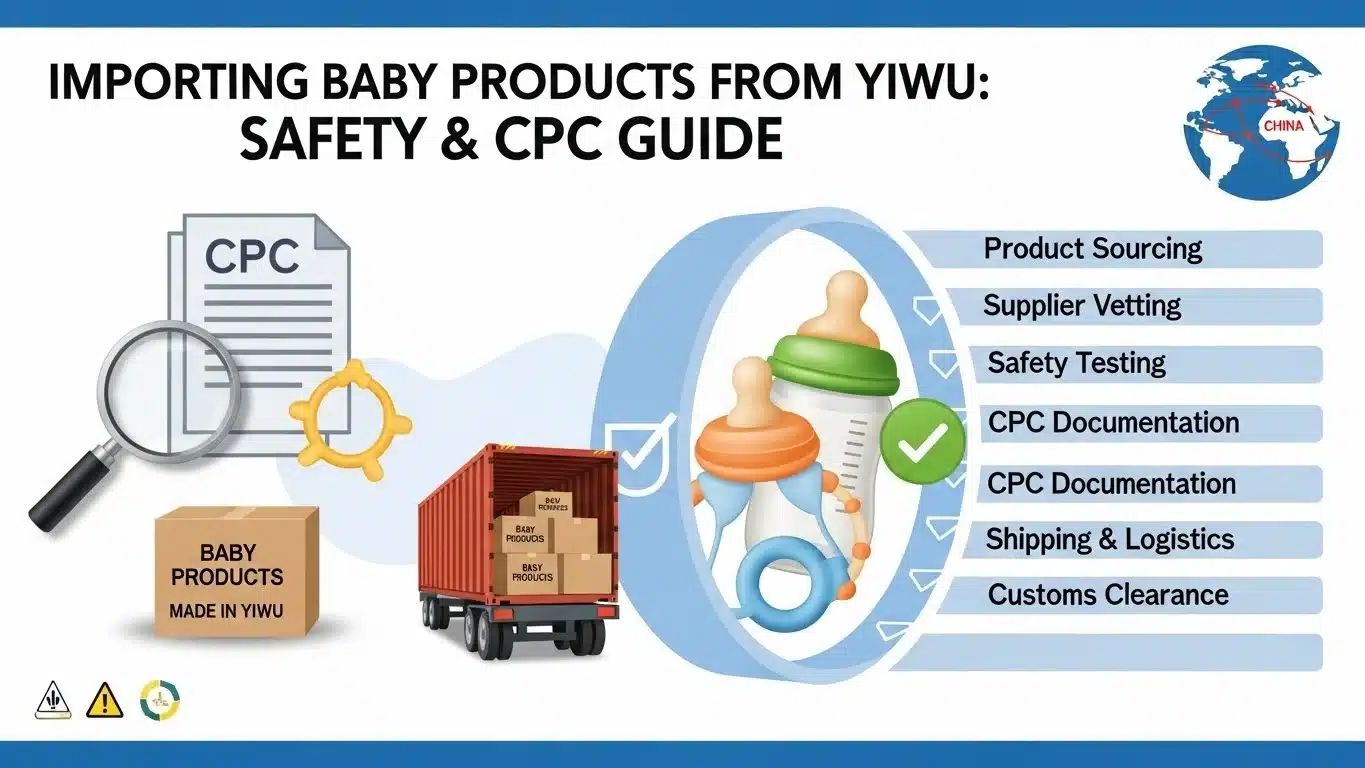
This guide breaks down the critical safety and compliance steps for importing baby products. We’ll cover the mandatory physical and chemical testing for items like strollers and bibs, explain the non-negotiable requirement for a Children’s Product Certificate (CPC), and provide a realistic look at lab testing costs, which typically range from $300 to $4,000 per SKU. You’ll learn how to verify suppliers and ensure your products meet the latest CPSC standards, like the new federal rule for infant support cushions effective in April 2025.
Industry Manufacturers List
Quick Comparison: Top Picks
| Manufacturer | Location | Core Strength | Verdict |
|---|---|---|---|
| Children’s Product Certificate (CPC) – United States | United States | Mandatory written compliance certificate for children’s products; cites specific CPSC regulations (e.g., CPSIA chemical limits, 16 CFR parts for toys, sleepwear, durable infant/toddler products); must reference accredited lab test reports and identify manufacturer/importer and production details. | Essential legal certification for selling children’s products in the U.S., based on third-party lab testing to ensure safety compliance. |
| CE Marking and EU Declaration of Conformity – Europe | European Union | Conformity marking and supporting Declaration of Conformity for regulated products; demonstrates compliance with essential safety requirements (e.g., mechanical, chemical, flammability, and labeling) under applicable EU directives/regulations. | Mandatory conformity mark and documentation for placing regulated products on the EU/EEA market, signifying adherence to EU safety standards. |
Children’s Product Certificate (CPC) – United States
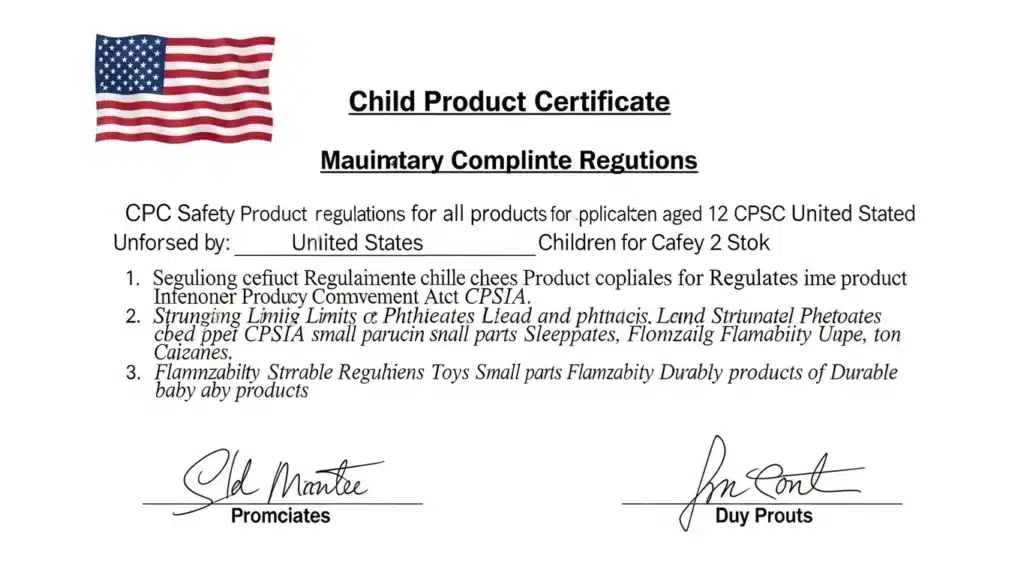
A Children’s Product Certificate (CPC) is a required compliance document for any product intended for children aged 12 and under in the United States. It formally certifies that the product meets all applicable safety rules enforced by the U.S. Consumer Product Safety Commission (CPSC). This includes strict limits on lead and phthalates under the CPSIA, as well as regulations concerning small parts, flammability, and other hazards specific to categories like toys, sleepwear, and durable infant products.
The certificate must be generated by the product’s manufacturer or importer and is based on passing test results from a CPSC-accredited third-party laboratory. Each applicable regulation, such as specific 16 CFR parts, must be listed on the CPC. A valid certificate must accompany every product shipment or be made readily available to distributors, retailers, customs officials, and the CPSC upon request.
At a Glance:
- 📍 Location: United States
- 🏭 Core Strength: Mandatory written compliance certificate for children’s products; cites specific CPSC regulations (e.g., CPSIA chemical limits, 16 CFR parts for toys, sleepwear, durable infant/toddler products); must reference accredited lab test reports and identify manufacturer/importer and production details.
- 🌍 Key Markets: Legal conformity documentation for placing children’s products, including baby clothing, bibs, pacifiers, toys, and durable infant/toddler products, on the U.S. market; used for customs clearance, retailer compliance checks, and CPSC enforcement.
Why We Picked Them:
| ✅ The Wins | ⚠️ Trade-offs |
|---|---|
|
|
CE Marking and EU Declaration of Conformity – Europe
The CE marking is a conformity symbol that indicates a product complies with applicable EU harmonization legislation, such as the General Product Safety Regulation (GPSR) or the Toy Safety Directive. It is not a quality mark but a manufacturer’s declaration that the product meets essential safety requirements covering areas like mechanical safety, chemical content, flammability, and proper labeling.
To affix the CE mark, the manufacturer must complete a conformity assessment, compile a detailed technical file documenting the product’s design and compliance, and issue an official EU Declaration of Conformity. This declaration legally identifies all relevant directives and standards the product meets and is a formal assumption of responsibility by the manufacturer.
At a Glance:
- 📍 Location: European Union
- 🏭 Core Strength: Conformity marking and supporting Declaration of Conformity for regulated products; demonstrates compliance with essential safety requirements (e.g., mechanical, chemical, flammability, and labeling) under applicable EU directives/regulations.
- 🌍 Key Markets: Legal prerequisite for placing many regulated products on the EU/EEA market, including certain baby products like toys, childcare articles, and connected devices; used by market surveillance authorities and customs to verify safety compliance.
Why We Picked Them:
| ✅ The Wins | ⚠️ Trade-offs |
|---|---|
|
|
Why Baby Products are a “High Alert” Category
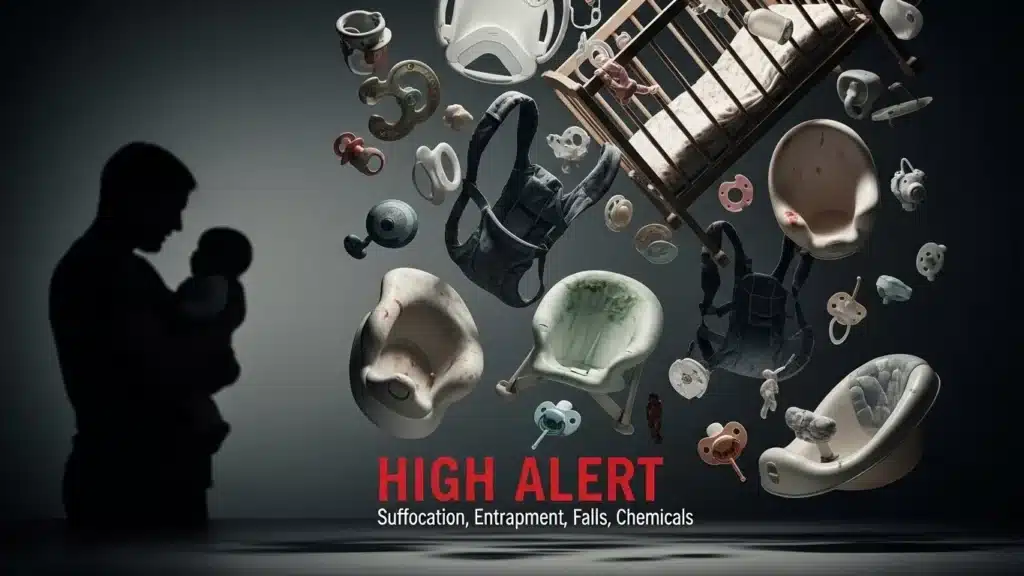
Baby products are a “High Alert” category due to frequent suffocation, entrapment, fall, and chemical risks, leading to numerous infant deaths and injuries, with ongoing CPSC regulations addressing these hazards.
The Core Risks: Suffocation, Falls, and Chemical Hazards
Between 2010 and 2022, infant support cushions like loungers and sleep positioners were linked to 79 infant deaths and 124 injuries, primarily in babies under 3 months old. Common incidents involve suffocation, entrapment, and falls, often occurring on adult beds or in cribs.
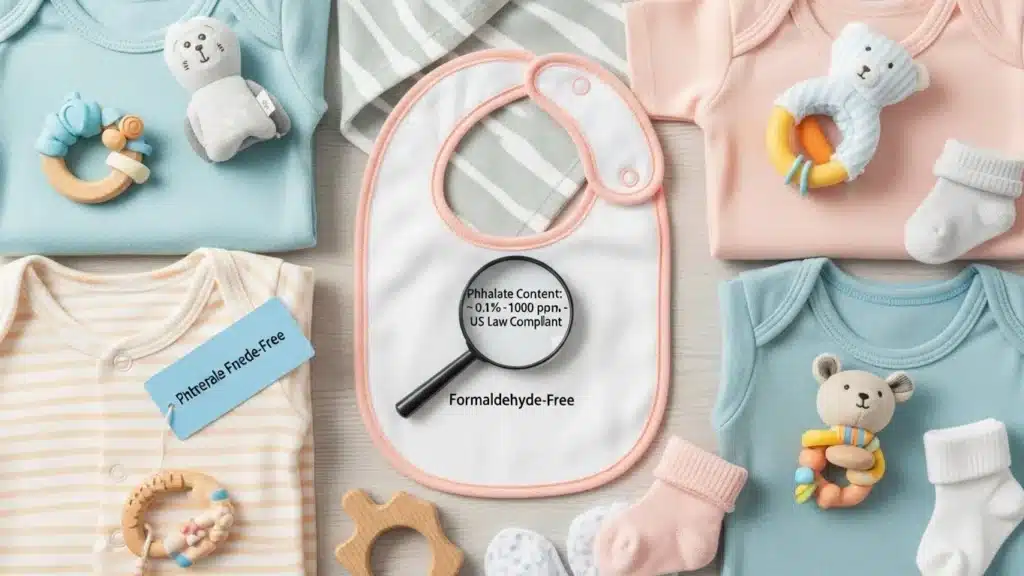
Chemical risks from substances like lead, phthalates, and formaldehyde in textiles and plastics pose long-term health threats to developing infants. For example, U.S. law prohibits phthalate concentrations above 0.1% (1,000 ppm) in accessible parts of child care articles like bibs.
Regulatory Landscape and Recent Safety Standards
In October 2024, the CPSC approved a new federal standard for infant support cushions, effective around April 2025. It mandates firmness testing, sidewall angles over 90 degrees, a maximum 10-degree incline, and prohibits restraints.
In January 2025, the CPSC updated its standard for non-full-size baby cribs (16 CFR 1220), incorporating the ASTM F406-24 standard with modifications, effective April 5, 2025. Recalls in 2025 for infant sleep products and highchairs, alongside new rules for neck floats, demonstrate ongoing regulatory action to address persistent hazards.
Essential Compliance and Verification for Sourcing
Mandatory CPSIA testing covers harmful chemicals (lead, phthalates), design flaws (e.g., crib slat spacing), and choking hazards from small parts. For U.S. imports, a Children’s Product Certificate (CPC) based on third-party lab testing is required.
Voluntary certifications like OEKO-TEX Standard 100 test textiles for over 100 harmful substances, providing an additional safety layer for items in direct skin contact.
For reliable sourcing, verify products through CPSC-accredited lab testing, check for ASTM compliance, and inspect for quality components like YKK zippers as indicators of durable, safer construction. Lab testing costs for baby products typically range from $300 to $4,000 per SKU, depending on complexity and the number of components.
Sourcing Bibs & Textiles: Formaldehyde & Phthalates
Formaldehyde and phthalates are used in baby textiles for properties like wrinkle resistance and softness, but they pose significant health risks including skin irritation, allergies, and hormonal disruption. U.S. law strictly limits phthalates in child care articles like bibs to 0.1% (1,000 ppm), and safety certifications such as OEKO-TEX® Standard 100 are critical for verifying low or no presence of these harmful chemicals.
Understanding the Chemical Risks in Baby Textiles
Formaldehyde and phthalates are common in textiles to provide wrinkle resistance, softness, and plasticity. Exposure to these chemicals can cause skin irritation, allergies, hormonal disruption, and developmental issues in infants.
In the United States, the Consumer Product Safety Improvement Act (CPSIA) prohibits phthalate concentrations above 0.1% (1,000 ppm) in accessible parts of child care articles, which includes baby bibs. Formaldehyde is regulated as a harmful substance in textiles, with long-term exposure linked to increased risks of asthma and cancer.
Real-World Testing Data and Compliance Benchmarks
Testing on baby bibs reveals variable phthalate levels. For example, one feeding bib tested at 277 ppm total phthalates, while another showed 28.3 ppm DEHP and 11.9 ppm DBP. Overall, only 11% of 35 tested baby accessories had detectable phthalates, mostly below 100 ppm, suggesting bibs are a lower-risk category.
However, high contamination risks exist in the broader supply chain. Other baby products, such as sandals, have been found with phthalate levels as high as 443,000 ppm DiNP, violating safety limits. This data underscores the necessity for proactive testing and verification, even for products not traditionally considered high-risk.
Essential Safety Certifications for Compliant Sourcing
OEKO-TEX® Standard 100 is a key certification that tests for over 1,000 substances, including formaldehyde and phthalates, ensuring textiles are safe for baby skin contact. For silicone bibs, LFGB certification verifies the material is free from formaldehyde, BPA, and phthalates through platinum curing processes.
CPSIA/CPSC compliance is mandatory for the U.S. market, requiring a Children’s Product Certificate (CPC) that proves phthalates are under the 1,000 ppm limit. In the European Union, the EU Ecolabel restricts formaldehyde and phthalates in textiles, often mandating the use of organic cotton and avoiding fragrances in baby products.
Stop Overpaying. Start Sourcing Smarter in Yiwu.

Strollers & Gear: Physical Stability Testing
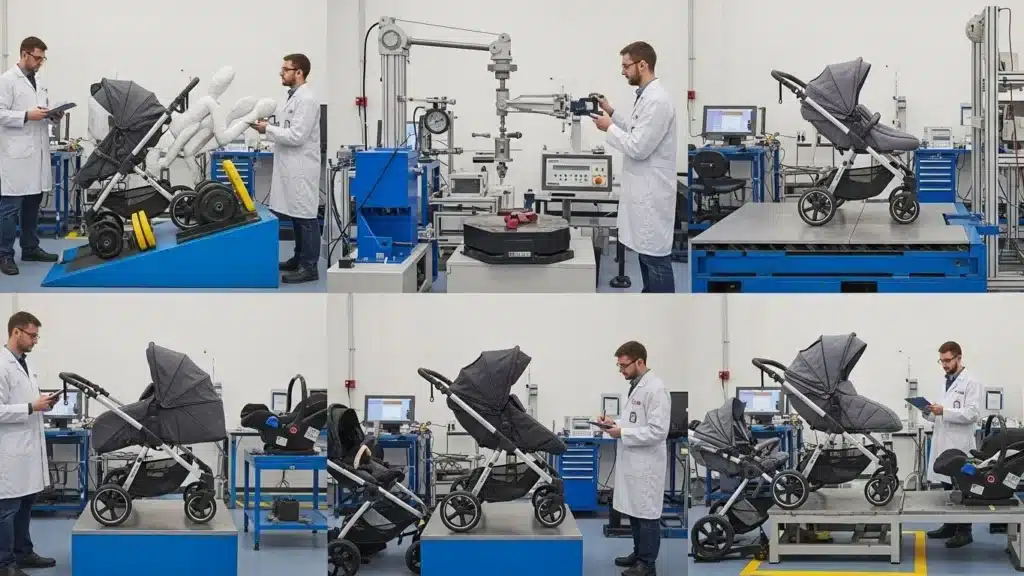
Strollers and related gear must pass rigorous physical stability tests to prevent tip-overs and collapses. These mandatory tests simulate real-world conditions, such as pushing on uneven ground or a child leaning on the product, to ensure safety under load. Compliance with standards like EN 1888, ASTM F833, and ISO 31110 is legally required for market access and is critical for consumer trust.
The Purpose and Mandate of Stability Testing
Physical stability testing is a mandatory safety requirement for strollers and related gear to prevent tip-overs and collapses during use.
These tests simulate real-world conditions, such as pushing a stroller on uneven ground or a child leaning on a product, to ensure it remains safe under load.
Compliance with standards like EN 1888 (Europe), ASTM F833 (USA), and ISO 31110 (International) is legally required for market access and is critical for building consumer trust.
Key Test Methods and Requirements by Standard
EN 1888 requires strollers to remain stable on uneven surfaces and during sudden direction changes, with tests simulating child weights of 9 to 15 kilograms.
ASTM F833 mandates static load tests, such as applying a 22.7-kilogram (50-pound) center load to a carriage, to verify it does not tip over or collapse.
The ISO 31110 standard provides a framework for performance testing focused on tipping resistance and overall structural integrity under use conditions.
Recent updates to these standards, like the 2022 amendment to EN 1888, have increased testing rigor to better reflect real-world usage and failure modes.
Integrating Testing into the Sourcing Process
For importers, verifying that a factory’s product has passed stability testing at a certified lab (like Intertek or JJR) is a non-negotiable step before production.
A sourcing partner can manage this verification by requesting test reports during the sample approval phase and ensuring the final bulk order matches the certified sample.
This due diligence protects against liability and costly recalls, as non-compliant products can be identified and rejected before they leave the factory or the consolidation warehouse.
Lab Testing Costs per SKU
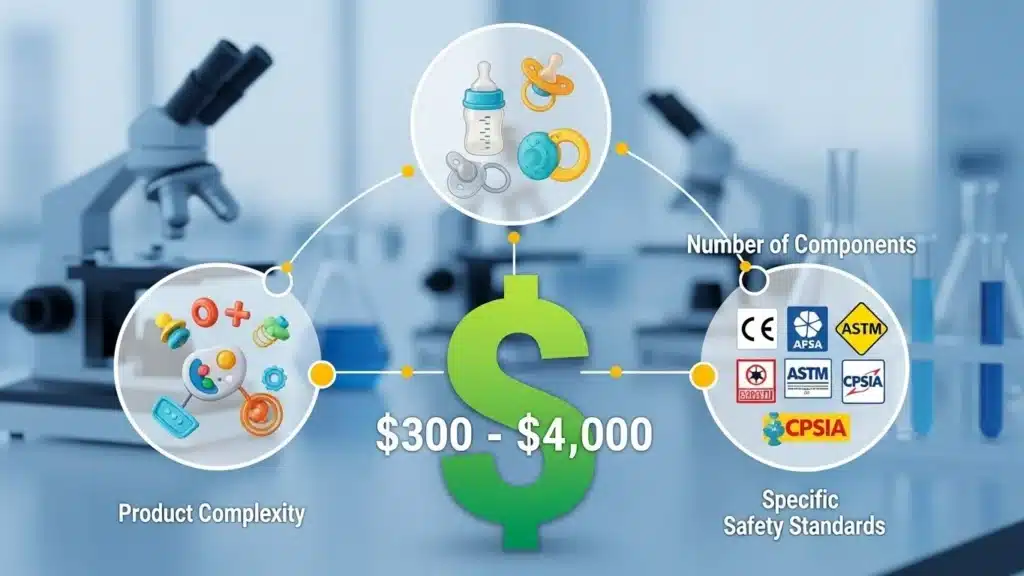
Lab testing for baby products is a variable expense, typically ranging from $300 to $4,000 per unique SKU. The final cost is determined by the product’s complexity, the number of individual components requiring separate analysis, and the specific safety standards it must meet.
What Drives the Cost of Testing a Baby Product?
Costs are not a flat fee but are calculated based on the product’s complexity and regulatory requirements.
Each physical component, like a zipper, button, or fabric color, requires its own separate test for hazards like lead, which can cost around $75 per element.
A full compliance suite for the US market (CPSIA) typically includes tests for lead, phthalates, and relevant ASTM safety standards (e.g., F963 for toys).
This component-based approach means a simple onesie costs less to test than a multi-part item like a stroller or crib.
Typical Cost Ranges and Key Considerations
For most baby products, third-party lab testing costs range from $300 to $4,000 per SKU.
Simpler items like basic bibs or plush toys often fall in the $500 to $1,800 range.
More complex gear such as cribs or strollers can cost between $1,000 and $3,000, or even up to $4,000 for highly engineered items.
A single SKU covers one specific product variation; different colors, sizes, or patterns each count as a separate SKU and require full, repeated testing.
Testing is not a one-time expense. CPSIA compliance requires periodic re-testing, typically annually or whenever materials change.
How a Sourcing Partner Manages Testing and Compliance
A professional partner helps navigate the testing process by identifying CPSC-accepted labs and obtaining accurate quotes based on your product’s bill of materials.
They ensure that all components, even those from reputable suppliers like YKK zippers, are included in the testing scope to avoid compliance gaps.
Consolidating multiple tests or products with a lab can sometimes reduce per-SKU costs through bundled pricing.
The partner’s quality control inspection verifies that the mass-produced goods match the certified sample, a critical step for maintaining compliance.
Frequently Asked Questions
Do I need a certificate for baby clothes?
There is no universal legal requirement for a specific ‘certificate’ on all baby clothes. However, in the U.S., manufacturers and importers of children’s products, including baby clothes sized 12 or smaller, must issue a Children’s Product Certificate (CPC) based on third-party testing. This certifies compliance with CPSC safety rules like flammability standards (16 CFR parts 1615/1616) and limits on lead and phthalates. Voluntary certifications such as OEKO-TEX Standard 100, GOTS, and BSCI are highly recommended for safety and quality but are not legally mandated.
What is CPC certification?
CPC certification refers to a Children’s Product Certificate. It is a written document where the U.S. manufacturer or importer certifies that a product intended for children 12 and under complies with all applicable U.S. children’s product safety rules under CPSIA and other CPSC-enforced laws. For baby products like bibs or onesies, this certificate is based on passing test results from a CPSC-accepted third-party laboratory, showing the product meets requirements for lead, phthalates, small parts, and flammability. The CPC must accompany each shipment and be available to retailers, distributors, and Customs upon request.
Are Yiwu baby products safe?
Yiwu baby products are not inherently safe; safety varies significantly by product and manufacturer. There are documented risks and regulatory violations for some items imported from the region. Key concerns include chemical hazards like lead and phthalates, physical dangers such as choking hazards, and poor labeling. Compliance with standards like U.S. CPSIA or EU EN71 is inconsistent. Buyers must verify supplier certifications (like CPC), request test reports from accredited labs, and check recall databases before purchasing to mitigate these risks.
How much is a lab test?
A lab test for baby products typically costs between $400 and $800 per product SKU per test group at a CPSC-accredited third-party lab. Simple single-analyte tests can start around $150–$300, while comprehensive children’s product safety panels that bundle tests for lead, phthalates, flammability, and mechanical hazards often range from $600 to $1,200 or more.
Where to buy baby strollers in Yiwu?
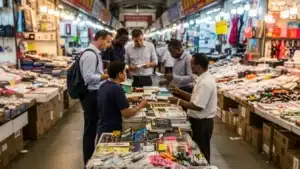
The primary place to buy baby strollers in Yiwu is the Yiwu International Trade Market (Yiwu Market), the world’s largest small commodities market. It has dedicated sections for baby products, including strollers, with over 75,000 booths. The market is ideal for wholesale, offering low minimum order quantities, immediate stock, and customization options. Additionally, the Yiwu International Baby Stroller Expo connects buyers with local suppliers. While offline wholesale dominates, some online platforms like Taobao also feature Yiwu-registered sellers.
Final Thoughts
Sourcing baby products from Yiwu offers significant opportunities in terms of variety and cost, but it comes with a high-stakes responsibility for safety. The risks—from chemical hazards in textiles to physical failures in gear—are real and backed by strict, evolving regulations. Success hinges on moving beyond basic supplier assurances to proactive, evidence-based verification.
The key takeaway is that compliance is not a single checkbox but an ongoing process. It starts with understanding the specific standards for your product category, mandates third-party lab testing for every SKU, and requires a Children’s Product Certificate for U.S. imports. Partnering with a sourcing agent who can manage this verification, from sample testing to final inspection, transforms regulatory complexity from a barrier into your most reliable safeguard for brand reputation and consumer trust.