 Justin
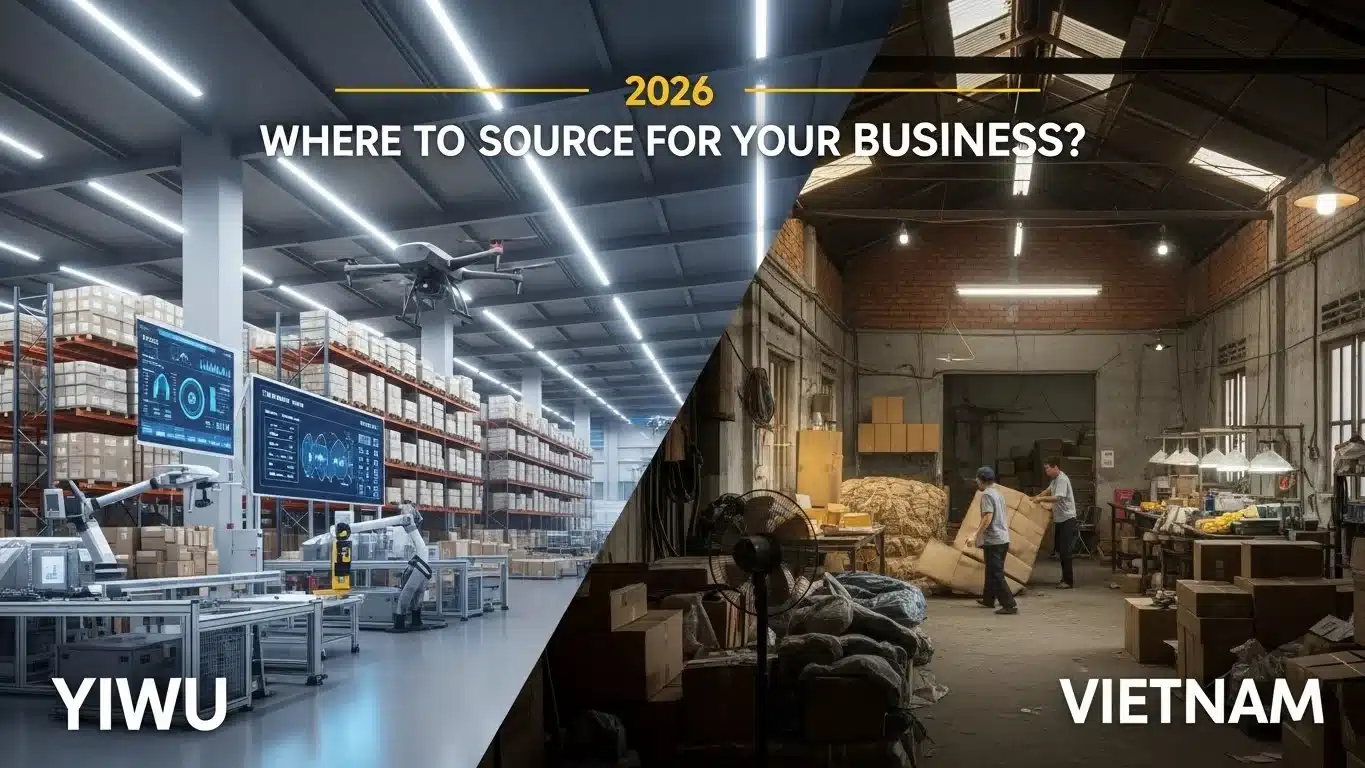
Choosing between Yiwu and Vietnam for sourcing is no longer a simple cost decision; it’s a strategic choice between speed and scale. For B2B buyers, the dilemma is real: do you prioritize the instant availability and low MOQs of Yiwu’s wholesale market, or the long-term cost and tariff advantages of Vietnam’s manufacturing base?
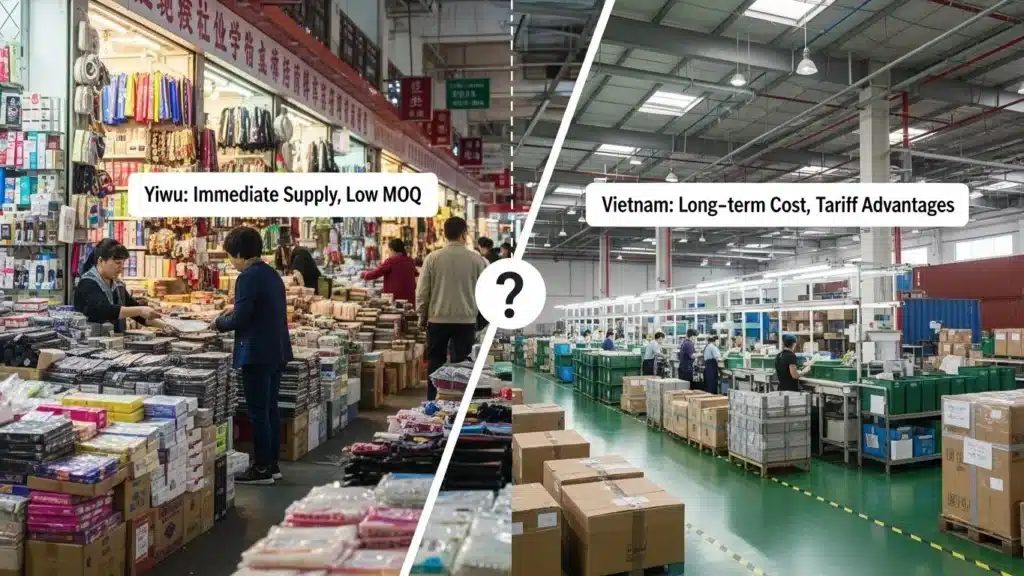
This article breaks down the 2026 landscape, comparing the two across critical factors like labor costs, where Vietnam’s $3 hourly rate offers a clear advantage over China’s $6.50, and production speed, where Yiwu’s 2 million ready-to-ship SKUs can bypass weeks of lead time. We’ll analyze the ‘China Plus One’ strategy, raw material dependencies, MOQ requirements, and the significant 125-point US tariff differential to help you determine the right sourcing node for your business goals.
The “China Plus One” Strategy Explained
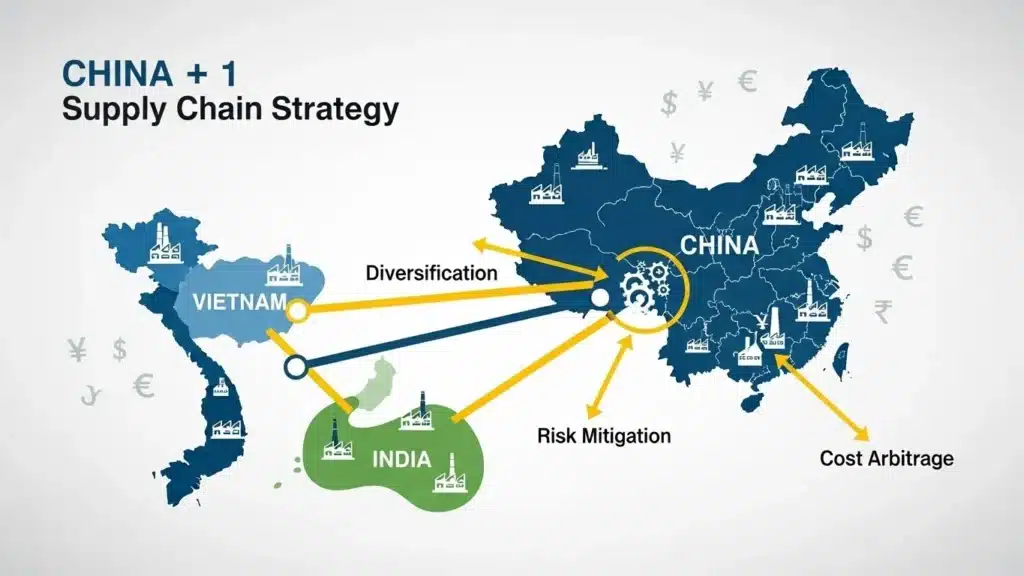
China Plus One is a supply chain strategy where companies maintain core production in China while establishing at least one additional manufacturing base in another country, like Vietnam or India. This creates a dual-base architecture to diversify risk from tariffs, political issues, or supply disruptions, and to arbitrage costs, without abandoning China’s deep manufacturing ecosystem.
What is China Plus One? A Network Design for Resilience
China Plus One is a dual-base manufacturing architecture. Companies maintain capacity in China while adding at least one other production country, such as Vietnam, India, Thailand, or Mexico.
The primary goal is risk diversification to avoid a single-point-of-failure from tariffs, political uncertainty, currency fluctuations, or supply chain disruptions. It’s not about replacing China, which holds 31.7% of global manufacturing output, but about building optionality and resilience alongside it.
The strategy is evolving from ‘China +1’ towards ‘China + Many’, with production distributed across multiple backup nodes for greater flexibility.
How It Works in Practice: Splitting Production Between Nodes
In practice, companies split product lines or SKUs. High-volume, labor-intensive goods like garments and basic electronics move to lower-cost nodes like Vietnam, while automated, complex, or ecosystem-dependent production stays in China.
Samsung’s investment of over $17 billion in Vietnam is a flagship example, making it the company’s main smartphone hub outside China and driving nearly 20% of Vietnam’s total exports. Similarly, HanesBrands operates a heavily automated plant in Nanjing, China, for higher-tech production, while running minimally automated garment plants in Vietnam and Thailand.
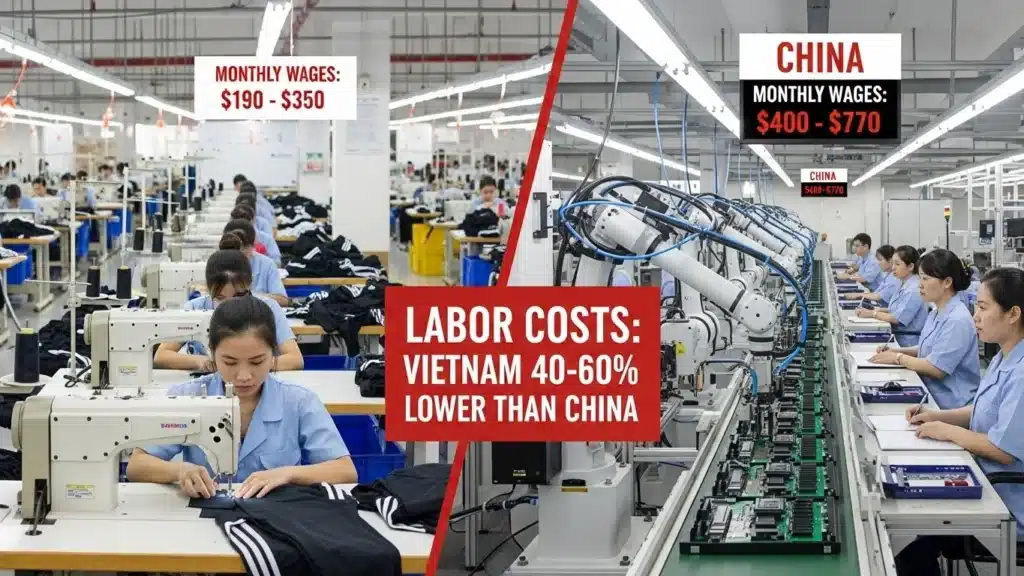
This approach allows firms to arbitrage wage differentials—Vietnam’s labor cost is around $190 per month versus China’s $400—and benefit from trade agreements. It enables them to gradually build supplier depth in the new location without losing access to China’s established ecosystem.
Labor Cost: Vietnam ($190/mo) vs. China ($400/mo)
Manufacturing labor in Vietnam is significantly cheaper than in China, with costs often 40-60% lower. While headline monthly rates can be as low as $190-$350 in Vietnam versus $400-$770+ in China, total cost analysis must consider productivity, skill levels, and the type of manufacturing work.
| Cost Metric | Vietnam | China |
|---|---|---|
| Headline Monthly Rate (Unskilled/Minimum) | ~$190 – $350 | ~$400 – $770+ |
| Hourly Rate (BCG, 2020) | $3.00 | $6.50 |
| Monthly Equivalent (at ~172 hrs) | ~$516 | ~$1,118 |
| Cost Advantage for Vietnam | 30-70% lower than China | |
Understanding the Labor Cost Figures
The $190/month for Vietnam and $400/month for China are typically cited as base minimum wages for unskilled labor in manufacturing hubs, not fully-loaded costs. These figures represent a starting point, often for entry-level positions in labor-intensive sectors.
Verified industry data from sources like the Boston Consulting Group shows a broader range: $3/hour (~$516/month) in Vietnam versus $6.5/hour (~$1,118/month) in China. These hourly rates provide a more accurate comparison of fully-loaded labor costs, which include benefits and other statutory contributions.
Recent statistics from 2023-2024 indicate average monthly manufacturing wages of $250-$350 in Vietnam and over $770 in China, reflecting a consistent 50-70% cost advantage for Vietnam. This gap persists even as wages in both countries rise, with Vietnam implementing a 6% minimum wage increase in 2023.
China’s wages have doubled over the past decade, pushing its focus toward automated and high-tech manufacturing, while Vietnam’s costs remain competitive for labor-intensive work. This shift means China’s labor premium is increasingly tied to higher-value, complex production.
Beyond the Hourly Rate: Productivity and Total Cost
Lower labor costs in Vietnam can be partially offset by lower productivity and higher error or rework rates compared to more experienced Chinese workers. For some projects, the time and material lost to corrections can reduce or eliminate the initial cost savings.
For complex products requiring skilled labor or tight tolerances, China’s higher-wage but more productive workforce can deliver better value and faster throughput. The expertise found in established Chinese industrial clusters often leads to fewer production delays and higher first-pass yield rates.
The total landed cost calculation must include these efficiency factors, as well as Vietnam’s reliance on imported materials from China, which can add to lead times and complexity. Sourcing components may require additional logistics, potentially offsetting labor savings.
Vietnam’s labor force is younger and growing, supporting cost efficiency, but requires investment in training to match the skill depth found in established Chinese industrial clusters. Building this expertise is a key factor for manufacturers considering a long-term shift to Vietnam.
Raw Materials: Why Vietnam Still Buys from China
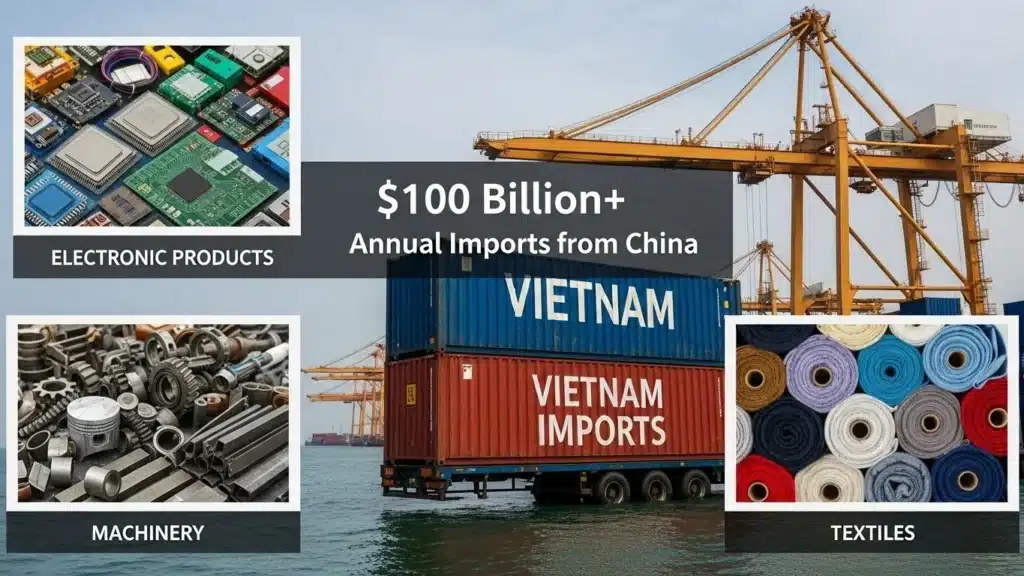
Vietnam imports over $100 billion in raw materials from China annually, primarily electronics, machinery, and textiles. This reliance stems from China’s deep supply chain for critical inputs like chemicals and fibers, which Vietnam cannot produce at scale, creating a significant trade deficit and limiting the benefits of free trade agreements.
| Import Category | Value (First 7 Months 2025) | Key Insight |
|---|---|---|
| Total Imports from China | USD 101.45 billion | 40.2% of Vietnam’s total imports |
| Computers, Electronics & Components | USD 28.55 billion | Up 47.1% year-over-year |
| Machinery, Equipment & Spare Parts | USD 21.32 billion | Represents 64% of Vietnam’s total imports in this category |
| Textile Raw Materials (2023) | Over USD 4.3 billion | For manmade filaments, staple fibers, and cotton |
The Scale and Scope of Dependency
Vietnam’s import dependency on China is massive and growing. In the first seven months of 2025 alone, Vietnam imported USD 101.45 billion worth of goods from China, which accounted for 40.2% of its total imports. This share has increased year-over-year, signaling a deepening reliance rather than a move toward diversification.
The dependency is concentrated in critical industrial inputs. Computers, electronics, and components made up USD 28.55 billion of these imports, while machinery, equipment, and spare parts accounted for another USD 21.32 billion. For the textile and garment sector—a major export engine for Vietnam—essential raw materials like manmade filaments, staple fibers, and cotton are overwhelmingly sourced from China, with imports for fibers alone exceeding $4.3 billion in 2023.
Consequences for Trade and Manufacturing
This structural dependency creates a stark trade imbalance. In the same seven-month period in 2025, Vietnam exported USD 35 billion to China but imported USD 101 billion, resulting in a significant deficit. While this import flow supports Vietnam’s export growth in processed goods, such as electronics, it keeps the high-value-added upstream activities, like component manufacturing, firmly within China.
The reliance also limits Vietnam’s ability to leverage free trade agreements. For example, because textile exporters source yarn and fabric from China, they often cannot meet the Rules of Origin required for duty savings under major FTAs like the EVFTA and CPTPP. This forfeits a key competitive advantage. Furthermore, the high cost of imported inputs erodes the final product’s price competitiveness, negating potential labor cost advantages and questioning the premise of cheaper manufacturing in Vietnam.

Production Speed: Yiwu’s “Ready Stock” Advantage
Yiwu’s advantage comes from its 75,000-booth wholesale complex, holding over 2 million ready-to-ship SKUs. Buyers can inspect, purchase, and dispatch goods immediately, bypassing weeks of production lead times. This contrasts with Vietnam, where sourcing raw materials and factory scheduling create significant delays.
The Infrastructure of Instant Access
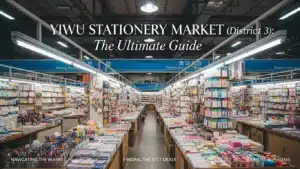
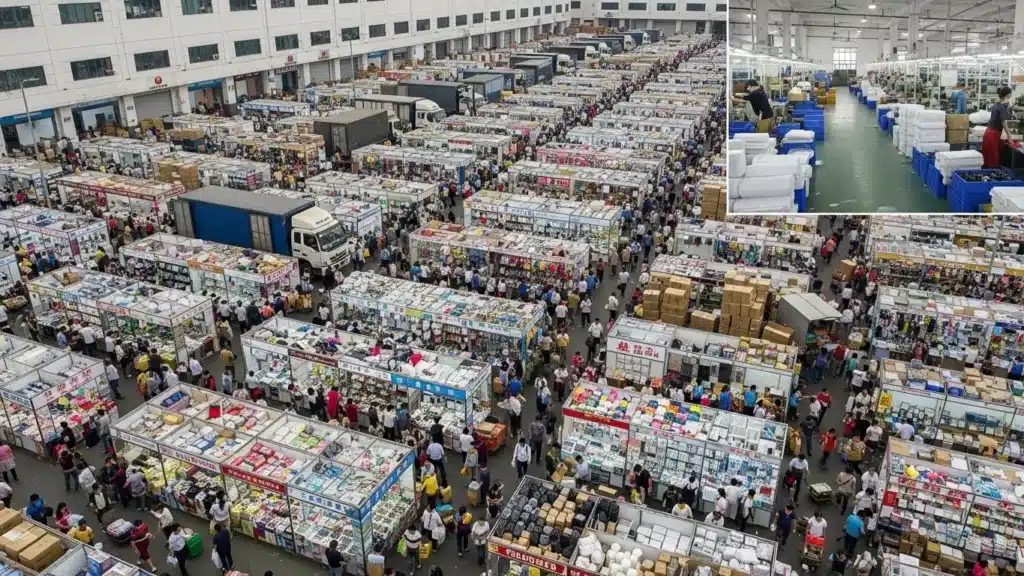
The “Ready Stock” model is built on the physical scale of the Yiwu International Trade City. This complex spans 6.4 million square meters and is divided into five districts, containing 75,000 individual booths.
These booths collectively stock more than 2 million distinct product types, from Christmas decorations to daily household items. This inventory is available for immediate purchase and shipment, eliminating the wait for production.
The market is supported by a dense network of over 2.1 million suppliers and nearby light manufacturing zones for textiles, accessories, and plastics. This allows buyers to visit factories for minor adjustments or new orders within days, not months.
This setup removes the major bottlenecks found in production-centric models like Vietnam’s, where delays come from procuring raw materials and scheduling factory capacity.
Logistics and Scale: Turning Stock into Speed
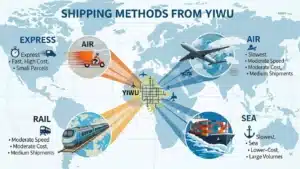
Yiwu’s logistics infrastructure is designed for high-volume, rapid dispatch. The market supports the export of 570,000 standard containers annually, with up to 3,000 containers shipped daily during peak seasons.
A robust rail network, including 25 freight train routes connecting to over 160 cities globally, ensures reliable transportation. The Yiwu-Madrid line alone has operated 6,700 trains carrying 670,000 containers over the past decade.
This system facilitates trade for 210,000 daily visitors and supports commerce with 219 countries, generating over $40 billion in annual foreign trade. The first half of 2025 alone saw trade reach 406 billion RMB, a 25% year-over-year increase.
The sheer scale and efficiency mean Yiwu can supply an estimated 70% of the world’s Christmas goods directly from pre-existing stock. This demonstrates how market depth and integrated logistics directly translate to faster, more reliable supply chains compared to waiting for custom manufacturing.
MOQ Comparison: 100 pcs (Yiwu) vs 10k pcs (Vietnam)
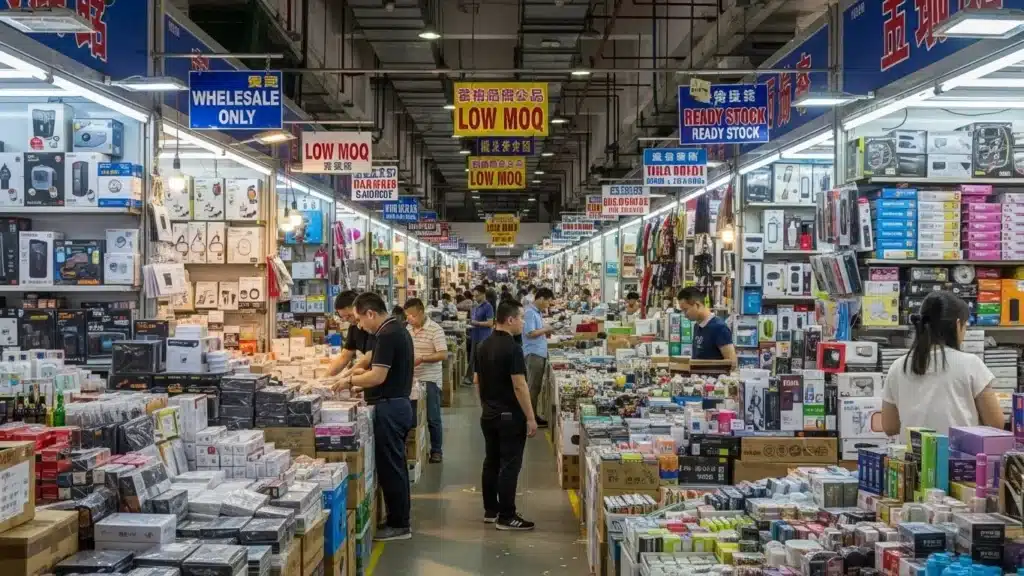
Yiwu suppliers commonly accept orders as low as 10-100 pieces for off-the-shelf goods, catering to micro-importers and e-commerce. In contrast, Vietnamese factories typically require MOQs of 5,000 to 20,000 pieces per style, optimized for large-scale export brands in apparel, footwear, and furniture.
The Yiwu Small-Batch Model: Flexibility for New Brands
Yiwu’s wholesale market is built on a fragmented network of traders and small factories serving cross-border e-commerce.
Typical MOQs for off-the-shelf items like gadgets, pet supplies, and home tools range from 20 to 100 units. For customized products with logos or special packaging, MOQs typically start at 100-500 units, rising to 500-1,000 for complex items.
Some vendors, like Leeline Bags, demonstrate extreme flexibility with MOQs as low as 3 pieces for standard products.
This model is viable due to low setup costs, high market competition, and a focus on rapid turnover of a vast array of SKUs.
Vietnam’s Large-Run Economics: Efficiency for Scale
Vietnamese factories are structurally oriented toward long production runs for major international brands in apparel, footwear, and furniture.
Starting MOQs commonly fall in the 5,000 to 10,000 pieces per style or purchase order range, with 10,000-piece orders considered normal.
Higher MOQs offset lower production line flexibility and higher relative setup costs compared to more agile Chinese setups.
This aligns with Economic Order Quantity (EOQ) principles, where factories calculate optimal batch sizes based on setup and holding costs to maintain efficiency.
The focus on deep supply chain commitments—like securing fabric or component capacity—only becomes economical at these larger volumes.
Duty Savings: US Tariffs on China vs. Vietnam
The US imposes a 145% tariff on most Chinese imports, while goods from Vietnam face a 20% rate. This 125 percentage point difference creates significant duty savings, driving a surge in US imports from Vietnam as companies relocate production. However, a 40% penalty on goods transshipped from China narrows this advantage for non-compliant shipments.
The Tariff Differential: A 125-Point Cost Advantage
US tariffs on Chinese goods escalated from a 34% reciprocal base to 145% by April 2025. This increase was driven by trade surplus rankings and additional measures, including a 20% levy related to fentanyl.
Vietnam’s tariff rate was initially set at 46% but was lowered and stabilized at 20% under the current trade framework.
Importing from Vietnam at 20% versus China at 145% yields a 125 percentage point reduction in duty costs. This gap is a powerful incentive for supply chain shifts.
Even compared to China’s initial 34% rate, sourcing from Vietnam offers a 14 percentage point savings. This advantage grows substantially as Chinese rates escalate.
Enforcement, Risks, and Real-World Trade Impact
A key enforcement risk is a 40% US tariff specifically on goods transshipped from China through Vietnam. If applied, this penalty could erase the cost advantage of sourcing from Vietnam.
Vietnam’s rising imports of Chinese raw materials complicate compliance. This trend blurs the line between legitimate assembly and tariff arbitrage.
The financial scale of the tariff differential is underscored by US tariff revenue estimates: $237 billion from China versus $63 billion from Vietnam.
The strategy’s effectiveness is evidenced by Vietnam’s export surges to the US. Year-over-year increases included 29% in March and 28% in June 2025, with total export volumes up 14% for the first eight months of the year.
Final Thoughts
Choosing between Yiwu and Vietnam isn’t about finding a single “best” option, but about matching the sourcing strategy to your business model. Yiwu’s “Ready Stock” model offers unparalleled speed and flexibility for small-batch, off-the-shelf goods, making it ideal for e-commerce sellers and new brands testing the market. Vietnam, with its lower labor costs and favorable US tariffs, is structured for large-scale, long-run production of items like apparel, footwear, and furniture, catering to established export brands.
The “China Plus One” strategy reflects this reality. It’s not about replacing one source with another, but about building a resilient network. For many companies, the optimal path involves using both: leveraging Yiwu’s market for speed and variety in smaller orders or new product lines, while establishing production capacity in Vietnam for high-volume, cost-sensitive goods destined for markets with high tariffs on Chinese imports. This dual approach balances the need for agility, cost control, and risk diversification in a complex global trade environment.
Frequently Asked Questions
Is labor cheaper in Vietnam than China?
Yes, labor is cheaper in Vietnam than in China. The average manufacturing hourly labor cost is $3 in Vietnam compared to $6.5 in China. Monthly wages are around $250-$350 in Vietnam versus $770 in China.
Can I buy small quantities in Vietnam?
Yes, small quantities can be purchased from Vietnamese manufacturers. Smaller factories often offer low minimum order quantities (MOQs) of 250-500 pieces per style for first orders, which is lower than the typical 1,000-piece standard in larger operations or in China.
Does Vietnam have a wholesale market like Yiwu?
No, Vietnam does not have a single wholesale market equivalent to Yiwu International Trade City. Yiwu spans over 5 million square meters with 75,000+ booths and 58,000 suppliers, exporting over $35 billion annually in small commodities. Vietnam relies on distributed platforms and smaller hubs without a comparable centralized market.
Are Vietnam factories reliable?
Vietnam factories are generally operationally reliable by global benchmarks. The manufacturing PMI has consistently hovered around 50–54.7, indicating stable or expanding production, and the sector has a large output integrated into international supply chains with compliance to standards like ISO 9001. A key constraint is upstream dependence on raw-material imports, primarily from China, which can introduce schedule and cost risks.
What products are best to source in Vietnam?
Vietnam excels in sourcing sheet metal fabrication, plastic injection molding, pipe and tube processing, consumer goods assembly, and textiles and garment production. Established hubs like Hai Phong and Binh Duong support these industries, along with capabilities in simple to mid-level electronics assembly, including PCBAs and camera modules. Precision for CNC machining can reach tolerances of ±0.005 mm.