 Justin
Sourcing from Yiwu for Amazon FBA can streamline your supply chain, but only if your products arrive at the warehouse fully compliant. A single labeling error or missing suffocation warning can lead to costly delays, with Amazon’s inbound error fees set to increase to $0.32–$1.74 per unit in 2026.
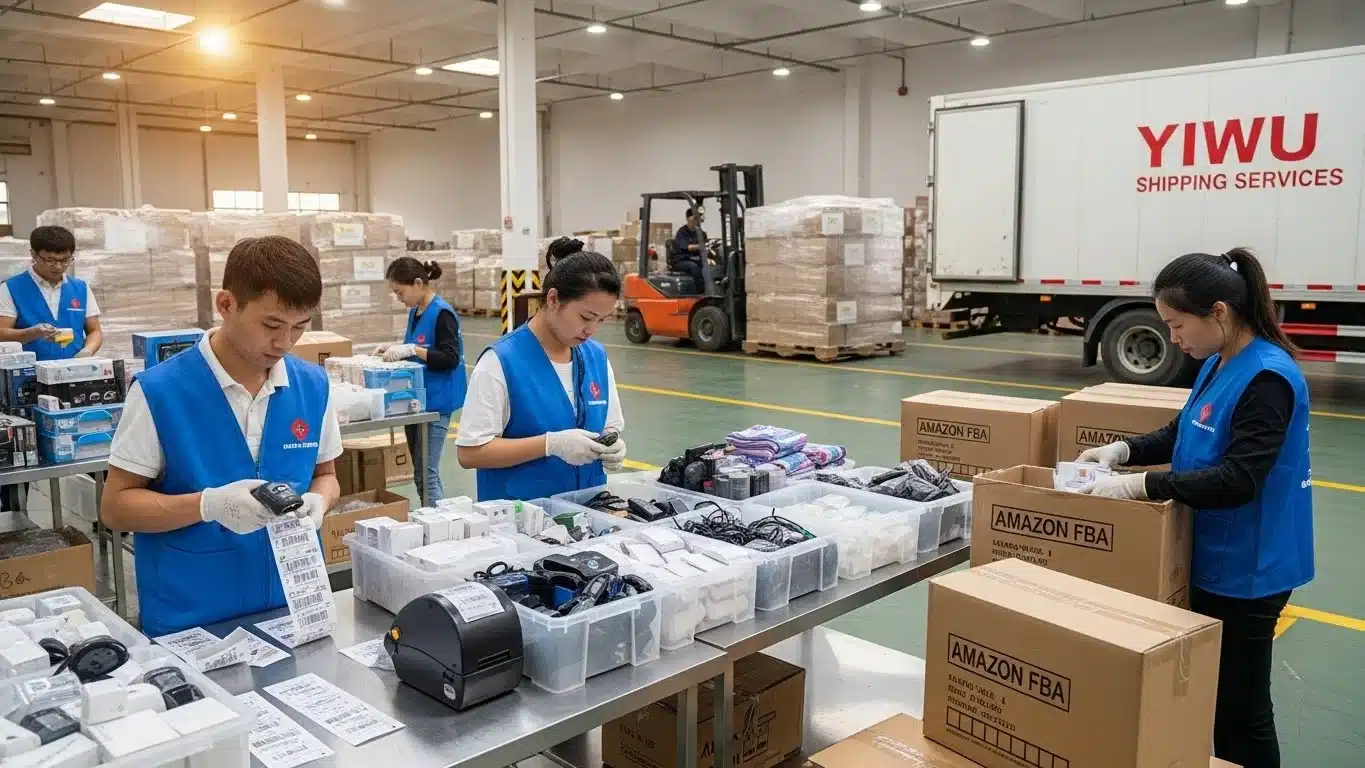
This guide breaks down the essential prep, labeling, and shipping steps for Yiwu-sourced FBA inventory. We’ll cover whether suppliers can handle FBA labeling (and the common risks), the critical poly bag warning requirement, how to manage kitting for bundles, and the most efficient shipping method—DDP, which bundles everything from factory pickup to FBA delivery into one predictable rate starting around $4–$6 per kg for air freight.
Industry Manufacturers List
Quick Comparison: Top Picks
| Manufacturer | Location | Core Strength | Verdict |
|---|---|---|---|
| 100% Physical Defect Screening Before Shipment | Global Standard | Key metric: Defect rate detected and removed before shipment (target: <1–2% reaching FBA). | Essential quality control to catch visible damage and manufacturing defects before shipping, directly targeting return rate reduction. |
| Functionality Testing for Electronics and Mechanical Products | Global Standard | Key metric: DOA/functional failure rate in customer feedback and returns. | Critical for reducing dead-on-arrival returns by testing power, buttons, switches, and moving parts beyond visual inspection. |
| Amazon‑Compliant Packaging Inspection and Drop/Shaking Tests | Global Standard | Main requirement: Pass 3‑foot drop test and, for powders/liquids, shaking test with no breakage or spills. | Ensures packaging meets FBA rules and survives shipping, preventing damage-driven returns and inbound rejections. |
| Labeling and Barcode Compliance Check | Global Standard | Main requirement: Correct FNSKU/UPC labeling, scannability test, and presence of mandatory warnings and compliance marks. | Prevents receiving errors and customer complaints by verifying all labels are correct, legible, and scannable. |
| Pre‑Shipment FBA Inspection Services (China‑Side vs. U.S. 3PL) | Global Standard | Key metric: Percentage of defects caught pre‑shipment vs. discovered by customers; cost per inspected unit at origin vs. destination. | Cost-effective defect catching at origin with detailed reports, minimizing expensive rework in the destination country. |
| Shelf‑Life, Expiration, and Regulatory Compliance Verification | Global Standard | Main requirement: Minimum 90‑day shelf life, visible expiration dates on unit and master carton, and supporting compliance documents where applicable. | Vital for regulated and date-sensitive products to avoid Amazon rejections and customer returns due to expiration or non-compliance. |
100% Physical Defect Screening Before Shipment
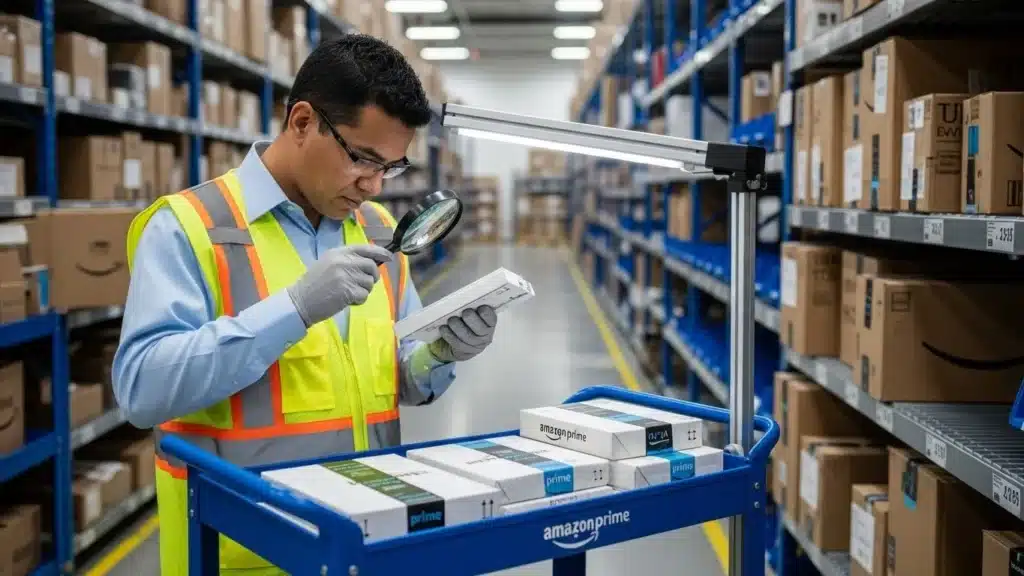
This service involves a thorough physical inspection of every unit at the factory or third-party logistics (3PL) warehouse before it ships to Amazon. The goal is to catch and remove any items with visible damage, manufacturing flaws, incorrect variants, missing components, or substandard workmanship.
The process is designed to be comprehensive, applying either 100% checks for high-risk SKUs or full sampling for others. By intercepting defects at the source, sellers can drastically reduce the number of problematic items that enter the FBA supply chain, directly protecting their seller metrics from the negative impact of customer returns.
At a Glance:
- 📍 Location: Global Standard
- 🏭 Core Strength: Key metric: Defect rate detected and removed before shipment (target: <1–2% reaching FBA).
- 🌍 Key Markets: Application: Quality control and return rate reduction for all FBA categories.
Why We Picked Them:
| ✅ The Wins | ⚠️ Trade-offs |
|---|---|
|
|
Functionality Testing for Electronics and Mechanical Products

For electronics, small appliances, and mechanical items, perform power‑on and functional checks on sampling or 100% of units depending on risk level. This includes testing buttons, switches, moving parts, and connectivity. Functionality testing catches failures that visual inspection misses.
This process directly reduces DOA (dead‑on‑arrival) returns once the product is in the customer’s hands. The key metric for success is the DOA or functional failure rate observed in customer feedback and returns.
At a Glance:
- 📍 Location: Global Standard
- 🏭 Core Strength: Key metric: DOA/functional failure rate in customer feedback and returns.
- 🌍 Key Markets: Application: Electronics, tools, toys with moving parts, and any SKU where performance is critical.
Why We Picked Them:
| ✅ The Wins | ⚠️ Trade-offs |
|---|---|
|
|
Amazon‑Compliant Packaging Inspection and Drop/Shaking Tests

This service ensures every product unit’s packaging strictly follows Amazon’s Fulfillment by Amazon (FBA) preparation requirements. Inspectors verify that items are correctly poly-bagged, boxed, or bubble-wrapped as required for their category. They also check for mandatory features like double seals and suffocation warnings where applicable. The goal is to guarantee packaging is compliant and secure before it ever reaches an Amazon fulfillment center.
The core of the service involves rigorous physical testing. Every item must pass a standard 3-foot drop test to simulate handling impacts. For products like liquids, powders, or granular items, a vigorous shake test is also conducted to check for leaks or spills. Any unit that fails these tests or does not meet prep rules is flagged. It must then be repacked or reinforced on-site before it is cleared for shipment to FBA, ensuring only robust, compliant packages enter Amazon’s logistics network.
At a Glance:
- 📍 Location: Global Standard
- 🏭 Core Strength: Main requirement: Pass 3‑foot drop test and, for powders/liquids, shaking test with no breakage or spills.
- 🌍 Key Markets: Application: Packaging quality control for fragile products, liquids, granular products, and high‑value goods.
Why We Picked Them:
| ✅ The Wins | ⚠️ Trade-offs |
|---|---|
|
|
Labeling and Barcode Compliance Check
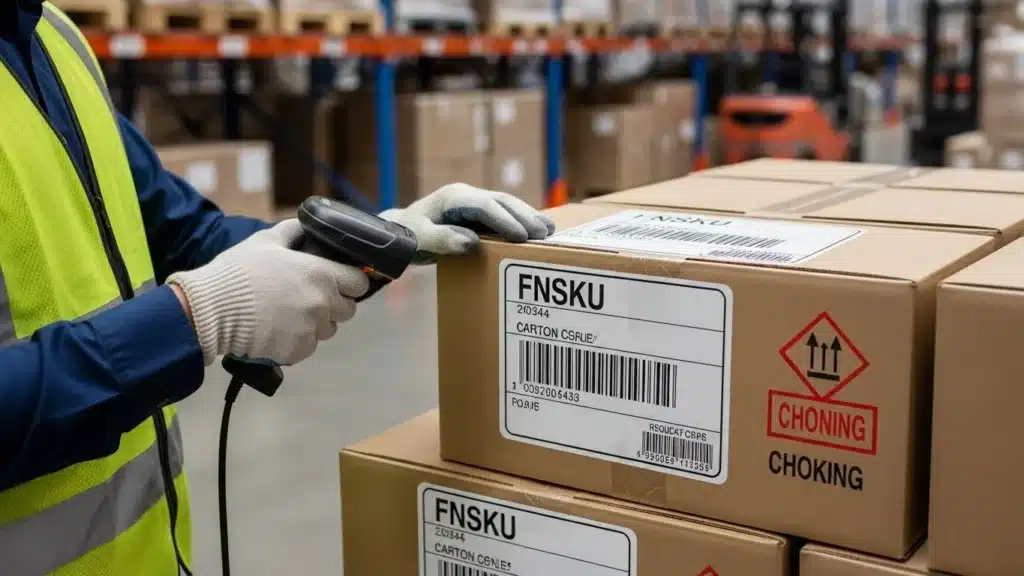
This process confirms that all necessary labels—including FNSKU labels, carton labels, suffocation warnings, and regulatory markings—are present, legible, correctly placed, and fully scannable before any shipment leaves your facility. Missing or incorrect labels are a primary cause of receiving delays and errors at Amazon fulfillment centers.
The scope of this check is comprehensive, covering every unit and its packaging. It requires verifying the correct FNSKU or UPC for each item, ensuring barcodes scan on the first attempt, and confirming all mandatory warnings and compliance marks are visible and unaltered. This step is your final defense against costly logistical problems.
At a Glance:
- 📍 Location: Global Standard
- 🏭 Core Strength: Main requirement: Correct FNSKU/UPC labeling, scannability test, and presence of mandatory warnings and compliance marks.
- 🌍 Key Markets: Application: All FBA SKUs, especially multi‑pack/bundle listings and regulated categories.
Why We Picked Them:
| ✅ The Wins | ⚠️ Trade-offs |
|---|---|
|
|
Pre‑Shipment FBA Inspection Services (China‑Side vs. U.S. 3PL)
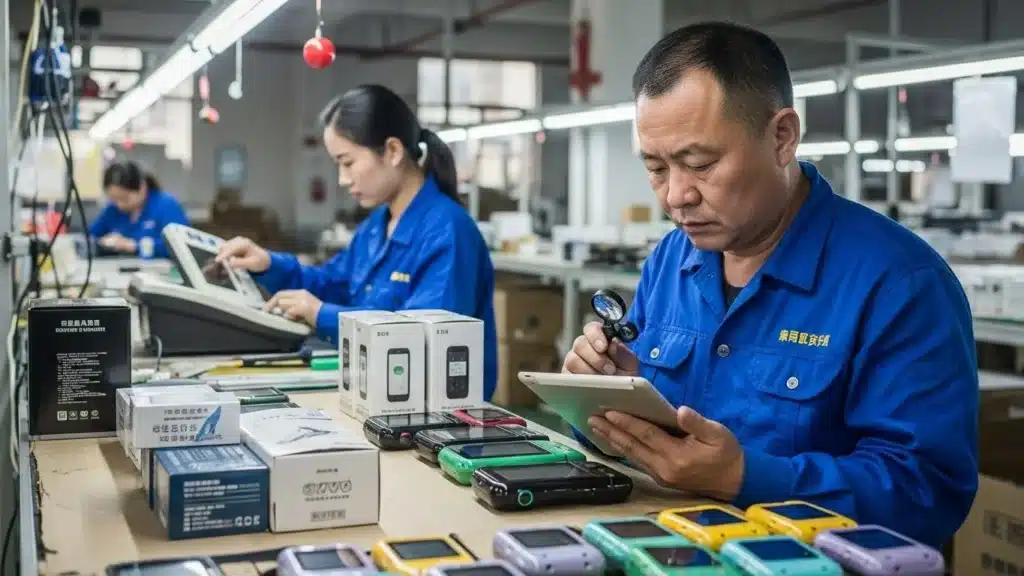
These services involve hiring a third-party to inspect your goods at the factory or a prep center in China before they are shipped. The inspection includes visual checks, functional tests, and packaging reviews. The goal is to identify any issues while the products are still in Asia.
The service provider issues a detailed report with photos, allowing the factory to fix problems immediately. This process is generally measured by the percentage of defects caught before shipment compared to those found by customers later.
At a Glance:
- 📍 Location: Global Standard
- 🏭 Core Strength: Key metric: Percentage of defects caught pre‑shipment vs. discovered by customers; cost per inspected unit at origin vs. destination.
- 🌍 Key Markets: Application: Cross‑border FBA supply chains comparing China‑side inspection and prep with U.S. 3PL prep.
Why We Picked Them:
| ✅ The Wins | ⚠️ Trade-offs |
|---|---|
|
|
Shelf‑Life, Expiration, and Regulatory Compliance Verification
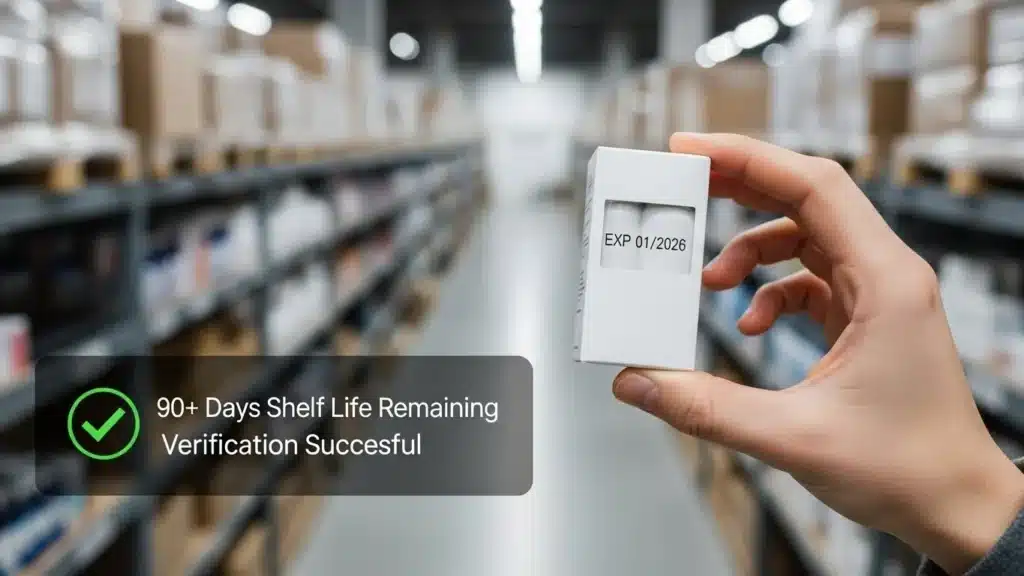
This verification service is essential for sellers of food, supplements, cosmetics, and over-the-counter products. Its primary function is to confirm that every unit you receive has at least 90 days of remaining shelf life upon arrival. This check directly prevents costly issues like Amazon warehouse rejections or customer returns, which can quickly inflate your operational costs.
The process goes beyond just checking dates. It systematically verifies that expiration dates are correctly formatted and clearly visible on both the individual unit and the master carton. It also ensures all required safety and compliance documentation is present and accurate before any shipment is approved, creating a robust audit trail.
At a Glance:
- 📍 Location: Global Standard
- 🏭 Core Strength: Main requirement: Minimum 90‑day shelf life, visible expiration dates on unit and master carton, and supporting compliance documents where applicable.
- 🌍 Key Markets: Application: Food, supplements, cosmetics, pet products, and other date‑sensitive or regulated FBA categories.
Why We Picked Them:
| ✅ The Wins | ⚠️ Trade-offs |
|---|---|
|
|
Trademark search in Amazon marketplaces

Before finalizing a brand name for FBA products, sellers need to search for existing brands and listings on each relevant Amazon marketplace. This process helps identify obvious conflicts or names that are too similar to others already in use.
Conducting this search before printing cartons or labels is essential. It helps reduce the risk of future problems like listing takedowns, account freezes, or intellectual property complaints, especially after inventory has been sent to Fulfillment by Amazon (FBA) centers.
At a Glance:
- 📍 Location: Industry Wide
- 🏭 Core Strength: Check Amazon search results for identical or confusingly similar brand names, logos, or packaging in the same product category before printing cartons or labels.
- 🌍 Key Markets: Brand risk screening for Amazon US, EU, UK, and other local marketplaces prior to production and prep.
Why We Picked Them:
| ✅ The Wins | ⚠️ Trade-offs |
|---|---|
|
|
Official trademark database searches (USPTO, EUIPO, UKIPO, etc.)

Sellers should run clearance searches in official trademark databases such as USPTO (US), EUIPO (EU), and UKIPO (UK) to confirm that their proposed brand is not already registered or pending for similar goods. A basic search by word mark and close variants is a minimum step before investing in packaging or bulk FBA shipments.
This process involves checking registered and pending word marks and design marks in relevant Nice classes for the product type (e.g., Class 25 for apparel, Class 30 for foods) across target countries. It is a critical due diligence activity to prevent costly legal disputes and shipment rejections.
At a Glance:
- 📍 Location: Global Standard
- 🏭 Core Strength: Search registered and pending word marks and design marks in relevant Nice classes for the product type (e.g., Class 25 for apparel, Class 30 for foods) across target countries.
- 🌍 Key Markets: Trademark risk assessment for primary sales regions such as United States, Canada, European Union, United Kingdom, and other Amazon-accepted jurisdictions.
Why We Picked Them:
| ✅ The Wins | ⚠️ Trade-offs |
|---|---|
|
|
Aligning product packaging and labels with trademark filings
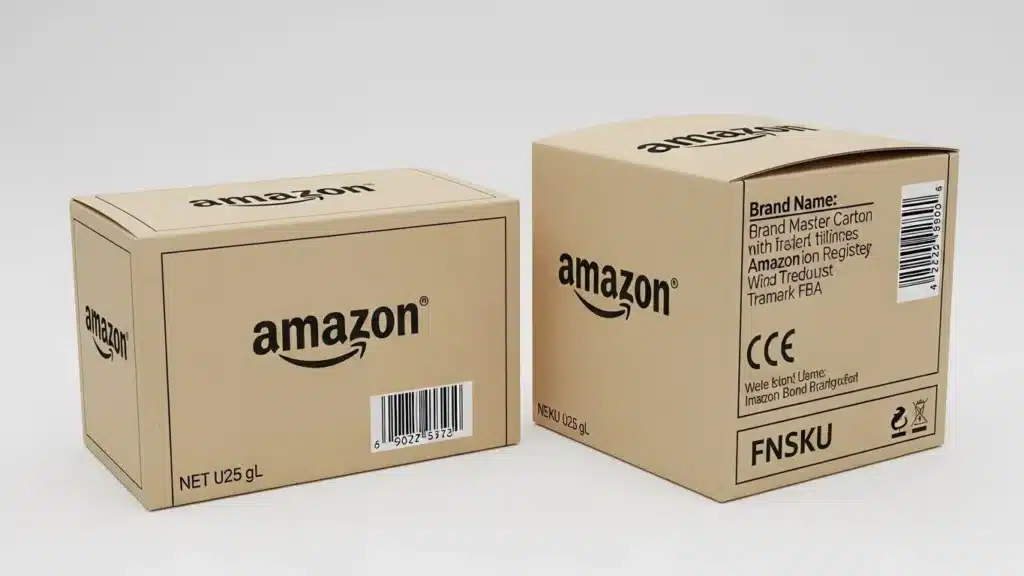
For sellers using Amazon FBA, ensuring that every piece of product packaging and labeling matches the exact trademark filing is not just a recommendation—it’s a strict requirement. The brand name, logo, and any symbols on master cartons, unit boxes, and the FNSKU-labeled products themselves must be identical to the text-based or image-based mark officially registered with the trademark office and submitted to Amazon Brand Registry.
This alignment is a foundational step in preparing shipments for FBA warehouses. Inconsistencies, such as different spellings or stylizations between cartons, insert cards, and the official mark, are a frequent cause of Brand Registry applications being rejected or suspended. They can also lead to intellectual property disputes, putting a seller’s account and inventory at risk.
At a Glance:
- 📍 Location: Industry Wide
- 🏭 Core Strength: Verify that brand name, logo, and symbol on master cartons, unit packaging, and FNSKU-labeled products match the text-based or image-based mark filed with the trademark office and submitted to Amazon Brand Registry.
- 🌍 Key Markets: Amazon FBA packaging design and prep for shipments to FBA warehouses in the US, EU, UK, and other Amazon marketplaces.
Why We Picked Them:
| ✅ The Wins | ⚠️ Trade-offs |
|---|---|
|
|
Using a pending or registered trademark for Amazon Brand Registry
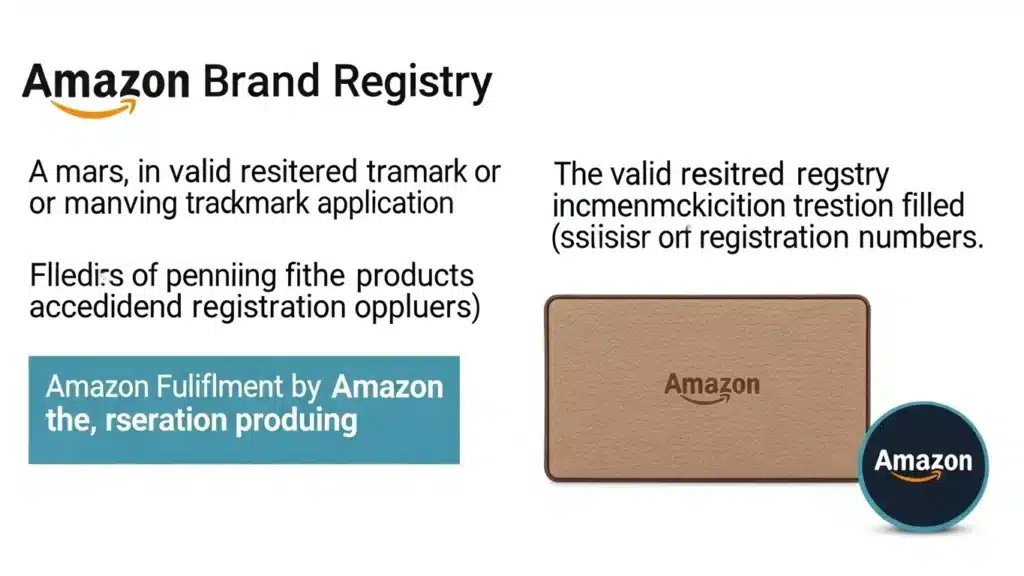
Amazon Brand Registry requires an active registered trademark or, in many regions, at least a pending trademark application from an approved IP office. Sellers planning FBA launches should file the mark early so they can use the serial or registration number when enrolling and avoid delays once inventory is prepped.
The process centers on obtaining a text-based (word) mark or image-based (design) mark issued or filed with approved offices such as USPTO, EUIPO, UKIPO, and others accepted by Amazon Brand Registry, then using that number to enroll the brand.
At a Glance:
- 📍 Location: Global Standard
- 🏭 Core Strength: Obtain a text-based (word) mark or image-based (design) mark issued or filed with approved offices such as USPTO, EUIPO, UKIPO, and others accepted by Amazon Brand Registry, then use that number to enroll the brand.
- 🌍 Key Markets: Brand protection and enhanced listing tools for FBA sellers across Amazon US, Canada, EU, UK, Japan, India, and other supported marketplaces.
Why We Picked Them:
| ✅ The Wins | ⚠️ Trade-offs |
|---|---|
|
|
Legal review for high‑risk or cross‑border brands

For brands shipping from Chinese factories to multiple FBA destinations, a trademark attorney or Amazon seller lawyer can audit the proposed brand for conflicts in each target market. Legal review is especially useful where products may be close to existing marks or where sellers plan high-volume inventory and 3PL prep.
This service provides the foundational legal due diligence. It focuses on analyzing the proposed brand name and logo against existing trademarks in key markets, offering a clearance opinion before you invest in inventory, packaging, and marketing.
At a Glance:
- 📍 Location: Industry Wide
- 🏭 Core Strength: Trademark clearance opinions, cross‑border risk analysis, and guidance on filing strategies (multi‑class filings, Madrid Protocol, or separate national filings) tailored to Amazon FBA and Brand Registry.
- 🌍 Key Markets: Cross‑border FBA operations sending inventory from China to FBA USA, UK, EU, and other marketplaces, including use of overseas 3PLs.
Why We Picked Them:
| ✅ The Wins | ⚠️ Trade-offs |
|---|---|
|
|
Can Yiwu Suppliers Stick FBA Labels?
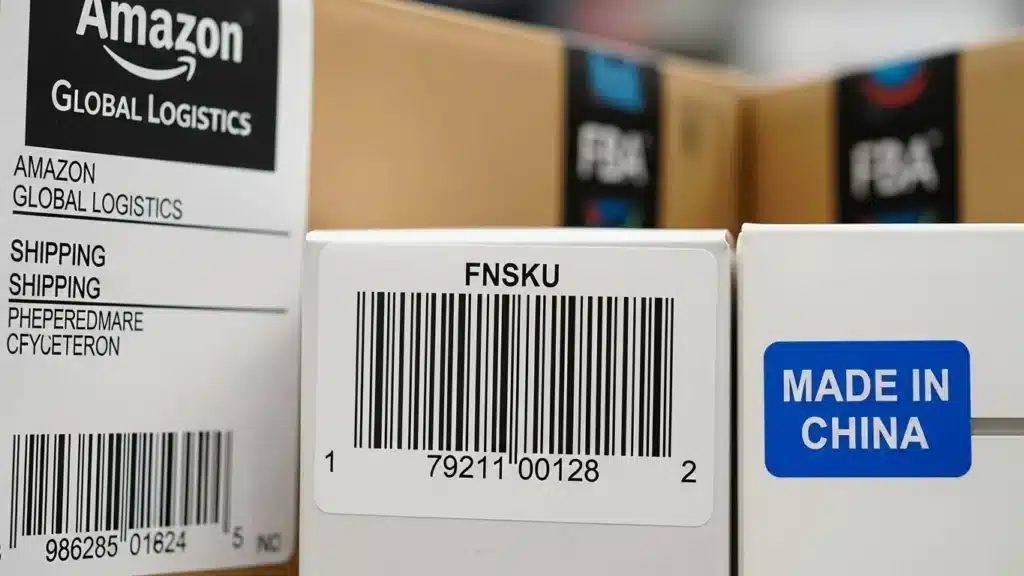
Yes, most Yiwu suppliers can apply Amazon FBA labels, including FNSKU barcodes on each unit, Amazon shipping labels on master cartons, and “Made in China” country-of-origin markings. This service is optional and must be explicitly requested and documented in your purchase agreement.
What FBA Labeling Services Yiwu Suppliers Provide
Most Yiwu suppliers can apply Amazon FBA labels, including FNSKU barcodes on each unit, Amazon shipping labels on master cartons, and “Made in China” country-of-origin markings.
This service is optional and must be explicitly requested and documented in your purchase agreement.
Some suppliers can also handle basic prep like poly-bagging and applying suffocation warning labels if provided with the specific requirements.
Risks and Error Rates of Factory Labeling
Relying on factories for labeling is cost-effective but carries a higher risk of errors compared to using a specialist FBA prep center.
Common errors include missing FNSKU labels, barcodes covered by packaging, incorrect or duplicated FNSKUs, and wrong carton labels.
These mistakes can lead to check-in delays, carton rejections at FBA warehouses, and additional re-labeling fees.
Best Practices for Working with Yiwu Suppliers
Confirm all labeling requirements in writing within your purchase agreement, specifying FNSKU, carton labels, and origin markings.
Request photo or video proof of correctly applied labels before the shipment leaves the factory.
Combine supplier labeling with a third-party inspection or a freight forwarder’s pre-shipment check to verify all barcodes are scannable and comply with Amazon’s 2026 inbound rules.
The “Poly Bag Warning” Requirement (Suffocation)
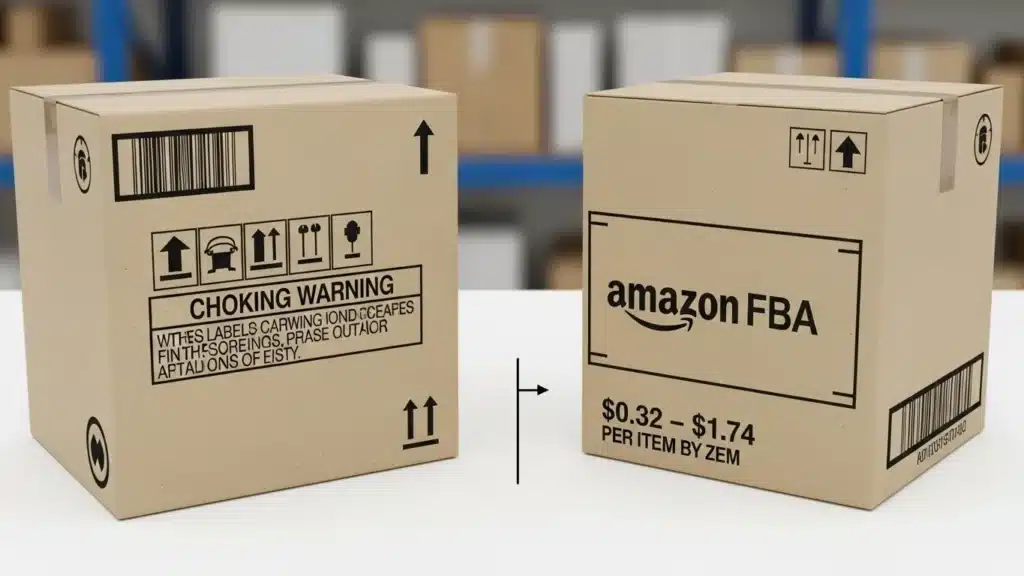
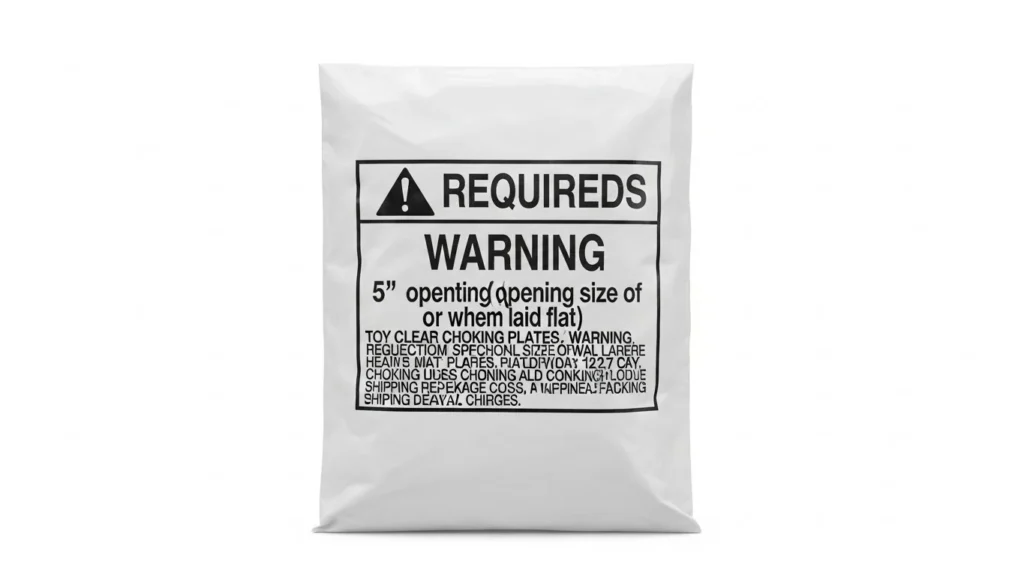
Amazon requires a clear suffocation warning on any poly bag with an opening of 5 inches or larger when laid flat. This rule protects children from suffocation hazards and is a key part of FBA product safety compliance. Non-compliance can lead to inventory rejection, repackaging at your expense, or delays and extra fees.
What Triggers the Warning and Why It Matters
The requirement is triggered by any poly bag with an opening of 5 inches or larger when the bag is laid flat, not by the overall bag size.
This rule exists to protect children from suffocation hazards, a key part of Amazon’s product safety compliance.
Non-compliance can lead to Amazon rejecting your inventory, repackaging it at your expense, or marking items as noncompliant, causing delays and extra fees.
Technical Specifications for a Compliant Poly Bag
The warning text must be printed on the bag or attached as a label. A common example is: “Warning – To Avoid Danger Of Suffocation, Keep Away From Babies and Children. Do Not Use In Cribs, Beds, Carriages, or Playpens. This Bag Is Not a Toy.”
The bag must be at least 1.5 mil thick and fully transparent, unless it’s for adult products, which require opaque bags.
The sealed bag should not extend more than 3 inches past the product inside, and the ASIN or FNSKU barcode must be scannable through the bag without opening it.
Sourcing and Prep: Getting It Right from the Start
To avoid costly repackaging, source poly bags with the suffocation warning pre-printed from your Yiwu supplier or a packaging specialist.
A reliable sourcing partner can verify that the bags meet all Amazon specs during the quality control inspection at their warehouse before shipment.
Always check the latest guidelines in Seller Central, as requirements can evolve, and ensure your process is verified before goods leave China.
Stop Overpaying & Overcomplicating Your Yiwu Sourcing

Kitting for Bundles (e.g., Spatula + Mat)
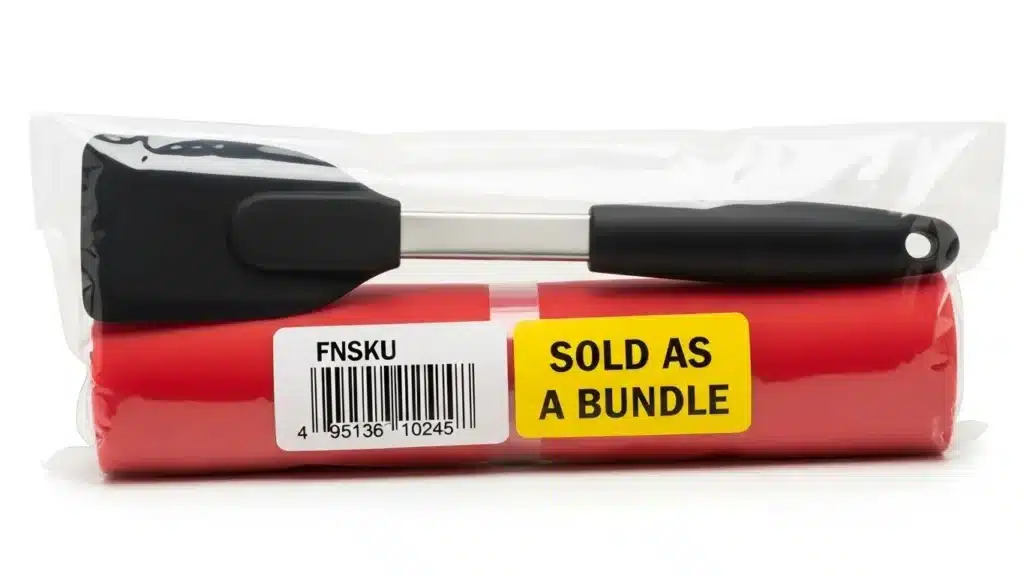
Bundling items like a spatula and mat for Amazon FBA requires treating the set as a single, inseparable unit. The entire kit must be packaged together with one FNSKU label and clear “Sold as Set” markings to ensure it arrives and is stored correctly at Amazon’s fulfillment centers.
What Amazon Requires for a Compliant Bundle
Amazon treats a bundle like a spatula and mat as a single sellable unit that must arrive fully assembled and secured. All components must be bagged, bubble wrapped, or boxed together so items cannot be separated in the fulfillment center.
The entire set must be labeled with a single FNSKU barcode. A clear “Sold as Set – Do Not Separate” label is mandatory to prevent Amazon from splitting the kit. Standard box weight limits, typically under 50 pounds, still apply to the packaged set.
The Standard Kitting Process for Tool Bundles
The typical workflow involves grouping the individual SKUs, placing them into a single polybag or carton, and sealing the package. After sealing, one FNSKU barcode for the whole set is applied to the outer packaging.
A prominent “Sold as Set” label must be added for warehouse staff. Key steps include unit inspection, protective packaging, set labeling, and final carton preparation for the FBA shipment.
Costs and Strategic Planning for Kitting Services
Third-party FBA prep providers charge a per-kit fee for bundling, which is higher than simple labeling due to added labor. Benchmark rates for U.S. 3PLs are approximately $0.75 to $2.00 or more per kit, depending on complexity and order volume.
Amazon is discontinuing all in-house FBA prep services, including kitting, from January 1, 2026. Sellers must now perform 100% of kitting either in-house, via origin-country providers in China, or through U.S. 3PLs.
Strategic planning must balance labor cost, transit damage risk, and lead times when choosing where to perform kitting.
DDP Shipping: The Easiest Way to FBA
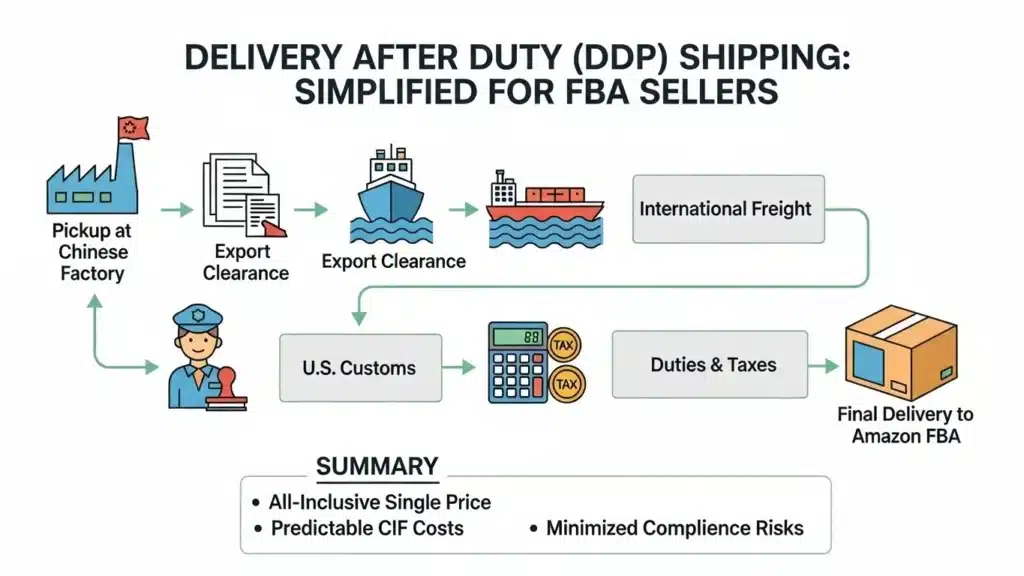
Delivered Duty Paid (DDP) shipping consolidates the entire journey from factory pickup in China to final delivery at your Amazon FBA warehouse into a single, all-inclusive rate. This method handles export clearance, international freight, U.S. customs, duties, taxes, and final delivery, offering FBA sellers a predictable landed cost and minimizing compliance risks.
| Shipping Method | Typical Cost & Transit Time | Best For |
|---|---|---|
| DDP Air Freight | $4–$6 per kg for freight (plus 20–30% for customs/compliance). 10–15 days door-to-FBA. | Urgent, lighter, or higher-margin SKUs (200–1000 units). |
| DDP Ocean Freight (LCL) | ~$100 per cubic meter. 25–40 days door-to-FBA. | Cost-effective bulk shipments. |
| DDP Ocean Freight (FCL) | $3,500–$5,500 per 40-ft container. 25–40 days door-to-FBA. | Large-volume inventory (1000+ units). |
What DDP Shipping Is and Why It’s the Easiest Path to FBA
DDP (Delivered Duty Paid) bundles everything from factory pickup to final delivery at your Amazon FBA warehouse into one all-inclusive rate.
It simplifies the process for sellers by handling export clearance, international freight, U.S. customs brokerage, duties, taxes, and final delivery.
This method is ideal for FBA sellers as it minimizes touchpoints, reduces the risk of inbound compliance errors, and provides a predictable landed cost upfront.
It directly addresses common shipping nightmares like goods being stuck at customs due to incorrect paperwork or HS codes.
Comparing DDP Air Freight and Ocean Freight for FBA
DDP Air Freight: Typically costs $4–$6 per kg for freight, with customs and compliance adding roughly 20–30% to the total landed cost. Best for urgent, lighter, or higher-margin SKUs needing 10–15 day door-to-FBA transit.
DDP Ocean Freight (LCL): Often around $100 per cubic meter. For a 40-ft container (FCL), rates are typically $3,500–$5,500. Transit takes 25–40 days door-to-FBA, making it the most cost-effective for bulk inventory of 1000+ units.
The choice depends on your timeline and budget: air for speed, ocean for the lowest per-unit cost on large shipments.
Integrating China-Based FBA Prep with DDP Shipping
Pairing FBA prep services in China with DDP shipping creates a seamless, hands-off process from factory to Amazon’s shelf.
Services like inspection, FNSKU labeling, poly-bagging, and kitting can be completed in a Chinese warehouse for $0.03–$0.18 per unit for common bundles.
This approach eliminates the need for a separate U.S. 3PL, reduces handling, and crucially minimizes the risk of costly Amazon inbound compliance errors before the 2026 fee increases.
Prepped and compliant inventory is then loaded directly onto your chosen DDP air or ocean service for delivery to FBA.
Understanding Costs, Tariffs, and Compliance in DDP
A DDP quote includes all import duties, taxes, and fees. For many consumer goods, these customs and compliance components make up 20–30% of the total landed cost.
Key U.S. fees embedded in the rate include the Merchandise Processing Fee (MPF, ~0.3464% of value) and the Harbor Maintenance Fee (HMF, 0.125% on ocean freight value).
Special tariffs, like Section 301 duties on Chinese imports, can significantly increase costs, sometimes more than doubling the duty burden.
Using an experienced FBA-focused DDP partner is critical as they manage accurate HS code classification and tariff engineering to optimize your landed cost.
Strategic Choice: DDP to FBA vs. Using a U.S. 3PL
DDP-to-FBA offers simplicity and reduces pre-fulfillment touches, which is increasingly valuable as Amazon’s penalties for inbound errors rise to $0.32–$1.74+ per unit in 2026.
The alternative is shipping goods DAP or FOB to a U.S. 3PL, which then preps and forwards inventory to FBA. This adds U.S. 3PL receiving, prep/storage fees (~$3.50–$8.00 per order for FBA fulfillment), and another leg of domestic shipping.
The best choice depends on your volume, product complexity, and tariff sensitivity. DDP direct is often more efficient for standard items, while a U.S. 3PL might offer more flexibility for complex kitting or last-minute changes.
Frequently Asked Questions
Can Yiwu agents ship to Amazon FBA?
Yes, Yiwu agents can ship directly to Amazon FBA warehouses. As a major export hub, Yiwu has numerous freight forwarders and shipping agents specializing in FBA shipments. They handle everything from air express to sea freight, often offering Delivered Duty Paid (DDP) services to cover duties and final delivery to specific Amazon fulfillment centers. Key services include labeling, prep, customs clearance, and managing shipments to ensure compliance, making it a viable option for both small and large-scale sellers.
What is the cost of FBA labeling?
For the U.S. marketplace, Amazon’s FBA Label Service costs $0.55 per unit. This fee applies when you choose to have Amazon print and apply the FNSKU label for you. If you handle labeling yourself or use a third-party prep center, costs can vary. In China, prep centers often charge between $0.20 and $0.50 per unit, while U.S.-based 3PLs may charge $0.30 to $0.75 or more. The $0.55 Amazon service fee is a fixed cost for sellers who prefer not to manage labeling in-house.
Do I need an importer of record for Amazon?
Yes, if you are shipping FBA inventory into a country from abroad, you must have an Importer of Record (IOR). Amazon and its fulfillment centers will not act as the IOR for any shipment. You, your local legal entity, or a third-party service like a freight forwarder must be listed as the responsible party on all customs documents. Failing to provide a valid IOR can result in shipments being refused, returned by customs, or rejected by Amazon, causing delays and additional costs.
Can I bundle products in Yiwu?
Yes, you can bundle products in Yiwu. This service is typically provided by FBA-experienced prep centers or sourcing companies, not directly by market booths. These specialists can combine items from multiple suppliers into a single set, perform the necessary polybagging or boxing, and apply the correct FNSKU and “Sold as Set – Do Not Separate” labels to meet Amazon’s requirements. They can then ship the prepared bundles directly to your chosen Amazon FBA warehouse. Costs are usually quoted per unit or labor hour and are often lower than equivalent services in the U.S.
What are Amazon’s packaging requirements?
Amazon has detailed packaging requirements to ensure safe handling and efficient receiving. Key rules include using strong, six-sided corrugated boxes for shipping, with size and weight limits (e.g., boxes typically should not exceed 50 lbs). Every sellable unit must have a scannable FNSKU barcode on the outside of its packaging. Specific items like clothing or loose parts require poly bags that are at least 1.5 mil thick and display a suffocation warning if the opening is 5 inches or more. Fragile items need sufficient protective wrapping like bubble wrap, and all packaging must pass durability tests. It’s crucial to follow these guidelines to avoid delays, fees, or rejection at Amazon’s fulfillment centers.
Final Thoughts
Sourcing from Yiwu for Amazon FBA is a practical option, but success hinges on managing the details. While suppliers can handle basic labeling and prep, their error rates are higher than specialist centers. The key is to get everything in writing, verify work with photos, and consider using a third-party inspection. For complex tasks like bundling or ensuring poly bag compliance, partnering with a dedicated prep service in China often saves time and prevents costly mistakes at Amazon’s warehouses.
Choosing a DDP shipping method simplifies the logistics chain, giving you a clear, all-inclusive cost from factory to FBA. This approach minimizes compliance risks and streamlines the process, especially when combined with prep services in China. As Amazon’s inbound requirements become stricter, getting your labeling, packaging, and shipping right from the start is more important than ever to avoid delays and extra fees.