Justin
For B2B buyers, the biggest challenge isn’t finding inventory—it’s finding profitable inventory. The global supply chain creates a constant stream of overstock, cancelled orders, and near-expiry goods, but navigating this secondary market requires specific knowledge to avoid risk and secure genuine value.

This guide breaks down the stock lot market in Yiwu, the world’s capital for surplus goods. We’ll explain how to assess quality using formal AQL standards, compare the dedicated overstock hub of Wuai Stock Street with the massive Futian Market, and show you how to buy strategically—whether by weight (jin) or by piece—to maximize your margins on categories like apparel and toys.
What is the “Stock Lot” (Inventory) Business?
A stock lot is a batch of identical items produced together and assigned a unique tracking number. The stock lot business involves buying these complete, often discounted, batches from manufacturers or distributors and reselling them as a single unit to secondary markets, leveraging the lot’s traceable history for quality and compliance.

The Core Concept: A Batch as a Tradable Unit
A stock lot is a group of items manufactured or processed under identical conditions and handled as one inventory unit, identified by a unique lot number or batch ID.
This lot number acts as a digital fingerprint, linking all items to shared data like production date, supplier, raw materials, and quality test results.
Because all items share these attributes, the entire lot can be bought, sold, and valued as one coherent economic unit, which is the foundation of the stock lot business.
This system enables the purchase of complete, often undervalued batches—such as overstock, cancelled orders, or near-expiry goods—for resale in secondary channels.
The Operational Backbone: Traceability and Management
Warehouse Management Systems (WMS) and ERPs store detailed lot data, including quantities, storage locations, and expiration dates, enabling precise inventory control.
Operational methods like FIFO (First-In-First-Out) and FEFO (First-Expired-First-Out) are used to manage lot rotation, especially for perishable or time-sensitive goods.
Lot-level traceability is critical for regulatory compliance in sectors like food and pharmaceuticals, allowing for targeted recalls of specific batches instead of entire product lines.
For traders, this traceability provides a defensible record of a lot’s origin, quality status, and remaining shelf life, reducing risk when flipping distressed inventory into discount wholesale or export markets.
Wuai Stock Street vs. Futian Market
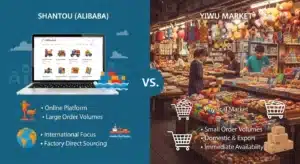
Futian Market is the world’s largest small-commodity wholesale complex for standard, repeatable orders. Wuai Stock Street is a dedicated overstock market for liquidating surplus inventory at deep discounts. They serve fundamentally different sourcing strategies.
| Market | Wuai / Meihu Stock Street | Yiwu Futian Market (International Trade City) |
|---|---|---|
| Core Purpose | Dedicated overstock & inventory liquidation (stock lots). | Continuous-flow wholesale for standard, repeatable export orders. |
| Business Model | Clearance, dead stock, and lot-based negotiation for quick sales. | Long-term showrooms for factories/traders, offering OEM/ODM and stable SKUs. |
| Scale & Scope | Concentrated street market with >2,000 stores. Focus on apparel, suitcases, toys, shoes. | ~6.4 million m² complex with 75,000+ booths and over 2.1 million product types across all small commodities. |
| Buyer Profile | Price-driven discounters, stock-lot traders seeking high-margin flips from irregular supply. | Export buyers, distributors needing consistent specs, MOQs, and catalog-based pricing. |
| Operational Data | Annual turnover cited at over 700 million yuan for the stock market cluster. | Sees roughly 200,000 buyers daily. Districts are zoned by product category (e.g., District 1 for toys). |

Core Purpose and Business Model
Wuai Stock Street (Meihu) is Yiwu’s dedicated overstock ecosystem, with over 2,000 shops focused on clearance, dead stock, and inventory liquidation. It is the physical embodiment of the stock-lot business.
Futian Market (Yiwu International Trade City) is a continuous-flow wholesale infrastructure for stable, repeatable export orders. Its 75,000 booths function as long-term showrooms for factories and trading companies.
Wuai targets price-driven buyers and stock-lot traders seeking high-margin flips from irregular supply. Futian serves buyers needing standard specs, OEM/ODM capabilities, and consistent MOQs for catalog-based pricing.
Scale, Product Scope, and Operational Data
Futian Market covers about 6.4 million m² across five districts, offering over 2.1 million product types. It sees roughly 200,000 buyers daily and is zoned by category (e.g., District 1 for toys, District 2 for luggage).
Wuai Stock Street is a concentrated street market at the Jiangdong Middle Road and Binwang Road junction. It is the largest stock market in Yiwu, with an annual turnover cited at over 700 million yuan for the cluster.
Product focus differs: Futian’s core is small commodities like jewelry, hardware, and stationery. Wuai’s core is overstock apparel, suitcases, toys, and shoes, sold in mixed-lot bundles.
Assessing Quality: Why was it rejected?
A stock lot is rejected when a formal quality inspection, following standards like ANSI/ASQ Z1.4, finds too many defects in a sample. Inspectors classify flaws as critical, major, or minor and compare counts against Acceptable Quality Limits (AQLs). If defects exceed the AQL threshold—common limits are 0.25% for critical issues or 2.5% for minor ones—the entire lot fails and is often sold off as surplus.
| Defect Class | Typical AQL Threshold | Description & Risk |
|---|---|---|
| Critical | 0.25% – 0.65% (0% ideal) | Poses safety or compliance risks. Requires lot-by-lot inspection; not eligible for skip-lot programs. |
| Major | ≈ 1.0% | Affects product function or durability. Exceeding this AQL leads to lot rejection. |
| Minor | ≈ 2.5% | Cosmetic or non-functional issues. The most lenient threshold, but still a cause for rejection if exceeded. |

The Pass/Fail Rule: How Sampling Plans Decide a Lot’s Fate
Quality inspections use formal sampling plans like ANSI/ASQ Z1.4-2003 or ISO 2859-3 to decide if a lot is acceptable. Inspectors randomly pull a set number of items from a lot—a common method uses 19 sample points—and check them against specifications.
Each defect found is classified by severity: critical, major, or minor, each with its own Acceptable Quality Limit (AQL). If the number of defective units in the sample exceeds the plan’s acceptance number for a given AQL, the entire lot is statistically ‘not acceptable’.
The decision is binary: the lot is either accepted or rejected. There is no middle grade for marginal failure. Rejected lots are not shipped to the original buyer. They become surplus, are reworked, or are sold as ‘B-grade’ stock, feeding the secondary market.
Common Flaws That Trigger Rejection: From Cosmetic to Critical
Visual defects are a primary cause of rejection, including irregularities like color mismatches, surface blemishes, or misprints discovered during inspection.
Mechanical test failures occur when a product’s physical properties, such as tensile strength, hardness, or elasticity, fall outside the specified tolerance range.
Chemical composition issues lead to rejection if materials contain off-spec purity levels or contaminants that violate safety or regulatory standards.
For critical defects, which pose safety or compliance risks, the AQL is often set between 0.25% and 0.65%, with an ideal target of 0%. Major defects, affecting function or durability, typically have an AQL around 1.0%, while minor, cosmetic issues may have an AQL near 2.5%.
Critical characteristics are never placed on reduced ‘skip-lot’ inspection programs under ISO 2859-3; they require consistent, lot-by-lot checking due to high risk.

Buying by Weight (Jin) vs. Piece
In Yiwu’s stock lot market, goods are priced either by weight (jin) or by piece. Buying by jin, where 1 jin equals 500g, is standard for bulk, irregular, or waste materials like fabric rolls or metals, as it accounts for density and reduces disputes. Buying by piece is used for discrete, uniform items like finished garments, where fixed pricing applies. The choice impacts cost, logistics, and final yield.

The Logic of Buying by Weight (Jin)
The jin is the standard weight unit for bulk goods, precisely defined as 500g in mainland China. This enables scalable pricing for materials with variable forms, such as clearance textiles, metal scrap, or fabric rolls, where piece counts are inconsistent due to defects, sizes, or irregular shapes.
This method prioritizes total mass over individual count, which reduces negotiation disputes in high-volume transactions by focusing on the aggregate yield. For large transactions, the dàn (擔), equivalent to 100 jin or 50kg, is used as a standard unit for logistics and pricing calculations.
The logic is similar to charging by dimensional weight in shipping, where the space occupied can be more critical than the actual mass. For bulk commodities, the density and total usable material are the primary value drivers.
When Piece Pricing Makes Sense
Piece pricing is applied to discrete, finished items like garments, toys, or housewares where units are uniform and easily countable. Evaluation under this model requires checking specific product specifications that affect value.
Key factors include stitch density, measured in stitches per inch, and material composition, such as a blend of 92% polyester and 8% spandex. Construction details like seam types—overlock or flatlock—are critical quality indicators when assessing per-piece value.
This method can inflate costs for lightweight bulk items where paying by weight would be more economical, highlighting the importance of choosing the right pricing model. The historical shift from 16 liang to 10 liang per jin standardized units to prevent pricing arbitrage in cross-border stock lot trades.
Top Categories: Apparel, Toys, Houseware
Apparel, toys, and houseware are the dominant categories in the stock lot market. Each category has unique drivers for surplus, such as seasonal overstock for apparel or promotional batches for toys. Managing these lots effectively requires specific strategies like lot tracking and FEFO rotation to maximize margins and minimize waste from dead stock.

Apparel Stock Lots: Seasonal Batches and Lot Control
Apparel stock lots typically consist of overstocked seasonal clothing batches, such as holiday-specific apparel.
These lots are managed using lot numbers for precise tracking, enabling FIFO (First-In, First-Out) or FEFO (First-Expiry, First-Out) rotation strategies.
The primary goal of lot control is to minimize dead stock by prioritizing the sale of items with the shortest remaining commercial life.
This systematic approach is key for buyers to achieve high-margin flips on clearance inventory.
Toys and Houseware: Managing Perishable and Critical Stock
Toys stock lots often involve perishable promotional batches with expiration dates, managed as anticipation stock for predictable demand surges like festive seasons.
Houseware lots feature critical stock items, such as kitchenware, where maintaining minimum stock levels is vital for supply chain continuity.
Inventory strategies combine cycle stock for regular demand, safety stock as a buffer, and speculative stock for planned promotional events in these categories.
Warehousing demands strict lot segregation to prevent mixing batches, comply with quality regulations, and enable accurate demand forecasting for profit optimization.
The “Cash & Carry” Rule in Stock Markets
The ‘cash & carry’ rule is a financial arbitrage strategy. It involves buying an asset in the spot market and simultaneously selling a futures contract for the same asset when the futures price is higher than the spot price plus the total cost of holding the asset until the contract expires. This locks in a risk-free profit as the prices converge at expiration.

The Core Concept: Spot, Futures, and the Cost of Carry
The cash-and-carry rule is built on the cost-of-carry pricing model. This model calculates a theoretical fair price for a futures contract. For a non-dividend-paying stock, the fair price is determined by the formula \(F_0 = S_0 \times e^{rT}\), where \(S_0\) is the spot price, \(r\) is the risk-free interest rate, and \(T\) is the time to maturity. For equities that pay dividends, the model adjusts to \(F_0 = S_0 \times (1 + rT) – D\), where \(D\) represents the present value of expected dividends.
Arbitrage becomes possible when the actual market futures price trades above this calculated fair value. This situation, known as a positive basis or futures premium, signals an opportunity. The strategy to capture this profit involves taking a long position in the physical asset (the “cash” part) and a simultaneous short position in the corresponding futures contract (the “carry” part).
Execution and Application in Modern Markets
In practice, traders execute this by purchasing the underlying stock or index in the cash market and shorting an equivalent notional value of futures contracts on an exchange like the NSE or BSE. The primary cost in this trade is the interest on the borrowed cash used to fund the spot purchase. For commodity futures, additional carry costs like storage, insurance, and transport must be factored in.
The position is held until the futures contract expires. At expiration, the spot and futures prices converge, allowing the trader to realize the locked-in spread as profit, net of all carrying costs. The long spot position can often be used as collateral for the futures margin, making the trade capital-efficient.
When the opposite pricing condition occurs—when futures trade below their theoretical fair value—traders employ a “reverse cash-and-carry” arbitrage. This involves short-selling the underlying asset (often facilitated through stock lending programs) and taking a long position in the futures contract to profit from the convergence.
Final Thoughts
Navigating Yiwu’s stock lot market requires a clear understanding of its core mechanics. The system is built on buying and selling complete batches of inventory as single units, a practice distinct from the standard wholesale model of Futian Market. Success hinges on knowing how to assess quality through inspection standards, choosing the right pricing model—by weight or by piece—and focusing on the dominant categories like apparel and toys where surplus is most common.
The opportunity in this market lies in its inherent inefficiencies. Goods end up here for specific reasons: overproduction, cancelled orders, or minor quality deviations. For buyers who can accurately evaluate a lot’s condition, trace its history, and manage its logistics, these ‘problems’ become the source of significant value. It’s a specialized trade, but one where knowledge of processes like lot tracking and the cash-and-carry principle can translate directly into margin.
Frequently Asked Questions
Where is the stock market in Yiwu?
The main hub for stock lots in Yiwu is Stock Professional Street in the Meihu area. This is the city’s designated professional street for surplus and clearance goods, officially listed in the Yiwu market address system.
Are stock lots damaged goods?
No, stock lots are not damaged goods. They are typically excess, surplus, or end-of-line inventory that is sellable and undamaged. Damaged goods are a separate category that requires immediate separation and reconditioning.
Can I buy branded stock lots?
Yes, branded stock lots are available through authorized surplus channels that have brand-owner approval. These deals often include specific conditions like relabeling to avoid trademark infringement, with typical discounts of 30–70% off first-quality pricing.
Do they sell by the kilo?
Yes, goods in stock lots are commonly sold by weight in kilograms or metric tonnes. These transactions must use legal-for-trade scales that comply with national weights-and-measures laws, with gross, tare, and net weights recorded on official scale tickets.
Is there a minimum purchase for stock lots?
There is no universal regulatory minimum. Sellers or marketplaces set their own requirements, typically requiring the purchase of one full lot. In practice, lot values often start around US$2,000–US$5,000 on major B2B liquidation platforms.