 Justin
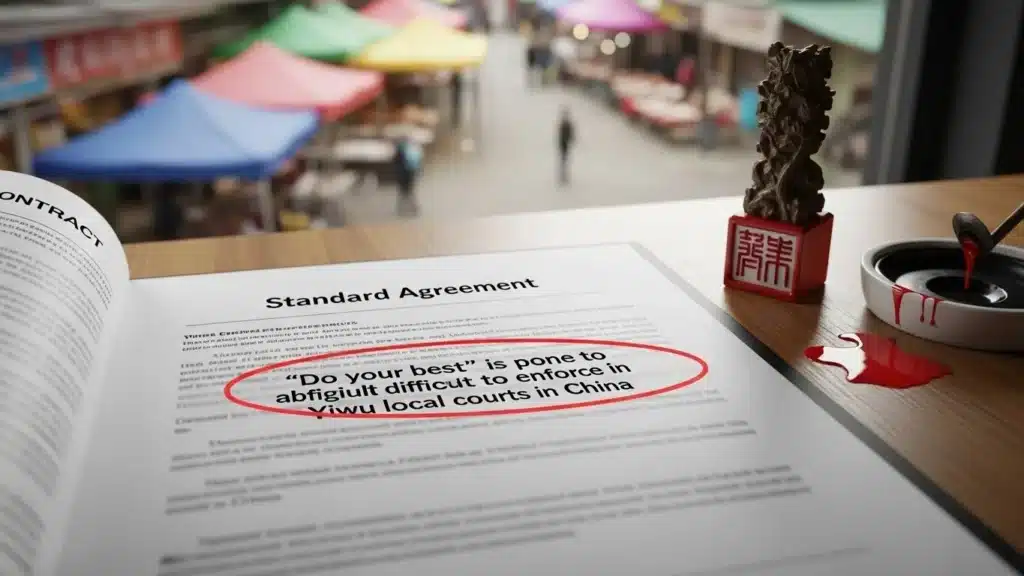
Your standard Western contract is likely unenforceable in Yiwu. China’s civil law system, governed by the PRC Civil Code, treats contracts as strict, textual documents, leaving broad clauses like “best efforts” open to interpretation and difficult to enforce in local courts.
This guide breaks down the two essential contracts for sourcing in Yiwu: the NNN agreement for protecting your designs and business relationships, and the detailed Purchase Order that turns quality requirements into enforceable terms. You’ll learn why a 30/70 payment structure ties the 70% balance to a passed QC inspection, and how verifying a supplier’s official red company chop is a non-negotiable first step for any agreement.
Why Western Contracts Don’t Work in China
Western contracts fail in China due to a different legal system and enforcement reality. China’s civil law framework, governed by the PRC Civil Code, prioritizes strict textual interpretation over common-law precedent. Key issues include the difficulty of enforcing foreign judgments, the need for explicit, quantifiable terms, and a commercial culture that views contracts as relational frameworks rather than rigid transactional documents.
The Legal System Mismatch: Civil Code vs. Common Law
China’s legal system is fundamentally different from common-law jurisdictions. Contracts are governed by the PRC Civil Code (Book III: Contracts, 2021) and Supreme People’s Court interpretations, not by case-law precedent. This creates a foundational mismatch for agreements drafted with Western assumptions.
Chinese courts apply a strict textualist approach. The signed document is treated as the definitive and exhaustive expression of intent, leaving little room for extrinsic evidence or implied terms that are common in common-law contract interpretation.
This makes Western reliance on broad, qualitative clauses risky. Terms like “best efforts,” “good faith,” or “material adverse change” often lack enforceability in Chinese courts without explicit, quantifiable definitions written into the contract.
The legal doctrine of *contra proferentem*, which interprets ambiguity against the drafter, is much weaker in China. It is rarely applied outside of standard-form contracts, meaning vague drafting is more likely to lead to unenforceability or an unfavorable interpretation for the foreign party.
Enforcement Realities and Practical Drafting Solutions
The practical barriers to enforcement are significant. Enforcement of foreign court judgments in China is rare and uncertain. While foreign arbitral awards under the New York Convention are theoretically enforceable, they can be delayed or refused, particularly if the Chinese counterparty has strong local political connections.
To be effective, contracts must be optimized for local enforceability. This means using Chinese-language agreements governed by PRC law, with jurisdiction specified in Chinese courts or arbitration bodies like CIETAC.
Drafting must be precise and operational. Specific, monetary liquidated damages clauses—such as a fixed amount per week of delay—are more likely to be enforced than vague performance assurances. Contracts should also address regulatory realities, like SAFE review for payments over USD 50,000, by specifying who handles approvals and backup payment methods.
Financial protections are critical. In a Chinese bankruptcy proceeding, unsecured creditors typically recover very little. To mitigate this risk, contracts should include security interests, guarantees, or milestone-based payment structures (e.g., a 30/70 split) rather than relying on post-breach damage claims.
The NNN Agreement (Non-Disclosure/Use/Circumvention)
An NNN agreement is a specialized contract for sourcing from China. It combines Non-Disclosure, Non-Use, and Non-Circumvention clauses to prevent a factory from leaking your designs, using them to make competing products, or bypassing you to deal directly with your customers or suppliers. It’s a critical tool for protecting trade secrets, product specifications, and business relationships.
| Core Element | Purpose | Key Detail |
|---|---|---|
| Governing Law | Ensures enforceable jurisdiction | People’s Republic of China (PRC) law and courts are standard, aligning enforcement where a breach would occur. |
| The Three “N”s | Defines core protective covenants | Non-Disclosure, Non-Use, and Non-Circumvention clauses work together to block data leaks, unauthorized production, and business bypass. |
| Protected Assets | Eliminates ambiguity | Explicitly lists items like product specs, CAD drawings, source code, formulas, pricing, and customer lists. |
| Enforcement Mechanics | Provides legal leverage | Includes rights to injunctive relief, monetary damages, and clauses like “no waiver unless in writing” to prevent informal breaches. |
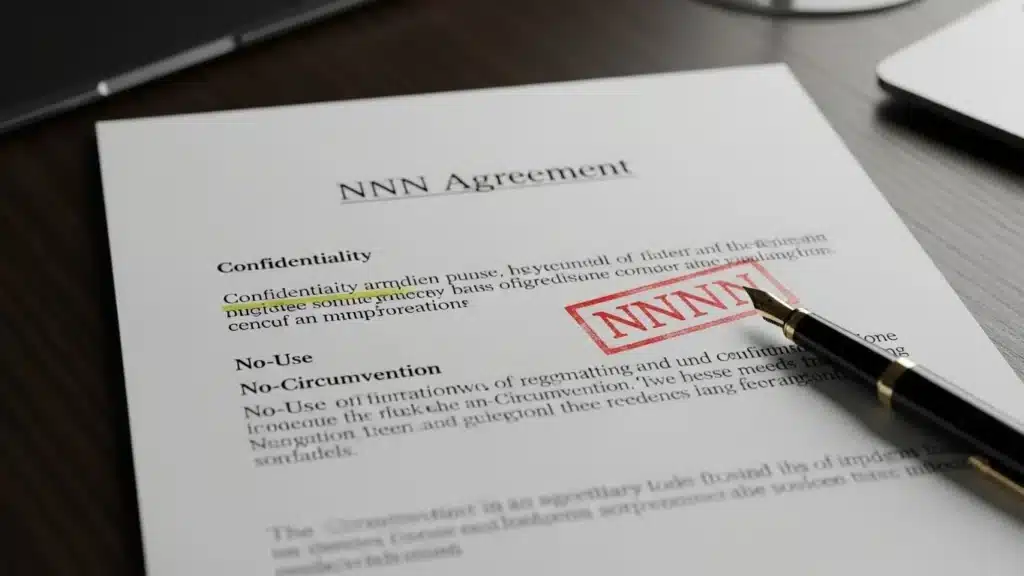
What an NNN Agreement Protects and Why It’s Essential
An NNN agreement’s strength comes from its three core covenants. Non-Disclosure prevents the factory from sharing your technical information, business models, or customer lists. Non-Use stops them from producing similar items for themselves using your designs. Non-Circumvention blocks them from contacting your suppliers or customers directly to cut you out of the deal.
To avoid ambiguity, the contract explicitly lists the assets it protects. This includes specific items like product specifications, CAD drawings, source code, formulas, pricing data, and prototypes. This clarity is crucial for defining what constitutes a breach.
For practical enforcement, these agreements typically specify PRC law and courts as the governing law and venue. This is strategic because it aligns the legal system with where the breach—like unauthorized production—would actually happen, making court orders to stop production more enforceable.
Beyond a legal document, an NNN acts as a process control tool. It limits the factory’s access to your information only to personnel who need it for the project and requires those individuals to be under similar confidentiality obligations, compartmentalizing risk.
Key Clauses and Enforcement Mechanics
The operational power of an NNN lies in its specific clauses. Standard provisions include the right to seek injunctive relief—a court order to immediately stop unauthorized production—and to claim monetary damages for lost profits if the agreement is breached.
The contract clearly defines the “Parties” (you as the Discloser/Customer versus the Manufacturer/Recipient) and the “Scope” of the agreement. A schedule or appendix is used to list the specific products, bills of materials (BOMs), or project codes covered, leaving no room for misunderstanding about what information is protected.
Protection doesn’t end when the business relationship does. Confidentiality and non-use obligations typically survive termination for a defined number of years or for as long as the information remains a trade secret, ensuring long-term security for your intellectual property.
Mechanics like “no waiver unless in writing” and “entire agreement” clauses are critical. They prevent the manufacturer from claiming you allowed a breach through informal actions, past conversations, or side promises, ensuring the written contract is the sole source of the agreement’s terms.
Key Clauses for Your Purchase Order (PO)
A purchase order is more than a price list; it’s a binding control document. Key clauses embed quality and engineering requirements, define inspection rights, and mandate traceable documentation. They turn external standards into enforceable contract terms, giving you the right to reject goods, audit suppliers, and enforce remedies for non-conformance.
| Clause Category | Purpose & Key Requirement | Enforcement Mechanism |
|---|---|---|
| Specification & Revision Control | Mandates strict conformance to the ‘latest revision’ of all drawings, specs, and instructions. | Eliminates ambiguity; nonconformance is a direct breach of contract. |
| Incorporation by Reference | Pulls external standards (e.g., aerospace specs, Dodd-Frank compliance) into the PO. | Makes external guidelines enforceable contract terms. |
| Quality Assurance & Sampling | Requires specific inspection plans like zero-acceptance sampling with AQL ≤ 1.5. | Sets a statistical bar for rejecting defective shipments. |
| Certificates of Conformance (C of C) | Demands C of Cs with specific traceability data (PO#, part#, lot#, etc.). | Creates an auditable, per-delivery record for liability. |
| Inspection & Rejection Rights | Defines a clear window (e.g., 120 days) to inspect and reject goods after delivery. | Protects against latent defects missed during initial receipt. |
| Right of Entry & Audit | Grants buyer, end-customer, and regulators access to supplier facilities and records. | Enables firsthand verification of compliance during performance. |
| Change Control & Subcontracting | Requires written buyer approval before any process change or subcontracting. | Prevents unauthorized cost-cutting and maintains control. |
| Nonconformance Reporting | Obligates detailed defect reports with “is/should be” analysis and traceability data. | Provides the necessary evidence for corrective action and claims. |

The Core Control Clauses: Defining Quality and Compliance
These foundational clauses specify what you’re buying and how compliance is measured, turning supplier promises into verifiable obligations.
Specification and Revision Control: Clauses must require strict conformance to the ‘latest revision’ of all drawings, process specs, and instructions. This eliminates ambiguity about which version of a design the supplier must follow.
Incorporation by Reference: POs systematically pull in external documents like industry standards (e.g., aerospace specs) and regulatory frameworks (e.g., Dodd-Frank conflict minerals compliance), making them enforceable parts of the agreement.
Quality Assurance & Sampling: Mandate specific inspection plans, such as zero-acceptance sampling with an Acceptable Quality Level (AQL) of 1.5 or lower for machined parts. This sets the statistical bar for rejecting defective shipments.
Certificates of Conformance (C of C): Require C of Cs with specific traceability data—PO number, part number, quantity, serial/lot numbers—to create an auditable record with each delivery.
Enforcement and Risk Management Clauses
These operational clauses grant rights, define timelines for action, and control changes, enabling practical enforcement and mitigating supplier risk.
Inspection and Rejection Rights: Define clear windows for inspection after delivery. Institutional buyers often retain the right to inspect and reject nonconforming goods for up to 120 days after delivery, protecting against latent defects.
Right of Entry and Audit: Grant the buyer, its end-customer, and regulatory authorities the right to access the supplier’s facility and records during the performance of the PO to verify compliance firsthand.
Change Control and Subcontracting: Require the supplier to obtain your written approval before making any changes to manufacturing processes, materials, or before subcontracting any part of the work. This prevents unauthorized cost-cutting.
Nonconformance Reporting: Obligate the supplier to provide detailed reports on any defects, including a description of the problem, the affected engineering requirement, quantities, and all relevant PO and lot/serial data for traceability.

The “30/70” Payment Trap: When to Pay the Balance?
The 30/70 structure is a standard payment term where a 30% deposit is paid upfront to start production, and the 70% balance is held until after the buyer approves a final quality inspection report. This protects the buyer by ensuring goods meet specifications before full payment is released.
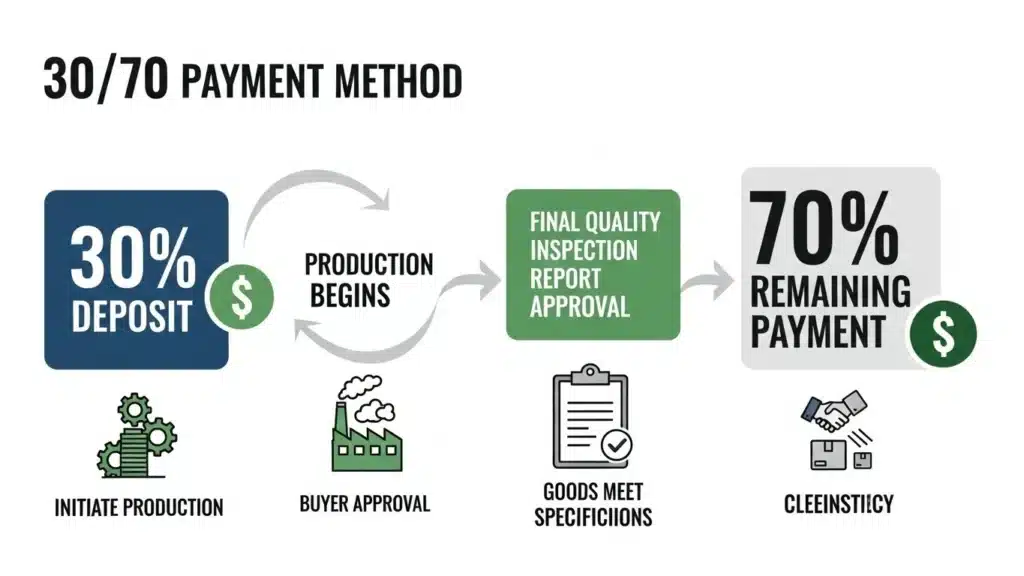
How the 30/70 Structure Protects Buyers
The 30% deposit secures factory capacity and covers initial material costs, committing the supplier to the order.
Holding the 70% balance gives the buyer leverage; payment is only released after verifying the goods meet the agreed quality and quantity.
This structure directly counters the ‘bait and switch’ tactic by tying the majority of payment to a passed, independent quality inspection.
The Critical Payment Trigger: Final QC Approval
The 70% balance is due only after the client receives and approves the final Quality Control (QC) inspection report, not upon shipment or production completion.
For maximum protection, the inspection should be conducted at a neutral site, like the agent’s warehouse, before goods are loaded for export.
This timing ensures any defects found can be addressed, with goods returned to the factory if necessary, before the buyer’s funds are fully transferred.
Dispute Resolution: Arbitration in Yiwu vs. Hong Kong
Choosing between Yiwu and Hong Kong arbitration is a choice between two distinct legal systems. Hong Kong operates under a modern, international framework based on the UNCITRAL Model Law, offering features like tribunal autonomy and direct access to PRC courts for interim measures. Mainland-seated arbitration, including in Yiwu, follows the domestic PRC Arbitration Law, requiring institutional administration and granting courts more control over key procedures.
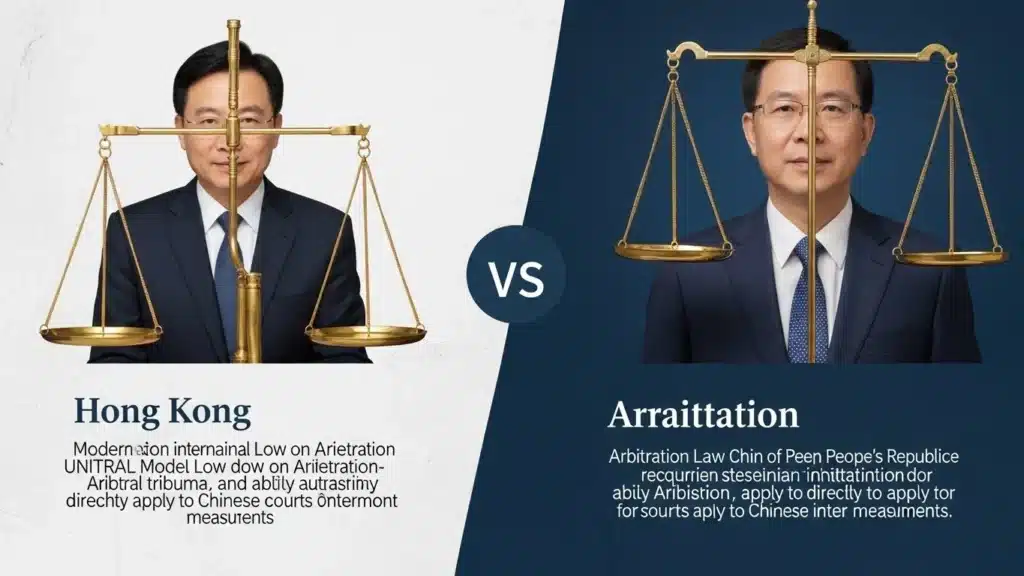
The Legal Frameworks: Model Law vs. PRC Arbitration Law
The legal foundation for arbitration in Hong Kong is the Arbitration Ordinance (Cap. 609), which is based on the 2006 UNCITRAL Model Law on International Commercial Arbitration. This provides a common-law, pro-arbitration regime that is familiar to international parties. In contrast, arbitrations seated in Mainland China, including those administered by the Yiwu Arbitration Commission or CIETAC, are governed by the PRC Arbitration Law. This law is not based on the Model Law and operates within a more institution-centric domestic system.
A critical procedural difference stems from this foundational split: ad hoc arbitration, or proceedings without an administering institution, is permitted in Hong Kong. For arbitrations seated in Mainland China, ad hoc proceedings are not allowed; all arbitrations must be administered by a recognized arbitration commission.
Procedural Powers and Cross-Border Enforcement
The practical implications of each seat are significant for tribunal authority and court support. In Hong Kong, tribunals have ‘competence-competence,’ meaning they have the power to rule on their own jurisdiction. In Mainland China, this power rests with the arbitration commission and the competent PRC courts, not the tribunal itself.
A key strategic advantage for Hong Kong-seated arbitration is its link to Mainland courts for interim measures. Since 1 October 2019, parties to Hong Kong-seated arbitrations administered by eligible institutions like the Hong Kong International Arbitration Centre (HKIAC) can apply directly to PRC courts for interim measures, including asset preservation, conduct preservation, or evidence preservation. Mainland-seated tribunals have no statutory power to order such measures; applications must go through PRC courts.
For enforcement, Hong Kong awards are enforceable in Mainland China under the 1999 Arrangement between the courts. This provides a streamlined, reciprocal mechanism for enforcing an award against a supplier’s assets in China, operating outside the New York Convention framework. This combination of a pro-arbitration common-law judiciary in Hong Kong and direct access to PRC interim measures and enforcement creates a structurally distinct option compared to a Mainland-seated arbitration in Yiwu.
Chinese Chop (Stamp) Verification
A Chinese company chop, not a signature, is the primary legal authorization for contracts. Verification requires checking its physical traits—a circular or oval red-ink impression with a central star and the exact Chinese company name—against the official business license. The ultimate authority is its registration with the local Public Security Bureau (PSB).
What a Legitimate Company Chop Looks Like
The official company chop is typically circular or oval in shape and uses red ink as the standard color. Blue or black ink may be used in specific regions or under certain local PSB regulations, such as in Hong Kong.
A valid chop must feature a central red five-pointed star and display the company’s full, exact name in Chinese characters. It may optionally include bilingual text (Chinese and English) or the company’s 13-digit Unified Social Credit Code.
The details on the chop must match the information on the company’s official business license, particularly its Unified Social Credit Code and the name of its legal representative. Any discrepancy is a red flag.
For a chop to have legal recognition, it must be registered and filed with the local Public Security Bureau (PSB). This registration is the foundation of its authority. Chops that are other shapes, sizes, colors, or use languages like English-only lack legal value and often indicate potential fraud.
The Step-by-Step Verification Process
Begin by visually inspecting the chop impression. Check for the standard physical traits—shape, red ink, central star, and the precise Chinese company name. Immediately cross-reference these details with the supplier’s official business license.
For definitive verification, confirm the chop’s registration with the local Public Security Bureau (PSB). Their records are legally conclusive in any dispute. Control of a PSB-registered chop is effectively control of the company’s legal authority.
A contract signed with an unregistered or fraudulent chop is invalid. This can nullify claims for damages or specific performance. In enforcement scenarios, such as claiming liquidated damages for late delivery, the burden of proving a chop’s validity falls on the claimant if initial checks fail.
Be aware of digital chops, which are legally equivalent to physical ones under China’s Digital Signature Law. A valid digital chop must be bound to a digital certificate from a licensed provider and use encryption to make any tampering detectable. It must be under the exclusive control of the signatory, with its creation data retained.
Final Thoughts
Sourcing from Yiwu, or anywhere in China, requires a fundamental shift in how you think about contracts. The goal isn’t to draft a perfect Western-style agreement, but to create a document that works within the Chinese legal and commercial system. This means prioritizing local enforceability above all else. Your NNN agreement and purchase order terms are your primary tools for this. An NNN protects your intellectual property before you share a single file, while a well-drafted PO gives you the concrete rights to inspect, reject, and demand corrections when goods don’t meet your standards.
The practical steps are clear: get a Chinese-language NNN signed and stamped before any serious discussion, embed specific quality and inspection clauses into every PO, and structure payments to keep leverage until you verify the goods. Verifying the company chop is non-negotiable, as it validates the entire agreement. By focusing on these enforceable, operational controls, you move from hoping a supplier will do the right thing to having a contract that gives you the tools to make them comply. This approach turns legal theory into practical business protection.
Frequently Asked Questions
What is an NNN agreement?
An NNN agreement is a written contract commonly used with Chinese manufacturers. It combines Non-Disclosure, Non-Use, and Non-Circumvention obligations to prevent a supplier from sharing your confidential information, using it to create competing products, or bypassing you to work directly with your customers or suppliers. It’s the standard first document for protecting intellectual property before sharing technical files or pricing with a factory. In practice, these agreements often include a fixed, pre-agreed financial penalty for each breach to make court enforcement faster.
How much does a China contract cost?
There is no fixed price for a contract in China. Costs are not set by law and must be negotiated and agreed upon between the parties. If a contract doesn’t specify a price, market rates at the time of signing may be used as a reference. While suppliers can propose price adjustments through negotiated clauses in long-term contracts, they cannot unilaterally raise prices after an agreement is made.
Is a PO legally binding in China?
A purchase order can be a legally binding contract under Chinese law if it is in writing, states key commercial terms like goods, quantity, price, and delivery, and is properly authorized. For it to be fully enforceable in court, it should be accepted by the supplier and ideally signed by the company’s legal representative and stamped with the official red company seal. In serious business transactions, a standalone PO is often paired with a formal, stamped supply contract to provide stronger legal protection.
What if the supplier breaks the contract?
If a supplier commits a material breach, such as failing to deliver or providing substandard goods, the standard process is to issue a formal written notice and allow a cure period, typically 10 to 30 days. If unresolved, you can pursue remedies like pre-agreed liquidated damages for late delivery, source goods from another supplier, terminate the contract, and claim compensation for losses. Contracts often define these specific penalties and procedures upfront to provide clear enforcement steps.
Do I need a Chinese lawyer?
You are required by law to hire a Chinese-licensed lawyer if you need to file a lawsuit in a Chinese court and you are a foreign company or individual without a domicile in China. For drafting and negotiating contracts, it is not legally mandatory but is considered a standard and prudent practice due to the complexity of local regulations and the risks involved in enforcement.